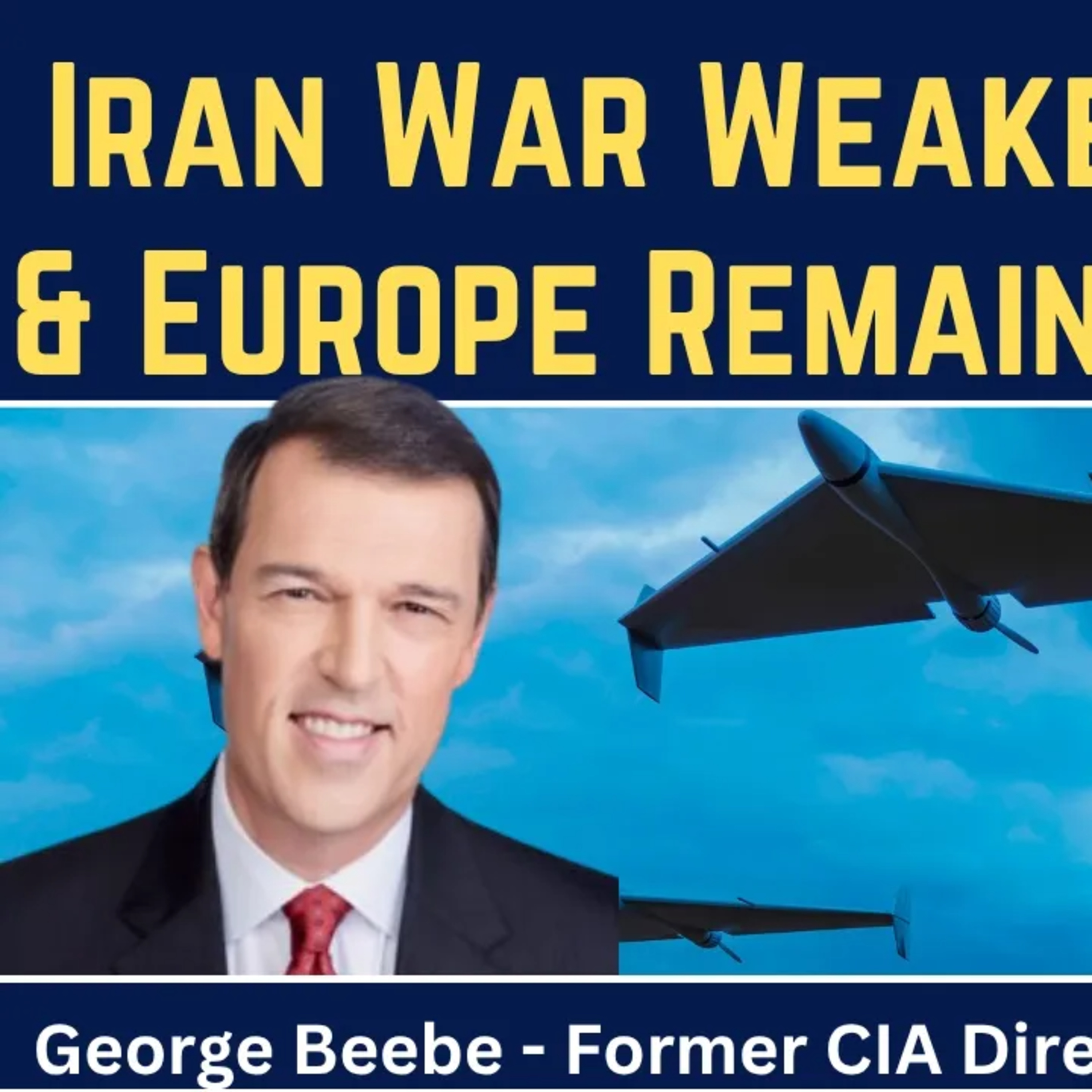
George Beebe: Iran War Weakens Ukraine & Europe Remains Irrational
About this episode
George Beebe is the former CIA Director for Russia Analysis and currently Director of Grand Strategy at the Quincy Institute. Beebe discusses why the Iran War incentivises Ukraine and the West to put an end to the war, yet the Europeans remain determined to keep the war going.Read Responsible Statecraft: https://responsiblestatecraft.org/Follow Prof. Glenn Diesen: Substack: https://glenndiesen.substack.com/ X/Twitter: https://x.com/Glenn_DiesenPatreon: https://www.patreon.com/glenndiesen Support the research by Prof. Glenn Diesen: PayPal: https://www.paypal.com/paypalme/glenndiesenBuy me a Coffee: buymeacoffee.com/gdiesengGo Fund Me: https://gofund.me/09ea012fBooks by Prof. Glenn Diesen: https://www.amazon.com/stores/author/B09FPQ4MDL
Get every episode summarized
Each time Glenn Diesen - Greater Eurasia Podcast publishes, we email you a written briefing from the transcript — the topics, who appeared, and any specific claims, with the ad reads skipped.
Email me new episodesFree for 3 shows. No card needed.
Hosts & guests

Transcript ready
240 searchable segments. Every word is indexed and playable.
Full transcript
Glenn Diesen - Greater Eurasia Podcast — George Beebe: Iran War Weakens Ukraine & Europe Remains Irrational. Machine-transcribed; use the interactive transcript above to jump the player to any line.
Welcome back. We are joined by George PV, a former CIA director for Russia Analysis and currently the director of a grand strategy at the Quincy Institute for Responsible State Craft. I will make sure to leave a link in the description. And yes, always thank you for coming back on. It's my pleasure. Thank you. I wanted to ask you, as we now see the war in Ukraine and the war in Iran is becoming more and more interlinked, it seems, especially if you look at the reports today from I think was Wall Street Journal, writing that because of the weapons shortage, there has to be some difficult decisions whether or not to divert American weapons away from Ukraine and towards the war in the Middle East. But again, the, I guess, the consequence of the Iran war on the Ukraine war and also for Russia, it's a, it goes far beyond this. I was wondering how do you see
this? To what extent the war with Iran impacts the strategic balance between Russia and NATO in Ukraine? Well, I think it has a number of effects. First of all, it definitely has an effect on how many weapons we have available to provide to Ukraine. Now, of course, the United States made a change under the Trump administration where we have been providing military aid to the Ukrainians through Europe. So the Europeans are actually purchasing the American weapons and then in turn transferring those to the Ukrainians. But we simply don't have enough of some key weapons systems to provide for Ukraine's needs. And I think the most acute problem it comes in air defense. That was a problem even prior to the Iran war. I think the, the Russians via their missile drone and glide bomb attacks were putting extreme strains on Ukraine's air defense capabilities and drawing down
the reserves of air defense missiles that we could provide to the Ukrainians to defend themselves. But I think with the, the operation in Iran, the longer this goes on, I think the, the result is going to be an absolute emergency situation for Ukraine's air defense capabilities. And that, I think, bodes very ill for Ukraine's battlefield prospects for, for very long should this work continue. So that gives Ukraine, I think, a battlefield reason to seek an end at the negotiating table sooner rather than later. The other thing that this war does is I think it really interferes with the strategy that the United States and Europe and Ukraine have long had to try
to squeeze Russia's energy earnings internationally and in so doing incentivize Russia to compromise and agree to end this war on terms that are at least perceived as equitable and reasonable rather than, you know, a capitulation of Ukraine to Russia's terms. And because the international energy situation is approaching a crisis point as a result of the war with Iran, that strategy of trying to keep Russian energy off the international market is just not viable. And we're, we're already seeing this, that the Trump administration first indicated to India that we would not object to Indian purchases as we, we did several months ago. The Trump administration has
provided a, at least a short-term relaxation of sanctions against Russian energy sales more generally. I think it's omnisinevitable that that one month relaxation is going to move on to two months and three months and probably become permanent simply because the pressure on international oil markets is so great. And the United States economic situation looks so precarious that we can't afford to continue that old, old strategy of trying to squeeze Russia's energy earnings under these circumstances. And that also, I think, is another reason for Ukraine to seek a compromise sooner rather than later. So the other thing this does is because the increased oil prices,
Russia is benefiting from a short-term windfall of energy earnings. And that in turn means that their ability to sustain this war economically is, is that much greater, at least over the short-term as a result of the war on Iran. So the Russians aren't under any particular economic pressure right now to, to cut this war short. I mean, it's very likely that they're not going to be for some time to come. Well, I thought, yeah, for this reason, it could be, well, a silver lining or something positive to come from this war. That is, if we're losing a war, it's always the way it's solved, is usually to shift focus to something else. Often we, you know, seemed to only focus on one thing. We had Russia gate and then it seemed to come to an end with COVID and then COVID ended when, you know, Russia invaded Ukraine. So, you know, it seemed like this, you know, there could be an
opportunity to put an end to this war. But even as we see this massive crisis now with the shortage of energy fertilizers, you would think this would create massive pressure, not just on Ukraine and the US, but also on the Europeans to put an end to this war. Yet we see now that the Europeans appear to be advising Zelensky not to take the deal presented by the American studies that they pull out of Donbass and accept neutrality. Indeed, we even seen attacks during the night on this, on the Russian oil facilities on the Baltic Sea, which appears to have the drones either transiting or originating from the Baltic states. Now, again, it's a lot of uncertainty about exactly this. I wouldn't want to say anything, you know, to sure. But at least the Europeans advised to Zelensky not to put an end to the war. How do you explain this? Because it looks like the
Europeans are the one who will get hammered much, much more than the Americans in this energy crisis coming up. I agree. I think to a great degree the Europeans are the big losers in this war in Iran because of the disproportionate impact on their energy situation that this is having, and they don't have good alternatives. A rational actor in Europe would look at this situation and say, you know what, we're going to have to buy Russian energy. There really is no other way out of the circumstances that we find ourselves in right now. But I think what's actually going on is the Europeans are looking at the situation saying, well, if we can hold on, if Ukraine can hold on, if we can manage to get through the next several months, the political situation in the United States is likely to change. I mean, I think their calculation is that all of this could
greatly undermine President Trump's political circumstances and lead toward growing unpopularity, a defeat in the midterm elections in November. And my guess is that what the Europeans are saying is rather than make what they regard as a very unwelcome compromise to end the war in Ukraine, they're hoping they can just hold on, you know, through the next several months, and then the political circumstances they hope will change. And Trump will not have the ability politically to drive this peace process, see it through to its end. And then who knows what could happen, the future is very unpredictable. So I think it's an unwise bet on their part. But I think that's what's going on.
Yeah, well, often when the Europeans look towards the US, and it's, well, at the extent to which it engages in this war against Russia, it's always this assumption that the US have, you know, all the capabilities it needs, the only thing missing is the will. And which is why they might go for waiting out Trump yet again. But use the word rational. If you would, you know, be rational, you would seek to negotiate an end to this war. Do you see the European leaders being irrational here, though, or if so, why? Why, why are they, now, but are they, you know, is it ideology? Is it lack of political imagination? Are they simply, you know, they don't have any other solutions? Well, how, how do you explain this? Because I often, I often make the point I can understand all the different actors. I understand why the US initially went very hard, hard into this war. I didn't understand why they now want to distance themselves. I think I understand why the Russian
CCC is an existential threat. I understand why the Ukrainian CCC is, as an existential threat. But I can't ever really make proper sense on the European position, though. Well, you know, I do think this is largely irrational. It's driven in part by wishful thinking. You tend to see what you want to believe. And I think in part it's a lack of imagination and a fear that if they do compromise with Russia on big geopolitical issues on the future of NATO enlargement, that that might undermine the entire European enterprise and bring the European Union into disarray and lead to disunity in Europe in a profound way. To some degree, Russia has been a unifying factor within Europe.
When you face a common enemy, that common sense of threat can bridge a lot of differences that might otherwise be more significant. And I think to some degree, the Europeans don't want to let go of that threat. They have a political interest in continuing to see a Russian threat. And rather than trying to manage and mitigate the threat, I think they'd like it to continue, because it's politically useful for them in a lot of ways. And also, I think from the airport if you keep the United States in Europe, it keeps the United States in NATO. Now, I think a lot of this is an accurate perception. A lot of this is seeing what you want to believe. So there is an element of self delusion, I think, in all of this. And I think it's going to
backfire, frankly. So I think it's an unwise approach. But it's never easy to explain things that appear irrational. That's always a challenge. Well, how do you see them? They're the possibility of how Russia might respond to all of this, because you hear pressure in, you hear stories about pressure mounting in Moscow that they should essentially do what the Iranians have done. That is assert their deterrence, because they let their own deterrence slip over the past four years to the extent, you know, in the West, we can launch missiles into Russian cities. And this does seem to be any consequences. Again, you wrote an, no, you gave an interview. I remember back in December of 2021, I think was for radio free Europe, when you warned that a war could come if the Russians see in action as becoming more dangerous than action in terms of the West, you know, cementing its position within Ukraine, that they, this would be their last chance to dislodge NATO.
How do you see the calculations in Russia now? Because on one hand, the Americans are tied up in, in the Middle East. The Europeans appear to be willing to escalate. And again, it appears. And you have all this pressure on the Kremlin that they should start to take a tougher line. Do you think they could, I guess, escalate in a much greater way? Well, I think it is possible. And I think there are those in Moscow that are making that argument that the United States is not actually agreement capable that Trump, Trump can't be trusted. I think they look at the performance of Trump's onvoys with Iran, who are the same onvoys that the Russians are dealing with on the Ukraine settlement process. And look at what appears to them to be bad faith negotiations on the part of those
negotiators with Iran. And they wonder, can we trust Trump and his onvoys to negotiate in good faith with us? So that's one of those elements of doubt that opponents of a compromise in Russia, people that are saying, look, we should just go all out and win this war and reestablish deterrence. I think that's part of what they're arguing right now. And I think they are also saying we've got a window of opportunity. The United States is distracted. It doesn't have the capacity to both wage the war in Iran and supply Ukraine with its needs. Europe doesn't have the economic wherewithal to support the Ukrainians under these circumstances. And let's seize this window of opportunity. Now, although there is that view, I think, in Moscow, that is I don't believe the unanimous opinion. And as far as I can tell, Putin is not
yet there at that point. And I think the reason is, I don't think he wants to give up the possibility of day-taught with the United States, of normalizing the relationship with the United States, of entering into negotiations over European security, over strategic stability. These are all very important goals for Russia. It advances Russia's position in the world to have a normalized relationship with the United States. It allows Russia a lot more geopolitical room from maneuver, vis-a-vis China, helps ensure that China is not simply going to become the dominant partner of Russia. And Russia is left as a subordinate junior. And a lot of those big European security issues for Russia can't be resolved just by taking the rest of the Donbass or even
seizing Odessa and turning Ukraine into a landlocked rump state. So I don't think Putin wants to give up on the possibility of a deal to end the war in Ukraine. And all of the improvements in the U.S.-Russian relationship that he expects would flow from that. Now, what would change his mind, I think, would be a belief that an improved U.S.-Russian relationship is simply not going to happen regardless that Trump is so weakened or that Trump really is not intent on a real normalization of the bilateral relationship. In that circumstance, then I could see the Russians saying, well, we're only giving up something that isn't going to happen anyway. So let's win this war and
really use the military capabilities that we have but have been reluctant to bring to bear in this war because we didn't want to close the door on a normalization with the United States. And I don't think Putin is there yet, but could he get there? Sure. I could see that happening. And I think we're going to find out the answer to that in the next few months. Yeah, I don't think there's necessarily any pressure to pick one path or the other just yet because even if Trump is a bad faith and negotiator, it doesn't, as long as Russia doesn't let the diplomacy influence its strategy on the battlefield, it could still pursue the diplomatic path even if it continues to make advancements on the battlefield. But another way, though, it seems that this war in Iran could affect the war in Europe would be that NATO itself is coming
on the great pressure. You probably saw the press conference that Trump was giving, at least he was answering questions in which he was making the point. More or less that NATO will regret and not joining in on the campaign against Iran. And it almost sounded like an announcement of a divorce coming in the future because he was just waiting a few months. You will see, remember this. What do you think this could be used as a way to untangle the US from NATO or is that not really in his interest? It's more just to put the pressure. Well, I think there is, there already was in the transatlantic relationship growing distrust and tension between Washington and its European allies to varying degrees. But I think the Iran war has really exacerbated these pre-existing tensions. And I think we're
in a situation where Trump turned to the NATO allies and said, we need your help. You benefit disproportionately from oil that is shipped through the state of Hormuz. You should come help us open the strait. And the answer that he got from our allies was, you know, no, not our problem. And so I think the perception in the White House is what good are these allies? Why are we providing all this security support to them, which has underwritten their security for so many decades? And in our time of need, they're not coming to our assistance. This is a one-way relationship, and we're not benefiting. Now, I think from the European perspective, I think they look at the situation and come to almost the opposite conclusion. They look at what the President has done vis-a-vis Iran as putting Europe in peril. They believe that Trump has to, to a large degree,
created a crisis over the state of Hormuz because of a lack of foresight, a lack of adequate planning, a lack of envisioning things that were obvious to a lot of experts for a long time, mispotential consequences. And having created the crisis then turns to Europe and says, you know, help bail us out of this situation, put your ships and your soldiers in peril instead of doing. And by the way, you've created an extraordinary energy crisis and economic crisis for Europe. So what good is America's protection and all of this, if you're not actually enhancing European security, you're undermining it. So to me, this has the makings of some very, very serious strains in the alliance. There aren't going to go away. I'm wondering if probably we'll get more so
good. I'm wondering if Trump would have asked, well, would have informed the Europeans before that hack whether or not they would join in that they would have got more commitment because you saw in the early days of the bombing that the Europeans were, you know, lining up to support, especially people like Chancellor Merz. You know, when they thought it would be more successful than it was. But by not getting their commitment early on, they could wait and see until it began to run into problems. And then asking, once it seemed like a, well, dangerous proposition, then, you know, they would decline. I think this could have been a mistake if we would have consulted them early on and get their commitments then before this all went south. I think you would have been able, especially Merz, to get him on board. But what does this mean, you think, for the possibility of peace now, not just in Middle East, but with Ukraine, because last time we spoke,
you said there's still a window opportunity to end this at the negotiating table, but this window's closing. Or is it opening up? No, I think the window opportunity is still there, but I do think it is closing. I don't think it's going to extend much beyond this summer, quite honestly, because at that point, the political calendar changes things. And I'm sure that the, the window for compromise is going to be open much beyond, you know, early fall of this year. I still think the sides have incentives. The Ukrainians have a very strong battlefield incentive to get what they can right now before the situation gets much worse. I think the Russians have an incentive to try to get a deal while Trump is still agreement capable. I think Trump needs a win. Iran operation has been very bad news for him politically and in his foreign policy more generally. In this kind of situation,
it makes a lot of sense to try to get a win by bringing the Ukraine negotiations to a successful close. And my guess is that the Trump administration is likely to tell the Ukrainians just that, now is at the time. You've gotten everything you needed. You're not going to get more. This is as good a deal as you're going to get. Take it now, because the alternatives are going to be much worse. But why does it have to close then? What are the main reasons why I think the window opportunity for a diplomatic settlement would be over after summer? Well, I think the Russians will become disillusioned with the Trump administration's ability to bring this across the finish line. And I think they're going to have growing doubts about whether the United States actually is serious about a normalized relationship and whether the Trump administration is even capable
of normalizing the relationship with Russia going for it. I think the longer this war goes on, unresolved, and the longer the war in Iran goes on, the more doubts the Russians are going to have about those things. So that's a part of this. And then the other part of this is patience on Trump's part. I think we could reach a point where he becomes disillusioned and thinks we're just not going to get the sides to come together. So if or when he reaches that point, I don't know, nobody can predict that sort of thing, but I don't think the patience in Moscow and Washington will be infinite. And then on the Ukrainian side, the dilemma that they have is whether they want to play a waiting game and hope that the circumstances in Washington will be more favorable for them
six months from now. And that also is the issue with the Europeans. Yeah, this is a last question. There's been some media reports that the Russians are aiding the Iranians. And well, I just assume that's the case. It would make sense. But it's all something that Zelensky has been pushing very hard to direct Trump's fury towards Russia as opposed to spending using all these weapons only against Iran. To what extent do you think this could impact relations? Because so far, Trump has seen him with dismissive. He probably knows this is correct, but he doesn't want to disrupt the possibility of the diplomatic process. Do you see this possibly escalating out of control or that the Russians would start to send more heavy weapons? I'm not sure what possible cards the Russians could play, I guess, to return their
favor after all the past four years, especially against probably not so much the Americans anymore, about the more against the Europeans, the Germans and the British, especially. Well, it would be very difficult for the United States to argue that Russian intelligence provided to Iran that might be used to kill Americans and target our forces is wrong in principle. As the Russians would quite quickly say, this is exactly what you've been doing to us since early 2022, and I think Trump understands that. The real question is, do the opponents of a compromised deal in Washington and in Europe? He is on this question and hype it in ways that create big political problems, big obstacles to a deal and create an environment in which Trump
has much less room from maneuver vis-à-vis Russia and vis-à-vis the end game of a Ukrainian peace deal. And that's possible. I think it's already clear that there's an awful lot of media attention to this issue, and I don't think that's accidental. I think the people that are trying to focus attention on this are doing so because they see this as a means of making a deal a compromise in Ukraine less likely and putting obstacles in the path of a normalization of the US-Russian bilateral relationship. Well, there's a lot of pessimism this day, so I'm very happy to at least hear some optimism from your side in terms of the possibility, still lingering and possibility, to have some diplomatic path still forward. So thank you very much for taking the time, and yes,
enjoy your days in Geneva. Great. Thank you very much.
More episodes
More from Glenn Diesen - Greater Eurasia Podcast

Steve Jermy: End of U.S. Military Primacy - New Strategic Thinking Requried
Glenn Diesen - Greater Eurasia Podcast

Trita Parsi: Massive Houthi Victory Transforms U.S.-Iran War
Glenn Diesen - Greater Eurasia Podcast

Peter Schiff: Economic Armageddon - Bonds & Dollar in Crisis
Glenn Diesen - Greater Eurasia Podcast

Sean Foo: U.S. Allies Dumping Bonds - Is the Dollar Next?
Glenn Diesen - Greater Eurasia Podcast