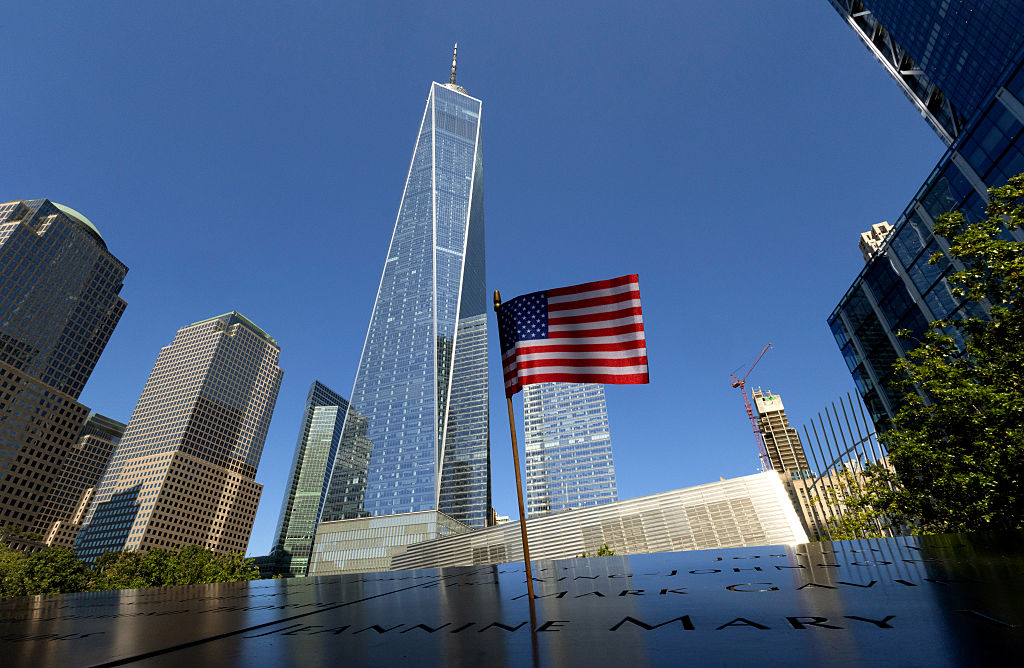
About this episode
On today’s edition of The Briefing, Dr. Mohler discusses the 25-year anniversary of 9/11, Americans in a situation of war undergirded by the theology of Islam, 9/11 as a death knell to postmodernism, the lasting worldview impact of 9/11 on Americans, and praying for the safety and security of the U.S. in light of the evil of 9/11.
Part I (00:14 – 08:43)
The 25-Year Anniversary of 9/11: Remembering the Effects of Terrorist Attacks That Left an Indelible Mark on Our Nation
Part II (08:43 – 16:57)
The Wake-up Call of 9/11: 9/11 Showed Americans That They are in a Situation of War Undergirded by the Theology of Islam
Part III (16:57 – 19:48)
9/11, a Death Knell to Postmodernism: Those Terrorist Attacks Forced Evil as a Moral Category Back into the American Conscience
Part IV (19:48 – 22:10)
9/11 and the Short Memory Span of Americans: Where is the Lasting Worldview Impact of 9/11 on Americans?
Part V (22:10 – 23:55)
The Power of Evil in Light of the 25-Year Anniversary of 9/11: Americans Need to Pray for the Safety and Security of the U.S. – May God Bless America
Sign up to receive The Briefing in your inbox every weekday morning.
Follow Dr. Mohler:
X | Instagram | Facebook | YouTube
For more information on The Southern Baptist Theological Seminary, go to sbts.edu.
For more information on Boyce College, just go to BoyceCollege.com.
To write Dr. Mohler or submit a question for The Mailbox, go here.
Get every episode summarized
Each time The Briefing with Albert Mohler publishes, we email you a written briefing from the transcript — the topics, who appeared, and any specific claims, with the ad reads skipped.
Email me new episodesFree for 3 shows. No card needed.
Hosts & guests

Transcript ready
267 searchable segments. Every word is indexed and playable.
Full transcript
The Briefing with Albert Mohler — Friday, September 11, 2026. Machine-transcribed; use the interactive transcript above to jump the player to any line.
It's Friday, September 11, 2026. I'm Albert Molar, and this is The Briefing, a daily analysis of news and events from a Christian worldview. Just to listen to that date, this is Friday, September 11, 2026. This is the 25th anniversary of the 9-11 attacks on the United States of America. There is simply no way to treat this day as just like any other day. There are certain dates that are simply engraved in the American mind, in the American heart, in the American soul. You can think of December 7, 1941. Americans alive at that time said that there was a clear before and after in terms of their lives. There was the day and the life, the years before December 7, 1941, and then everything that followed was in light of that Japanese attack upon Pearl Harbor, the beginning of America's direct involvement in World War II. A war that, by the way, reshaped to the world. In a similar way, you look at 9-11, 2001, September 11, you look at a date that is indelibly etched in the American conscience precisely because, once again, there is a before and after.
But what we're looking at right now with the 25th anniversary comes with some fairly humbling realizations. One of them is that the passage of time really does not erase the date, but it does move past a lot of the memories. The freshness of the understanding of what happened on September 11, 2001 is lost upon many Americans, and then you face the fact that untold millions of Americans were born after that date, or were even too young at that time to understand why there was a before and after that makes a determinative difference for the history and future of the United States of America. But that's the nature of human experience. The same kind of pattern was a matter of reflection after December 7, 1941. How in the world could something like this be missed? But that's just another very humbling reminder of the human condition, a human condition that just gets multiplied when you look at the national level, even a nation like the United States of America. You go back to what happened on that morning.
It was an astoundingly beautiful morning, and that actually was part of the plan. The plan called for a very clear day in which the plan could proceed. The plan to use four commercial passenger airliners and turn them into aerial bombs to be flown with intentionality into strategic sites that would have not only a powerful impact, but an incredibly powerful symbolic value. You look at the two world trade center buildings in New York City, and then you consider the Pentagon, and then you think about the Capitol, which is where the fourth of those planes was too head. And of course, we know that that particular fight was diverted precisely because there were passengers on board who came to understand at least in part what was going on. And they put an end to that particular threat, but at the cost of their own lives, the lives of everyone on that passenger airline is it crashed in Pennsylvania. But the three airliners that got through, they did incredible damage. They actually changed the world in one sense because America had to take on a different disposition towards the entire globe and certainly towards the threat of Islamic terrorism.
Let's go back to where America was in September 11, 2001. And there was a very clear understanding that there was an increased danger of Islamic terrorism. That is something that had been experienced in other parts of the world, including Western Europe. And there had already been an attack on the world trade center. There was actually an attempted bombing that was partially successful in the world trade center. But this was something very, very different. And even when it comes to Islamic terrorism, this was a movement that was different. You had the rise of what was known as Al-Qaeda. And Al-Qaeda led by the mastermind of Somah bin Laden, who by the way came from an extremely wealthy family, a Saudi family that was highly involved in international business and international construction. So you're talking once again about the fact that when these terrorist actions take place, it's often thought this is someone coming from nowhere. No, they always come from somewhere. And this was an attack that came from somewhere. Somah bin Laden formed Al-Qaeda as an updated form of a terrorist extension of Islam.
And the intention was to do maximum damage to the United States of America, to describe to buy bin Laden as the great Satan. And that similar language had been used in terms of the Iranian revolutionaries as well. But when you look at Al-Qaeda, you look at the plan. It was audacious. So audacious that it was outside the imagination of American intelligence, military, and law enforcement officials at the time. That's to say, there had been the danger of hijacking on American airliners going back to the late 1960s. So by the time you get to the end of the 1970s, there are certain kind of detectors and airports, but nothing like what we know today. And that's because there was no perceived danger. There was no perceived actual threat of someone turning airliners themselves into bombs. And by the way, the weapons that were used by the hijackers in this case came down sometimes to simple box cutters. And so this was something that was outside the expectation of a terrorist plot, but it turned out that one of the most infamous terrorist plots in all of world history came down to motivated men,
activated in Islamic terrorism, who actually undertook to use American commercial airliners to do maximum damage to the United States of America. Okay, so let's go back to that morning. Why was it so important that the weather be so beautiful? It is because the terrorist wanted a clear line of vision for the airliners to be flown into those buildings. Now the diabolical plan behind all of this, when you just consider the calculated effort here, and you also have to wonder in retrospect, why did no one think this was unusual to the point of involving national security and law enforcement officials? Why were there so many young Islamic men who were taking lessons in flight schools about how a modern jetliner would take off, but they were not even staying for the lessons on how an airliner would be landed? Now in retrospect, that makes horrifying sense. It's because they wanted to know how to fly these planes.
They really didn't even have to take off. They just needed to know how to control the planes in flight. They allowed the actual airline crews to go all the way through the takeoff process. They actually achieved altitude. And then and only then did the hijackers take over the plane. Once they did, they operated the plane. And of course, they did so with the plan of flying them right into the Twin Towers in New York City, right into the Pentagon. And as we said, the fourth plane would have gone right into the United States capital. You look at the video that emerged. I have to go back to that morning. And I want to tell you that it's a reminder to me that the human, the human consciousness, the human brain, the human mind can only take so much in at a time. One of the most interesting things to see in retrospect is a transcript, even of air traffic control and observational comments that came first of all in New York City with the Twin Towers. You had people who say, well, evidently, there was, for instance, a cable news network that interrupted and said, evidently,
a small plane has crashed into one of the towers of the World Trade Center. And then they're talking about what this could mean and how this might have happened. When reports come in that it wasn't a small plane, it was a large plane. And then there was also the report. Now there is a second plane that is flown into the second tower with a second devastating effect. And then video became available because this was something that was fairly new in terms of the technology of the time. And then all of a sudden you were able to look at this and recognize this could not be by accident. Frankly, one plane flying into one of these towers could not happen by accident. But there is no way that two could happen by accident. And then of course there was also the attack at the Pentagon. And there was loss of life, massive loss of life in the Twin Towers. And that is because they were filled with thousands of people. The number of dead and injured in the Pentagon was lower simply because of the nature of the building, but still all too real. And remember there were also living souls on those airliners. They were victims.
They were turned into just absolute fuel for the explosion. And they were atomized. It is assumed at the very time of the explosions themselves. In retrospect, one of the most interesting things about the time, about September 11. And about the moments and the hours after the attacks had happened. And by the time you could connect the dots, it was very, very clear. This was beyond the imagination. Not only the average American, this appeared to be beyond the imagination of most in American national security. Otherwise, there would have been some kind of plan to prevent this. The president of the United States, George W. Bush at the time, was fairly untested. And he was of course the son of another president of the United States, George H. W. Bush. So there's 41 and 43. This was 43. This was September after he had just taken oath of office for his first term after a very contested election, just to remember the election crisis in the 2000 presidential election. He took office in January of 2001.
This took place September 11, 2001. President George W. Bush was in a public school classroom, reading a children's story to children in Andrew Card. His chief of staff walked into the classroom and clearly spoke to the president. His face was at least largely impassive. But how in the world did he take the news of what had just happened? He did excuse himself and he was eventually taken to Air Force One. National security protocols that had never been used before went into place. Air Force One headed west because the attacks had taken place in the east. We now know as a matter of fact, without going into anordinate detail, the president George W. Bush decided that once there was some understanding of what had taken place, he had to get back to Washington DC himself and address the nation. And I will say that at that time, President George W. Bush really presented a model of statesmanship. And he really did give an example of what it means for a national leader to try to speak to all
Americans at one time to articulate the nature of this horrifying attack, the injury, the harm and the grief of its horrifying toll and the reality that we are now in a different world situation, of course, that would lead to far more controversial decisions, including matters of war. What are the interesting things for us to consider is the claim that was made almost immediately in the aftermath of 9-11. The world has changed. The way we look at the world, it's fundamentally changed. America's place in the world has changed. I think in retrospect, one of the interesting things to note is how you can connect so many developments before 9-11 to 9-11. And then you can connect so many developments after 9-11 and understand there's a continuity here. There is a pattern here. Right now, we are speaking with the United States still involved in a military conflict with Iran over some of basically the same issues with international terrorism being very much a part of the larger concern here. Now, what were the big things taking place that Americans had noticed?
I want to say there's one giant issue that I believe is at the top of the list of what Americans, that includes the American military, American intelligence services, and the average American had not fully come to understand. We are in a situation of war. And that was true before 9-11, 2001, it's true after it's true now. There are those who want to bring about the end of the United States of America. And furthermore, there are those who want to bring about the end of what we can only describe as the world order. And that includes most importantly and centrally the continuation of the project of Western civilization. There are those who see this as the problem. They see revolution, terror strikes, and eventually military action bringing about the end of the American empire and the crash of Western civilization. They see this as success. They also see this faithfulness. One of the things that took place as we understand 9-11 is that Americans were slow to understand this is a theological argument. This is a theological argument based in Islam.
And one of the things we see right now is that there is a continuing confusion over that matter. Back behind all of this is the fact that Islam, classic Islam, orthodox Islam, worldwide Islam divides the world into two different spheres. One of them is the world of Islam. And that means under subjection to the Quran. That is where Islam has absolute supremacy. That is one part of the world. The other part of the world is the world of war, the world of struggle, the world that Muslims have to bring into submission in order to complete their assignment to bring the entire world under subjection to the doctrines of Islam. And you look at that as you say, well, we have to be careful about speaking about such issues. Yes, of course, we have to be careful. But this is where Americans largely failed the test. American leaders failed the test, I would say, in 2001. And I think they continue to fail the test. And I credited President George W. Bush with giving remarkable leadership to the nation in the aftermath of the 9-11 attacks. But I want to be very clear.
I think there was one huge error that President Bush made and he continues to make the same error. He continues to say the same thing. So as you go back to 2001, just days after the Islamic terrorist attack that it cost the lives of so many thousands of Americans and changed American history, he went on to insist that Islam is a religion of peace. That's virtually a direct quotation. The President said over and over again, we understand that Islam is a religion of peace. Just in the last 48 hours in a conversation at his presidential center with former national security advisor and then later Secretary of State, Condoleezza Rice, the now former President, 25 years after the fact, who by the way, made a statement there and is not going to make, we are told, any other statement on the 25th anniversary of 9-11, he went on to say again that Islam is a religion of peace. But that fails to account for the fact that Islam has a theological structure that once again calls for the world to be brought under subjection and submission
to Islam, which divides the world between the world of Islam and the world of war where subjection is to be brought about. We come to understand that Osama bin Laden did not come up with this. Osama bin Laden yes, held to a very radical vision of Islam, but he can make the argument, this is the classical radical vision of Islam. And furthermore, looking at the world picture, the vast majority of Muslims are almost eager to say, yes, they agree that there is a necessity of Muslims, faithful Muslims, to bring the world unto subjection. And frankly, what you see is that what we saw then in 9-11, 2001, is that there was enormous support throughout much of the Muslim world for this undertaking. Now, that doesn't mean that every Muslim was complicit in it. It doesn't mean that every Muslim agrees with it. It is to say that when Osama bin Laden and al-Qaeda hatched this plot and claimed the authority of Islam, they were claiming a very long, legitimate, historical pattern. Some will remember that at the time there was much
conversation about the category of holy war and its function within Islam. Americans came to understand that that is absolutely tied to the terror attacks of 9-11. And furthermore, when we're looking even now at the challenge of Iran, yes, it's a different variant of Islam. We're talking in the case of Iran about Shiite Islam when you look at Saudi Arabia and at least much of al-Qaeda you're talking about Sunni Islam, but the fact is that the logic of separating the world into two different parts, the world of Islam and the world of war, that is common to both. And the pattern here becomes very, very clear. And one of the things I regret, and I regret that I have to say, is that 25 years after 9-11, 2001, there are still many people who are in denial. And I think a part of this is because they don't want to say, omuzlans are responsible for this. That is clearly a true statement. But that's very different than saying, Islam is a religion of peace. Well, that's true by Islamic definition after the achievement of bringing the world under submission to Islam. That's how they define peace. There's something else really big,
absolutely huge, that takes us back to 9-11, 2001. When you look at the American intellectual elite, you could add the European intellectual elite, perhaps even more so. You come to understand that at least one of the major worldview philosophical variants of the time was known as postmodernism. Postmodernism, it certainly emerged from France and from European sources, it took over the American college and university campuses. And you're really talking about a claim of relativism, the claim that all truth is socially constructed. And that includes moral truth, even claims about right and wrong and good and evil. As a matter of fact, over the course of the second half of the 20th century, what you really had was a unilateral disarmament on the part of many American academics, a many American intellectuals as well as European intellectuals. They just wanted to surrender their category of evil. They no longer really believed in moral evil. If they did believe in it, then they talked about evil as some kind of sociological process, not something that is deeply
embedded in the human heart that comes out in acts of violence. But September 11, 2001 put all that to the lie. Now, that's not to say that postmodernism and moral relativism and all of this simply disappeared from the academy. I can simply say that there's a before and after because there was no way any intellectually honest person could look at the terror attacks of September 11, 2001 and look at the terrorists who took over those airplanes and hijacked those planes and murdered all those people and murdered so many more in the aftermath who trained in such a cold, diabolical way for this terrorist attack and then took it out and believed they were doing so in a way that would change the world. There is no way you can look at those events and come up with any other verdict than evil. Evil is not only real and undeniable. It is visible. Now, of course, as Christians, we have a far more substantial understanding of evil. But the point here is that even in the larger very secularized culture, all of a sudden, evil had to become a part of the vocabulary. But I want
you to notice something else. There was also at the same time evidence that even then there were those who were trying to come up with a different category to put this in some kind of economic oppression category to put this into some kind of foreign policy struggle category or to put this we now know into some kind of personal grievance category. As a one of the things that's been even uttered and has been brought up as an issue of contention in the 2026 midterm elections. That's right now is the fact that one particular person I'm not going to give him airtime right now simply said in response to these kinds of terror attacks hurt people hurt people. Well, you know, that is just another way of saying there is no real moral responsibility here. There was something else that we learned September 11, 2001 and in the immediate aftermath and I live through this as a matter of fact was involved in some of these events in the aftermath of the attacks. Christians were trying to come together and simply to ask big questions. What do
we do now? How can we help? And what is the proper response to all of this? I want to say one thing that was clear is that simply secular explanations won't work. It became more clear to Americans at that time that the secular worldview simply doesn't offer enough depth enough truth enough resources to respond to this in any kind of comprehensive way. And so there was as has happened in other world disasters and world events, traumatic events, there was a sense in which many people were asking deep questions that they even understood were spiritual questions and theological questions. And so in the aftermath of 9, 11, there was a considerable surge in attendance in churches. There were a lot of people who just because of the trauma and the huge crisis, including a worldview crisis and all this looking for answers, they turned to churches. And in some cases they heard the gospel. And some other cases I presume they heard something else. But the interesting thing for us to note is that Americans, it's not just an American phenomenon,
but Americans tend to get over something like this fairly quickly. The churches filled, even by the standards of that time after December 7, 1941. The churches filled in their own way after September 11, 2001. But we now look at the course of American history and we know this was not a major reset. It was a major reset in terms of a lot of national policy, military strategy, national security. I mean, even the process of getting on an airplane at the airport changed fundamentally. But you know what? I don't think there was any lasting impact on the worldview of most Americans. And now we face a new wrinkle, consider how many Americans were born after September 11, 2001. They never experienced the shock that America experienced on that day. And I think the way they look at it is because I've heard it. This is something they know was really big. And it's something that many people look to with very powerful memories. They understand that it did have practical effects. But you know what? Apparently the world just moved on.
As human beings, made in God's image, we are nonetheless temporal beings who experience temporality, time, and memory. We understand that both time and memory come into juxtaposition on the 25th anniversary of the terror attacks of 911, 2001. There are clearly lessons here for the country. There are lessons here for national security experts, foreign policy, military leaders, and all the rest. But I think for Christians, the most important thing to recognize is that this takes us back to a fundamental assessment of the meaning of time, the meaning of our lives, and the meaning of human history. And for Christians, quite honestly, we need to pray that there will not be another attack like what took place 25 years ago today, September 11, 2001. But we also understand that evil is alive in this world. Evil is organizing in this world. Evil is powerful in this world. And in this very dangerous world, we have real enemies. At the very least,
in light of all of this, was so many things for us to think about. Christians know that it is right to pray. And thus we pray, may God bless, guide, and protect the United States of America.
More episodes
More from The Briefing with Albert Mohler
Thursday, September 10, 2026
The Briefing with Albert Mohler

Wednesday, September 9, 2026
The Briefing with Albert Mohler
Tuesday, September 8, 2026
The Briefing with Albert Mohler

Friday, September 4, 2026
The Briefing with Albert Mohler