About this episode
Burgess Everett, congressional bureau chief for Semafor, talks about the latest news out of Congress this week, including a bipartisan housing bill that passed the Senate, the stalemate over DHS funding, the president's push for the SAVE Act and more.
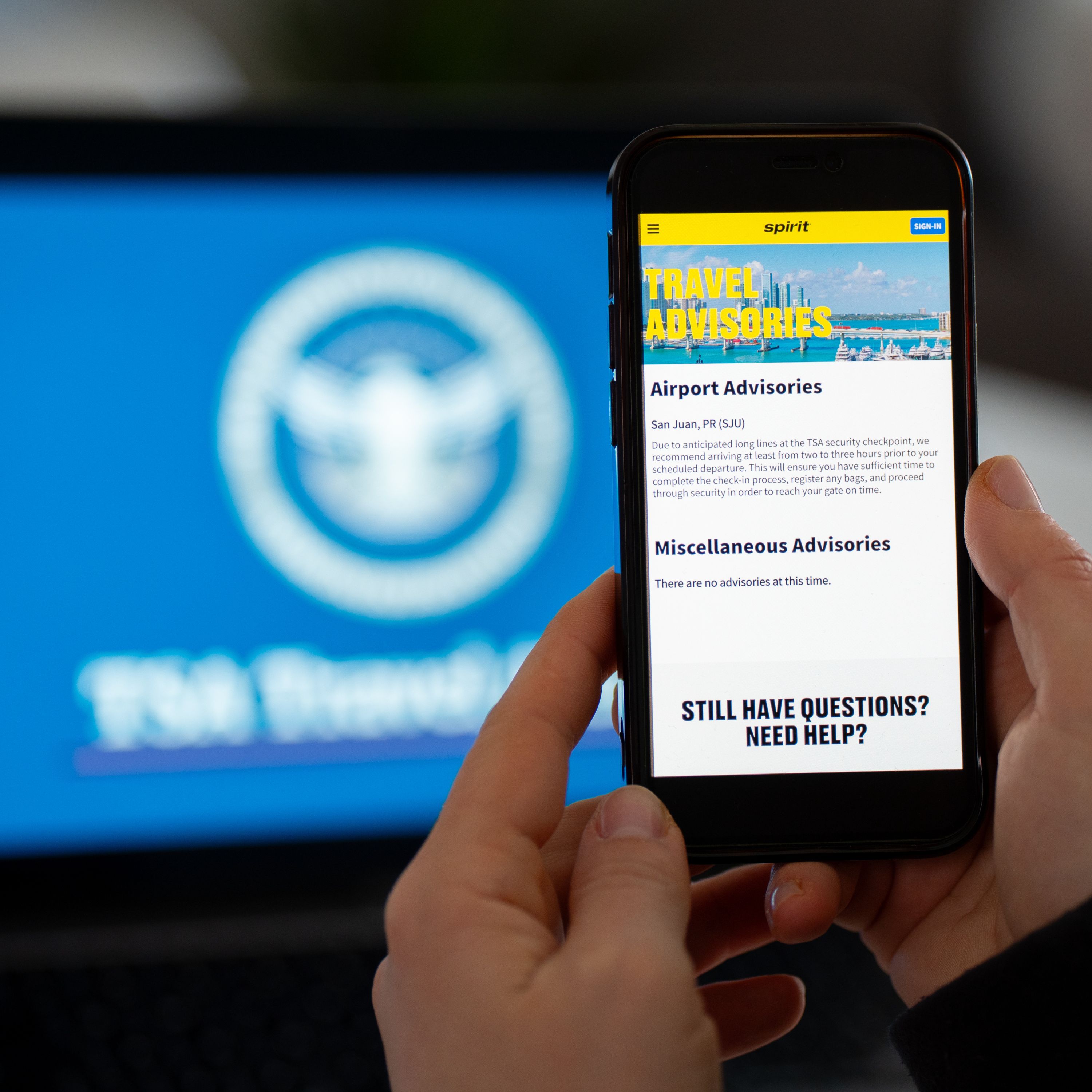
Photo: US aviation faces a crisis due to a Department of Homeland Security partial government shutdown, leading to Transportation Security Administration staffing shortages. (Photo by Marcin Golba/NurPhoto via Getty Images)
Hosted by Simplecast, an AdsWizz company. See pcm.adswizz.com for information about our collection and use of personal data for advertising.
Get every episode summarized
Each time The Brian Lehrer Show publishes, we email you a written briefing from the transcript — the topics, who appeared, and any specific claims, with the ad reads skipped.
Email me new episodesFree for 3 shows. No card needed.
Hosts & guests
Transcript ready
709 searchable segments. Every word is indexed and playable.
Full transcript
The Brian Lehrer Show — Friday Morning Politics: SAVE Act, DHS Shutdown and More. Machine-transcribed; use the interactive transcript above to jump the player to any line.
United Health Group is bringing in-home treatment directly to patients, closing caregabs, identifying risks earlier and improving patient outcomes. In 2025, patients received over 19 million home visits. Learn more at unitedhealthgroup.com slash commitment. Few things are as uplifting as the greatest moments in sports. And nothing brings us together quite like Team USA at the Olympic Winter Games. From NBC Universal's iconic storytelling to the innovative technology across Xfinity and Peacock, Comcast brings the Olympic Games home to America, sharing every moment with millions. When Team USA steps onto the world stage, we're not just watching. We're cheering together. This winter, we're all on the same team. Comcast, proud partner of Team USA. There's nothing like your first Mac. Here's what people online are sharing. At Doctor Rain says, everything is just so smooth and fast I still can't get over it. Sinking stuff between my phone and this is just chef's kiss. At Mr. Incredible488 says,
Apple Silicon basically cures low battery trauma. That's how they felt with their first Mac. How will you? Introducing the all-new MacBook Neo, an amazing Mac at a surprising price. Find out more on Apple.com slash Mac. It's the Brian Larosho on WNYC. Good morning again, everyone. Here's how weird and stuck a moment this is right now in Congress. Even after three presumed terrorist attacks in the last week in New York, in Detroit, in North of Virginia, Democrats can't agree on a way to reopen the Department of Homeland Security. I should say Democrats and Republicans, I meant to say, can't agree on a way to reopen the Department of Homeland Security. The issue remains rules of engagement for ICE after its own deadly behavior in Minneapolis
and disruption of so many families' lives nationwide. Nobody cameras, no face masks, no deal. President Trump is demanding that his election rules bill, proof of citizenship to register, government ID to vote other things, gets acted on before anything else except Homeland Security funding. He even wants Republicans to consider what's known as the nuclear option in Congress, abolishing the filibuster. So the voting bill can pass the Senate with 51 votes instead of 60. Of course, with actual voter fraud vanishingly rare in this country, the rules would mostly create paperwork barriers for people who are perfectly eligible to cast ballots. Maybe Trump is so focused on making it harder for people to vote, because he and his Iran war are so unpopular, as we look at the polls and head toward the midterm elections. The president who ran on lowering gasoline prices and boasted about doing so in his state of the union address
is even trying to spin the now soaring gasoline prices from the war as a good thing. Here's 10 seconds from the state of the union address on what he had been saying. Under my predecessor, it was quite honestly a disaster. It's now below $2.30 a gallon in most states. And in some places, $1.99 a gallon. And here's what Trump posted yesterday, however, on social media. Quote, the United States is the largest oil producer in the world by far. So when oil prices go up, we make a lot of money. When oil prices go up, we make a lot of money. That's a new twist, right? Can you imagine it as a Republican Congressional candidates campaign slogan? Higher gasoline prices are making America great again. The party's main path to victory this November. Maybe the Democrats are also very unpopular right now. And we'll cite a poll number on that. Democrats as a party are really unpopular.
One of the bills stuck in the queue in Congress is actually bipartisan and actually addresses one of the country's main concerns which voter fraud is not the high cost of housing. It passed the Senate 89 to 10 yesterday. This isn't even getting a lot of attention. This passed the Senate 89 to 10 yesterday. This housing bill sponsored by the unlikely duo of Democrat Elizabeth Warren and Republican Tim Scott. As the New York Times describes the bill, it aims to boost the supply of new housing, a critical step toward bringing down housing costs by removing regulatory barriers, providing incentives and preserving the existing supply. It would also set new limits on the role institutional investors play in the single family housing market. Trump addressed that in the state of the Union too. We want homes for people, not for corporations, corporations are doing just fine. So that bill has now passed the Senate, but faces uncertain prospects in the House.
And Trump won't sign it anyway, he says, until he gets his voting rules. Burgess Everett, Congressional Bureau Chief for Semaphore, is with us now. Some of his recent articles address the things I just mentioned. He's got headlines like, Trump threatens to block his own agenda over voting bill. Trump voting bill strains Republicans to the breaking point. Republicans watch the clock on Trump's Iran war. And White House turns to a familiar promise of pain for gain as oil prices spike. Burgess, thanks for coming on. Welcome back to WNYC. Hey, good morning, Brian. Can we actually start with a bipartisan housing bill? I said, I don't think it's getting as much attention as maybe it deserves. Can you tell us more about it? And how in this partisan environment, they got to an 89 to 10 vote in the Senate? Yeah, I mean, I think part of the nature of this bill's success in the Senate is because it was so under the radar. And because there is so much else going on, for example, yesterday, one of the lead Democrats,
Brian Schatz of Hawaii, he decided he didn't really left the way that that institutional investor provision was written. He ended up voting against the bill, and a handful of Republicans did as well. But because this is really not front-page news, and not dominating sort of the social media, and et cetera, I didn't feel like there was that much controversy about it. And so this kind of quietly slipped through while most of the senators are kind of distracted by that voting bill. And most of the public is watching the Iran War. But at 89 to 10, why isn't the bill a slam dunk to pass the House? I read that it isn't. Well, there's a lot of tension between the House and the Senate right now over that voting bill. These things are obviously not related. But the House members, first of all, some of them are starting to say they do not want to pass any Senate legislation until the Senate passes that voting bill. And we can get it into that a little bit later. So there's that. There's also what Trump is saying, which is creating more of that tension,
which is he doesn't care about anything else except for that voting bill. Now, obviously, that kind of rings hollow because this contains a bunch of his priorities. It could give them something to campaign on, because it may reduce costs and increase supply of housing. But Trump is fixated elsewhere right now. Now, I will tell you, I spoke to John Kennedy, Senator from Louisiana, a Republican yesterday. And he said that the White House has been encouraging the Senate to pass that bill. So it does seem possible, if not likely, that in the end, perhaps the bill gets altered a little bit in the House, but that it does get to the President's desk, and that he does sign it. It doesn't seem like it's going to happen right now. But I could totally see that happening in the next few months. We'll get to some of those other things you mentioned. Certainly the voting bill will talk about the war. We'll talk about the Department of Homeland Security. Still technically shut down with the gridlock on the budget. But on the housing bill, the New York Times says policy disagreements
on the housing measure remain profound. And an example they cite is the provision that would restrict how private investors can purchase billed and own single-family homes. It says under a new proposed rules, be it headed by Senator Raphael Warnock, Democrat of Georgia, investors who own 350, that's a lot. 350 single-family homes would not be able to buy more. And then it says while the bill would allow investors to build single-family homes exclusively as rentals, it would require builders to sell those homes after seven years. And I realize we're getting in the weeds now, but that's a limit that critics of the provision, provision including some House Republicans, argue would make it harder for developers to build new rental housing at a time when the country desperately needs new supply that from the New York Times.
And anything more on that, because it sounds like a good populist thing when Elizabeth Warren or when Raphael Warnock say it, institutional investors shouldn't be allowed to own so many homes for ownership or rental, but then economists really debate whether it be a net plus or not. Yeah, and I do think that there's plenty of folks, especially on the Republican side who think that the free market could take care of this. And I don't mean to belittle the policy disagreements, but to me it's really just more of a political one. And when I say that, I think that there's a little bit of a wrestling match between the two chambers of Congress, but I also think a lot of Republicans follow President Trump's lead. And so if and when he turns to this legislation, prioritize it, says here the changes I want or changes he doesn't want, I could see it passing by House. So I think if this was a huge policy disagreement among the two parties,
you would not have seen that vote yesterday in the Senate, 89 to 10. I mean, I'm not sure. A delicious cheese pizza can get that many votes. What? No pepperoni? Listeners, your comments or questions about Congress. Welcome for a semaphores congressional bureau chief, Burgess Everett, 212-433. WNYC, caller text, Congress in the war, Congress in the housing bill, Congress in the voting bill, the dismal approving ratings for both parties right now, the Homeland Security funding measure or anything else related, 212-433. WNYC, caller text, 212-433. 9692. So Burgess remind us what does Trump most want in the voting laws bill? And why does he consider it so important? Well, he, this bill primarily would require, as you said, at the start, government ID to vote,
as well as proof of citizenship to vote. The president has cast this as existential for the midterms. He hasn't said it quite explicitly like that, except sort of the implication is the Republicans need to pass this to win the midterms. Now, he hasn't said that's because of the policy necessarily. But as you know, non-citizens voting in elections is pretty rare. Some states already have voter ID requirements. And four years ago, a lot of Republicans said they oppose the federalization of voting laws when Democrats were trying to pass a different measure. So I do think there is something to the online campaign that the president has sort of ginned up on this, which now includes folks like Elon Musk who are going after the Senate majority leader. I think it's a little bit of a test of Trump's political strength in the Republican Party as much as that is about the policy itself. And we've done whole segments on this,
but remind us, too, why do the Democrats so vociferously object to the voting bill? To many Americans, if you look at poll results, these don't sound like onerous provisions. Proof of citizenship, since citizenship has always been a requirement to vote anyway. And voter ID just prove you're you. Why do Democrats find it so toxic? They see this as creating fertile paperwork for plenty of citizens of the United States folks that do not have photo IDs right now that would be complied with this law or the same thing for the proof of citizenship requirements. So they see it as creating barriers across the country for people to vote, but it is, of course, interesting to me how the two parties will often flip. They're talking points a little bit because as we just referenced, Republicans oppose any federalization of voting laws for years ago and now as Democrats who oppose any federalization of voting laws.
These policies are very different, but both parties have now tried to do this in some way. Right. But if the lines are breaking down the way they are, then there must be some pretty good data out there that this would mostly reduce the turnout, the ability to vote among democratic constituencies. You have anything on that? I mean, I have also seen some analysts say that it's not as clear cut that this would help Republicans because their constituency has changed in recent years to include more working class voters, yes, working class white voters, but in the 2024 election, working class voters who are Latino or Black as well. And you had an article yesterday how the Senate will take up the voter ID bill. Why is how a question? How is a question because I do not want to bore your listeners with Senate procedure, but there is a question of does it take 60 votes to come to the Senate floor or does it take 50? Senate Republicans have a 53 seat majority.
So if it only takes 50 to bring it to the floor, they can at least consider it and perhaps vote on some amendments. So they've settled on a strategy to take up the House past legislation, which requires only 50 votes to get on the floor. If they used a Senate bill, a new bill, and tried to put it on the Senate floor, they would need 60 votes just to open debate. So that's the key difference here. Now, what's really important is that even with this strategy, that Senate Majority Leader John Thune is using, he's going to need 60 votes to end debate on the bill. And that's where this whole talking filibuster situation comes in because he does not have 60 votes to end debate on this bill because Democrats oppose it and will filibuster it. So here's a question. Why haven't Republicans with their Senate majority already abolished the filibuster, the ironic math there, which you were getting at, is that you only need 51 votes to abolish the 60 vote requirement
for all those other bills. And there are more than 51 Republicans who among them has reservations and why. Yeah, I mean, I can name a bunch for you right now, people like Susan Collins, Lisa Murkowski, Mitch McConnell, Tom Tillis, even the majority leader John Thune likes the legislative filibuster. I would say historically the legislative filibuster has been a tool for conservatives to use more than for progressives to use. And when I say that, that's because we talk about the Republican Party, typically they want a smaller federal role in government. And that means passing less legislation. They can do a lot of their agenda with 50 votes anyway. You can do tax cuts with 50 votes. You can approve new federal judges with 50 votes. The Democrats have a much more expansive view of what they want to do through legislation. And that often requires 60 votes. So that's why a lot of Republicans liked the legislative filibuster and they don't want to be the ones to break it.
So why doesn't Trump share that concern? Especially with the prospect that Democrats could take both houses as November, right, by Slim margins and hamper the Trump agenda quite a bit next year. If the Republicans don't have filibusters to hold the Democrats back. In my view, President Trump does not see much beyond his own term. And so he's looking at the next nine months as probably his only time left with unified government, given the likelihood that the Democrats at least take the house. A lot of senators, I mean, some of these folks like Chuck Grassley have been around in the Senate since the 80s. They've seen everything flip back and forth. They've seen the long arc of history. And that's what they have in mind. Now, there are Republicans who say Democrats will change the filibuster as soon as they get majority. It's certainly possible, but it's really hard to get those votes. We saw that four years ago when Joe Manchin and Kirsten Sinema opposed changing the filibuster.
And there were a lot of other Democrats that had reservations as well, even though they voted to change that rule. So I think that there's a little bit of two parties trying to blame each other and say, the other guys are going to break it before we do, but nobody's quite gotten to that point yet. Let me take one caller in favor and one caller opposed to the voter ID bill. Karina, my senior name right in Manhattan, you're on WNYC, hello. Hey, good morning, Brian. Thanks for your show and all your work. Yes, please. I was just saying that, you know, I left the Democratic Party. I was a lifelong Democrat, but I left last year because they just continuously focus on minuscule one 100th type of issues for the greater voting population. And this voting ID, it's a win-win for everybody. I mean, we all know Trump is full of Malarkey
when he says there's fraudulent voting, but that's not the point. I think Hakim and the rest of the Democrats are saying, we're not giving this win to the Republicans, but the same thing, you know, take the, in the 2024 election, Kamala and the Democrats are focusing on trans rights. And that's again, another one 100s. And, you know, Trump was smearing that all over the, you know, blowing it up to, you know, extraordinary proportions. And then he's sitting in the White House, and I'm sure he's saying, hey, Kamala, how do you like those apples? Mind you, I can't stand Trump. I think he's, you know, nothing but the Charlotteson and the Snake Oil Salesman, but Democrats have to stop playing the Mike Glocking. They need to like serve the greater, you know, population. Karina, I'm gonna leave it there. Call us again. Thank you for that. And of course, Democrats would say, it was the Republicans who were putting the spotlight
on the tiny percent of the population that is trans and trying to vilify them and get everybody to vote based on that and the Democrats' position on trans rights. But okay, that's a big debate between the two parties. Staying on the voter ID law, David and Stuyth, David on the street in Stuytheson town, apparently, has the other point of view. Hi, David, you're on WNMC. Hey, yeah, I actually like all the Democrats' objections to the voter ID notion, but also, you know, I'm reminded of a sort of more fundamental, super fundamental principle that is in the opposition to it, I think, going back to stuff I used to, in line with stuff I used to hear back in the 80s when I thought I was a conservative myself. And that is like, what if you wanna live as off the grid as possible? What if you wanna have as a little paper trail
about your identity or as anonymous as possible? Right now Republicans want to, you know, and for, you know, encourage, and forings on that, want to, they want to portray that ability. You can't just be whoever. You can't just be off in Montana and, you know, join some weird right-wing militia if you want to, because they'll wanna, you know, they'll wanna know who you are. But, and if you wanna do that stuff, then you can vote. You wanna be anonymous? No, then you don't get your vote. David, thank you very much. So interesting, Burgess, right? Cause we had one caller who was a former Democrat and left for the reasons that they said and then the other caller, former conservative, who left that camp for the reasons that he said, you know, pretty interesting. Yeah, definitely. I mean, I was meeting with some folks this week who were discussing all of the Obama Trump voters across the country and that just shows you, can you think of two more different candidates,
ideologically, temperamentally, et cetera? And yet, there are hundreds of thousands, millions of people that voted for each person for president. We'll continue in a minute and move it to Congress and the war with Burgess Everett, Congressional Bureau Chief for Semaphore and more of you at 2-1-2-4-3-3-WNYC with your calls in your text. Good morning. Good morning. Good morning. Good morning. Good morning. Good morning. Good morning. Good morning. Good morning. Good morning. Brian Lair on WNYC as we continue with the Congressional Bureau Chief for the new site Semaphore and that is Burgess Everett and with you at 2-1-2-4-3-3-WNYC. Let's talk about Congress and the war. You wrote the article just a few days into the war and now we're concluding two weeks tonight. Republicans watch the clock on Trump's Iran war.
Republicans watch the clock. What did you mean then? And how do you think it applies today? Yeah, I mean, there's two big questions I think that Republicans are looking at. There's one, the political one. They want this thing to end quickly. They don't like the spike in gas prices and the volatility. And the potential that other prices spike as a result of the war, if it goes on. You've heard affordability as much as I have. Anything that increases prices is political poison at this point. And so to the extent that the Iran war does that, they wanted to end as early as it possibly can and get Americans out of there. There's also just like Americans dying overseas is a horrible thing. We had four more killed service members overnight. This is not the kind of thing that anybody wants to happen or respond to politically or substantively. And there's also a legal issue here, which is that there's a law that allows Congress
would have to extend the war after 60 days or plus a 30 day withdrawal period. Some presidents have sought to get around that law. The War Powers Act. But this is like a real war. Republicans, several of them have admitted it is. And so there's definitely a question of would that vote be called and how many votes would it get affirmatively to support and authorize US engagement there? So there's legal and political and frankly, moral questions coursing through the Republican Party right now. And not everybody's on the same page. You had an article over last weekend. Senate Democrats vowed a force around war votes if Republicans don't hold hearings. And you wrote that Senator Cory Booker of New Jersey and Chris Murphy of Connecticut or among the leaders of that. What do they want exactly? Yeah, I mean, they basically the Democrats have tired of these classified hearings. The public doesn't get to hear what's happening in them.
They hear people go to the microphones after and describe in broad brushes of what's going on with no specifics. And so I think they want an opportunity for people to hear about this, but also an opportunity to question people like Defense Department Secretary Pete Hegseth and Secretary of State Marco Rubio in public and sort of grill them. And so they have this procedural leverage to launch these war powers votes. They already had one since the war started. It failed, but this is getting Republicans on record in support of the war. And they have five of these ready to go if there aren't those public hearings. And there's no real sign right now that those hearings will happen. So I would not be surprised to see them start launching those votes in the next few days. You had an article a few days ago. White House turns to a familiar promise of pain for gain as oil prices spike. Pain for gain as oil prices spike. But I mentioned in the intro, Trump's new social media post that goes even further.
Quote, the United States is the largest oil producer in the world by far. So when oil prices go up, we make a lot of money, unquote. Really ever it would he resort to that? Really Burgess would he resort to that rationale? I don't foresee that rationale really working long term. And I know that he said that. And I think that shocked a lot of people given how much Republicans particularly have weaponized the price of oil and gas in the past. And so I don't think that's what most Republican candidates will be saying on the stump this fall. I think you'd be hearing people talk about we think the war is going to be over. It'll prices will go down after that happens. And because the world will be safer, I think that's the kind of messaging they would like to be hearing. Not the patriotic can pay higher prices. Joanne, in Mount Trump or New York, you're on WNMC calling about the war, right?
Yeah, that's high. Thanks for taking my call. So I, you know, it's very upsetting everything that's happening. This country is being ruined by this president and the world is being ruined by this president. Congress is doing nothing. And I ask myself, what can we do as people? I can't start a movement. But there are people in this country that have a voice that have a really strong, you know, they're well-known. Why aren't we rising up? Why aren't we having millions of people with March on Washington? How do we make this happen? Well, there are movements. There's the No Kings movement. There are, you know, there are other things. Maybe the question. It's not big enough. Well, well, well, Burgess, why do you think it hasn't gotten bigger than it has? If you accept Joe Ann's promise? Well, I do think folks are fairly exhausted with this president that people had opposed him in particular.
And I think there's a stat they lost in 2024. And so there's a little bit of a, well, we can't really do anything about it in the short term. But Brian, I do agree with you. And I've seen them with my own eyes. There have been large protests in not only just in Washington, DC, but all across the country. And so I do see, you know, even here, one near drive on the beltway in the suburbs of DC, you see people with ice posters standing out there in the frigid cold. So I certainly sense there is an activist movement. But I also think people, Fosov Trump, are tired and a little bit dispirited. And I think the real test of activism is coming up in about eight months. And if Democrats are energized as it seems like they'll be, it could be an interesting election year for them. Joanne, I'm guessing that you're a Democrat, but you're frustrated with your own party. Like if Chris Murphy and Cory Booker are serious about,
you know, the issue that they raised regarding the war, why are they just calling for some kind of hearings? Why aren't they leading sit-ins, things like that? Or, but I'm putting words to your mouth. You tell me. No, no, I just think it's just what's hot. I go to the King's rallies and stuff, but it's not big enough. When, you know, how do we get millions and millions of people out? Like have a, you know, a strike, a, you know, what's it called when nobody's working anymore? Yeah, it's a general strike. A general strike, stop working, go to Washington, make something happen, this just can't go on. Joanne, thank you very much. And it gets to this point, Burgess, that Americans are very dissatisfied with both parties. Trump's approval rating is in the 30s, which is very low. The Democratic Party's approval rating in a December Quinnipiac poll was in the teens.
In the teens. And I imagine that some people like Joanne, who are frustrated with the Democrats for not being democratic enough, as well as Republicans, and some independents who don't like them, you know, more from the right of the party. Still, that poll found Democrats with a four point lead nationally over Republicans for who people would prefer, for Congress. So it's pretty dismal all the way around. If a party can have an 18% approval rating, but be in the lead for the midterms, what do you make of it? Yeah, I mean, to me, our politics now is driven by what I would call negative partisanship. And what that means is you're not motivated to vote for someone. You're motivated to vote against them. And I think that's what we've seen in most, if not all, recent election cycles. And so if Trump is not on the ballot this fall, I still think Democrats strategy and best case for winning,
but either the House or the Senate, or perhaps both, is to motivate people to vote against Trump, to vote for Democrats as a check on Trump. You don't hear Democratic leaders talking a ton about an affirmative agenda for when they win, or if they take Congress. And what that tells me is they want this to be a referendum on the other guys, not a referendum on Democrats. We have just two minutes left, but we have to touch on what's happening with Homeland Security funding. Even that is falling out of the headlines with the war. The partial shutdown is many weeks old now over the issue of rules of engagement for ICE. The Democrats won't vote for Homeland Security funding unless the Republicans agree that ICE agents are gonna wear body cameras, not wear face masks, things like that. And the shutdown seems to be having less of an effect on immigration enforcement, which is proceeding a pace, than on lines at airports as TSA agents aren't getting paid. So what are you seeing from that politically in Congress?
Yeah, I mean, you could tell people are reacting to those lines because yesterday, before the Senate left for the weekend, there was a big bruja on the floor about funding other agencies under the Department of Homeland Security, like TSA, like the Coast Guard, like FEMA, and then leaving ICE and CBP customs and border patrol unfunded. Republicans rejected those because they said we can fund all these agencies right now if we just fund the entire department. So they're really at loggerheads on that particular front and I'm not hearing anything positive about negotiations, about changing those rules of engagement on immigrations and customs enforcement. However, if there is a bright spot and this is a very thin one, but I have also been told by folks in the administration that now that Kristi Nome is out as DHS Secretary, things are going a little bit better in negotiations to try to reopen the government. So I'd keep your eye on that dynamic and whether the new DHS Secretary, Mark Wayne Mullin,
kind of gets a little bit of a fresh start when it comes to that and maybe can make some a headway there. Burgess Everett, congressional bureau chief for Semaphore. Thanks so much for joining us today, really appreciate it. Thank you, Brian. Since WNYC's first broadcast in 1924, we've been dedicated to creating the kind of content we know the world needs. Since then, New York Public Radio's rigorous journalism has gone on to win a Peabody Award and a Dupont Columbia Award, among others. In addition to this award-winning reporting, your sponsorship also supports inspiring storytelling and extraordinary music that is free and accessible to all. To get in touch and find out more, visit sponsorship.wnyc.org.
More episodes
More from The Brian Lehrer Show

Tuesday Morning Politics: State of Iran War; Home Stretch to Midterms
The Brian Lehrer Show

The CDC and Measles Deaths
The Brian Lehrer Show

History of the War on Terror
The Brian Lehrer Show

Labor Day: Working Class; White Collar Unions; Supermarkets; Summer Songs
The Brian Lehrer Show