Get every episode summarized
Each time The Brian Lehrer Show publishes, we email you a written briefing from the transcript — the topics, who appeared, and any specific claims, with the ad reads skipped.
Email me new episodesFree for 3 shows. No card needed.
About this episode
The Brian Lehrer Show is made possible by:
“I'm Kushan Avidar, filling in for Bryan today here on WNYC. So some listeners know that when I'm not hosting at WNYC, I co-host a national radio show called Climate One.”From the transcript
Amy Westervelt, climate journalist and host of the Drilled podcast, and author of BROUGHT TO YOU BY: How Corporations Warped the Truth, Conned the Public, and Broke Democracy (Bloomsbury, 2026), previews the UNGA climate priorities, plus discusses her recent ProPublica investigation into how fossil fuel companies have funded climate research at top universities, and how the same companies have contributed to science misinformation and climate change denial.
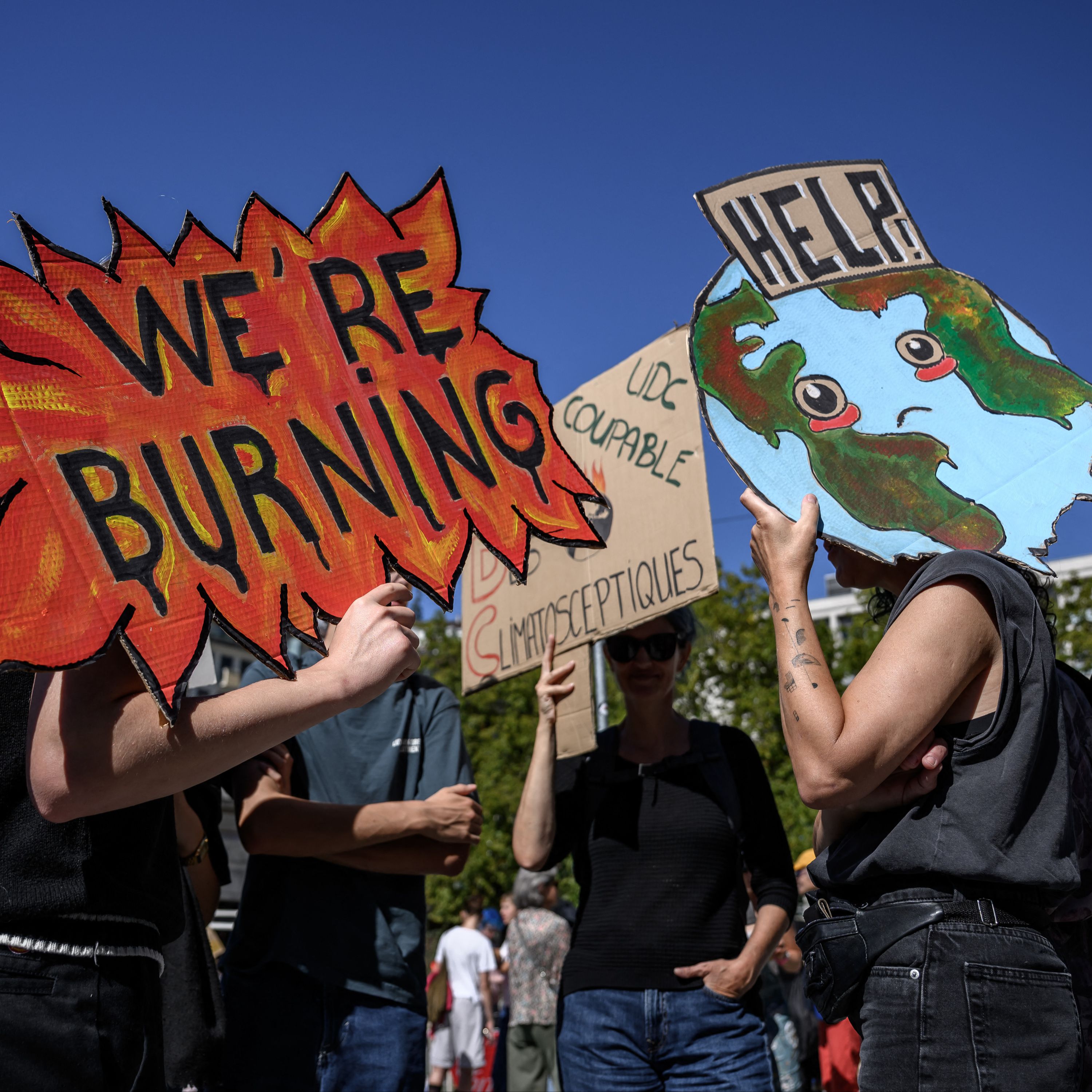
Photo: Demonstrators carry placards as they take part in a climate protest under the slogan "No 50°C summers!" in Lausanne on September 19, 2026. (Fabrice COFFRINI / AFP via Getty Images)
Hosted by Simplecast, an AdsWizz company. See pcm.adswizz.com for information about our collection and use of personal data for advertising.
Get every episode summarized
Each time The Brian Lehrer Show publishes, we email you a written briefing from the transcript — the topics, who appeared, and any specific claims, with the ad reads skipped.
Email me new episodesFree for 3 shows. No card needed.
Hosts & guests
Transcript ready
311 searchable segments. Every word is indexed and playable.
Full transcript
The Brian Lehrer Show — Climate Week Begins. Machine-transcribed; use the interactive transcript above to jump the player to any line.
It's the Bryan Lair Show. I'm Kushan Avidar, filling in for Bryan today here on WNYC. So some listeners know that when I'm not hosting at WNYC, I co-host a national radio show called Climate One. It's a show about climate solutions. And this week is particularly jam-packed for those of us in the climate world because it is New York Climate Week or its official name Climate Week NYC. It's organized by the International Nonprofit Climate Group and it includes get this more than a thousand events all around the city hosted by different organizations all to tackle climate change. Here to help us preview what this week could mean for the state of climate change is Amy Westerville, Amy's a climate journalist. She hosts the Drilled Podcast which has now turned into a newsroom that co-publishes with places like ProPublica and Rolling Stone.
Amy is also the author of the new book titled Brought to You By. How corporations warped the truth, calmed the public and broke democracy. Amy, hi, welcome to the show. Hi, thanks for having me. So the UN General Assembly is happening this week. We just talked about it at the top of this show. And Climate Week is happening this week. It's not a coincidence, right? Right, that's how it was originally conceived back in 2009. I think it got started and Mayor Bloomberg was a big fan and organizer of it. And it's now grown to be huge, which is maybe good and maybe not. No, it's your right. Victor, if it's unsuccessful, maybe. Yeah, yeah. On Wednesday, UN Secretary General Antonio Guteraiz is convening a high level event on climate action and the just transition. Yeah. That's what the priorities are for UNGA this week regarding climate. Yeah, I mean, there, you know, it's a weird time under statement of the year.
And it's especially strange for this to be happening alongside the high level event, because you have Marco Rubio being sent to this event. And, you know, the State Department press release is like he's going to discuss the primacy of nations, which is it's like a real like we're not into multilateralism statement. Right. And the UN's approach to dealing with climate has always been a multilateral approach. So they are trying to kind of reframe what that means in today's world and how to kind of hold the line on that and how to talk about climate solutions in a way that is not just, you know, we're going to buy this many solar panels, but also how are we listening to civil society groups? How are we really thinking through how people will be impacted and are already being impacted by the climate crisis? And what can we do in a situation where, you know, one of the world's superpowers is kind
of like, you know, sticking its fingers and its ears and saying no, no, no. So a big priority this week will be to preserve multilateralism in a world where it seems that that is going by the wayside. Yeah. That's a big undercurrent of the week. And we did have, you know, just a few months ago, the US was trying to block the UN from kind of bringing on board and operationalizing this unanimous ruling from the International Court of Justice last year, which said very explicitly, governments have a legal obligation to protect their citizens from the worst impacts of the climate crisis. And that includes regulating the corporations headquartered in those nations. And they also explicitly said this applies whether the government in question, you know, agrees or not. It seemed written for a particular government. Right. Right. Right. Right. And, you know, that came out in 2025.
And then the, there was a big push, mostly spearheaded by Pacific Island nations to get the UN General Assembly to kind of adopt a resolution saying like, we're going to take this on and we're going to operationalize like, what does this look like? And how do we enforce it in a way because it's, you know, it's a weird situation where it's the International Court of Justice. It's a ruling. It has a lot of weight, but it doesn't necessarily have teeth in terms of like, you know, holding people to account. So the US tried really hard to block that resolution. They were, you know, threatening trade partners with like, we're not going to renew a trade agreement with you if you go through this resolution. So it obviously was threatening in some way. And it managed to get through anyway with, I think it's the US, Saudi and a couple of other nations voted no, but it still passed. So that was actually a big win for multilateralism. There was a lot of talk at that time about like, this is going to be a real test.
Like if this one kind of rogue nation can like tip over the apple cart here, it's going to be really hard for us. So it's existential. It's like what is what is the purpose of this, which I think a lot of folks, I mean, in the previous segment, this idea of it being performative and the major players not actually haven't buy in, brings into question the whole, the whole efficacy of this. So and I think totally in climate, you see it as a perfect example where it manifests. Totally because climate change is not restricted by borders. Right. You know, even the way it's so odd like the way we even think about emissions and how we source emissions, you know, like people will often say, well, the US is a historically the biggest emitter, but it's not the biggest emitter anymore. And that does not take into account the role that US oil majors play in developing oil gas resources all over the world and in lobbying governments all over the world against certain policies and all of that kind of stuff that goes into increasing emissions everywhere.
So yeah, it's listeners. What do you hope gets discussed about climate change at this year's UN General Assembly? Give us a call or send us a text. We're at 2124339692. That's 22433WNYC. And more generally, I'd love to hear from folks about how they are feeling when it comes to climate change. And whether that's making you take action or you feel unmotivated, why? We're here with climate journalist Amy Westorfeld. So give us a call. Tell us how you're feeling. 2124339692. Amy, I included that part of the call in about how you're feeling because I think at least in the climate space, from my experience, I'll speak for myself, it can feel so slow moving. It can feel like unless you get really deep into the weeds, it just feels like the same song and dance this year. So I think when you think about hundreds of thousands of people listening in New York City right now about this, is there anything special happening lately that might get exhausted folks to maybe tune in to what's happening at climate week discussions?
I mean, I think there's a few things. I'm glad you mentioned is it inspiring action because I feel like even amongst people who are usually quite active on climate, there's a real sense of defeatism right now. People are feeling like, oh, we can't do anything with this. We don't want getting introduced to any of these things, but I think there's a whole motiv perception it actually. expressive planning for everyone to really deal with. So let's talk about various things. Now, yeah, it'll be there. ロBo Indeed, it's always something like, really tough, but I think it should be there for how mainstream państwa strive to play an important role in Europe to win a stage of rarely-conswered, or in Europe's overall overall performance. the climate movement, especially in the wake of the standing rock movement in 2016-2017, there were all these laws that were passed across multiple states that criminalized or increased the criminality of protest around fossil fuel infrastructure. There's only been more of them
passed since then, and this administration has really ratcheted that up a notch. So, you know, people are feeling like they're not sure what they can do, they're not sure what the risk is of action, all those things, but something that's giving me a little bit of optimism before it gets too bleak is that I am starting to see the people who have always done a good job of connecting the climate crisis to everything else going on in terms of, you know, the various wars happening right now, cost of living crisis, instability in general, you know, the lean towards authoritarianism as being a climate story and really framing it that way, and that's where I think the kind of energy that I'm looking forward to is at this week. There's a little bit of, I think, a divide happening in the climate space itself right now between folks who feel like, yeah, like, everyone is worried about AI and data centers and inflation and war. These are all things that
have a huge climate component. We should be out there connecting those dots for people, and the people who are like, we don't want to make anyone mad. Let's just talk about batteries and solar panels. Yeah, right, right, right, the good side of it. And the place where everyone can kind of basically agree on this, unless you're a fossil fuel. But what we've seen in the last couple of years, right, is that we can't in fact all agree on that. And that those things, you know, are not generally enough to like, inspire the level of political will required to spur massive systemic change, which is what we're seeing is needed in kind of multiple layers of society right now. Well, you brought up AI, you brought up war. Those are definitely topics that are going to be discussed generally this week. So how much is climate a part of those discussions? I think so I'm seeing a lot of discussion around, you know, regulation of AI and sort of multilateral governance of AI and how do we handle this and whatnot. And I am seeing in quite a
few climate events, some mention of the fact that like, hey, it's not just tech companies that are into this build out like every single one of these data centers has a dedicated private gas plan anymore. And let's talk about the water that they're eating up and taking from drinking water sources as well. So there's a huge environmental impact. There's a huge climate impact to all of these, you know, people will talk about the Amazon plant here or the, you know, Microsoft data center there. And I really feel like we should be attaching the fossil fuel majors that are partners in those to how we talk about them, which I do think we're starting to see a little bit of this climate week. On the war front, I mean, how can you not connect that's on that, you know, we had, I think the industry was pretty successful in the wake of Russia's invasion of Ukraine and selling people on the idea that like, oh, if we'd only been drilling more oil and gas at home, we wouldn't have had an impact on, you know, prices and we would have been fine and we would have weathered this storm. Now,
you know, so soon after that, they tried to kind of use the same talking points and it's not really working. I think people are starting to see, okay, if we're worried about energy security and we're worried about national security, dependence on a volatile commodity seems like a bad move. Yeah. Yeah. Let's get Ryan from Bedside down. Hi, Ryan. Welcome to the show. Hi. Well, first of all, I just want to say that I listened to your guest, the co-host on, you know, on radios of theory, it's on climate change and it was really informative and wanted shout out and to say everyone should listen to that. Yeah, it's great. That's show in general. That would be great too. Yeah. Yeah. And that was a couple years ago and now, you know, I think that things are moving faster than everyone anyone could know. You know, AI is moving faster.
Climate change is faster than AI and even and I, you know, I don't want to be like super doomsday and I don't think this should be doomsday but I mean, I do think that everyone needs to really wake up and realize that the climate change is here. The climate crisis is here. You know, what we are seeing now is just going to get worse and really we need to be thinking about how are we as humans, you know, going to survive and not just like how are we going to preserve our society, but like, yeah, actually, how are we going to continue existing on this planet? Ryan, thank you so much for that call. I mean, I imagine Amy, you hear a version of this all the time. Go ahead. Yeah. Yeah. I mean, I actually, I think about this a lot because there's a way that the climate conversation gets boiled down to this kind of like political chess conversation and I mean, I find it pretty annoying when any issue gets discussed that way but it really doesn't make sense
on climate where we have actual physical limits, right? So people will kind of like fetishize compromise in this way of like, oh, well, yeah, okay, we're still going to be drilling a lot of new oil and gas projects but we're going to do, you know, this carbon market thing and we're going to do this thing and whatever. I mean, you see it even in the latest overshoot report from the UN Environment Program. It's like, oh, overshoot is happening. We're going to blow past 1.5, but we can use carbon capture technology. Yeah. Yeah. And it's like sounds good on paper, makes everyone feel a little better isn't real. Like, I don't want to bump people out either. However, the reality is it kind of doesn't really matter what political compromise is you come up with. If it doesn't reduce the amount of bad molecules going up to the atmosphere, like this is a physical science problem, you know, and a lot of people who get kind of in the weeds on the policy issues just can't kind of wrap their heads around that. Yeah, it's troubling.
This brings me to your new book that just came out, which is titled, Brought to You By. And the reason that I think of it is because the narrative is such an important element of this and who controls the narrative. And when I first read the title, Brought to You By, my brain was immediately transported to watching TV back in the day. And I'd hear the announcer plug, whichever company paid for that show. It was like, this episode has been brought to you by like Rick's Curtain Emporium, which is not a real place, but it's just my mind. That's exactly the point. You're looking at how corporations have put their tentacles into the media ecosystem. Yeah. Was there a specific moment for you where you encountered that and then made you want to write the book? Yeah, totally. I did the first season of my podcast drilled on the origin story of climate Nile, because I was just curious about how that had happened. And the Exxon New Reporting had come out from Columbia and inside climate news. And I thought it was so explosive. All these documents that showed that Exxon knew about this problem and really made moves to keep everyone else from
knowing about it and all of that stuff. So I wanted to hear from those people directly. And the more I learned, the more I just was like, this is the dumbest strategy. This is not a genius, just like what my toddler says, you know, like, no, uh, you know, that's not true. Yeah, yeah, yeah. Right. And I realized that, you know, part of the, part of the efficacy of the strategy is that it's telling people that they don't have to make any change, which is always quite appealing, but also I just, I was like, there, what came before this? There had to have been something happening before all of this to make this work so well. And the more I looked into it, the more I realized that, oh my gosh, like this industry, the fossil fuel industry, was a really early beta tester of all of the kind of modern corporate propaganda techniques. And, you know, we hear a lot about like, oh, big tobacco did this and then big oil did it or big oil did it and then, you know, big chemical did it. They all did it. And, uh, and, you know, the tactics were created by
really like the disinformation industry, the propaganda industry, which now goes by the name of PR. And, and it hasn't just resulted in disinformation, it's completely shaped this, the narrative around everything. It's shaped how we understand what the environment is, it's how we understand what the economy is, the relationship between those two, our relationship to all of it. It's very powerful how corporations have been able to do that. And then on top, then, you know, you kind of build on that foundation, your policy wish list, right? Or your, um, I don't know, fight against taxes and regulation and all of that. But first you build this foundation of like, the narrative of how things work and should work. And to your point, it's not new, but there are new elements about it. And that's what your book is about. Because, you know, you mentioned the fossil fuel industry, the sugar industry did something similar 60 years ago, like companies like
to metal with information to protect their bottom line. So what's different now? Well, two things, one, I want to say that like at the bottom of this, then and now is really not wanting to deal with democracy. Like at its most basic, right? It's like, the voters aren't on our side. So what do we do to convince them to vote in our interests, even though that's often against their own interests? That's what this stuff does. It's an end run around democracy. And it's been used, you know, the reason it goes back so far is that like the turn of the 20th century is when corporations had to actually deal with democracy by, you know, they had labor strikes. There was journalism kind of revealing certain things about their business. And you had some of the first regulations being passed on corporations. So fast forward to today, we have a new batch of anti-democratic industrialists, the tech industry. Like I see all this coverage of big tech and, you know,
how terrible they are and their pro with authoritarian and their very anti-democracy and all of these things. And it's like, yeah, they are great job. We should recognize that. However, they really are like the newest flavor of this genre. And on top of all the other things, you know, they created a parallel media ecosystem. So they really like they added a really big new bell and whistle to the machine in the form of social media and AI, right? So not only are they using the various tactics, but they've built a whole, you know, parallel media ecosystem that they have total control over. At the same time, and for me, everything that you're saying seems to resonate, I also think that there are instances in which industry really can move the needle in the way when things align. And I want to bring down Kevin from Yonkers. So I think it might have a point about that. Kevin, hi, welcome to the show. That was a dial tone. Kevin, are you there?
We might have lost Kevin. Kevin, if you're listening, I'm going to summarize what I see you saying. But Kevin was actually driving down through West Texas. And when Mills were exceeding oil pumps on his drive. And he was saying it's encouraging to see regardless of what the government is trying to do, maybe industry has its head on straight. So Kevin, thanks for bringing that point to the foray. Amy, I want you to talk about that side too, because it's not as clear cut as just like business bad. All business is bad. Yeah, totally. And I don't make that argument. Right. I don't want to make it. So yeah, it's not that all business is bad. The problem as I see it is that there is nothing constraining businesses from being bad, right? We're relying on, and actually, this is a fiction created by the PR industry as well. We're relying on corporations to behave like people with moral compasses, and they are not. So you're going to end up with the same spectrum that you have in individuals, right? You're going to end up with some bad faith actors and some good faith
actors and some moral actors and some immoral actors. And it's the job of government to make sure that that doesn't impact the public. And they're not doing that job. That's that's the issue. It's not that every corporation is bad. It's that corporations are incentivized to be bad. Yeah. And now you're also saying there's this turbocharged element to it with social media where corporations have more capacity than ever to play towards those adverse incentives. That's right. They have, I mean, I talk about this in the book a lot that they have this they've had for a long time, this giant megaphone to sort of shout over the public square. And now that's like times a thousand. An individual who, you know, because sometimes people will say, well, anyone can start a podcast now or a YouTube channel or, you know, become TikTok famous, theoretically true. But if that person is saying things that are, you know, threatening to various entities, it's much harder for them to break through. And I think
if a corporation has, you know, kind of the endless money cheat to get out like their message over and over and over again, some amount of responsibility should come with that. Yeah. Let's bring in Sunny from New Mexico. Hi, Sunny. Welcome to the show. Good morning. How are you today? Good. Thanks. Go ahead, Sunny. I hope you are well. Okay. So in our area, we have a lot of coverage about data centers going up here there and everywhere. And I really would like the climate change conversation to start including the word data because we all are utilizing data. This device I'm talking to you on right now is using data and data equals water and water equals the lack there of and the droughts here in my area. And right now this summer, all of the pinion evergreen trees have
died because of the drought. I mean, massive amounts. And this is, you know, a pinion net that we eat. The bears, mountain lions, bobcats are coming down from the mountains. And then the other part of this climate conversation that I also want to tap into is like wild harvesters over for over harvesting things that wild critters need to live. And, you know, like just as native as a native person, yes, we forage, but we never ever over harvest. We always leave seeds behind. We always leave something for the wild critters to live on. And then this time of drought, you know, maybe this five-finger people step back a little bit. But this whole data thing, I'm data or data however you want to pronounce it. Sunny, thank you so much for that call. I think it is crucial that
we talk about a little bit more how data AI data centers are changing the climate conversation. Sunny saying that they wish they were hearing more of it in the discussion. How does that resonate for you? I agree. I see, I do see a fair bit of people in the climate space trying to get the word out that, you know, these are energy, hungry, you know, centers that they eat up a lot of water, that they have high emissions, all of those kinds of data points are coming out. But I think connecting it to like, hey, and by the way, here's what those centers are being made to do. Like here the services that you could like opt out of if you want to reduce demand for these things. And also here, there's a lot of like again, very anti-democratic things that these data centers are being built to do, one of which being 24-7 surveillance of people, you know, which I don't think any of us want.
So I do think that actually the climate movement could be doing a better job of connecting the dots and tapping into, you know, people already being ticked off about these data centers being built in their communities. I also think that there's a huge need to remember that as, you know, people kind of celebrate blocking one center or another that this is a big systemic problem. And these companies are going to just find somewhere else to build that data center that got shut down. And we need to be thinking about how do we rein them in and rein this growth in kind of across the board. So, you know, you've got, I'm sure, a really busy week. If listeners are interested in what you're doing, where will you be? Any event you encourage folks to check out? Yes. So tonight at the Bell House in Brooklyn, I'm doing a comedy show. I'm on a comedian, but
thankfully the other people on stage will be with the folks at Climate Town. They do a YouTube show by the same name and are genuinely funny. So come and check that out. Tomorrow I'm doing a talk at the New York Society for Ethical Culture. And that'll be kind of focused on the book. And generally, sort of what I call information pollution in the climate space. And then Thursday at peer 57, I'll be part of a all day program from the Institute for Human Impacts that is focused on the narrative. It's all this narrative stuff. That is actually something I'm seeing a lot of this year is, is focus on narrative change and creativity and how to kind of tap into that stuff to deal with these issues. Well, we encourage folks to come check it out, but we'll have to leave it there with Amy Westerville Climate Journalist and author of the new book brought to you by thanks Amy. Thank you. WNYC's journalism and storytelling is heard by millions of passionate listeners,
sponsors of our programming, gain our listeners attention, and their respect. Learn about how your organization can support WNYC and WNYC Studios at sponsorship.wnyc.org.
More episodes
More from The Brian Lehrer Show

30 Issues in 30 Days: How Elections Work
The Brian Lehrer Show

Mayor Mamdani's 'Broken Windows' Promise
The Brian Lehrer Show

Anti-MAGA Insights
The Brian Lehrer Show

A Rancher Takes on Wildfire Management
The Brian Lehrer Show