About this episode
Get every episode summarized
Each time World Today publishes, we email you a written briefing from the transcript — the topics, who appeared, and any specific claims, with the ad reads skipped.
Email me new episodesFree for 3 shows. No card needed.
Hosts & guests
Transcript ready
491 searchable segments. Every word is indexed and playable.
Full transcript
World Today — China's services trade fair showcases the value of openness. Machine-transcribed; use the interactive transcript above to jump the player to any line.
Daily News and Analysis. We keep you informed and inspired. Chinese President Xi Jinping is said to attend the 18th Brick Summit in New Delhi. China's services trade fairies on the way in Beijing showcasing innovation and promoting openness. And Russia first puts sovereign AI models into law. Hello and welcome to World Today. I'm Do Hongyu in Beijing. To listen to this episode again or to catch up on previous episodes, you can download our podcast by searching World Today. Our first story. Chinese President Xi Jinping is said to attend the 18th Brick Summit in New Delhi from Saturday to Sunday and the invitation of Indian Prime Minister Narendra Modi. India's Ministry of External Affairs says Brick's leaders will exchange views on strengthening intro-bricks cooperation on common priorities and share perspectives on global and regional
matters of mutual importance. So what can we expect from this year's Brick Summit? What is the evolving role of the global South in the global governance? And how can Bricks address the world's challenges? Joining us on the line is Wang Xingsong, associate professor with the School of Government at Beijing Normal University. Thank you for joining us, Professor Wang. Okay, for having me. As leaders are about to discuss bolstering intro-bricks cooperation and exchange views on global and regional issues, which areas of Bricks cooperation do you think hold the greatest potential for tangible progress and discouraging? Well, I think there are some of the most prospective areas that we will seek some concrete progress are in finance, trade, as well as technologies. So when it comes to finance, it's probably the area we should watch more closely because India is pushing for Bricks countries to make
cross-border payments easier, including greater use of national currencies and eventually linking every country's central bank digital currency systems. So the objective is to make transactions among member countries faster and cheaper. And then the new development bank is another concrete instrument. And Bricks finance officials have also discussed how the NDB can mobilize much more private capital for infrastructure and sustainable development. Then trade, I think, is the second promising area. Bricks trade ministers have already agreed this year on the JAPAR consensus, including principles to improve credit access for small and medium-sized businesses. And they have been working toward a Bricks economic partnership strategy by 2030. And lastly, I think technology is the area we should keep a close eye on because India has put AI startups, digital public infrastructure and innovation
quite high on its presidency agenda. And health ministers have already agreed on cooperation involving digital health and responsible AI. So finance, trade, and technologies. Now, looking at the Bricks mechanism itself, and Indian media outlet reported that the Bricks mechanism is unique as there is no constitutive treaty, permanent secretariat, or common budget. And the group is built on consensus. So how does this feature empower this platform and also its members? Well, this loose structure is actually a strength is one of the reasons why Bricks has been able to bring together such different countries. If you consider the membership today, you have members not seeing every issue of geopolitics in the same way. So a highly centralized organization would probably be much harder to sustain. So Bricks instead gives governments considerable strategic
autonomy. They cooperate with interests overlap without having to align their firm policies on every issue across the board. Take India as an example, it participates in Bricks as well as CO. But it also belongs to the Quad and maintains a very close relationship with the United States and Europe. So China has, by far, the largest economy in Bricks, but it cannot simply impose a decision on other members. Every member has to be brought along for any discussion item on the agenda. So the principle of consensus making gives smaller members the comfort and the respect they need for global governance participation. And the absence of a large bureaucracy makes the mechanism very flexible because priorities can change from one presidency to another. So this year India has organized the chair ship around issues like resilience, innovation, cooperation,
sustainability. And Bricks has expanded significantly in recent years with Egypt, Ethiopia, Iran, Saudi Arabia, and the United Arab Emirates becoming full members in 2024, then followed by Indonesia in 2025. What has been attracting global South countries to join? I think the first reason is obviously the representation that Bricks offers in global governance because many developing countries believe their economic weight has far grown out of their influence in the institutions that work created after the Second World War. And emerging and developing economies today account for about 61 percent, 61 percent of global GDP measured by the IMF. But if you look at the IMF voting structure, it is pretty unfair. It's huge, very dramatically toward the leading economy, traditional leading economies like the United States. So Bricks gives these countries
another platform where developing economies themselves can have much greater agenda setting power. The second attraction is more practical. As members gain access to a network of major markets, energy producers, commodity exporters, and so on. So Bricks cooperation covers trade, finance, agriculture, technology, and many, many areas. And these are concrete development areas where every member can benefit from. And the new development bank we earlier talk about provides another source of development finance. And then the third factor is strategic diversity occasion. Joining Bricks does not require country to break with the United States or Europe, or any of the existing international institutions. So members can still maintain their conventional existing relationships while joining a new organization that offers new opportunities. And how will this bigger grouping shape the tone and outcomes of discussions in New Delhi this year?
This grouping brings together major Asian economies, important Middle Eastern energy producers like UAE and Saudi. And then large African states like Egypt and Ethiopia. And then you have leading economies from South America. So that gives discussions on energy, climate, development finance, and global governance much more weight than they would have had a long time ago when there were just five members. But to be sure, diversity comes also with challenges. Members take different approaches toward the war in Ukraine as well as toward the ongoing conflict in the Middle East. So I would expect the United Summit to be careful on the most divisive geopolitical questions, but more ambitious on areas where interests overlap. And India has good relations with a very large range of Bricks members. It has traditionally emphasized strategic autonomy. So it does
have incentive to keep the grouping focused on global South cooperation rather than allowing it to become defined by the confrontation with the West. And finally, Professor, the current global landscape is marked by geopolitical tensions and strengths and multilateral institutions and a lot of other problems. Can Bricks push for reforms to the existing global governance system? And if so, what do you think is the way that Bricks do this? Yes, you know, although it's great, greatest influence will probably come through reforming existing institutions rather than trying to replace them. And Bricks members repeatedly emphasize that United Nations and international law are the major channel of participation in global governance. And the argument is that the institutions such as the UN Security Council and the World Bank and so forth need to reflect today's distribution of population and economic power. So there are several conflict areas where
Bricks can exert some pressure. One is on the UN Security Council reform, which has been caught for a long time by Africa, Asia and Latin American countries for more representation. Another is to reform the international financial system we talked about earlier like the IMF, like WTO. And then the third one is the global rule making on newer issues, right? Bricks can choose already discussing AI governance, climate finance, digital infrastructure and cross-border payment systems. These are the areas where many of the rules are still being written. So developing canchus can have better opportunity to participate from the very beginning rather than trying to change the established rules decades later. Thank you very much. That was Wang Xing-Zong, associate professor with the School of Government at Beijing Normal University. This is world today. Stay tuned.
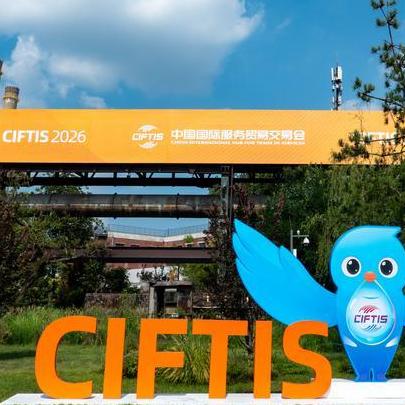
The China International Fair for Trading Services is underway in Beijing. Over 90 countries, regions and international organizations have set up exhibitions and host events with more than 1,800 enterprises exhibiting on-site and Shogang Park. More than 90 companies and institutions are set to release new products with over 100 global or China debut in Fintech Digital Healthcare, Smart Education and Green Technology. China has posted rapid growth in services trade. Official data shows that in the first seven months of 2026, China's services trade totaled nearly 4.5 trillion yuan, or over 656 billion US dollars, up 8.3% in the year. Now for more, we are joined by Dr. Zhou Mi, senior research fellow with the Chinese Academy of International Trade and Economic Cooperation. Thank you very much for joining us, Dr. Zhou. Now more than 90 countries, regions and international organizations are participating in this year's
ZIFTIS. What is the value of hosting such a large international platform for trading services? And what can these participating companies and businesses actually gain from it? Well, first of all, I would say that trading services is not that common compared with trading goods for many people. So many people still have to understand what the trading services really mean. The international platforms for all the related organizations are really very active in promoting the trading services. So China is the only country who are giving the platform for all the 12 major sectors of the trading services in WTO. So we are trying to give a platform for all the related stakeholders to come to discuss about the related issues and we're also trying to give more energy to the participants who want to benefit from China's development in the service sectors. So this platform is really an important one. Each year, everyone in the areas of the
trading services is expecting to look at what is happening now in China and what would be the opportunity for them to catch. So these participating countries are really interested or attracted by China's market development. And if they are able to benefit from this development, they would be quite able to promote their own business development and also trying to have a better access to China's market. And SIFTES is expected to serve as a window into where global trade is heading rather than simply a platform for trading services. Now, what emerging areas of global service trade stand out to you and this fair? In the past, many people are wondering that trading services should face on the market access. Like in WTO, all the members have some commitments that they will open their trading services in all the four modes of the
trading services in WTO. But now we are saying that there are many new issues we need to concern. It's not only about the market access. We also need to understand that the trading services should also have a better alignment with trading goods. And there will be quite a lot of discussions in the national security issues in trading services. So the trading facilitation is not just a very easy way for us to reach. We need to also consider about the balanced interest of the different stakeholder. And we need to also try to look at how can we balance the different areas. Well, another one is also a very attractive this year that is a development of the technology, especially the artificial intelligence are playing quite important role in the way of the trading services. They are providing more intelligence ways of serving people and also giving people more choices based on the much quicker response to the customers. So we are
expecting that trading services can have a better development based on this new technology. So it has injected so many new energies in the development of trading services. And then beyond the business deals, what does the fair tell us about the value of keeping trade and economic cooperation open at a time when protectionism is on the rise? Personally, I would say that if you are going to just meet with some people in a very short term like one day or several days, it is not that easy for you to trust that the transactions could happen just in such short term. So we need to understand that when the people go to the cities, they are not expecting to reach the deals just in those days. Most of these occasions are, these people are establishing a better understanding about the market and also trying to give more confidence about the future corporations. So the trust is very important or crucial things for
many people. So when they are having face-to-face discussions about the possible ways of doing businesses, it was much easier for them to do that in the future. Compared with the trading goods, the trading services are even easier for the long distance interactions. So based on these face-to-face discussions and the relations are established. When they go back home, they can still continue their efforts of engaging with each other. I think that is quite important. So the time are giving us some very bad choices when the protectisms are on the rise. The protectisms are giving people so many uncertainties, no matter from the tariffs, to the restrictions on the people's flows or something to do with the technology cooperation. So if people are still believing that interactions among different stakeholders can benefit all of us,
we should try to fund some complementary space. I think that is very important to fight against protectisms and benefit from the cooperation in the globalization era. And looking at China's service trade as a whole, it reached nearly 4.4 trillion yuan in the first seven months of this year. That's up 8.3% on year. So what is driving this growth and how significant is it for the transformation of China's trade structure? China is definitely our manufacturing country, but we are having more desire to develop the trade-in services. For the service sectors, we encourage and the prices to involve better technology and also having many pilot zones like in Beijing, they have the pilot zones for service sectors opening up. We really are very curious about that because the services are not just not consuming too many resources and do not have many impacts on the environment. They are providing more sustainable
way of development. The services can also be complementary for the development of the manufacturing. So if you're looking at the growth rate of the trading service, I think that is coming from the two sides. For the export side, China's enterprises for the service are getting stronger and the government are facilitating the service trade to provide the better platforms in the free trade agreements, platforms, and also other ways to encourage the export of the services, including the insurance, the healthcare, medical care, and education. And we do have more incoming the tourists from other countries that is also our effort. Well, the import is also a playing flight, important role. We welcome the foreign suppliers of the hospitals, of the insurance of some of the financial products to invest the theory in China. I think that is also a benefit in Chinese consumers
and the enterprises. That is the import of the service trade. So based on both sides, I think that China is willing to share our opportunities with our trading partners. And it's important for us to have more resilient development in the international trade. And the structure of China's service trade is noticeable because the knowledge intensive services now account for about 44% of the total. What kind of services are included in this category? And why is their rapid growth important? There are quite a few of the knowledge intensive services. Like for example, when we are trying to develop some new medicines, some of the surgical errors, when we need to do that, we need to try to do a lot of tests and examinations. So if we are able to deal with those data, it will be much quicker for us to get the right direction and find the suitable medicine. So this one is based on the accumulation of
experiences together with the knowledge. Well, also, you know, something to do with the education and services when you are trying to teach people, teach students, that is also knowledge intensive. So for most of the research and development services, they are based on the accumulation of the experiences and also, you know, a lot of improvement of different resources. They are knowledge intensive. So the reason is that because that when you are doing the knowledge intensive sectors, you benefit from higher profits and the more sustainable development and you can also climb up on the global supply chain. I think that is quite crucial for many and the prices in China and no matter whether they are coming from China or from other countries as the investors here in China. Now, China's 15th, 5-year plan prioritizes high quality development of services trade. So what breakthroughs do you expect in China's service trade opening
under this plan? I think that you may notice that China has opened all our manufacturing sectors. There are no barriers for, you know, all kinds of differences for the foreign investors, compared with China's domestic one. But for the service, we still have some, you know, markets, some sectors we need to open. I think that is what we want to do more experiment, new matter in the free trade zone or free trade port in China. I think that all these practices are being doing right now and we want to test whether it is possible for us to open the market as a whole market in China. Well, another one is very promising that is coming from some new areas of technology. Are the future intelligence can we do more to set the gallery as the same time to make the market to be more active? I think this kind of development and openness are really, we are really pioneers in the world. There's no other countries have
done that before successfully. So we want to be, you know, a good place for attracting all these development of the services. So we need to provide a very friendly environment, business climate for all these businesses to happen. And finally, Dr. Zhou, the global trade structure is experiencing a major transformation where it is becoming more service oriented. What do you think is China's role in this transformation? I would say that China is the late commerce in many of these, you know, advanced service sectors. So we want to learn from others, including the finance, including some of these high tech industries, even for the education. We are the late commerce, but we want to open our market. We want to introduce the resources from other service suppliers that is the way for the service imports. So for the export, I think China is getting stronger and stronger in many areas like for the, you know, the transportation, for marine time transportation, of Asian transportation, and also a lot of things to do with,
the labor intensive industries. But we think getting more advantages in other areas, I think that is definitely what we need to do. We are the promoter of many of these new rules, and we are very firm, supported of the global, the rules of these governance, including W2. So actually, we really like to experience and try to cooperate with our training partners in the freight trade agreements, including at the end, and also the asset. This is what we really need to do, because we believe that we can do more to not meet the demand of ourselves, but also the demand of the world. Thank you very much. That was Dr. Zhou Mi, Senior Research Fellow. With the Chinese Academy of International Trade and Economic Cooperation, you're listening to World Today, to listen to this episode again, or to catch up on previous episodes. You can download our podcast by searching World Today. We'll be back after a short break.
Hello, my name is Alessandro Golombievsk, they shade it. I'm a professor of public policy management at Tinhua University in Beijing. I am a great listener of the world today. In my opinion, the world today is one of the best China radio programs. In the world today, we can get the best news and analysis in what is happening now in the world. So please come to join us. You're listening to World Today with me, Do Hongyu, in Beijing. Wednesday marks the World EV Day, a global initiative inviting more drivers to experience the benefits of electric vehicles. This year's theme centers are making EV ownership and operation more accessible and affordable for everyone. Events and campaigns taking place around the world are celebrating electric mobility and highlighting the supportive policies needed to accelerate this vital transition.
First launched in 2020, this is the seventh World EV Day. For more on the state of the global car industry, Sean Caleb sent down with Lauren Fick's Editor-in-Chief of Car Coach Reports. So as the world marks World EV Day, how worried should we be about the health of the global auto industry right now? Well, there's a lot of shrinkage going on, but part of it was a very bloated industry that had a lot of different vehicles available, but China has come in and really shown other brands. What can be done? Some brands have stepped up their game and put out some impressive product at reasonable prices, while some are pushing back. And then of course, every country's got their own restrictions in tariffs. The US having some pretty aggressive tariffs against China. There's a lot of legislation going on right now, which is going to really push China out of this country and some of the technology. Just yesterday, Sean Duffy, the Secretary of Transportation here in the US, sent a letter to Ford Motor Company CEO Jim Farley and told him
that they need to cut ties with a lot of the Chinese suppliers, C-A-T-L, which is a battery supplier. Of course, Ford pushed back on that, but you're going to see a lot of this going on. There are three pieces of legislation that could pass. One of them is right at the brink that's data collection, the other two have to do with Chinese materials coming to the US, whether it be as part of another vehicle or part of Chinese vehicle. So this is to be watched because if this passes, it's really going to hurt China selling into the US. Interesting. Now, is the EV race entry perhaps a new chapter where profits matter much more than volume? And what about all those customers right now who buy high hybrids and EVs because they believe it's the responsible thing to do? Will they continue to do that in a tougher economy? Well, I think that's a really good question. I think the big thing is electric vehicles don't work for most of North America as far as the US specifically. We have minimal chargers in the, they call the flyover states where you're going to see it is obviously California and certain areas in New York. But for the most part, even more I live
here in Buffalo, New York, we have very minimal charging unless you charge at home. And remember that the United States only about 67% of homes here in the US have garages. So you're going to have to use public charging or some sort of outdoor charging, which certainly limits that when there's a million gas stations, literally probably a lot more than that around the country. You could fill up in seven minutes and be on your way. So because of that, a lot of Americans have chosen hybrids. Hybrids are very popular right now. Every brand is leading to them. General Motors is a little behind the eight ball on that, but we might be seeing some changes coming for the 2027 model years. But either way hybrids are very popular, which is why you're seeing Toyota pretty much all in on hybrids. I'm test driving at Tacoma truck right now. And it's a hybrid. And that's what people want. They want the best of all worlds, which is typical of Americans. We kind of want it all. I want to find out more about that Toyota in just a bit, but we know China is leading the production of EVs. But what about the auto strategy as a whole? Because China has inexpensive cars. And as you mentioned, it has the infrastructure. Europe and Latin America want cheaper cars, but they lack infrastructure. And then
here in the United States, as you just detailed, the Trump administration really has no interest in it. Basically saying it's not working right now for the United States. Right, it has to be incentivized for people to even show interest. You're seeing cars sitting on dealer lots. They cannot sell them. I've been talking to a lot of dealers. I've been talking to a lot of manufacturers executives that they'll admit to you off camera. But yeah, there's a problem. We can't sell these vehicles. You pick up brand any brand. They're just not selling like they should. So you're seeing that the car manufacturers that are selling here in the US that are assembling here in the US are realizing the hybrids the best answer or range extender, which is another way of saying you've got a gas backed up motor, which is pretty much the same thing. Gives people the best of all worlds. I don't see electric vehicles taking over here. It just doesn't work because of the difference in climate. If it's too warm, if it's too cold, it doesn't work, which is a big problem. Canada's having even though they're bringing in 49,000 electric cars from China. We'll see how that goes. I know there's a tariff issue going on right now.
We'll see how that unfolds as well. It's hard to predict because sometimes there's a leverage game being played. But as far as profits you were saying, profits versus what people want, people walk by what they want. If you're in North America specifically without some sort of incentive, they're just not going to do it. And even with the incentive, the sales just never were there. And I want to talk about the German auto industry. Auto sales there. It's just tanked. I mean, that's the only way you can say it. Mercedes, BMW, and Volkswagen's latest struggles. We just detailed those. What about the challenges that is facing legacy car makers? It's a huge challenge for Germany. But this is a little different situation. They allowed all the Chinese cars to come in. They said there's not going to be any tariffs on them. And then they realized, boy, they're destroying our auto industry, which is our number one employment for the entire country. Volkswagen Group is talking about winding down Scota, which is a Spanish brand moving it into CUPRA, which is a very cool product. They're talking about selling off to Coddy. The Bugatti has been spun off. So you're watching a lot of different brands being spun off from
Volkswagen Group's very large group. Porsche has cut back Volkswagen Group. Audi has cut back because they went all in on electrics, but their prices were too high. And when you can't come in with a $70,000,000 electric card, the US, when the Chinese cars are coming in, and they're less expensive, they have just the same amount of tech, but they're also being subsidized by the Chinese government, which is their choice. But now that it's there, they want to put tariffs on, they want the amount of the country. So you should have thought about that beforehand, it's sort of closing the door after the horse has left the barn. And so now they're going to have to figure out how to unwind this, and they've got a lot of layoffs because of it. That was Lauren Fix, editor-in-chief of car coach reports. This is world today. We'll be back. Hello, I am Dr. Dick B. James Renn, a political analyst and international relations scholar specializing in China area studies. World Today offers unmatched, indebted perspectives on China's politics, economics, business, technology, and society. World Today's team of reporters and contributors provides valuable information from all over the world's major economies. I hope you can join me on World Today
for the very best insights and news from China, on China, and help to build a better understanding of China's role in the world today. Welcome back. Russia's first law specifically aimed at supporting the development of artificial intelligence has come into force. It introduces the categories of sovereign and national AI models, with measures to support their development as part of Russia's efforts to strengthen technological independence. It's reportedly the world's first federal legislation to formally establish the concept of sovereign AI models. The law includes provisions defied the models into sovereign and national models based on their degree of dependence on external technologies. A sovereign model must stay under the control of a Russian developer throughout its life cycle and be fully reproducible. For more, we're joined by Warwick Powell, Anjok Professor and Queensland University of Technology. Welcome to the show, Professor.
First of all, Russia's first dedicated AI law has taken effect, and it's the world's first federal legislation defining the concept of sovereign AI models. Could you break down what this new legal framework sets out to achieve? Look, as you say, it is in some respects the world first. At the heart of the legislative regime, is this distinction between a sovereign model and a national model? A sovereign model must be developed entirely by a Russian legal entity controlled within the Russian Federation, a subject of the Russian Federation, a municipal authority or a Russian citizen without foreign citizenship or by entities under their control. The developer must control the model throughout the whole life cycle, as you say, and ensure full technical and technological reproducibility of the development cycle. That includes the training and the initial weights and to generate responses and store data exclusively in Russian owned data centers on
Russian territory. You can see here that it is tackling the issue of sovereignty throughout the entire stack, the location of the data storage and the operations, as well as the people and organizations involved in the development of the model. The important thing about this is that the model itself is developed domestically as well. This is contrasted with what they call the national model, where it is substantially developed by a Russian legal entity, but foreign open source or open license components are permitted. But at the same time, the model remains under Russian developer control with the same data localization and Russian territory server requirements. So the difference there is that a national model does allow for the use of foreign open source or open license components, whereas the sovereign model does not.
And early in 2019, Russia launched its National AI Development Strategy through 2030 with a goal of becoming a global leader in artificial intelligence. So how does this new law advance that goal? Well, the new law lays out the parameters of what will receive strong state support and endorsement. One of the greatest challenges that Russia faces in the development of its artificial intelligence capabilities in industry goes to the availability of some hardware components. So there are already some challenges in relation to computational resources. And importantly, there are significant constraints or bottlenecks arising from limitations in the skills and capabilities of a suitable workforce. So local talent is also somewhat constrained. And these laws aim to create the regulatory environment and the clarity that will encourage the development of the hardware, as well as spur on a greater commitment
to developing what I would call the soft capabilities. In other words, the know how the skills and the human resources. That's the aim, but there are still nonetheless important challenges that need to be addressed and questions that need to be answered through the execution and the administrative implementation of these laws. So the law is aimed at solving some problems. But how difficult is it to implement the law itself as a sovereign AI model must remain under the control of a Russian developer throughout its entire life cycle? So what are the difficulties in meeting such a requirement in practice? Look, in some respects, elements of the laws are relatively straightforward to police and to administer to become an authorized entity or individual going about the development of these models. It requires pre-qualifications and that can be, of course, done through a regular company registration procedures, as well as identity and
authorization and licensing procedures. The location of service, of course, can also be properly governed. That's actually not too difficult to do. The biggest challenge is actually around one of the more interesting provisions in the legislation and that goes to the issue of the models needing to respect, quote, traditional Russian, spiritual and moral values. So this particular requirement, which builds on a late 2022 presidential decree, which aims to preserve and strengthen traditional Russian spiritual and moral values, will be a particularly challenging requirement to be policed and implemented because the decree lists the Russian spiritual and moral values as covering things like an all-Russian civic identity, life dignity, human rights and freedoms, patriotism, citizenship, service to the fatherland, responsibility for the faith of
the fatherland, high moral ideals, a strong family, etc., etc. Now these are very high level abstract ideas that will be difficult to codify and ultimately can only be properly policed and administered on an evolving case by case basis. So I would suggest that some of the more straightforward elements of the legal framework going to locations and the registration and licensing of the particular developers, not too difficult to implement, but the cultural and values governance will be especially interesting to watch because this issue is one that will not go away and will matter a great deal to others in the world who share Russia's concerns about the dominance, if you will, of Western cultural values that is embedded into the more generic American-driven AI
models. And then what kind of support will be needed for Russia to really build and scale up its qualified like sovereign AI models as this law comes into force? As I mentioned, there are the two big bottlenecks. One is building out computational infrastructure and that's data centers, its micro-processes, and of course Russia has been subjected also to sanctions which has created significant challenges for the Russian technology industry to respond quickly. It's not the only country in the world that has been restricted from accessing some of the world's leading technologies and as a result it's had to focus a lot on develop its own domestic capabilities. The human resources piece is actually the long run bottleneck because you can have all the best hardware in the world, but if you don't have sufficient engineers and mathematicians and an application designer is coming through the pipeline, you will always have
difficult things. And then turning to some external challenges, how do you think this new AI law, especially with those sovereign AI models, affects the cross-border AI cooperation and data sharing and technology exchanges between Russia and other countries? Look, it's a great question and the idea of sovereignty is not counter-posed to the idea of cross-border collaboration and data sharing we're appropriate. The whole point though is to ensure that nation states are able to define and govern the parameters around which collaboration operates and how data is shared and how knowledge is developed collaboratively. In this sense it is not unlike any other cross-border exchange process where nation states ultimately have rules and regulations about what can come in and out of a country. If you think about food for example, there are a lot of laws about food safety
for example. And so a similar philosophy is being adopted to the management of data and particularly in the context of AI governance and collaborations. An interesting part of this international dimension is that Russia's laws actually are reasonably compatible with the broader strategic directions that have already been mapped out by Bricks for example where Russia initiated the Bricks AI Alliance network back in 2024 when Bricks was convened in Russia. And also at the recent Shanghai Corporation organization summit held in Bishkek a package of AI-related documents including a concept for regional data processing centers computing capabilities and the development of the artificial intelligence industry a memorandum on cooperation the field of AI China's own
proposal operationalized within the SEO framework for China SEO AI application cooperation center etc etc. So participating nations actually understand that sovereignty is not about shutting the door. Sovereignty is about managing the interfaces but at the same time working within a collaborative environment and international collaborative environment to put in place the standards and the rules and the regimes that will ultimately enable countries to manage and govern their own information space whilst at the same time facilitating their interoperability and cooperation. Thank you very much that was Warwick Powell and Dr. Professor and Queensland University of Technology. This is world today stay tuned. Several Chinese universities are rolling out pet-friendly policies. The measures include dedicated
activity areas, boarding services and health checks for pets. Meanwhile more universities are introducing pet-related study programs. China's urban pet consumption market reached over 310 billion yuan or about 46 billion US dollars last year. The market is expected to surpass 400 billion yuan by 2028. For more my colleague Lien Qingxuan spoke with Professor Li Yu Mei from the college of Humanities and Development Studies and China Agricultural University. Professor Li also chairs the academic committee of the universities pet-friendly and rule-of-law research center. Why do you think universities are responding to this pet-friendly trend now and what does it tell us about the role pets are playing in young people's lives? Okay thank you. I think more and more college students are pet owners are waiting to keep pets in daily life. University's launching pet-friendly measures is a timely response to changing
the demands of students and teachers showing more humanized and open campus management. Pats not play a bigger emotional role for young people. Many college students face heavy pressure in study, social life and personal development. Pats acts as steady companions easing low learners and anxiety and lifting their science of belonging and mental there being. Besides the pet-acknowing has built a full industry dream in need of more professional talents. So universities, new added in the plans, fit the trend of the job market. These trend in mirrors shifts in modern people's life demands. Pats are no longer just for guarding homes but an important part of many people's lives. Universities adapting to this change
is not only adjustment of many different rules but also a response to the new generations emotional needs and industry development. Sure, pets are no longer simply something that people keep at home but they are becoming part of people's everyday lives. But once pets enter a shared environment like campus that also raises some practical questions, how should universities manage pets on campus in practice and what do you think are the most important rules for making a pet-friendly campus work while also protecting the rise of students who don't have pets? Yes, I think the first important is university should draw up a clear standardized management rules, requiring pet owners to finish, unified pet registration, regular vaccinations and here's a guarantee to prevent zonotic diseases and accidental injuries.
On this basis, zoning management balances different groups needs. Set a special pet activity areas and a band pass from TT area, NAMPET owner, domitres, canteens and other public spaces to safeguard the study and the life order of NAMPET keeping students. In addition, campus holiday pet boarding services have student-arrange past-during vacations and stop three paths from appearing on campus. Universities can also support pet-loving associations set a self-regulatory rules and get owners to clean pet, excreater and avoid disturbing others, building, salivate pet-caping of their needs. That is the need of pet-caping and NAMPET-caping
student is a core of the pet-friendly campus. They're satisfying the emotional needs of pet lovers. All policy must respect the rights of students, these energies of those, unreading to stavis beds, making sure the policy brings no extra trouble to other groups. Let's shift gear to consumer spending. Tannis Urban Pet consumption market now reached over 310 billion yuan or about 46 billion US dollars last year, nearly 10 times its size in 2012. So how has the way people spend on their paths changed and in which areas such as food, healthcare or some other services are seeing the strongest demand? It's very interesting. In the past, people's paths many mainly covered basic living needs.
Now, the pet-arrasing consumption structure has become diversified with grossing demand of high quality, personalized pet products and services. More pet owners see, pets as family members thus, that routine their physical health, more regular check-offs, disease treatment, elderly, pet care and rehabilitation services have gradually become rigid demands. Be sensitive and nutritious in food. Somebody widely products like functional snacks and customized, formula food are popular among young pet owners. Here, they should personalize their services, including pet grooming, foster care, travel, photography, social activities and the universe are also rising rapidly. This consumption change shows pet have shifted from working livestock to emotion-carrying
family members and pet consumption has extended from basic material level to emotional and service level, reflecting consumption upgrading and made economic development. That's very interesting, as you've said, the past travel and funeral etc. So, as pet consumption becomes more diverse, where do you see the next big opportunities in China's pet economy, which industries or services do expect to benefit most from this growth? I think China's pet economy has two major growth growers. First is market segmentation. At the moment, they still like enough skilled vests and standard pet hospitals to meet demand. There are plenty of opportunities in specialized areas, including care of elderly pets,
rate control for over-veit pets, special feeding plants and pet behavior training. Customer products, such as personalized pet food and breed specific pet insurance, will also become a new growth point. Second is lower-time market. The pet industry used to do many some people in big first-tier cities, but now residents in second and third-tier cities have higher incomes and more people are keeping pets. Demand for pet products and services, there is rising rapidly. Companies that build offline service, utilize early, will get a competitive advantage. Among all sectors, I want to say, professional pet services will benefit most. Unlike pet goods, demand for services grows steadily as customers burn more on their pets.
They look for higher quality, professional care. Besides, connecting online-white consultation with offline clinics will also push the whole industry forward. That was Professor Li Yu-mei, chair of the Academic Committee and the Pet Friendly and Rule of Law Research Center, China Agricultural University, talking with my colleague, Liang Qing-shui. That's all the time for this edition of World Today, making headlines. Chinese President Xi Jinping said to attend the 18th Brick Summit in New Delhi, and China's services trade fairies underway in Beijing showcasing innovation and promoting openness. To listen to this episode again or to catch up on previous episodes, you can download our podcast by searching for World Today. I'm Duhun Yu in Beijing. Thank you so much for listening. Bye for now.
More episodes
More from World Today

Panel: President Xi in India: the BRICS message and beyond
World Today
Panel: How can better China-India ties empower BRICS?
World Today
What's needed to restore China-UK relations to their "historic high?"
World Today
What to expect from a "next golden decade" for China-Qatar ties?
World Today