About this episode
Get every episode summarized
Each time Clare FM publishes, we email you a written briefing from the transcript — the topics, who appeared, and any specific claims, with the ad reads skipped.
Email me new episodesFree for 3 shows. No card needed.
Hosts & guests

Transcript ready
573 searchable segments. Every word is indexed and playable.
Full transcript
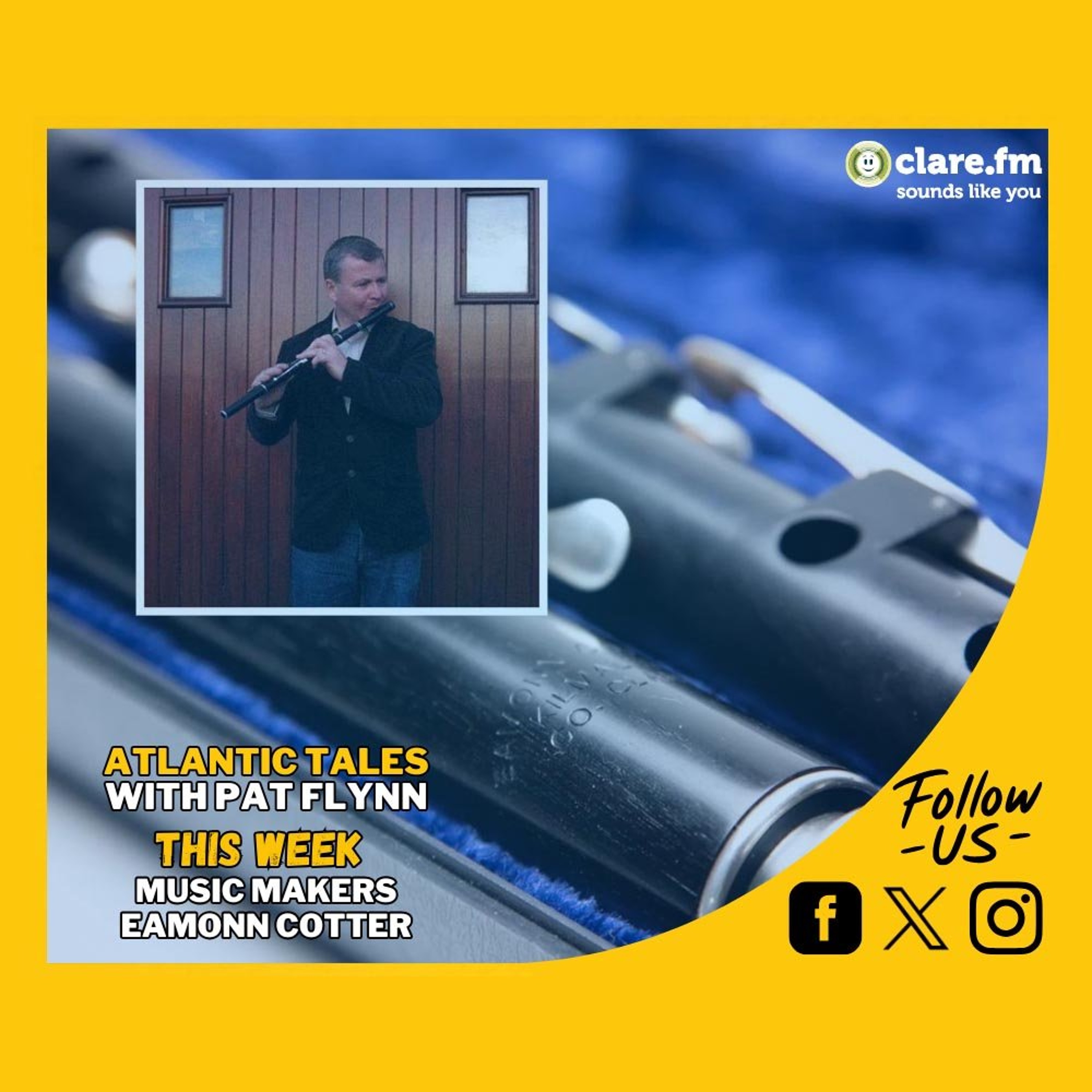
Clare FM — Atlantic Tales - Music Makers - Eamonn Cotter - Episode 1. Machine-transcribed; use the interactive transcript above to jump the player to any line.
This feature, the Music Makers, has been funded by Komachunimon with the Television License Fee. Good evening and welcome to Music Makers on TerraFm. Over the next few weeks we'll meet some musicians who are also musical instrument makers. County Claire is known globally for its traditional music. It's recognized too for producing some of the world's best known Irish traditional musicians.
Furthermore, the Banner County is home to some accomplished musical instrument makers. Over the next few weeks we'll meet some of County Claire's Music Makers. Our musical journey begins this week in Kiln-Maley County Claire. Originally from the Claire Road in Ennis, Aiman Carter was one of a family of seven. His mother was a music teacher so there was always someone playing an instrument in the house. He's younger brother Kiron, a talented rugby and football player passed away in 2005 at the age of 40. He was also a gifted concertina player. Not only was Aiman raised in a house full of music himself, his own daughters, Gronja, Saive and Quiver Carter are all talented fiddle players. Music was in the house because my mother had school music so she taught piano from the
50s so I was born into a house with two pianos and I just grew up with it. You couldn't invite it as soon as you walk up in the morning there was pianos, there was someone practicing scales. There was a procession of young people coming and going in and out of the house and a lot of the time they were or babysitters you know. So it was, it was, ideally we all played a piano like a, and I played a piano at one stage but I viewed away from that in my teenage years so I'd gone and taken an interest in like a lot of people in that time. I was then going back to the late 60s, early 70s like we were, we got an opportunity to learn Irish music in the over in the tech you know so it was classes they were held by started originally by Jack Mulcare, Brande McBah and Tarte they were at Tom Barrett's. So it was the Keurren handrains to Parraud which is all the same like the musicians we all kind of went together, we were all around the same age group and we walked over to the tech I don't know what night it was in the middle of winter, practice and learn and all. Few tunes and that kind of started us all off you know. So it was kind of unique.
It was the first of those music classes in the country you know it was operated by tech you know. That was how we started. No my mother was teaching me the piano and I suppose I took more of an interest in piano is that something you bring around in your back. So like if you wanted to go and play sessions and play tunes and go to fliers or that you needed something. And I started an issue with the whistle in. When I went to Flannins College for the Hogan they wanted me in the band. My stuff and still lines got the first two flutes that the school managed to acquire two instruments. They got a geontist to acquire two instruments, two flutes, some of the different sorts of mortar for those for whom and eventually managed to buy proper flutes you know. But it was the whistle you started with the whistle. I started with the whistle. What was did in school we did the towers? That was the instrument for everyone really you know. But moving from the whistle to the flute then in school was that a big transition? Was it being a high-sighted in doses and was a big transition because there was no flute teachers and such.
People didn't get one-to-one situation like you got an instrument if you were lucky to get an instrument and you walked away yourself and it wasn't until I went on and studied classical flute subsequently that I learned actually how to play the instrument as opposed to playing music. Playing music is one thing but actually the physicality of playing an instrument is different and the classical people had that almost had that structure, that educational approach. Irish music in those days was you just had an instrument and work away. So young people know of where it's opportunities to learn how to play properly you know, past your own. I mean when I teach the Willie Clancy or Scholekshire or at the Mehl you ask anyone of the kids they all have private tuition everyone has a flute teacher or a fiddle teacher or you know maybe more than one you know. Learning more than just how to play. Yeah I just see playing to play music is different from learning to play the instrument. The instrument is like it's the physicality of it. It's like if you want to use whaling as an equation it's all to whaling properly and
all to hit the bar properly, all to rise it you know. That's because the end game is putting it over the bar and that's supposed to be music. It's playing the end game is playing the music but you have to learn basics and that wasn't there when I was young. When I went to the school of music in Limrich back I suppose I was 18 years old and there was a teacher there John Parrot and he was like a chiropractor he was spending months straight in Mehl because he had developed a lot of bad habits but I went out and I studied the diploma and taught classical flute for a few years you know. So classical and traditional music? But not just that you had an interesting other. Well I had of course you never use it because music. It's like a wrong ball and soccer like in our football it's the same. If you're interested in sports and sports it's same as music. Because my mother was a pianist she was teaching classical probably my only classical music so we would have had a good collection of classical records in the house and we had a few traditional music records because they weren't available and all say there wasn't that
many traditional music records. And all change and I suppose in the mid to late 60s this with this Celtic folk revival traditional music became more popular like I suppose you had there. I think probably after 1966 Michel Orre then you heard the Chieftains and the Planckstee and the body band and they done it and it was a glory period for the Chaskeh in the course of the band I involved with. This early 70s was just a fantastic period for music and for bands and for people traveling here and there and playing and gigs and festivals and listening to them. The good old days. The development you know. When your self-insurances are in line with the two flutes had you a choice of instruments or were these instruments? No father Hogan was he needed two flutes in the band the band was no I would have always been interested in the flute anyway you know. My mother was very like she was like all Irish mothers like she knew how to walk around me you know because I was I was I was I wasn't I was a bit lazy like like more so I wanted to do other things than display music so to keep me at it then she I used to be a
Joel father Hogan remember it at a festival in Scarif father Hogan come this is just before I went to flan as a father Hogan coming over to me like in shape of my hands. We need you on the band no bad we need flute players in the band you know. I'm sure my mother put him up to it you know like I'm I straightened up you know I think if he's stuck we stuck he's stuck for flute player I'm going to be the man you know. What was there a good flute teacher at the time or? Well there was no flute teacher you know. No no no no. People didn't go like in some respects if it was nearly sign a weakness to be actually to actually anyone who was getting they had the had the luxury of some kind of one-to-one relationship with an older musician you know kept it to themselves you know there wasn't you know people didn't advertise the fact that people didn't advertise their teacher in first of all you know so you'd be afraid to approach someone to ask him to musicians themselves hadn't any teachers you know so they didn't have the confidence to teach to pass it on you know they didn't have the. So sitting in the session learning how to do that.
That's what you did yeah you had to you didn't need to show off your entire you know you had to just walk and see the end and sometimes you might get I think the trick in when you're young indoors is anyway as long as you don't know how when you keep your head down and just play away and you know try not to force force things force the issue you know just pick up your future ones and just you know when you're a young person side amongst adult musicians and you just want to I want to say it's seen and not heard but just you just want to just keep keep keeping the background all the time you're taking it you're taking it that's the way you that's the way that's the way that's the way the music was handed down over the years you know nowadays it's just as I say everything you know is formalized ever so there's good and bad sides to that you know mostly good like but I suppose what you get is a comfarmacy you know you know styles of kind of morphed into you know one very good teacher now can can teach a lot of musicians but the other side of that is they can they can also adapt their mannerisms and their musical advice you know so it's the trick
as an artist is to develop your own voice you know what music do I mean as a subject without an option in flannel and you're a no no no presence we didn't have music as such in flannel and say there wasn't music it wasn't part of the curriculum but we had a curly band like I mean we had like so it was Garo the Harron or the Hilton and then we had Carri Shannon my power rosh Vini make my hand we saw many people who went on to have careers in music they didn't just were in the band you know so it was you know flannel they treated the music as well as they treated the harling you know obviously it's the hearty and and the harling is is a very important part of the flannel's identity but the music in those days was too you know so going over to the tech and doing the classes there playing with abandoned flannins a lot of music in your life had anything else in your mind in terms of a career all kinds of dollars there's no you never cut and we know concept of a career I mean you know you just don't play music for music sake like it was never there was never an idea that
like even the older musicians like the the household names we think of Bobby Casey and uh Joe Ryan are these people like Willy Clancy they didn't have careers in music and they had no no interest in having a career in music and it was there was no career path the idea that you would actually make make any kind of money from music was was maybe in England you know in America there was but I didn't that I mean most of what we did in those years was what I referred to as God's Bayou de Hilt was kind of voluntary you know we did a lot of concerts when I was young for court as I cut you know fundraising concerts you know fundraising concerts for question how and things like that you know and for different charities like that was part of it you never wasn't our attention to take off music is uh is it in any kind of a full-time basis you know what you knew when you finished school you'd have to earn a few barb go out and work when I finished in flannins I went straight into syntax I did five years in syntax to which we just agree with a great fact to like five years a year for it was enough to I didn't know if after that
and I kind of finished adult and my own after that you know and over when it was in syntax it allowed me to do was you know I was able to 20 years of age I was able to buy a site out here in Camille where I moved moved out moved out of town and with a spot to site and got married in 1985 to my good wife Mary Kisparcic from Tulasa you know we're still married you know so we're we're here over 40 years so did the shift work affect your music fan I did yeah and that was what's pulling me because I couldn't do any an irregular basis out of it if I was studying the classical fluid and I was I was starting to get a bit of a profile and I was playing with a totally kelly band I did a few TV programs at the time and and I felt well if I'm going to go for it whatever whatever you've gone for these I said it's not going to it's not going to work if I keep on the comfortable and safe pensionable job you know around 1982 where did you actually I kind of rejected it you know working in 10th text great job great experience but it held you back in terms of your music you left that eventually I went on my father had an engineering business in Venice they are just at what
we was called Brown's yard with their behind PJ Kelly's dog in in Camille Street my father was there for many many years I squinned there as a child you know there was a couple of different workshops was a blacksmith in their times your coffee was in there whenever is young so you'd have it was a great place to hang out whenever is young so I was attracted to that nice and small and welding and fabrication that's what I was you know I never had a formal training as a as a welder but I I was welding as such a young age like so I just I loved that idea of making things I always worked with my father even when I was in syntax but I I kind of went with him full time so we would that we would build anything trailer of I'll tanks would be thinking there's steel I'll tanks and anything really you know so when you have a business like that you someone walks in they want something made you just you made it that was to you know you didn't see any obstacles you know and that prepared you I prepared for maybe for floats I go ironically like because it's to it's a different bar game but absolutely what is the kind of it's the kind of blind optimism
you need to do something like that like I remember sent to my father we'd say I had the machines one or two of the machines that I'd need to make floats so I just got this eureka moment and one day and I think I got make a float we will he said you know that was just for him it was just another job so he because my father was a very good engineer he trained with the air coreback in Lafarties so he had a great experience he engineering experience so he saw no obstacle you know in you know just making a float just just just another job you know working with your dad you had more time for music so I had more time for music and the first band I played with I suppose any kind of a say a professional basis was with the toller you know so we traveled I did I still now do a few gigs with the tolicially band I did it two tours of England and a tour of America with the toller so I suppose in after that then I played a different small groups with you know eventually then I got I got an invitation from Tom Kostin and Christmas 89 as the 88 89 would I play with the Shaskin over Christmas period it was torturing gigs over
the Christmas just just because the show obviously things were indoors but so I sat in with the band for that period so I'm still with with them you know how did you get called up to the toller in the process well I suppose people I suppose I would have known about it here obviously because we grew up together and P Joe and I would have been playing with I you know you'd be known like so there weren't that many float players you see there was only handful of us around you know the like there's 20 of every instrument you know there's a hundred of every instrument now you know but indoors there's only handful of float players and player a handful of concertina players you know handful of feet of players of all generation you know so that has all changed you know so I was looking off to be asked to play with the toller and I'd great experience and great times you know but I was I suppose playing bands Kali whether I hit a stamina for it I had the again you see the technique that I acquired with my studies in classical flute you know the physicality and developing diaphragmatic breathing all that tone that all helped me to be able to sit up on the stage
it's not even the doors there's not a lot of players had the ability to play three-horse constant you know so I had that ability I had the music then the traditional music repertoire is expensive you're learning as you're going along would there be a certain number of tunes you had to learn had to know yeah well I suppose the requirement and clarity generally reels you know with jigs a not selection of hard pipes and probably an all-pog you know that was it in clarity was just jigs and reels I've I have a good I have a good year for two and that's one of the few gifts I have you come naturally to me you know but my ability to to record tunes or to learn tunes you know they just stick for some reason you know and that's what's required really to be able to to pick up tunes fast and under who for you sometimes you you can be on stage you know with an event and you might know a particular tune but you have to kind of blow off your way by second or talk time around you'll have it you know you'll have it you know so confidence wouldn't have been an issue either so if you're recalled up to the shashky or a 13 giga time no no no no you're not you know stage rock is a different thing again you know the confidence
to the ability to play is that is is is kind of a given but your ability to perform certainly solos on your own and stages and other that's always a challenge there's always been a challenge for me you know that's something from some people it comes they glory in it for me it's something you know it's part of being a musician you have to you have to go out and tell go and you know you have to you have to get over yourself you know you mentioned your late brother you put the concertina player jirled in your sister played piano did all the other siblings you got the all playing up and that's the same extent you know they all have the wrong careers I suppose juggling be my all the sister like I'm next in line so I suppose I don't know what it is I suppose we were maybe my mother probably had had the energy to keep us at it you know people make choices you know just I suppose just as I've been juggling had this kind of we have this understanding musically like it you know because we've been planned together all our lives and and she's the first person I'd go out to when for piano compliment you know so it's
because she is she is one of the best you know but she knows the tunes which is just because something is in G major A minor or E minor the tunes don't there would end at you know they can they can move around to modulate here and there you know but she you have to know the tune and play the cards accordingly you know and she does you've always worked very well together performed a lot together we have performed a lot together if that is special brother sister band there you know we have this kind of understanding it's telepathic you know it has to be you know because I can just look obviously playing the flute you don't have the verbal communication you see you communicate with your eyes are your face are you know are you brothers but but she she's some some reason she's able to read you know exactly for playing something not necessarily we're obviously when we're recording we have all our ducks in a row we we know when we're changing that we're sometimes a fine playing a selection say at a concert and I decide I got to play this first
you're gonna play it again you know we have a signal to tell her you know well you know she's waiting for a change and I just look around there'll be some movement and she knows we're not not changing does it all work it does yeah it does but no she wouldn't be happy if if if I didn't change I was supposed to change because to leave our exposed you know coming up we'll hear more from flute player and flute maker Aiman Carter about his love of the instrument and the process of producing one welcome back to music makers on clarifn Aiman Carter is originally from anis and was born into music he learned both classical and
traditional flutes and his musical interest is wide ranging he entered full time employment when he left school and later went to work with his father who was a gifted engineer and this gave him more time for his music it was no surprise then that Aiman would try his hand at making a flute himself something he had long wanted to do I suppose the instrument evolved in the mid 19th century when boym re-engineered the flute and just changed changes forever you know so the flute set came into came into play in Irish music or instruments were rejected from the from the arches as of Europe like in the mid to late 19th century so that's why they became available because people just took to the new classical boym system flute they were made from obviously a lot necessarily all for metal but majority of the of the bombs system flutes are metal there are wooden versions that are still been made much of a difference between them in terms of playing them the difference is I suppose like with with the old flutes that I make the 19th
century flutes that like say the bass done say a rodel and rose that type there were the old are pratin there were both in half there were the old names with the old flutes you were actually covering the holes yourself and you so you had contact with the with the air flow with the bomb system it was like your pressing keys like a keys on a saxophone or keys on a caronate you know so the I suppose what boym did he reversed it with the old conical flutes that I make again the 19th century flutes you blew into the the widest part of the flute and you know so where as boym reckoned you know you should be blowing into the narrows part of the flute so you kind of turned it upside down and so it's basically cylindrical flutes you know with keys at what point did you decide that you wanted to make a flute that you were able to make a flute you had that little bit of experience engineering with your dad so you were going with the hands yeah I will say yeah I didn't I'd not fear machines and let's just inventing you know I'm not fear of I didn't fear failure like when and failure is part of the game I suppose I started off just with pieces of
wood basic pieces of wood and and repairing a couple of instance I had myself to just basic repair work and and of course without the help of of all the Eugene Lamb brandy MacMahon Jeff Wolf like all the music instrument makers you know pipe makers there were all but I could ring any way and I could you know so there was no YouTube so I had to figure out myself with the help of all these instrument makers there were all more than helpful you know also there was I lived lost a Shen in airport in you know in in in Can Mary here so there's always engineers you'd meet them out and socially like guys working and more Huck was a great factory that time there was you get knowledge people give you information you know pet castles obviously pet mollons don't need Shen and they were great they were a part of this it's it's it's small community you know music engineering like it's all you know and and and what just happened to us people the world was out that I was making fluids and people would approach me and say well I have if you're stuck or I can help you or if you need any this data the other you know so it was it was great you
know making your first one that was for yourself it would have been I mean I spent a lot of time researching and I remember I had a book here of filibates with my filibates and I studied it inside out it was it was very technical but there was a lot of measurements and I measured a lot of all instruments and and that was eventually I had to decide on a particular flute and I had to decide to make a flute that suited my playing and I don't have exceptionally big fingers so flute to suit myself so that was the way forward so the instrument I make I haven't changed more to over the years you know do you remember when you finished the first instrument great center pride presumably but fear fear because I remember a story I was on which we were in one Christmas when I knew Hensy was with Claire Femme and Tom Kossum must have said something to I knew that I was making flute and and of course I knew and the middle of the program they can embarrass me as they take out the flute and play a tune for us you know so I didn't manage to play a tune on the flute like but but a law commenced it to me afterwards he said you were working hard which was the best piece of advice I ever got if I have to work out to play
my instrument the instrument has to work for forever you know did you change much then after that for us instrument which was kind of the beginning it wasn't I twice I know I had to learn at that stage even you know so some of my early flute so I'd be I've had I've had flute spec after 25 or more years 30 years and and and and I was surprised I'll go to the world because they're like children you send into the world you worry about them you know that well you know initially with someone comes to get I always like to meet the clients you know and most of my clients are in their teens I'd have had us but mostly mostly teens you know 10 12 13 14 years of age and you lost right away like if there's an issue like you know so I'm like again I'd I'd play a tune anyone who comes to get a collective flute I'd play a tune with them and we'd play along and I'll just keep and I I'll give them if with their parents consent I'll give them some advice you know maybe gentle advice because they want to interfere with their the teachers advice you know they're on teachers like well it's kind of maybe a bit gentle persuasion just straight and open I'll be like a chiropractor again
you know but when you have someone at that age coming to you for a custom made flute what's going through their head I'm just wondering because they could go to a shop and pick something up the shelf but they want something special very rarely you get a good instrument after shelf unless maybe you're lucky to get an old 19th century flute and antique that might you know even at that most of the enough that it does old antique flutes weren't very good anyway you know sometimes people had the impression like the first flute I got for example it was a hawk flute I have it there actually somewhere I can find it yeah that was that was a hundred pounds in 1975 which is a lot of money now it was it was a good flute for its time still sounding well it's it's yeah we'll see you know it could be anything inside then no I could be a discordant some spider no you know yeah that hasn't been played for a long long time but I recorded with that you know back in back in the day but it was it was a hawk's flute probably made in the 18th or 18th or 18th or 18th
or 18th or 18th or 18th or 18th or so it was already 150 years old when I got it oh do you have to mind that then it's a way of minding your instruments well the rest way to mind an instrument is to play it you know because to see that what happens with with flute especially is they can try out and you know especially with a there's another issue now which is a kind of a 24 century problem for for instruments is the new houses like they're air tight air to water houses on the floor heating like you know you can't just leave your fiddle or your your flute down the floor like on your you know which most of us would do would have done years ago like you would you'd leave things in the floor because it's like you might as well leave it on the radio which is you know so that's an issue that's going to be an issue with instruments in the future you know down the years when I'm making flutes like if I send the flute I've sent flute to Arizona and Texas and California like Mexico you know and across to Europe so you have to climateize an instrument there there are lots of issues with instruments like what does very dry climate so we never really get dry dry as much as the weather has been dry for
the last while it's not a it's not the same as central Europe or our instrument you might make for a client in Europe in Ireland or the UK they have to have different to watch my send a lot of stage not necessarily different but what you'll kind of give an extra I suppose I have like an oven as I put it into sometimes just to give it to make to bring it up to certain to make sure anything is going to happen happens before it goes you know if it gets extreme heat or extreme dryness like sometimes what will happen is maybe rings and comb loops or do you have to just kind of you have to be extra careful like if you've an issue with it just in the flute to slide off and as an issue with it it's just a day in the past you know there's no you know you can deal with it straight away not so easily even it's in America or in Europe or even in England knows a bit more of a challenge you know but because you make flutes and you know that flute in Arizona might have issues you can tell the client that or they'll be there not only dance anyway you know they know how to I remember a teacher in music in the Catskills upstate New York years ago and all the students came
with the flutes in the top top of where boxes you know like this is July so what did have is kind of damn sponges and so just to keep a moisture level up so I generally like with my flute take kind of I have wrapped up in flats and their kind of flats are kind of semi damp you know but I suppose I suppose I can be careless with my own instruments because I have I play a lot and I'm not as delicate maybe with my own instruments as I showed you know they're quite robust anyway instruments you know again as I said the best way to mind an instrument is to play it you know we take it out and keep it in mind and I let it out every and all again and I let's what I generally recommend
the process for making a flute the raw materials someone rings you're looking for a flute where do you start the wood I use is African black wood anyway it comes in from Tanzania which is an East Africa I find it's a more stable stable wood I've tried I've I have had boxwood I'll actually have some boxwood but I tend to just stick with the to court Henry Fordy kind of any quarry or want as long as it's black it's a kind of policy of trying not to complicate I make one style of flute no I'm different keys I make C D E flat if I try not to complicate things by by having different styles of kinds of flute you know what happens is I'll get emails or requests from people saying well I let's say well I've tried one of your flutes five years ago one you made
five or ten years ago it's a lovely flute they still making those flutes and I still I know that I haven't changed my dimensions you know there are so many different options I operate in one manner operation here like so you don't want too many complications now the wood I use is African black wood Green and Delas are from refer to the only issue with that that wood now has become is very restricted by sighties it's a world governing body to do with woods and everything but technically you know and it's like a plan another wood you could use if that's why I let it be my Asian I've enough to see I've I've I've enough to see me old you know probably enough to see me open but I can still acquire there's a company in Spain that that I deal with and then and the other side then you have silver so I get castings made from a company in England so that my rings the keys are let us to tubing you know I use on the flute I get from a very good company and in Charlie high-tech tubes they've been there for you many years they've been very good to me you know you know I think they make tool for pipers and that tool you know I've loose a
take a can to be made by hand there has to be some machinery involved well I suppose if I'm not in I'm not that the high-tech type you know I'm not into CNC machinery you know computerized machinery so it's generally what I have is like I have called just a machine over harrowstone machine miford blades like these are all old machines it came out of probably technical schools you know so they're not you know small factories like they're they're not the modern machinery is they're not most most engineering know-histon is it's computerized you know so I have never got down that road it's just as I'm the wrong age for it you know and I do not hope successors of it would be you know a lot of it is tactile you know because I mean it's it's you know I'm not of I mean I have a lot of what you call fixtures you know I've ways of reproducing without having to I do very little hand-turning I mean that's I'm not one of those guys I could turn a ball I probably I if I tried to turn a ball to probably go go through the window you know you know it's that I decided early on like the wood just hand-turning was not the way to go you
know so I just I took an engineering approach you know again I had to develop my own way of making the flutes you know and I found it just the engineering approach was the best you know then you got consistency you got continuity you know because it's important that you know each part of each instrument can be swapped around you know so if someone says that all I've an issue with a particular part of the flute and they're up in England I just paused out whatever whatever's required you know so that's where you that's what engineering gives you as a post hand-turning you know coming up we'll hear more from accomplished flute player and flute maker Aiman Kotter and meet a musician who was introduced to Aiman's music at a young age and now plays one of his instruments you
I've used Schillac like French polish on the outside it's just a while ago French polish sanded off in polish it gives it a glass it's it seems the wood it seems to extend everything I see with French polish you know I make it up myself you know welcome back to music makers on Claire F M Aiman Kotter is a well-known and respected flute player and flute maker originally from Eddys County Claire he began playing the flute in school with the St. Flannins College Caley band and later the acclaimed Tola Caley band he has been a member of Shaskin since 1989 he has appeared on countless TV and radio programs and documentaries and recorded several albums including his solo CDs traditional music from County Claire and the Notted Court only this year the Coruffin traditional festival recognized Aiman with a lifetime achievement award
Aiman still plays regularly but a lot of his time is taken up with making flutes which can now be found all over the world the wood that Aiman prefers is sourced in Tanzania and arrived to him in the form of billets there isn't a single process for making a flute it takes time and involves several stages I leave them up for months I have wadier for years so I drill it all so there's a few you know it's different processes you can't just you can't just start to get a piece of raw wood and make a flute because to follow parts so I might spend a couple of days really old wood I spend a couple of days turning downwards you know there's different you know the longer you can leave it the better you know wood no matter how dry it is it has a tendency to move and if to lower the stresses to you know initially I didn't have that time you know because it took a while to build up a stock so I could afford to leave wood for months and months and you know so that takes time that's the most you know the most challenging part of it you know so what
way I think time is quite long but what I mean by that is like it's a work on pieces I date I mean I'll re-date them again as whatever I do so like that main piece of wood there and all this that would have been they came as a log you know it's what's about 300 and 30 me long you know roughly 30 inches by an inch and a half square so I would have drilled that out six months ago I probably already had it for a few years drilled it out and partially re-mute then and then re-mute again you know so you I've polished that piece of wood three or four different times because you have to lower the stresses and then you have that's what it's worked in you know so you don't have issues with cracks or so timber is still living in a way or something like that is an organic you know that's like to keep telling that to people like it's a it's a it's a stays organic it doesn't it can always move but it's generally doesn't move once that's that wood is very stable once you've again as I said to more often you approach it and put it away and take it up more away that's that's that's the luxury I haven't enough of it there you know
what I have here knows the middle section of a keelest flute people be familiar with that the six holes so what I have done here know I've I've it bored out and milled on the inside I've the holes on it I've just retard down the external dimensions for that and I have to do the barrels with the carcillins if you want to call them that I've just turned around here now with this I just do I'm just walking there this is turning the external it's kind of you start off at 24 mil and the one end and you have to use to kind of guide it up this is where I used the the feed under lead and I just operate the I've seen that afterwards now so it's kind of roughing off at the moment and bringing the dimensions up gradually a lot of this textile is so when you take it off the machine you know I'll show you what I mean I do I just don't imagine here but using the dial here at the top just bringing it out gradually so I could do that by hand but because I find this more efficient and I bring it up to about 29 just over 29 mil and at the end
so that's it that's the the next station is to turn down the the barrels at the end which are the carcillins what I mean by the tactile aspect of it is he it's like horror speaking of horror is it's you'll know the feel of it you'll know if it feels right or you know sometimes I remember I had cast a while I was saying you should close your eyes when you're whether you're feeling the horror or feeling an instrument you know it's a question of balance you'll feel things are on right there's no machine can read that I might you have to position the holes to suit the hand side of that effect of sound you can move the holes in the one which I have done but but but only especially for you know I for people who have issues you know I'm a one-time having to offset a hole because I'm in an accident with a finger but I've had to do that in occasions are offsetting against holes but I generally try to avoid it if I can if someone if someone you know has an issue with not being able to cover the holes properly it's generally
to do with the posture you know and it's much easier to change someone like just say well if you will do this you can start with that problem but that's the middle section and essentially the fluid then is of the head the your head giant as your head giant and your and your foot giant and that's that's your key that you've standard key the sleuth you know key fluten is this is your key lot more work you're left more work here and there's a left hand it's a they're kind of block monitors you know this is an E flat fluid which is a high slightly higher pitch does your keys now you see your G your yeah that's natural well it is again to the knee flat but if you imagine that your left natural B flat G sharp and your high D sharp
yeah that's your that's your keys again this is that's as I said that's a knee that's semi-tron above no sir yeah this is the this is the concert here no this is would you play more than one instrument would you bring a number of instruments with your digging our touring I do actually was in fecal and sunday I just happened we just went for myself my wife me already went for a spin to fecal you know we're just with just to just to hang out for an hour you know and for my body you know but and I was asked to sit in and play a tune you know so and it was an E flat which is slightly this semi-tron above concert pitch it's not everyone would have an E flat instrument you know but but um fiddle players can tune up or band you play as contuno but for a concertina cardina like the flute players you know it can be the kind of they're out of luck you know but the flat I'd carry a D an E flat a C and an F flute and F flute more for just two and so on and that are if it's something that's in B flat you know if is is is a perfect key for it you know if you prepare it for all the venture relatives they
have mildly bag like they don't have cases for each I just have to switch into one bag you know when you're hoppin or I'm back to find so wherever like and and you don't you don't want Mr. Aliari what's happening under short and I suppose it's an issue for all musicians I suppose traveling and and and flute players are lucky you know they don't have I mean I could have three or four flutes in it and a carry on bag you know no one else a difference but they or fiddle pairs have to buy seats in them. Rhinoloclin is from Kora Finn County Claire and started playing music when he was seven years old he began on the tin whistle with Gary Shannon as a teacher and about six months later moved on to the flute. Rhin started off on a keyless flute made by Brendan MacMahan he now plays a
cutter flute but long before Brian ever met Aiman Cotter he was introduced to his music when he got a present of his first album. My aunt Fenola he actually got me a recording of Aiman Cotter's first album by the traditional music from Kona Tlaire and that was my first introduction our first time here in Aiman Cotter and I wore the CDO to the last I think that was probably around 19 or 2000 maybe and when I got that learning with Gary Shannon learning to whistle originally but moving on to the flute that was probably going to be a natural progression given who Gary Shannon is. Yeah I suppose that's why although my mother always said that I always wanted to play the flute that I wanted to play and that was probably it was probably got to do with that and said John Gary was playing the flute and it was an easy transition right from the tin whistle lot to the onto the flute. Well there are any other instruments that interested you growing up. I suppose look I I for a plane I suppose not really was always the flute that I want to play on my dues. During a transition year in second school I did take up the recording for a while just like
the texture spare time my mother plays recording so it was one of the house and I actually went to cut a knee there in Kifinora for a few lessons during that year so I kind of did that new for a year or two after but then between every time then I just kind of stuck with the flute after that. Well there are much music in an assignment and what's their music in primary school. We actually didn't have any music in primary school no we know just the the school choir now for maybe confirmations and and communions and our last but no we didn't play any music actually in school. Second school in assignment then we had kind of a school band right we was caught to the in its time in community hospital cop times a year and play for the for the residents up there and for the patients up there but as far as learning music in school there wasn't any of that knowing Carfin or any assignment so it was all doing outside of school for music classes so as I said I started to carry in Carfin and in Chacuole on the remisor and then on to did flute lessons in with him and his house in Ruan also did a group classes in with Park Raleigh he was teaching and the West County Hotel at that time on every second Saturday I think was so so yeah as
guards music classes that's that's where I'd have gone and went to Brothers would have gone there as well. What about sessions when would you have started playing sessions? What I remember my first session actually was we was played up in Kilfinora and I was probably about 11 or 12 I think when we started doing it during the summers myself and my brother Keats on the banjo and Emer Hauli from Kilfinora she was in the fiddle and Paul Redden in order to go from Kilfinora as well he was in the piano so the four of us were all around the same age probably 10-11-12-13 I think just about a year before he was all I think so we used to play on a Tuesday and a Friday night in Vans in Kilfinora and that was my first introduction to playing out in pubs of course the four of us were going to Park already at the same time we were in bands and groups at him and Gary as well we were going to Gary Shan for the barren groups he was kind of the younger the say 112-115s and then we used to do the bands with Park for under 15 and under 18 so I don't think confidence was an issue for us no obvious just love playing together and we got all the crackdowns that part of the flute
then Brian while they branded MacMahon flute so it was actually Gary Shan that sourced that flute for me it was the second hand flute and Brendan was making flutes I think still at the time here in Innis but Gary would have sourced that one for me and he was going to recommend it or there would have been a great flute so I was the key this flute I played that for probably about a year and half for two years until it was so supposed to be with the flute you kind of start half most people start half with a keyless flute and then progress on to one with keys yeah I had to bring back my hand in for probably a year and a half for two years it was time then to top cred onto Keydland so I suppose him and Carter being so local and such jobs such she'd have such an aim for for making good flutes I played in order for one of his and it got around probably probably 2001 or 2002 I think I remember actually it was just after Christmas actually because I remember I got it before I'm back to school after the after Christmas hulles yeah she was great I'd say when she got a new one she was playing for hours and hours every day before I'm back to school and
big commitment as well but what do you remember a meeting aim at for the part time to discuss the flute that you wanted to buy and play so I actually I suppose I'd miss aim and first in Milton Mellewett when he can't see somewhere school he taught me flute teachers kind of maybe swap around so he's taken maybe a day or two days for a class and then move on to another class so I remember he taught me my first year back there when I went to the summer school I had him for two I think two days it was it was that was my first time meeting him and then as regards the flute I suppose I was just looking for a fully keyed flute and that was that was kind of really like when they are to then with him and obviously I tried a few I tried a few of them before I was able to do his workshop I loved them like John it's had to be great to him often and great back often so put in the order and that was it then yeah much of an input into what you wanted or were you trusting the process so no I would have just left him and gone at the flute for me had of trusted process and I wouldn't have any had any input in any sort of any specifications around and like that so still going well 25 years later still going well some five years later
and we'll ask forever about your mind it wants his mind just yeah that's the best thing about him yeah yeah yeah the one thing I love about that flute is just the tone and the volume that you can get out of it but then at the same time it can be even got nice sweet kind of mellow tone after as well so I suppose and then of course when it's John it's made by local maker and I suppose every musician with their instrument is John it's very personal thing and it's when you have the longer you have it the more you the more you nearly tend to like us when the bus am you put in the order it's made it does make it special I mean I love going out to him and the workshop is very it's just very special kind of place and seeing all the different flutes you made at different stages and do you get to play much music so yeah I am I get to play a lot of music show a lot of certain I mean come to clear here it's endless amount of sessions and gigs that you can do so yeah I do I get to play a lot now especially this time here in summer and Ramdenas and Dulan and Coruffin and so yeah it's it's it's gone well yeah
as long as musicians like Brian or Loughlin choose to play a cutter flute Aiman will still make them music continues to be a big part of Aiman's life and he's showing no signs of slowing down but nowadays sets his own pace I'm trying to I'm not old chess and work you know I'm happy to keep doing what I'm doing you know and that what as long as it doesn't get too too chaotic you know I enjoy as well with the gardening and the fishing and the rambling around the place you know so it's a it's a bit busy busy you know for you this year you know you know I did the mehelt this year was with Gary Shannon and I did I was obviously the Willie Clancy every year you know we did and you know kind of sure that you know it's just the chirrelling that I was the very successful show you know in the door yeah there's all something I also play in it I play with a jazz group like we have we're trying to we rehearse every now and again you know so we're I'm involved in in the Limrich Jazz group so we kind of practice when we play John the Winter and that's all kind of that's my so there's a good few of us in there
you know we've different combos and I like improvisation you know so that's it's a different thing altogether from playing traditional music I don't I tend to not to kind of do fusion you know I kind of kind of stay away from it but what we do know the group with Joe Callan and John Dele and Eddie O'Donovan like we have a nice little combo with the Albert work we have Joe Callan composed it is from temporary he composed a lot of a lot of music and great jazz musician he's been guiding me there all the years you know so I'm working with him at the moment
this feature the music makers has been funded by Kommesh Unimon with the television license fee
More episodes
More from Clare FM

Sunday Prayer - Sunday 13th September 2026
Clare FM
Sunday Prayer - Sunday 13th September 2026
Clare FM

Ennis MD To Explore Potential Sites For Dog Park In County Town
Clare FM

Clare FM Sideline View Friday September 11th
Clare FM