About this episode
Episode 198 is the second in the clutter series, and it's the heavy one. Leah covers both halves of emotional clutter: the weight you're already carrying, and the weight you refuse to pick up.
The first half is the emotions that run quietly in the background for years. Worry. Overwhelm. Frustration. Disappointment. Discouragement. None of them dangerous on their own. All of them expensive together, and most of us are treating them like personality traits instead of choices.
The second half is the one nobody talks about. You feel something, and before you've felt any of it, you're already doing something to make it stop. Buy. Scroll. Clean. Fix somebody else's problem. Reorganize the pantry at eleven at night. That's where the pile in your guest room actually came from. We over-consume because we under-feel.
And then the part that costs people their lives, not just their closets: most people don't fail at their dreams. They fail at feeling, in their efforts to get to them. The dream isn't too big. There's a feeling on the way there you haven't agreed to have yet.
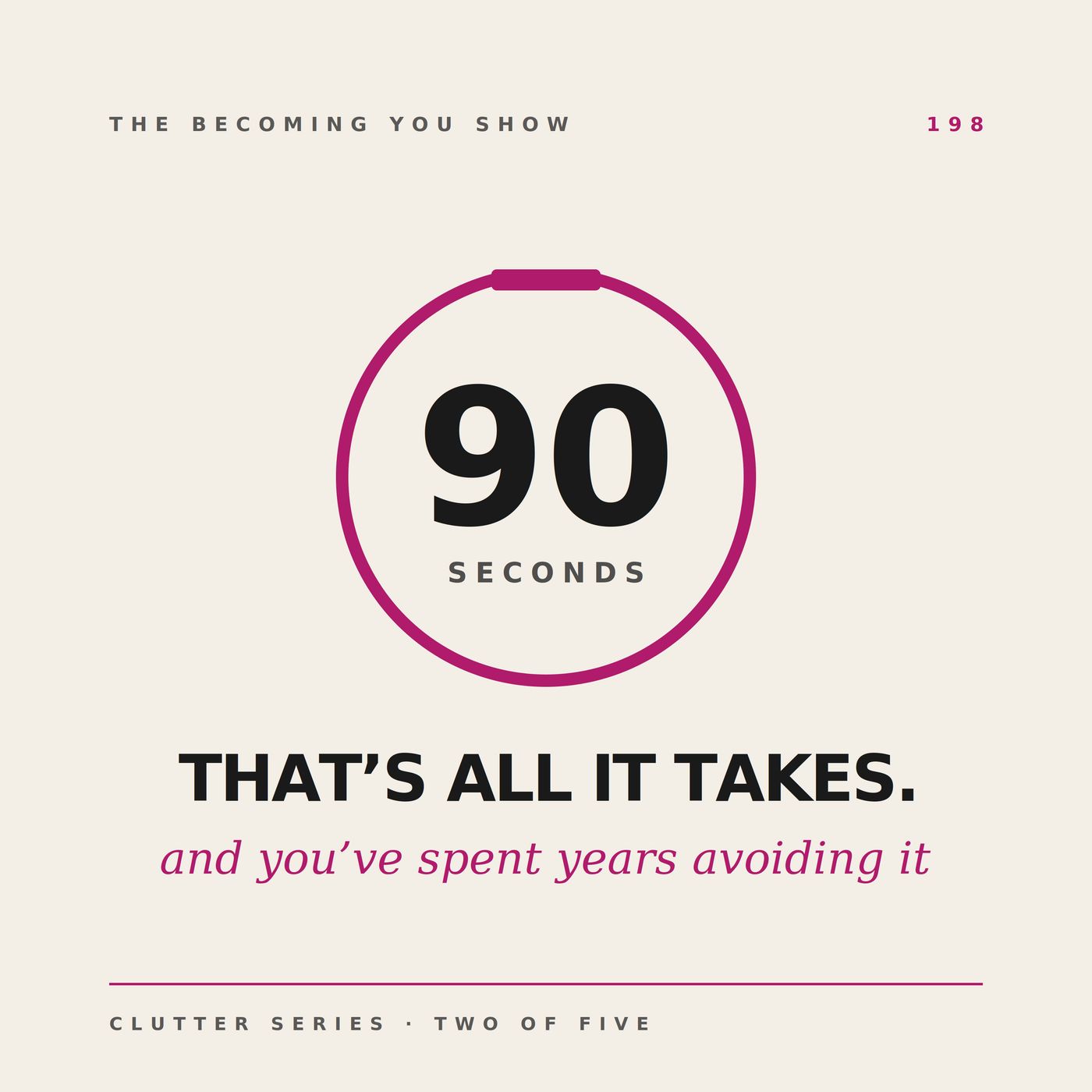
In this episode: why containment isn't processing. The ninety seconds a feeling actually takes. What buffering looks like when it stops being a reaction and becomes a routine. And the two questions worth sitting with this week.
Learn. Live. Lead.
You learned the frameworks. InnerLab is where you live them. Live monthly membership with masterclasses, coaching labs, reflection labs, tools, and a practice community doing the work alongside you. → https://innerboardsuite.com/innerlab-5011
Not ready for the room? InnerBoard Academy is the self-paced library of courses behind every framework we practice inside InnerLab. → https://innerboardsuite.com/academy
Get every episode summarized
Each time The Transformation Network™ publishes, we email you a written briefing from the transcript — the topics, who appeared, and any specific claims, with the ad reads skipped.
Email me new episodesFree for 3 shows. No card needed.
Transcript ready
263 searchable segments. Every word is indexed and playable.
Full transcript
The Transformation Network™ — 198. 90 seconds. That's all it takes. Machine-transcribed; use the interactive transcript above to jump the player to any line.
Welcome to the Becoming You Show, where limits get torched and possibility takes the mic. I'm Leah Rowley, human in permanent beta, neurosrategist, mom to three amazing humans, married to one legendary soul, and your no-fluff permissions lead to stop waiting. Every week we rewire rain patterns, smash, hand me down mindsets, and dive into the daring, identity-shifting conversations most people dodge. Ready to turn potential into proof? Grab your pen. Your next chapter starts now. Hello my beautiful friend. Welcome to the Becoming You Show. I am your host, Leah Rowley, and I am so excited that you're listening to this conversation. Today we are doing a series on clutter, and this is the conversation around emotional clutter. And last week I had told you,
I had shared with you that there were two spaces, right? Two spaces in the chain, right, where you actually get to say, where you actually get to interrupt and clear out the clutter on purpose, right? The first one is between what happens and what you decide it means, and that was last week. And so when we get to, when we can interrupt that intentionally, we get to really unclutter our mind. Today, the second one is between what you feel, right, by way of your thinking mind, and what you immediately do in order to stop feeling or to feel. And so that's today. And it's probably a, I don't want to say heavy, but it's probably the one that is most misunderstood. We understand
mind management. We understand mindset. We understand thoughts. We understand that work. Where I think we're a little slower to understand is the emotional realm of what makes us human. And so this is what I wanted to bring forward for you today, because we can understand every single thing that I said last week and still not change, right? Because knowing what your brain is doing and being willing to feel what comes next are two completely different skills. One of them is understanding the other one is tolerance. And almost nobody teaches this one, this tolerance one, we're going to get into it. So I want to say what I think is most likely going on with each and every one of us, okay? We're not exhausted and tired because of our schedules. We're not. We are exhausted and tired because of what we're carrying emotionally and almost none of it is required.
We're not stuck because we don't know what to do. We're stuck, right? Because there's a feeling in the way. Yeah? And instead of feeling it, we've built an entire life out of small moves designed to not feel it. All of that is emotional clutter. All of it's emotional clutter. Remember, I told you last episode that I believe that the life that you want, the life that you really, really, really, really, really, really want is buried. It's buried underneath all of the things that you don't want. And those things that you don't want, I'm calling clutter. So we have unwanted thoughts. That was session one. That was series one. That was last week. This is unwanted feelings. And I want to break, I want to break this down for you. And I was trying to figure out how to do this in a way that created understanding and clarity and not confusion. So we're going to unpack
this today. This emotional clutter into two halves, right? The first half is what you're carrying. The emotional clutter that you are experiencing unnecessarily, indulgent emotions that create unnecessary pain. That's the first half. The second half is the emotion that is required, that we refuse to pick up. And so we avoid it and we distract ourselves, which creates all sorts of other clutter challenges. So that's what we're going to do. So let's talk about the weight that you're already carrying. I want you to start with what you're already holding, what you're already, shouldering. There is a category of emotion that most of us live inside and we never really name some of us name it, but we don't recognize that it's clutter.
Worry, clutter, overwhelm, clutter, frustration, disappointment, discouragement, clutter. I don't mean that they're fake. They're very real, right? You feel them in your body, your shoulders know them, your chest knows them, your stomach knows them. What I mean is these are the ones that we go back to. These are the ones that we let run all day in the background because they feel like we're, that they're doing something. Like think about worry. Worry feels very productive. Worry feels like preparation. Frustration feels like having standards, having a high level of integrity, discouragement just feels like I'm just being realistic here. None of these emotions are doing what they promise. Worry has never once, not one time prepared anybody. Frustration doesn't raise anyone's performance, including your own, and discouragement
has never produced, rarely produced, a single person from being disappointed later. Okay, and they go unchecked, right? Because any one of them on their own is not really a big deal. It's just a bad 20, 30 minutes. It's a mood. It's the accumulation just like with any other clutter, friends. It's 30 of them running at the same time every day for years, and that is heavy in a way that doesn't show up anywhere you can point to. Okay, you can't photograph it, you can't open up the closets and see, oh my gosh, how did all these clothes get in here? How did all this emotion get in here? Nobody can see it. There's no scale for it. You can't put it on the scale, but you feel it, you feel it at four in the afternoon, you feel it at two o'clock in the morning, you feel it in and how little time you have left for the people that you love by the time you finally get them because it's exhausting. It's exhausting. So let me walk through how each of them are showing up
in a way that is robbing you of the life that you want. Remember, the life that you want is buried underneath these types of clutter. Okay, so worry, worry, barring trouble from your future. That's what I say, but it's you running a scenario at midnight that hasn't even happened. It probably won't happen and would not go the way that you are rehearsing in your mind even if it did. And you'll defend it, and you will tell me that you're being responsible, right? And I will tell you, with love, and a wink, that responsible people make a plan and then they go to sleep. Okay, frustration, right? This is this is an interesting one, okay? Because it feels like it feels like caring. It feels like holding a standard of excellence, right? Again, it feels very responsible. It feels very self-righteous. But what it actually produces is not a standard of excellence. It produces
in impatience with other people. It produces behavior, right? That you do, that you would not consider of quality, right? It has you do things in frustration to absolve for everybody else's ineptness, and then you end up carrying something that somebody else could be learning to do. And then you carry more and then you become more frustrated and then that frustration turns into resentment, right? And then you just tell yourself this story that, you know, you know, it's not you then who and nobody else will get it right, and that's all just nonsense made up. It just is. All of that is just clutter. Disappointment, okay? It's kind of quiet. It's kind of quiet. It's kind of you measuring your life against a version that you made up, right? And the made up one is always better because you build it with zero conflict and no traffic and sunny days and and and and where
everybody behaves, right? According to your rulebook for them and and that's not life. That's not life. And so we find ourselves disappointed in life when life wasn't ever supposed to be that way. How do we know? Well, look at reality. Look at your life right now. I'm guessing it's filled with with with some awesome and some awful on purpose. Like what if that was on purpose? Like what if that was the way because in my life and my experiences and coaching hundreds of hundreds of clients, that is the way of it. That is the way of it. When we try to outrun it and think that it should be different, we end up disappointing ourselves unnecessarily, okay? And then there's discouragement. This is kind of the expensive one, right? This is this, this just doesn't just sit there, okay? Discouragement doesn't just sit there quietly. It it invites you to stop taking action, to stop asking,
to stop putting things in front of people, to to stop efforting, to stop taking massive action. Okay? And that produces the exact result that keeps it fed, the exact result that you keep confirming in the discouragement of it. Okay? So those are some of the bigger emotions that we tend to indulge in and call it, tell ourselves the story that they're productive. Okay? So before I go into the next second half of emotional clutter, I want to share with you kind of a story from my own perspective because I didn't, a lot of this work came from my own experience, right? I didn't know that people that there was a strategy to think. I didn't know that was a thing.
And now I'm like, I can't believe that people don't have one. I didn't realize that emotions were to be felt. I didn't know that. We only know what we are like taught and conditioned. Okay? I did not have a weight problem. A scale, a whole life. A scale would have told you that I was fine. Right? I step on it. Everything's normal within probably five or ten pounds. Nothing really to see here. But friends, I was emotionally obese. No joke. I was carrying an enormous amount of weight and not one person could see it, including myself. And here's what I didn't understand at the time. I thought that heaviness was my life. I thought that's just what it felt like to be a person with responsibilities and people who needed things from from me. I thought everybody felt like this.
I felt like, oh, that's just pressure. I know idea how much of it was coming from one thing, one thing. And that was my unwillingness, my unknowingness, to let myself feel my own feelings. I would not give them any room, not any. Every single one that showed up, every single feeling that showed up, I did something with it. Right? I filed it away. I dismissed it usually by deciding that it wasn't a big enough deal to take up space over. Right? I pushed it down. I put it in a bin and told myself that I'd get to it, but never once got to it. No one time. Right? There's not a version of this, friends, that you get to later. You guys, the bins just stack up. Every time I told myself that I was fine when I wasn't, that's weight. That is weight. And I was heavy, heavy, heavy with weight. Every time I dismissed something that actually hurt
because acknowledging it felt dramatic. It felt like, this is not a big, this is not a big enough deal. Like my mom is navigating big deals, big challenges with, with my brother. Like, that's a big deal. My stuff, um, wait. Every worry that I dressed up as being responsible and ran at midnight. My mom used to say that I, if I wasn't worrying, I was in breathing. Right? That's weight. All of the overwhelmed that I just chucked up to pressure and stress from being the quote unquote responsible one kept me so busy that I couldn't have sat down with myself if I'd wanted to. Right? I don't think busy was an accident for me, friends. I think busy was the plan. Because busy for me was a very well respected way to never be alone in a room with myself and my
feelings. That's what I was hauling around. Not pounds years of that. And nobody knew. That's, that's the part that kind of gets me now. And it, and it comes up in my conversations with clients. I was functioning for sure. I was doing very, very well by every measure anybody could see. And I was tired. And I was exhausted. And I kept thinking to myself, there has to be a better way to live. This cannot be all there is. There has to be more than feeling like this day in, day out. But I couldn't have told you why back then because there was nothing in my life to point to outside in on paper Rosie. There was nothing to point to because it wasn't in my life. It wasn't ever outside of me. It was in what I refused to feel inside of me. That is weight. That is weight that is unnecessary.
And then we have the second half. This is the one that almost nobody talks about. And emotional clutter, isn't just what we just talked about. It's not just about what you're carrying unnecessarily. It's not all the worry and the discomfort and the discouragement and the shame and the guilt and the fear and all of that. It's not just that. It's also what you refuse to pick up. What you won't truly feel. This is what I mean. You feel something. And before you felt any of it, you're already doing something. We call this buffering in the world of psychology. We buy, we scroll, we eat, we clean, we text somebody, we fix a problem that that isn't even yours. Again, I think just to remain busy. We reorganize the pantry at 11.
Like in some of you make a case that it works. I eat chocolate to help with my stress. I shop and then I feel better. It is merely a dopamine rich distraction. The feelings are still there. My friend. Right? And here's the thing. This is that second interruption. The gap between feeling and doing, between the stimulus and response is so small most of us never see it. It's not even a decision. It's more like a flinch. Like they just find themselves on their way to the pantry. Or they just find themselves in their phone on their favorite game or on social media. They don't even realize that they're distracting themselves from a feeling. It is always a feeling that you're distracting yourself from. Okay? Every one of those things is an action that you take from feeling a feeling that you've never actually felt. Right? And that's where all the stuff comes from. That's where all
of the other clutter comes from. So many of us over consume in all sorts of different ways because we under feel. We shop our way out of grief. We shop our way out of disappointment. We shop our way out of a Tuesday that doesn't go the way that we wanted. Right? And the box shows up and the Amazon came. We bring the box in the house and maybe we feel good for about 20 minutes. If that. And then it goes on the pile with everything else that you bought to end a feeling. And that pile in your closet, that pile in your garage, that pile in your basement, it's a receipt. Right? It's a list really of every emotion that you really weren't willing to sit inside. Right? And none of this. None of this is to shame us. It's not. Right? We all have
our own buffers. Right? And I'm not suggesting that that's all we do is shop. Right? Some of us, yeah, some of us buy. Some of us clean. Some of us work. Some of us run. Some of us scroll. Whatever your version is, it's the same move. Something showed up. And we took action to avoid rather than feel. We went to the pantry, grabbed the chocolate. We went, we opened up our tablet. We opened up our phone. We went to Facebook. Right? All of that. All of that was to avoid feeling. So I was thinking about this because I, like, it showed up for me with a client just last week. So she had handled one would say a hard weekend. Right? Something pretty serious happened. And it was out of town and it was out of her control. And she handled it,
well, like she stayed steady. She made good decisions under real pressure. And if you watched her, you would have been impressed. I mean, I was. And then when she got home, she woke up at about two or three in the morning. And then the next day, the next night, the same thing. And she was very confused. Right? In her mind, the thing was handled. It was over. She dealt with it. And here's what I told her. You handled the situation. You never felt the feeling. You closed it off in your head, but you left it open in your body. And your body doesn't care that your calendar says that it's finished. It's still holding what you didn't let in. And she is not unusual, right? Most competent people, honestly, right? Navigate this. If you're capable, you get very, very good at managing the situation. And you can go decades without anyone noticing, right? That you've never once felt your way through any of it. And you'll be tired and you'll wake up at three and you'll assume that it's a sleep problem.
And the reason we do this is not because we're weak. It's that most people have never told us that feelings are survivable. We learned early that a feeling is an emergency and an emergency requires action. So we act every time for 30 years. So that's what I wanted to offer up to you in a way that we can't just contain and organize feelings, right? There's a difference between organizing something and processing it, experiencing it, feeling it, right? We know that to be true about a garage. You can spend all day in there and move every single thing into a nice little bin and label it. Right? And at the end, you almost have as much stuff as you did that morning. It's just easier to walk past now. It looks better, at least, but the stuff doesn't go away. It's just contained, right? For now, eventually you will still have to deal with this stuff. That's true with our feelings. That's what most of us do.
We contain them. We name them a little. We put them someplace nicer. We move them to the basement. We move them to the garage. We call it handled. Right? But containing something is not the same as processing it. Right? The bin doesn't empty the feeling. It just makes the feeling easier to live next to. Hey, there's no bin for this one, you guys. There's no product for this. And believe me, they've tried. They've tried to sell you one. Engineers are paid billions of dollars to help you escape your feelings. The only way out of a feeling is through it. And it really doesn't take that long, you guys. A feeling that you actually let move through your body without arguing with it, without running from it, without buffering it, it takes about 90 seconds, usually. That's it. 90 seconds. What takes years is the resisting, right? The thing that you've been out running since March, 90 seconds. You spent seven months and a considerable
amount of money to avoid 90 seconds. And I'm not saying, again, I'm not saying any of this to shame anybody. I've done it. I'm saying it because I want you to know the actual size of the thing that you're so afraid of. It's so much smaller than the life that you build around, not exploring it. Right? And I know maybe some of you are saying, you know, what, Leah, this, you know, okay, 90 seconds. What about grief? What about that? Okay, that's not 90 seconds. Okay. And I hear you. It's not all 90 seconds. Some of this is grief. Some of this is real loss. And it's been years, not 90 seconds. Right? Grief is at 90 seconds. Grief, at least for me, we all navigate it differently. Comes in waves. And it comes back. Comes back on birthdays. And all the days. And it cannot keep flat in a grocery store aisle. Even six years later, that's not a malfunction. That's just love with nowhere to go.
So I like to use this distinction when I talk about it. Okay? There's clean pain. And there's heavy pain. Clean pain moves. Right? It moves through you and it changes you. And you come out on the other side, different grief is clean pain. Right? And so, so is disappointment. If you actually let yourself feel it, heavy pain doesn't move. It keeps you in it. It circles. It's the same thought it to for the hundredth time. And you're not getting anywhere. You're just getting more tired. Right? Clean pain is loss. Heavy pain is the story that you built on top of that last. Right? So there's grief itself. And then there's the pile of stuff that we build on, right? On top of the grief that makes it heavy. Right? So there's the grief you keep.
The pile on top of it, the judgment on top of it, the ridiculing and the frustration and the discouragement on top of the grief, that's the pile that's made and released and processed in 90 seconds. Okay? So I want I want to talk real quickly about what this is costing you because I feel like I want to make sure that you understand the scope. Because it's not just an emotion that you're unwilling to feel. Okay? I don't and it's not just indulging in feelings that are unproductive and that are unnecessary. This is not just I'm just not limiting this to that. Okay? I don't think people fail at their dreams. Okay? I think they feel they fail at feeling on their way to them. I want I want you to think about the thing you say you want. Right? That real one that maybe
you're not really willing to share with anybody else. Okay? What's actually between you and it? It's almost never the strategy you could find the strategy in afternoon. Ask Claude. Give me the strategy for where I'm at and where I want to go. It's rarely information. It's not usually even the money. Right? Although money is a nice place that my clients and humans like to hide. You know where it is? What it is? It's a feeling that you're not willing to have on the way there. Rejection. Judgment. Cringe. Right? Looking looking like you don't know what you're doing while people watch you not know. Being told by somebody who's opinion matters to you that it's not a good idea or just not saying anything at all. Being seen wanting something and not getting it. Right? The dream beautiful isn't too big. Right? That's what everybody tells themselves and it's almost always wrong. The dream is just fine. Just fine. There's a feeling required to reach it that you haven't agreed
to have yet. That you haven't committed to experiencing and feeling it all the way through. Which means this work isn't just about being lighter. Although you will be lighter. It's about range. Every single feeling you become willing to have on purpose, widen what's available to you. It creates expansion. It creates possibilities. Right? That's the actual return here. Not necessarily a tidier home house but a bigger life because you stop ruling out every road that had discomfort in it. For the sake of comfort. Right? Most roads have discomfort on them. That's not a design flaw. That's just where the good stuff is. Right? I want you to think about what you'd actually do at the hard feeling stopped being a reason to stop. Right? You'd say the thing at the meeting. You'd raise your price. You'd apply for it. You'd have the conversation that you've been drafting in your head for years. You'd publish the book. You'd start a podcast. You'd put the work out there where people could see it and possibly probably not like it. None of it really requires
you to be braver than you are. It just requires a willingness to feel something that you have it. So the practice, the practice in this, right? Is a sorting question, right? You can run it on almost any emotion that you're carrying. It's does this emotion let me show up as who I want to be. That's it. That's the whole test. Okay? Not is this feeling justified? I'm sure you can justify it. Not it's not fair. I'm sure you can find proof where it's not fair. Not they deserve it. Right? Not is this comfortable? Right? Different conversations. Does this person, right? Does this emotion let me be the person I write right now? Does it reflect the most courageous, confident, compassionate, curious person? If it does keep it, right? If it doesn't, it's clutter. Right? It's not a bad emotion. That it's not because you're bad. You're not a bad person for having it. It just doesn't help you
be who you want to be. And it's taking out space that you need. Doesn't expand you or contract you. So, I want to end with just inviting you to be onto yourself. Be onto yourself with these indulgent emotions. Do they make you feel heavier or lighter if they're heavier? Let them let them down. If they allow you to be to grow into a bigger part of you, allow them to stay and just sit in the discomfort as the price of your dream. And if you need support or help in navigating this, in extra tools to be able to support you, uncluttering yourself to live the bigger life, to find the life that's yours, the one that you want, and you're not in the membership, get in there with us. Get in there. This is the month to do that. I'm so baffled that
there are so many tools that are available to help you live a better life, right? Thinking tools, emotional tools, behavioral tools, and they're available. And they're in the membership. And we want you in there because a better life is yours to have. Should you want to have? All right, my beautiful friends. Next week, we're talking about relational clutter, which is really just thought clutter with a face, decided to bring it to you. Have a beautiful one, everybody. Take care. Bye-bye. If this episode cracked something open, go ahead, let it. And then head to learrollingcoaching.com and grab the tools to rewire the story and reclaim your future. It is yours. And then share this with someone who's still waiting to be chosen, still waiting for permission and remind them they don't need that they are the right path. Until next time, my beautiful friends, invest in you and keep becoming.
More episodes
More from The Transformation Network™

You Can Unlock Your Spiritual Powers
The Transformation Network™

Lightning in a Bottle: Entering the Infinite Game of Joy
The Transformation Network™

Cosmic Matchmaking: Follow Your Pleasure, Find Your Power
The Transformation Network™

Train Your Brain, Transform Your Life: Emotional Intelligence, Self-Awareness &...
The Transformation Network™