About this episode
Of the nearly 3.8 million 911 calls routed to the NYPD in 2025, only about a quarter were reporting a crime in progress and more than 500,000 involved “harassment, verbal conflicts, or disputes between two or more parties.” This comes from a new analysis by the Vera Institute of Justice. Daniela Gilbert, who directs the Vera Institute Redefining Public Safety initiative and served on the Mamdani administration’s Community Safety transition team, talks about the analysis and argues that many of these calls could potentially be handled by alternative responders.
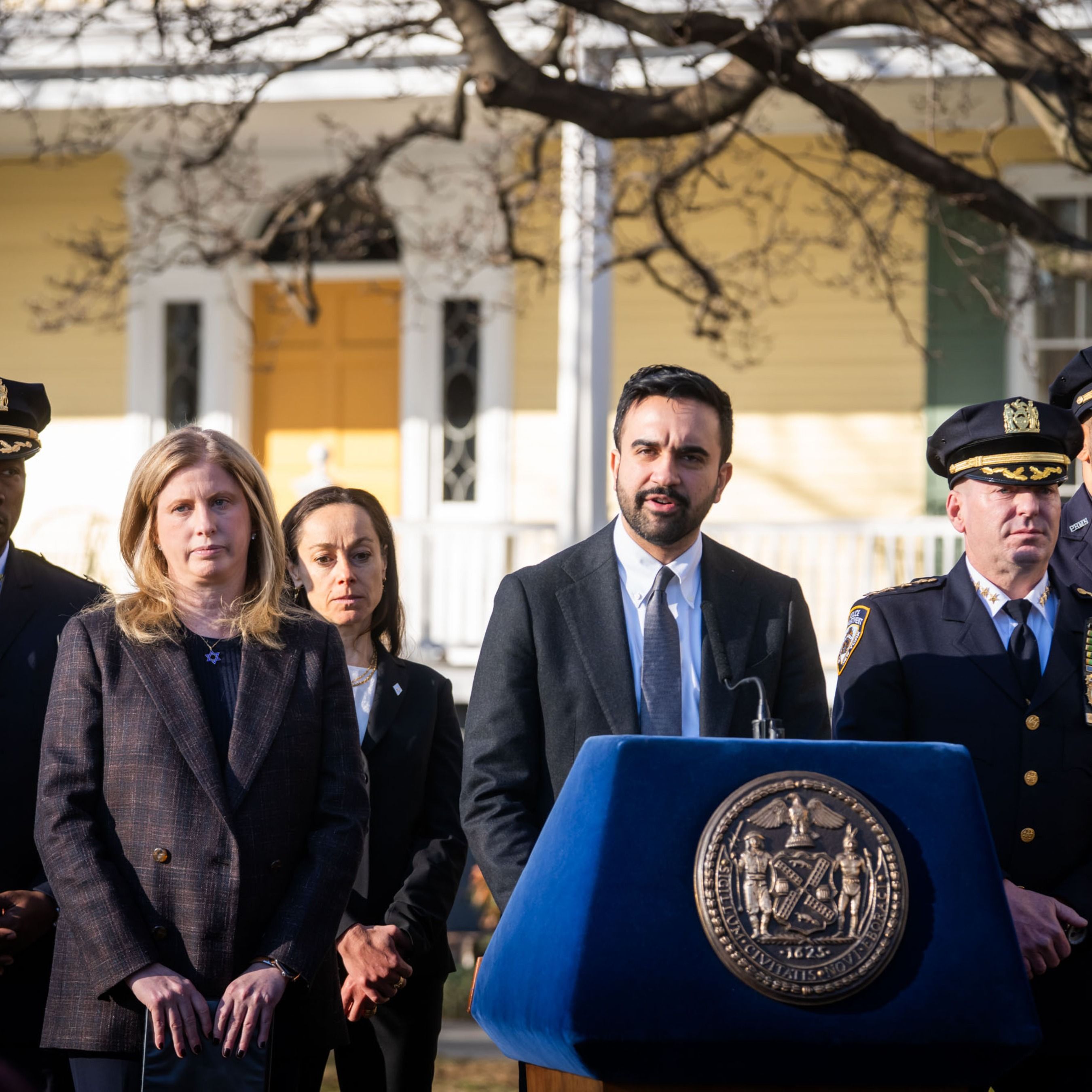
Photo: Mayor Zohran Mamdani holds a press conference at Gracie Mansion with New York City Police Department Commissioner Jessica Tisch on March 9, 2026. Source: Ed Reed/Mayoral Photography Office.
Hosted by Simplecast, an AdsWizz company. See pcm.adswizz.com for information about our collection and use of personal data for advertising.
Get every episode summarized
Each time The Brian Lehrer Show publishes, we email you a written briefing from the transcript — the topics, who appeared, and any specific claims, with the ad reads skipped.
Email me new episodesFree for 3 shows. No card needed.
Hosts & guests
Transcript ready
352 searchable segments. Every word is indexed and playable.
Full transcript
The Brian Lehrer Show — Why New Yorkers Dial 911. Machine-transcribed; use the interactive transcript above to jump the player to any line.
It's Brian Larosso on WNYC Good Morning, everyone. So last year, nearly 3.7 million 911 calls in New York City were assigned to the NYPD. That average is after about 14,000 a day. But here are a few things about those calls that stand out. Only about 28% of crime-related calls were actually reported as crimes in progress. And more than a half a million calls involved harassment, verbal conflicts, or disputes between two or more parties. This comes from a new analysis by the Vera Institute of Justice, the Criminal Justice Research and Policy Organization. The Vera Institute looked at what New Yorkers are actually calling 911 about. And whether the city's emergency response system, and this is the important part, whether
the city's emergency response system is set up to send the right kind of help. And if Mayor Mamdani has something in mind that can improve it. Our guest is Daniela Gilbert, Director of the Redefining Public Safety Initiative at the Vera Institute of Justice. And she previously worked in the Mayor's Office of Community Mental Health, and at the New York City Police Department itself, and served on the transition team on community safety for Mayor's around Mamdani. Daniela, thanks for coming on WNYC today. Hi. Hi, Brian. Thank you so much for having me. And listeners, we're going to open up this segment to you as well. First of all, any 911 operators or dispatchers listening who want to talk about what goes into working at that job and help us report this story. Call us up. You'll get first priority on the phones if anybody who does work or has worked in the 911 system wants to call and give us your take on if people call 911 for the proper things
all the time, whether there's too much stress on the system, whether there could be some other avenue for things so that police response time, and I guess by extension, other emergency services response times aren't improperly elongated. So 2-1-2-4-3-3-WNYC, if you work for or ever work for the 911 system, anyone else may call as well? 2-1-2-4-3-3-WNYC-4-3-3-9-6-9-2, have you ever called in New York City? What prompted you to do so? What happened when you did, I'll tell one very short anecdote of my own, which probably plays into what Vera is complaining about, honestly. But Daniela, let's start. Your team looked at about 3.7 million 911 calls, assigned to the police last year. What is the data reveal about the kinds of situations New Yorkers are reaching for 911
to deal with? Great. Thank you so much, Brian. You know, we're really not trying to complain, we're trying to start a conversation, and I want to start out our conversation by being clear that we all want the same thing. Everyone deserves to feel and to be safe. I care about that, then YPD cares about that, and for too long, the NYPD has been solely responsible for responding to a wide range of situations. And you know, some like crimes and progress, of course, should have a police response. There's like mental health crises or disputes that don't involve a weapon, maybe suited well for a different kind of responder. And we did this analysis of 911 call data because this data is really an untapped resource for understanding community safety needs and assessing whether our current approaches are meeting those needs. We know that alternative responses work, cities across the country are using these teams,
and New York City is doing it too on a limited basis. So we're excited for this to get the attention that it's getting. And you know, this analysis, really like I said, is a conversation starter. It's not an implementation guide, it's not trying to draw a particular line in the sand. We really recommend that system and community stakeholders alike be involved in planning and developing solutions that deliver public safety for all New Yorkers. And the data includes 457 different call types that dispatchers use, 457. So what does that variety tell us about how broad the role of 911 is? Right. So people are calling 911 for a variety of situations. And you know, interestingly, there's this wide range and at the same time, there are some opportunities to get at the nuance of situations in a way that may better meet people's needs. So for example, related to mental health calls, the term emotionally disturbed person is
commonly used as a broad term for these kinds of situations. But that term misses important nuance that if responders were able to have the information whether someone was experiencing psychosis, whether someone was having a particular response to substance use, there's actual detail that could help determine the kind of response that a person could get to better meet their needs. Some texts coming in already, listen to writes, I call 311 to report malfunctioning traffic lights. The 311 operator asked me if the condition is dangerous. And if I don't say no, 311 transfers my call to 911 and listen to writes, I've always felt this was unnecessary. To listen to writes, most recent of many examples mentioned to me by a firefighter I know, club owner called three times in same week to clear patrons from the club because they
wanted to close for the night. And I think I have one more here, listen to writes, I have tried calling my local precinct and 311 for various things like a disturbed person or a shop displaying pornography in the window and they always tell me to call 911. So that's some interesting input from those few, huh? Absolutely. And that actually mirrors really closely the categories that we identified as having a potential for an alternative response. So I already talked about mental health crisis, but there are also a number of calls related to disturbances and conflict resolution, over a half a million conflict resolution calls that, you know, what that is is a verbal conflict, a dispute between two or more people. And those situations may be better addressed through mediation or a deescalation focused response that can get at the underlying issue and try to resolve it.
And with disturbances, there's a little over 400,000 of those calls and other jurisdictions find that when they send an alternative responder to these situations, they do often involve a person with underlying needs related to health care, whether it's medical, mental, or behavioral. And when you have a trained civilian responder who can in a way that is focused on deescalation and connecting with that person helps so that they're not repeatedly coming to the attention of the system. Charles is calling for Merrick and says he used to be a medic responding to 911 call calls where too often there were no true emergencies. Hi, Charles, you're on WNYC. Tell us your story. Oh, hey, Brian, you know, a long time listener, I always like to contribute. So yeah, New York City paramedic, I will one paramedic. We tried for quite a few hours now, but I mentioned to the guy who picked up the phone
and that, you know, frequently we'd get to a 911 call location and, you know, it wouldn't be a true emergency. You know, as a medic, a health care provider, I always viewed myself as a health care provider and not really much more, you know, try to empathize, but, you know, two particular calls that have always stuck in my mind were somebody called 911 because there was a diamond ring stuck on a finger and, you know, making an assessment, you know, the finger was not in any danger of compromise in any way, offered to cut the ring off. We carry a little device that, you know, will cut a ring off a digit, a finger without any injury to the person. And the family members, it was the daughter put the mom's ring on, the family, the mom refused
and no, you can't do that. And Charles, this matters because while you're responding to calls like that, you're not available to respond to calls that are actual medical emergencies, right? Certainly, certainly. And it would happen, you know, sometimes, you know, two, three times a day, you know, and that person, you know, I can't say insisted, but, you know, I mean, we're obligated to bring them to an emergency room for that. Another issue was, again, I always try to empathize and menstrual cramps can be, I imagine, quite painful, but, you know, getting calls from menstrual cramps, we're not permitted to give medical advice like take a couple, you know, have you tried taking a couple of things up or taking a couple of books and it's not really a role to give medical advice. So, you know, that person went to the emergency room. And Charles, let me just ask you if you think there's a structural solution to too many people calling 911 in the case of your field for medical, you know, reasons in the case
of our guests, she's focusing mostly on NYPD, but is there a solution to this other than maybe to talk about it once in a while, or people know what the alternative is on? Well, I'm not sure what the solution is, the, you know, the call receiving operators, you know, they do try to parse, you know, what's emergent and what's not, you know, that's wronging, but, you know, a lot of times, you know, we walk out of the ERF to dropping some little scratch in our head, saying, you know, you know, there's a cardiac arrest up the road here and, you know, we're taking somebody with a ring on the finger. Yeah. Charles, thank you very much. We appreciate your call on this. So back to Danielle from Vera, yes. Yes. Thank you. There were two things that Charles brought up that I wanted to note. So, well, that came up in the conversation. So our report is titled what 911 data says about community needs in New York City.
And we did analyze the NYPD's 911 call data, but we're really focused more broadly on looking at this administrative data to understand what's coming to the attention of the system in terms of people safety needs and trying to develop solutions that better meet folks needs and better use the limited resource that is NYPD's time. And on the topic of time, earlier, you know, before we began speaking, you brought up the matter of response time. And of course, it's really important to have an urgent response to an emergency. And we should always be looking at whether that is happening and how it could be improved when it's necessary. But there are also other important measures to consider when we're thinking about the success or the efficacy of a 911 system. And I think that came up with Charles's comments, you know, are we sending the right responder for a given situation?
Is it a good use of our resources, whether it's FDNY, EMS or NYPD, was the person connected to the services that they needed, was enforcement action taken? Are there important questions that we actually have the answers to? And it's time to begin developing solutions with that information? I'm going to get to where you think Mamdani's proposed Department of Community Safety comes in in just a second. But staying for one more moment on advice to individuals, my own anecdote, and this is years ago in a different building in a different neighborhood, and I say that not to inadvertently alarm anybody where I live now, who in case anybody habits to be listening, because it's not relevant to any of my actual neighbors. But years ago, another building, another neighborhood, my wife and I thought we might have heard an incident of domestic violence in progress across the wall.
And we debated with each other for a few minutes. Should we call 911? We hate to get the police involved if not really necessary for any family. On the other hand, we really thought it might have been. And we did call 911. And we never heard anything about it either from the NYPD or from the family. But that was a close call for us. How do people call? I'm sorry. Your question cut out for a moment. How can people navigate, decide for themselves, in close call situations? Ah, thank you. Yes. So, I think in situations where someone is concerned about an immediate risk to public safety, of course, it's really important to call 911. I think the shift that we need to make is an individual New Yorker shouldn't have to know three different numbers and navigate in a high risk situation or a stressful situation
which number to call. And so, ideally, we have a range of options available when someone calls 911 beyond the current ones. And there's also an opportunity to strengthen call taker training and dispatcher training and potentially reviewing policies to assess whether there might be ways to address certain calls without sending a response. And I know that that's currently a practice. But I think the ability to show that the system is responding to people's needs and create more options is a really important aspect to people actually engaging with and using the system. You know, it's possible that in the situation that you and your wife were experiencing, if you knew there was a non-police responder available to respond to conflicts where there isn't clearly a weapon, then you might have called sooner.
Maybe so. So you're up at in the daily news in January, making the case for stronger collaboration between city agencies in the context of public safety. I have spent 17 years helping cities in their police departments, including the NYPD, build and sustain effective safety solutions. As Mamdani's administration builds the Department of Community Safety, I see three key actions that will help it thrive alongside existing services, most notably the NYPD. So what are those three key actions? So one is collaboration with system actors. So I think I said this earlier on in the conversation. The best way to develop new solutions is to include the people who are most affected by them, who have a stake in them. And that's the frontline responders. It's the managers who manage those responders. Community members who rely on public services. And it's important to recognize, you know, like I shared before, NYPD has been responding
to a range, you know, millions of situations that take them away from what they do best, fighting crime and addressing violent situations, solving crimes. And so it's important to take an inclusive and collaborative approach to planning what the Department of Community Safety will look like. It's also really important, like our analysis tries to do, to use the data resources that New York City has. There's an incredible amount of information that is already available, but typically agencies can't talk to each other, can't share the information amongst themselves. And so one really important role that the Department of Community Safety will play is figuring out how to strengthen coordination so that we're using resources efficiently in a way that is increasing access and care. Zeke and Plymouth New Hampshire is calling in on this. Zeke here on WNYC. Hello. Hi Brian, greetings from beautiful Plymouth New Hampshire.
I'll try to be concise. What I think is kind of missing from this conversation is, let's see how to put this, like, I guess to respond to what your guest was just saying, you know, whoops, you're lying just. Please. Oh, try to get me now, Brian. Yeah, we have it. Try one more time. Okay. Yeah. I think, you know, it should be great if the police cooperated with other agencies, but the whole historical kind of cause of this situation where 9-1-1 is the only number anybody knows for the most part, is that the police don't want to cooperate. They want the most of the city budget they can get, and this is true of any big city. And, you know, the police intentionally have taken over all these services, right, that could be done by other people who cost less and don't carry weapons, but they don't want that. You know, they want road flagging. They want to respond to mental health stress calls.
They want to respond to everything because it's, they get paid to money, it's blood. And I think that's what's missing from this conversation is this is an, this is an accusation there. And in your 17 years helping cities and their police departments in your career, Daniela, do you see evidence of that? Well, what I'll say is in cities that have really taken seriously the opportunity to create alternative responses, cities that have stood up, these community safety departments, Albuquerque, New Mexico, and Durham, North Carolina are two of the cities that we work with who have done that. Police appreciate the addition of this resource. And certainly, change is hard. Adjusting people's roles is difficult. It challenges the status quo, certainly, but when there's a commitment and a concerted effort to take a different approach, police are become among the champions of these kinds
of programs. Let me get one more call in here. Luca in Manhattan, who I think is an EMT, Luca, you're on WNYC. Hello. Hey, Brian. I wanted to comment further on what the last caller was a medic said about, you know, how to give alternatives to EMS. We're one of the only major EMS systems in the country that lacks like a robust system for triaging outcalls. We send an ambulance to basically everything could be, you know, a weak old foot pain. We get, you know, that we get in both of them and also not getting an ambulance. Wake County, North Carolina, for instance, has a system where certain calls are triaged out to a nurse practitioner who then decides whether they get an ambulance or not. Maybe they send a lift to take the person to urgent care. And we do have a system similar to that, but it's severely understaffed. So frequently we'll see jobs where the person tried to speak to a telemedicine practitioner
and they didn't pick up. Or the moment the caller says they want an ambulance, we have to send one. So frequently people have already called 911. They're going to ask for the ambulance and we're stretched extremely thin. People are not getting ambulances. Other systems where they send cab vouchers for people, connect them with home health resources, send a visiting nurse, whatever the case is. So it's shocking to me that we're the only system that doesn't really do this, you know. Thank you. Thank you. We did 1.8 million calls last year. Yeah. Thank you for your insight on that. Interesting that he compares New York City unfavorably to other cities. Do you have any better models, Daniela? Yes. There are, you know, over half of the biggest cities in the country have alternative responses and there's a lot of places that respond to calls beyond the mental health calls, like I had mentioned. I think the opportunity here is to look both at New York City's data and also to the
strong practices and results from other jurisdictions to help bring our system up to really up to the standards that the caller mentioned. And you know, just in terms of the range of types of responses, types of calls that these alternative responders take in other cities, mental health, welfare checks, unwanted person, general assistance, substance use, suicide threat, domestic dispute, traffic. And the opportunity here is really to, again, use the limited resources that we have to meet New Yorkers needs in a way that is more efficient and also really supports and honors the difficult work that first responders do. Yeah. And of course, in addition to the delayed response time that results from this, certainly what a lot of the press has been focused on in recent years and part of Mayor Mamdani's
concern is the examples of how police responses to mental health emergency situations can go tragically wrong, like in January when NYPD officers shot a Queensman, Jabez Chakraborti, four times after his family called 911 while he was experiencing a psychotic break. He remains hospitalized and there are those who say in some, and of course the hard part is finding where the line is where you don't need an armed response to a mental health crisis because sometimes you do, but that's of course another aspect of this. So last question, do you see Mayor Mamdani and I realize his administration is still so new, starting to implement the kinds of things that would solve these problems of excess of 911 calling for any of the emergency services. We've heard from somebody about the fire department, we heard from that paramedic, we heard
about the NYPD. Yes. Well, I think the announcement of bringing on board a deputy mayor for community safety is an exciting step because in these situations where you're standing up a new entity where you're trying to create more coordination across government silos, it's really important to have a balance of subject matter knowledge and the input of community as well as political will and an imperative from the city's executive to make these changes. So that's one thing that I'm excited about. I think the recognition that the city's current alternative response be heard needs to be expanded is also exciting, but going back to what some of the callers have shared, call triage limitations and narrow eligibility criteria right now have meant that a lot of calls eligible for the alternative response that exists are still getting a police response. And so I think when we talk about expanding the existing services, of course, going upstream
to address the 911 call policies that might be outdated and need to be revisited as well as further downstream and investing in more community based services so that responders whether they're their traditional first responders or alternative first responders have places to take people that can meet their needs. Danielle Gilbert, Director of the Redefining Public Safety Initiative at the Vera Institute of Justice. Thank you so much for joining us. Thank you for having me. Since WNYC's first broadcast in 1924, we've been dedicated to creating the kind of content we know the world needs. Since then, New York Public Radio's rigorous journalism has gone on to win a Peabody Award and a Dupont Columbia Award among others. In addition to this award-winning reporting, your sponsorship also supports inspiring storytelling and extraordinary music that is free and accessible to all. To get in touch and find out more, visit sponsorship.wnyc.org.
More episodes
More from The Brian Lehrer Show

Tuesday Morning Politics: State of Iran War; Home Stretch to Midterms
The Brian Lehrer Show

The CDC and Measles Deaths
The Brian Lehrer Show

History of the War on Terror
The Brian Lehrer Show

Labor Day: Working Class; White Collar Unions; Supermarkets; Summer Songs
The Brian Lehrer Show