About this episode
Paul Offit, MD, director of the Vaccine Education Center, an attending physician in the Division of Infectious Diseases at Children's Hospital of Philadelphia, and the author of Autism's False Prophets (Columbia University Press, 2008) and Tell Me When It’s Over: An Insider’s Guide to Deciphering COVID Myths and Navigating Our Post-Pandemic World (National Geographic, 2024), talks about the changes to vaccine recommendations and conceptions of public health in the current HHS.
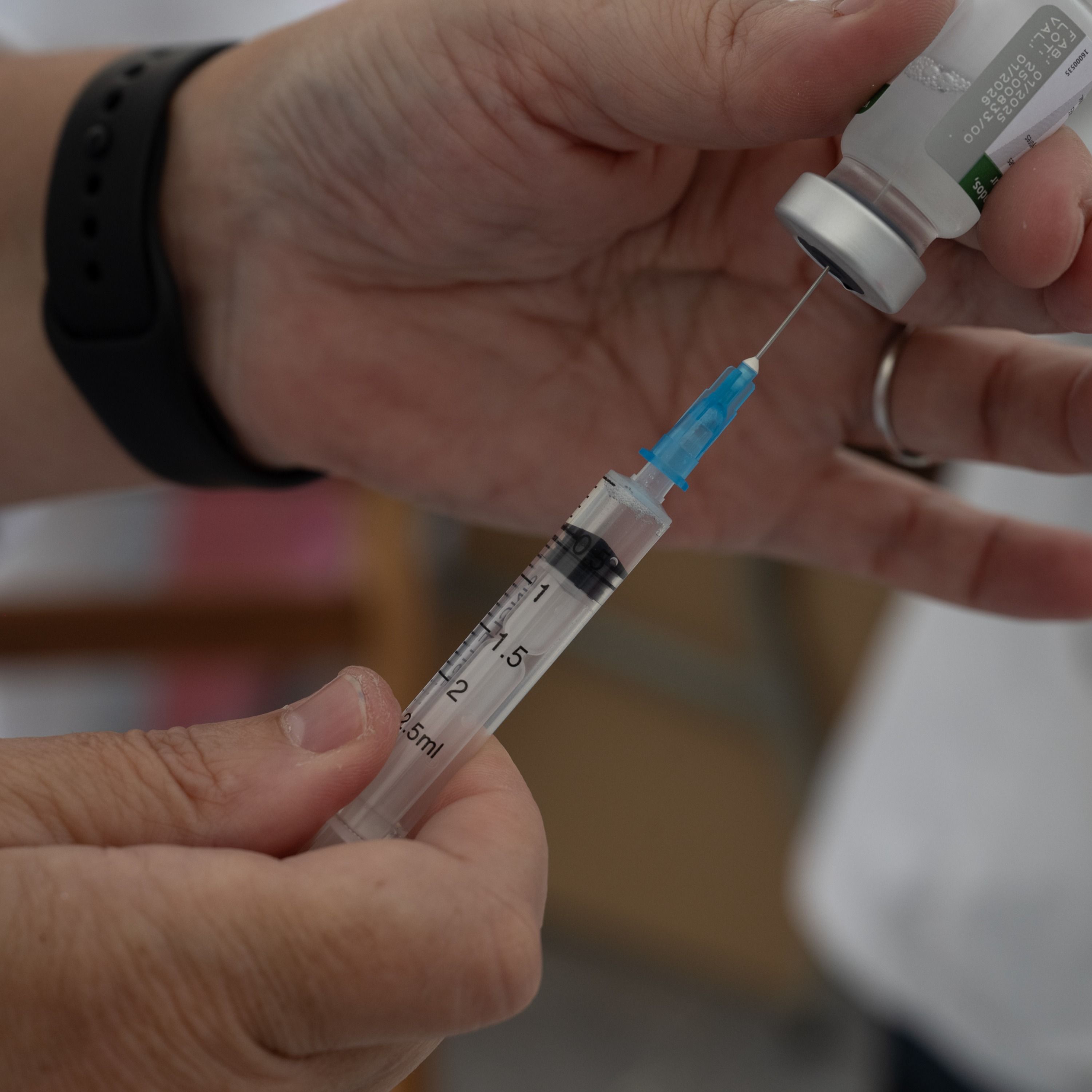
Photo by Pablo la Rosa, 10 April 2025, Wikimedia Commons.
Hosted by Simplecast, an AdsWizz company. See pcm.adswizz.com for information about our collection and use of personal data for advertising.
Interactive timestamps
Jump to segmentGet every episode summarized
Each time The Brian Lehrer Show publishes, we email you a written briefing from the transcript — the topics, who appeared, and any specific claims, with the ad reads skipped.
Email me new episodesFree for 3 shows. No card needed.
Hosts & guests
Transcript ready
347 searchable segments. Every word is indexed and playable.
Full transcript
The Brian Lehrer Show — Vaccine Hesitation & Misinformation. Machine-transcribed; use the interactive transcript above to jump the player to any line.
0:00WNYC Studios is supported by Odoo. When you buy business software from lots of vendors, the cost's at up and it gets complicated and confusing. Odoo solves this. It's a single company that sells a suite of enterprise apps that handles everything from accounting to inventory to sales. Odoo is all connected on a single platform in a simple and affordable way. You can save money without missing out on the features you need. Check out Odoo at odo.com. That's odo.com. Brian Lair on WNYC. And yes, on Tuesdays on the show, we like to bring the science on health and climate and sometimes other science policy issues. Today we return to the issue of vaccines with one of America's leading vaccine scientists. As the vaccine news continues to pile up,
1:00even as the public is mostly being focused on the war, we don't want to get distracted from everything else. As we speak, in the first two months of this year alone, the US reported 1100 cases of measles. Six times more than has been typical for an entire year since measles was declared eliminated in this country. This outbreak unfolds against a backdrop of sweeping changes, as you know, to how the federal government talks about recommends and regulates vaccines. The CDC's advisory committee on immunization practices was overhauled. The childhood vaccine schedule has been cut. And the chair of that committee under RFK has even suggested that the polio vaccine should be optional. Earlier this month, the FDA also reversed course on reviewing a new flu vaccine that trial showed was significantly more effective than what we currently have. They then under public pressure reversed themselves again and now they will at least review it.
2:02And some breaking news is that the Trump administration has apparently convinced an international panel to wait until after the midterm elections to declare if the US loses its measles elimination status. So with me, on as much of this as we could get to, is Dr. Paul Offett, Director of the Vaccine Education Center and in attending physician and infectious diseases. Children's Hospital in Philadelphia is the author of Autism's False Profits. And most recently, tell me when it's over an insider's guide to deciphering COVID myths and navigating our post-pandemic world. He's also one of those ACIP vaccine advisory board members who was fired last spring. Dr. Offett always good to have you. Welcome back to WNYC. Hi Brian, it's my pleasure. And I see you publish something just this morning responding to comments that Health Secretary Kennedy made on a podcast this week about germs.
3:04You characterized it as the Toilet Seat Challenge Test. What? What do you mean by that? Right, so on a podcast, Robert F. Kennedy Jr. said that he's not scared of germs because he has snorted cocaine off toilet seats, which I guess means that he doesn't have to worry about that anymore. I mean, you can get past the fact that our nation's number one public health official said something like that. He has many germs to worry about as a man in his 70s like respiratory sensitial virus or influenza or pneumococcus or COVID. I mean, all of which can cause someone his age to be hospitalized or worse. So he's not immune to germs even though he was able to snort cocaine off of toilet seats. This is like the worst most conspiratorial thing that people have said about RFK that I've been slow to believe that he seems to be confirming with this comment that he doesn't believe in germ theory, right?
4:04Meaning that he doesn't believe fundamentally that germ spread from person to person or in this case surface to person and cause disease. Am I overinterpreting this? No, if you read his book, the real Anthony Fauci and I don't recommend it, but on pages 285 to 288, he says that he says that he doesn't believe that specific germs cause specific diseases which was well established by the late 1800s. Rather, he believes in sort of the miasma theory that there's kind of generally these poisons out there which you can avoid simply by having good health and making sure you have good nutrition. And he'll say that. I mean, he'll say things like when children, for example, die of measles, he'll assume that they were immune, compromised or they were living in a food desert which wasn't true of the two healthy little girls in West Texas last year who died of a vaccine preventable disease measles because they weren't vaccinated. So here's that breaking measles news. An international panel was set to meet in April, I see,
5:05to decide whether the US officially loses its measles elimination status. That meeting has now been pushed to November after the midterm elections. And I see that that's at the request of US health officials. They say they need more time to analyze the data. Do you believe the rationale? And what would it mean except a designation on paper for the US to lose its measles elimination status? You're right, that's all it means which is a designation on paper. The fact is this is a measles endemic country now. I mean, last year, 2025, we had more measles cases than we've had in more than 30 years. We had three people die of measles which equals the total number of measles deaths in this country over the last 25 years. We had our first measles death in a child since 2003. That's more than 20 years ago. I think you can assume that if you're coming to this country you better make sure that you're immunized against measles because measles is circulating here.
6:05And last June, Kennedy fired all 17 members of the CDC's Advisory Committee on Immunization Practices. This is maybe a little wonky and bureaucratic for a lot of listeners. They don't know what ASIP is. The Advisory Committee on Immunization Practices ACIP and full disclosure, you were included among those who were canned. And then earlier this year, the committee cut the childhood vaccine schedule from 17 diseases to 11 and that included a vaccine that you co-invented, the rotavirus vaccine. And that's no longer universally recommended by them for infants under the new schedule, along with hepatitis A, hepatitis B, RSV, HPV, and the meningococcal immunization. So, you know, maybe there's some point of personal pride that's been damaged here for you,
7:05but what does it mean to you personally? And what do you think it means medically that those vaccines are not being universally recommended anymore? Well, just for the record, I was on the ACIP between 1998 and 2003. I was, oh, you were not currently on it. Sorry, I wasn't one of those. I was on the FDA Vaccine Advisory Committee in 2017, 2025. And they asked me to be on for another four years. I said, sure, but I think RFK junior blocked that. So that may be what you're confused. But in any case, you're right. What he's done is he's doing what he's been doing for the last 20 years. For the last 20 years, he's been an anti-vaccine activist and science denialist who's flooded the social media with misinformation. Now he's in a position where he can make public policy and do far more harm. And that's what he's doing. He wants to make vaccines less available, less affordable, and more feared. And his first step is this one, which is, aside from firing all 17 members of the advisory committee for immunization practices,
8:06which generally gives advice and then replaces them with people like him who have an anti-vaccine bias. He's taken vaccines like the influenza vaccine or the COVID vaccine or the rotavirus vaccine and made them basically optional. So-called shared clinical decision making, which means you can recently make a decision not to get any of those vaccines, which would not be a good decision. I mean, what's too about all three of those viruses of flu, COVID, and rotavirus is that all of them are short incubation periods who are called mucusyl infections, meaning if everybody in the world were vaccinated, you would still see those viruses circulating. The goal of that vaccine is to keep you out of the hospital, keep you out of the intensive care unit, and keep you out of the morgue. By choosing not to get that vaccine, that's a very real choice to perhaps suffer with those infections because those viruses continue to circulate. They're kind of all over the place on the measles vaccine. The CDC's new acting director, a Kennedy L.I., Dr. Jay Bhattacharya,
9:08publicly endorsed the measles vaccine. Dr. Bhattacharya, also, however, co-authored the memo that cut the childhood vaccine schedule from 17 to 11, but they didn't take measles out of that universally recommended. At the same time, at her confirmation hearing last week, Casey Means, the Surgeon General nominee, wouldn't say that mothers should vaccinate their kids against measles. One of the chapters in her best-selling book is titled Trust Yourself, Not Your Doctor. That being said, she has repeatedly debunked the myth that childhood vaccines lead to autism. So taking all of these things together, they're kind of all over the place. What do you make of it? It's a mess. I mean, you have basically the first child died of measles in this country in more than 20 years' last February. And since then, no one has really stood up and said, get a measles vaccine.
10:08I mean, vaccinate your children in this death was unconscionable. This unvaccinated child's death was preventable and therefore unconscionable. No one, although so you had your nation's number one public health official, Robert F. Kennedy, Jr., not doing that. You have Casey Means, who was up for the possible position of United States Surgeon General, who was unwilling to clearly say that the need that children should get a measles vaccine. But finally, J. Batticharia, in a two-minute public health announcement on X, said that it is important to get a measles vaccine for which he was universally adored by people at the CDC. There was an article in the New York Times saying, you know, that this was a great thing. That's how low the bar has sunk. I mean, we have more than 3,000 cases of measles in this country. And finally, a public health official said something on behalf of public health instead of just talk to your doctor. The germs thing is still blowing my mind. Do you think that that kind of underlies Kennedy skepticism
11:09about vaccines? He has said many times that he believes that vaccines have merely a lessened infectious disease at the cause of causing chronic diseases. And so his war against vaccines, which is successful. I mean, we have, look at the cases of influenza and measles and tetanus and hoop and cough last year have taken off because of his anti-vaccine advocacy. But he thinks he's doing good. He thinks that although these diseases are coming back, that's okay because he believes he's lowering chronic diseases. Even though there's no evidence for any of that. He's that far gone. Let me ask you to do one science favor before you go. And that is explained from your point of view, the controversy over mRNA vaccines in particular. RFK Jr. has called the mRNA COVID vaccine, quote, the deadliest vaccine in history, the various ones, because the big ones were all mRNA.
12:12And the news related to this is that the FDA rejected Moderna's application to review a new mRNA flu vaccine. Then they did reverse course, as I said in the intro, two weeks later after an uproar from the pharmaceutical industry, among others, meaning they're at least looking at it now to make a determination. But why mRNA? Remind people what it stands for. Remind people what the theory is that leads people like Kennedy to think that they're more dangerous than other vaccines in your take as a vaccine scientist. Right. So mRNA stands for messenger RNA in each cell of our body, or most cells in our body. We have about 200,000 separate pieces of mRNA, which make the proteins and enzymes necessary for life. The mRNA vaccines makes specifically a protein on the surface of SARS-CoV-2 virus, the cause of COVID. And it was a highly effective and safe vaccine.
13:13I mean, that vaccine has probably saved 3 million lives in this country and 20 million lives worldwide for a very small cost. I mean, it was a rare cause of myocarditis, which means inflammation of the heart muscle. But that inflammation was generally short-lived, temporary and self-resolving. So considering this vaccine has been given to more than a billion people, it has worked extremely well. Why is it sort of the target then of people like Robert F. Kennedy, Jr.? I think the answer is the first two years of the pandemic. In 2020, you know, we didn't have anything. We sort of closed businesses, restricted travel, closed shuttered schools. And I think that was seen as massive government overreach. And then the second year, 2021, when we had a vaccine, people couldn't go anywhere without their vaccine card. You know, couldn't go to their favorite bar restaurant or sporting event or wedding. And they may be fired from their jobs. And that, I think, created this libertarian backlash and that we've kind of leaned into that left hook. And I think mRNA vaccines have been,
14:15had probably suffered the most. There's nothing specifically about the vaccine that should be worrisome. It's tremendously safe and effective. And that mRNA flu vaccine certainly looked great and finally, after two weeks, the FDA caved and agreed to honor something they had committed to written in written form months earlier. So I don't know. I think it's political. It's a political vaccine, which is unfortunate. There's no current mRNA flu vaccine that's been approved anywhere in the world is my understanding. So if this one gets through, let's say it does get approved, what is it open up? And we have 30 seconds. Right, so if you look at the data, it looks like it's 27% more effective at preventing flu symptoms. It looks like it's about 49% effective at preventing flu hospitalizations. This looks like a tremendous advance. So hopefully that vaccine will be available August and September of this year for use because the data certainly look good.
15:15And there we leave it with Dr. Paul Offit from Children's Hospital in Philadelphia, author of books, including his latest. Tell me when it's over and inside his guy to decipher and COVID myths and navigating our post-pandemic world. Thank you for coming on with us again. We always learn when you're here. Thank you, Brian. Since WNYC's first broadcast in 1924, we've been dedicated to creating the kind of content we know the world needs. Since then, New York Public Radio's rigorous journalism has gone on to win a Peabody Award and a Dupont Columbia Award among others. In addition to this award-winning reporting, your sponsorship also supports inspiring storytelling and extraordinary music that is free and accessible to all. To get in touch and find out more, visit sponsorship.wnyc.org
More episodes
More from The Brian Lehrer Show

Tuesday Morning Politics: State of Iran War; Home Stretch to Midterms
The Brian Lehrer Show

The CDC and Measles Deaths
The Brian Lehrer Show

History of the War on Terror
The Brian Lehrer Show

Labor Day: Working Class; White Collar Unions; Supermarkets; Summer Songs
The Brian Lehrer Show