About this episode
Fred Kaplan, Slate's War Stories columnist and the author of many nonfiction books and his latest, a novel, A Capital Calamity (Miniver Press, 2024), offers analysis of the war with Iran after President Trump said he was not opposed to boots on the ground and a military leader said more U.S. casualties are expected.
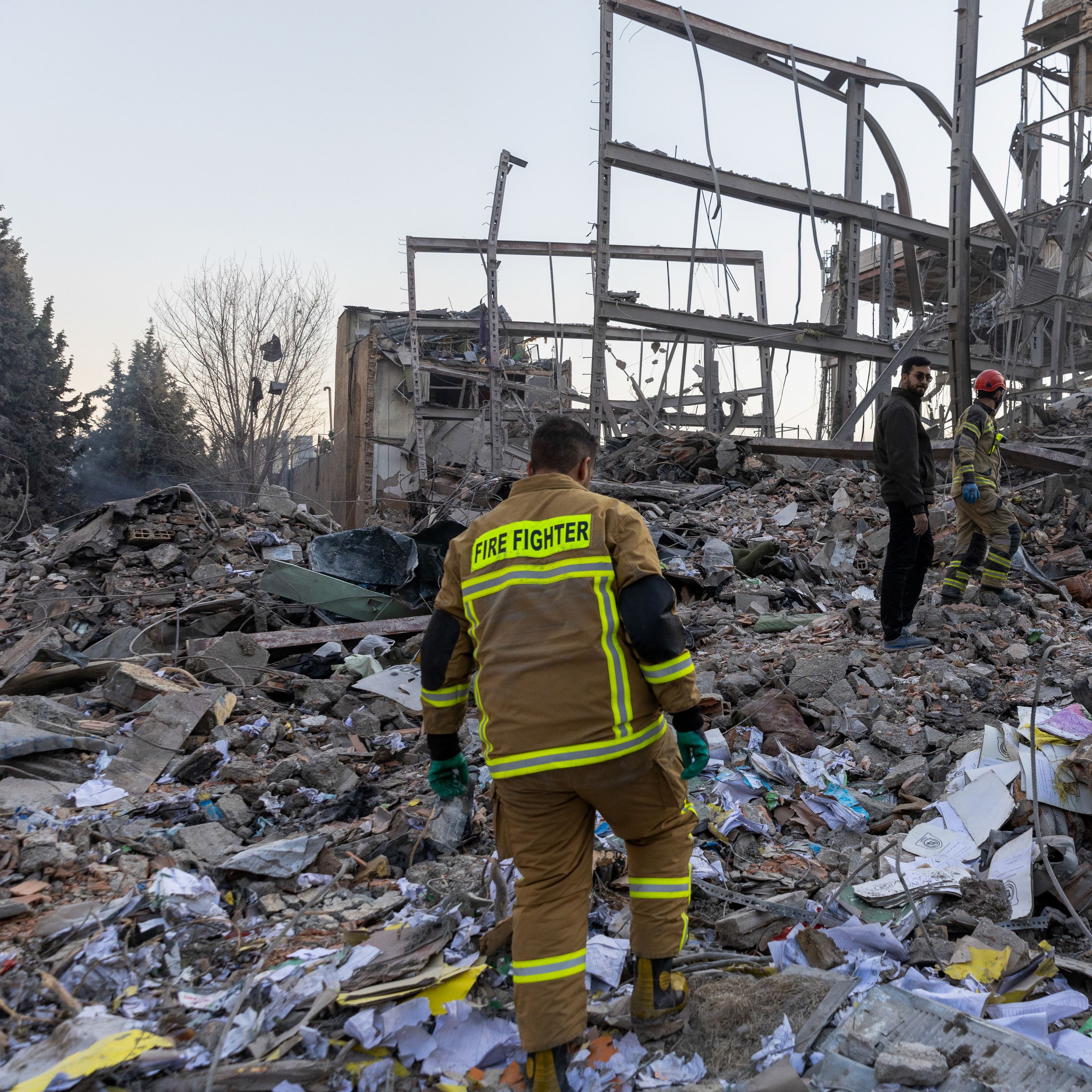
Photo: Firefighters work at the scene of an airstrike that destroyed shops and residences on March 2, 2026 in Tehran, Iran. Iran's Supreme Leader, Ayatollah Ali Khamenei, was confirmed killed after the United States and Israel launched a joint attack on Iran on February 28. Iran retaliated by firing waves of missiles and drones at Israel, and targeting U.S. allies in the region. (Photo by Majid Saeedi/Getty Images)
Hosted by Simplecast, an AdsWizz company. See pcm.adswizz.com for information about our collection and use of personal data for advertising.
Get every episode summarized
Each time The Brian Lehrer Show publishes, we email you a written briefing from the transcript — the topics, who appeared, and any specific claims, with the ad reads skipped.
Email me new episodesFree for 3 shows. No card needed.
Hosts & guests
Transcript ready
279 searchable segments. Every word is indexed and playable.
Full transcript
The Brian Lehrer Show — Trump's War With Iran. Machine-transcribed; use the interactive transcript above to jump the player to any line.
The sun is out, the birds are chirping, and the open road is calling. Bring on the spring at the Honda Spring Event and take that road trip you've been dreaming on. Now's the time to check out the Honda Civic and HRV from Honda, the 2025 Kelly Blue Books KVB.com Best Value Brand. Based on 2025 Consumer Choice Awards from Kelly Blue Book, visit KVB.com for more information. It's Brian Larosho on WNYC, good morning everyone. Here are three things that have changed in the last day about the war with Iran. The Trump administration isn't promising regime change, isn't for the Iranian people anymore. The State Department is urging Americans to immediately leave 14 different countries
where they could be attacked by Iran because the war seems to be widening faster than they anticipated. And President Trump is signaling the war might go on longer than he first thought. You were just hearing about that on the BBC. He spins it here though as a point of pride. Right from the beginning we projected four to five weeks, but we have capability to go far longer than that. We'll do it. Whatever somebody said today, they said, oh well, President wants to do it really quickly after that he'll get bored. I don't get bored. Trump at a Medal of Honor ceremony for past war heroes yesterday. Fred Kaplan writes the war stories column for slate about U.S. military and foreign policy. He's the author of many books including The Bomb, President Generals and the Secret History of Nuclear War, and his latest novel called A Capital Calamity. His latest article on slate is called Trump is about to send more forces to Iran and there
is still no strategy. Thanks for coming on Fred. Welcome back to WNYC. Sure. I'm always good to be here. What do you mean there's still no strategy? Well, you know, you just played a clip with sort of illustrates this. I mean, we're now we're not into regime change, so and we might be there longer than four or five weeks and might even send ground troops to what end? What are we doing there? You know, if you go back Saturday morning, it seems like about a month ago, but it was just a few days ago. When he made his announcement, he talked about destroying their nuclear capability, which even though it was supposedly obliterated just a few months ago, getting rid of their ballistic missiles and their military, and then regime change, and then he invited the Iranian people to rise up, the government is theirs to take, and then within a couple
of hours, he says, well, you know, there might also be a diplomatic off ramp where, you know, I could be out of here in a couple of days. And then on Sunday, he told one interviewer that, well, you know, it could be like the Venezuelan solution where we just get rid of the top two people and keep the rest. So imagine, Brian, that you're a democratic activist in Iran. And the president has said, we're about to destroy your regime. And then, in fact, in the first wave of bombing, he did destroy, you know, 40 top leaders, including the leader, and he says, take to the streets. It's to now your time to act. And then he says, well, you know, it might just be like Venezuela. That would be the ideal solution. And you've already seen, by the way, a month ago when Trump said, rise up, rise up, and they did rise up, and thousands of them got mowed down in the street. What kind of signal are you taking?
And if you're an interviewer, a member of the regime, and he's going back and forth like this, the signal that you get is, well, I'll just hold out a little longer, inflict casualties on, you know, the enemy. And maybe Trump will back out. He's not giving any signals, either as rhetoric or as apparent policy of what is the criterion of winning right now. What, what, what, you know, in a war, you don't, you don't have to kill every single enemy soldier. You don't have to destroy every single tank or ship or missile or whatever. So what are the criteria for success here? He has not spelled out any rationale, except worse yet, he has spelled out three or four quite contradictory rationales of what it takes, what this war is about, why we got in it, and what, what, what will it take to get us out of it?
I want to come back to the issue of the pro-democracy movement in Iran and what Trump said originally about, you know, Iranians have been waiting for the United States to do this and give them this opportunity for decades, and I'm the president who's doing it. But yesterday's briefings, that pro-democracy, pro-human rights motive was missing from their lips as you point out, and a three-person panel appointed by Hamanay is now in charge. I guess my question is, why did he say it in the first place? Was that all just BS to make Americans feel good about the war in the first place because Americans feel good about things that are for democratic change? I think part of it is that he has seen too many movies. I mean, remember when he moved two aircraft carrier groups into the area, I mean, you know, just a lot of firepower, and then Whitcoff, his emissary, said, you know, Trump, Trump
is puzzled why they haven't just folded. We brought all this firepower there, and they're still making threats, they haven't surrendered. I mean, is if that's how anything works, I think. And maybe it's because he's gotten away with this so many times in domestic politics. He makes threats to Congress, they fold. He makes threats to networks, they fold. He makes threats to universities, they fold. He sends one quick round to Venezuela, kidnaps the criminal president, new people, his deputies step up, say, yeah, we're willing to work with you now. Maybe he just thinks that international politics is this easy. He doesn't. We know for a fact that intelligence analysts, his chairman of the Joint Chiefs of Staff, had told him in briefings that no Iran is a little bit different, they have a government
that's thoroughly entrenched, that's deeply entrenched with an elite military unit that is not messing around. He just thinks that this is easy, that he says something is going to happen, then it happens. Fred Kaplan is with us who writes, the war stories column for Slate. Listen to right. Trump is changing his narrative constantly because he's just trying out in real time to see which reason resonates with his base. So here's Defense Secretary Hegseth yesterday taking a stab at explaining why this is important to U.S. national security, and that seems to be the emerging rationale, which reminds me a lot of George W. Bush before the Iraq war, that this is preventive to take care of a potential long-term threat to U.S. national security. Listen. Iran was building powerful missiles and drones to create a conventional shield for their
nuclear blackmail ambitions. Let me say that again, a conventional shield for their nuclear blackmail ambitions. Our faces, our people, our allies, all in their crosshairs. Iran had a conventional gun to our head as they tried to lie their way to a nuclear bomb. So Fred, do you understand that or think that's true as far as it goes? I understand that, but you know, they've had this enormous missile force for the many years when they were not pursuing a nuclear weapon. They have their own direct, as they see them, threats or their own kind of intimidation. They don't need that nuclear. You can have ballistic missiles without having them as a shield to your nuclear threat. And in fact, the fact is, you know, ignored in all this is that in 2014, Barack Obama and six other leaders, including Russia and China, by the way, got Iran to sign to what's been
called the Iran nuclear deal, which they were abiding by. There were many inspections by the International Atomic Energy Agency. They basically dismantled their nuclear force. And then Trump comes along in his first term and says, this is the worst deal ever made, terrors it up. Iran then hails the priest. Iran then starts to rebuild its centrifuges. They start enriching uranium again. You know, it has been limited by diplomacy before. And in fact, even in the negotiations that Whitkopf and Jared Kushner had been having with an Omani intermediary, Iran was making some interesting proposals. They were proposing limiting their enriched uranium to levels even below those that they agreed with Obama. And in fact, having no enriched uranium at all for three years, that is, for Trump's
entire term of office, as well as dismantling their centrifuges and doing a lot of other things, and allowing inspectors. And Trump didn't take it. He got it in his head that, no, no, you have to have no enrichment at all, which I mean, this is getting into the weeds a bit. I can either go into that a little deeper or not, depending on your inclination, but you can have a little bit of enrichment without being anywhere near the ability to have a nuclear weapon. You didn't want to go there. 190 nations, including Iran, have signed the nuclear non-proliferation treaty, which enshrines the right to enrich a little bit of uranium. Iran is thinking, why should we be more outlawed than the rest of the world? It's never been a negotiable position. There are ways that you can keep a severe limits on nuclear weapons capability without outlawing
enrichment entirely. Trump didn't want to go there, and here we are. Listen to rights. There are too many in the American government who think that the successors to the Iranian regime are not going to seek retaliation or not as radical and are not as power-hungry as their predecessors. The listener writes indicating that that's probably not true. Another unknown related for how the war will expand is outrage and Shiite communities like in Kashmir, control by India, and in Karachi, Pakistan, where Hamine was considered an important religious figure, not just a repressive authoritarian religious extremist theocrat. There have been clashes around U.S. embassies in those places. You have a reporting that indicates Washington understood that risk. I'm asking you. Do you have a reporting that indicates Washington understood that risk going on, or do they have plans to deal with it? This was according to several reports.
This was pointed out both by the CIA director and by the chairman of the Joint Chiefs of Staff that this could lead to escalation that Iran could retaliate, that Americans could get killed, that it could destabilize the region. As terms of succession, I mean, the business about, hey, people, just go rise up. There is no Nelson Mandela in Iran, and if there were, he has since been killed, jailed, or sent into exile by the regime. There is no African National Congress. Like this, there was that Mandela could appeal to in South Africa. All of these protesters, they aren't armed, they aren't organized. There are 190,000 soldiers in the Revolutionary Guard, this elite military unit, which is wedded to the regime, which is thoroughly integrated in the control of the country's economy,
its social institutions. The most likely scenarios, if let's say the regime does fall apart, that they killed all these top layer people and the other layers are killed as they come up, and then they flee, leaving nothing, the two likely scenarios are that the Revolutionary Guards take over, and they are, if there are any moderates in the Revolutionary Guard, we don't know who they are. In fact, Trump, at one point, he said that he knows of three people who could maybe take over, who would be good, and then he revealed the other day that they've all been killed in the air strikes. So it's either going to be that, or it's going to be chaos and anarchy, like you had in Libya, where you have factions, opposing factions, vying for power, and by the way, democratic activists aren't going to be a big source of that. They're going to be ethnic, they're going to be Kurds, it's going to be armed slaughter.
So the idea that you get rid of the bad guys, and the good guys rise to power, I mean, one could hope that would happen, but you don't start in with a war, with all this, and mobilize everything that Trump has mobilized, and take all the risks without much allied support by the way. And based on a very remote hope of how things might go, and knowledge that the alternatives to this hope are worse than the current situation is. Another listener writes, the president who tried to ban all Muslims entering the United States is doing this for another payout from Saudi Arabia not to protect Muslims. And you know, Fred, I've seen theories that the U.S. is shedding American blood, sacrificing American lives to back up Trump's ally Netanyahu, or that it's not so much for Israel, but
more for some Gulf states that have helped make Trump rich with business deals since he became president, and that's who this sacrifice is for. Do you have a take? Well, as for Israel, I mean, it's well known, there's never been a secret about this, that Netanyahu has been praying for regime change in Iran and trying to get presidents to be his buddy on this for many, many years. And he finally found someone gullible enough to take his cue. We now see, because Hezbollah has gotten back into this war, that Israel is mobilizing to take back territory in Lebanon again, where Hezbollah is based and had been reduced to almost nothingness for a while until they were roused to action again by killing the Aitola. As for Saudi Arabia, I mean, I have heard that the Saudis also pressured Trump into doing
this by saying, look, you've mobilized all this force. If you don't do something about it, you'll be weak. You'll be seen as weak. But the other, the Gulf countries, they always want to stay out of this. They're getting attacked now. They don't, look, none of these people have any love for the Aitola or the Iranian regime. They're Sunnis and the Iranians are Shiites. They would like to see the Islamic Republic of Iran destroyed. But none of it means that they get caught in the crossfire. And they are caught in the crossfire. The Trump administration is now urging Americans to evacuate 14 countries, 14 and most are right around there. But give me a little more on that before we run out of time. Part of the U.S. strategy in the Middle East generally has been to try to unite Israel and
the Arab States against Iran. Iran, remember for people who don't know, largely Muslim, but not Arab, and Iran under the current leadership is largely an enemy of most of the Arab states. So the Arab states have reasons to want this, but they also have reasons to fear this. How do you see that balance and whether they are happy with what they're seeing? Well, I mean, I find it interesting and instructive that all of the Arab powers said, look, in previous Israel, Iran confrontations when Iran fired the first shot of missiles, we've been there, either publicly or kind of secretly letting you overfly our territory with missiles or aircraft, providing bases. But in some cases, cooperating and shooting down Iranian drones and missiles, this time
however, they said in advance, we're not going to do any of that. We're not going to let you fly over our territory. We're not going to help you out with air defense. And so it should have been known that, look, if you fire the first shot in Israel and U.S. fire the first shot, we're not going to put ourselves on the line to do this. Well, they find themselves on the line anyway, because Iran has decided, I think, sort of stupidly, to attack all the countries that have U.S. bases, even against targets that are other than the U.S. bases themselves. So is this good news? Does this mean they're all going to rally and help us overthrow the Iranian government or do whatever it is that Trump has decided he wants to do? We shall see, but we're talking about widening the war. It's interesting that at the very beginning of this, this won't be like Iraq, this won't
be prolonged, this will be a few days, maybe a few weeks, and Brian, you and I have been around long enough to remember, that's what everybody says at the start of these wars. Everybody goes into a war saying, well, this might last many months or years, they always have this illusion that, oh, especially the bigger country, we will show them how strong we are and they will quake and fold, and it just usually doesn't happen. I'll let you plug your novel on the way out the door, your nonfiction work called a capital calamity. I know the prologue reads, much of what follows is true except for the plot, and it says it tells the story of a cynical defense consultant who's mischief plunges the world into a cataclysmic crisis. Wait, I thought you said it was fiction.
Yeah, right. Well, I would say this, not to discourage anybody from buying my book, it's much more lighthearted than anything that's going on now, and the capital calamities that I envision occurring because of the Congress or bureaucrats or steely generals or whatever are thoroughly outdone by what this administration is inflicting on the world and what the Republican Congress is exceeding to. So yeah, at this point, I would view my novel as entertaining escape, not ominous warning. Fred Kaplan writes, the war stories column for slate, his latest article is called Trump is about to send more forces to Iran, and there is still no strategy. His latest novel is a capital calamity.
Fred, thank you for joining us. Thank you. Brian Lair on WNYC, much more to come. Since WNYC's first broadcast in 1924, we've been dedicated to creating the kind of content we know the world needs. Since then, New York Public Radio's rigorous journalism has gone on to win a Peabody Award and a Dupont Columbia Award, among others. In addition to this award-winning reporting, your sponsorship also supports inspiring storytelling and extraordinary music that is free and accessible to all. To get in touch and find out more, visit sponsorship.wnyc.org.
More episodes
More from The Brian Lehrer Show

Tuesday Morning Politics: State of Iran War; Home Stretch to Midterms
The Brian Lehrer Show

The CDC and Measles Deaths
The Brian Lehrer Show

History of the War on Terror
The Brian Lehrer Show

Labor Day: Working Class; White Collar Unions; Supermarkets; Summer Songs
The Brian Lehrer Show