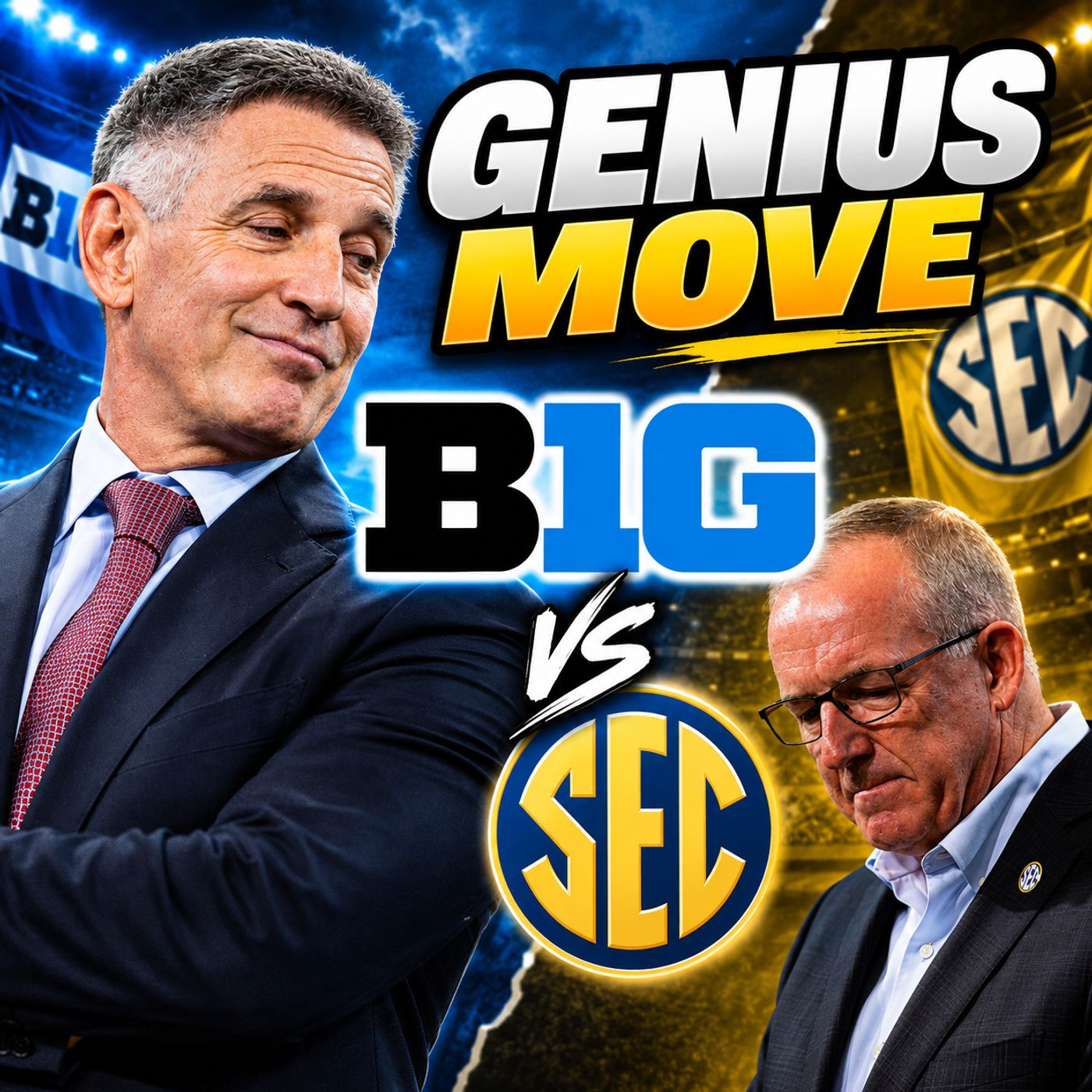
Tony Petitti Just Got One Over on Greg Sankey ONCE AGAIN
About this episode
The Big Ten Huddle Podcast is made possible by:
Tony Petitti and Greg Sankey are nearing an agreement that could reshape Big Ten football and the expanded playoff format.
Reports suggest Big Ten leadership is ready to support a requirement for teams to play 10 games against Power 4 opponents or Notre Dame to qualify for the post-season. This potential shift indicates a major realignment in how the expanded college football playoff will function, with the conference seemingly gaining an advantage in the new structure.
We analyze what this means for scheduling and the future of the sport. Greg Sankey appears to be securing his objectives, but the specific requirements discussed by Tony Petitti suggest the league is positioning itself to handle the rigors of this new qualification model better than most.
Subscribe for weekly Big Ten breakdowns, and let us know in the comments if you think this 10-game requirement is good for the sport.
0:00 The Big Ten's Strategic Playoff Compromise
2:34 Why Power Four Status Doesn't Guarantee Quality
5:10 The SEC's Baked-In Advantage
9:38 The Case for a Ten-Game Big Ten Schedule
14:10 The Future of Big Ten Independence
Shop at Homefield: https://www.homefieldapparel.com/?rfsn=7872586.e3e1d25
Shop Big Ten Huddle Merch: https://the-big-ten-huddle-shop.fourthwall.com/
Apple Podcast: https://podcasts.apple.com/us/podcast/the-big-ten-huddle-podcast/id1703305789
Subscribe for more Big Ten content!
More Big Ten Football News: @jrs_BigTenFootballNews
Big Ten Basketball News: @JRs_BigTenBasketballNews
Follow us on social media: @TheBigTenHuddle
Contact: [email protected]
Hosted by Simplecast, an AdsWizz company. See pcm.adswizz.com for information about our collection and use of personal data for advertising.
Get every episode summarized
Each time The Big Ten Huddle Podcast publishes, we email you a written briefing from the transcript — the topics, who appeared, and any specific claims, with the ad reads skipped.
Email me new episodesFree for 3 shows. No card needed.
Hosts & guests
Transcript ready
89 searchable segments. Every word is indexed and playable.
Full transcript
The Big Ten Huddle Podcast — Tony Petitti Just Got One Over on Greg Sankey ONCE AGAIN. Machine-transcribed; use the interactive transcript above to jump the player to any line.
It's fall in Jeep country and during the drive into fall sales event get a great deal on 4x4s that refuse to be contained like Jeep Wrangler. Confidence built into every drive with the most awarded SUV ever, Jeep Grand Cherokee, and freedom that can't be denied with the open air freedom in Jeep Gladiator. After 85 years, it's no surprise that Jeep became America's SUV brand, get a great deal during the Jeep Drive into fall sales event. Jeep is one more awards over its lifetime than any other SUV brand, Jeep and the Jeep Grill Registered trademarts of FCA US LLC. The problem isn't your finance team, it's the spreadsheet they're stuck using on month end. Chasing receipts, reconciling transactions, hoping nothing was missed. With the American Express Corporate Program, you get real-time visibility into company spending as it happens. Issue employee cards or virtual cards, set controls up front, and see the transactions instantly. So, instead of reacting at the end of the month, your team can stay better informed throughout the month, with built-in controls, clear visibility and fewer surprises.
Learn how the American Express Corporate Program supports modern finance teams at americanexpress.com slash corporate. This is Belie, one network, every topic, everywhere. Tony Petiti is reportedly about to give Greg Sanky pretty much exactly what he wants. And somehow, I think this could end up helping the Big Ten more than it helps the SEC, because Petiti has now opened the door to the Big Ten supporting a requirement that teams play 10 games against power for opponents. Or, no to name, to qualify for an expanded college football playoff. 2014 is to be exact. You see the SEC wanted everybody to play the 10 power for games every season. The Big Ten wants a 2014 playoff. So, on the surface, this looks like the compromise that finally gets both sides what they want. Sanky gets his 10 power for games. Petiti gets 24 playoff teams. Everybody shakes hands, we move on, we're good.
Except, I don't think this scheduling requirement is actually going to change college football nearly as much as Greg Sanky and some SEC fans hope that it will. And the bigger story might be what Tony Petiti does with this change if it truly does come to play, but all reports seem to indicate that it will come to play. Because if 10 power for games becomes mandatory, I think the Big Ten essentially has two choices. Create some type of Big Ten SEC scheduling challenge or go to 10 Big Ten conference games. And right now, I think the second option is the one that looks a whole lot more likely. So, in this episode of the Big Ten, how they'll presented by Fandole, let's talk about why Sanky's big scheduling victory might not change all that much. And why it could actually give Tony Petiti the opening to completely reshape Big Ten scheduling the way he wants it, he's just not had a reason to do it. Yeah, so here's the first news. All right, so here's kind of where everything comes from. Tony Petiti has signaled that the Big Ten is willing to work with the SEC on its 10 game power for scheduling requirement.
If that's what it takes to get the SEC to support the 24 team college football playoff. And Petiti discussed the situation this week. A Big Ten official told CBS Sports the conference is quote comfortable meeting at that scheduling standard if it leads to the larger playoff. So, we're getting closer to this deal, not there yet, but we're getting closer to it. And I'll give Greg Sanky credit here. He identified something the Big Ten wanted and used SEC leverage to get something in return. Because as we know, the only two that are really making the decisions about the playoffs are the Big Ten and the SEC. And when you make decisions about that, you're making decisions about the rest of college football. That's what a commissioner is supposed to do. But here's where I disagree with some of the reaction. I don't think 10 power for games suddenly fixes scheduling in college football. I don't think guarantees substantially better games. And I definitely don't think it creates equal schedules because power for does not always mean good. We literally were reminded of that last night. Rutgers just lost at home to UMass 37 to 21. UMass hadn't beaten an FCS, FBS, an FBS opponent since 2023. And they went into a Big Ten stadium scored 30 unanswered points. And Rutgers is a power for team.
Right? UMass is it. So if we're pretending the little P4 logo that's kind of imaginary with these conferences. Besides somebody conference affiliation automatically makes the team more valuable than difficult. Well Rutgers just gave us a pretty good reminder that this sport doesn't always work that way. Does it work that way more now? Sure. But it doesn't always work that way. And this is what I think people are missing. There are programs that already want huge non conference games. They're going to keep playing them. Ohio State isn't suddenly scheduling Alabama because Greg St. you created a rule. The state already has Alabama on the schedule in Columbus in 2027 and in Tuscaloosa in 2028 Ohio State. Please Texas this year Michigan plays Oklahoma this year. They played them last year, right? These programs. Understand what big games are worth to them to their fans to their you know economics. So they want to play these and they see value in doing so. They want the television audience. They want the recruiting environment. They want the national spotlight. This isn't this isn't changing. Right.
In programs that don't want to play those games, they're going to find the weakest quality possible power for opponent and try to play them. That's what athletic departments do. I'm if I'm trying to make the playoff and you tell me I need 10 qualifying games. If you don't care whether the 10th game is Georgia or Boston College, why would I voluntarily choose Georgia? That's the flaw in all this. We're regulating the classification of the opponent instead of the actual quality of the opponent, which is really what should be regulated here. If you want this whole scheduling thing to happen and for schedules to be more balanced and fair. A 10 game requirement for power 14s doesn't say like you need 10 hard games. It says you need 10 games carrying the correct conference label. Those are not the same thing and that's not going to continue. That's not going to change from being the same thing because guys aren't getting kicked out of conferences anytime soon or at least that as far as we know. They're not. This is also why I still think the SEC does benefit from Sanky's rule here in a way over the
big 10 several SEC programs already have annual ACC rivalry games built into their schedule. You got Georgia, Georgia Tech, Florida, Florida State, South Carolina, Clemson, Kentucky, Louisville. Some of those teams might be good, but those some of those teams are also at a major spending and revenue disadvantage from the other SEC teams are. I'm not saying those opponents will all be bad, but there is a much greater chance for those opponents to be worse year over year than the big 10 or the the SEC opponents. They play. Clemson has been great. They're not great now. Florida State has been great. They're not great now. Louisville can be good and they have been good, but they're not consistently good enough to make the playoffs. Georgia Tech just lost the Colorado. Right, but those SEC programs already have their qualifying non-conference game built into the calendar every single year and they know that team year over year, which makes a difference as well. They don't have to go hunting for one and over a long enough period. Some of those ACC opponents are inevitably going to be good. They are inevitably going to be mediocre or bad while still counting exactly the same toward this rule as Ohio State playing Alabama. Right, that's an SEC advantage baked into this rule here.
But even then, I don't think it changes enough to justify all the celebration around this proposal because schedules are still going to be wildly different. Someone's going to play Alabama and someone's going to play sorry Rutgers fans. Someone's going to play the Rutgers equivalent this year because there's not going to be great power for teams every single year. Both get one check mark and that's why I keep coming back to the centralized scheduling idea because eventually we're going to create a math problem here. Look at Purdue this season. Purdue has nine big 10 games. Then on top of that, they play Wake Forest and they play Notre Dame. You know, nine, 10, 11. That's already 11 power for games when you include Notre Dame in with the power for opponents. Louisville is basically doing the same thing. They have nine ACC games, Ole Miss and Kentucky and so that's 11. Now imagine that more, you know, now imagine more conferences moving toward a scheduling system like that.
Could eventually have one school desperately needing its 10th qualifying opponent while another school schedule is already full with 11. What happens when everybody needs power for games but the available dates don't match up for that to happen. What happens when conferences change from nine games to 10 games? What happens when existing rivalries eat up the available inventory? Are we seriously going to reach a point where a 10 and 2 team can have its playoff eligibility at question because an opponent canceled a series five years earlier in the athletic director can't get a Rutgers or a Boston college or name your terrible power for team here. That's absurd. If you're going to make this an eligibility requirement, you need some mechanism to make sure teams actually have reasonable access to qualifying opponents. That's where centralized scheduling becomes important. I'm not asking for NFL scheduling here and I realize how difficult this is with 138 teams in all of college football.
I think you could bring it down to the 60 some, I think it's nearly 70 teams that are in, well, 34, 33, yeah. So 68 teams right now in the power for college football will never have perfect equal schedules. That's impossible. But you can do better than this. Create a neutral schedule in body that can help facilitate these games across conferences. If a big 10 school needs a qualifying opponent and an SEC school needs one, you match them together. If the SEC is full but the ACC has some openings, you work there to try and figure something out. Try to match programs by competitive tiers when possible, protect traditional rivalries, rotate opponents. I can't believe I'm going to say this but use data before the season starts like SP plus. What's the guy Parker Fleming his graphs stats of war. I think is what he's called on Twitter. Use some of his, use some of these numbers out there and most importantly, don't create a national playoff rule and then tell 136 athletic departments, good luck and figure it out.
Because that's eventually going to create situations that nobody and tens. And this is where I think Greg Sankie might be celebrating a little too early if he's really excited about this deal. You see, the big 10 doesn't necessarily need the SEC to solve its 10 game problem. It can solve it itself and I think it would solve it itself tomorrow if the playoff were changed. You play 10 conference games. That is what I believe the big 10 is eventually wants to do. They just don't want to do it before the playoff changes. Petiti was already publicly discussing a possible 10 game big 10 schedule early of this year and connection with the expanded playoff. So if the SEC says everybody needs 10 qualifying games, well, okay, the big 10 has 18 schools. It has a high state Michigan, Penn State, USC, Washington, you know Iowa, Illinois, Indiana. All these schools Nebraska, you have 18 schools here. And so when you already have 18 schools, you can set yourself up for playing more conference games, which helps helps the TV company.
It helps you because you're playing more other teams and you're getting more matchups between teams and it helps with recruiting as well. If you're recruiting somebody from out in California, you're more likely to play a California team for their family to come see him. So just add another conference game on and I increasingly think that's where this is headed for the big 10 because it solves several problems at once. The big 10 controls the inventory, Fox, CBS and NBC get another weekend of big 10 versus big 10 games. The conference isn't sending one of its brands somewhere else. So another television package benefits from it. And there's another piece of this that I think matters to not just sending Ohio State to play Alabama on ESPN. You don't want to do that. But most importantly, it's Notre Dame. We talked about Notre Dame on this channel multiple times now. This is part of my projection as well. I don't think the big 10 hasn't as much incentive to keep helping Notre Dame build an independent schedule forever. We've seen this play out. We saw it. We've seen the big 10 dwindle off and what teams are playing Notre Dame in the future.
Yes, USC is getting back to that. But that's also arrived really a bit of a special scenario. Notre Dame currently relies on plenty of games involving big 10 ACC programs. In 2026 alone, the Irish play Wisconsin, Michigan State and Purdue from the big 10. If I'm Tony Petiti, why why keep shipping, you know, valuable big 10 inventory outside the conference when I can create another conference game that my own media partner either controls pay for use strategically, right. The big 10 would obviously benefit, excuse me, if Notre Dame eventually decided independence was no longer viable because they cannot schedule the teams they need to schedule. So if 10 conference games makes it harder for Notre Dame to find big 10 opponents, I don't think Tony Petiti loses sleep over that at all. He gets his 10 qualifying games. He gets more big 10 inventory to make more money and he makes independence slightly more difficult for Notre Dame as they're also having to travel all the way down south and you know, not so much all the way out east. I mean, yeah, they would have to go all the way out east, but it's not as big of a deal. That's three benefits from one decision. And this is where fans should pay attention because 10 conference games sounds awesome.
And still you start doing the math. You still probably want one manageable non conference game, maybe another home game, right. And then suddenly there's very little room left. You're most likely capping out at seven home games that season, which is going to impact the economics of your school games like Iowa Iowa State become vulnerable. That rivalry is already kind of facing some questions about this long term future of conferences, move toward 10 conference games. And I don't like that. I do want to see that game, but I also see where the Iowa fans are coming from. You play them every year. I get it, but you still want the option to be able to play them. That's the exact kind of college football, you know, game that should be protected, right. We want to have more regional stuff. We want to have more historical stuff. Does it need to be everything in college football? No, but it is an aspect of college football that many people enjoy. Fans live beside each other. Families are divided. Those games are part of the game. And those games are part of what has made college football different for so many years. And we don't want to just lose that all in one, you know, blow up of what's going on. So yes, 10 big 10 games would produce more Ohio State USC Michigan, Oregon type of inventory.
But don't pretend this isn't a trade off. You made gain conference inventory while losing some of the regional rivalries that built the sport outside of the conference. So where does this leave us, right. Greg Sanky probably thinks he's got his win here in the SEC one of the 10 game power for standard. The big 10 appears willing to accept its exchange for movement toward a 2014 playoff. Fine, fine, fine, fine, fine. But I think the big 10 may still be multiple steps ahead here because this rule doesn't suddenly make the SEC schedule, you know, dramatically tougher or anything like that. It doesn't force scared programs to schedule elite teams and I don't it doesn't solve to me competitive and balanced what it does do is it gives Tony Petiti another reason to make a decision the big 10 was already considering now he is too legitimate past year. Build some kind of big 10 SEC challenge and create huge inter conference television games. You're going to you're still going to be able to earn even by shipping Ohio State off because you're going to get Oregon versus Georgia or Penn State versus LSU or whatever that might be.
Or do you keep the inventory yourself and moved up 10 big 10 conference games. My bet right now is that 20 Ptd wants the control. I think 10 conference games is the most likely path. And if that's where this ends, look at what Tony Petiti, you know, potentially gets the 2014 playoff he's been pushing for 10 qualifying games without depending on other conferences, more big 10 controlled television inventory and additional pressure on Notre Dame's independent scheduling model. So yes, think he may have won this negotiation and some in some sense, but he may have also given Tony Petiti exactly the excuse he needs to make the big 10 even more self contained and that's what might end up being the much bigger story here. Do you want the big 10 to play 10 conference games or would you rather see a big 10 versus SEC challenge because I think that's the decision coming next in college football and it's the one that could be changing things a whole lot more than people realize. Let me know what you think though in the comments below what do you want the big 10 to do big 10 SEC challenge or 10 conference games. Let me know down below subscribe to the big 10 how to like the video for more big 10 football and basketball analysis and we'll see you next time. Have a good one.
More episodes
More from The Big Ten Huddle Podcast

Ohio State Has Another PROBLEM... for College Football
The Big Ten Huddle Podcast

LIVE REACTION: Michigan's Very Real Underwood Problem
The Big Ten Huddle Podcast

USC–Oregon Just Got WAY More Interesting After Boise State
The Big Ten Huddle Podcast

Indiana May Have ALREADY Solved What People Thought Was Their Biggest Problem
The Big Ten Huddle Podcast