About this episode
Get every episode summarized
Each time Clare FM publishes, we email you a written briefing from the transcript — the topics, who appeared, and any specific claims, with the ad reads skipped.
Email me new episodesFree for 3 shows. No card needed.
Transcript ready
459 searchable segments. Every word is indexed and playable.
Full transcript
Clare FM — The Future Of Housing: Week 1 – Rural Housing. Machine-transcribed; use the interactive transcript above to jump the player to any line.
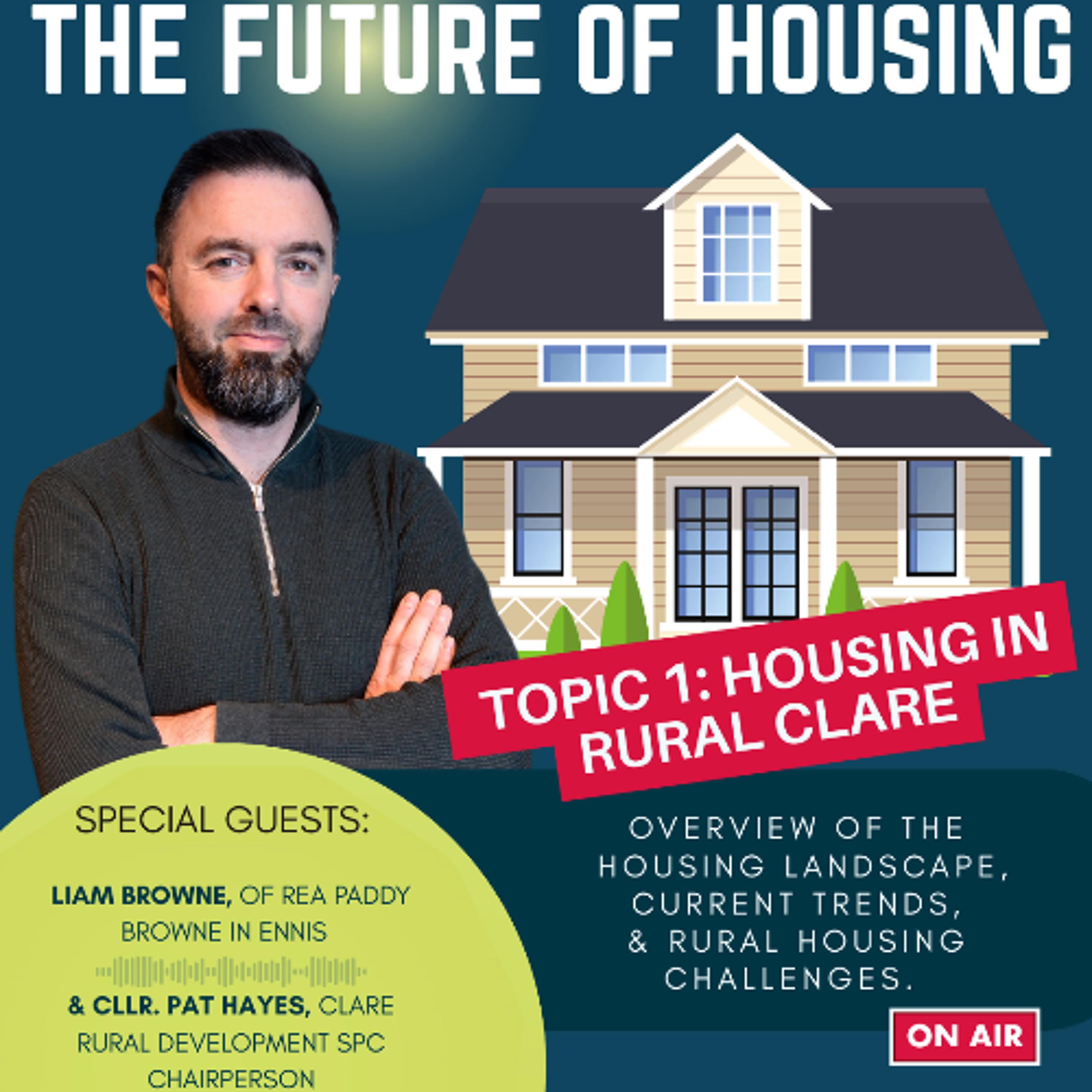
And it is time for our newest feature on Morning Focus, and it is on housing in Claire. And over the next 12 weeks, this new feature is going to feature is going to deliver sustained in-depth reporting on housing in County Claire to provide clarity, context, and accountability. So each week, we will examine a different aspect of the crisis from supply and pricing trends to planning permission barriers, social housing allocations, mortgage access, and the role of sustainable rural building, answering the key questions. And for our very first week, we are going to focus on housing in rural Claire. And we're going to talk now about housing in rural Claire and joining me in studio to do just that is Liam Brown of OREA Paddy Brown in Endless Lane. Good morning to you. Good morning. Thanks very much for coming in. And also with us is the Matter of Uniform Counselor and Chairperson of the Rural Development SPC Pat Hayes, Pat Good Morning to you. Morning. Thanks very much for being with us. We'll get the ball rolling with yourself. In terms of rural Claire, how would you describe the current housing market? And how has that changed over the last 10 years?
I'm just thinking, did COVID play any significant part in where it's currently at? Well, I think COVID influenced people's thinking about housing versus employment. And this home to work has been an important influence in purchasers. Like from a COVID point of view, properties have probably increased by nearly over well over 50% since COVID times. The biggest difficulty we have in Claire is as well as Claire is probably one of the countries that has the least few housing stuck in the country. Supply is influencing prices, location influences, but I think the biggest impediment at the moment is affordability. Are people, are you finding that that's leading to people moving out of more rural locations west and north of the county and moving to more urban areas like Shannon or Ennis, or if pricing comes into us? I think there's a balance in that. But some people, because of specific requirements,
be a held age or something like that, may move from rural to urban. Again, it all depends what type of house type and what type of level of bracket in the marketplace that you're talking about. Sometimes people who would have never looked at rural are looking at it because of affordability. The other reason is people are looking at it from a lifestyle point of view. Do they want a larger site? Do they want a bit of space? Connectivity then to employment centers, infrastructures or an important factor. And then there's others that just want peace and quiet. So there's no go in rule for it. But road properties as a consequence of urban prices increasing substantially is it is having a knock on effect on values out there and demand. Pat Lim mentioned a pertinent word, their infrastructure. And I was going to ask you what you're taking on the current state of rural housing in Claire would be. And I wonder, because it is an issue that comes up so often, infrastructure, wastewater, electricity, and so on.
And how the lack of them can be impediments. Are they causing issues in terms of how you see the state of rural housing in rural Claire? Suppose if you look at the county in a sense, there's growth down the center vein of the county. We have in our own electoral area, an East Claire of Tuller, Crushing, and Quinn growing at a huge rate. And then just move a few miles down the road into other areas like O'Callons, Middles, and Feetland, Easterry. There's no development in even Scarf-Tjum Greene to that level. And just making those as examples is very similar back west layer and back probably into North Claire as well. Because people are actually moving where there are houses. I suppose the end there are 52 settlements that don't have infrastructures, don't have sewers, don't have the basing. So it doesn't allow for development. Look, there is a proposal there for developer-led sewers, games, and things like that. But that has to go through. We had that in the past, and it left a lot of issues and challenges. But we also have a lot of villages and towns that have infrastructure, and we don't have growth in a meter.
And I think that's really what the challenge to my view is why isn't that happening? When you have the infrastructure, and you have some lovely villages and towns out there, that have no growth, and people are moving, I think sometimes people move to services. That was what I was going to ask. And these places that do have infrastructure, is it the lack of services that is leading to? Sometimes it's work related. And more times, if you're buying a house in your coming antennas, or Shannon, or Quinn, or that, you're using the services of childcare, you're using the services of healthcare, you're using all that that centralizes it. And that's one of the challenges really for rural communities, because services are moving with. And then you lose shops, and you lose that when you don't have the business. And there all comes back to, if you happen to basing housing growth in the area, and people don't see the value in having services or businesses in rural communities, if you happen to grow to population. And we're seeing it in several schools and education facilities, where schools are struggling
to stay open now. And then you have the complete imbalance of where you're in schools that have in capacity. So there's a lot of nostartial thinking in my mind and planning, and how we've done this. We have reacted in certain ways, you know, you're in childcare, you'll do this, you're in services, but like ultimately, it's the people you're deciding. And because of the cost of maybe a standard house, the three, fifty, four hundred thousand, two people have to be working. So they actually have to have childcare. They actually have to have doctors to actually need to live where people might mind children from as well. And there's a whole lot of other issues that come into the data. And then we're also educating an awful lot of people that are now seeing a difference out of the world. And particularly in the farming community, we're seeing a downturn in people, staying in farming, and the age profile of the farming community in itself is moving an awful lot of people into part-time farming. So you can see a real challenge coming in rural areas at the moment. But there are some huge things
that are making big changes as well, which I say the Cree Conn has gained for single rural houses where there was the fifth highest in the country. And I think as a five hundred applications have been approved to get funding to upgrade all housing as well. That is a real opportunity now in my mind. That is something that has made a huge change here. And a lot of people are seeing an opportunity. You don't have the challenges of planning as much as the same issues if you're going into an old house and you're also bringing life back to a community. And just before I go back to Lehman, do you want to see that role that else? I mean, the policy schemes in Luzdune, Varna, and in Fekil are being very well received as part of the ready to build a service side scheme. Would you want to see that happen in other places? Inclared that it will be gas. More services and facilities come into those areas if there are more houses. Candid's help in that regard. I think the new CEO, Claire Conn, the council garden daily, has clearly met housing is most important issue to deal with. I think projects and things like the Creek
honour for Luzdune, Varna and Fekil are very much a template while we're building and proposing on council lands at the moment. I think we need to move further into the private developers and help them to develop sites as well. To give them a reason why they would go to the Fekil's and to the white gates and to other villages that don't have growth to try and encourage. We're going to have to do something to help developers move into areas that there is no growth. I think there is an opportunity to look at this and see how this works. Because presently, if you can get a service site that has all the sewers, water and light and all, it reduces costs. It really is attractive to people. Okay, I'd be interested in a state agent's perspective on all of this lean, what do you think? Yeah, well, I suppose the one thing that I've seen more recently is under the door like sites, regulations and care-county-counts and efforts to bring disused properties into either be sold,
be renovated and be suitable for occupation. That has been a very positive approach by the council. Like I think in the last few, since 2022, there's been over 300 properties, which were line idle and either by way of CPO or I suppose a little bit of push on behalf of the council but the owner, there are being renovated or sold. And with the door to excite schemes that they have and the grants, it is appealing to parties to renovate for might or an investment point of view and for their own residential. In relation to the rural areas, yet look in the marketplace, there's always, you'll always find people have a pull to certain areas. And I'll take, I find a very good example is if you look at the development in Croixine in the last 20 years and again, even in particular in the last few years, there's been over 200 new houses
by the time there finished existing development, there's probably going to be around 400 new houses within the center of Croixine. One of the factors of Croixine is connectivity between Galway and Shannon. And you also have all the main services there. And it has all the services, charged shops, GEA schools. And the question for their railway station to be reopened, which would really add to that. I would add to it, but what you'll find is people that are priced at Limerick, are priced at Venice and are priced at Galway. They're common to Croixine and they're living. I find probably one of the, and again, it's a slightly, it doesn't have the same infrastructure in relation to its connectivity role, but it would be a very popular residential area in Claire. And that would be the Ruan area. Ruan area has, like, Croixine, all the services that has school, larry school, charged shops, everything. But what's stigmatized in any development in Ruan, and it has plenty of land suitable for development,
is the lack of services. And I don't understand, this has been going on for 10 or 15, 20 years, I don't understand why that hasn't been dealt with. And it opens off land and potential affordability to the Barca place, if it was, you know. And that's something, look, we can't do everything, but there is certain things I think that we could do to open up land banks. And again, I do see the local authority there, there are looking at open and up additional land, especially land zones, cheese degrees, or of interresidential to make it available within the marketplace, which is a very positive approach. But I think the provision of services with Ishkaya Air is, you can't have one without the other. A great example of that is what happened in Queen, Queen Rees, and he got an upgrade and storage. In the last three or four years, you've seen two or three developments actually taken place there, prior to that, there was no developments in the last 15 years.
Pass your chair of the rural development SPC. What concerns you most right now in relation to rural housing? Is this vacancy dereliction? Is this infrastructure issues? Is it like a services? Or is it just a mixture of all of that creating the most throbbing in your temples? Well, it's a mixture of everything really, but I suppose ultimately, I suppose, if we look at individual houses and planning permissions, as well, that brings challenges as well. And I think to date in a lot of parishes and communities, the single rural house has been the only opportunity because we don't have the infrastructure and the small villages and towns, and the possibility of its challenging. So do you think like village-led development is better than compared to isolated housing? I don't think that. No, I don't think that. But there's a balance. But we have a challenge trying to manage that as well, because linear development and urban development
coming out of towns. The preferred area for most people to live is within a mile or two of a town or a village. And we see that in a lot of communities, but at the same time, the challenge is to try and keep that for locals as well. And at the same time, it's to get sustainability to keep schools and businesses open. So it's a very challenging one at the moment. I suppose for the main issues for single rural houses, really, it's the policy issue and the county development plan where it's up to the county have deemed high pressure, which is not suitable for people moving in. And some areas could do what people are moving in. And then we have other areas where we have designated land that doesn't allow you with designations to build houses and you have road safety issues and your percolation issues. And those are the main things that crop up every day for everyone. And it's very hard to say that very few houses got through on the first round. There's a lot of further information requests and challenges around percolation, rounds, sightlines, and all that. And that's a challenge for a lot of people.
But a lot of people still want to live in rural areas. And if we don't continue to support that role development and housing out in rural areas, we really want to have communities at all. But it is that challenge where the younger generation are moving towards the larger towns, whether it's jobs and whether it's services. And to try and get that balance is very hard at the moment. Which is disappointing, Liam, if younger people are leaving their localities to go to those areas, ideally want people to ensure they would like to buy a house and rare a family in an area where they themselves have grown up. Is that going to become more of a possibility in rural housing in clear over the next five to 10 years? I mean, can you see a lot of the issues, the stumbling blocks that both you and Pat have highlighted being smoothed out or gotten over to allow first-time buyers be they from elsewhere? And they just want to move to a quite rural area or for young people from that locality being able to stay there and raise their family. How optimistic can they be about the prospects of doing that?
Again, I can't see all the issues being fixed in the next five to 10 years. There are certain sections that, yes, that couldn't make it easier. I do think the planning regulations and restrictions in certain areas is an impediment for people who wish to live in particular areas. However, I do understand there has to be some sort of governance on that keeps control of the development. The biggest thing is infrastructural transport, amenities and services are they available. Sometimes you'll find in rural houses one of the biggest things that people look for is broadband. What is the capability or is it high speed? Are they going to have interruptions? Because a lot of the people that are looking at rural housing possibly one of them or both of them are working from home. Just going to say that, yeah, it's fine. And it is a major factor. And then, and I think Pat said it there, services I did, the need childcare, school placements,
is there availability of school placements in the area? There are connectivity to services. It's healthcare and all that. There are little things that make a difference. You know, like if you're inside in the middle of, outside in Westclair, and there's no healthcare center inside in Westclair, or it's 20 30 kilometers away, it could influence your decision. There can be a lot of things to be done, but I suppose you have to try to prioritize what is in, what will have the best impact on reducing, I suppose, the supply of houses and reducing the demand. But in the current market place with the level of properties are under market, common in the market. It's hard to see that change in the next year or two. Which in the 30 seconds that are leftos, Pat is a sobering thought. Those, some of those issues could be sorted out. You would already address short to medium term, but there's quite a lot of, on that to do list there.
I don't, but it actually, since a different direction from our council and a different direction at government level, we have to try and take on all these challenges. We've had appeals and board planal and all these things are going on. Vindictive challenges at times. We really need to straightforward, and we need to build standard houses as well. And we need to just build houses, whether it's modular housing or not. We just need to, to tackle it at a point where we can actually land 20 houses into a village and get it done. If there are 20 modular houses at the moment, we have to try and sustain communities as well. And for it not to take years and years and years. We need to get out of that. But the reason, I find it every day now that there's a change coming and there's an effort. It's sometimes it's hard to get that through because people, I don't know, like I pass through some places and I wonder, by the time we get things done, the good has gone out of them, like, but we can't afford to continue the way we are. That's all I say. We need to make sure there are real changes. The thing with the modular sometimes,
and again, there may be a short term response to it, it is, I think, what has to be done? There has to have to be sustainable in the long term. Yes, that it is not just short-fixed. I'm sure that, but at the same time, there's opportunity as well. The sustainability is present because if we continue in some areas, we lose everything because services won't remain. And it's a real challenge in the rural areas, in the rural towns and villages. And like whether we're building single houses or not, if villages in the area are not improving and if you lose a business, a core business out of a shop or a pub or something like that, people move away then. And those young local couples in first-time bars, I was referring to, I mean, they'd be more likely to buy, might chump at the best for a modular home because it gets them on the property ladder and that initial phase of the family can be done in there before they might eventually move on elsewhere. Well, I think we really have to start thinking a little bit outside the box here. Like, we did react very well in terms of the Ukrainian crisis
and we got a lot of houses and people are still going in, living in houses. We really need to make sure, know, that we change it all around and get our own country going and look after our own people. Because all of the challenges, look at our three kids in that particular phase, where there are one houses and I'm not sure how that'll happen, but we need to make sure people like them, we can keep them in our country, keep our services because of those people are leaving and moved to our cities for jobs. The challenge is very much for rural communities and that has a knock on effect for the town of Ennis and Shannon and every her. If they're not living in the rural Claire, they're not living, they're not coming in tennis to services either. Will you better hope they find housing or you'll arrive home one day and they'll have changed the locks and it'll be them squatting in your place where I will leave it there at that age and Liam Brown from Ori-A, Paddy Brown, Nena Skies. Thanks very much. Thank you. This feature, The Future of Housing, is funded by the news reporting scheme.
More episodes
More from Clare FM

Clare Beach Bye-Laws End For 2026 Season Today
Clare FM
Hopes Droichead Na Gabhair Funding Will Help Complete Project 'Sooner Rather Tha...
Clare FM

History In Focus – The Famine, Emigration, And Clare
Clare FM

Fianna Fáil Tulla Centenary Celebration
Clare FM