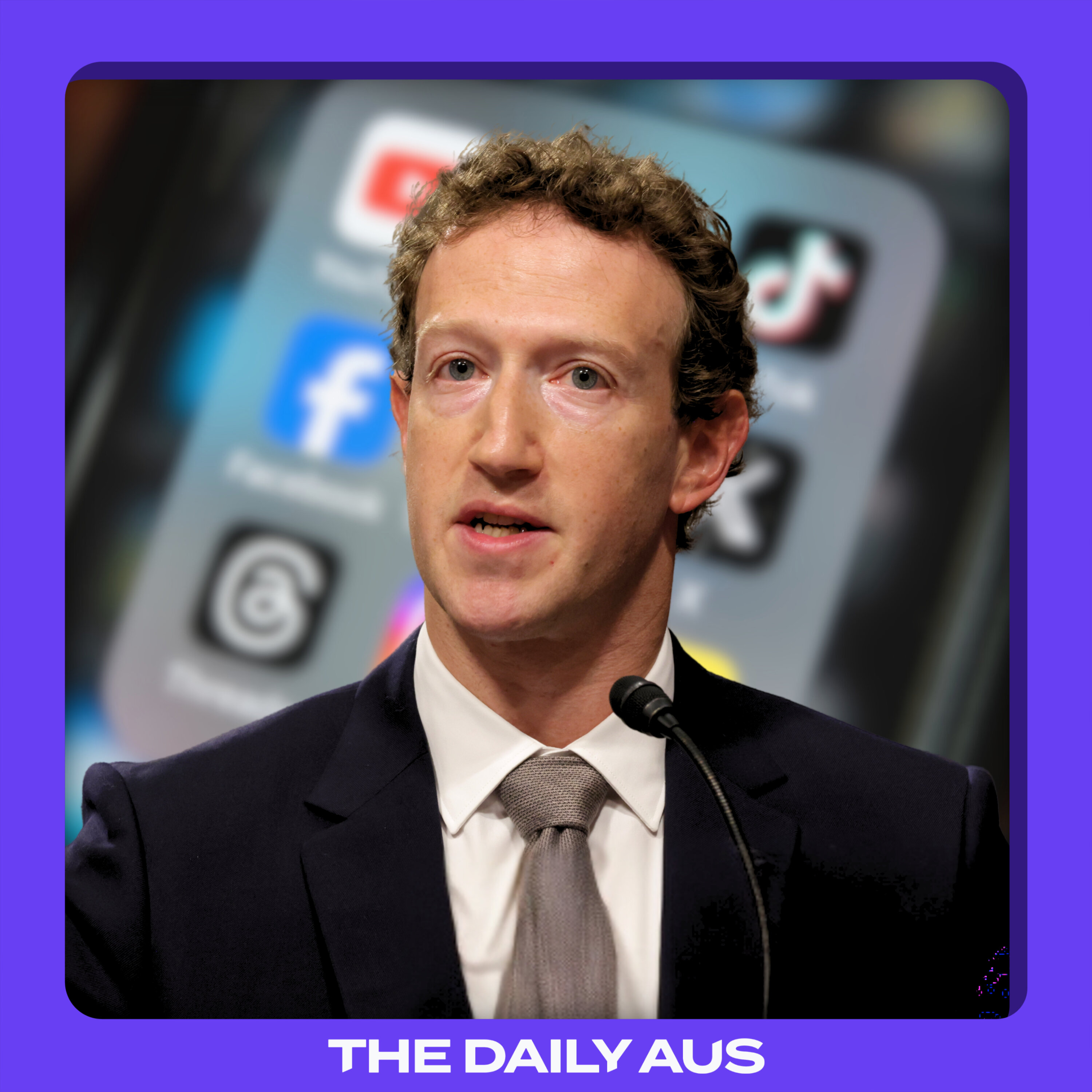
About this episode
If you've ever felt like social media is designed to make it feel impossible to put your phone down, a jury in the U.S. just agreed with you. They’ve ordered Meta and YouTube to pay for it. This landmark trial was the first in a series of court cases that could reshape how social media works worldwide. In today’s deep dive, we’ll explain how we got here, and what it means for the future of the world’s most popular apps.
Hosts: Emma Gillespie and Sam Koslowski
Producer: Rosa Bowden
Want to support The Daily Aus? That's so kind! The best way to do that is to click ‘follow’ on Spotify or Apple and to leave us a five-star review. We would be so grateful.
The Daily Aus is a media company focused on delivering accessible and digestible news to young people. We are completely independent.
Want more from TDA?
Subscribe to The Daily Aus newsletter
Subscribe to The Daily Aus’ YouTube Channel
Have feedback for us?
We’re always looking for new ways to improve what we do. If you’ve got feedback, we’re all ears. Tell us here.
See omnystudio.com/listener for privacy information.
Get every episode summarized
Each time The Daily Aus publishes, we email you a written briefing from the transcript — the topics, who appeared, and any specific claims, with the ad reads skipped.
Email me new episodesFree for 3 shows. No card needed.
Hosts & guests
Transcript ready
180 searchable segments. Every word is indexed and playable.
Full transcript
The Daily Aus — The first social media addiction trial. Machine-transcribed; use the interactive transcript above to jump the player to any line.
Ready and this is the daily off. This is the daily off. This is the daily off. Oh, now it makes sense. Good morning and welcome to the daily off. It's Friday the 27th of March. I'm Emma Gillespie. I'm Sam Kuzlowski. If you've ever felt like social media is designed to make it feel impossible to put your phone down, a jury in the US just agreed with you. They've ordered meta and YouTube to pay for it in a landmark trial, which is actually the first in a series of court cases that could reshape how social media works worldwide. In today's deep dive, we are going to explain how we got here and what it could mean for the future of some of the world's most popular apps. And we've actually covered this trial when it kicked off back in February and we've actually covered a number of similar cases around the world. Most of them in the US that are kind of
putting on trial this idea of social media's role and responsibility in a mental health context in a data privacy context. This is a really interesting case where we actually have a judgment. So for anyone who isn't up to speed on this particular case, set the same for us. So this case centers on an out 20 year old woman who grew up in California. Her name is Kaylee. That's pretty much all we know about her. She's made a real effort to not really be the face of this, but she brought this legal action and essentially claimed that she started using YouTube when she was six Instagram when she was just 11 and ultimately argued that the use of those platforms became compulsive throughout her childhood in 10 years. And as a result over time, she developed depression, anxiety, body dysmorphia and had all of these problems associated with an addiction to these platforms. Really interesting. And so she has decided at age 20 to actually take meta the parent company of Instagram and Google the parent company of YouTube to court over
this. What was her legal argument here, though? So the key legal arguments centered around the design of these platforms of both YouTube, Instagram and Facebook. So like the way that the product kind of looks and feels exactly not the content, but the product itself. And the legal argument was that the design features were deliberately made to hook young people to get them addicted to these platforms. So there were comparisons in the legal arguments to online casinos and big tobacco. So kind of flashing lights and lots of ways to encourage more continued use of that. Yeah, and a critical argument also was that the companies behind these platforms knew that they were causing harm and knew that these features were addictive. Snapchat and TikTok were also originally named in this lawsuit. Yeah, there were four kind of parties right at the beginning. Yes, but very early on both of those companies settled privately for an undisclosed amount. Right. They were not involved in the case by the time it went to trial. Now an interesting point
here is that in the US, there are protections for tech companies that mean they can't be held liable for the content on their platforms. Got it. But because this case was arguing about features, that was irrelevant. So you can't sue meta because someone on Instagram said something horrible about you in a post or a comment. You can't take action against the individual user, but that wasn't what this case was about. And it's really the first time we've seen these features, things like the algorithm recommendations, infinite scrolling, auto player video, the ways that the specific tools in which these apps are designed. Yeah, push notifications, beauty filters. So all of those kinds of things formed the basis of this legal argument that they, those features are harmful and that the companies behind them knew it. It's worth mentioning here quickly that we're talking about the civil case, right? So this isn't about criminal liability. There's not like a director or Mark Zuckerberg or something going to jail here. This is really about monetary penalties in the civil proceedings.
Well, it's about, I suppose, arguing these potential harms in a court of law. The result of that is not jail time. The result of that is the form of compensation, but it could also lead to regulatory changes and there are several other cases we get into later that could also lead to those kinds of change at a policy level. So there's a lot at stake here and it went to trial. And interestingly, there was a jury, which is a quirk for a lot of civil proceedings. When the representatives of YouTube and meta got up in front of that jury to defend themselves, what kind of things were they saying in almost trying to figure out a way to frame themselves as just the providers of the platform, not necessarily having this agenda to encourage overuse? Well, the first thing to note is that this was an extensive trial. It ran for seven weeks in an LA court. So there was significant evidence from both sides and this jury, as you mentioned, of five men and seven women. So we heard from therapists, engineers, tech executives,
Kaylee herself, Mark Zuckerberg himself, and he, as meta CEO, took the stand in February and told the jury that keeping young people safe had always been a priority for meta and had always been inbuilt in its processes. He also argued, quote, if people feel like they're not having a good experience, why would they keep using the product? So basically saying if meta is so dangerous, why is it so popular? And Google put forward a similar rhetoric with YouTube. It also really argued that YouTube is not a social media company and not a social media platform. A debate that we've had here in Australia in the context of everything from the age verification laws to news media bargaining. Yeah. So YouTube insists it's a video streaming platform, not a social media site, and that its features were not designed to be addictive. Both meta and Google said that there's no direct link between social media and mental health problems. That's what we talked about a couple of months ago. Exactly. They claimed that that has not been definitively proved that this is an oversimplification. And for the plaintiffs specifically, Kaylee,
they argued that she had this troubled background. She'd grown up in a house where domestic violence had occurred. She experienced bullying at school. They said that it was not the platforms that played a role in her depression and anxiety, but that there were so many contributing factors. That is so interesting because in a lot of these sorts of cases, you get somebody who's coming forward to take on these big tech giants, for example, who's kind of used as a bit of a test case. Yes. And it's not necessarily about their specific circumstances, but it's about kind of what that plaintiff then represents. Yeah. That sounds like they went really into Kaylee the person. Did Kaylee herself then testify in court as well? Yeah. We did hear directly from Kaylee who spoke about how these platforms had really eroded her sense of self-worth. She described getting so drawn into them at such a young age that she had to run to the bathroom during class when she was at school to check on how many likes her post had gotten or how many comments she had gotten. She talked about how that environment
led her to constantly compare herself to others that she used beauty filters to try to change the way that she looked. Filters that met her own employees and dozens of external experts actually did warn could be harmful, acknowledged the damage that they caused throughout this trial. But even now Kaylee said she still feels the urge to monitor her feeds to scroll through artwork. So that addiction that she describes is very much still real. Her lawyer, Mark Lanier, showed the jury internal meta documents. This was a pivotal moment in the case. That included a document that described the company's strategy to attract young users. So one document reportedly said, if we want to win big with teens, we must bring them in as twins. And that kind of goes to that idea you mentioned before about it's one thing if the mechanics of these apps were found to have been encouraging addiction. It's another thing if we can figure out through evidence that the companies knew that. Yes. And there was another document that appeared
in court that showed 11 year olds were four times as likely to return to Instagram compared to competing apps. Now that's despite Instagram's minimum age in the US being 13. Obviously now here it's 16 because of our own legislation in Australia. But yeah, essentially painting a picture with these internal documents that the focus priority at the company was certainly led by a priority to get young people on the platform as early as possible to keep them there as long as possible. I want to talk through the verdict and what happens now. But first here's a quick message from today's sponsor. Okay. And we've talked through the evidence here and the ways in which meta and Google defended themselves. I want to talk now about the verdicts. We've said right at the top that this is the first time that meta and Google have been found guilty of encouraging addiction on these apps. Talk me through exactly what we learned from this verdict. So the jury took more than eight days to deliberate. It was extensive following an extensive trial. But on Wednesday,
ultimately they found meta and YouTube liable on all counts. They found the companies were negligent in how they designed their platforms that they knew they were dangerous and addictive that they failed to warn users of those risks. And ultimately all of that combined led to Kayleigh's mental health issues. She was awarded $3 million US dollars. That was in compensation for the harm caused by these platforms. Interestingly, the jury found meta 70% responsible and YouTube 30%. So that will be how the fines are divided. There were additional penalties, punitive damages is what they're called. But additional fines recognizing this wrongdoing by the platforms. The meta that was a fine of $2.1 million US dollars and for YouTube $900,000. I wanted to play you a little bit of what Kayleigh's lawyers said outside the court. There are so many families who've been tragically hurt through the addiction of social media. And we've sent a message with this that
you will be held accountable for the features. Just because of the features alone that drive addiction, these companies can be held accountable. That's a huge message for these companies. And I think that you're going to see even more legal changes that will alter the landscape of social media attraction and opportunity for those young child developing brains. There were also a group of parents of teens who've died from what they argue is social media use. And I wanted to play you a moment from one of those mothers outside the court as well. We now know that they were manipulating our children for profits while we were watching and trying to keep our families safe. They are the predators. And can I just pick up on one thing you said they're the 70-30 split? I think that's a really interesting decision by the court. Were there any reasons why the jury said that meta was more responsible, double as responsible kind of than YouTube? It really came down to the evidence
that was presented over these weeks and weeks of hearings. Ultimately, the evidence against meta was significantly more extensive. We had those internal documents that were put to the jury that I mentioned earlier. There was also evidence that supported YouTube's argument that Kaley's own account records showed that she'd spent very little time on the site. Now, there was pushback against that. Kaley's lawyer said that that was just the time she spent on YouTube logged in. As you know, you can watch plenty of YouTube without being logged in. Her lawyer's counted that pushback against that. But ultimately, it led the jury or contributed to the jury's decision that meta was significantly more liable or played a much bigger role in Kaley's issues than YouTube. So this big verdict comes out. Have we heard from the companies themselves? I mean, these are some of the biggest companies in the world. Yeah. Well, both say they plan to appeal. Both rejected the verdict. YouTube continues to argue it shouldn't be categorized as a social media platform. Yeah. We also heard from a meta spokesperson outside of court. He's what they
said. We respectfully disagree with the verdict and will appeal. Team mental health is profoundly complex and cannot be linked to a single app. We will continue to defend ourselves vigorously as every case is different. And we remain confident in our record of protecting teams online. I noticed there was very little movement in their share price in the hours after the decision got handed down. So investors seem to not be that concerned with this kind of opening the flood gates of potential other claims. That's an interesting, you know, not an indicator of anything particularly meaningful this early, because they're still going to appeal, but still always interesting to see how the markets react. That's kind of end with a big picture here. We've had this massive verdict, but it comes amidst a whole lot of other court activity. Give me a sense of where you think this leaves everything in this space in the big picture. Yeah, well, this case has been described as a bell weather trial, basically a landmark setting a precedent
ahead of several other cases, a test case designed to signal how they may go. Now, when I say several other cases, I'm talking about thousands. There are approximately 2,000 lawsuits tied to this one brought by parents, school districts who have argued these platforms were designed to make a generation of young people dependent on them addicted to them separately this week in the state of New Mexico. A jury ordered meta to pay $375 million in US dollars, about $600 million Aussie dollars after finding that it misled users about safety and allegedly enabled child exploitation. The $6 million penalty for meta from this other case in California is a drop in the ocean in terms of its earnings and worth. $375 million is a much bigger headache for meta you would have to argue. We've had those two massive verdicts in two days. In terms of where it leaves us, there is this theory that social media can cause personal injury, personal harm that's been
validated now by Kayleigh's lawsuit. The trial continues to be compared to legal battles against Big Tobacco that we saw in the 90s that ultimately caused significant reform in that industry, so tech giants could be exposed to further damages with a bill that could rack up into the billions if every case is $6 million worth of compensation. That may force product changes. There are about 40 attorneys general across US states bringing action, looking to force regulatory changes, looking to hold particularly meta to accounts. That's about 80% of America is currently thinking through as a state body how they restrict or limit or at least measure this use. It's incredible. You've got government officials, politicians, parents, school districts, all these states all pushing for a similar outcome. The story is just getting started and far from over. We'll be keeping a close eye on how these other trials unfold over the coming months.
And I think if I was to cast a bit of a crystal ball here on what we could look at in the next couple of years, you'd say that there's a likely chance that this ends up in America's Supreme Court. I mean, you've got so much court activity across the country, so many tech giants ready to appeal every verdict as well. I would say that within the next couple of years there'll be the one big social media case in the Supreme Court. That will be, I think, probably the defining moment. You'd have to think that's where it's going, especially based on the defense that Google and Metta are continuing to push. The language is exactly the same time and time again. The phrases, the quotes are identical for different states, different courtrooms, so I reckon you're probably on the money there. Thanks so much for that, I really appreciate it. Thanks, Sam. And thank you for joining us for that deep dive. I have a really interesting topic and thank you for joining us this week. It's been a sensational week of pods from the team here at TDA. We're going to be back this afternoon with some headlines for you until then have a beautiful Friday.
My name is Lily Madden and I'm a proud Arranda Bungalong Calcutune woman from Gadigal Country. The daily odds acknowledges that this podcast is recorded on the lands of the Gadigal people and pays respect to all Aboriginal and Torres Strait Islander nations. We pay our respects to the first peoples of these countries, both past and present.
More episodes
More from The Daily Aus

Kyle Sandilands' $100m legal fight
The Daily Aus

Headlines: Govt insists fuel supply is secure
The Daily Aus
Headlines: State & federal leaders to hold fuel crisis talks
The Daily Aus

Your questions about the Iran war, answered
The Daily Aus