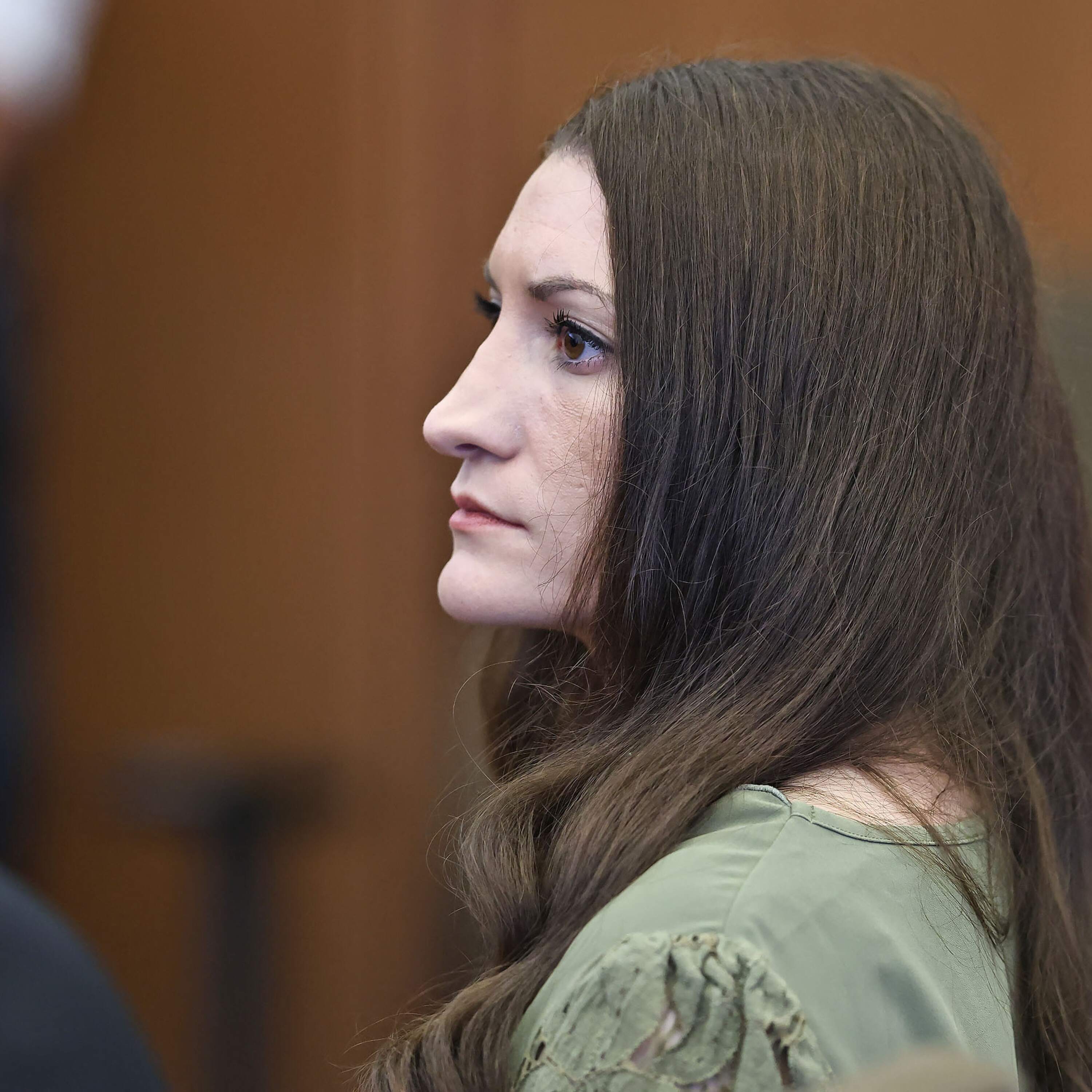
About this episode
Up First from NPR is made possible by:
On this episode of The Sunday Story, Ayesha Rascoe talks to WBUR’s Deborah Becker, who was at the courthouse for the duration of the trial. She explains why this trial ended without a verdict – and what the public interest in the case says about an evolving view of postpartum psychosis.
See pcm.adswizz.com for information about our collection and use of personal data for sponsorship and to manage your podcast sponsorship preferences.
NPR Privacy Policy
Get every episode summarized
Each time Up First from NPR publishes, we email you a written briefing from the transcript — the topics, who appeared, and any specific claims, with the ad reads skipped.
Email me new episodesFree for 3 shows. No card needed.
Hosts & guests

Transcript ready
439 searchable segments. Every word is indexed and playable.
Full transcript
Up First from NPR — The Clancy trial and a split over postpartum psychosis. Machine-transcribed; use the interactive transcript above to jump the player to any line.
A warning that this episode contains descriptions of violence against children and mentioned suicide. Please take care while listening. I'm Ayisarasco and this is a Sunday story from up first. The murder trial of Lindsay Clancy ended earlier this month. She's the Massachusetts mother accused of killing her three small children in 2023. Her attorneys argued that she was not criminally responsible for those deaths because at the time she was experiencing postpartum psychosis. The prosecution said that she intentionally planned the killings. The trial provoked an intense debate over how we treat the mental health of new mothers and ultimately the jury was unable to reach a verdict. At this point, I'm going to declare that the jury is deadlocked and I'm going to declare a mispronouncement.
Deborah Becker is a correspondent at WBUR in Boston. She covered the trial from inside the courthouse in Plymouth, Massachusetts and she joins us today to talk about the case, the arguments of both sides, the jury's inability to reach a unanimous decision and what it all means for Lindsay Clancy and for how the court of the public perceives maternal mental health. Stay with us. This message comes from Schwab. With the new Schwab Teen Investor account, teens can gain hands-on investing experience. It's co-owned by you and your teen so you can monitor the account while your teen learns how to invest and manage money. Learn more at Schwab.com. This message comes from BetterHelp, imagining carrying a backpack every day, inside it, every conversation, every mistake, every expectation.
It is easy not to notice how heavy it is until someone asks if you want to put it down. Sometimes feeling better starts exactly like that. Better isn't one size fits all. Better is personal. It's therapy tailored to the individual to help lighten what you carry. Match with a therapist who truly understands. Visit BetterHelp.com slash NPR. This message comes from Mint Mobile. If you're tired of spending hundreds on big wireless bills, bogus fees and free perks, Mint Mobile is for you. Shop plans at MintMobile.com slash switch. Taxes and fees extra. See Mint Mobile for details. We're back with the Sunday story. I'm talking to WBURs, Deborah Becker, about the Lindsay Clancy trial. Deborah, thank you for joining us today. Thanks for having me. So I know you've covered a lot of trials, but I would imagine this one was particularly hard.
For those who haven't been following, can you remind listeners about the facts of this case? Yeah, it's a tough one. But Lindsay Clancy, who's now 36, was tried on three counts of first degree murder in Plymouth Superior Court for strangling her three children in 2023. Her daughter, Korra, was five years old. Her son, Dawson, was three years old, and her third child, Callan, was eight months old. The children's father and Lindsay Clancy's then husband, because they've since divorced, Patrick Clancy, discovered the children in the basement of their home when he returned from errands that Lindsay Clancy had asked him to run. He testified for the prosecution and said that his now ex-wife had been struggling with her mental health for months. On the day of the killings, he said, when he left home to pick up, take out and stop at the pharmacy, he said he wasn't concerned. Here's part of his testimony when he was questioned by assistant district attorney, Jennifer
Bragg. Is she telling you she was having thoughts of harming the kids? No. Did she ask for help or anything that caused concern? No, she's having one of her best days. One of her best days. But then Patrick Clancy said when he returned home, he found his wife badly injured in their yard, where she landed after jumping from a second story window during a suicide attempt. She remains paralyzed from the waist down. Patrick Clancy called 911 and then he found his children strangled in the basement. Now this trial hinged on whether Lindsay Clancy understood at the time, whether killing her children was wrong, or that her mental state made her unable to control her behavior. Her defense attorney, Kevin Reddington, argued that Clancy had been suffering from postpartum psychosis, and her mental health was exacerbated by multiple prescriptions. The damn medicine and the lousy medical care that she got.
Now Reddington claimed that Clancy was in the throes of a psychotic delusion and that she should not be held criminally responsible for her actions. But the prosecution argued that she was in control that day. She was able to drive a car, they said, communicate with her daughter's pediatrician and send her husband out on errands. They say she deliberately planned to kill herself and her kids. Assistant District Attorney Sprague said Clancy's crimes should be considered extreme cruelty and atrocity, which is required for a first degree murder conviction. She left them discarded on the basement floor like broken toys because she was done playing the game. Now both sides did agree that Clancy was a devoted mother who was mentally ill, where they disagreed was on whether her mental illness made her unable to conform her conduct to the law. Deborah, why did they charge her with three counts of first degree murder and not, you know,
manslaughter? Well, they never clearly said why they went with first degree, as opposed to lesser charges. They did say that the first degree charges were appropriate for this crime because three children were violently murdered. But the consequence of their decision to try her for first degree was that this had to be a trial with a jury. In the state of Massachusetts, that's required lower charges can go before just a judge. And the DA has gotten a lot of criticism because if he'd taken a different approach, it could have resulted in a judge mandating treatment for Clancy rather than prison time. And this all ended in a mistrial. Before we get into the jury's decision making, Deborah, could you take a look at this? Tell me about the diagnoses at the heart of this case. It seems like this case really struck a chord with so many people and had so many eyes on it because of the mental health issues. The defense said that Lindsey Clancy was experiencing.
And the fact that a lot of people seem to think that she was failed by the medical system. Yeah, almost from the beginning, this case really turned into an examination of mental health care, especially for new mothers. And it really laid bare a lot of the inadequacies and lack of clarity, really, about what is going on with new moms amid huge hormonal and life changes. Even the experts didn't agree on the definition of what the postpartum period is. The prosecution said it's up to four weeks after birth and that's as stated in the DSM. That's the diagnostic and statistical manual of mental disorders that psychiatrists use to diagnose a patient. And the prosecution maintained that because Clancy killed her children after that four-week period, remember she had given birth to her third child eight months prior, they said she was not in postpartum psychosis. And prosecution experts said she may have had bipolar two disorder and she was depressed,
but not psychosis. The defense, of course, challenged those experts and then questioned their expertise in postpartum mental health. So, what is the difference between depression and psychosis? Well, according to the National Institute of Mental Health, depression is a mood disorder. It's generally a persistent feeling of sadness. Postpartum depression is said to happen to about one in seven new mothers. Postpartum psychosis is not as common, occurring in one to two of every one thousand births. And that's according to the Cleveland Clinic. And basically, psychosis is losing touch with reality. And several postpartum experts say it's not well understood, but it can be treated if it's successfully diagnosed. Now, postpartum psychosis is not listed as its own illness in the DSM, although advocates are feverishly trying to change that. I spoke with Dr. Arouj Kamal Header, who's an academic perinatal psychiatrist about this.
She says more people need to be educated about the symptoms of postpartum psychosis because it's often misdiagnosed. There is a dangerous misconception that the mom has to be hallucinating aliens or sealing her baby, but really it's the quieter symptoms that we miss. I also spoke with a mom who experienced postpartum psychosis. Her name is Megan Cliffall. And she said one day when her second child was eight months old, she lost touch with reality. It's wild how quickly it happened and also how, in my case, how logically I was acting, but in a diluted reality. She said she went to work that day and she was functioning, but her thoughts kept spiraling. And I went to sort of from feeling a little off all day to suddenly believing people were watching me. And so my brain is essentially taking all of these little details and knitting them together into this new alternate sense of terrifying truth where in the entire city is out to get
me. Cliffall says she was hallucinating and she thought that if she proved that she would jump off the roof of her New York apartment building, she might save herself and her children. She ended up physically fighting with her husband when he tried to intervene. My husband's got our two baby girls in our bedroom and I punch him in the face trying to get to them. I run to the door of our apartment building and say, I just need to go to the roof. In my mind, I was thinking if a showed I'd be willing to jump from the roof, that would just showing I'd be willing would prove my loyalty and sort of save us. Her husband then called the police. I was handcuffed on the floor of our Lower East Side apartment. My kids were artfully distracted by watching Elmo in our bedroom. She was committed to a psychiatric hospital for 12 days and started taking medication, but it was a while before she got a diagnosis. It took about two months and only when I was in the seat of a reproductive psychiatrist
for somebody to say you had postpartum psychosis. That moment of somebody naming it was so helpful to me. Cliffall was successfully treated and went on to have another child. Postpartum psychosis is what Clancy's lawyer argued that she was experiencing when she killed her children. The defense pointed out that other medical experts define the postpartum period differently in some cases up to a year after birth. Their experts included forensic psychiatrist Dr. Philip Reznik. He's an internationally known specialist on the risk of violence and what's known as malingering, meaning someone is exaggerating or faking mental illness. He testified via zoom during the trial and he said Clancy was definitely experiencing psychosis. She was hearing a voice which was commanding her to engage in the killing behavior and
she did not feel any sense of control. She felt that she had to obey. Now the prosecution called several of Clancy's healthcare providers to the witness stand and they said they never diagnosed psychosis. But on cross examination the defense criticized her providers for not managing her care well and not being aware of all of the ways Clancy had been trying to get help from multiple providers. So how was Clancy trying to get help? Well, what we heard from the clinicians and her family members and her medical records was that she tried prescriptions for several medications. She extended her maternity leave from her job as a labor and delivery nurse. She checked into McLean Hospital, a psychiatric hospital for inpatient treatment just weeks before the killings and was released after spending five days there. She went to a day program for outpatient care but she wasn't eligible.
She went to the emergency room and she called to suicide hotline twice. And really what emerged from all of this was that Clancy was responsible for managing a lot of her own care, recording her prescriptions, monitoring side effects, finding appropriate providers. And while she sometimes appeared fine, she would also repeatedly tell her family that she was getting worse. And what was the prosecution's response to that? They argued Clancy had ample access to care but sometimes disregarded her provider's advice. Switched providers are stopped taking certain medications. They said she wanted to take her own life but didn't want to leave her children. And during this dueling between both sides about her mental state, there was a lot of really hard emotional testimony from Lindsay Clancy's ex-husband, her mother, her former mother-in-law, her sister-sponder who arrived at the scene.
And Lindsay Clancy sat in court, paralyzed in her wheelchair, often with her head bowed. Several times she became very emotional. There were times when court was actually postponed by the judge because Clancy broke down sobbing when listening to details about the children's deaths. And I would say perhaps the most gut-wrenching moment was when the prosecution played Patrick Clancy's 911 call the night of the killings when he arrived home to find his wife on the ground outside in his children in the basement. That audio was not shared publicly but it was played at the trial for the jurors and it was very harrowing. And that 911 call is something that I don't think I'll ever forget. I've covered a lot of trials and I don't think I ever cried during a trial.
But that call was so disturbing. He was literally on the phone and you could hear him trying to keep his wife stable while he waited for first responders. And then when they arrived he ran in the house and his phone was still on. He was still on the line with the dispatcher. And you heard him discover his children strangled in the basement and he was just howling. It was awful. After the break we take a look at the one-hold-out juror who reportedly kept the jury deadlocked and the media frenzy and the online conspiracy theories that have surrounded this trial. When I started feeling the amount I wrote my signature on each one and then he said, but I'm still not going to say that she's not guilty by reason of incident. Stay with us.
This message comes from Schwab. With the new Schwab teen investor account, teens can gain hands-on investing experience. It's co-owned by you and your teen so you can monitor the account while your teen learns how to invest and manage money. Learn more at Schwab.com. This message comes from Jerry. Car insurance gives drivers plenty to be skeptical about. Jerry gives them a way to check. Jerry shop's rates from over 100 insurers so drivers can review their options and switch all in the app. No spam calls, no hidden fees. Jerry has saved drivers over $1 billion on car insurance. It has 4.75 stars on the app store and over 5 million drivers. Still skeptical? There's only one way to find out. Download Jerry today. Support for NPR and the following message come from GoodRx. With GoodRx Companion, members get over 250 medications for free. Plus discounts on dental, vision, labs, and more through the GoodRx Companion Network. Free medications are subject to change, terms apply, savings vary based on provider, service,
and geographical area. GoodRx is not insurance. Cut costs, not care. Go to GoodRx.com slash Companion. We're back with the Sunday story. I'm talking to WBUR's Deborah Becker about the Lindsey Clancy trial. Deborah, tell me about the last days of the trial. I saw that the jury returned twice without a verdict and that each juror had an individual conversation with the judge. So what happened? How did we get to this outcome? There was a lot of drama. The jurors deliberated for about 38 hours and they weren't able to come to a unanimous decision. When Judge William Sullivan said he was going to declare a mistrial, Lindsey Clancy's attorney asked for an emergency stay. He asked to have one juror removed. I mean, I can a defense attorney do that. Like, why did he ask for that? He said the jury for person had reported that one hold out juror of the 12 would not
follow the law on reasonable doubt. And that was what was preventing a unanimous decision. So the defense made an 11th hour appeal to the state Supreme Judicial Court to try to get that juror removed, but a single justice of the high court declined to get involved and the mist trial was declared. What do we know about what the other jurors were thinking? Well, actually, since the trial ended, some of the jurors have spoken out about what happened. They all backed up the defense claims that there was one hold out. They said one man told the other jurors that he had reasonable doubt about whether Clancy was criminally responsible, but he would not go along with the other 11 and issue a verdict of not guilty by reason of insanity. So they were left without a unanimous verdict, deadlocked and the mist trial was declared. The judge sealed their names for two weeks, but some of them appeared on camera, including the four person who told NBC 10 Boston that she was frustrated that one juror was actually
holding out. He admitted he had reasonable doubt and I started filling out the forms. I was so excited. I actually did with three forms I had a fill out and I started filling them out. I wrote my signature on each one and then he said, but I'm still not going to say that she's not guilty by reason of insanity. And the mist trial announcement was really emotional. Many of the jurors were visibly upset. Some dabbed their eyes or covered their faces, but Judge Sullivan thanked them for their work during the seven weeks of this trial. I watched every day, day after day, week after week, all of you performing that duty they embraced for. So that's inside the courtroom. What about outside? How did the public react? There was a big reaction. There are many people who were there following the trial for days and weeks on end.
I spoke to several women who were outside on the day of the mist trial announcement. Sue Hatfield from Massachusetts had been there for several days over the course of weeks. She was among the folks I spoke with. I'm disappointed. It feels unfinished. It feels very anti-climatic either way, whichever way it could have been. It's very yeah. And this wasn't the first time there was a crowd outside the courthouse, right? Like this trial got a lot of attention. Right. A couple of weeks ago, about 400 people, mostly women dressed in pink. That was the color to signify support for Clancy. They stood outside the courthouse. Many of them were wearing buttons saying they were, quote, standing with Lindsay, some carried signs saying things like, you're a good mom or the system failed you. The lead organizer is a woman, Renee Kimball of Maine. And she said she spontaneously decided to organize the demonstration after watching the trial
and hearing about Clancy's repeated attempts to get post-partamental health care. I think that every one of us women believe that it could be any one of us. Any one of us who have dealt with mental health, anxiety, depression, post-partum, I think we just know that any one of us could be sitting in her chair and it should not take for it to get to tragedy. There was also a call from counter demonstrators who have shown up at the courthouse here. They say that people need to remember the children who were killed. The counter demonstrators have been a much smaller group than those in support of Clancy. Deborah, why do you think this trial has garnered so much national and even international attention because it seems like this kind of took people like the court and others by surprise. Absolutely. Well, the proceedings have been live streamed so people could watch them every day.
And this case had aspects of the kind of true crime thriller that many people in this country seem fascinated by the media pool included. In the last days of testimony, there were long, long lines to get into the courthouse. I mean, I had to get here before 7 a.m. many days to even get through security before the court doors opened at 830 and the trial started at 9. The networks have several reporters and producers. There are YouTubers, influencers, documentary film producers. Some networks are said to be negotiating for the first interview with Lindsay Clancy or her family members. Every day, lots of ordinary people, just members of the public, also were showing up here to get inside the courtroom. I met women who flew here from other parts of the country just to be inside for the trial. For closing arguments, the court had to set up a special overflow room for the public.
Online, there were so many conspiracy theories, blood spatter analysts, all kinds of who done it talk. And theories that Patrick Clancy wasn't truthful about what he discovered that night. There's just been so much discussion about this. I think it really did sort of overwhelm and surprise people. Well, yeah, I mean, I saw a lot of stuff on social media and people with all sorts of theories, right? But when it happens like that, when you're seeing all these people talking on the internet and coming up with all sorts of theories, it is a space that's right for misinformation. Right. It was astounding to be in court every day and then read what people were posting online. But it shows how hard it is in this fractured media information landscape to really stick with facts because those things can get repeated and really misconstrued.
And all over social media, I would say that the attention on this case really got people talking about mental health care across the country. Deborah, before we get to that, like, was the jury shielded from all of this media? Firestorm? Like the jury wasn't sequestered in this case, right? Right. No one requested sequestration. I think no one realized how big this was going to get. It feels like the discourse online has moved past mental health into some bigger questions about motherhood, the expectations of motherhood and how mothers should behave. Do you think this trial is going to move the needle on anything? Could it change the conversation about maternal mental health and the kind of pressures that we put on new mothers in our society?
Well, I think it's hard to know right now. I would want to point out that Patrick Lansy and Lindsay Clansy's family have filed competing medical malpractice suits against her healthcare providers and depending on how those go, there may be improved care in the future. Many people who've attended or watched this trial say they're energized to work on making improvements in post-piredum care. And there's been vehement debate at the courthouse and online about about motherhood. Some say three children were violently killed and a mother's mental health is not relevant. Others say the expectations of mothers to be the nurturing primary caretaker at all times can really get in the way of moms admitting that they need help. They might worry their children could be taken away, for example, or just feel that they're inadequate because they're having a hard time handling all the changes that come with caring
for a new baby. But all the media attention, it probably has made a difference. I've spoken with folks from the group post-piredum support international at the Massachusetts chapter and they told me that calls from Massachusetts have increased substantially since this trial began. And Iisha, one thing also during this trial, a similar case came back into the news. The state's highest court ordered a new trial for LaTarsha Sanders, a black low income woman who was convicted of killing her two children in 2022. The high court ordered the new trial because the judge did not allow her mental health records to be presented as evidence. And the same district attorney will decide whether to retry that case as well. Wow. Okay. So, Deborah, what's next in the Lindsey Clancy case? So theoretically, there could be another trial. The district attorney has to decide if he will retry the case and whether it will be on the same or lesser charges and whether it would require a jury.
He could also negotiate a plea deal. Plymouth County District Attorney Tim Cruz says he hasn't decided yet, but he did say his office is responsible for seeking justice for the three children that Lindsey Clancy admitted that she killed in 2023. And Cruz says he realizes that a lot of important topics were raised during this trial, such as the difficulties getting adequate post-partum mental health care, but he said those are not the issue here. This office's job is to prosecute crimes. And in the meantime, Lindsey Clancy remains in a state hospital pending next steps in the legal process. If she had been found guilty, the prison could have said her mental health needs were more than they could accommodate, and they might have to keep her in a medicalized unit. If she was found not guilty by reason of insanity, she'd remain at a state hospital. Maybe the same one she's been at for more than three years, maybe another. And she'd stay there if she was not guilty by reason of insanity, but there would be
annual reviews as to whether she could be safely released. And in terms of the attention this has gotten, there is movement underway to get a law passed in Massachusetts to have new moms who are charged with crimes go to treatment instead of into the criminal legal system. Right now, the only other state that does this is Illinois. And the proponents of the legislation say this trial has really increased momentum for the bill to move forward. Deb, I know that this has been a rough trial to cover, but it's such an important topic. Thank you so much for sticking with it. Yeah, it was grueling and complicated, and thank you for giving me the time to explore some of the issues here. This episode of the Sunday Story from Up First was produced by Rinne's Vernoski, Liana Simstrom, and Irene Nguci edited this episode.
The Sunday Story team includes Andrew Mombo, Jenny Schmidt, and Justin Yan. Jimmy Keely mastered this episode. I'm Aisha Roscoe up first is back tomorrow with all the news you need to start your week until then have a great rest of your weekend. This message comes from Donors Choose. Right now, there's a student that needs something. Maybe it's books, art supplies, or a science kit that will unlock their learning potential, and you can be the reason they get it. With Donors Choose, you'll fund real classroom projects from real teachers, so your gift goes exactly where it's needed most. Because when students start with what they need, they're ready to build confidence, discover new ideas, and succeed all year long.
Give what students need right when they need it at DonorsChoose.org slash local. This message comes from the Conservation Fund, protecting at-risk land before it's lost. The forests, farmland, open spaces, and places that wildlife call home. They believe conservation shouldn't be a choice between protecting nature and supporting people. It should advance both in harmony. With over 9 million acres protected across all 50 states, the Conservation Fund secures the irreplaceable lands people love. Learn more at conservationfund.org.
More episodes
More from Up First from NPR

BRICS Summit in India, Amazon Air Plane Crash, Federal Film Tax Bill
Up First from NPR
Remembering 9/11, Republican Midterm Convention Wraps, SCOTUS Missouri Redistric...
Up First from NPR
Trump Convention Speech, Missouri Contempt And Redistricting, Apple's Foldable i...
Up First from NPR
US Strikes Iran Oil Tankers, Israeli Settlements Sanctions, Smithsonian Head Ret...
Up First from NPR