About this episode
David Streitfeld, Pulitzer-prize winning reporter covering tech for The New York Times, explains the landmark trial regarding social media addiction, brought by a 20-year-old woman against Meta’s Instagram and Google’s YouTube for optimizing their products to her mental and physical detriment.
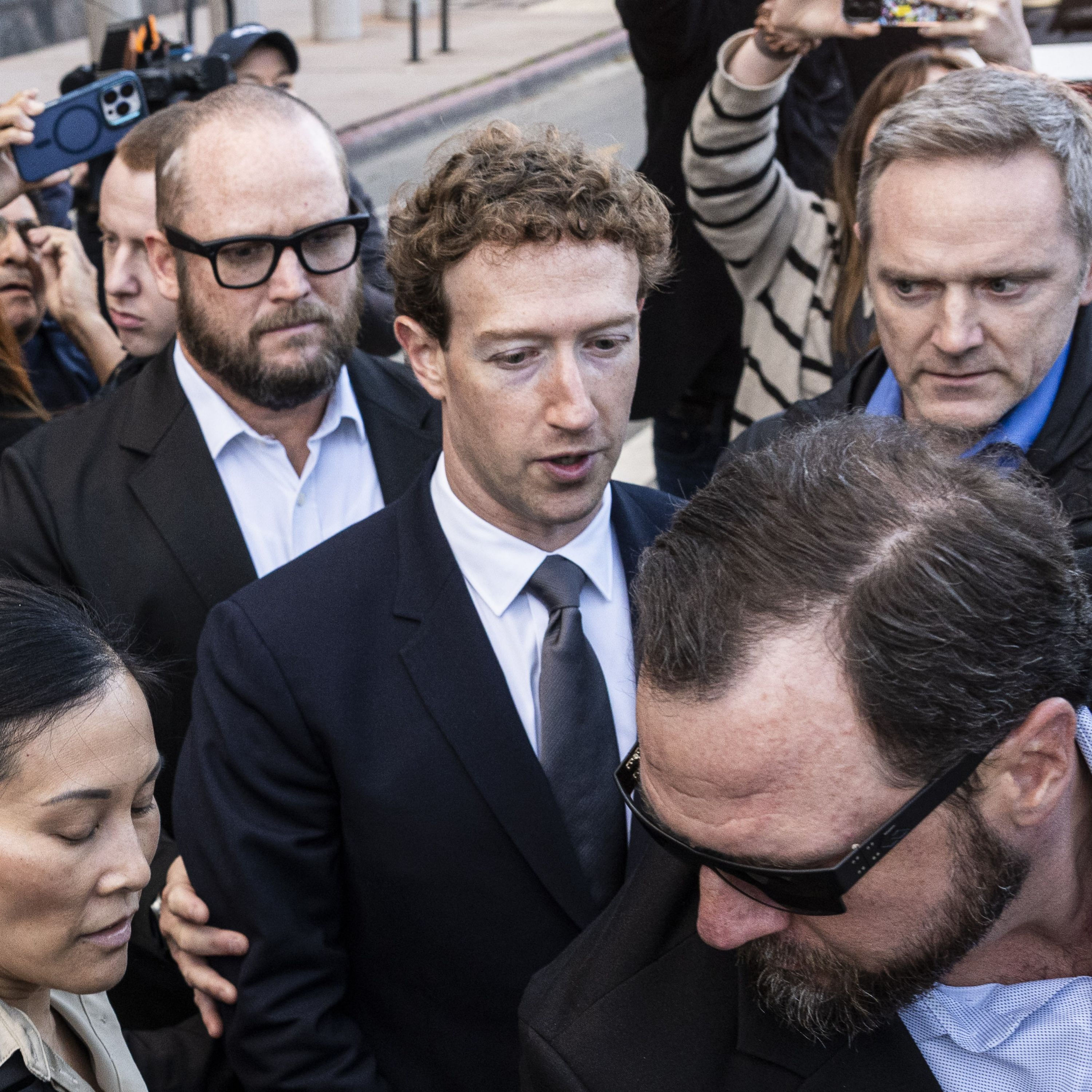
Photo: Meta CEO Mark Zuckerberg leaves the Federal Courthouse in downtown Los Angeles after defending the company in a landmark social media addiction trial in Los Angeles, United States, on February 19, 2026. (Photo by Jon Putman/Anadolu via Getty Images)
Hosted by Simplecast, an AdsWizz company. See pcm.adswizz.com for information about our collection and use of personal data for advertising.
Get every episode summarized
Each time The Brian Lehrer Show publishes, we email you a written briefing from the transcript — the topics, who appeared, and any specific claims, with the ad reads skipped.
Email me new episodesFree for 3 shows. No card needed.
Hosts & guests
Transcript ready
491 searchable segments. Every word is indexed and playable.
Full transcript
The Brian Lehrer Show — Social Media's Addiction Trial. Machine-transcribed; use the interactive transcript above to jump the player to any line.
WNYC Studios is supported by Odoo. When you buy business software from lots of vendors, the cost's at up and it gets complicated and confusing. Odoo solves this. It's a single company that sells a suite of enterprise apps that handles everything from accounting to inventory to sales. Odoo is all connected on a single platform in a simple and affordable way. You can save money without missing out on the features you need. Check out Odoo at odo.com. That's odo.com. It's the Brian Larosho on WNYC. Good morning again everyone coming up later in the hour. Sam Sanders and you on anything from the Oscars last night. But now we turn to what's being seen as a landmark trial regarding social media addiction. After a month of hearings, jurors are now deliberating on whether or not social media companies
should be liable for harm caused to children. It was brought by a 20-year-old woman this lawsuit against Metta's Instagram and Google's YouTube for optimizing their products to her mental and physical detriment. And though it's not getting all that much coverage, legal scholars like Columbia's Tim Roof for example and many media outlets are comparing this trial at least potentially to the big tobacco trial from more than half a century ago, which ushered in more successful lawsuits against tobacco companies, a lot of money that went into anti-smoking programs and helped move Americans away from smoking tobacco. Joining us now to break down the trial and what it all could mean for the future of social media is David Streitfeld, Pulitzer Prize-winning reporter covering tech for The New York Times. Hey David, thanks for coming on. Welcome back to WNYC. Hi, thanks for having me. So the plaintiff, in this case,
is identified as Kaylee or KGM. Her initials in Los Angeles County Superior Court documents though they're keeping her full identity anonymous because of her age. The lawsuit accuses Instagram and YouTube of making content deliberately addictive to children. Can you give us the outline of her case? The argument is that she had a bad childhood and social media made it worse. Her lawyer equated the social media companies to drug pushers. The pusher in your local park just wants money for his drugs. He doesn't care if you have to rob your grandmother to do it. And so Kaylee is arguing that social media was designed, was built to steal her attention to a dictator and that it did and that it broke her. And this was a very bad thing to do to a young child.
Does she say how it broke her? The argument is that these social media, the platforms are designed to addict you, to compel you to stay on hour after hour after hour. Things like the continuous feeds. So you're on Facebook or almost anything else and you can never get to the bottom of it. I mean, if you're reading a magazine in the real world, sooner or later you get to the last page. But on social media you never get to the end and you keep getting these little dopamine hits to keep going. And so you just stay on it. So it is designed to keep her on it. That's the argument to her detriment. To her detriment in terms of being able to succeed in school or her self-image in some ways
or what detriment? Being able to function in life. It, I don't think the argument is that it is literally ruining her life. The argument is it is just keeping her online all day long. And she's talked about being online for 16 hours. And that by definition is hurting her. YouTube and Instagram are the two social media platforms. She's focusing on is she alleging different kinds of harm from each? Most of the focus is on meta, which owns Instagram. It's not really on Facebook. She wasn't on Facebook. And YouTube is definitely the less important defendant here. YouTube maintains that it's not really a social media company at all. So it's argument is that it really
shouldn't even be part of this trial. The focus is definitely on Instagram. And one of the other ways that they push back I've read is that Kaylee had a very troubled home life to begin with. And so there were so many factors in her family or a few big factors in her family impacting her mental health that they can't even tease out what effect social media had or blame social media primarily. Can you flesh that out for us a little bit? What do we know happened in her childhood? And how is it coming up in court? Her childhood was very difficult. Her father left home when she was four. She did not have a stable father figure. There's a lot of abuse, a lot of yelling, a sibling I think who tried to commit suicide.
It was a life filled with trouble so far. The way I see it is this is putting two contrasting philosophies that are deeply ingrained in this country. They're putting them up against each other. One is that if you have something wrong with you or something's going wrong in your life, there is someone responsible, a government, a company, a shadowy coalition, and you need to hold them to account and punish them for it. And that's essentially what Kaylee is arguing. The other argument is the one that the companies that are defendants are using, which is your life is up to you. You're in control of your life. If you're an addict, it is your fault.
And you should know or your parents should know that at a certain point you've just kind of turn off social media or you've got to turn off the phone. So we're not the blame here. We're just offering a service that nearly everybody likes. Is this plaintiff the best possible plaintiff? For this case, if this is such a landmark that it's supposed to set the template for more than a thousand other cases that are waiting in the wings is what I read. If this plaintiff had a particularly troubled childhood where there might be more evidence than with some other people that her home life was the primary driver of mental health problems, is she the best possible plaintiff here? Well, I see your argument. But on the other hand, if you had someone who was a model student who had lots of friends
who goes to Harvard and is a huge success there, the companies would argue, hey, what's the problem here? Social media, it's great. This woman's at Harvard now. So I understand why the lawyers chose her. We'll see shortly if the verdict goes against the companies. Taley was a great choice for the first plaintiff here. If the companies don't suffer much or don't suffer at all, she'll be a bad plaintiff. Listeners, you want to lay in here or ask our guest, David Strickfeld, tech reporter for the New York Times, a question as we lay out this case in Los Angeles and the claims of the defendant that social media companies have caused her mental and physical harm to 1-2-4-3-3. WNIC, 2-1-2-4-3-3-9-6-9-2.
Call or text, is this resonating for you? Especially if you're in Kaley's age group and have really grown up with social media and think, oh, yes, this sounds like me or this sounds like someone I know or parents of people in the age group. 2-1-2-4-3-3. WNIC or any lawyers for that matter on this. 2-1-2-4-3-3. WNIC, 4-3-3-9-6-9-2 on the social media trial. Now, I guess, in the hands of the jury, right, David and LA? Right, and it was in the hands of the jury all day Friday and the usual thinking, anything can happen, but the usual thinking is if the jury's just going to say, we do not think the defendants are at fault here and the weekends coming and we want to get our lives back, they tend to do it relatively quickly, efficiently on a Friday.
They're meeting again today and so, you know, again, anything can happen, but this bodes a little less well for the defendants. Would a win in this case for the plaintiff actually change the way platforms deploy certain tools like infinite scrolling? That's an Instagram thing, keeps going to the next thing, and auto-playing videos on YouTube, or is it more about the fact that individual users can now seek damages in individual cases? Well, it will be if the verdict goes sharply against the social media companies, it will definitely be at least a symbolic defeat for them, which they rarely have, and they will be vulnerable at least to public pressure. Legally, I'm sure they will instantly appeal,
that will take a while, and these cases do get into first amendment concerns. And probably on appeal, the first amendment side of things will be front and center, and that's gonna be a barrier for the plaintiffs. So, just like anything else in America, this will be litigated for probably quite a while. Listen to rights. This lawsuit is reminiscent of the tobacco case, but that case seems stronger as there was abundant information around in the 80s regarding the harmful effects of smoking, but there seemed to be no loud guardrails, protecting children from social media 20 years ago. Actually, I'm not sure if this text is making the case that the argument is stronger here or stronger there. It's a little confusing to me. But what about these comparisons that are being made in many places with the lawsuits against big tobacco?
There is some comparison, but with big tobacco from the beginning, meaning the mid 60s, you had the government on the side of the critics. The government came out and said, we have determined that smoking is bad for you. And that really helped all the private lawsuits that helped the shift in public opinion. But even so, it took 10, 15, 20, 25 years until things like smoking on airplanes was completely eradicated. So it's a slow process even for tobacco. With social media, the companies who are even richer than the tobacco companies were. And it's somewhat harder to see the effects of what's going on. There's a lot of evidence that students
are not doing as well. School that children and adults have fewer friends now. They go out less outdoors, all things like that. But you can't really definitively connect them to what social media is doing the way you soon could connect one cancer to cigarettes. So there are some parallels, but social media in the best scenario for its critics is going to have a tougher road. Some texts coming in, Listen to Rights on 33 and can relate to her even as an adult. I see how it affects my mental health. I had to delete Instagram because it was a dictating and I'm much happier. Now, Listen to Rights. Gen Z here. If there's one thing I wish I never picked up at social media, you can quit vaping. Similar, Gen Z, Vice, but social media is so embedded in our lives.
Now, Listen to Rights. I agree with the premise of Ryan's query, the particular question I asked earlier. Listen to Rights. A representative from a healthy home environment who nevertheless went off the rails would present a stronger case and heaven knows there are many such young Americans. Maryland and mountain lakes, you're on WNYC. It's hi. Thanks for taking my call. I really affirm the addictive process, the addicted nature of the social media. And I know it's hard to prove, but in the meantime, my whole thing is to protect kids because I heard once that addiction is a disease of loneliness and isolation. And nobody wants kids going through that. So I support the case and I hope it brings attention to the suffering that's caused, because addiction takes money, time, and relationships away from people's lives. Thanks for listening. You told our screener you're a therapist.
Can you tell any kind of anecdote? Oh, yeah. I mean, I have so many clients, and it's hard. It's like an invisible addiction. And so there was a lot of work on, you look at the effects. You can't always prove the causes, but you look at the effects. And when I said, you know, it takes time, it takes money, and it feels relationships. You know, folks have, I just had one person in particular. They had to find a group to get the kind of recovery that we get from AA or I'm in a program for food addiction. You know, they had to get into a group to get the recovery they needed. So if you need a group to recover from an addiction, you have an addiction. Nobody joins one of those groups to say, oh, I just need a little help. We, y'all, because we need to get help emotionally, physically, and spiritually, of pure support in getting rid of this addiction. So yeah, I just, I really, I really hope people will take this very seriously. And in the meantime, in the meantime, the parents will really be finding alternatives
and really spending more, you know, time than with their kids. Time and attention, presence. On this. Thank you so much for your call. Listen to right, I teach in this topic an important similarity to the tobacco cases that social media companies in particular met did their own internal research that demonstrated a negative impact on a large portion of teens' mental health. And listeners, maybe some of you heard the excellent New Yorker Radio Hour interview with the author Jonathan Height, who's very much on this topic this weekend. And David, I don't know if you're familiar with some of what he was revealing to David Remnik there. But part of what he was citing was documents from Meta, and I think also another company, where people who were working inside were basically doing what this listener writes, acknowledging that there was a negative impact
and that it could be seen as addictive. I don't have the exact words. But I don't know if those kinds of documents came up in the trial. They were interesting for me to hear in the interview. They've come up in the trial. And frankly, they've come up fairly frequently for Meta over the past, whatever, seven, eight, nine years. There's been whistleblowers. There's been reports that have leaked from inside. There's been tell-all books. And somewhat to my surprise, none of this has actually created any sort of a mass movement to reign in Meta. And you always hear people saying these companies, social media, is addictive.
But I'm always puzzled that if many people felt that Congress always responsive to what its voters are thinking would be acting to control social media. And either the number of people who feel it's a problem are a minority, or I don't know, I don't know, but I don't know, but I don't know how the, with cigarettes, the society moved away from smoking. And I don't feel that starting to happen with social media yet, for whatever reason. Joyce in Manhattan, here on WNYC, hello. I have a couple of points that I'll make for the government to be able to respond to the response of the line. But Australia, I believe,
made social media illegal for people under 16 or something. They must have done that with good reason and some proof of detrimental effect. I also, just regarding what their guests just said, I don't see the Congress has acted for the majority of American views and I did see all the social media guys standing behind, you know who, at the inauguration, because they're obviously giving money so they get a lot of money. So I don't think that's a strong point that if the population was against it, Congress would do something. Look at the world we're in now. Okay, thank you. Joyce, thank you very much. I wanted to that point. We have another caller who we're not going to have time to get to, but Mike and Bayshore, I see you, call us again on something else. But Mike is saying, this is too evil is battling.
I don't think social media should be brought to heal by the torch system. But I guess Joyce's call is kind of a response to that without even knowing that he was on the line. The torch system may hear maybe kind of a last resort here because the social media companies have so much power over the government that would otherwise make laws like Australia did, that this is what people have to resort to, civil suits. Can you compare Australia and the United States in this respect? Well, Australia certainly went ahead and did something. It's unclear, first of all, what effect the law is having, how many people are following it, and it's going to be many years before we know if the law actually worked the way the people who put it there intended. But I mean, I certainly agree
for critics of social media, this lawsuit and the lawsuits that will follow it here, there are kind of last ditch attempt to bring the companies, particularly Metta to heal. Congress didn't do it, regulators under President Trump are not going to do it, so lawsuits are their last and maybe they're only hope at this point. So as we run out of time, your article on this is headlined social media addiction trial near Zand society long ago rendered it's verdict, but your article ends all future engagement will be with the machine. On Facebook, content generated by artificial intelligence is already being prioritized over friends and family. Yikes. So connect your headline and your last line. Well, my argument is that social media
had this brief period, 10 years, 15 years, where it, if you're idealistic, had many, many things going for it. Everybody in the world could speak to everyone. And also, as this case reveals, there were many problems with it. My worry as a journalist is that social media is evolving into something that will make people nostalgic for the situation they have with it now. And there we leave it with David Streitfeld, Pulitzer Prize-winning reporter covering tech for the New York Times. We'll see any time now, I guess, the verdict of in this trial, which is in the hands of the jury. Thanks for talking about it with us. Thanks for having me. Since WNYC's first broadcast in 1924, we've been dedicated to creating the kind of content we know the world needs. Since then,
New York Public Radio's rigorous journalism has gone on to win a Peabody Award and a Dupont Columbia Award among others. In addition to this award-winning reporting, your sponsorship also supports inspiring storytelling and extraordinary music that is free and accessible to all. To get in touch and find out more, visit sponsorship.wnyc.org.
More episodes
More from The Brian Lehrer Show

Tuesday Morning Politics: State of Iran War; Home Stretch to Midterms
The Brian Lehrer Show

The CDC and Measles Deaths
The Brian Lehrer Show

History of the War on Terror
The Brian Lehrer Show

Labor Day: Working Class; White Collar Unions; Supermarkets; Summer Songs
The Brian Lehrer Show