About this episode
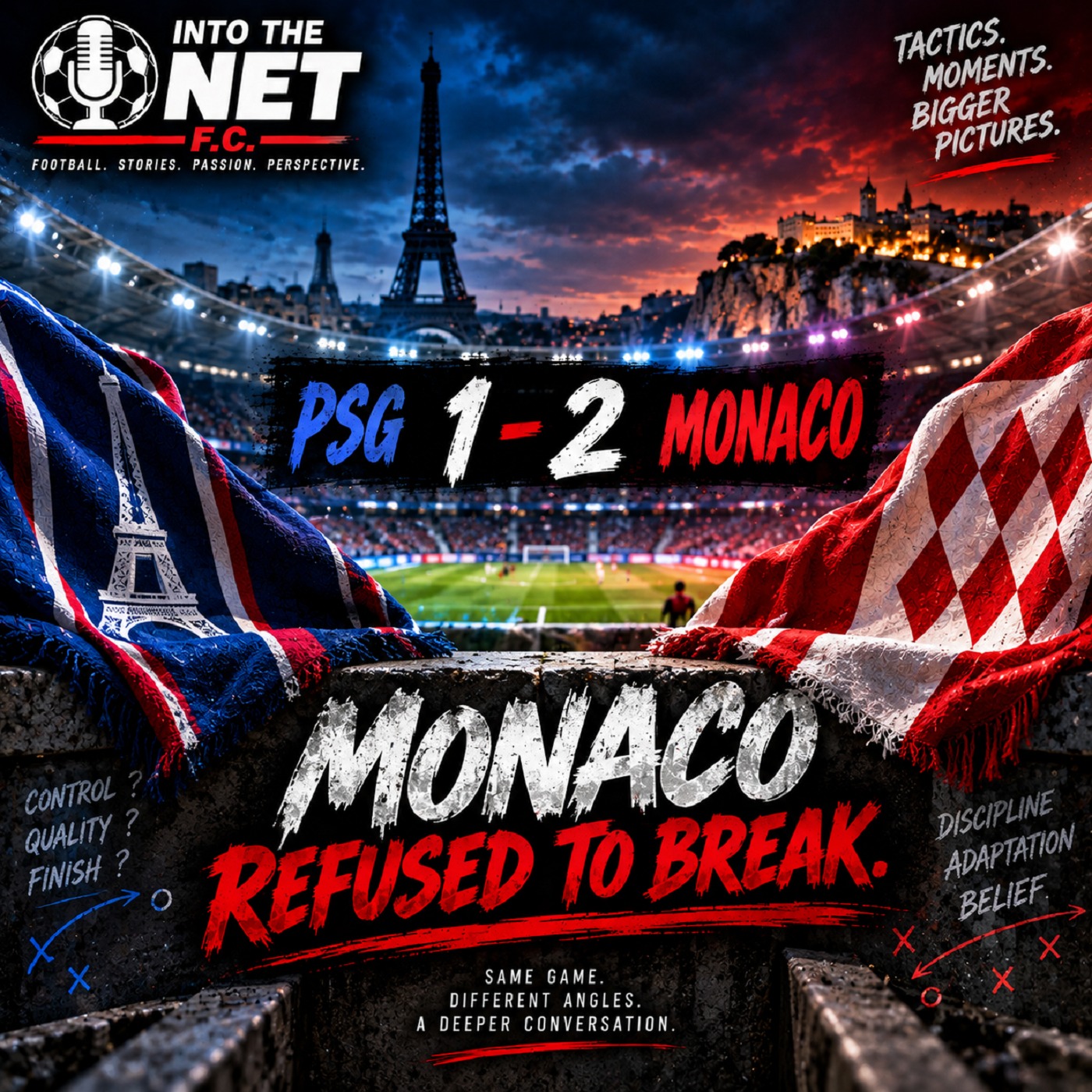
Paris Saint-Germain appeared to have the match under control, but AS Monaco refused to accept the direction it was heading. A fearless second-half response turned a deficit into a 2–1 victory at the Parc des Princes, exposing PSG’s growing struggle to turn extraordinary individual quality into complete performances while proving Monaco deserve to be taken seriously.
⚽🔥
🎧 Listen to Into Net F.C. on Spotify and Apple Podcasts — hit subscribe and turn on notifications so you never miss an episode!
📲 Follow me for more:
- X (Twitter): @BearManofTX | @BearTX_podcast
- Instagram: @thebearoftx | @thebearoftexaspodcast
- TikTok: @thebearoftexas
💪 Support the podcast and keep the content coming:
- Venmo: @BearSportsWriter
- CashApp: $AlexAlKazzaz
- PayPal: paypal.me/TheBearofTX
🙏 Every follow, share, and donation helps — thank you for being part of the journey!
Advertising Inquiries: https://redcircle.com/brands
Privacy & Opt-Out: https://redcircle.com/privacy
Get every episode summarized
Each time Into The Net F.C. publishes, we email you a written briefing from the transcript — the topics, who appeared, and any specific claims, with the ad reads skipped.
Email me new episodesFree for 3 shows. No card needed.
Transcript ready
116 searchable segments. Every word is indexed and playable.
Full transcript
Into The Net F.C. — PSG Had the Lead. AS Monaco Took the Match Away From Them.. Machine-transcribed; use the interactive transcript above to jump the player to any line.
Palais Saint-Germain entered this match searching for their first league victory of the season. Instead, A.S. Monaco, entered the Pacté-Pras, recovered from being one goal down and escaped the French capital with a tremendous 2-1 victory over Palais Saint-Germain. Marquinho escaped PSG the lead during the first half, but A.S. Monaco responded in a second half. Nazino scored the equalizer for Monaco, and then a player by the name of Stanis Udombo completed the comeback with the winning goal. This was more than a surprising result. It was merely a demonstration of Monaco's courage, discipline and ability to adjust during difficult matches, but for PSG, it was simply another warning. Their individual quality remains undeniable, but right now, Palais Saint-Germain does not possess the same control, balance or authority that has defined their recent success. Ladies and gentlemen, welcome to another edition of INTO THE NET FC. My name is Alex Alcasaz, and I'm also known as the Bear of Texas.
PSG began in their familiar 4-3-3 formation. Louis and Ricca selected a midfield containing Vitinia, Jauneves and Fabien Ruiz. Gavaret Scalia started in the attack alongside Dizieré Duet and former Monaco player Magnus Atliouche. Monaco used a 4-2-3-1 formation. Dennis Zacaria and Lamin Camera protected the defense, while a player by the name of Alexander Golovin and Idombo supported Paris Brunner in the attack. I have to apologize because I mispronounced the Dizieré earlier in the intro. It's Idombo, if I'm saying it correctly. The two systems appeared similar in certain moments, but the teams wanted to use them differently. PSG wanted the ball. They wanted to move Monaco from side to side, create openings between the lines and control the match through the midfield. Monaco, however, was prepared to defend in the compact shape, particularly, but they were not interested in spending the entire evening protecting their penalty area.
Whenever they recovered possession, they attempted to move forward with speed and with purpose. Such ambition became increasingly important as the match further developed. PSG was obviously the stronger side during the first half of the game. Their passing was cleaner, their midfield found space, and AS Monaco were forced to spend long periods without the ball. Kovarat Scalia was particularly important. He attempted to carry the ball toward Monaco's defense and create uncertainty with his movement. Monaco could just not simply allow him to attack one defender at a time. When an additional defender moved toward him, space became available elsewhere. PSG's pressure eventually produced the opening goal. Kovarat Scalia created the opportunity and Marquinhos finished it. The PSG captain stepped forward and gave his team the lead. It appeared to be the goal that would settle for Paris, obviously, or at least with settle Paris. Give him confidence. PSG had controlled the match, found the breakthrough and placed Monaco in a position where they had to respond.
However, it did not become the beginning of a complete domination. Absolutely not. It became the point from which PSG slowly lost their authority. So why did PSG not finish the match, you might ask, because that simply seems to be the case. They did not finish. They didn't get the job done. PSG's failure, the greatest failure, was not conceding the equalizer. PSG's greatest failure was failing to take complete control after moving ahead. A team with PSG's experience should understand how to make the opponent feel like that, feel that the match is slipping away. And that would require keeping possession. It requires maintaining pressure, recovering the ball quickly, and forcing the opponent to defend without relief. PSG did not do that consistently enough. But I should ask, did they do that consistently at all? Because their attacks began to lose the sharpness and the moments of technical quality but not enough sustained danger.
Monaco were given time to recover mentally. They reached halftime only being one goal behind, but they were still organized and they still believed they could change the contest, which was extremely important because AS Monaco did in fact, they did in fact, eventually, changed the contest. PSG had been the better team, but Monaco had survived the most difficult part of the game. Once the second half began, the momentum had changed. Now, Monaco's second half responds, speaks for itself. Felipe Luis deserves considerable credit because his team did not emerge from halftime with a mentality of a team hoping to avoid further damage. As a matter of fact, it was the opposite. AS Monaco became more aggressive. They moved the ball forward more confidently, their wide players advanced, and their midfield began challenging PSG instead of simply reacting to them. Monaco still respected PSG's attacking ability, but that respect did not become fear. That's extremely important.
That respect never became fear, and that right there was the difference. They understood that remaining passive would eventually lead to another PSG goal, so therefore Monaco increased the pressure and began asking questions of the home side, and PSG did not answer them well if they answered them at all. The spaces between the midfield and defense became easier to attack, the control weakened, and Monaco began arriving in dangerous position with greater confidence. The match was no longer being played entirely across PSG's wishes, control, or command. One of Monaco's most important decisions arrived early in the second half, a player by the name of Jordan Teza, who replaced another player by the name of Vanderson. A few minutes later, Teza helped create Monaco's equalizer, and this was an excellent example of a substitution immediately influencing a match. Teza entered with energy and he helped Monaco become more dangerous from the right side. His contribution led to Flavio Nazino finding the goal that brought Monaco level.
Nazino had already worked hard defensively, and now he provided the attack, contribution Monaco desperately needed. The equalizer changed the atmosphere completely because PSG were no longer protecting a lead. Monaco were no longer simply chasing the match, the match was entirely open, and at that point Monaco appeared to possess the greater belief. So PSG had to react, and Luis Enrique, the manager for PSG, responded with several changes. Ferron Torres entered the attack. Luca Hernandez came into the defense. Micah Gatz and Usman Dembele were also introduced as PSG searched for greater energy and creativity. On paper, those changes gave PSG even more attacking quality, but adding talented players does not automatically restore control. The problem was no longer simply about personnel because PSG had lost their rhythm. Their attacks became increasingly dependent upon individuals producing something special. The collective movement was not strong enough, the passing was not quick enough, and Monaco were able to protect the center and force PSG into a less dangerous area.
The substitutions changed the names on the field, but that did not mean that they changed the direction of the match. So it was Edombo who completed the comeback, as we know. Monaco's winning goal arrived through Stannis Edombo. Alexander Golovan helped create the goal. Golovan found Edombo and the young attacker produced the decisive finish. It was a composed and confident moment. Monaco were playing away from home against the reigning French and European champions, and they had trailed during the first half of the game. But when the opportunity arrived to complete the attack, Edombo did not hesitate. That finished representing Monaco's entire second half performance. They were brave enough to attack, they were calm enough to make the correct decision, and they were ruthless enough to punish Palais Saint-Germain. After moving ahead, Monaco had to demonstrate a different sort of quality. They had already shown courage, but now they had to show control. PSG introduced attacking players and attempted to force an equalizer. The pressure increased as the matched approach to its conclusion, Monaco remained disciplined.
Eric Dier provided experience in the center of defense. Sadi Boo, Sane played alongside him with impressive composure. The midfield continued protecting the spaces in front of them. Zakaria gave Monaco physical strength and he gave him leadership. Camera worked beside him and helped prevent PSG from attacking directly through the center. Monaco did not defend perfectly. Against PSG, that ladies and gentlemen is nearly impossible to defend perfectly. But they defended together. Let me say it again, it's so important. They defended not perfectly, but they defended together. When one player moved toward the ball, another protected the space behind him. When PSG attempted to enter the penalty area, Monaco had bodies in position. They understood what the match required and there was no panic, no panic whatsoever. PSG began with enough technical quality to dominate almost any opponent. Fittinia can control the pace of the match. Jau Neves can play under pressure and recover possession. Fabian Ruiz can move into attacking spaces and connect the midfield with the forwards. Yet that midfield did not control the entire contest.
During the second half, Monaco had become more aggressive and the passing lanes narrowed. Specifically, Monaco became more aggressive around PSG's attack. PSG's midfielders were forced to release the ball more quickly, but the movement ahead of them did not consistently provide strong options. When PSG lost possession, Monaco attacked before the midfield could reset, which resulted in the defense being exposed. But this does not mean that PSG suddenly lacked quality. It means quality without collective control can become highly vulnerable. That defending champions are currently producing moments rather than complete performances. And that is not enough against a confident and organized opponent like AS Monaco. And of course, as we know, Bradley Bachcola recently departed by Sanjama and arrived at Liverpool. So apparently there is a bit of an effect of Bachcola's departure. This was PSG's first major examination since Bradley Bachcola completed the move to Liverpool. But one match cannot determine whether PSG made the correct decision by allowing him to leave. His absence changes their attacking options. That's for sure.
Bachcola offered direct running with, along with acceleration. He could receive the ball on the outside and immediately force a defense to retreat. PSG still possess outstanding attacking players like Kavanaugh Scalia, Desire du Wé, Usman de Mbele, along with their new additions providing tremendous quality. The issue is not a lack of talent. The issue is rather redistributing with the responsibilities. Who consistently stretches the defense? Who provides the direct run when everyone else moves toward the ball? Who changes the pace of an attack when PSG's possession becomes predictable? Luis Enrique must find those answers within this new version of PSG. PSG should not blame this defeat entirely on one departed player. However, they must recognize that removing Bradley Bachcola from the squad will require tactical adjustments. So in this contest, Felipe Luis, the manager of AS Monaco, he won the managerial battle.
This was the greatest victory of Felipe's young Monaco career. He had already guided Monaco past Olympic Dumaset. Winning at the Pacte Pass after falling behind represents another level of achievement. His most impressive contribution was not one complicated tactical invention. It was the mentality he gave his team. Monaco did not collapse after they conceded. They did not abandon their structure. They trusted the match plan. They became more aggressive after halftime and they accepted the risk that was required to get the win. The introduction of Taze also provided, excuse me, also proved to be influential. Monaco's second half performance demonstrated that the manager understood what needed to change and that his players trusted him enough to execute it. Before the match, the PSG manager Luis Enrique praised AS Monaco's manager for his courage. Monaco then demonstrated that courage against Balisange Alman.
Now, Luis Enrique has earned patience. He has built a PSG team capable of conquering Europe and the club has extended his contract through the year 2030. One difficult start does not erase such achievements. However, PSG's current problems cannot be ignored. They have begun the league competition without a victory. They have needed late recoveries in previous matches and this time no recovery arrived. The concern is not simply the results. It is the repeated loss of control. PSG can dominate one period of a match and then allow the opponent to regain their confidence. Their defensive transitions have highly become vulnerable and their attack has become highly predictable and the substitutions have not always restored the rhythm that has disappeared. Luis Enrique does not need to abandon his philosophy. He simply needs to restore the intensity and collective understanding that once made that philosophy so powerful. So what does this victory mean for AS Monaco?
Monaco should not treat this as an isolated upset. They have now defeated Olipid du Marseille and PSG in consecutive league matches. The Marseille victory showed their defensive organization and their efficiency. This victory against PSG demonstrated something else. It showed that AS Monaco can adjust during a match. It showed that they can recover after falling behind and most importantly it showed that AS Monaco is able to handle pressure inside one of Europe's most demanding stadiums. That creates genuine belief ladies and gentlemen. It is far too early to declare Monaco champions of the French league or make dramatic predictions about the entire season. However, this team deserves to be taken very seriously because they are organized, they are confident and they possess young attacking talent. And they have a manager who is already communicating his ideas and is communicating them effectively.
So therefore Monaco deserved this victory. PSG controlled the opening stages and produced the first goal. However, they failed to turn that advantage into authority. Monaco stayed alive. Then they changed the match. Nazimio brought them level. Idombo completed the comeback and Teza influenced the contest from the bench. Galovans supplied the creativity, Zakaria and Camera protected the center, D'Air and Sane defended with composure and that ladies and gentlemen is what I call a complete team victory. In PSG's case, the defeat exposes a troubling pattern. The talent remains, the reputation remains, the ambition remains, but the control that once separated PSG from the rest of France is now missing. Monaco did not win because PSG simply gave the match away. AS Monaco won because they recognized PSG's uncertainty and most importantly they attacked it. They survived PSG's strongest period. They trusted their manager and when the match opened they were more decisive team.
PSG entered the night looking for their first league victory. Monaco left the French capital with something far more powerful and that would be proof that they are no longer arriving merely to challenge the current French champions and European champions. They are arriving to just simply beat them and that's exactly what AS Monaco did. They came from behind to beat PSG 2-1 at the Pacti Pass and the French capital. PSG again is still without a win after three games in the league of this season. The standings now are certainly speaking for themselves. Monaco is undefeated with three wins. PSG is currently in 12th place and PSG remains winless and checked this out they have a negative one goal differential. The top three of the French league are Monaco, Olympic Leunet and Lille. So PSG is nowhere near the safe zone and it's very sad to see that Monaco is not safe zone but that can certainly change.
PSG has a lot to work on and they've got to get to work immediately. Ladies and gentlemen, Internet FC is available on Spotify and Apple Podcast. So if you would please hit that subscribe button, hit that notification bell. That way I know for sure that you're not going to miss out on any exciting upcoming content. Thank you all very very much. We all have a good one and God bless.
More episodes
More from Into The Net F.C.

Real Madrid’s 4–1 Victory Revealed More Than the Scoreline Could Explain
Into The Net F.C.

Sunderland Made Arsenal Suffer. The Champions Made It Count.
Into The Net F.C.

Liverpool Had Every Weapon. Fulham Never Let Them Become an Attack.
Into The Net F.C.

Atlético Madrid Solved Liverpool Early. Liverpool Refused to Stay Solved.
Into The Net F.C.