Loading...
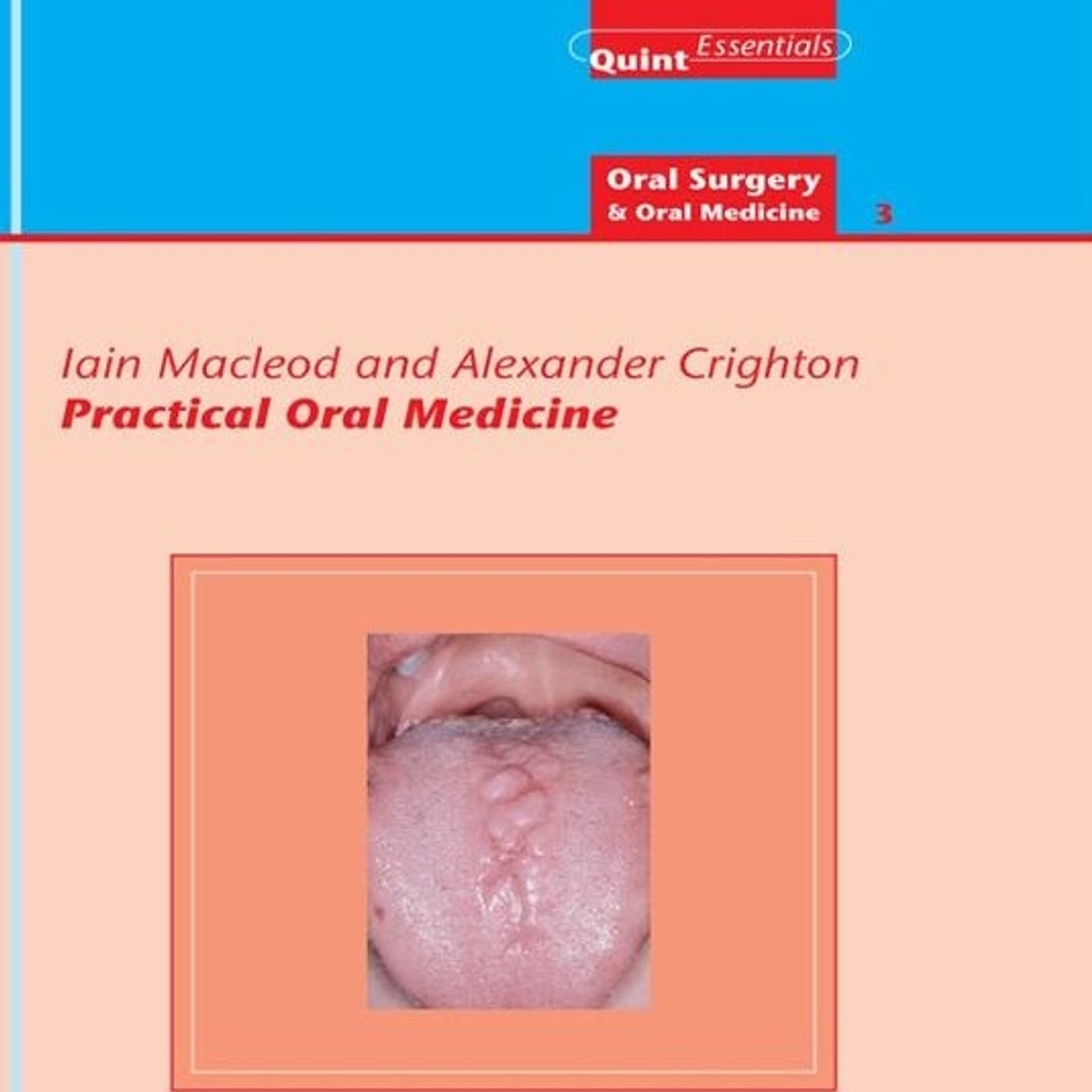
About this Episode
A comprehensive clinical guide for identifying and managing various orofacial disorders. The text details essential diagnostic protocols, emphasizing the importance of a structured consultation to distinguish between localized dental issues and systemic diseases. Key topics include immunological conditions like aphthous ulcers, salivary gland disorders, and life-threatening oral cancers. Additionally, the source addresses complex neurological sensory losses and various forms of chronic facial pain, such as trigeminal neuralgia and migraines. The authors also evaluate the role of complementary therapies and provide practical treatment strategies for common ailments like dry mouth and jaw dysfunction.
Get the Book now from Amazon:
https://www.amazon.com/Practical-Oral-Medicine-Quintessentials-McLeod/dp/1850970653?&linkCode=ll2&tag=cvthunderx-20&linkId=af632c530024e012cb0e69909ab12d73&language=en_US&ref_=as_li_ss_tl
You can listen and download our episodes for free on more than 10 different platforms:
https://linktr.ee/dentistry_made_simple
Produced by:
https://www.podcaistudio.com/
Get the Book now from Amazon:
https://www.amazon.com/Practical-Oral-Medicine-Quintessentials-McLeod/dp/1850970653?&linkCode=ll2&tag=cvthunderx-20&linkId=af632c530024e012cb0e69909ab12d73&language=en_US&ref_=as_li_ss_tl
You can listen and download our episodes for free on more than 10 different platforms:
https://linktr.ee/dentistry_made_simple
Produced by:
https://www.podcaistudio.com/
Hosts & Guests
Transcript
Warning, the following Zippercruder radio spot you are about to hear is going to be filled with F words.
When you're hiring, we at Zippercruder know you can feel frustrated.
For Lauren even, like your efforts are futile and you can spend a fortune trying to find fabulous
people, only to get flooded with candidates who are just fine.
Fortunately, Zippercruder figured out how to fix all that.
And right now, you can try Zippercruder for free at zippercruder.com slash zip.
With Zippercruder, you can forget your frustrations because we find the right people for your roles
fast, which is our absolute favorite F word. In fact, four out of five employers who post on Zippercruder
get a quality candidate within the first day. Fantastic! So, whether you need to hire four,
40, or 400 people, get ready to meet first rate talent.
Just go to zippercruder.com slash zip to try Zippercruder for free.
Don't forget that zippercruder.com slash zip. Finally, that zippercruder.com slash zip.
Finding great candidates to hire can be like, well, trying to find a needle in a haystack.
Sure, you can post your job to some job board, but then all you can do is hope the right person
comes along, which is why you should try Zippercruder for free at zippercruder.com slash zip.
Zippercruder doesn't depend on candidates finding you. It finds them for you.
It's powerful technology identifies people with the right experience and actively invites them
to apply to your job. You get qualified candidates fast. So, while other companies might deliver a lot
of, hey, Zippercruder, find you what you're looking for. The needle in the haystack.
See why four out of five employers who post a job on Zippercruder get a quality candidate
within the first day. Zippercruder, the smartest way to hire. And right now, you can try Zippercruder
for free. That's right. Free at zippercruder.com slash zip.
That zippercruder.com slash zip zippercruder.com slash zip.
Access to affordable credit helps me pay my employees that I don't really need it.
Infliction is killing me. What do you care? Big retailers and making record profits.
That's why we support the German Marshall credit card bill.
See, banks and credit unions help small businesses make payroll.
This bill would cut the vital resources they need while increasing megastore profits.
They deserve it. Don't they?
Tell Congress stop the German Marshall money grab for corporate megastores paid for by the
Electronic Payments Coalition. Welcome back to the deep dive. Today, we are stepping away from
the drill and the mirror and moving into, well, the detective work of dentistry.
Yeah, the real investigative stuff. Exactly. We're talking about the soft issues, the
immune system and those moments when a patient opens their mouth and you see something that
just makes you pause and think, uh, I have absolutely no idea what that is.
Which is a feeling every single dental student and honestly, even seasoned clinicians have
experienced at some point. The mouth is a incredibly busy place. It really is.
And it is often the very first alarm system for the rest of the body.
Right. So to help us navigate this, we are breaking down practical oral medicine by
Ian McLeod and Alex Endercrighton. That's from the quintessentials of dental practice series.
And it's such a great resource because it's designed to be a field guide. Really?
It is not a dense academic tone that you just leave on a shelf.
It is a practical clinical manual for diagnosis and management.
The authors are very clear on their mission here too. They want to bridge that gap between,
I see a spot and I know what this is and exactly how to treat it.
Precisely. Because oral medicine covers chronic recurrent and medically related disorders
of the oral facial region. I mean, it's basically the interface between dentistry and
internal medicine. So let's get straight into the structure they propose.
Chapter one is called the art of the consultation, which, uh, sounds a bit abstract at first,
but they actually have a very rigid framework for this, don't they?
They do and for very good reason. Diagnosis starts the second the patient walks in the door.
They break it down into five essential stages.
Okay, let's go through it. The first is the greeting.
It sounds basic, but they emphasize body language and seating arrangements.
Like if you have a patient who is anxious about a potential cancer diagnosis,
you shouldn't be towering over them while they're lying supine in the chair.
Right. That power dynamic is terrible.
Exactly. You need to be at eye level. It establishes trust.
And then comes the introduction phase, which is actually a major pitfall area.
You have to clarify the purpose of the visit immediately.
You need to ask yourself, is this a referral for a specific problem or is it just a routine review?
Because misunderstanding that is a leading cause of patient complaints, right?
Oh, absolutely. If the patient thinks you're going to fix the problem today,
but you're really only there to assess it, you have failed the consultation before you've
even looked in their mouth. That makes a lot of sense.
So then we move to information gathering, the history taking.
Right. And they advocate for a standardized history taking plan to ensure reproducibility.
You need the presenting complaint, the history of that complaint,
and the medical and social history.
But the specific tool they highlight here is the pain score.
You mean just the standard zero to 10 scale?
Yes. It seems almost too simple, but in oral medicine,
visual inspection can be incredibly deceiving.
A lesion might look absolutely angry, but feel totally fine,
or it might look improved while the patient is actually in sheer agony.
So having a patient rate pain from zero to 10 gives you a concrete baseline.
Exactly. If they were in eight last month and they're a four today,
well, the treatment is working, even if the tissue looks exactly the same to the naked eye.
That is a great tip. And that leads to review and discussion and finally,
conclusion and future planning, which is where you set the review interval.
And you really have to explain why you're setting that specific timeline.
You mean example?
So you'd say something like, I want to see you in two weeks,
because that is the healing cycle for this specific tissue,
giving them the why builds patient compliance.
All right. Let's move into the actual pathology now.
Chapter two covers immunological problems. This is a heavy chapter.
It is a massive topic. We're talking about the body fighting itself.
They start with allergic disorders, specifically erythema multi-form.
That's a hypersensitivity reaction.
Yes.
Clinically, you'll see blood-crusted lips,
and often these target lesions on the skin,
they look like a literal bullseye.
And people usually assume that's an allergic reaction to a drug or something.
That is the common assumption, yeah.
But the book points out that the leading trigger
is actually the herpes simplex virus, HSV.
Oh, wow.
So just giving them steroids might not be enough if it's recurrent.
Exactly.
The author suggests prophylactic acyclover for six months
to suppress the underlying viral trigger.
That is a crucial distinction.
Speaking of drugs, though,
there is one specific medication interaction they highlight here
that feels like an absolute must-know for anyone listening.
Nicarandale.
Oh, yes.
This is a classic board exam question
and a genuine clinical lifesaver.
Nicarandale is a potassium channel blocker used for angina.
And the side effect is in the mouth.
Yeah, a major side effect is these deep,
punched-out, incredibly painful ulcers.
Usually on the tongue, right?
Yes.
Typically, the lateral border of the tongue
are inside the cheek.
And the big red flag here is that these ulcers
do not respond to topical steroids at all.
So you can biopsy them and treat them all day
but they won't heal?
They will not heal until that drug is stopped
or substituted by their physician.
So if you see a nasty ulcer in an angina patient,
you have to check the med list first.
Absolutely.
From there, the chapter moves to
Orofacial granulomatosis or OFG.
This one is tricky because clinically,
it looks exactly like Crohn's disease.
Right, you get the swollen lip carlitis,
granulomatosis and those mucosal tissue tags.
Exactly.
Now, if the patient has gastrointestinal symptoms
alongside the mouth symptoms,
we label it oral Crohn's.
If it is isolated strictly to the mouth, it is OFG.
But the investigation is where it gets interesting.
You have to play detective what they're diet.
You do.
Common triggers are benzoids,
which are preservatives, cinnamon and carbonated drinks.
But you also need to order specific blood tests
to rule out other things.
Correct.
You check fairytale and B12,
but specifically, you need to check ACE levels.
That's angiotensin converting enzyme.
Why ACE levels specifically?
To rule out sarcoidosis,
sarcoidosis can present with very similar
granulomatous inflammation in the mouth.
If the ACE is elevated,
you're looking at a systemic condition
that affects the lungs,
not just a food sensitivity.
Okay, let's talk about the most common complaint you'll see,
ulcers or recurrent oral ulceration.
ROU.
It's important to note,
ROU is a broad term.
Afthiastomatitis is just one type.
The authors clearly distinguish between true
afthosestomatitis and dramatically induced aftho.
Meaning, some patients are prone to ulcers,
but they only actually get them
because they're physically stressing the tissue.
Exactly.
Usually through parapunctional clenching
or chronic cheek biting.
So treating their immune system won't do a thing
if they are just chewing on their cheek all night.
Spot on.
For those patients, you just need a soft bite splint.
But for true afthos ulcers,
the book outlines a very strict management hierarchy.
You do not just jump to the big guns immediately.
What does that ladder look like?
Step one is correcting any underlying deficiencies,
like iron or B12.
Step two is using topical agents,
like chlorhexidine mouth washes.
Step three is topical steroids,
like beta methamethasone or clobetasol.
And if all that fails?
Only if all those fail,
do you even consider systemic immunosuppressants
like prednisolone or azetheoporin?
Got it.
Rounding out chapter two,
they cover vesiculabillus disorders,
like pempagus and pempagoid.
The key takeaway here is purely diagnostic.
You cannot diagnose these just by looking at them.
You absolutely need a biopsy with immunofluorescence
to see exactly where the antibodies
are attacking the tissue layers.
They also mention angina bolosa hemorrhagica, right?
Yes, those are blood-filled blisters,
usually on the palate.
They look absolutely terrifying to the patient,
but they're usually benign
and just caused by trauma,
like eating a hot slice of pizza.
Moving right along to chapter three.
Lumps and bumps.
This covers a whole range of overgrowth.
They discuss vascular anomalies,
like, hey, mangiomas,
and they're linked to sturgweber syndrome.
But the big focus is on connective tissue hyperplasia,
like epilates.
They'll localize gum overgrowth.
Right.
You have the pregnancy epilus,
which is driven by hormones
and the giant cell epilus.
But importantly,
they dive into drug-induced,
gingable hyperplasia.
We just talked about nicarandal causing ulcers.
What are the culprit drugs for gum overgrowth?
For gum overgrowth,
you are looking for calcium channel blockers,
like knifeabeme.
You also look for fennetorn,
which is used for epilepsy and cyclosporine.
So if a patient's gums are practically
growing over their teeth,
you check for those three drugs.
Exactly.
Then they talk about bone anomalies,
specifically, Tory.
The bony lumps, right.
Taurus palatinus and Taurus mandibularis.
Yes, palatinus on the midline of the roof of the mouth
and mandibularis on the lingual surface
usually near the premolars.
And the treatment advice there
is basically just to leave them alone.
Leave them alone entirely.
Unless they are actively interfering
with the fit of a denture surgery
is just unnecessary trauma.
They also briefly mention a rare condition
called cherubism.
Yeah, it's a childhood genetic condition
that causes symmetrical jaw swelling.
The kids literally look like renaissance cherubs,
but it usually resolves completely on its own in adolescence.
So watch and wait is the standard strategy.
Chapter four takes us into infections.
Bacterial viral and fungal.
Let's start with bacterial.
The big one to recognize there
is acute ulcerative gingivitis or ANUG.
It's a necrotizing condition.
What are the clinical signs?
You'll see blunted,
punched out,
interdental,
papier,
extreme pain,
and a very distinctive foul odor.
It's historically known as trench mal.
And it is heavily linked to smoking, isn't it?
Heavily linked to smoking and severe stress.
The treatment is very specific.
You need metronidazole
and rigorous oral hygiene instruction.
They also mention syphilis in this section.
They do,
noting that the primary chancur often appears as a painless ulcer
right on the tongue.
Now, for viral infections,
it's mostly herpes simplex.
Yes,
but you need to distinguish
primary gingivostomatitis from secondary herpes.
Right.
Primary comes with systemic symptoms.
Exactly.
Fever and flu-like symptoms,
whereas secondary herpes
is your classic cold solas
or intraoral ulcers,
specifically on keratinized tissue like the hard palate.
And finally, fungal infections.
Mostly Candida.
They break it down into three main types.
Arthematous Candidasis,
which is red-romucosa,
often seen under dentures.
That's your denture stomatitis.
Then angular chylitis.
Which is cracking at the corners of the mouth,
often a mixed infection of Candida and staff.
And finally, chronic hyperplastic Candidasis.
Now, that is the white patch that does not wipe off right.
Correct.
And unlike the other fungal infections,
this one actually has pre-malignant potential.
You must biopsy it.
You cannot just treat it with anti-fungals
and assume everything is fine.
That actually segues perfectly into chapter five white patches.
The authors seem to have a golden rule here.
Can you wipe it off?
That is always the very first diagnostic test.
If you can wipe it off with some gauze,
it is likely just debris or pseudo-membranus
Candida basically thrush.
But if it doesn't wipe off,
you have to work through a differential diagnosis.
What are the common non-scary ones?
Well, leukodema is incredibly common.
It's a filmy, milky whiteness on the buckle mucosa.
The test for that is if you physically stretch the cheek
and the whiteness disappears,
it's leukodema.
Totally benign.
What about frictional carotosis?
That is basically just a callus forming from friction
like chronic cheek chewing.
There is also chemical trauma,
like an aspirin burn causing white sloughing tissue
and nicotinic stomatitis or smokers palette.
Where you see the inflamed minor salivary glands
looking like little red dots on a white background.
Exactly.
But if it is not one of those obvious causes,
we start worrying about chapter six,
oral cancer and pre-malignant lesions.
What are the clinical red flags you need to be hyper-aware of?
The author's list four critical signs.
One is an ulcer persisting for more than two to three weeks.
Two is in duration,
which means a noticeable firmness or hardness in the tissue.
Three is fixation, right?
Yes.
The tissue feels stuck or tethered to the underlying structures.
And four is any unexplained tooth mobility
or parasithesia numbness in the area.
And regarding the color of these pre-malignant patches.
We talk a lot about white patches or luchoplockia,
which is strictly a diagnosis of exclusion.
But a redtherlockia, which is a bright red velvety plaque,
is actually the high alert lesion.
Really?
Worse than the white patches.
Much worse.
It has a significantly higher rate of malignant transformation
than homogenous white patches.
And what if you see a mix of both red
and white?
That's called speckolucoplockia.
And that is incredibly dangerous,
often associated with severe dysplasia or early carcinoma.
So a biopsy in these cases is non-negotiable?
Absolutely non-negotiable.
They emphasize the importance of taking a representative sample.
They highly recommend using disposable punch biopsies,
usually four or six millimeters.
It's just a clean, safe procedure.
Exactly.
And it provides a perfect, continuous core of tissue
for the pathologist to examine.
Moving to Chapter 7, this deals with oral pigmentation.
Most of it is benign exogenous pigmentation,
like amalgam tattoos, which are just
gray or blue macules near old fillings
caused by amalgam particles embedded in the tissue.
Or black-herry tongue.
But endogenous pigmentation can actually
signal systemic disease.
It can.
Generalized brown pigmentation across the mucosa
can be a sign of atticence disease,
which is adrenal insufficiency.
Perial freckling around the lips can be
puits jagger syndrome, which links to intestinal polyps right.
Yes.
And of course, the rare but deadly one is malignant melanoma.
It can absolutely occur in the mouth,
and usually presents as a dark,
expanding, very irregular mucule.
Let's look at Chapter 8,
Disorders and Salivary Glans.
Dry mouth or Xeroestomia is a massive
quality of life issue for patients.
It affects literally everything.
Patients have difficulty swallowing their speech clicks
because the tongue physically sticks to the palette
and they get rampant cervical carries.
What are the main causes?
Often it's polypharmacy.
Drugs like sympathetic medics or antidepressants.
But it can also be autoimmune conditions
like the chugrin syndrome.
How do we manage it?
Because just drinking water isn't really enough, is it?
No water wets the tissues, but it doesn't lubricate them.
They recommend mucin-based saliva substitutes.
They also mention avoiding sugar and alcohol, obviously.
What about medications to stimulate saliva?
They discuss pylocarpine, which is a colonergic drug
that stimulates saliva flow.
It definitely works, but the systemic side effects,
like heavy sweating, flushing, and nausea,
can be really difficult for patients to tolerate.
And regarding salivary swallings?
The mucoseal is the most common.
It's a traumatic rupture of a minor salivary duct,
usually on the lower lip.
Then you have silithiasis.
Salivary stones.
Right. For those you look for patient reports of sharp pain
and swelling, specifically occurring at meal times
when saliva flow peaks.
And silosis.
That is a bilateral, totally asymptomatic
enlargement of the parodid glands.
It's not an infection.
It's usually metabolic linked to undiagnosed diabetes,
chronic alcoholism, or bulimia.
Chapter nine is fascinating.
Facial pain.
This is an area where a dentist can accidentally
cause a lot of harm if they misdiagnose.
Definitely.
They discuss atypical odontelja, which is often called
phantom tooth pain.
The patient sits in your chair, reporting
intense irreversible pulpitus symptoms.
But all your clinical tests and radiographs
are completely normal.
And the trap is doing the root canal anyway
just to try and help.
Exactly.
The well-meaning dentist thinks I'll just open it up
and relieve the pressure.
But there's no pressure.
The pain persists.
So then they extract the tooth entirely.
And then the pain just moves to the neighboring tooth.
Exactly because it is neuropathic pain.
The nerve pathway itself is misfiring.
You have to treat it with systemic medications,
not mechanical dental surgery.
They also cover temporal mandibular disorders or TMD.
I actually found their approach to acute TMD very practical.
It really is.
When a patient comes in with acute trismis
basically lock jaw and severe pain,
you can't just make them a splint immediately
because you physically cannot get an impression tray
in their mouth.
Right.
So the goal is to convert the acute situation
into a chronic one.
Convert acute to chronic, yes.
It means settling that acute muscle spasm first.
They suggest putting the patient on a strictly soft diet
prescribing NSAIDS
and possibly a short course of a muscle
relaxant like daizapam.
Just for a few days to break this spasm.
Right.
Once that acute phase subsides
and the jaw can actually open,
then you can manage the chronic underlying issue
with standard splint therapy.
They also mentioned burning mouth syndrome in this chapter.
Or oral dysysthesia.
It is most often seen in older female patients
and typically there are absolutely no
clinical signs of inflammation.
Management is notoriously difficult,
usually involving anxiolidics
or tricyclic antidepressants.
All right.
As we near the end,
chapters 10 and 11
cover neurological and complementary therapies.
Neurology primarily focuses on Bell's palsy,
which is facial nerve paralysis.
But the complementary therapy section
is surprisingly balanced for a medical text.
They don't just dismiss it entirely.
No, they acknowledge that patients are actively
using these therapies.
For example, acupuncture actually has shown some
proven efficacy for managing T&D pain,
controlling severe gag reflexes,
and even helping somewhat with show grins.
They mention homeopathy too,
like cures like.
Yes, with the ultra-high delusions.
They do note the controversy
regarding its scientific basis,
but they acknowledge you will encounter patients using it.
And herbalism.
That is where they issue a strong warning
about drug interactions.
You have to remind patients
that just because something is natural
doesn't mean it is safe.
Like St. John's word.
Exactly.
St. John's word induces liver enzymes
and can significantly reduce the effectiveness
of other critical prescription drugs
the patient might be taking.
The book wraps up with an appendix of clinical protocols.
Just straightforward checklists
for history taking for specific conditions
like like in planis or sore lips.
It just continually reinforces
that systematic reproducible approach.
Absolutely.
Now before we finish up,
let's test your recall with a quick scenario
based on what we've discussed today.
Let's do it.
All right, here's the case.
A 65-year-old patient
presents with a deep,
very painful ulcer
on the lateral border of his tongue.
It has been present for four months.
It has a distinct punched-out appearance.
He has been applying topical steroids
for weeks with zero improvement.
You check his medical history
and you see he is currently being treated
for angina and hypertension.
Okay, so the question for you
is based on our discussion
of the immunological problems chapter.
What specific drug should you look for in his history
and what is the likely diagnosis?
Think back to the potassium channel blocker we mentioned.
If you said Nicarendol,
you are absolutely correct.
The diagnosis is a fixed drug eruption
or Nicarendil-induced ulceration.
And what's the mansion for that?
You must consult his physician
to have them substitute the medication.
That is literally the only way
that ulcer will ever heal.
It is a perfect example
of why the knowledge in this book
matters so much.
The mouth really is a mirror
for the rest of the body.
It is.
As a clinician, you aren't just a mechanic for teeth.
You are an oral physician.
You need the knowledge to spot the difference
between a simple traumatic ulcer
and a scrumousel carcinoma
or a systemic disease manifestation.
And that systematic approach history
exam investigation referral
is your ultimate safety net.
So keep learning
and always keep looking deeper.
Thanks for listening to this deep dive.
We will see you in the next one.
Warning, the following Zipper Cruder radio spot
you are about to hear
is going to be filled with F words.
When you're hiring,
we at Zipper Cruder know you can feel frustrated.
For Lauren even,
like your efforts are futile.
And you can spend a fortune trying
to find fabulous people
only to get flooded with candidates
who are just fine.
F***.
Fortunately, Zipper Cruder figured out
how to fix all that.
And right now, you can try Zipper Cruder for free
at zippercruder.com slash zip.
With Zipper Cruder, you can forget your frustrations
because we find the right people
for your roles fast,
which is our absolute favorite F word.
In fact, four out of five employers
who post on Zipper Cruder
get a quality candidate within the first day.
Fantastic.
So whether you need to hire four,
40 or 400 people,
get ready to meet first rate talent.
Just go to zippercruder.com slash zip
to try Zipper Cruder for free.
Don't forget that zippercruder.com slash zip.
Finally, that zippercruder.com slash zip.
Access to affordable credit
helps me pay my employees.
But I don't really need it.
Infliction is killing me.
Who cares?
Big retailers and making record profits.
That's why we support the
Durban Marshall credit card bill.
See, banks and credit unions
help small businesses make payroll.
This bill would cut the vital resources they need.
While increasing Megastore profits,
they deserve it.
Don't they?
Tell Congress stop the Durban Marshall money grab
for corporate megastores
paid for by the Electronic Payments Coalition.
Did you know that parents
rank teaching financial literacy
as the toughest life skill?
That's where Greenlight comes in.
The debit card and money app made for families.
With Greenlight, you can send money to kids quickly,
set up chores, automate allowance,
and track spending with real-time notifications.
Kids learn how to earn, save, and spend responsibly.
While parents have peace of mind
knowing smart money habits are being built
with guardrails in place.
Try Greenlight, risk free today
at greenlight.com slash try greenlight.
That's greenlight.com slash try greenlight.


