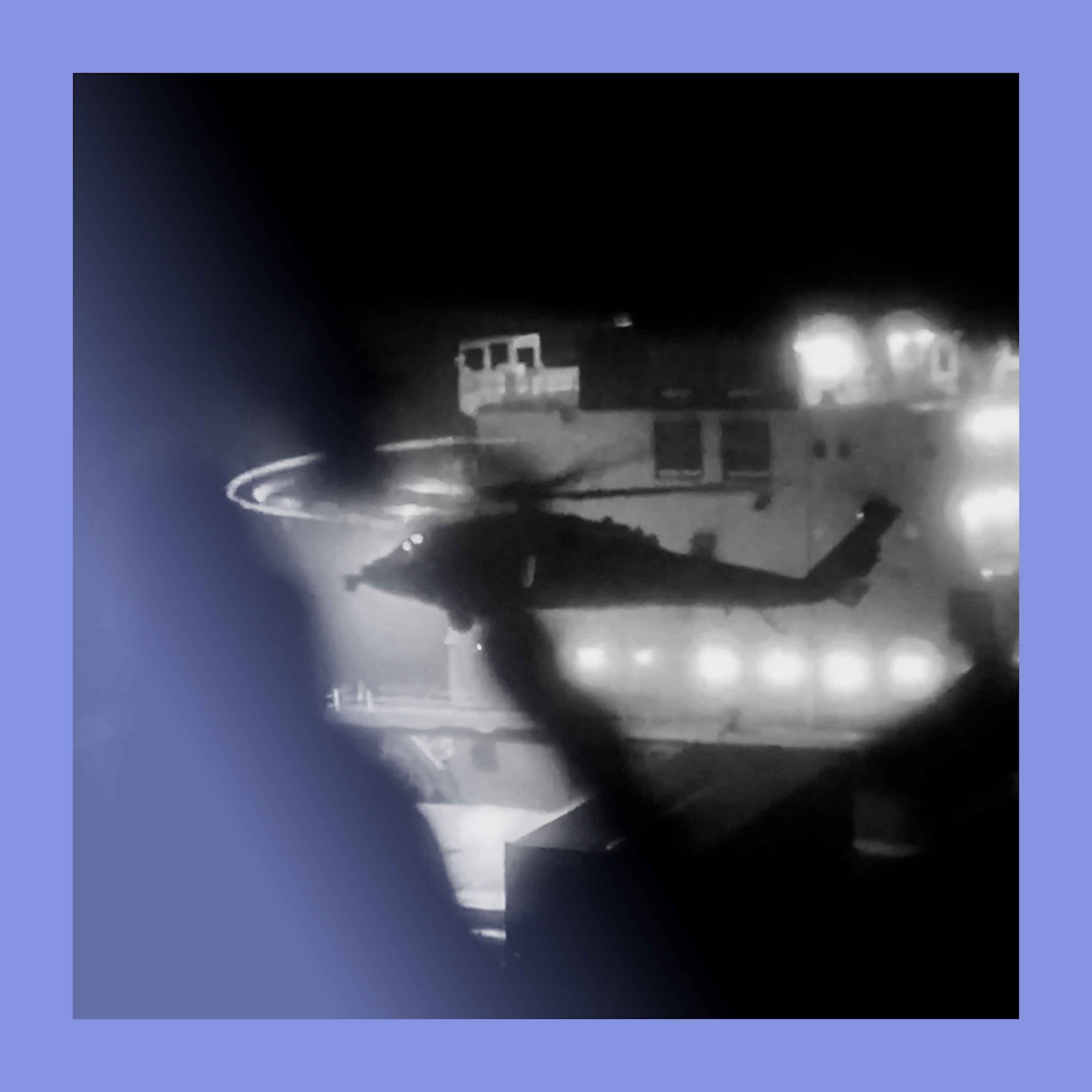
Now boarding: America seizes an Iranian ship
About this episode
This week’s peace talks are endangered after American forces fired on and boarded a cargo ship in the Strait of Hormuz. We visit Chernobyl’s ruined reactor to assess the damage done by a Russian drone to its enormous safety structure. The likes of McDonald’s and KFC have long been in China’s cities; now they are expanding at pace in the countryside.
Guests and host:
- Gregg Carlstrom, Middle East correspondent
- Sarah Lawrynuik, deputy editor of “The Intelligence”
- Don Weinland, China business and finance editor
- Rosie Blau, co-host of “The Intelligence”
- Jason Palmer, co-host of “The Intelligence”
Topics covered:
- Iran war, Strait of Hormuz
- Chernobyl, Ukraine war
- China, fast food
Get a world of insights by subscribing to Economist Podcasts+. For more information about how to access Economist Podcasts+, please visit our FAQs page or watch our video explaining how to link your account.
Hosted on Acast. See acast.com/privacy for more information.
Get every episode summarized
Each time The Intelligence from The Economist publishes, we email you a written briefing from the transcript — the topics, who appeared, and any specific claims, with the ad reads skipped.
Email me new episodesFree for 3 shows. No card needed.
Hosts & guests

Transcript ready
245 searchable segments. Every word is indexed and playable.
Full transcript
The Intelligence from The Economist — Now boarding: America seizes an Iranian ship. Machine-transcribed; use the interactive transcript above to jump the player to any line.
Hello and welcome to the Intelligence from the Economist. I'm Jason Palmer and I'm Rosie Bloor. Every weekday we provide a fresh perspective on the event shaping your world. One year ago an enormous hangar was slid into place over the site of the Chernobyl accident in Ukraine, intended to isolate it for a century. Last February, a Russian drone blew a hole in it. We paid a visit asking just how much damage was done. And McDonald's and other Western fast food joints have been in China for decades and spurred local competitors. But our correspondent reports of foreign chains are now gaining ground again. Rural China is the final burger frontier.
But first, the shaky ceasefire between America and Iran got even shakier overnight. Motor vessel toscope. Motor vessel toscope. Vacate your engine room. Vacate your engine room. We're prepared to subject you to the Sabling Fire. American forces fired at an Iranian flagship in the Strait of Hormuz before Marines boarded and seized the vessel. Exactly what's going on in the Strait has been a subject of some confusion, with markets reacting on Friday as if a full opening were just around the corner. Peace talks scheduled for this week are now up in the air. The existing ceasefire expires on Wednesday, and after this American flex in the Strait, a return to full-on war is looking worryingly possible. This is the first time the Americans have actually had to enforce their
blockade of the Strait of Hormuz. Great Karlstrom is a Middle East correspondent for the economist. There was an Iranian ship, a tanker trying to sail out of the Persian Gulf through the Strait. The Americans say they warned us to stop it kept going, and so they fired at its engine room disabling it and then they boarded it afterwards. So after days of talk about how the Strait was closed from the American side, they have now militarily enforced that blockade. And there had been confusion about whether it was open, it was closed, some conflicting information, as you understand it. Was it open, was it closed, is it closed now? A short answer is yes, it is closed, and it was closed. I think there was a lot of misinterpretation at the end of last week of a tweet from Abbas Aragchi, the Iranian foreign minister. He posted that because America had forced Israel to stop its war in Lebanon. The Strait was now open, subject to coordination with the IRGC, the Islamic Revolutionary Guard Corps in Iran. Now, if you read that
carefully, that was restating what Iran's position has been for much of this war, which is, they say, the Strait is open as long as vessels coordinate with us and use the route that we mandate, and so on and so forth, and in some cases pay a toll to use the Strait. In practice, what that means is it's not open. It's only open to a limited number of vessels, and he was restating that. But I think Donald Trump and other people in America, oil traders, all of whom were desperate to see the Strait fully reopened, saw that tweet as something more than it was, and so we saw oil prices plunged towards the end of last week. Brent Crude dropped down to about $85 a barrel. Everyone was very excited. Then the pushback started in Iran, the Revolutionary Guard said no. The Strait is not open, except for vessels that we approve, and there were cases over the weekend where ships tried to get out of the Gulf through the Strait and the Iranians fired on them for doing that. Then we had the Americans do the same thing. In practice right now, the Strait is not open to anyone, except the very, very small number of vessels that can coordinate with the Iranians
and pay the Iranians to exit. How has Iran responded to the boarding of the ship? There's been a lot of tough talk, as you would expect, about how there's going to be retaliation. There were claims in state-backed media in Iran that they had fired drones at American military vessels, but there's no proof that that actually happened, and there's no evidence of any damage to American warships in the region. I think there are three things that the Iranians could do in response. One is they really could attack American warships. The risk is if they do that, the ceasefire is over. I think at that point, Donald Trump is going to resume attacks. Second option would be attacks on commercial vessels in the Gulf, not even vessels transiting through the Strait, but vessels that are at anchor in the Gulf or in ports in the Gulf. We've seen the Iranians do that throughout the war. They've fired drones at ships at port in Dubai and elsewhere. I'm not sure what purpose that serves, because they've already deterred commercial shipping from using the Strait. Carrying out further attacks, it doesn't have any more deterrent
value, but it ticks the we retaliated box for the Iranians domestically. The third thing they could do is they could do nothing. They could just accept that there's this mutual blockade now on both sides and both sides fired on commercial ships over the weekend. The only way this is going to get resolved is in negotiations. They could just try to secure a deal that ends this mutual blockade of the Strait. But the prospects for those negotiations are definitively worse than they were before. They are partly because of the blockades. The Americans are saying there will be talks on Tuesday in Islamabad and JD Vance. The Vice President is going to head another delegation to meet with Iran and discuss a deal. They're actively making preparations for that. There were C-17 cargo planes over the weekend that landed in Pakistan that were thought to be carrying Vance's motorcade and other equipment and personnel for an American visit. They seem ready to talk. The Iranians, depending on who you ask, there might be talks. There might not be talks. There were some very strong messages that came out in Iranian media after this American attack
on the tanker in the Strait saying that so long as the American blockade is still in place, we're not going to Pakistan. Now, if you think back to the last round of negotiations, we heard the same thing from Iran in the run up to it. They said, we won't meet with America unless the ceasefire is expanded to include Lebanon. We won't meet with America unless it agrees to unlock billions of dollars in our money that is frozen by sanctions and banks overseas. They insisted that those were preconditions for negotiating. America didn't meet those preconditions and the Iranians showed up anyway. So, perhaps again, this is just a springmanship from Iran. They're trying to extract whatever concessions they can before the talks even take place. Or perhaps they're serious. We don't know yet which it is. If there was willingness by Iran to join those talks, things were kind of on an even keel. There were some positive signs. Why do you suppose going to this level of aggression on the part of America? There's a real difference in how it's perceived on both sides. For Iran, it's exactly the way you're describing it. They think we were willing to meet again. We showed some willingness to make concessions around our nuclear
program and other things in the previous round of talks. Why are the Americans escalating like this? This is proof that we can't trust them. Whereas, I think from the American side, there was a belief that to enter these talks in the first place that Iran had committed to reopen the straight-of-formals that was supposedly in their ceasefire agreement. That hasn't happened. So, the Iranians did not deliver on that promise. And so, they think this blockade of the straight, it's not escalation on America's part. It's sort of evening things out. Iran is still imposing its own blockade. So, America is now just doing the same thing on its own side. And I'm sure for the Trump administration, the belief is this gives us more leverage now going into these talks because we have shown that it's not just a rhetorical blockade of the straight that we are willing to actually physically enforce it. And so, that gives us a point of leverage to get the Iranians to lift their own blockade. I'm familiar with the Trump administration's need to sound tough, do tough things and so on. But as of Friday, as you say, there was a great deal of hope. The market's about it back. Oil was down. Why put that at risk if indeed the markets are one
of the only things that clearly drive Donald Trump's behavior? They clearly drive his behavior, but it's hard to understand what drives their behavior at this point. I mean, the idea that oil dropped as low as it did on Friday on the basis of a single tweet from the Iranian foreign minister, who is by no means the most influential person in Iran, seemed a bit irrationally optimistic and sure enough when trading reopened in Asia on Monday morning, we've already seen Brent jump by about $10 a barrel. So, that exuberance is already fading. I mean, I think there's still this belief in the markets that Trump can bend reality to his will by saying things or by tweeting things. And apparently that was extended to Abbas Aragchi as well last week, but it's simply not the case. The only way you really get a durable solution for the markets is by ending the war, is by getting to some sort of agreement that reopens the state of harmless and that reassures shippers and oil companies and other firms that the war isn't going to restart, that they can send their tankers into the Gulf, they can fix the infrastructure that was damaged during this war,
and there's not going to be a risk of renewed conflict. But that looks like an enormous ask at this point. We don't even know if those talks are going to happen tomorrow. We don't know if they're going to happen. And then even if they do, despite some willingness on both sides to make concessions, there is just still a huge gap between what they are asking for. Okay, the Americans have walked away from this demand that Iran never be allowed to enrich uranium, which was a non-starter in previous rounds of talks. But what they are asking for a prolonged moratorium on enrichment is still more than the Iranians are willing to give. And these are just the first issues. Even if you can reach an agreement on those, you have so many other detailed points that need to be negotiated to make this into a proper arms control agreement. So the talks may not happen. And even if they do, there's no guarantee that they're going to be able to bridge these enormous gaps. Thanks very much for joining us, Greg. Thank you, Jason.
For years into Russia's war in Ukraine, there is an ominous topic that is often overlooked. In the country's north lies Chernobyl, the site of the worst nuclear accident in human history. Sarah Lorneuk is deputy editor of the intelligence. And despite the fact that none of the four reactors onsite are currently in use, Chernobyl still requires careful management, but is constantly caught in the middle of fighting. I took a tour of the Chernobyl site this winter and had a chance to see what that actually looks like up close. This involved passing through umpteenth security gates and following so many security precautions that the team there onsite follow every single day. Two, one. Thank you very much. Well, no contamination. As previous, please hold your helmet when you move
up or down. Pavlo Hrentienko is my tour guide and works for the nuclear power plant. And so this is the old sarcophagus? Yes, shelter objects, ulcer gephagus. Reactor number four inside. Four decades ago, in the wreckage of that destroyed reactor four, Soviet workers and engineers worked to clean up the site as fast as possible, building a sarcophagus over the reactor. What I was now staring at. In the 90s, it became obvious that more work needed to be done to contain the radiation. They designed an additional dome and it would be called the new safe confinement. Decades end $1.6 billion later, the European Bank for Reconstruction and Development, or the EBRD, had managed to orchestrate the construction of a massive hangar type style structure and it was the first of its kind in the world, funded by 45 nations.
It was tall 250 meters wide and 150 meters long. It provided a hermetic seal where humidity and temperature around the old sarcophagus could be controlled, mostly to prevent any corrosion. It was meant to give the world another 100 years to figure out how to manage the site. Well, we all heard on February 14th the news that the drone had hit the new safe confinement from the very first day was not easy to determine to what extent the facility was damaged and how difficult it would be to repair it. On multiple occasions, missile and drone strikes have caused issues at Chernobyl, including forcing the plant on to back up power. But on February 14th, 2025, a Russian drone directly struck the new safe confinement,
piercing a hole through the protective dome. Balthazarlin-Gauer is the director of the EBRD's nuclear safety program. The damage is very, very significant, it will be very difficult to repair and currently the new safe confinement doesn't fulfill its functions, so it is currently useless building almost. Understanding what happened when the drone struck the new safe confinement, and seeing it with my own eyes, those are two different things. Pavlo took me inside to see exactly what the damage had looked like. Okay, you can see on the top, yes, this is maintenance garage for main crane system. He points to bright yellow steel beams that run across the roof. The drone hit from the top of this garage, so this garage, it was like an obstacle. Drone could attack another place of the roof, it can affect, for example, the old shelter object.
The old shelter object, also known as the sarcophagus built in 1986, and beneath it, reactor 4. And if the drone had struck there, no one actually knows what would have come next. And we even don't know what could be the results. This garage saved shelter object. Meanwhile in the control room, they have pictures posted all over the walls of what the destruction looked like. Flames and smoke coming from the hole. The Ukrainian shift supervisor at the time explained that in the first two hours, the open and visible flames were extinguished. But the fire that caught between the internal and external layers of the new safe confinement
cladding, in there, it burned for weeks. In the end, some 300 small holes needed to be cut into the new safe confinement cladding to try and extinguish the embers. The video shows that the internal membrane of the new safe confinement was completely gutted. So all the reds in is where a smoldering, this smoldering happened? Half of it. What? Like half of it? Yeah, and they had to find there were different parts of confinement where the fire would start because of this smoldering happening everywhere. In the time since, a temporary repair has been made. But that doesn't address the issue that the hermetic seal has been lost. And so engineers at the construction companies that originally built the new safe confinement
have been working on proposed plans for how this could be fixed in the long term. Two options were considered, one in which they fixed the building where it stands. The other, they removed the largest movable land-based structure in the world and fix it off-site. One of the key question is it can be designed repairs which will not require too many people to spend too much time in areas that are affected by high radiation. So that's one of the key questions we have. They have made the decision now to fix the new safe confinement where it stands. And while the staff working there will have to operate in a high radiation exposure environment, the EBRD decided that leaving the old sarcophagus unprotected for any length of time was just too dangerous. And it will be very expensive and there's no two ways about it. The estimated price tag for the repairs is 500 million euros, a figure that is only likely to balloon further. The clock is ticking here. A few years without humidity and temperature control
expose the old sarcophagus to greater threats of corrosion and irreparable damage. The International Atomic Energy Agency Director General Rafael Mariano Grossi put it to me in stark terms. So far there has been no radioactive release but the risk will only grow without repairs because the whole shelter object is unstable and the new building is enabled to confine a release. But asking the international community to send more money to Ukraine at present is a hard sell. This Sunday will mark the 40th anniversary of the 1986 Chernobyl nuclear accident. The Economist will have much more coverage throughout the week leading up to it. Looking at the lessons learned from this site that has inspired a multi-generational case of the HBGBs, right now you can find on our website and app a digital interactive version of Sarah's story.
On Wednesday I'll be on Bavage, our sister show on science and technology to talk about Chernobyl as a one-of-a-kind laboratory looking through the urgent research that's even now still being done. And on Friday a special episode of the Intelligence will actually go inside the Chernobyl plant recounting the history of the accident and considering the legacy that it's left. So when I got off the train in this little city called Hentran, I was really surprised because it felt like I was stepping out into the countryside. Don Wainland is our China business editor. Technically speaking, Hentran is a city but when you're in the downtown area,
if you can really call it that, it's very quiet and I was surprised to see this because I was actually going here to eat McDonald's. And I was surprised how far down market these global fast food chains had gone. McDonald's was really buzzing. It seemed like something that people were coming out of the fields for. Places like Hentran are really becoming the front line of fast food globally. Don, thank you for your epic mission to eat a burger. Western chains have been in China for decades. So what's behind this new strategy? Where are they really going? That's right. They've been in China for many, many years. Most of these fast food chains now and I can give you a long list of names. McDonald's, KFC, Burger King, Domino's, Pizza Hut, Starbucks
and Subway, they're all here and they're all expanding quite rapidly. Big cities have tons of these already. When you're in a place like Shanghai where I live or Beijing, sometimes you can see two McDonald's when you're standing on the road. 70% of KFCs in China are within 10 minutes bicycle ride of another KFC. It's about 60% for McDonald's. So the big cities are very saturated and that is what is driving these companies out of the big cities to places that don't really have a whole lot of competition. Don, last year you and I recorded an episode of Drum Tower, our China podcast about the rise of domestic fast food Chinese chains. What's happened to them? Yeah, they're still around and they are expanding as well. So there are a lot of Chinese fast food names that are popping up in big cities. What's really interesting is that the Chinese ones tested
their chops in smaller cities and are now trying to get market share in the bigger cities. Global fast food is moving in the other direction. So they've started in the biggest cities and are moving into smaller towns. At the time that we spoke, we thought that McDonald's might even retreat a bit from China. So what's changed? One thing that has happened over the past decade for global fast food is that they now have very big Chinese investors. And you see this almost across the board now. So for example, McDonald's is owned mainly by City Capital. This is a very powerful state backed company. Yum China, which owns KFC in Pizza Hut, has capital from local investors. And you really see most of these global names, which represent Western culture. They are owned by local investors. And one thing that's changed recently is that these local
investors are willing to put up the capital that is needed to go into these smaller markets, these smaller towns like Hentran. Without backing of the local investors, I don't think the global fast food chains would really be trying to do this. It's a very risky bet. But the local investors here are giving it a shot. And what are their chances of success? Do you think rural Chinese are really hungry for Western brand fast food? It's a really important question for all these companies. Do Chinese farmers want to eat McDonald's and drink Starbucks? We're going to find out over the next couple of years. I see a number of problems when I go into these places. In Hentran, McDonald's chose this place because it had a newly opened Western style mall. A lot of places don't have this type of real estate that can host a restaurant like this. There's a lot of other challenges as well. So, you know, you mentioned the Chinese brands. They
are present in most of these small cities. They sell at a much cheaper price. They're much more tuned to the local market. And they're going to give McDonald's and KFC a lot of competition in these places. Another problem, supply chains. It's hard to build reliable supply chains in small cities across rural China. One reason though for optimism is that there is a lot of fascination in these types of Western fast food chains when they open up in rural towns. So people are really interested in trying Starbucks. They appear to be interested in burgers. If the Western chains can keep up that level of enthusiasm, then I think they might have a chance. Don, thank you very much for talking to me. Thank you. And if you want to listen to the discussion that Don and I had about fast food in China on
Drum Tower, our China podcast. The link is in the show notes. That's all for this episode of The Intelligence. We'll see you back here tomorrow.
More episodes
More from The Intelligence from The Economist

Chainsaw sputtering: Milei’s experiment falters
The Intelligence from The Economist

School of shock: teenagers get dimmer
The Intelligence from The Economist

All right on the night: AfD’s victory
The Intelligence from The Economist

Bargaining chips: Nvidia is the bank of AI
The Intelligence from The Economist