Get every episode summarized
Each time Be Amazed publishes, we email you a written briefing from the transcript — the topics, who appeared, and any specific claims, with the ad reads skipped.
Email me new episodesFree for 3 shows. No card needed.
About this episode
Be Amazed is made possible by:
“This podcast is supported by your Southern California Kia dealers. Around Southern California, it's easy to spend plenty of time behind the wheel.”From the transcript
It’s safe to say us humans are obsessed with constructing some massive megastructures. But, big and impressive as these feats of engineering ingenuity are, have you ever considered how they got there in the first place? Yep, even more impressive than the size of some structures, are the tremendous transport operations that helped them get from A to B. From towing towering oil platforms, to road-ready space shuttles, get your seatbelt strapped, as we take a look at the largest things ever moved!
Our Sponsors:
* Check out BetterHelp: https://www.betterhelp.com
Advertising Inquiries: https://redcircle.com/brands
Privacy & Opt-Out: https://redcircle.com/privacy
Get every episode summarized
Each time Be Amazed publishes, we email you a written briefing from the transcript — the topics, who appeared, and any specific claims, with the ad reads skipped.
Email me new episodesFree for 3 shows. No card needed.
Hosts & guests
Transcript ready
279 searchable segments. Every word is indexed and playable.
Full transcript
Be Amazed — Largest Things Ever Moved. Machine-transcribed; use the interactive transcript above to jump the player to any line.
This podcast is supported by your Southern California Kia dealers. Around Southern California, it's easy to spend plenty of time behind the wheel. Whether you're commuting from OC or heading to Santa Barbara for the weekend, going farther between fuel stops is something everyone can appreciate. That's exactly what Kia's hybrid lineup is built for. Kia offers five hybrid models that combine turbocharged power with hybrid efficiency, with some delivering more than 600 miles of driving range on a single tank. One model that really stands out is the all-new 2027 Kia Telluride Hybrid. It offers seating for up to seven passengers, the confidence and capability of a three-row SUV, and a turbocharged hybrid powertrain that delivers impressive efficiency for fewer stops at the gas station. It's ready for weekday errands, weekend getaways, and everything in between. If a hybrid fits the way you drive, Kia has a model designed to fit your needs. Learn more at Kia.com or visit your Southern California Kia dealer.
Saturday, September 26, two of combat sports' most dangerous strikers collide. Bear Knuckle! Liverpool's own down in the Gorilla Tilt goes to war with Cuban powerhouse Yoel Soldier of God Romero. Plus, the Bear Knuckle Midowage Championship of the world is on the line. When the rating champ Dave Verednick Mundell defends against undefeated British challenger, Jack Demeek Cleaver-Colin, BKFC 94, Tilt vs. Romero. Watch it live only on the zone. Sign up now at thezone.com. It's safe to say us humans are obsessed with constructing some massive mega structures, but big and impressive as these feats of engineering ingenuity are. Have you ever considered how they got there in the first place? Yep, even more impressive than the size of some structures are the tremendous transport operations that help them get from A to B. From towing towering oil platforms to road-ready space shuttles, get your seatbelt strapped as we take a look at the largest things ever moved.
At 1500 49 feet tall, the Troll A platform found in the middle of the North Sea is a super soaring structure. In all, this platform used to extract natural gas from the Troll Gas Field measures around the height of the Central Park Tower, the 15th tallest building in the world. Not that you'd be able to tell that from looking at it though, you see this platform is mostly made up of four legs descending down nearly 1000 feet to the sea floor. The question is, how did something so big end up here? This behemoth was constructed in a dock near the village of Vots on the western coast of Norway. After the legs had finished construction, they were filled with water until they were virtually submerged. Following this, engineers Troll A's platform over the legs. Once the platform was floating above the legs, water was pumped out of the legs, gradually raising them out of the water and closer to the platform overhead.
After all that, by May 1995, Troll A was finally ready for its journey. Now those involved had the small task of getting the 1.2 million tons structure from Vats to the Troll Gas Field over 120 miles away. Ten tugboats had the unenviable task of towing the towering structure. Due to the sheer size of the operation, the tugboats, which were generating 130,000 horsepower, couldn't travel faster than two miles per hour. As a result, it took the boats no less than seven days until they finally reached their destination. From there, Troll A's legs were once again filled with water until they were resting on the seabed nearly 1000 feet down, where they were then fixed in place by attaching suction buckets to the base of the structure, which gripped the seafloor via a permanent vacuum seal. With the anchors in place, water was pumped out of the legs once more, finally finishing this enormous operation.
Now that's what you call a long haul. When you think of space shuttles, you probably conjure up images of rockets whizzing through orbit, but that's not always how these vehicles get from A to B. Take the Endeavor. In 1992 to 2011, the shuttle completed 25 missions, visiting faraway locations like the International Space Station and the Hubble Space Telescope. Yet the Endeavor's final journey wasn't quite so meteoric. Rather than paying one last visit to space, this rocket had to make the nine-mile journey from L-A-X Airport to the California Science Center. Sounds simpler than flying into space, right? For weighing in at 86 tons, the shuttle was too heavy for a helicopter, plus it couldn't be dismantled without causing permanent damage to the vehicle. So the California Science Center made the decision to shell out $10 million to transport the shuttle over land. Yep, the space shuttle was hitting the road.
That came with another problem, though, at 122 feet long and 78 feet wide, the Endeavor wasn't exactly road-ready. Being so long and wide, there are a whole host of paths in Los Angeles that the space shuttle could never realistically travel through. Eventually a 12-mile path was settled upon, with the Endeavor taking off at midnight on October 11, 2012, as well as choosing a route that avoided as many traffic signals and buildings as possible, 400 trees were chopped down to provide clearance for the old orbiter. For its ride, the 86-tonne shuttle was loaded on top of four self-propelled modular trailers, or SPMTs for short. These multi-axle computer-controlled vehicles allowed precise maneuverability and stability while moving the shuttle through such a busy route. In all, it took two days to transport the orbiter to its new base at the California Science Center, and to think, this shuttle traveled
over 17,000 miles per hour in space. Still, the effort to lug a literal 122-foot-long space shuttle through the streets of Los Angeles makes this one of the world's most mind-blowing transportation feeds. But it's not just enormous inanimate objects like space shuttles and oil platforms that have been part of mega-moves. Back in January 1997, a weak old female gray whale was found stranded on the coast of Southern California. To save the critter, it was decided she'd be brought into SeaWorld San Diego to undergo rehabilitation. A crowd of seagullers hoisted the 14-foot-long 1670-pound heavy, young whale onto a 24-foot truck, constantly dousing her in water to keep her hydrated. Following a lengthy 140-mile journey, the creature finally reached SeaWorld San Diego. After a year under SeaWorld San Diego's care, the whale, which had been named J.J., recovered well.
Incredibly, she'd grown to 30 feet and managed to pack on 9 tons of weight, delighted as her carers must have been it left them in a sticky situation. The plan was always to release J.J. after she recovered. But how do you go about transporting a living being that's close in length and weight to a school bus? First up, J.J. was scooped up from her tank in a custom-made sling, lifted by crane and placed into a 40-foot, water-filled, foam-patted trailer. From there, a truck pulled the trailer from SeaWorld to the nearby harbor. Then, J.J. was transferred once more this time onto the 180-foot buoy tender, US CG-C conifer. That vessel then sailed her out into the waters of the Pacific before her stretcher was lowered down into the waves below. Once back in the ocean, J.J. took a big breath before diving down and disappearing into the dark depths. Man, who knew transportation efforts could make you teary-eyed?
I mean, let's see what mammoth move is up next. In 2017, McLaren Engineering Group embarked on their own trepidacious transport mission. They were tasked with moving a heat recovery steam generator, or HRSG for short. This is a pretty important piece of kit in power plants used to capture waste heat from gas turbines. The generator McLaren moved was a neck-breaking 130-feet tall and weighed some 4,000 tons. Essentially, this cargo was close in height to the Arcta Triomphe and around as heavy as 70 standard American homes. Wolf! On top of that, McLaren Engineering Group had to somehow transport this thing down 130 miles, from Ravenna, New York, to a power plant in Soar and New Jersey. Unsurprisingly, it was ruled that the colossal cargo was too tall to make the trip on land. Instead, it was decided the best route would be down the Hudson River.
So a fleet of five self-propelled modular trailers delivered the HRSG onto a 400-foot-long barge, which would be towed by three tugboats. Fortunately, the HRSG was just small enough to allow the barge to sail just below bridges on route, with some offering as little as nine feet of clearance. So, stupendously large was this shipment, the barge even beamed red and white marker lights to alert small aircrafts of its presence. Incredibly, though, after 36 hours on the water, traveling at a snail-like five miles per hour, the humongous unit reached its new home at Soar and. Man, that's one monumental moving mission. Whether it's the Empire State Building, One World Trade Center, or the Statue of Liberty, New York has some of the world's most recognizable attractions dominating its skyline. But while the Empire State Building and One World Trade Center were constructed in the Big Apple, the same can't be said for Lady Liberty.
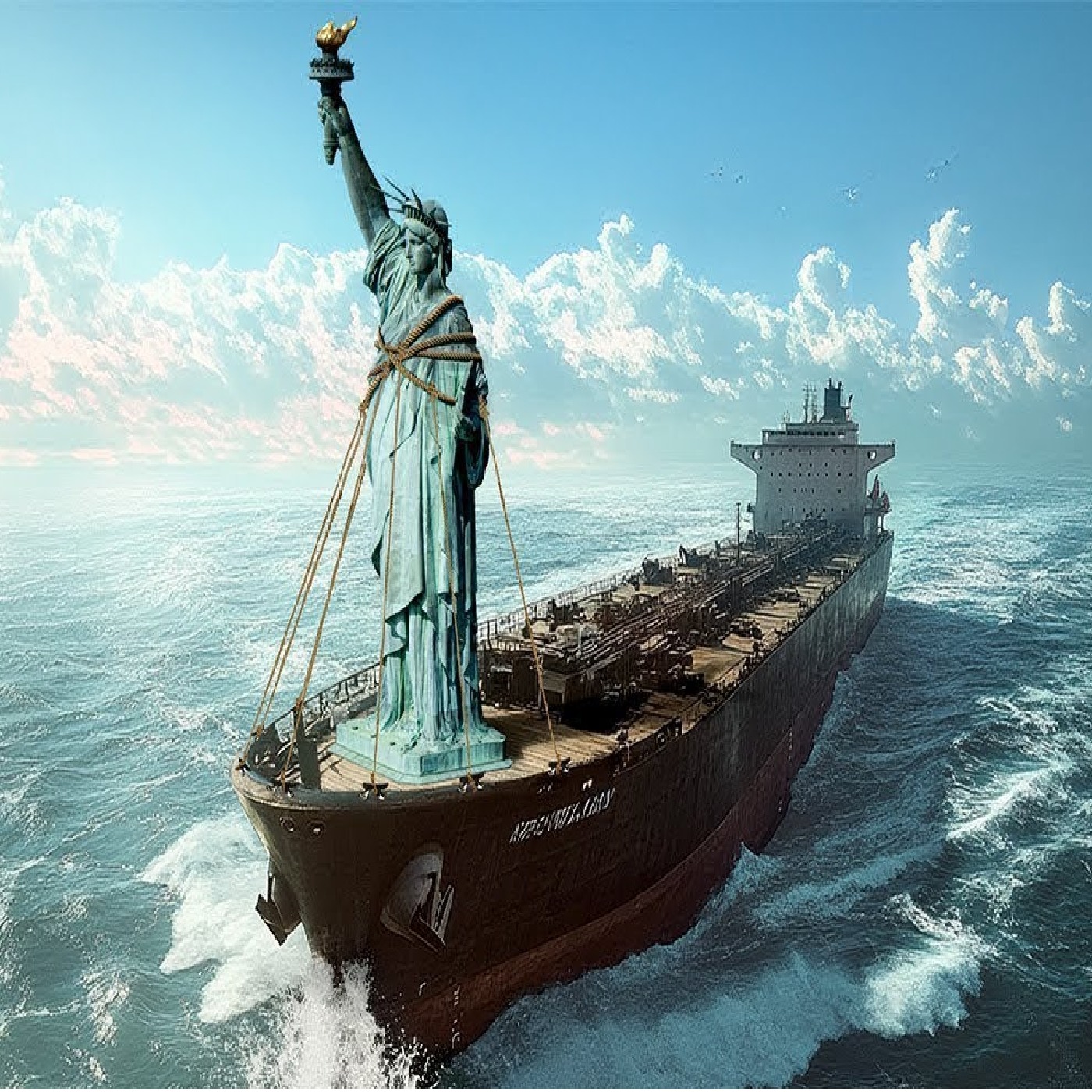
In the 1860s, French intellectual Edouard de La Boulette proposed that a statue representing Liberty be built to mark the 100th anniversary of US Independence, as well as the country's friendship with France. So, starting in 1876, French sculptor Frederick Auguste Bartolet began work on the construction of the statue. By 1884, the 150 feet tall, 225 tonn copper and steel structure was complete. Now came the hard bit, getting the thing across the Atlantic to America. It was decided the 215 foot long French frigate, Ezzair, would transport the soaring statue. Cool, as it had been to have large liby strapped up right to the hull of the Ezzair, the risk of gales blowing this marvel into the depths of the Atlantic, were too great a risk. Instead, the statue was carefully dismantled into 350 transportable pieces, which were packed into around 200 wooden crates aboard the ship.
After the colossal cargo was on board, the Ezzair set sail, taking some 27 days until she finally reached the shores of New York. From there, the crates were loaded onto a smaller vessel to be taken to Liberty Island, where the statue would later be reassembled in the spot where she still stands today. Man, who knew liby had clocked up so many miles, but the statue of Liberty isn't the only bulky bus to have undergone a major move. Back in 13th century BC, Egypt, Pharaoh remesses the second, oversaw the construction of the Abu Simba complex. Carved into the cliff face were two massive temples, as well as four colossal statues of remesses the second, with the entire structure stretching 125 feet wide and 108 feet high. This monumental marvel stood strong for more than 3,000 years, until in the 1960s plans to construct the Aswan High Dam right next to the structure threatened its very existence.
Numerous ideas on how to save the temples were put forward, one involved building a gigantic aquarium around the temples with elevator accessible underwater viewing chambers for visitors. Cool as that had looked, the idea was way too ambitious to get the green light. Another proposal involved raising the temples on hydraulic jacks, but the cost would have been immense. Eventually, it was decided the Abu Simba would be moved from the site to a nearby artificial hill. But much like the statue of Liberty, it wasn't feasible to move this massive monument in one piece. Instead, starting in 1964, the Abu Simba was cut up into more than 1,000 manageable chunks using specialized marble cutters. Well, I say manageable, those blocks still weighed up to 30 tons. Once cubed, each piece was then picked up by a crane and dropped into a truck to be transported to a depository. When the last of the temple blocks had been moved, work began on reassembling this large Lego-like structure.
By 1968, the project was finally complete, with the Abu Simba being returned to its ancient splendor, only now it was found 900 feet inland and over 210 feet higher than before. I guess you could say the Abu Simba complex was moving up in the world. If you thought transporting the Abu Simba piece by piece sounded like hard graft, it's nothing compared to what workers over in Russia had to lug back in the 18th century. In the 1760s, work began on the construction of the Bronze Horsemen, a statue that was to be erected in St. Petersburg. For the pedestal, it was decided the thunderstorm, a large boulder found in the marshland of Lacta, would be used. The only problem? Lacta is around four miles away from St. Petersburg. While cranes and trucks were used to help with the transportation of Abu Simba, that sort of technology wasn't around in the 1700s. Instead, they had to rely on good old manpower.
Considering this big boulder was 46 feet long, 16 feet high and weighed over 1,600 tons. This was no walk in the park. 400 men were given the tough task of somehow moving the stone. So how did they pull it off? Marinos Carbarris, the man in charge of the move, waited for winter to set in. This allowed the monolith to be slid along the frozen ground through two vertical axled rotating machines, each turned by a team of more than 30 workers. To aid the effort, Carbureus developed a metal sled that had run along the track. Yet only around 300 foot of track was available, meaning it had to constantly be disassembled and relayed. Even still, the workers managed to move the boulder around 500 feet per day. If all that wasn't complicated enough, the Nevka River separates Lacta from St. Petersburg. So once they reached the crossing, the bulky boulder had to be transferred to a barge mounted between two warships of the Russian Navy.
Following a short sale, the thunderstorm finally reached its destination in Central St. Petersburg after nearly nine months of backbreaking work. Man, all that graft for a pedestal, 18th century Russia, really had no chill. This episode is sponsored by BetterHelp. If you could wake up tomorrow and instantly be better at one thing, what would you choose? For me, it would definitely be handling everyday stress in healthier ways and learning how to truly unplug. When I gave BetterHelp a try, having a space to talk things through with a professional gave me tools to navigate that overwhelm, and it really shifted how I approached stressful days. Better is a feeling defined by you, and for BetterHelp it's a BetterHelp therapist who really gets you. It's a focus on globally emotional well-being, with thousands of therapists and millions of members in over 100 countries, its progress, and its getting better at working through stress and feeling more balanced in daily life, just like I did.
It's life changing, sign up and get 10% off at BetterHelp.com. That's betterHELP.com. Now, let's get back to it. This podcast is supported by your Southern California Kia dealers. It's hard not to notice how many electric vehicles are on the 405, 101, and 10 freeways these days. Better technology, convenient charging, and longer driving range are making the switch to electric more practical than ever. Kia offers three all-electric models that combine performance, technology, and capability. With compatible DC fast chargers, they can charge to 80% in less than 30 minutes, making it easier to get back on the road. One model that really stands out is the 2026 Kia EV9. It's an all-electric SUV with three rows of seating over 300 miles of all-electric driving range, and the capability and technology you'd expect from a modern SUV. Whether it's your daily commute to Burbank or a weekend drive to Ohio, the EV9 is built to fit the way you live.
If you're ready to make the move to electric, Kia has an EV designed to fit your needs. Learn more at Kia.com or visit your Southern California Kia dealer. Saturday, September 26, two of combat sports' most dangerous strikers collide. Bear Knuckle! Liverpool's own down in the Gorilla Tilt goes to war with Cuban Powerhouse Yoel's Soldier of God Romero. Plus, the Bear Knuckle Midowit Championship of the world is on the line when the rating champ Dave Verednick Mundell defends against undefeated British challenger, Jack Demeek-Pleaver-Colin, BKFC-94, till verse Romero. Watch it live only on his own. Sign up now at Dizone.com The bulky plane in question is the CC-177 Globe Master 3, stretching to a length of 174 feet and weighing in at 208 tons. This awesome aircraft is virtually twice the length and equal in weight to a blue whale. While it's nowhere near as heavy as the thunderstorm, what makes the moving of this aircraft so incredible is who did it?
You see, back in 2009, one lone individual attempted to move the CC-177 Globe Master by themselves. So, who was it? Probably some scary muscle man that you'd not want to lock eyes with. Well, in fact, the plane puller was Kevin Fast, a pastor at St. Paul's Lutheran Church in Canada. The plane was secured to a rope attached to fast body while the pastor pulled at a thick rope to edge himself and the colossal cargo forward. Incredibly, after heaving the haul for 76 seconds, fast somehow managed to lug the 200-plus ton load close to 30 feet. Man, just thinking about Kev's formidable feet is making me sweat. The only thing stronger than this pastor's faith in God are his calves. If you've ever moved home, you'll know how stressful the process of lugging all your belongings from place to place is. Still, that's way more chill than one house move that took place in Wuhan, China, back in 2016, where the building itself was moved.
In fact, this wasn't even a house. It was the Honku Ye-Yong Fire Association, a huge three-story building reaching 111 feet tall and weighing in at a staggering 16,650 tons. In 2016, huge demolition works were taking place in Wuhan. But as the Honku Ye-Yong Fire Association was considered a historic building, it was decided it'd be relocated rather than removed. So how did they pull it off? While few specific details were publicly shared based on other similar historical moves of large buildings, it's likely the building was hollowed out and reinforced before being raised using hydraulic jacks. Once slightly elevated, it could then be slid across these six large concrete tracks, allowing the soaring structure to be rolled 118 feet down the road. Though the Honku Ye-Yong Fire Association only moved a distance slightly longer than a basketball court, the delicate move took 11 days in total.
Yikes! So next time you're dreading a house move, just remember, things could be a whole lot more stressful. The behemoth in this story is a giant splitter vessel. If you didn't know, this is a large piece of industrial equipment used in the petrochemical industry to help the refining process of oil and gas. In all this particular splitter measures out at 315 feet long and weighs over 800 tons. For reference, this thing is equal in length to 18 limousines and as heavy as 4.0.7 for 7-400s. Jeez! Talk about a large load! Traveling from Edmonton, Canada, the splitter was heading for the nearby Hartland Petrochemical Complex at Fort Saskatchewan around 15 miles away. A simple journey under normal circumstances, but not when you've got to move such a sizable splitter. If that wasn't already challenging enough, the traveling time was in January, meaning they'd have to contest with skiddy surfaces as well.
It was decided the splitter, which was secured on two double 26-shoierly inner-combi trailer lines, would be pulled by two trucks from the front and pushed by four more from behind. Taking into account the size of the load in the cold conditions, the splitter, which took up the entire width of a two-lane highway, traveled its meticulously planned route at a sensible speed of 9 miles per hour. And of course, much slower on the carefully coordinated corner turns. Much of the route took place on Alberta's High Load Carter, a specialized network of roads with minimal obstacles and wider lanes to handle the transportation of humongous loads, just like this one. Finally, after three days of steady steering, the gargantuan splitter reached its new home at the Hartland Petrochemical Complex. I guess you could say slow and steady one that race. In April 2014, the MV Sioux Wall, a passenger ferry traveling to South Korea's Jeju Island, tragically capsized after making a sharp turn while battling a strong current.
Three years after the disaster, attempts were finally made to salvage the wreck. At the time of its capsizing, the vast vessel weighed over 6,800 tons and was carrying over 3,600 tons of cargo. As you can imagine, lifting nearly 10,000 tons of weight from the sea ain't easy. To start with, two huge barges were placed either side of the wreck, beams were then installed below the ship by digging through the seabed underneath. From there, cables were attached to a hydraulic jack system on the barges that pulled the sideways ship to the surface. Once the MV Sioux Wall had been pulled out the water, it was then up to this mega machine, the Hyundai 10,000 floating crane, to lift the ship into an upright position. In all this clawing contraption is made up of 2,590 foot long crane boom supported by two sets of 230 foot high backstay supports. To haul the ship upright, the crane's 64 wire ropes attached to either side of the battered vessel, allowing the crane to pull the MVs so well upright by gradually tilting the body of the ferry.
And voila! It may not be the longest transport operation we've seen, but a vast vessel getting hauled up by a colossal crane. What's not to like? Now we couldn't mention sea-based supermovers without giving a mention to boats that elevate themselves out the water. Yes, you heard that right, and no, this isn't the work of some black magic. It's actually down to this ingenious invention known as a liftboat. At sea, these boats float on the water like any other, however they're also equipped with three or four long limbs known as pipe legs which can extend down 220 feet deep into water. The legs are controlled using a jacking system which lowers them to the sea floor where they can be securely attached, either on a pre-built platform or by penetrating into the ground. As well as that, these legs can be retracted and extended vertically, meaning the ship's hull that was once on the water surface can be elevated to a heavy height.
Now you're probably wondering why a ship needs to be hundreds of feet up in the air in the first place? Well, by raising the hull up out of the waves, lift boats are able to provide a stable platform for construction and maintenance work carried out on offshore oil and gas platforms. Yep, fair to say the awesome ascent of these vessels certainly makes them stand out. Found in the Gulf of Mexico, this humongous oil platform known as the Bullwinkle, stands over 380 feet over the waves. Pretty impressive, isn't it? But that ain't the half of it. In fact, that ain't even the quarter of it. Below the water, this superstructure dives down a mega 1,353 feet, meaning the total length of the Bullwinkle oil platform exceeds 1,700 feet. That makes Old Bullie about as tall as the One World Trade Center. But how could something so mega get transported to the middle of the Gulf of Mexico? First, we've got to go back to 1989. This was the year construction of the platform had finished in Texas.
By the time the jacket of the Bullwinkle was complete, it weighed around 50,000 tons, around 7 times the mass of the Eiffel Tower's frame. Now construction was complete, came the hard bit, moving the thing. So large was the oil platform it required a custom-built barge stretching to some 853 feet long, allowing the Bullwinkle to be towed to its destination. Starting at the tip of Texas, four tugboats towed the barged Bullwinkle some 380 miles out into the Gulf of Mexico. Once it reached its destination, Bullwinkle was launched off the barge. Then workers climbed the semi-submerge structure to manually activate the hydraulic system, opening the flood valves, filling the hollow legs with water and sinking the Bullwinkle down 1,350 feet to its new home on the ocean floor. Man, what a moving mission! All those involved in this transport operation really had to be on the Bullwinkle.
In the Jean-Dark Basin, over 2,500 miles northeast of the Boecky Bullwinkle is the site of another colossal construct. Say hello to the Hebron Gravity Base structure. The Hebron Oil Field, located off the coast of Newfoundland, Canada, required the construction and transportation of a colossal gravity-based structure, otherwise known as GBS to extract oil gravity-based structures, get their name from the fact that they're anchored to the sea floor by their tremendous weight, and this particular concrete behemoth would provide stability for the oil platform above. After construction of the Hebron GBS was completed in a dry dock, the structure reached a heavy height of 390 feet. On top of that, Hebron GBS also consists of over 4.5 million cubic feet of concrete, enough to fill more than 50 Olympic swimming pools, meaning this Titan clocks the scales at over 650,000 tons.
So how did something so dense end up 220 miles off the coast of Newfoundland? A whole lot of towing, that's how. In all, it took the might of several tugboats who managed to tow the GBS to its new home. Part of the design of the Hebron GBS included a caisson, a large hollow watertight structure that maintained the Hebron GBS buoyancy as it towed out to sea. This being such a stupendously sized structure, the tugboats couldn't exactly race to their target. Traveling no quicker than 3 miles per hour, it took two weeks until the GBS reached its final destination in the Jean-Dark Basin. From here, water was pumped into the Hebron GBS sending it down into its final position. And that sounds like hard work, but considering the Hebron GBS now pumps out some 150,000 barrels of oil per day, this sounds like a mega move that paid off. In January 2012, land transport company Almage Joy embarked on the most ambitious terrestrial transport operation ever attempted.
They were tasked with moving a water desalination unit, a facility that turned saltwater into drinking water. But this wasn't any old water desalination unit? Oh no, in total the unit measures over 400 feet long, 110 feet wide and 40 feet high, making it similar in size to a football field. Geez, if that didn't sound massive enough, the unit also weighs a back-breaking 5,400 tons. As much as I'd like to say this oversized unit was lifted up and dropped to its destination by some humongous helicopters, this load was way too large for that. To start with, a 475 foot vessel transported the unit overseas from South Korea to a port of Ross, Al-Care, in Northeastern Saudi Arabia. From there, an SPMT equipped with 172 axles, 688 double width tires and a load capacity exceeding 7,300 tons was placed under the unit.
After slowly rolling the structure of the boat, the SPMT now had the arduous task of transporting the large load from the port to the Ross Al-Care desalination plant over four miles away. But Almage de Weez work wasn't done there, in total they had to transport not one, not two, but eight of these units to the Ross Al-Care desalination plant, meaning they moved well over 40,000 tons worth of water desalination units. Fortunately, all that hard graft worked out in the end. By the time the Ross Al-Care desalination plant was finished in 2014, it could turn salt water into 228 million gallons of drinking water per day. For context, that's enough to provide H-20 for 3.5 million people. All that's left to say is water-wapping transport operation that was, and there we have it. Which of these mega-moves amazed you the most? Can you think of any more mammoth transport missions yourself?
Let me know in the comments if the platform allows it, and thanks for listening. Saturday, September 26th, two of combat sports' most dangerous strikers collide. Bear Knuckle! Liverpool's own down in the Corilla Tilt goes to war with Cuban Powerhouse, Choluel's soldier of God Romero. Plus, the Bear Knuckle middleweight championship of the world is on the line when the rating champ Dave Verednick Mundell defends against undefeated British challenger, Jack Demeek Cleaver-Colin, BKFC94, till verse Romero. Watch it live only on the zone. Sign up now at Dizone.com. Saturday, September 26th, two of combat sports' most dangerous strikers collide. Bear Knuckle! Liverpool's own down in the Corilla Tilt goes to war with Cuban Powerhouse, Choluel's soldier of God Romero. Plus, the Bear Knuckle middleweight championship of the world is on the line when the rating champ Dave Verednick Mundell defends against undefeated British challenger, Jack Demeek Cleaver-Colin, BKFC94, till verse Romero.
Watch it live only on the zone. Sign up now at Dizone.com.
More episodes


