About this episode
Best Self-improvement Motivation
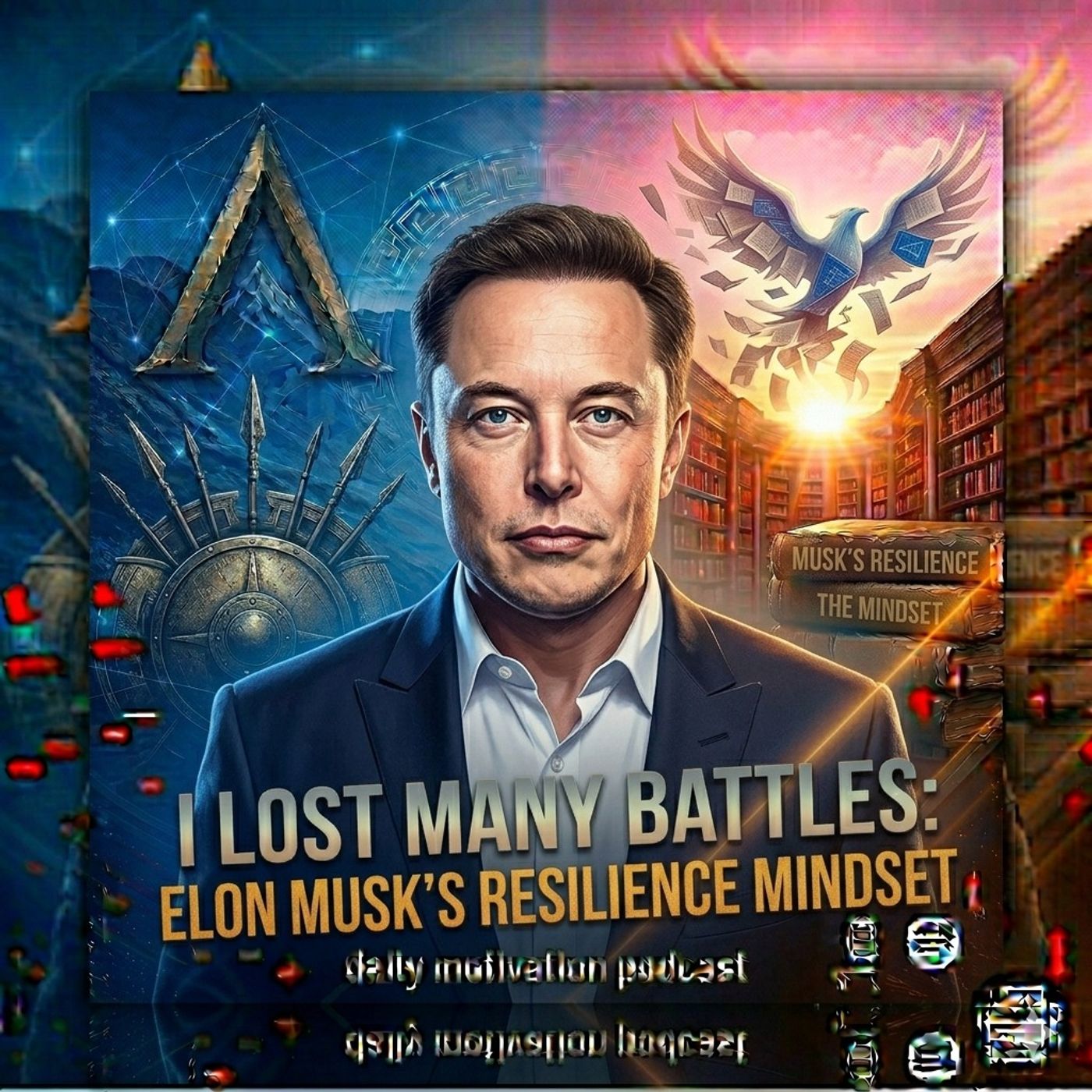
I Lost Many Battles: Elon Musk’s Resilience Mindset
Learn resilience from Elon Musk. Discover how setbacks fuel success, build mental toughness, and keep pushing toward your biggest goals.
We Need Your Love & Support ❤️
Get 3 Audiobooks Free - 👍
👉 How to Boost Your Productivity (audiobooks)
Listen To The Ultimate Life-Changing, Self-Improvement & Self-Development Motivational Audiobooks For Free:
The Subtle Art of Not Giving a F*ck👈
Think Like a Monk by Jay Shetty👈
You Are a Badass by Jen Sincero👈
All The Light We Cannot See by Anthony Doerr👈
How to Win Friends and Influence People by Dale Carnegie👈
Attention Span: Finding Focus for a Fulfilling Life by Gloria Mark👈
A Promised Land by Barack Obama👈
#Motivational_Speech
#motivation #inspirational_quotes #motivationalspeech
👉Best Audiobooks for You - 👍
Hosted by Simplecast, an AdsWizz company. See pcm.adswizz.com for information about our collection and use of personal data for advertising.
Get every episode summarized
Each time Motivational Speeches publishes, we email you a written briefing from the transcript — the topics, who appeared, and any specific claims, with the ad reads skipped.
Email me new episodesFree for 3 shows. No card needed.
Hosts & guests
Transcript ready
121 searchable segments. Every word is indexed and playable.
Full transcript
Motivational Speeches — I Lost Many Battles: Elon Musk’s Resilience Mindset. Machine-transcribed; use the interactive transcript above to jump the player to any line.
Well, I certainly have lost many battles, so far I've not lost a war, but I've certainly lost many battles. Oh, yeah, more than I can count, probably. I mean, we had many, that Tesla became many times close to bankruptcy. In fact, at the end of 2008, we were only a few days from bankruptcy, but it was literally two days, or three days maybe. I gave, basically, both SpaceX and Tesla, from the beginning, a probability of less than 10% of likely to succeed. In the beginning, I only actually wouldn't even let my friends invest because I don't want to lose their money. I thought it was like, you know, I'd rather lose my own money. We almost did die at SpaceX, actually, so we budgeted for three flights. I mean, technically, I didn't have a plan where I had to have money from PayPal, I had about 180 million from PayPal, and I thought, you know, I'll allocate half of that to SpaceX
and Tesla and solar city, and that should be fine, I'll have 90 million, like, just lots. But then what happened is, things cost more and took longer than I thought, so I had a choice of either with the rest of the money in, or the companies are going to die. And it's like, so I put, I ended up putting all the money in, and borrowing money, we're rent from France. If you want to try to come up with an innovative breakthrough, that's going to be how it is. Anything which is significantly innovative is going to come with a significant risk of failure. Take big chances in order for the potential for a big positive outcome. If the outcome is exciting enough, then taking a big risk is worthwhile. It's really our approach, but then once executing down a path, actually, do my absolute best to reduce risk, you know, or to improve the, another way of saying it, to improve the
probability of success, because when you try to do something that is very risky, you have to spend a lot of effort trying to reduce that risk as you embark down that path. I think I'm kind of constitutionally just geared to just keep going, I don't know. It's a, yeah, I mean, it just, I, I don't know, I mean, it's certainly, there are times when things don't go well, and then that's quite disparaging, for sure. And so then it's difficult to proceed with the same level of enthusiasm, but I do think like, I do think the things that we're doing are, you know, pretty important to the future. And if we don't succeed, then, you know, this, well, there's not, it's not clear what other things would succeed, and if we don't succeed, then we'll be certainly pointed to
as a reason why people shouldn't even try for these things. So I think it's important that we do whatever is necessary to keep going. So how do you keep your focus on the big picture when you're constantly faced with, we could be out of business in a month? Well, it's just a very small percentage of mental energy is on the, on the big picture. Like, you know, you know, you know, where you're generally heading for, and, and the actual path is going to be some sort of zigzaggy thing in that direction, you're trying not to deviate too far from the path that, that, that you want to be on, but you're going to have to do that some degree. I think a successful entrepreneur is probably coming all sides of shape and flavors and obsessive nature with respect to the quality of the product. It is very important. Even if you're, if you're the best, the best, there's always a chance of failure. So I think it's important that you really like whatever you're doing. If you don't like it, life is too short. If you like what you're doing, if you think about it, even when you're not working, I
mean, it'll just, it's, it's something that your mind is drawn to. And, and if you don't like it, you just really can't make a work, I think. A lot of times people think like creating companies is going to be fun. I would say it's not, it's really not that fun. I mean, there are periods of fun and there are periods of where it's just awful. And particularly if you see over the company, you actually have a distillation of all the worst problems in the company. There's a point in spending your time on things that are going right. So you only spend on things, your time on things that are going wrong. And there are things that are going wrong that other people can't, can't take care of. So you're like the worst. You have a filter for the crappest problem in the company. Most pernicious and painful problem. I think you have to feel quite compelled to do it and have a fairly high pain threshold. And there's a friend of mine who says like starting a company is like staring at the abyss and eating glass. And there's some truth to that. The staring at the abyss part is that you're going to be constantly facing the extermination
of the company. Because most startups fail. It's like 90%, like 99% of startups fail. So that's the staring at the abyss part. You're constantly saying, okay, if I don't get this right, the company will die. You can be quite stressful, quite stressful. And then the eating glass part is you've got to do, you've got to do the problems. You're going to work in the problems that the company needs to work on, not the problems you want to work on. So that's you're not working on problems that you really wish you weren't working on. And so that's the eating glass part. And that goes on for a long time. You may have heard me say that it's good to think in terms of the physics approach for the first principles, which is, rather than reasoning by analogy, you boil things down to the most fundamental truths you can imagine and you reason up from there. And this is a good way to figure out if something really makes sense or if it's just what
everybody else is doing. It's hard to think that way. You can't think that way about everything, it takes a lot of effort. But if you're trying to do something new, it's the best way to think. And that framework was developed by physicists to figure out counterintuitive things like quantum mechanics. So it's really a powerful, powerful method. The reason I came up to this time was actually to work on energy storage technologies for an accurate card. That summer, 95, I was looking at the internet and it seems to me like the internet was going to have a big effect on humanity. So I thought, well, I can either work on electric vehicle technology and do my PhD at Stanford and watch the internet get built, or I could put my studies on hold and try to be part of the internet. And at first, I tried to get a job at Netscape, because that was the only internet company. And they didn't respond to me.
So I was like, okay, if I can't get a job at the only internet company, then I'm going to try starting something. But I talked to my professor and I said, look, I'm going to try starting a company. It's probably not going to succeed. And if it doesn't succeed, can I come back? And he said, sure, no problem. And so I put my studies on hold and I started the company. If things had just gone a little bit the other way, both companies would be dead. And one of the most difficult choices I ever faced in life was in 2008. And I think I had maybe $31.00 left, $31.00 left in 2008. I had two choices. I could put it all into one company and then the other company would definitely die or split it between the two companies. And if I split it between the two companies, then both might die. And when you put your blood sweat in tears into creating something, it will be something.
It's like a child. It's like, which one am I going to let one starve to death? I can bring myself to do it. So I put my spilt the money between two. Fortunately, goodness, they both came through.
More episodes
More from Motivational Speeches

Why You Can’t Get Rich Looking Poor | Dan Lok
Motivational Speeches

Why the Worst Number in Business Is ONE | Dan Lok
Motivational Speeches

Why the Best Leaders Are Full-Time Learners | Darren Jacklin
Motivational Speeches

Why Selling Is Not a Four-Letter Word | Dan Lok
Motivational Speeches