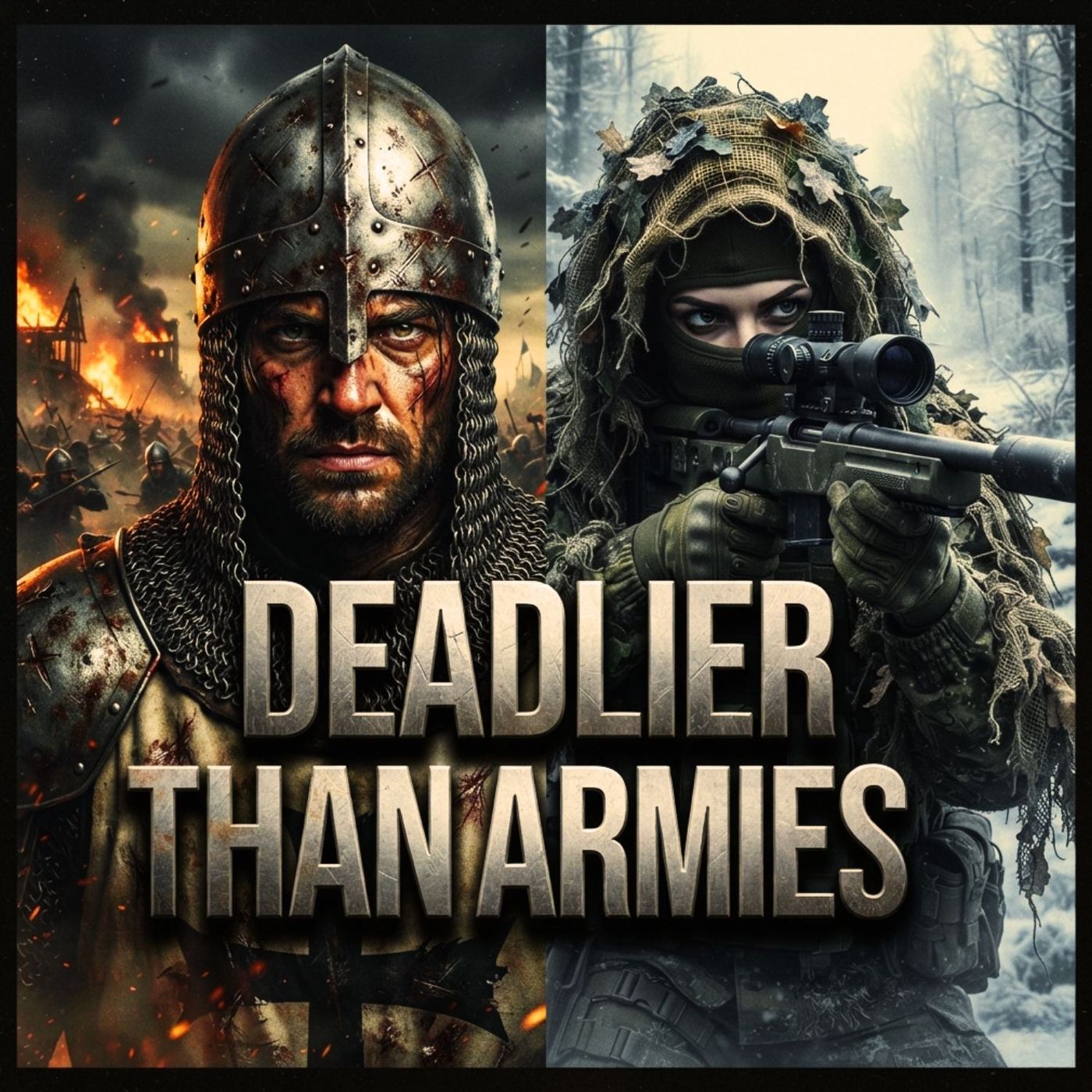
History's MOST DANGEROUS: The Lethal Individuals Who Changed the World
About this episode
Thrilling Threads - Conspiracy Theories, Strange Phenomena, Unsolved Mysteries, etc! is made possible by:
Most textbooks focus on the kings who signed treaties, but they ignore the individuals who actually finished the job. From the undefeated knight William Marshall to the tactical pirate leader Jiang Yi Sao, we’re uncovering the stories of history’s most lethal individuals. These weren't just soldiers; they were master duelists, deadly snipers, and notorious serial killers who dominated their era through pure personal prowess and a terrifying psychological impact. ⚔️
Why do we still whisper their names? Is it their martial discipline, or the unorthodox tactics they used to survive the impossible? In this podcast, we countdown the figures who reshaped human history outside of traditional military command. We explore how raw lethality, extraordinary survival, and combat skill allowed these icons to dominate their adversaries in every life-or-death encounter, leaving a terrifying and lasting mark on our world. 🛡️
Why This Episode Is a Must-Listen:
- Individual Lethality: Discover how one person shifted the tides of power through personal mastery.
- Mastery of Death: The psychology behind history’s most dangerous people.
- Survival Tactics: How they won every encounter using unorthodox tactics and sheer grit.
- Modern Relevance: Why their legacies still haunt our collective memory today.
✨ Enjoyed the mayhem? Hit that subscribe button, leave a glowing review, and share this with your favorite history buff! Who is the most lethal person you have ever heard of? Drop a comment below! #History #LethalIndividuals #Podcast #TrueCrime #WarriorCulture #LegendaryKillers
Become a supporter of this podcast: https://www.spreaker.com/podcast/thrilling-threads-conspiracy-theories-strange-phenomena-true-crime-unsolved-mysteries-etc--5995429/support.
ThrillingThreadsPod.com - Unravel the Unknown.Dive deep into the world's greatest conspiracy theories, strange phenomena, true crimes, and unsolved mysteries. Follow the threads.
Get every episode summarized
Each time Thrilling Threads - Conspiracy Theories, Strange Phenomena, Unsolved Mysteries, etc! publishes, we email you a written briefing from the transcript — the topics, who appeared, and any specific claims, with the ad reads skipped.
Email me new episodesFree for 3 shows. No card needed.
Hosts & guests
Transcript ready
1,187 searchable segments. Every word is indexed and playable.
Full transcript
Thrilling Threads - Conspiracy Theories, Strange Phenomena, Unsolved Mysteries, etc! — History's MOST DANGEROUS: The Lethal Individuals Who Changed the World. Machine-transcribed; use the interactive transcript above to jump the player to any line.
This is Matt Rogers from Lost Culture East. It's with Matt Rogers and Bowen Yang. This is Bowen Yang from Lost Culture East. It's with Matt Rogers and Bowen Yang. You know when people try a new food and suddenly it's like, okay, hold on. I got a new favorite food. That's the reaction a lot of people are having when they first try Cupid Mayon. Yeah, it's the one with the red cap and the little baby on the bottle. You've probably seen it at the grocery store. And this mayo is different. Mm-hmm. Most mayonnaise uses whole eggs. Cupid only uses egg yolks, which gives it this rich umami flavor. It's smoother, deeper, almost buttery. Once people try it, they start putting it on everything. Egg sandwiches, fries, burgers, chefs use it, restaurants use it, people who really care about flavor use it, put it on just about anything. Then you'll understand. Cupid, the original Japanese mayonnaise. This is Ashley Akinetti from the Almost Amos Podcast. You ever notice you and your spouse keep saying, we need to get away, but you never actually plan anything. That was us until we did something fun and spontaneous. We went to resortpass.com. There are hundreds of hotel resorts,
pools and spots and private beaches that you can enjoy. You can spend the day at a luxury resort, pool, spa, massage, without booking an overnight stay. And listen, I may have only been like 15 minutes from home, but it felt like it was a whole different world. And I'm thinking, this is exactly what I needed. So just go to resortpass.com, choose your resort, choose your day, luxury, resort, day passes, start at just $25. Once you post your daycation, people are going to ask where you are. Go to resortpass.com, slash Almost Famous, and use the promo code Almost Famous to get $20 off when you spend $100. That's code Almost Famous at ResortPass.com, slash Almost Famous. Kitchen and bathroom professionals know what goes behind the tile matters. That's why Trade Pro's trust Fiber cement, Party Backer Board to keep tile firmly in place, resist cracking, and help block moisture. Chosen in over 40 million kitchen and bathrooms,
Party Backer Board, what the best build on. Shop now at participating Home Depot, Lowe's, and floor into core stores. For more information, visit jameshardy.com, slashhardybacker. Imagine for a second you're standing on a battlefield. Oh wow, okay, setting the seat. Yeah, right. So the air is just thick with smoke. Like you can actually taste the sulfur in the back of your throat. And the noise is just this deafening, I mean, totally chaotic roar of artillery and shouting and clashing steel. And you look across the mud and the carnage at the enemy line. Right. And you have to ask yourself, what makes the person standing across from you genuinely terrifying? That is a, that's a really phenomenal question. Right, because is it the weapon they're holding? Or maybe the sheer mass of the army standing behind them, or is it something intrinsic? Is it just them? Yeah, as humans, we naturally want to attribute danger to, well, to external measurable things.
Right, things we can actually see. Exactly, we look at the armor or the caliber of the rifle or who has the high ground. We desperately want danger to be a quantifiable metric. Because if we can measure it, we can theoretically defeat it, you know? Yeah, that makes total sense. But the people we're looking at today completely shatter those metrics. Welcome to Thrillin Threads. It's great to be here for this one. It's going to be intense. Oh, it really is. We are embarking on a massive exploration today, pulling from historical records, military treatises, and compilations of history's most lethal individual. Our mission is to look at 20 individuals whose raw personal lethality, I mean, their physical, psychological, and strategically lethality made them the absolute most dangerous people to ever walk the earth. Oh, we should probably clarify our parameters here. Oh, definitely. We are ignoring the bureaucracy of war today. So the generals in the tents, the emperors, the dictators. Right, the guys sitting behind a desk somewhere. Exactly. They shaped the world, certainly.
But their danger came from a chain of command. We are analyzing personal applied lethality, the actual mechanics of individuals who became forces of nature on their own. Okay, let's unpack this. Because I want to dive straight into the deep end with people who seem like they walked out of, like a mythology text, but they are entirely real. The warriors whose sheer physical presence broke enemy morale, right? Exactly. Before a weapon was even swung, let's start in Japan's Sengoku period with a samurai named Honda Tata Katsu. Ah, yes, Tata Katsu. Disky, he fought in over 100 battles during literally one of the most brutal chaotic eras in Japanese history. And the historical consensus is that he never took a single wound. Which is just wild. Not one scrap. The forces us to ask, you know, what are the actual mechanics of surviving that kind of chaos? Because our modern minds immediately write this office folklore. Right, we just assume someone exaggerated the records because it sounds completely impossible.
Oh, sure. You're telling me he fought in a hundred Maylays and never even like tripped and scraped his knee on a straight spear? Well, to understand Tata Katsu, you really have to understand the physics of a Sengoku battlefield. It wasn't the romanticized, you know, one-on-one samurai duels. You see it movies. Right, no honorable bowing before the fight. Not at all. It was a chaotic crush of foot soldiers, the Ashegaru wielding massive pikes. You had matchlock muskets firing blindly through thick smoke, horses panicking in the mud. Danger is coming from 360 degrees. Yeah. So to survive that without a scratch isn't magic. It's an unparalleled mastery of spatial awareness and chaos theory. It's kind of like an NFL running back who can see the holes in the defensive line before the players have even shifted, but, you know, with razor-sharp steel. That is precisely it. Tata Katsu had this acute ability to read the micro movements of a battlefield. He wasn't just reacting to the sword swinging at him. He was seeing the whole picture.
Yeah, he was reading the footing of the man three paces away. He saw where an enemy's balance was shifted, where the momentum of a crowd was pulling, and he positioned himself in the negative space of the violence. And he did all this while wearing a massive imposing helmet. Like it was adorned with these huge deer antlers. Right. And he's wielding a spear named Tung Bo Geeri, which translates to the dragonfly cutter. So he basically made himself the most visible target on the field. And that is the psychological brilliance of it. The antlers and the legendary spear, they made him instantly recognizable. Yeah, you'd seem coming from a mile away. Exactly. When you combine that level of technical spatial perfection with a terrifying visual silhouette, you create a psychological cascade in the enemy ranks. You weren't fighting a man at that point. No, they were fighting in the concept of death itself. A soldier's Odae loop, their ability to observe, orient, decide, and act. All right, right. Yeah. It completely breaks down when the giant horn demon they've heard campfire stories about
is suddenly charging at them. The psychological defeat happens before the physical clash even starts. OK, so let's test that theory of physical and psychological dominance in a totally different theater. Let's do it. We're crossing the globe to the American Revolutionary War. I want to talk about Peter Francisco, the Virginia giant. Oh, this guy's fascinating. He really is. He stood six foot six in the 18th century, which is just massive for the era. A giant, literally. Yeah. And he wielded a custom six foot broadsword. The records say he fought off multiple British cavalrymen single-handedly. But here's the claim that makes me slam the brakes. He allegedly carried a half-tun cannon at the Battle of Camden to stop it from falling into enemy hands. It is a fantastic image, though. It's a comic book image. I mean, the physics of one man lifting 1,000 pounds of iron and wood, let alone while under musket fire, it just does not add up. No, it really doesn't. So how do we take his lethality seriously
with that kind of exaggeration on his resume? Well, you're right to question the physics, absolutely. But the exaggeration is actually the key to understanding his danger. Let's look at the biomechanics of a six foot six man wielding a six foot blade against the line of British regulars. Or what, maybe five foot six on average? Exactly. Francisco had an insurmountable reach and leverage advantage. Before a British soldier could even bring a bayonet to bear, Francisco's blade was already passing through their defensive sphere. So his physical reality was already devastating on its own? Exactly. He was genuinely a human-threshing machine on the battlefield. Now, combine that genuine physical terror with the rumor of the cannon. Because in war, truth is completely subservient to belief. If you are a British soldier, far from home, hungry, fighting in a dense, unfamiliar forest. Yeah, you're already on edge. And the whisper down the picket line is that the colonial army has a giant who eats cavalry for breakfast and carries artillery on his back. I mean, your morale is fractured.
Totally shattered. Francisco's sheer physical dominance catalyzed a mythology that turned him into a weapon of mass intimidation. The colonial army didn't need him to actually lift the cannon. They just needed the British to believe he could. That makes total sense. The myth does the heavy lifting pun totally intended. No, it's what. Which leads me to Kutulun, because her power was completely tangible. No myths needed. She was the great, great granddaughter of Genghis Khan, which is a lineage that inherently comes with a vast network of political and military power. Yes, but she demanded her own terms. Kutulun was a fearsome warrior and an absolute master of Mongolian wrestling. She laid down a rule for her life. A very strict rule. Yeah, any suiter who wanted to marry her had to defeat her in a wrestling match. And if they lost, they had to forfeit horses to her. And nobody ever beat her. Nobody. She reportedly accumulated 10,000 horses from defeated suitors and fought right alongside her father in massive military campaigns. To really grasp how dangerous she was,
we have to look at the mechanics of Mongolian wrestling or Brooke. OK. Yeah. Because it has no weight classes. It is entirely about leverage, group strength, and manipulating your opponent's center of gravity. Wow. No weight classes at all. None. So for Kutulun to defeat hundreds, perhaps thousands, of elite male warriors from across the empire, she had to possess a biomechanical understanding of balance that was absolute. She was just outleveraging them. She wasn't just overpowering them. No. She was systematically dismantling their kinetic energy and using it against them. And she's doing this in a culture where pure physical prowess is essentially the highest currency you can hold. Like respect was earned through physical dominance. And that brings us to the economic reality of her lethality, actually, because 10,000 horses is not just a collection. Right. And the Mongolian Empire, 10,000 horses, is a strategic military asset. It is mobility. It is logistics. It is immense wealth. She literally wrestled an army's worth of logistics
out of the fragile egos of her suitors. I love that. She weaponized their egos. And what fascinates me most is that she was barely mentioned in the official court texts. The historians, well, they really tried to erase her. But they couldn't. Because oral history is immune to court sensors. Her legend thrived among the common people of both Mongolia and China. You can burn a scroll, but you cannot erase the cultural memory of an undefeated warrior queen who bankrupted princes on the wrestling pitch. So true. So brute strength, spatial awareness, and leveraging your own mythology work incredibly well in a muddy battlefield or a wrestling pitch. Definitely. But let's shift gears. This is Matt Rogers from Los Culturistas with Matt Rogers and Boan Yang. This is Boan Yang from Los Culturistas with Matt Rogers and Boan Yang. You know when people try new food, and suddenly it's like, wait. And that's the reaction. A lot of people are having when they first try QB mayo. It's the one with the red cap and the little baby on the bottle. You've probably seen it in the grocery store before. And if you've ever just walked past it,
some people would say that's a huge mistake. Because this mayo is different. Most mayonnaise uses whole eggs. QB only uses egg yolks, which gives it this rich umami flavor. It's smoother, deeper, and almost buttery. Once people try it, they start putting it on everything. Egg sandwiches, fries, burgers, some fans even swear by dipping pizza crust in it. And once you notice it, you start seeing it everywhere. Chefs use it, restaurants use it. People who really care about flavor use it. Never try it. Grab the bottle with the red cap next time you're at the store. Put it on just about anything. Then you'll understand. QB, the original Japanese mayonnaise. This is Ashley Akinetti from the Almost Amused Podcast. You ever notice you and your spouse keep saying, we need to get away. But you never actually plan anything. That was us until we did something fun and spontaneous. We went to resortpass.com. There are hundreds of hotel resorts, pools and spots and private beaches that you can enjoy. You can spend the day at a luxury resort, pool, spa, massage,
without booking an overnight stay. And listen, I may have only been like 15 minutes from home, but it felt like it was a whole different world. And I'm thinking, this is exactly what I needed. So just go to resortpass.com, choose your resort, choose your day, luxury, resort, day passes, start at just $25. Once you post your daycation, people are going to ask where you are. Go to resortpass.com slash almost famous and use the promo code almost famous to get $20 off when you spend $100. That's code almost famous at resortpass.com slash almost famous. This episode is brought to you by Spreaker, the platform responsible for a rapidly spreading condition known as podcast brain. Symptoms include buying microphones you don't need, explaining RSS feeds to confused relatives and saying things like, sorry, I can't talk right now, I'm editing audio. If this sounds familiar, you're probably already a podcaster. The good news is Spreaker makes the whole process simple. You record your show, upload it once,
and Spreaker distributes it everywhere people listen. Apple podcasts, Spotify, and about it doesn't apps your cousins swears are the next big thing. Even better, Spreaker helps you monetize your show with ads, meaning your podcast might someday pay for well, more microphones. Start your show today at spreaker.com. Spreaker, because if you're going to talk to yourself for an hour, you might as well publish it. What happens when lethality steps off the battlefield and into say a polite structured society? Oh, you are talking about the weaponization of unpredictability. Exactly. Let's talk about the fatal duel. Specifically, Julie Dolby-Nee, known as La Moupe. Legendary figure. She was a 17th century French opera singer and just an exceptional swordswoman. Her father trained her defense, which was highly irregular, and she routinely dressed in men's clothing to skirt the rigid societal rules. My favorite account of her life, and this is just wild, she attends a masked ball at the palace of her side.
She kisses a young noble woman to cause a massive scandal. As you do. And when three different men challenge her to a duel over the perceived insult, she goes outside into the dark and defeats all three of them in succession. What's fascinating here is to understand why Julie Dolby-G was so lethal. We have to examine the mechanics of 17th century rapier combat and the society had existed in. Okay, lay it out for us. Fencing in this era was highly linear. It was governed by strict tempos, specific parries, and very gentlemanly rules of engagement. It was essentially an extension of the highly structured, rigid class system of France itself. Like a violent dance with very specific choreography. Exactly. Now enter Julie. She has the technical training of a master, but she fundamentally rejects the choreography. By flouting gender norms, class conventions, and the law itself, she broadcasted to her opponents that she did not play by their rules. How does that translate into a sword fight, practically speaking, like in the moment? Well, it creates hesitation.
When those three men followed her outside, they expected a standard duel. They expected the established tempo. But she brought the explosive unpredictability of the operatic stage to the dueling ground. If you are fighting someone who you believe is operating under the same gentlemanly, constraints as you, and they suddenly drop their center of gravity, break the linear plane, and attack on a half beat. Your brain just can't catch up. Right, your brain cannot process the new geometry fast enough to parry. Her danger lay in her absolute refusal to be categorized or controlled. That concept of tempo and performance brings us perfectly to Joseph Belon, the Chivalier de Sons-Scheur. Yes, an incredible individual. This man's life is just a master class in duality. He's an 18th century French master fencer, but simultaneously a celebrated composer and conductor. Elite aristocrats would literally flock to watch him fight. And he later commanded a regiment during the French Revolution, though he was tragically imprisoned for 18 months due to revolutionary paranoia.
But I'm just fascinated by how a master composer can also be the most lethal duelist in Paris. It actually makes perfect sense when you break down the underlying mechanics of both disciplines. Think about what a conductor does. They lead the orchestra, keep the beat. Right, a conductor manages time, cadence, and rhythm. They anticipate where the music needs to swell and where the rest are. So he was literally conducting his opponents in a fight. In a very real sense, yes. In fencing, there's a concept called stealing the tempo. Stealing the tempo. Yeah. If I parry your blade in a steady one, two rhythm, your brain gets comfortable with that metronome. If balloon parries on the one, and then delays his repost by a fraction of a second, which is basically a musical syncopation, right? Oh, I see. His opponents blade sweeps through empty air, expecting contact on the two, leaving them entirely exposed. That is terrifying. It's weaponized music. And it extended beyond the physical duel, too. Yeah. And mixed-race man navigating the incredibly treacherous, racist waters of elite French aristocracy.
Right, which was a minefield. Exactly. High society is itself a duel. It requires the same footwork, the same carrying of subtle insults, the same timing of when to advance and when to retreat. He was an exemplary representation of control danger. Yeah. His elegance, his music, and his charm made his lethality acceptable to the aristocracy. He was a predator invited into the parlor because he played the violin beautifully. Precisely, which makes him vastly more dangerous than just a brute on a battlefield. OK, so if fighting is a rhythm, and if there is a literal science to stealing the tempo, who writes the sheet music? The professors of violence, essentially. Right. Let's move into our next section, the architects of combat. These are the individuals who documented violence and turned it into a repeatable curriculum. Because how do you actually teach someone to survive a sword fight? It's the transition from experiential survival to academic lethality. First up is Fiori De Liberi, a 14th century Italian master. He fought numerous personal duels, won all of them
without serious injury. But his true legacy is his manual. A very famous manual. Yeah, he wrote incredibly detailed treatises, emphasizing grappling, timing, and precision over brute force. But why take the time to write it all down? Because Fiori recognized that human bodies, despite their variations, are governed by identical physical laws. Before Fiori, combat knowledge was incredibly guarded. Like family secrets. Exactly. You survived, you learned a trick, you kept it secret. But Fiori looked at violence objectively. He mapped the biomechanics of the human body. He calculated the geometry of armed conflict. Could be an example of the geometry of conflict. What does that actually look like? Well, look at his work on fighting against a long sword with just a dagger. Instinct tells you to run from the sword, right? To back away. Yeah, get out of the way of the big blade. But Fiori's geometry dictates that you must step inside the swing. A sword generates its maximum kinetic energy at the tip of the blade. Right.
If you can close the distance and jam the opponent's forearms before the blade reaches its maximum velocity, you have completely neutralized their mechanical advantage. Wow. Fiori was dangerous because he realized a fight isn't one by the angrier man. Is one by the man who controls the levers and full-crums of the body. And someone who clearly mastered those levers was Donald McBain, a Scottish soldier who fought in really 100 sword fights. Often to the death, too. Yeah. And without ever receiving a single cut, he fought his last duel at the age of 63, easily one, and then retired to devote his life to God. Quite the career pivot. Right. He published a seminal fencing treatise in 1728. But I mean, surviving on in sword fights is one thing, but fighting a duel at 63? How does someone do that? By entirely removing ego from the equation, at 63, your fast twitch muscle fibers have degraded. You simply cannot rely on speed anymore. You just not as fast as a 20-year-old. Exactly.
McBain survived by relying on flawless defensive structure and distance management. He fought statistically. What does fighting statistically look like in a sword fight? It means you only take actions that have a 90% probability of success with a 10% risk of exposure. You don't take wild swings. You play the odds. Yeah. You keep your point online. You force the opponent to navigate your defensive geometry, and you wait for them to overextend. It's just cold calculation. Completely. In an era where a minor cut could lead to a fatal infection, receiving zero cuts over a lifetime of fighting, demonstrates a man who had completely demystified death. He saw the underlying matrix of a fight, where most men only saw chaos. That concept of demystifying death takes on a whole new dimension when we look east to the philosophers of combat. Sukahara Bukudin and Miyamoto Musashi. The architects of psychological warfare. Let's start with Bukudin. A wandering swordsman fought his first death duel at 17. Which is so young. I know. He participated in 19 duels in 37 battles
and killed over 200 men. He was wounded by arrows a few times, but never by a blade. And he founded a school called Mutatsu Ru, which translates to winning without hands. Now, I'm sorry. How do you win a sword fight without using your hands? It sounds paradoxical, I know, but it is the absolute pinnacle of martial philosophy. Bukudin realized that if you have to draw your sword, you have already entered a state of risk. You're already gambling. Exactly. Winning without hands means controlling the environment, the variables, and the emotional state of your opponent so completely that the conflict is resolved before violence is even required. And if Bukudin theorized it, Miyamoto Musashi perfected it. Oh, absolutely. Musashi won his first duel at 13 and went unbeaten in over 60 duels, but the story that really defines him is his duel with the master swordsman Sasaki Kojiro. A legendary encounter. Here's where it gets really interesting. Kojiro is waiting on an island with his legendary mastercrafted long blade. Musashi deliberately shows up hours late.
Hours. He steps out of the boat looking disheveled, holding a practice sword he just carved out of a spare wooden or on the right over. And with that wooden stick, he strikes down one of the greatest swordsmen in Japan. It is the ultimate display of dismantling an opponent's Odea loop. Okay, walk me through the mechanics of that. Why didn't Kojiro just, I don't know, cut the wooden or in half with his steel sword? Because Musashi had already defeated Kojiro's mind. Think about Kojiro's preparation. He is a master. He expects a formalized duel. He expects respect. Yes. He expects an opponent who respects the solemnity of death. Musashi intentionally arriving late was an act of profound disrespect that just infuriated Kojiro. And anger makes you sloppy. Exactly. Anger spikes your adrenaline, but it ruins your fine motor skills and your ability to judge distance. So Kojiro is furious. He's seething and then he sees the or. Yes. Kojiro's entire martial system was based on measuring the distance of standard steel katanas.
Musashi shows up with a weapon that is an unknown length, an unknown weight, and is a completely different balance point. He threw a total wild card at him. He did. Kojiro's brain just cannot calculate the geometry of the or fast enough. Musashi used the psychological weight of his own disrespect, combined with the physical anomaly of the or to shatter Kojiro's reality. Wow. When you can dictate the terms of reality for your enemy, you don't even need steel. That is a brilliant bridge into our next category, the system breakers. Yes. Because dictating reality for one opponent on an island is incredible, but some individuals expanded their lethality. They took on entire nations. They shifted their applied lethality from the personal sphere, to the structural sphere. Let's look at Spartacus, a Thracian gladiator who breaks out of a training school in Kappa with just 70 other slaves. A very small group to start. Very small. And the historical consensus is that Spartacus didn't really have grand political ambitions. He mostly just wanted to go home. Right. But he ends up building an army of 70,000 people
and repeatedly crushes the Roman legions. It is staggering to me that a man whose goal was basically I want to go home nearly collapsed the Roman Republic. Spartacus reveals the devastating lethality of unified purpose born from desperation. We really have to look at how he transitioned from a gladiator to a general. Because those are very different skill sets. Completely different. Gladiatorial combat is strictly one-on-one or small unit skirmishing. It is highly theatrical violence. The Roman legion is the exact opposite of that. Right. The Romans were a machine. A machine built on order, discipline, and subjugation. It was an interlocking failax of shields. Spartacus was the dangerous because he figured out how to break the mechanics of that machine. How did he do it? Well, he used the terrain for one, like repelling down the vines of Mount Fesuvius to flank a Roman encampment that thought they had him trapped. Oh, that's brilliant. He took a disorganized mass of traumatized, starving, enslaved people, and trained them to fight as a cohesive unit.
He exposed the fundamental flaw of Rome, which was that an empire that relies on millions of oppressed people for its infrastructure is constantly standing on a powder cake. Spartacus just provided the spark. He turned the empire's own labor force into a weapon against it. That's incredible. Our next figure did something arguably even more impressive, though. She built a machine that outcompeted the empire. Jeng Yisau. Yes. Jeng Yisau, the absolute pinnacle of the golden age of piracy. A truly phenomenal administrator of violence. Yeah. If we connect this to the bigger picture, she wasn't just dangerous because she had ships. Right. She takes over a massive pirate confederation in the South China Sea. She isn't just commanding a ship. She is commanding hundreds of vessels. Tens of thousands of pirates. She institutes a strict code of conduct, heavily regulates the plunder, and basically goes toe to toe with the King dynasty. And wins, largely. And the craziest part is her exit strategy. She negotiated her own surrender,
walked away incredibly wealthy, and lived peacefully. I mean, how do you beat a dynasty with a fleet of pirates? I'm not acting like pirates, honestly. What do you mean? Well, pirates usually fail because of internal betrayal, greed, and a total lack of long-term logistical planning. Zengi Sao was dangerous because she possessed supreme or relational genius. She was essentially a militancy. This is Matt Rogers from Los Cultures. It's us with Matt Rogers and Boan Yang. This is Boan Yang from Los Cultures. It's Matt Rogers and Boan Yang. You know when people try a new food, and suddenly it's like, wait. That's the reaction. A lot of people are having when they first try QB mayo. It's the one with the red cap and the little baby on the bottle. You've probably seen it in the grocery store before. And if you've ever just walked past it, some people would say that's a huge mistake. Because this mayo is different. Most mayonnaise uses whole eggs. QB only uses egg yolks, which gives it this rich umami flavor. It's smoother, deeper, and almost buttery. Once people try it, they start putting it on everything.
Egg sandwiches, fries, burgers, some fans even swear by dipping pizza crust in it. And once you notice it, you start seeing it everywhere. Chefs use it, restaurants use it. People who really care about flavor use it. Never tried it. Grab the bottle with the red cap next time you're at the store. Put it on just about anything, then you'll understand. QB, the original Japanese mayonnaise. This is Ashley Akinetti from the almost famous podcast. You ever notice you and your spouse keep saying, we need to get away, but you never actually plan anything. That was us until we did something fun and spontaneous. We went to resortpass.com. There are hundreds of hotel resorts, pools and spots and private beaches that you can enjoy. You can spend the day at a luxury resort, pool, spa, massage, without booking an overnight stay. And listen, I may have only been like 15 minutes from home, but it felt like it was a whole different world. And I'm thinking, this is exactly what I needed. So just go to resortpass.com, choose your resort, choose your day, luxury resort day passes,
start at just $1,5. Once you post your daycation, people are gonna ask where you are. Go to resortpass.com, slash almost famous and use the promo code almost famous to get $20 off when you spend $100. That's code almost famous at resortpass.com slash almost famous. This episode is brought to you by Spreaker, the platform responsible for a rapidly spreading condition known as podcast brain. Symptoms include buying microphones you don't need, explaining RSS feeds to confused relatives and saying things like, sorry, I can't talk right now, I'm editing audio. If this sounds familiar, you're probably already a podcaster. The good news is Spreaker makes the whole process simple. You record your show, upload it once and Spreaker distributes it everywhere people listen. Apple podcasts, Spotify, and about it doesn't apps your cousins swear as the next big thing. Even better, Spreaker helps you monetize your show with ads, meaning your podcast might someday pay for, well, more microphones. Start your show today at spreaker.com.
Spreaker, because if you're going to talk to yourself for an hour, you might as well publish it. Go. Okay, explain her corporate structure. How does she run this? She instituted a highly strict taxation system. If a ship looted a village, the crew didn't just keep the spoils. The plunder was registered, taxed, and distributed across the fleet. To everyone gets a cut. Exactly. To ensure even the ships that didn't see action were funded and maintained. She created dedicated supply chains for gunpowder and food. She established laws regarding the treatment of captives, punishing assault with immediate execution. Wow. So there was real order. Yes. She didn't just wage a naval war. She built a shadow economy that was more efficient and arguably fairer to her crews than the King government's official economy. She was dangerous because she literally replaced the state. That level of systemic control is mind blowing. But let's look at the opposite end of the system breaking spectrum. Okay. System breaking born not out of administration, but out of absolute unyielding grief. I'm talking about Toronto.
A heartbreaking, but terrifying story. The Apache leader who waged a decades-long guerrilla war against the United States in Mexico. The catalyst for his war was the massacre of his family by Mexican troops. He wrote that after that, he had no purpose left only revenge. And he evaded two modern armies for years. Toronto represents lethality, completely strip of ambition. He wasn't trying to conquer territory or build an economy. Right. He was just fighting to hurt them. When an empire attempts to eradicate a people, the individuals who survive and fight back are dangerous because they are no longer bound by the standard rules of self-preservation. You can't threaten a man who has already lost everything. Exactly. And practically speaking, Geronimo weaponized the arid brutal terrain of the American Southwest. The US cavalry operated on standard military logistics. They needed supply trains, water lines, specific encampment protocol. You're heavy and slow. Right. Geronimo and his band operated completely outside those logistics.
They could move incredibly fast, survive on the sparse vegetation of the desert and just vanish into the canyons. Like ghosts. He used the environment to exhaust his pursuers physically and psychologically. He was a ghost that a modern military infrastructure simply could not process. Which brings us perfectly to our next section. We're gonna look at what happens when these ancient primal ways of fighting clashed directly with modern military infrastructure. Battlefield Titans versus the anachronism. Right. We have to briefly touch on William Marshall, often called the greatest medieval knight. And Gergie Thurry, the Hungarian, who won over 600 personal combats against Ottoman officers. These were men who acted as the literal gravity of a battlefield. Because of their supreme mechanical reliability, right? Yeah. Marshall fighting in 500 Maylays means he possessed a stamina and tactical brilliance that literally held royal armies together. He was an institution of violence. But I wanna spend some time on someone who brought that exact medieval energy into the 20th century. Mad Jack Churchill. Oh, a figure who just completely defies all logic.
He really does. He fought in World World II. But instead of an SMG, Jack Churchill went into battle carrying a Scottish broadsword, a longbow, and bagpipes. In the 1940s. Yes. He actually scored the last confirmed longbow shill in wartime in 1940. When someone asked him why he carried a sword, he said, any officer who goes into action without his sword is improperly dressed. He also claimed he smiled in combat because people are less likely to shoot a smiling man. I mean, this is absolute pure lunacy. You are bringing a sword to a tank fight. Why didn't he die immediately? Because of the psychology of absurdity. Okay, unpack that for me. War in the 1940s was defined by industrialized, mechanized slaughter. Human beings were essentially reduced to statistics. Soldiers were trained to counter very specific threats, suppressing fire, flanking maneuvers, grenades. So they have a specific script they expect the enemy to follow? Yes. Now, imagine you were a German soldier manning an MG-42 machine gun.
You were scanning the tree line for a rifle squad. Right, looking for guys in helmets with rifles. Suddenly a man burst from the smoke, playing the bagpipes, swinging a medieval broadsword and smiling at you. Your brain just short-circuit. Exactly. It is an acute cognitive short circuit. Human brain cannot process the auditory and visual anomaly of a medieval highlander in a mechanized war zone fast enough. It's just too weird to compute. The sheer absurdity of his actions caused hesitation. In a firefight, a one-second hesitation is the difference between life and death. Churchill weaponized in acridism. Wow. He survived and was incredibly dangerous because he fundamentally refused to play the modern game. And his enemies just didn't know how to adapt to him. That is fascinating. He survived by being the loudest, most chaotic thing on the battlefield. But ironically, at that exact same moment in history, the concept of lethality was flipping completely on its head. Yes, moving the exact opposite direction. Right, survival was no longer about being seen. It was about vanishing entirely.
The invisible death, the snipers of the modern era. The ultimate evolution of psychological area denial. Let's talk about Vasily Zaitsev and Lidmila Pavlichenko. Zaitsev became an absolute legend in the ruins of Stalin Grad with 225 confirmed kills. He famously won a multi-day sniper duel against a German master sniper. A grueling test of patience. And Pavlichenko, known as Lady Death. She was a divorced mother and a student who joins the Red Army and amasses 309 confirmed kills on the Eastern Front. Including 36 enemy snipers, which is astonishing. Yeah. She would hide in freezing conditions for days, just to take out high-value targets. To understand their leafality, you really have to look at the physics of a sniper rifle, like the most in the Gant they used. This isn't just pointing and shooting. This is applied mathematics. You're doing calculus in the mud. Literally. Yes. You're calculating bullet drop over hundreds of meters. You are calculating windage, humidity, and even the Coriolis effect. You are fighting the environment as much as the enemy. Yes.
And the danger they posed wasn't just in the individuals they killed. It was atmospheric terror. Atmospheric terror. When a battalion knows a sniper like Pavlichenko is in their sector, the entire operational tempo just freezes. Soldiers can't stand up to stretch. They can't sleep. The psychological toll of an invisible enemy degrades an army's combat effectiveness faster than artillery ever could. And the ultimate manifestation of that atmospheric terror is Simo Heihe, the white death. Oh. A finished sniper during the 1939 Winter War. The Soviet army invades Finland. And Heihe racks up over 500 kills in just 100 days. It's an unbelievable statistic. He packed snow into his mouth, so his breath wouldn't be visible in the sub-zero air. He is literally a ghost haunting a frozen forest. The mechanics of Heihe's survival are terrifying. And one of the most incredible details is that he refused to use a telescopic site. Why? Wouldn't you want the magnification when you're shooting from that far away?
Normally, yes. But a telescopic site requires you to raise your head an extra inch or two above the snow line. Oh, exposing your silhouette. Exactly. Furthermore, glass can reflect the sun and give away your position. And a negative 40 degree weather, glass fogs up. So he just didn't use one? Right. He used simple iron sights. He wore all white. He packed the snow tightly in front of his rifle, so the muzzle blasts wouldn't stir up a cloud of powder and give away his position. He engineered every single variable to ensure he remained invisible. He merged entirely with his environment. He became the lethal manifestation of the Finnish winter. He redefined the concept of area denial. Yeah, I just couldn't go where he was. To march into his sector of the forest was to simply cease to exist. He didn't just kill Soviet soldiers. He shattered the geopolitical reputation of the Soviet military machine on the evil World War II. OK, we need to take a solemn pivot as we enter our final category. Yes, this is a darker turn. Because all the individuals we've analyzed so far,
the samurai, the pirates, the duelists, the snipers, they fought in wars or rebellions or formalized combat. Right, there was a context. Right, they fought for survival or honor or a strategic cause. But there is a type of lethality that possesses no honor and serves no strategic purpose. It is pure cold blood and malice, the predators. This is lethality devoid of conflict, which in many ways makes it the most unsettling to study. We are looking at Elizabeth Bathory, the blood countess. A 16th century Hungarian noblewoman widely considered one of the most prolific serial killers in history. And truly horrifying case. She used her immense wealth and status to torture and kill hundreds of young peasant girls in her castles. She allegedly used mechanical devices like clockwork cages. And the legends say she bathed in their blood to preserve her youth. And she got away with it for a long time. Yeah, the authorities only intervened when she made the mistake of targeting girls from the lesser nobility. Like peasants didn't matter, but nobles crossed a line. This raises an important question about how
society defines danger. Bathory forces us to examine the mechanics of systemic complicity. Her true weapon was not a sword. It was the feudal system itself. She used the system as a shield. Exactly. She weaponized her wealth, her aristocratic community, and the extreme isolation of her rural castles. She built a wall of social status around her crimes. Precisely. She was immensely dangerous because the society she lived in fundamentally agreed with her core premise, which was that lower class citizens were expendable. Her lethality was heavily subsidized by the political structure of 16th century hungry. That concept, weaponizing the structures of society to hide in plain sight, brings us to America's first serial killer. H.H. Holmes, the mastermind behind the Chicago murder castle. Yes. In the late 19th century, he built a massive, labyrinthine hotel filled with hidden rooms, soundproofing, trap doors, and gas chambers. He prayed on the influx of visitors coming to the world's fair,
estimates put his victim count potentially over 200 people. If Bathtri weaponized the static feudal system, Holmes weaponized the k-Ace of modernity. How do you mean? Well, look at the sociological landscape of late 19th Century Chicago, the industrial boom. Trains are bringing thousands of young, anonymous people into a rapidly expanding city, looking for work, or just to see the fair. A lot of strangers in one place. Right. Holmes understood the mechanics of this new urban anonymity. He realized that in a sprawling city, a person could simply vanish, and society would just assume they moved on to another town. And he didn't just hunt them in the streets. No, he weaponized architecture and trust. We inherently trust the structures of society, right? Bording houses, hotels, pharmacies. You expect to be safe in a hotel? Exactly. Holmes engineered a building that did the hunting form. He controlled the architecture, the gas lines, the locks on the doors. And battery represent the ultimate infiltration of danger. Yeah, they were on the inside. The threat isn't a giant with a broadsword charging at you on a battlefield.
The threat is a polite, wealthy, respectable member of society offering you a room for the night. Wow. So what does this all mean? After tracing this massive timeline, we have to pull these threads together. There's a lot to process. It really is. From Coutalune dismantling the logistics of princes on a wrestling pitch, to Julie D'Obeni stealing the tempo of 17th century society, we've seen Simo Heja engineer his own invisibility in the snow. And H.H.H. Holmes engineered the architecture of a city to hide his malice. Personal lethality is incredibly fluid. It adapts. It is raw spatial awareness. It is the manipulation of psychology and mythology. And it is the weaponization of the very societies we build. And observing that evolution leaves us with a necessary, if kind of uncomfortable, final thought. We have traced the anatomy of lethality from the swing of a heavy blade to the quiet mathematics of a sniper rifle. And finally into the architecture of modern cities. But lethality never stops evolving.
So where does it live today? In a world of digital anonymity and autonomous weapons. Exactly. Has modern technology like drones that can strike from orbit with zero personal risk or artificial intelligence that can cripple a nation's electrical grid from a laptop. Is it the hyper lethal, individual obsolete? Are they a thing of the past? Or have the most dangerous people simply adapted their methods again? Have they moved off the muddy battlefields entirely, taking up residents in the boardrooms, the dark, untraceable corners of the internet, or the biolaboratories? That is a profoundly chilling thought to end on. If the most dangerous person is no longer the one holding the spear, who is it? It's something we really have to think about. We really want to know where you stand on this. Starting at this vast history, which of these individuals do you think was genuinely the most terrifying to face? And more importantly, in today's highly connected, technological world, what do you think the most dangerous person actually looks like? Drop a comment and let us know your thoughts.
Thank you for taking this incredible journey with us on Thurling Threads. We will see you next time. This is Ashley Akinati from the Almost Amos podcast. You ever notice you and your spouse keep saying, we need to get away, but you never actually plan anything. That was us until we did something fun and spontaneous. We went to resortpass.com. There are hundreds of hotel resorts, pools and spots and private beaches that you can enjoy. You can spend the day at a luxury resort, pool, spa, massage without booking an overnight stay. And listen, I may have only been like 15 minutes from home, but it felt like it was a whole different world. And I'm thinking, this is exactly what I needed. So just go to resortpass.com, choose your resort, choose your day, luxury resort day passes start at just $25. Once you post your daycation, people are going to ask where you are. Go to resortpass.com slash almost famous and use the promo code almost famous to get $20 off when you spend $100. That's code almost famous at resortpass.com slash almost famous.
More episodes
More from Thrilling Threads - Conspiracy Theories, Strange Phenomena, Unsolved Mysteries, etc!

The Day The World Stopped: Why These Crimes Changed Everything
Thrilling Threads - Conspiracy Theories, Strange Phenomena, Unsolved Mysteries, etc!

Why Science Found the Cure but Your Doctor Doesn't Have It
Thrilling Threads - Conspiracy Theories, Strange Phenomena, Unsolved Mysteries, etc!

Molecular Resurrection: Was Ancient Mummification Actually ALIEN Cryo-Technology...
Thrilling Threads - Conspiracy Theories, Strange Phenomena, Unsolved Mysteries, etc!

The CIA, MKUltra, and the Arcade Game that Never Existed
Thrilling Threads - Conspiracy Theories, Strange Phenomena, Unsolved Mysteries, etc!