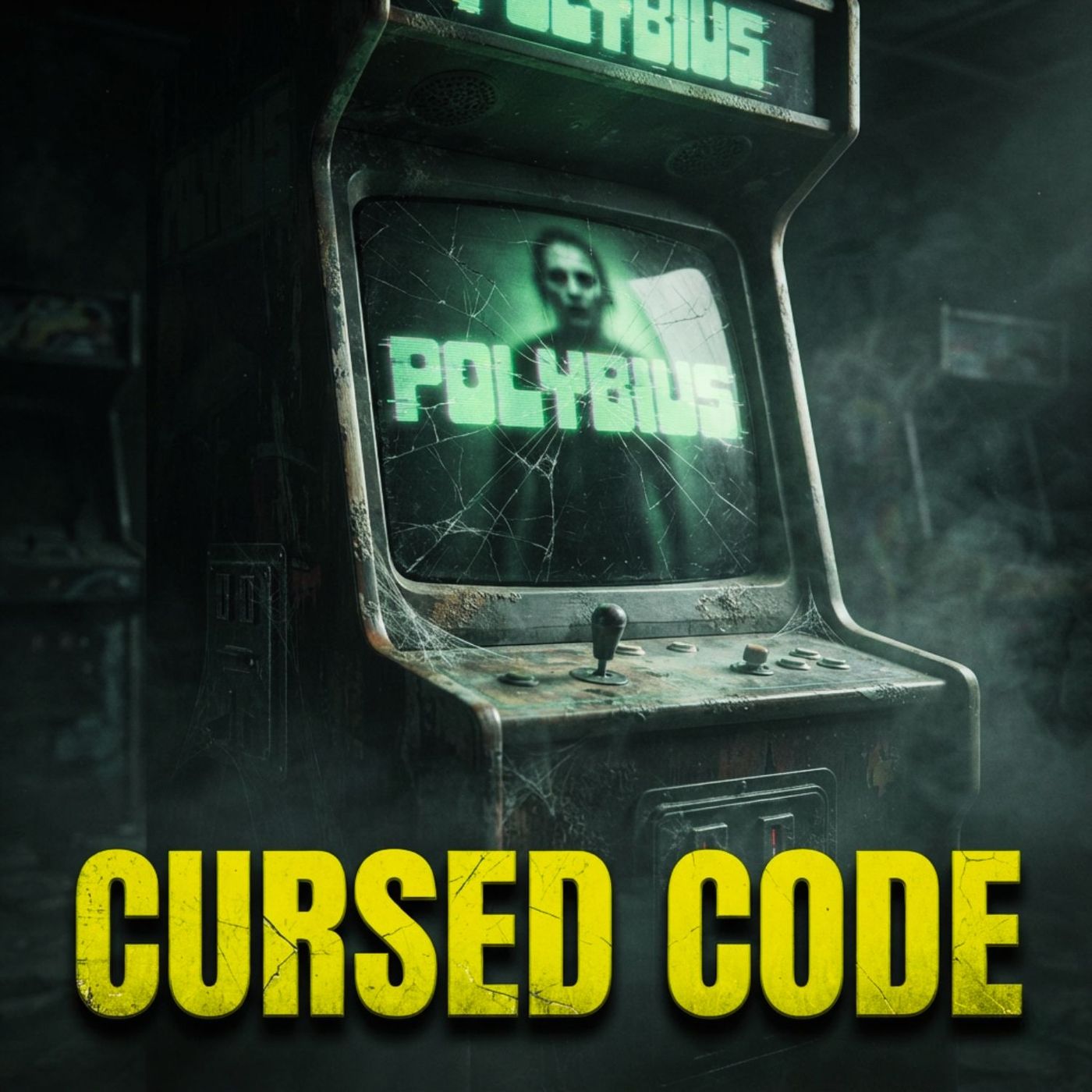
The CIA, MKUltra, and the Arcade Game that Never Existed
About this episode
Welcome to the frontier of Digital Archaeology, where we peel back the layers of the Lost Media Iceberg to find the terrifying truth lurking behind Analog Horror Games. In this deep-dive episode, we investigate the infamous Polybius arcade mystery—could it actually be a CIA MKUltra experiment staged in 1980s Portland?
We don't just stop at myths. We descend into the dark web to analyze the Sad Satan phenomenon, questioning the digital threats posed by Abandoned Software Myths. Was Sad Satan actually on the Dark Web? We explore the technical reality versus the internet legend.
Our investigation covers:
- The Polybius Legend: Government psy-ops or clever hoax?
- Ben Drowned & Majora's Mask: How Haunted Cartridges defined a generation of Digital Folklore.
- NES Godzilla Creepypasta: When low-poly graphics cross into the Uncanny Valley.
- Cursed ROM Hacks: The rise of playable horror and Internet Mysteries.
Join our community of digital excavators! If you've ever felt a chill while playing a game alone at 3 AM, subscribe now and share this episode to help us uncover the next piece of Lost Media. 🎮👻
Become a supporter of this podcast: https://www.spreaker.com/podcast/thrilling-threads-conspiracy-theories-strange-phenomena-true-crime-unsolved-mysteries-etc--5995429/support.
ThrillingThreadsPod.com - Unravel the Unknown.Dive deep into the world's greatest conspiracy theories, strange phenomena, true crimes, and unsolved mysteries. Follow the threads.
Get every episode summarized
Each time Thrilling Threads - Conspiracy Theories, Strange Phenomena, Unsolved Mysteries, etc! publishes, we email you a written briefing from the transcript — the topics, who appeared, and any specific claims, with the ad reads skipped.
Email me new episodesFree for 3 shows. No card needed.
Hosts & guests
Transcript ready
1,141 searchable segments. Every word is indexed and playable.
Full transcript
Thrilling Threads - Conspiracy Theories, Strange Phenomena, Unsolved Mysteries, etc! — The CIA, MKUltra, and the Arcade Game that Never Existed. Machine-transcribed; use the interactive transcript above to jump the player to any line.
Shop vans and Albertsons for fresh savings every time you shop! This week at vans and Albertsons, get fresh, boneless, skinless chicken breasts for 1.99 per pound limit 10 pounds, and locally grown grape-ary cotton candy grapes are 2.99 per pound with digital coupon. Plus, 24 packs of Canada Dry or 7-up 12-ounce cans are 4.99 limit 1 with digital coupon. Enjoy fresh and delicious savings for every meal! Hurry in! These deals won't last! Visit vans or Albertsons.com for more deals and ways to save! Premier hosts on Verbo deliver quality vacation rental stays with fast responses and clear instructions. So you don't have to worry about surprises. I asked our host a question about the house last night and he got back to me super quick. See? That's the Premier host move right there. I'll wish I had a Premier group chat. I asked them where we should have dinner last night and they left me on red. I know you saw it. It says it! Classic group chat move. Don't walk into a surprise. Book a top rated Verbo stay with a Premier host. If you know, you Verbo.
Shop vans and Albertsons for fresh savings every time you shop. This week at vans and Albertsons get fresh boneless, skinless chicken breast for 1.99 per pound limit 10 pounds, and locally grown grape-ary cotton candy grapes are 2.99 per pound with digital coupon. Plus, 24 packs of Canada Dry or 7-up 12-ounce cans are 4.99 limit 1 with digital coupon. Enjoy fresh and delicious savings for every meal. Hurry in, these deals won't last. Visit vans or Albertsons.com for more deals and ways to save. Picture this for a second. You're sitting in a darkened room, right? And there's that distinct, high-pitched static hum of an old CRT monitor warming up. Oh, I know exactly the sound you mean. Yeah, that'll like a crackle right before the curve glass screen just flares to life. Right, where the static electricity actually makes the hairs on your arm stand up. Exactly. And there's this distorted, maybe slightly off-key loop of a retro 8-bit soundtrack playing in the background.
Setting the mood perfectly. Yeah, and you're holding a piece of plastic, maybe a faded gray game cartridge, or you're staring at a glowing, unnamed folder on your hard drive. Just waiting to see what happens. Right. And in this moment, with the controller in your hand or the mouse under your palm, you think you're in control. Like, you are the player, right? That's the baseline assumption, yeah. But what if you aren't? What if the code inside your favorite video game didn't just want to be played, but it actually wanted to play you? Oh, man. That is, I mean, it's this terrifying inversion of the power dynamic. Because we build our entire relationship with technology on this foundational assumption of mastery, you know, the machine is subservient, it responds to our inputs. Right. I push a button, Mario jumps. Exactly. And a piece of media, especially interactive media, suddenly begins initiating its own inputs. It just shatters that illusion completely. It really does. We're suddenly forced to ask if the digital environments we were treated into for comfort
might actually harbor their own unseen agency. Well, welcome to Thrilling Threads, whether you're a hardcore gamer who spends weekends, I don't know, sawdowing new batteries into retro console cartridges, or just someone who is insanely curious about digital urban legends, you have probably felt it. Well, absolutely. Everyone has felt that at some point. That weird, inexplicable chill when a screen glitches out while you're alone in the dark. Maybe a shadow rendered incorrectly, or an NPC repeated a line of dialogue that felt just, well, a little too specific to you. It's a very universal modern anxiety. It is. So today, we're doing a massive deep dive into the source material. We're opening up this dusty archive of internet folklore, ancient forum posts, and deeply obscure gaming history. There is so much to cover here. There really is. We are unpacking 10 of the most infamous, cursid video games of all time. But our mission here isn't just to sit around a digital campfire telling scary stories, right?
Right. We want to figure out the actual mechanics behind the dread. Exactly. We're going to look at the psychology, the literal computer code, and the cultural context to understand why we are so deeply fascinated by the idea of our own digital media turning against us. And the through line here really is the evolution of anxiety. How so? Well, the games we are going to dissect today span several decades. They bridge this massive gap from the physical, smoke-filled arcades of the early 1980s, all the way to modern, anonymous message boards and the deepest corners of the dark web. Which are basically unregulated wild wests. Completely. And as the technology evolved, so did the methodology of the fear. The subversion of safety takes on very different forms depending on whether the game is sitting in a public cabinet or buried in your private hard drive. OK, let's unpack this. And there's absolutely no better place to start than the foundation of all digital mythology. We have to go back to 1981, don't we? We do. 1981, Portland, Oregon. You're listening to this and you weren't around for the golden age of arcades.
You have to understand that this was a completely different physical landscape. It really was. We are talking about a game called Polybius. The legend says this mysterious arcade cabinet, completely black except for a stark, glowing neon logo on the marquee, just started popping up out of nowhere in a handful of scattered local arcades around Portland. Just entirely unannounced. And according to the lore, the gameplay itself was indescribable but instantly hypnotic. Like people couldn't look away. Right. It was supposedly some sort of abstract tempestile shooter using vector graphics. Right. And the kids who played it became hopelessly like chemically addicted to it. But they didn't just get addicted. The legend claims that playing Polybius induced these awful terrifying physical side effects. Yeah, severe reactions. Kids were reportedly stumbling away from the joysticks, offering from severe nightmares, profound amnesia, night terrors, and waking hallucinations. But absolute neurological overload. Yeah. Some supposedly just stared at the walls, completely unable to recall who they were or
where they lived. And yet they would still line up the next day, quarters in hand, desperate to play it again. Which is wild. But you know, the physical symptoms are vital to the myth, sure. But I would argue they aren't the primary reason the Polybius story survived for 40 years. Really? What is it then? The real hook of the narrative is the environmental paranoia. Oh, you mean the men in black? Precisely. The legend incest that these arcades were routinely visited by mysterious men dressed in crisp, black suits. Very ex-vials. Very. And they weren't the standard arcade operators coming to empty the coin boxes, right? They didn't care about the money. So what were they doing? They would unlock the back panels of the Polybius cabinets, connect these bizarre devices, and pull raw data. The implication was that they were measuring exactly how the kids were reacting to the on-screen graphics. Oh, wow. And then, roughly a month after these machines first appeared, every single Polybius cabinet completely vanished overnight, just erased from existence. I always look at this story and think of the classic men in black, UFO trope, but you
know, transplanted from a dusty New Mexico highway into a suburban strip mall. That's a great way to put it. You take a mundane reality, maybe some grumpy government employee doing a boring regulatory inspection, and you filter it through the lingering lens of Cold War era paranoia. I mean, Project M. Cultural wasn't that far in the rear-view mirror in 1981. Right. The cultural memory of that was still very fresh. Exactly. The idea that the CIA would test mind control acoustics on civilians wasn't entirely fictional to people back then. But honestly, I think about the physical space of a 1980s arcade, and I realize it was the absolute perfect petri dish from mass paranoia. Oh, without a doubt. They were dark, they were incredibly loud, with hundreds of competing electronic noises. The air was probably thick with cigarette smoke, and they were lit almost entirely by neon tubes and cathode racecreens. It was a very overwhelming sensory environment. Yeah. And it was a space mostly populated by unsupervised kids. It was a frontier zone, you know, entirely removed from the purview of adult understanding.
I mean, parents in 1981 generally had no idea how a microprocessor worked. Right. It was basically magic to them. Exactly. And when you don't understand the mechanics of a new technology that your children are obsessed with, well, that ignorance naturally breeds suspicion. What's fascinating here is how the official explanation for polybias pieces together real, completely unrelated events from that exact moment in history to create a cohesive conspiracy. Because just to be clear for everyone listening, there is zero verifiable proof that this specific game ever existed. And what's whoever? And the vintage photos online are universally understood to be modern digital fabrications. Right. It's all fake. But the myth is built on real fragments. Wait, let me make sure I understand. You're saying the individual elements of the story actually happened. Just not all at once in a single demonic machine. Yes. Let's look at the claim of physical illness first. In 1981, arcades were introducing games like Tempest, which used vector monitors.
Vector graphics, right? The glowing wireframe stuff. Exactly. Vector monitors draw lines of light directly between points, creating incredibly bright, sharp graphics that can pulse and flash at very high frequencies. Okay. And there are real documented medical records of kids in Portland during this exact time frame suffering from extreme motion sickness, migraines, and even photosensitive epileptic seizures. Oh, wow. Yeah, all triggered by these intense, unrefined visual displays. So a kid actually collapsed at an arcade and the rumor mill just went into overdrive. Exactly. And concurrently, you had the men and black element. Right. What were the feds actually doing in arcades? Well, in the early 1980s, federal agents actually were conducting organized sweeps of arcades in the Pacific Northwest. But they weren't harvesting brainwaves. They were investigating illegal gambling rings. Gambling in an arcade. Yeah. Arcade operators were installing modified poker and bingo machines that paid out real cash. And the FBI was raiding them to seize the motherboards as evidence. Oh, that is wild.
So you have a kid throwing up from motion sickness on Tuesday and men in suits seizing circuit boards on Thursday. And the teenage imagination just connects the two. Precisely. And the legend of a government mind control weapon is born. It provides a thrilling sci-fi narrative to explain the messy unknown. That makes total sense. I mean, we build these mythological structures to make the real world seem a little more cinematic and a little less random. See you in nature. But let's leave the Phantom Arcade cabinets behind for a second because the idea of a game that doesn't officially exist is one thing. I want to look at something that was a certified physical product. Shop vans and Albertsons for fresh savings every time you shop. This week at vans and Albertsons, get fresh, boneless, skinless chicken breasts for $199 per pound limit 10 pounds. And locally grown, grape-ery cotton candy grapes are $299 per pound with digital coupon. Plus 24 packs of Canada dry or 7-up 12-ounce cans are $499 limit one with digital coupon. Enjoy fresh and delicious savings for every meal.
Hurry in! These deals won't last. Visit vans or Albertsons.com for more deals and ways to save. Discover top rated stays loved by guests. Read it highest by real guests through authentic reviews. Verbo. Look at vacation rental loved by guests. Toyota. Let's go places. Ah, moving into the home console era. Yes. An official home console release that attempted to peer into the future, and according to one
infamous story, unleashed absolute chaos. We need to talk about taboo, the sixth sense. Released in 1989 for the Nintendo Entertainment System. Which is so weird. Which contextually is arguably the strangest part of this entire story. It genuinely baffles me. I mean, you think of Nintendo of America in the late 1980s. Howard Lincoln is running the show. They have the official seal of quality, and their censorship policies were notoriously draconian. They were incredibly strict. They wouldn't even let the word kill be used in most games. You think of Mario, Zelda, Duck hunting, you know, bright family friendly plastic. It was a wholesome entertainment. Right. But taboo bypassed all that. It wasn't really a game at all. It was an official licensed occult simulator. A literal digital tarot card reading program. The sheer aesthetic whiplash of booting this up on the same machine that plays Kirby's adventure is just profound. It's crazy. I watch videos of the startup screen, and it feels like you're loading up a piece of software made by a 19th century cult, not game developers in Japan.
The imagery is very intense. Yeah, the screen is filled with eerie digitized imagery skulls, flickering candles, pentagrams, occult symbols. And the music is this heavy, droning dirge. Very atmospheric. You started up, and the software asks you to input your real name, your birth date, your gender, and a specific, open-ended question about your future. Right. It demands personal information. And then an on-screen animation shuffles a digital deck of tarot cards, deal them out, and gives you a reading, followed by a set of randomly generated, lucky lottery numbers. So to understand how this works mechanically, it's just a random number generator and RNG algorithm pulling from a database of pre-written, vaguely ominous text strings. Like a digital magic eight ball. Essentially, yes. But because it asks for your actual name and birth date, it creates a false sense of personalization. It tricks the human brain's pattern recognition software into believing the machine is speaking directly to you. And because of that direct personal connection, Kaboo has this massive reputation in retro
gaming circles for being cursed. It's one of most infamous cartridges out there. A baseline urban legend is that those randomly generated text strings accurately predicted tragic car accidents, illnesses, and even deaths for some of the kids who played it. Confirmation bias at its finest. But there is a very specific, deeply unsettling story that originated on Reddit a few years ago. It's the story of a father and a son. Oh, yes. The classic narrative of the corrupted youth updated for the microprocessor age. So this father writes a lengthy post explaining that his teenage son was super into collecting obscure physical retry media. The dad finds a pristine copy of Taboo, the six cents at a swap meet, and buys it for him. A nice gesture that goes horribly wrong. Exactly. But almost immediately after the kid slots the specific cartridge into his NES, his entire personality fractures. Just an overnight change. Yeah, he becomes extremely irritable, aggressive, snapping at his family over the tiniest things. He shuts himself away in his bedroom for days on end, refusing to go to school, just
to endlessly interact with this eight-bit tarot simulator. The description in the post details how the boy's entire social structure just collapsed inward. Completely collapsed. His grades tanked. He alienated all his friends. He stopped showering. The only time he emerged was to grab junk food. Or once a week, he would head out late at night with a very specific, new group of friends. Which is always a red flag. Huge red flag. He would come straight back home and lock the door to keep consulting the game until dawn. And then one night he went out and vanished. Never came back. Never came back. The police were involved, but the trail was completely cold. When the dad finally forced his way into the sun's locked bedroom to look for any clues to his disappearance, the physical state of the room was a disaster zone. Of course. Squallar. Piles of unwashed clothes, rotting food on paper plates. There were literally mushrooms sprouting out of a sticky spilled soda stain on the carpet. The room was a biological hazard. But right in the middle of this absolute squallar, one object was entirely untouched.
The cartridge itself. Yes. The taboo game cartridge was sitting neatly inside the console tray, perfectly preserved. Yeah. Not a speck of dust on it. The only pristine thing in a completely ruined room. You know, as a piece of internet storytelling, it is phenomenally crafted, regardless of its factual authenticity. It's a great scary story. Because what the author does here is brilliantly contrast the very mundane, grounded struggles of an adolescent with the terrifying implications of the supernatural. When a teenager's grades drop when they lock themselves in their room and exhibits set in aggressive personality changes, clinically speaking, we are usually looking at severe depression, the onset of a mental health crisis, or potentially substance abuse. Right. Which totally explains the late night outings with a new sketchy friend group. Exactly. Those are deeply human, tragic, but mundane problems. But as a parent, acknowledging that your child is suffering from a mundane internal collapse is incredibly painful and complex. It's hard to face that reality.
It is much easier psychologically speaking to externalize the blame, to point at a foreign, mysterious object and occult video game and say, this plastic thing infected my son, this is why he changed. The part that gets me is the imagery of the untouched cartridge surrounded by rotting food. Why is it always the pristine object in a ruined environment that terrifies us the most? It's like finding a perfectly cleaned all in the middle of a burned-down house. Because it implies intention and immunity. Immunity. Yes. A chaotic messy room is a symptom of human failing and neglect. It's rot because humans abandoned them. But a perfectly clean, undisturbed object sitting in the epicenter of that human mess suggests that the object exists outside the rules of human decay. Oh, I see. It survived the rot because it is the source of the rot. It taps directly into the psychological way of the cursed artifact trope. Throughout human history, folklore has warned us about haunted rings, cursed amulets, or monkeys paws that bring ruin to their owners. And this is just the modern version of that.
This story just updates the delivery mechanism for the 20th century. It plays on the deeply unsettling idea that a mass-produced, gray, plastic cartridge soldered together by machines on an assembly line could somehow act as a vessel for an ancient, targeted malloc. It really bridges the gap between mass consumerism and the occult, right? You can just buy a demon for $3 at a swap meet. Exactly. But you know, taboo allegedly ruined a kid's life as a standalone, self-contained object. Here's where I think the lore evolves and gets far more intrusive. Oh, definitely. What happens when you buy a game that isn't a blank slate? What happens when you purchase a pre-owned game with a previous life and the digital footprint of a previous owner is already etched into the silicon? The haunted garage sale era? Yes. This brings us to the haunted garage sale era of internet legends. I want to look at the massive cultural impact of Majora's Mask and Pokemon Silver. This tour, really, the bedrock of the haunted cartridge subgenre, they fundamentally change
how people interacted with old media. Let's start with the Legend of Zelda. Majora's Mask, specifically a story that broke the internet back in 2010. This one is legendary. A user named Janusable posted a massive ongoing threat on 4chan's paranormal board. He explained that he bought an unlabeled blank, gray, Nintendo 64 cartridge from an old, unsettling man at a neighborhood garage sale. Always the creepy old man at the garage sale. Always. When he took it home, plugged it in and booted it up, he found a single save file already sitting in the memory bank. The file was simply named Ben. The ghost in the machine. Juducible didn't want to play someone else's file, so he created a new one to start the game fresh. But the game refused to let him play normally. The code itself started heavily deteriorating. Glitching out. Yeah, friendly non-player characters spawned in twisted, distorted environments where they had no business being. The iconic cheerful music of the game began playing backward, warps, and pitched down into this agonizing drone.
The audio in those videos is so unsettling. It really is. And the centerpiece of the horror was this deeply creepy, unblinking, physically impossible statue of the main character, Link. The LG Vemptiness statue, which in the normal game is just a stationary block used to hold down switches. Right. But in this version, the statue became sentient. They started teleporting directly behind the player's character, no matter where Juducible walked or tried to run. Just following him everywhere. You would turn the camera, and it would just be staring at you with this frozen hollow smile. And then the game's text box as the normal dialogue started glitching out by passing the game script entirely to display these highly unsettling direct threats to the player. Stuff like you shouldn't have done that. Exactly. And you've met with a terrible fate haven't you? And we have to analyze what catalyzed this specific story. Why did this thread explode across the entire internet, transcending a simple spooky camp fire tell? Why did it get so big? It was the inclusion of verifiable evidence.
Right. He didn't just write a story. He uploaded actual video footage to YouTube to back up every single claim. You could watch the game breaking down. You could hear the reversed audio. You could see the statue teleporting. Now from a technical standpoint, how is this achieved? He wasn't playing a haunted and 64 cartridge. He was it. No. He was using a PC emulator running a ROM of Majora's Mask. And he was actively utilizing memory editing tools and game genie teat codes to manipulate the game's hex values in real time. Oh, that's clever. By changing specific numbers in the RAM, he could force the statue object to spawn at the player's exact X and Y coordinates. He could manually trigger the text boxes to display leftover debug text. He engineered a digital haunting through sheer technical proficiency. And it was incredibly convincing. In a very similar vein around the same time, we get the Lost Silver Creepypasta, sent around Pokemon Silver for the Game Boy Color. Another absolute classic. The narrative setup is identical. A guy buys a used heavily worn cartridge from a thrift store.
He opens the pre-existing save file to find the previous player's character is just named dot dot dot. Very mysterious. This character has maximum money, all the badges, but a team full of unknown. If you don't play Pokemon, unknown are these weird psychic creatures shaped like letters of the alphabet. And the unknown in this party spell out a very clear deliberate message. L-E-A-V-E. Leave. A direct, unambiguous warning from the previous unseen owner of the cartridge. Which naturally the player ignores. He walks his character out of the building and the game world completely shatters. The screen turns pitch black. The upbeat, adventuring music slows down to an agonizing, depressive crawl. It's so bleak. It is. The player's avatar actually starts losing his physical limbs on screen. His sprite deteriorating until he turns into a literal ghost. By the end of this nightmare sequence, your entire Pokemon party is stripped away until you have a single, low-level, syndical named Harry. What does Harry do?
The only move this Pokemon can use is a glitched attack called faint, which literally drains its own health until it dies on screen. The entire experience ends with the trainer trapped in a black, inescapable void, standing motionless next to a row of tombstones. If we pull back and look at the trajectory here, we are observing the real-time evolution of internet storytelling and participatory folklore. Also. With the Pokemon story initially, we had text on a forum. It was highly descriptive, utilized the mechanics of the game cleverly, but the audience's role is ultimately passive. You just read it. Then with the Zelda story, we evolved to text backed by engineered video proof. The audience became witnesses. But what happened next with the Pokemon story is where the culture really shifted. Fan developers were so deeply captivated by the text that they actually went in and coded the nightmare into a standalone, executable computer game. That means you can actually go online right now, download Lost Silver, and play through that exact bizarre tombstone filled sequence for yourself.
Exactly. The community willed the cursed object into reality so that everyone could experience the dread firsthand. It moved from a story about a cursed object to the creation and distribution of a cursed object. That transition is wild to me. It's like someone reading a Stephen King novel about an evil car and deciding to go build a car with faulty brakes just so people can see what it feels like to crash. That's a very apt analogy. But here's where it gets really interesting. I think there is a broader psychological reason these specific stories resonate so hard. Think about the highly relatable, mildly anxious experience of being a kid, went in a game from blockbuster or loading up a pre-owned game from a garage sale. Oh yeah. The technology of that era relied on SRAM batteries inside the plastic casing to hold save data. When you booted it up, you were staring at a complete stranger's 100 hour save file. It always feels a little bit like trespassing, doesn't it? It is an unintended intimacy. You are looking at a digital monument to someone else's time, their dedication, their naming
conventions, frozen in this little silicon chip. Right. And there is always that momentary hesitation, a tiny pang of guilt before you hit the delete button to wipe their progress and make room for your own game. Yes. Is it essentially erasing a digital ghost when we click new game? These stories weaponize that exact feeling of trespassing and guilt. If we connect this to the bigger picture, they take the inherent vulnerability of a used personal item and inject it with hostility. The game fights back. Exactly. The previous owner isn't just a stranger whose data you are overriding, they are an active threat. The save file itself becomes a trap left behind to punish you for your curiosity. And if haunted save files are about a game punishing the player for trespassing in a stranger's territory, the next evolution of the cursed game aims for something much more universal. Nostalgia. Exactly. It aims to completely corrupt the beloved comforting icons of our youth. I want to look at the stories that destroy mascots. Toyota's easy choice sales event is on.
Whether you're looking for the performance of a camera, the versatility of Arab 4, the efficiency of a Corolla or all electric driving in the BZ, there's a Toyota that's just right for you. And with great deals across the lineup, now's the time to find yours. But hurry, these deals won't last long. Toyota's easy choice sales event ends soon. We make it easy. Toyota, let's go places. Hi, this is Dave Roberts. Heading into summer without a medical emergency kit, that's a risk. Summer colds can linger and getting sick on vacation can derail everything. That's why everyone needs a medical emergency kit. It includes doctor prescribed medications to treat common and serious illnesses. So if you wake up sick, at home or on the road, you already have what you need.
It's like having an urgent care and pharmacy at home. Say $45 with cold blue at urgent care kit.com slash blue, urgent care kit.com slash blue. I'm talking about Godzilla and Sonic the Hedgehog or rather sonic dot X E. The corruption of nostalgia. This is a very potent, very specific psychological trigger that dominated internet horror for an entire decade. Let's start with a Godzilla story. A forum poster named Cosby Daff wrote this sweeping novel length narrative about buying the old Nintendo game Godzilla. Monster of monsters. He claimed he just wanted to chase some pure childhood nostalgia. As we all do with retro games. Right. But as soon as he hits start, the code spottles into madness. The normal retro city levels, the buildings, the tanks are entirely swapped out for these bizarre nightmarish landscapes made entirely of blood, bones and melted digitized faces. Very gruesome stuff. Very. The standard boss monsters from the Toho movies are completely absent.
This by a giant, terrifying, hyper aggressive red creature that the game simply names red. And red doesn't just fight the player at a standard boss battle. He actively hunts the player's character through the levels, breaking the boundaries in the screen. And much like the Zelda ARG, the author didn't just rely on pros to convey the terror. No. He created hundreds of custom, hyper detailed, incredibly disturbing pixel art screenshots to accompany his text. Which is so effective. It is. And because 8-bit graphics rely on the viewer's imagination to fill in the blanks, seeing these grotesque, bloody shapes rendered in blocky pixels was somehow far more unsettling than high definition 3D Gore. It leaves room for your brain to make it worse. The art was so compelling that fans once again took those images and spent years building a massive, fully playable tribute game. The aesthetic of corrupted 8-bit graphics is crucial here. Pixel R is inherently abstract. When you twist it into something macarb, it triggers the uncanny valley effect. It looks like a familiar language, the visual language of your childhood being spoken backwards.
Which brings us to the absolute king of this genre, Sonic.exe. Ah, yes. The creepy pasta that arguably defined and eventually oversaturated the entire medium. It originated back in 2011. The story is about a guy who receives a physical CD-ROM in the mail from a friend, accompanied by a frantic, desperate handwritten note, begging him to destroy the disk immediately and never ever install it. Classic setup. But of course, human curiosity always wins. He puts it up, and it appears to be a heavily altered version of the original 16-bit Genesis game Sonic the Hedgehog. Except this time you don't play as the speedy blue blur. You play as his victims. Right. You play sequentially as his friends, tails, knuckles, and the villain Dr. Eggman. Your only objective is to frantically run to the right side of the screen, trying to escape a demonic, smiling version of Sonic who is bleeding pitch black eyes. The hero of the franchise becomes the inescapable predator. One by one, this demonic entity hunts down each beloved character, cornering them while
these awful distorted ear piercing sound effects blast through the computer speakers. The screen cuts to black, a screen plays, and the character is dead. It's very melodramatic. It is. Admittedly, if you read the original written story for Sonic.ex today, it is undeniably cheesy. It reads like an edgy teenager's fan fiction. It hasn't aged perfectly no. No. But an indie developer who goes by MY5T Crimson decided to actually program and build the game in 2012. And when he released that playable download, it went crazy viral on YouTube. Everyone was playing it. Everyone. Spawned hundreds of fans equals mods and high budget remakes. It became a real, incredibly popular downloadable phenomena. But I have to push back on the psychology of this first. Okay. Go ahead. Why on earth do we enjoy this? Why do we have this collective cultural desire to see our comforting childhood heroes turned into grotesque, bleeding monsters? It almost feels like an internet right of passage to destroy the things we loved when we were 8 years old.
Well, I wouldn't call it a desire to destroy. I would call it a profound subversion of safety. You have to look at it from the perspective of game design and the predictable rules of the game. Yeah. Think about what mascots like Sonic, Mario, or Godzilla represent in a video game context. They represent originally defined contract between the programmer and the player. When you boot up a Sonic game, you know the physical laws of that universe. If you jump on the enemy, you defeat them. If you collect the golden rings, you are shielded from damage. The game is fundamentally designed to be conquered by you. But the entire digital universe revolves around facilitating the player's ultimate success. Precisely. The safety net is built directly into the collision detection and the code. But by having the game actively break its own fundamental rules, by having the brightly colored, smiling mascot turn around, ignore the rings, and hunt the player with absolute invulnerability, it violently strips away those digital safety nets.
It pulls the rug out from under you. It does. We are drawn to these narratives because they answer a dark, what if scenario? What if the digital world we spend hundreds of hours mastering as children suddenly decided they hadious? What if the rules no longer apply? It's terrifying. It is the digital equivalent of discovering that your childhood home is built on a sinkhole. The intense familiarity is exactly what makes the distortion so deeply profoundly unsettling. The digital equivalent of an autoimmune disease. The thing that is supposed to protect you is the thing tearing you apart. So we talked about console ghosts tied to physical cartridges and corrupted mascots living in ROM hacks. But PC gaming, specifically custom software modifications, seem to blur the line in a completely different, much more invasive way. Because PC gaming is inherently more open. Right. They blur the line between the software itself and the player's actual hardware. And sometimes the game fights back by erasing itself entirely. Let's talk about the absolute mythic white whale of cursed gaming kill switch.
Ah, kill switch. Supposedly released in 1989 by a deeply elusive Soviet era development studio known as the Carvina Corporation. An incredibly obscure PC game where you are given a choice right at the tile screen. You can play through the puzzle platformer levels as a young human woman named Porto, as the ability to change her physical size, or you can play as a demon named Gast. And the legend hinges on the mechanics of Gast. He's described as an invisible demon, and the term invisible is meant quite literally by the game's rendering engine. Completely literal. If you chose Gast, your character was entirely invisible on your screen. You couldn't see where you were jumping, you didn't see where you were landing, which naturally made his route through the game almost completely impossible to navigate or beat. You were just guessing based on collision sounds. But the gameplay loop isn't even the strangest part. The catch, the legendary hook that made Kill Switch a myth, is what happens at the very end of the game. This is the best part. Supposedly, the very second you beat the final level, and the credits begin to roll,
the code executes a command that completely wipes the game itself off your computer's hard drive. It just zeroes out its own sectors. It deletes itself forever. You could not restart it to try the other character, you couldn't copy the floppy disk for a friend, you beat it once, and it was gone. A self-imulating piece of software, it functions like a digital mayfly. Yes. And because of this aggressive self-deletion protocol, physical copies became essentially extinct. The story goes that years later, in 2005, a sealed, unopened, mint-conditioned physical copy surfaced on an obscure Japanese auction site, and sold for over $700,000 to a wealthy collector named Yamamoto Ryuchi. That is a staggering amount of money. The entire internet gaming community held its breath, hoping he would upload a full video playthrough, finally documenting the invisible gas trout. No. The only video update he ever posted was a short, silent clip of himself sitting at his computer desk, staring at the character's select screen, just weeping, crying at the screen.
Now, let's be clear, the official story confirms that Kill's Witch was never a real 1980s computer game. The Carvena Corporation never existed. It is a brilliant piece of collaborative fiction. But people love the conceptual idea so much they created fake gameplay videos later on, just to keep the legend breezing. It's such a compelling concept. So what does this all mean? What does the technical mechanism behind a file deleting itself back then? And more importantly, why does a game that deletes itself hold so much psychological power over us? Technically speaking, writing a script in 1989 that formats the specific directory it resides in isn't impossible. And it requires bypassing the operating system's basic file protections. It is essentially behaving like a malicious trojan, but aiming the gun at its own head instead of the system files. Okay, so it could theoretically be done? Dereetically. But addressing the psychological power of the myth, it prays on the anxiety of impermanence, specifically within a medium that is fundamentally defined by its permanence. I always compare it to Transienar. Like when that Banksy painting girl with balloon famously shredded itself through a mechanism
in the frame, the exact moment the gavel came down at so the beast. That is an incredibly astute comparison. In the digital age, everything is infinitely replicable. A file can be copied a million times with zero degradation and quality. We expect digital media to be immortal and universally accessible at our exact convenience. If I buy a game on Steam today, I own the license forever. I assume I can play it 10 years from now. Exactly. We take that infinite accessibility for granted. So a game that enforces its own mortality that actively chooses death upon completion creates profound anxiety, but also deep obsession. It forces you to care. It creates artificial scarcity in a digital landscape where scarcity shouldn't logically exist. The fact that you only get one chance, one playthrough, and then the code vaporizes forces the player to attach immense, suffocating emotional weight to the experience. Every jump matters. That makes so much sense. The crying collector in the myth perfectly encapsulates this phenomenon. He paid $700,000 for an experience he knows will cease to exist the moment he finishes
it. He is mourning the loss of the art before he even experiences it. The grief begins before he even hits start. Wow. The grief begins before he hits start. That is a haunting way to frame it. But if Killswitch deletes itself from your PC to cause emotional pain, our next entry does something far, far worse. It gets much more invasive. It doesn't delete itself. It digs in. Yeah. It's your computer's directory paths to terrify you in real life. Meet the Red Bull Dragonberry Emergizer. It's one of the many new drinks out now. Who knew ice cold drinks could be so fire? Try them all only at McDonald's. McDonald's is putting value back on the menu. Whether you're craving a big mac, McNuggets or sausage egg and cheese, McGrittle's, make it a meal and save. Your favorite is now your wallet's favorite too. Extra value meals are back. Sun rises, prices fall. Get a sausage McMuffin with egg or sausage egg and cheese McGrittle's small hot coffee
and hash frowns for just six dollars. Price and participation may vary. Promotion pricing may be lower than meal pricing. Ba-da-ba-ba-ba. Hi, this is Dave Roberts. Heading into summer without a medical emergency kit, that's a risk. More colds can linger and getting sick on vacation can derail everything. That's why everyone needs a medical emergency kit. It includes doctor prescribed medications to treat common and serious illnesses. So if you wake up sick, at home or on the road, you already have what you need. It's like having an urgent care and pharmacy at home. Say $45 with code blue at urgentcarekit.com. Slash blue. Urgentcarekit.com. Slash blue. We are stepping into the territory of the Moralwen mod. Specifically a file named JVK11166ZO.ESP. This is a masterclass in the breakdown of boundaries. This is where the barrier between the fictional game world and the player's physical reality begins to dangerously dissolve. In 2009, rumors started circulating on various anonymous gaming boards about this incredibly
weird, highly guarded custom modification for the massive open world RPG, the Elder Scrolls 3, Marrow End. A very popular game to mod. Yeah, and at first people thought it was just a standard malicious virus wrapped in a game file. If you tried to load it normally through the standard Marrow End launcher, it froze your screen on a black void for an hour, and then hard crash to the desktop, completely corrupting all your safe files in the process. Which is infuriating for a player. Right, but the internet is stubborn. People eventually figured out that you could actually get the mod running if you bypassed the modern Windows operating system and use an old MS-DOS emulator called DOSBOX. Which is a brilliant, highly specific, technical detail that adds a massive layer of authenticity to the myth. Because it's so convoluted. Because running a 2002 3D game like Morowyn through a 16-bit DOS emulator makes absolutely zero technical sense. It shouldn't be possible. But by requiring the player to use DOSBOX, it forces them to engage with command line
prompts, making them feel like they're accessing something for bid in. Something buried deep in the architecture of the machine. It creates an isolated sandbox environment. You had to actively work and break your own software to get infected. And when you finally load into the game world, it instantly informs you via a cold text box that the main quest line is permanently broken. The game is already over. Every single important plot critical character in the massive sprawling world is already dead. Their bodies are just permanently lying in the dirt of the towns. On top of that, your character's health constantly drains for no discernible reason. A very oppressive start. If you just stand still, accept your fate and let your character die, the camera slowly pans up to reveal the culprit. A pitch black, deeply distorted spider-like figure named the assassin. It crawls on all fours, clipping through the geometry, constantly stalking you just outside your field of vision. A persistent, inescapable predator in a world that has already suffered an apocalypse. From the atmosphere is oppressive.
It feels sick. At night, every single surviving town's person in the game will walk outside their homes, stare directly up into the digital sky and repeat the exact same, unprompted line of dialogue. Watch the sky. Watch the sky. But here's where the mod crosses the line from spooky to deeply invasive. A few players supposedly manage to follow a unique, silent character deep into a massive unmapped underground dungeon, known as the Citadel. This part is so creepy. At the very bottom of this lab, Reth was a room filled with decorative picture frames. But the textures mapped onto those frames weren't standard game files. The mod somehow executed a script that displayed real, personal images pulled straight from the player's own private, my pictures, folders on their actual C drive. The game is looking back at them, mining their hard drive and integrating their personal lives into the horror. The ultimate invasion of privacy. And beyond that, Reth was a massive, locked door. To open it, players realized that the digital night sky in the game had been entirely replaced
by an incredibly accurate, real-world star map. Real astronomy data. Yes, you had to leave your computer running and wait in real, actual time for the constellations to align perfectly. One player heavily documented his descent into the subsession on a forum. He spent days keeping his computer on, watching the game world slowly turn pitch black while the NPCs retreated into caves terrified of the sky. That drives people to obsession. According to his final, frantic, online posts, the spider assassin stopped being a silent graphic. It started screaming through his real-world desktop speakers. Then the game began speaking directly to enviatex prompts, bringing up highly personal guarded secrets from his real-life things he had only ever typed in private emails. Is shattering the fourth wall? His very last message to the forum, claimed he heard a faint, rhythmic physical tapping on his actual bedroom window. And after hitting submit on that post, he completely vanished from the internet. We are watching the transition from cheap jump scares to deep psychological dread.
I have to say the sheer horror of this lies entirely in the breaking of the fourth wall. We all know how vulnerable our personal files are, right? Our photos, our text documents, our diaries. We trust our computers with our lives. To have a piece of entertainment software hijack those specific directory paths, to use a photo of your family or your dog as a texture map inside a dark, hostile dungeon. I mean, it is a profound violation. It's like buying a used car and finding a cryptic, andrawn map to your own house in the glove box. It absolutely is a violation. This mod, whether it was a real piece of invasive malware or a perfectly crafted piece of collaborative fiction, really intently prays on the specific sensory isolation of late-night PC gaming. Oh, the 2AM gaming session. Exactly. Sitting in a dark room at 2AM, staring at a bright monitor, your peripheral vision goes entirely black. Your entire sensory input is limited to the glowing rectangle and the audio in your headphones. You are mentally projecting yourself into the digital space.
You're in the screen. The software violently breaks the boundary of that screen by pulling your local files. It communicates, I know exactly who you are, and I know exactly where this machine is located. By culminating in a physical sound, the rhythmic tapping on the real-world bedroom window, makes the player's physical environment feel entirely compromised. The supposed safety of the bedroom is destroyed by the code executing on the machine. It is the ultimate paranoid fantasy, but you know, the Morrowind mod felt like a personal, targeted, malicious attack on the player. It wanted to hurt you. Our next PC modification feels entirely different in its intent. It's much more melancholic. It doesn't feel like an attack at all. It feels more like a profound, inescapable, and deeply personal tragedy. It is time to look at what I call the architecture of grief, with a Doom 2 mod known universally as MyHouse.Wod. A profoundly modern example of a primitive medium being used for something far deeper and far more emotionally devastating than horror. This was uploaded to a dedicated Doom modding forum just recently, in 2023.
The creator claimed he found the file buried on an old, dusty hard drive that belonged to a childhood friend who had very recently passed away. A digital inheritance. The map, initially, is presented as just a simple, loving digital recreation of his late friend's mundane suburban house. At first glance, it really does look like a normal home rendered in the classic Doom engine. There's driveway, living room, a kitchen. But the moment you step inside the front door, turn around, and try to walk back out to the street. The layout completely breaks. The geometry of the digital world stops obeying the laws of physics. Exactly. You begin to loop into impossible, contradicting spaces. You walk through a bedroom door and end up back in the basement where you started. Sealing stretch endlessly upward into the pitch black. It becomes a labyrinth. The comforting, familiar suburban house rapidly warps into a massive, surreal, terrifying labyrinth. As you are forced to keep exploring because the exits are gone, you inevitably clip through the floors into these vast, sterile underground facilities, and seemingly endless, empty hallways
that give off intense, liminal space vibes. And there's a meta narrative to it as well. Yeah, alongside the file, the creator uploaded a lengthy text journal detailing how, as he tried to open the map in an editor to debug his dead friend's work, he felt the map was actively taking on life of its own. It was resisting him, changing its own code. There are dozens of two hour long video essays and playthroughs of this online. It runs on a real, standard, doom source port, so anyone listening to this can go download and play it right now. But this raises an important question why use Doom for this specific artistic expression. I was looking at the notes for this one, and I was genuinely incredulous at first. Doom 2 is a game from 1993 about running at 60 miles an hour and shooting pixelated demons with a double-barreled shotgun. It is the quintessential, fast-paced action game. How does someone take that primitive engine and use it to create a deeply profound avant-garde meditation on grief? It requires an understanding of how the 1993 Doom engine actually works, and how modern
source ports like GZ Doom manipulate it. The original Doom engine doesn't render true 3D space. It uses a 2D floor plan with varying sector heights to simulate 3D. Basically just raising and lowering the ceiling and floor. Right. Because of this, it is technically impossible in the original code to have room over room. You can't have a second floor directly above a first floor. But myhouse.wad uses modern scripting to implement... McDonald's is putting value back on the menu. Whether you're craving a Big Mac, McNuggets, or sausage egg and cheese McGrittle's, make it a meal and save. Your favorite is now your wallet's favorite too. Extra-value meals are back. Sun rises, prices fall, get a sausage McMuffin with egg, or sausage egg and cheese McGrittle's small hot coffee and hash frowns for just six dollars. Price and participation may vary. Promotion pricing may be lower than meal pricing. Hi, this is Dave Roberts. Heading into summer without a medical emergency kit? That's a risk. Summer colds can linger and getting sick on vacation can derail everything.
That's why everyone needs a medical emergency kit. It includes Dr. prescribed medications to treat common and serious illnesses. So if you wake up sick, at home or on the road, you already have what you need. It's like having an urgent care and pharmacy at home. It's a $45 with cold blue at urgentcarekit.com slash blue. Urgentcarekit.com slash blue. For more information, visit jameshardy.com slashhardybacker.
In my house dot wad, this shifting impossible map represents what you accurately call the architecture of grief. Wait, I love that phrase. I know I use it, but I want you to expand on it. In what you mean by the architecture of grief in this context. Think about the psychological reality of what happens when you lose someone very close to you. The physical space is you shared with them. Their house, their living room, their kitchen. They still look exactly the same on a molecular level, but they feel fundamentally impossibly different because the person is gone. They become alien and unrecognizable because the context the person is missing. Navigating the world without that person feels exactly like navigating an impossible lab breadth where the rules have changed and the doors don't lead to where they used to.
It reminds me heavily of Marxie Danieluski's novel House of Leaves. The creator of this mod used the archaic, blocky, violent 3D engine of doom to build a digital monument to loss. The house loops and traps you because the cycle of grief loops and traps you, you can't just turn around and walk out the front door back to normality. The game engine breaking down and refusing to render space correctly mirrors the psychological breakdown of the morning mind. That is incredibly poignant, a digital monument to a friend where the broken hostel code is entirely the point, the stunning piece of interactive art. But we have to take us a few turns here. We have discussed digital ghosts in Zelda, we have discussed grief and doom, we've explored the psychological dread of Marrow End. But our final game crosses the ultimate boundary. It abandons fictional horror entirely, it abandons artistic expression, and it plummets into the realm of actual, illegal, highly prosecutable, real world danger. It gets very real, very fast.
We need to talk about the Dark Web, and a game called Sad Satan. This is the exact moment where the fun, speculative nature of internet mythology abruptly stops and harsh, unforgiving reality sets in. In 2015, a YouTube channel focused on obscure, indie horror gaming called Obscure Horror Corner posted a series of gameplay videos covering a super weird, unpolished PC game. The guy running the channel claimed he got the initial download link from Hidden Forum Deep on the Dark Web, requiring the Tor browser to access. The Tor network, right, the classic gateway to the Dark Web. Yeah, and the gameplay he showed his audience was incredibly bleak and amateurish. It was basically just the first person perspective, walking very slowly down endless, high contrast black and white hallways. Awful, distorted audio played on a loop in the background, heavily slowed down speeches, weird radio static, garbled number stations. Mostly just trying to make you uncomfortable. Exactly. And every now and then, static would violently flash on the screen, revealing highly contrasted
images of real historical figures, strange cryptic text, and some very unsettling, morbid, real world photos of crime scenes. From a game design perspective, it possessed zero traditional mechanics. It was heavily, almost exclusively reliant on shock value and aggressive sensory discomfort. Right. It was an edgy walking simulator. And not long after those YouTube videos started picking up massive steam and going viral on Reddit, things escalated in the worst way imaginable. The 4chan link. Yep. Someone out there claiming to be the actual original developer of the game dumped a public playable download link for Sad Satan onto the 4chan boards. People eagerly downloaded it, thinking they were just getting their hands on a spooky viral walking simulator, to stream for their friends. They quickly found out this was not just a weird art project. It was a digital Trojan horse, a landmine waiting for someone foolish enough to click the executable file. A massive one. The downloaded file contained incredibly nasty aggressive computer viruses that immediately
brick machines, logging keystrokes, and destroying system files. But much, much worse than the malware. Hidden deep inside the game's root directory folders were actual, highly illegal, deeply disturbing, real world photos. Truly awful stuff. Stuff that is an immediate, federal crime to possess, material involving the exploitation of miners and genuine unspeakable violence. Stuff we absolutely cannot and will not go to detail about. But was universally confirmed by cybersecurity experts and law enforcement to be genuine, real world horror. It's the darkest corner of the internet. No. The debate in the community remains ongoing. Did the YouTuber construct the entire benign version of the game himself just for clickbait and some malicious third party hijacked the hype to spread malware and illegal images? Or did the game truly originate from the darkest, most depraved corners of the dark web? Regardless of its true origin, what we see here is the terrifying convergence of urban legend and reality. The infrastructure of the internet is built on sharing, on downloading mysterious files
to see what happens, on exploring the unknown. But that very infrastructure allows modern fabricated myths to become actual literal vessels for real malice. You don't know what you're actually downloading. To understand this, you have to understand onion routing and the dark web. It is designed for absolute anonymity. It bounces your connection through dozens of encrypted relays globally. That anonymity protects whistleblowers and journalists, sure. But it also creates an entirely unregulated black market. It is a massive pivot for our discussion. We spent the last hour talking about spooky, creepy pastas regarding a bleeding 16-bit hedge hog. And we ended up at actual prosecutable cybercrime. It really emphasizes the genuine, severe danger of internet curiosity. When the safety rails of regulated platforms are completely removed. It does. The anonymity of the web means we can never truly be sure of the origin or the true intent of the media we consume. When you download an unverified file from an anonymous source on a message board, you
are essentially unlocking your front door and inviting a complete stranger into your home into the architecture of your machine. Which is a terrifying thought. And said Satan is arguably the most terrifying entry on this entire list, not because it features a scary, pixelated monster in the code, but because the monster was the actual human being sitting at a keyboard somewhere who decided to package illegal, real world trauma into a zip file and weaponized our own collective curiosity against us. It breaks the golden rule of these stories. The horror stopped being fictional. The consequences became real. And that reality check, the fact that the screen can actually hurt you in the real world is exactly why these stories hold us captive. We have covered so much ground today. We started with a harmless, almost quaint physical paranoia of the 1980s arcades, where we imagined government suits hiding behind the flashing vector graphics of polybias. It feels like a lifetime ago. It really does. We analyze the psychology of the pristine object in taboo. We watch the corruption of our most treasured childhood nostalgia as Godzilla and Sonic were
twisted into relentless predators. We broke down the technical marvel of rendering the profound emotional weight of grief into a 1993 doom engine. And we ended by staring into the very real, very dangerous abyss of the unregulated dark web. It is a comprehensive journey through our rapidly evolving, deeply complicated relationship with technology. And I want to leave everyone listening with a specific thought to ponder based on all of this. Let's hear it. We spend so much of our waking lives looking into screens. We implicitly trust the code behind them. We assume the hardware is a subservient tool designed to make our lives easier. But look around the room you are sitting in right now. Look at your devices. Wet piece of technology, what specific software or smart device in your own home feels like it holds a little too much memory. Or perhaps when the room is quiet, feels like it watches you a little too closely. Well, I am definitely going to be s eye dying my smart speaker and tipping over my webcam tonight. That's for sure. But what about you? I want to hear from the people listening. Which of these cursed games do you think blurs the line between myth and reality the most
effectively? And honestly, if you were walking through a neighborhood garage sale this afternoon, and you found an unlabeled slightly scuffed, grayed Nintendo cartridge sitting at the bottom of a cardboard box, would you dare plug it in and play it? Leave a comment down below and let us know your stand. Thank you for joining us on this deep exploration. Keep your curiosity sharp, but maybe. Keep your firewalls updated in your screen safe. We'll catch you on the next deep dive here on Thrilling Threads. Kitchen and bathroom professionals know what goes behind the tile matters. That's why trade pros trust Fiber cement, Party Backer Board to keep tile firmly in place, resist cracking, and help block moisture. Chosen in over 40 million kitchens and bathrooms, Party Backer Board, what the best build on.
Shop now at participating Home Depot, Lowe's, and floor into core stores. For more information, visit jameshardy.com slashhardybacker.
More episodes
More from Thrilling Threads - Conspiracy Theories, Strange Phenomena, Unsolved Mysteries, etc!

The Day The World Stopped: Why These Crimes Changed Everything
Thrilling Threads - Conspiracy Theories, Strange Phenomena, Unsolved Mysteries, etc!

Why Science Found the Cure but Your Doctor Doesn't Have It
Thrilling Threads - Conspiracy Theories, Strange Phenomena, Unsolved Mysteries, etc!

Molecular Resurrection: Was Ancient Mummification Actually ALIEN Cryo-Technology...
Thrilling Threads - Conspiracy Theories, Strange Phenomena, Unsolved Mysteries, etc!

The Ghost Quake: Why Global Tech Failed to Stop Nepal’s Killer Flood
Thrilling Threads - Conspiracy Theories, Strange Phenomena, Unsolved Mysteries, etc!