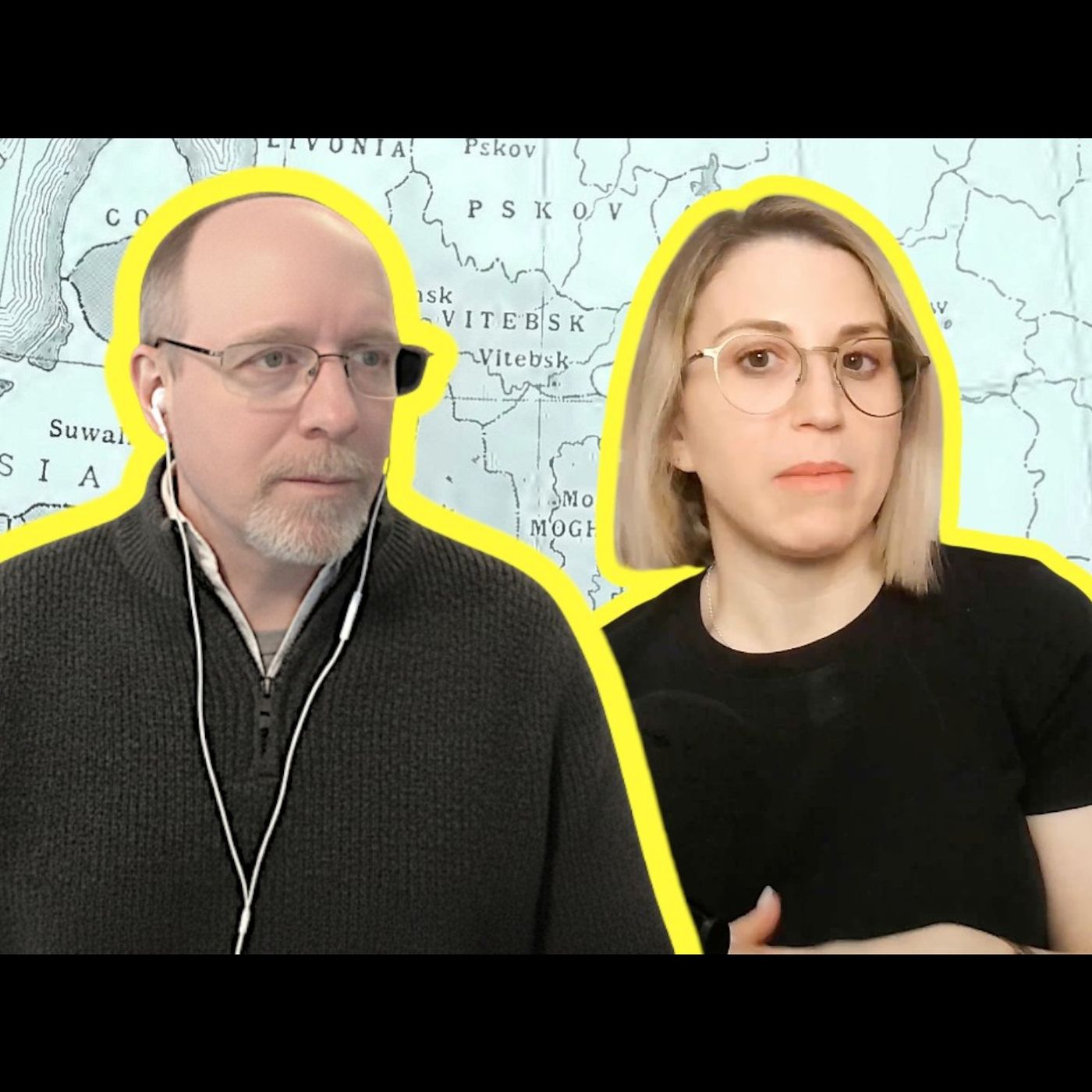
Hasidic Jews once thrived in Poland | Historian Glenn Dynner
About this episode
In this episode, I’m joined by historian Glenn Dynner, who was my professor years ago and played a pivotal role in getting me started as a tour guide. Our conversation focuses on Polish Jewish history, Hasidism, and how Jewish life in Poland developed under pressure, change, and violence.
Before we begin, here are Glenn’s books, which come up throughout the interview:
- The Light of Learning: Hasidism in Poland on the Eve of the Holocaust / https://amzn.to/3LNJYdu
- Yankel's Tavern: Jews, Liquor, and Life in the Kingdom of Poland /https://amzn.to/4qogrpM
- Men of Silk: The Hasidic Conquest of Polish Jewish Society / https://amzn.to/3ZdZJ0j
The conversation also touches on Glenn’s research trajectory, how historians approach Polish Jewish history, and why earlier frameworks sometimes fall short when trying to understand how these communities functioned over time.
As with all of my interviews, an audio-only version of this conversation is available on the podcast platform of your choosing.
Thanks for watching and listening.
Become a supporter of this podcast: https://www.spreaker.com/podcast/the-frieda-vizel-podcast--5824414/support.
Get every episode summarized
Each time The Frieda Vizel Podcast publishes, we email you a written briefing from the transcript — the topics, who appeared, and any specific claims, with the ad reads skipped.
Email me new episodesFree for 3 shows. No card needed.
Hosts & guests

Transcript ready
493 searchable segments. Every word is indexed and playable.
Full transcript
The Frieda Vizel Podcast — Hasidic Jews once thrived in Poland | Historian Glenn Dynner. Machine-transcribed; use the interactive transcript above to jump the player to any line.
There's real pogroms happening, but these custodic leaders in their own sermons are railing against the spiritual pogrom, which means assimilation. Hello everyone, my name is Frida Baisal and this channel I explore various topics on Judaism, New York City, Yiddish, Hasidism, and more. Today I'll be talking to Glenn Diner, who is a Polish Jewish historian with specialties in social and economic history, gender, and for my audience, especially Hasidism. He is the Jay Burke, which chair of Jewish history at University of Virginia in the Department of History. Here's a special little fact about Professor Diner. When I was a student at Sarah Lawrence College, Glenn was my professor. In fact, he got me started on my career and played an instrumental role in my work. Glenn has written numerous books and articles on Polish pre-war Judaism slash
Hasidism among them being Men of Silk, the City Conquest of Polish Jewish Society, Youngles Tavern, Jewish Licker, and Life in the Kingdom of Poland, the light of learning Hasidism in Poland on the eve of the Holocaust. I will link all of these in the video description. Welcome, Glenn, and thank you so much. I'm so happy you're here. And by the way, I don't know. At Sarah Lawrence, everyone called you Glenn. Is that how you go by everyone? It works for me. It works for me, especially you, Frida. You know, definitely you're in the right. I see. It's interesting because now I'm in the world where everybody goes by professor and doctor, and sometimes I don't know who they're talking to when they address me, but Sarah Lawrence is a very informal place, which is great. So yes, please call me Glenn. That way, you can also avoid mispronouncing diner, which everybody always does. Oh, it's dinner. I always get dinner. Yeah, no, no, it is diner.
Oh, it is diner. Okay. Yeah. Sometimes I go through entire episodes as dinner, and I'm sort of too shy to interrupt and correct. I relate because I've sometimes become a weasel in the process of being misal, so I get it. Yeah. Well, I'm super happy that we get to talk today. Long time since our days at Sarah Lawrence College, I would love to get started with your work, which has been so influential in my own learning and has been in so many ways so relevant to what I'm interested in myself. So can you get started with maybe what got you started in Jewish studies and where you began from early days? Absolutely. I mean, I think what got me started in Jewish studies is reading the books that were formative to the field, which was really in formation in the second half of the 20th century.
So books by Michael Stanislavski, Steve Zyprostin, Antony Polonski, my own mentor, and doctoral advisor eventually, and books by Ezra Mendelssohn and Jonathan Frankl. I mean, these were books which were so crucial, which created a foundation for the field of East European Jewish history, but they also had a framing that I very early on began to challenge because their own parents' generation was often immigrants or survivors of the Holocaust. They tended to de-emphasize things like tradition or traditionalism, and they tended to de-emphasize anti-Jewish violence. The idea was to get away from what Salah Baron called the lacrimos conception of Jewish history,
which was sort of teaching Jewish history, as maybe it's taught in still today in more traditional settings as a long history of victimization. What does lacrimos mean? The term lacrimos just means a gloomy depressing, negative, and instead they wanted to, in their own rebellion, they wanted to really emphasize the positive. So that means positive aspects of Jewish Christian relations or Polish Jewish relations, de-emphasizing violence and focusing on really important aspects of Jewish life that you might call affirmative, such as institutions, autonomous institutions of self-government, for example. And if you get into the interwar period, the emphasis is on secular political parties like Zionist and Socialist and other kinds of secularist movements.
So that was the legacy that I had was this real emphasis on the kind of positive axiomatic features of East European Jewish life. They're not so backward, they're not so victim, they're not so traditional, and the attempt to really emphasize or overemphasize secularism, and secularization, and positive relations between Jews and Christians, which is an important corrective. But as a contrarian, as a grad student, I found that I was bumping up against the limits of that framing because, come on, I mean, you have very serious anti-Jewish violence happening, not necessarily in the early part of Polish Jewish history as much, but definitely you get into the 16th, 17th centuries, you have blood liable accusations,
Kronilnicki, massacres, and then finally waves of pogroms, and then the Holocaust. And the Holocaust was always set off as this, and separate, immensely tragic event that didn't really belong to Jewish history that preceded it. You know, that was the picture we were getting, and I found that division artificial too. So what do I do as a grad student? I decide I'm going to study positivism, and I'm going to look at anti-Jewish violence, and I'm going to look at the more so-called backward areas, the sterile and the liquor trade, and the tavernkeeping that was such a crucial part of these interactions, it's really at the center of Jewish Christian interactions on a daily basis. And, you know, I came up with work that was meant to be a corrective to that, in the sense that,
you know, I really, really have been striving to integrate positivism, integrate anti-Jewish violence, integrates the tavern and the sterile into this very important legacy of relative security and prosperity, that my own professors, my own advisors, had given me. To that end, did you go to Poland to study there? So what I did very early on is I went to Poland in order to learn Polish, and to just travel around and climb fences and get into. What does that mean? Meaning, climbing fences to get into Jewish cemeteries that have been abandoned, and you know, we're trying to get inside old synagogues that were no longer functioning, and there's always like the one person who has the key that you kind of have to pay off
to enter, and it's this tragic abandoned space, but for me, it was poignant and beautiful. Glenn, my first trip to Poland was in June this year. I went to Krakow for the Jewish Culture Festival, and I've been thinking about Poland a lot since my trip. I'm actually working on a video about my experience. What years were you there, and what was it like? So I first went to Poland in the 90s, and that was when the country was just coming out of communism, and you could see each year become a little brighter, a little more free, a little more tourist-friendly, and so it was a really exciting time to be going there, and there was also excitement about the field of Jewish studies in Poland. You know, you had young scholars starting to study Polish Jewish history themselves, and so it was a very exciting time. At the same time,
it was a difficult time because incidents like the Yad Vabanum massacre that happened, you know, it was just coming to light, the work of Yangros, and so that really troubled the waters of Polish Jewish relations, too. Poles would always consider themselves to be victims during the Holocaust, and here they were being portrayed as persecutors. So it was all a very kind of difficult transition that happened, that had to happen, and I think ultimately, you know, it was good for the country to process this very difficult legacy of anti-Jewish violence and anti-Semitism. Well, you know, having done a little bit of content about Poland, I do find that there is a very strong internal like argument, maybe it's not internal, between Polish people and Jews, that plays out, for instance, in my common section. I didn't experience it in the country itself,
of course, but there is this argument that the Poles were suffering in the Holocaust, and get a lot of these comments of what did the Jews do to help? I wasn't in Poland long enough to understand the sentiments that the Polish people have about the Holocaust, but in my common section, I have been surprised and upset by a lot of what I see. Have you experienced when you were there, for instance, anti-Semitism? It's funny, I don't really experience anti-Semitism in Poland, I experience it more back home, and I think it might be just the circles that I'm traveling in in Poland, you know, there are a lot of people of Goodwill who are trying to get beyond the anti-Semitism, and they don't like the legacy of anti-Semitism, and so I've had really good experiences overall, maybe occasionally something negative would happen, but that's really anywhere.
So it's been important to me as a historian to try to get us beyond this notion of Poland as this intrinsically anti-Semitic place that's just one big Jewish cemetery, because it is where most of the concentration camps were, and so that kind of colors your whole view of the country, but we can't forget that it was a Nazi occupation under which this all happened. Without downplaying, you know, the role of, you know, definitely there was a Polish role in this whole thing, and it's very difficult to talk about. There was collaboration, there was just passive neglect of the Jewish population, but there's also heroism and rescue and, you know, really inspiring stories, too, and we just need to try to figure out what the balance was if we want to get a good picture. And I think that's really honestly the project of history itself is to try to find these balances, because inevitably we have to generalize, and we're not going to generalize anything accurately,
but if you can find a rough balance, which is funny because it relates to my recent book, which, actually, I have right here, the light of learning, which was an attempt to try to find that balance of cultural forces in Jewish life in a tour, really pre-Holocaust Poland, trying to figure out, you know, so was this story of secularization really accurate to what extent was it accurate? To what extent were the photographs of Roman Vishniak overframing this traditional, impoverished community, which, you know, he's been accused of doing, and which the correctives all tried to sort of get away from? To what extent though do we have to come back to that picture? You know, because what I'm finding in my own research is that these Hasadah communities and other Orthodox communities are extremely large. They're extremely vital.
Even in major cities, they have, you know, large enclaves where they're extremely, I would say, predominant, and the institution building that goes on in the wake of World War I is astounding. The building or rebuilding of the Khater of Yashivas, you know, these institutions tell their own story. So when all is said and done, I came out with a balance that was much more traditionalist than had been previously thought. You know, still, I would say, over half of the Jews of Poland significantly more than half probably, or what we'd call Hasidic or Orthodox. And the greatest stories of the Antwerp period had tended to emphasize the more secular oriented Jewish groups, you know, the Zionists, the Bundis and so on. So that was my intervention. Yeah, that's very interesting. It's something I relate to in my own work, the choices that storytellers make
shapes and narrative. And they bring only their own eyes. And their eyes are limited, obviously. And then there was a corrective and that corrective sometimes is too delegitimating of earlier work. I think that's really interesting. The way we pick from facts and make a narrative is something that I'm interested in general. And it's such a, it's such a challenging process and such an interesting process. So let's talk about your early project and we'll get to your more recent work later. What was your first project as a big undertaking that you were studying? Well, so I should say I come from a really reform assimilated background. And so I was drawn at Brandeis as an undergrad to studying the history of the Hasidic movement. And it was an exciting time to study Hasidism because Moshe Rossmann had just discovered the Balshamtov on a tax
list, actually a tax exemption list in the archives. And it was the first time you realized that you can actually study Hasidism in the same way that the rest of Polish history or Polish Jewish history has been studied with archival sources that you can ultimately blend with, you know, other kinds of sources like inner Hasidic sources, perhaps homiletic literature and even hegeography and get a much fuller picture. So that really excited me. So I wrote my dissertation on Hasidism in the Kingdom of Poland, which was a very urbanized environment. It was much less of an emphasis on dynasties and Hasidic courts and much more into learning and other kinds of urban pursuits. And so I found a really Polish Hasidism, if you're talking about central Poland with
everyone from, I don't know, the Maggi d'Evkozynica, the Syruv Lublin, the Katskur-Rebi, Simko-Bunum of Sischa, Anta-Ger and Alexander, these later groups. It really struck me as a very special kind of Hasidism because it managed to flourish very early on in the urban environment. And really shied away from a lot of the excesses of the big flamboyant courts, like what's happening in the Rizner dynasty and other types of dynasties. So I wrote my dissertation on this and I became fascinated with the mercantile elites who had actually been patrons to Hasidism early on. These are international merchants, very sophisticated, worldly individuals who chose Hasidism because without being emancipated, they couldn't really find
the kind of respect and esteem in the courts of the nobility and other places that you would try to get integrated into in Western Europe. And so they kind of formed their own sort of system of patronage and their own kings, so to speak, who were the Sadiqim or the Rebis. And so it was a very interesting phenomenon for me to see how Hasidism was so integrated into lifeblood of this very vital mercantile economy in Poland, really at the cost of the industrial revolution. And that became your book. And that became Men of Silk. Yeah. That became Men of Silk. I say, I'm just curious. I'm trying to get a mental picture of what it takes for a American young lad interested in Jewish roots. Do you have Polish roots yourself? If you go back far enough, yes. But I think that's true of every Ashkenazic Jew.
Okay. So you're interested in the roots of your Ashkenazi Jewry going to Poland and studying this very, very different world. It wasn't a religious learning for you, right? Well, okay. So let me try to answer this in a certain way. I always shied away from genealogy. I don't feel like that's my main motivation is self-discovery and all this. It's just where most of the world's Jews lived. Three-fourths of the world's Jewish population lived in these Polish speaking lands. And so I couldn't understand why everyone wasn't studying this. I found out why it's very hard to learn Polish in Yiddish and Hebrew. And to learn Hebrew well enough where you can read rabbinic and Hasidic sources and in that kind of Hebrew. It was certainly spiritually fulfilling at times. But I don't think that that was my main motivation. My main motivation is honestly
to try to find what moves this society, what is this Polish Jewish world? And that's what brought me to Hasidism. And I have to say that in this last book where I dealt very, very deeply into Hasidic homiletic literature, you know, sermons which are often, you know, very, very intricate druchotes, it wasn't that often that I was inspired spiritually by this later Hasidism, not in the same way as when I would read, you know, Kadushat-Lavi or something, you know. There are a few moments where something like the Shem Mishmule would inspire me or the Piasecina Rebbe in the midst of the Warsaw Ghetto. That's very inspiring. But most of the time it's actually very reactionary and almost obsessed, surprisingly obsessed with what they called the spiritual pogroms. So yes, there were real pogroms raging at certain periods, you know, in 1918 and 19,
and then in 1936, you know, other times too, there was real pogroms happening. But these Hasidic leaders in their own sermons are railing against the spiritual pogrom, which means assimilation. Going to Polish schools, going to universities, that is much more of a threat. In other words, Gentiles are more dangerous when they're nice to you than when they're terrible to you. And that was a very surprising message to find throughout this Hasidic literature. It's not one that's spiritually kind of inspiring to me, but it's fascinating. Because in the midst of a groms, they're worried much more about universities and other secularizing influences and how to combat them. The spiritual pogrom, I found that actually really, really interesting. It's very interesting to me also that oftentimes there's
a narrative that post holocaust Hasidism in its contemporary flavor was born out of the holocaust, is the reactions of the holocaust, that fear of assimilation comes from the holocaust. But what we see with your work, for instance, is that fear of assimilation existing to such a strong degree before? Absolutely. It's even slightly before World War I, but really picks up after World War I, because the Zionists and the Yiddish, Yiddishist Socialists have their own school systems, and the youth are starting to really stray and join these youth movements. And so there's a real moral panic that happens. That's why you have Aguida Israel, but Aguida Israel, which is mainly gayer, at least led by gayer. Can you explain what it is? Aguida Israel is a political party, but also a political movement with clubs and affiliated Yishivas and school systems,
the horror of school system, and it's sort of like the first time, not the first time, but the first time that Hasidism had been politicized at this level, where it really becomes all-encompassing. But many Hasidic groups were not part of Aguida Israel, and so they found their own ways of coping with modernity, coping with these secularist movements, and what they all agreed upon was the education was going to be key, Torah learning. So they're all building Yishiva. Bells is a bit of an exception, but they too have their Yishivas and their own style of learning. The point is that Torah learning is the only antidote to this secular modernity, and it's universal among Hasidic and Orthodox Jews that this is going to be the solution. This is going to save the youth. And so there's
an enormous effort to try to really build and improve the educational system so that you have Torah learning happening at a very high level, sometimes for the sake of government's funding, sometimes with two hours a day of secular education, too, even in major Yishivas. It's interesting because it is so reminiscent of what's happening in New York today. Let me say one thing about this, because you did mention this before, I think there are changes after the Holocaust. I think that this worldliness of, say, Guerrero Hasidism, which is one of these biggest dynasty in Poland, it becomes much more militant after the Holocaust, and that worldliness is something that's really lost to a great extent. You had youth groups and choirs and libraries, and you had sort of openness to the secular world in a very selective way, of course,
and that was lost. That was lost after the Holocaust. And another thing I should mention since you brought up the post-war period, and of course you know this world much better than I do, this whole phenomenon where you have entirely Hasidic areas, something like Barrow Parker, Williamsburg, that doesn't exist in Poland or the rest of Eastern Europe. Jews are living much more interspersed. So the everyday geography is very different. You can walk down the street and be passing a workers club that's affiliated with the Bunds, and a Zionist tea house, and a steable, and it's all much more intermingled. And I think that's crucial too, because instead of this bifurcation that you have in America, it's much more of an encounter, a forced encounter between these
secularists and traditionalists' kinds of influences. And they're all trying to navigate this, and they're all trying to weigh how much they can accept from the other, and still remain authentic. So you have Zionist leaders who are acting like Rebys, and even giving sermons like Rebys, you know, they take on, especially if they come from Hasidic households, they take on a lot of these kinds of leadership patterns that they're used to seeing. It's just secularized. And from the other side, the Hasidic courts, the Hasidic leadership, they start experimenting with theater and music and secular education. And newspapers is a big one. And of course, political parties too. So it was a real time of experimentation that's almost forced by this very close proximity.
Everybody's pretty intermingled, certainly compared to today. Made all of this, what's Hasidisms and Hasidic leaders response to anti-Semitism? You know, I have to be really careful here, because I can't say that they want it, but they don't hate it to the extent that it vindicates this traditionalist worldview. You see, you can never really trust them. You can never really be accepted. It's a, it's a, it's a wall against assimilation, which is what they really fear the most. They really fear that the most. Now, nobody could have predicted that anti-Semitism was going to lead to, to a mass genocide to the Holocaust, to annihilation the entire. Nobody could have predicted that. There are some cases where secular Yiddishists did seem to predict it. Okay, but they're secular
Yiddishists who tend to be a pretty pessimistic group. For the most part, Hasidic and Orthodox Jews were optimistic about the future of this storm shall pass. And the important thing is that our communities, you know, that we're not losing our youth to assimilation. In that mentality, anti-Semitism isn't as big a problem. It's only a problem when it becomes lethal on a mass scale, you know, with major pogroms or, of course, the Holocaust. When there is an attack, a program or whatever, what was the leadership's advice on how to handle it? So the advice was to have faith in the Sadikim, in the Rabbis. We will pray on your behalf. We will intervene with the authorities on your behalf. So it wasn't all just, just kind of magical
thinking, not to insult anybody's religious sensibilities. But it was also really a pretty pragmatic approach. We will lobby. We will bribe whatever officials we need to. And this is the way it's always been done. And it works most of the time until, of course, it doesn't work. This technique of lobbying, what's called straddleinutes, it does still work to an extent, even throughout the worst pogrom waves and so on. But at a certain point, the Polish Jewish youth are looking much more towards the Bund, which is organizing self-defense units. And the Zionists too to an extent. And so that's what positivism is up against. Is they haven't really innovated a physical response to pogroms in the way that these more
secularist movements had. They discourage it. They're right in the sense that it can actually inflame violence. It can make it worse. It can really backfire anytime, but anytime a minority engages in self-defense in physical violence, it could go either way. You know, it can really make things worse. Their way was to continue to intervene with authorities as they'd always done for centuries. But now you also have the world on your side. You know, you can you can foment protest on an international scale among American Jews. And they would do this as well. So it was evolving. Also, they can participate in the Polish parliament, which is known as the same. And they can thunder speeches, protests against this violence. What I found is much more than protesting the violence. The Orthodox and Hasidic representatives in the Polish same would protest things like the
anti-Skita legislation. The laws against kosher slaughtering, which were being, which were, which were being introduced and debated. And that was still much more of a threat in their eyes. You know, the Jews, the idea that Jews would eat non kosher meat because it's just too rare or expensive. As a result of this anti-Cosher slaughtering legislation, that was really seen when I looked through the press. And I went through the entire Gouda press. The Swedish Tagblatt, I found that the speeches and the editorials that were produced were much more concerned with the laws against kosher slaughtering that were being introduced. Restricting and trying to ban it all together. That was where their effort was. And when it came
to protesting pogroms, they gave permission, even encouraged participation in a Buddhist-led strike and demonstration. But it's not led by Hasidic leaders. It's not their main concern. The body may be endangered, but the soul has to be safe. And in danger in the soul is much more serious. It's very hard, I think, for those of us raising a secular environment to get that. Yeah, I know. It's very hard for anyone who doesn't appreciate the longevity of the soul and the meaning of the soul to make sense of a world in which perishing for Kiddish Hashem, martyrdom is a concept without it seeming to people really
cultish or disturbing. But I do understand it. You know, martyrdom is a really interesting problem, though, because it's also not encouraged. This is what I find, especially during the Nazi occupation, is you do everything you can to stay alive. But you can definitely risk your life to study Torah in one of these underground, Yashiva bunkers that I actually write about as well. People would bring you food and basically learn Torah until the bitter end. Something that's pretty inspiring. And again, maybe a little difficult to understand in the secular world, but that was more important than fighting in the Warsaw ghetto uprising. And a lot of people's minds. Can you expand on what was happening with these students studying Torah and you go into into it in depth in the book? Yes. And I don't want to exaggerate, you know, the
extent of this. You know, a lot of cathedic Jews during the Holocaust just gave up observance and shaved their beards and tried to survive anyway they could. But a surprising large amount more than was previously thought, I think, you know, I keep discovering these cells. These underground Yashiva bunkers in various cities, but especially in Warsaw, Krakow, and Łódź, Lodź, smaller towns as well. They would, you know, a few hundred Yashiva students and base Yachow students would just study full time and people would bring them their food. They wouldn't actually get, they wouldn't register. So they wouldn't even have any kind of tickets in order to get food. They would just try to remain completely anonymous and secretive and just go on doing what they always have been doing, which is learning.
Did they have their leadership to guide them in this? Yes. They really did, although a lot of them seem to have been spontaneous. You know, you did have in these various cathedic groups, this kind of hardcore, militant hardcore of youth who had already sort of cut themselves off from the rest of society. They weren't the majority at this point. They were a small elite, but these are the ones who would go underground, but occasionally, you know, there are cases of Rosh Hashivas joining them with meeting these, forming these sessions, and, you know, it's really inspired and, you know, anachonic assurment that I quoted in the book. At one of these Yashiva bunkers, the students are told that, you know, you are the oil that is allowing this light of learning to continue through all the starkness. You know,
it's very moving kinds of expressions of just being inspired by this holy act. Now, that's not exactly martyrdom, but it's also not exactly resistance or, or, and the other more practical way of escaping this fate. It's something that just, again, elevates the soul over the body. What else can you speak to that you found in your research on Hasidism during the Holocaust? I'm thinking of, of in your book, you were referencing particular examples or testimonies. Wow, there's a lot. I mean, you know, we've talked about education, we've talked about, you know, the underground Yashiva bunkers during the Holocaust, and, you know, I think the research that I did just really, really enhanced for me this sense of revitalization that happens.
A great example is Lubavitcher Hasidism, which isn't normally associated with Poland. I found these incredible archival sources on this one town, Gluboki, in which there are four Habad-led Stieblech, and the rabbi is actually a religious Zionist, and the Zionists try to sort of take control over the town and take it away from this assistant rabbi who had been Lubavitch, and you really see how Lubavitcher Hasidim mobilized. Even at this space, they just mobilized this incredible network of lobbying, bribery, philanthropy, and every other kind of mechanism to regain their power, and they succeed. They not only succeed in retaking that rabbinical post, but they actually create Lubavitcher Yashiva branch right in the town. It's kind of like planting
a flag, you know. Now, this is going to extend into the Holocaust, because at that point, really since 1933, Lubavitcher has moved its headquarters to Poland, and they are essentially, a Polish Hasidic group at this point, but when the Holocaust begins, they seem to be much better organized to survive. And what this means is really rescuing the best Yashiva students. So in Tomchay Tmimim Yashiva, which is Lubavitcher Yashiva, they manage to rescue a huge number, get them out of Poland and into Lithuania, which is neutral at that point, and finally get them to the United States in other centers. And they form really a major core of the revitalization of
Hasidism in Orthodoxy in the United States, and in Israel, once Israel established. So you see that Lubavitcher Rebbe first, he's rescued, and this whole rescue of Rebbe is also a fascinating phenomenon. He's rescued by, actually, by a Nazi officer. It's an incredible story in the secret service. Nazi Secret Service gets him out. This is before the U.S. has declared war or entered the war. And once he reaches the United States, he devotes all of his energies to rescuing as many Yashiva students and other Hasidic and other spiritual leaders. And he succeeds to a pretty good extent, if we're going to consider what the odds were, that you get so many Yashiva students out. Wow. What about the female? So that's the Achilles heel, right? You know, throughout much of my work,
I've tried to show what female Hasidism is. Like, what does it mean to be a Hasidah, or what does it mean to be a Hasidic woman? And there have been a story of trying to deny that it's even possible, which is unfortunate. Women really do play an extraordinarily important role in these Hasidic communities early on. They often will manage the entire courts. They have their own customs. It might not be, it might not look like Hasidism in the sense that, you know, sitting around the Rebys table and, you know, and studying in a Hasidic Yashiva, but it's its own form of kind of vernacular religious practice and customs and curating Hasidic tales and all kinds of Hasidic, I don't know, sacred objects and so on. But at the end of the day, when this whole system is
stressed in the way it is during the Holocaust, priority is definitely given to Yashiva students who are predominantly male. Now, that's not entirely true. They're exceptions, but for the most part, it's the boys. It's saving the boys. But let us not forget that in prioritizing the rescue of Yashiva students, and this is not just Hasidic organizations, it's not even religious organizations, it's even organizations like the joints. And, you know, in other organizations, they prioritize Yashiva students over, over lawyers, engineers, doctors, and other secular Jewish professionals. And that's an extraordinary phenomenon too. And I think what's happening there, and they even will express this, they'll articulate the reason for this, is that Torah learning seems to be, at least in the eyes of these American rescuers, that that is the unique legacy of East European
Jewry, right? Lawyers, we have plenty of doctors, engineers, we have plenty of, but these tomatic scholars have to be rescued if we're going to preserve something of that East European Jewish culture that is quote unquote authentic. And that proves to be a matter of life or death. The process of picking who to rescue and who not to rescue is always going to be mired in such difficult moral dilemmas. I can't even wrap my head around it or try to judge it in any which way I do understand what you're saying. I follow the logic in terms of what they were rescuing by rescuing human buffers. Speaking of the female constituency, let's pivot for a second here, and then maybe we can start to wrap this up. Can you speak to any interesting female characters in pre-war hasidism? Well, Sarah Schneer comes immediately to mind because she actually
creates an entire school system. It's co-opted by Aguda, or Aguda Israel, but this is her creation. She remains a kind of spiritual leader of the movement throughout even after her death. So she's a very important and interesting figure. I would also say that there are other maybe less well-known female Hasidic characters that we have a lot of information about. One that comes to mind is Yulavald, who is a relatively unknown direst. She keeps a diary throughout World War I and beyond. She writes it in Polish. And this is available in the evil archives to this day. It's currently being translated. It's just an extraordinary account of a kind of a typical Hasidic teenage daughter whose parents run a
tavern. And she's mainly feeling confined by this world. She's missing out on a lot of the excitement of her more secularized Jewish peers. But at the end of the day, she marries a Hasidic gentleman who's actually a lawyer and she manages to kind of find a balance. So she's a pretty interesting figure. Esther Crightman is another figure. She's a sister, the sister of the singer brothers, the famous authors. And she writes a kind of autobiographical novel, which he's pretty closely to her own experiences as a Hasidic woman. And this is largely negative. You know, she feels very marginalized. She feels like she doesn't have a place there. But for a more positive example, I would say Malka Shapiro is a very important case. And there are others as well. The rabbi's daughter, if you've ever seen this translation by Nakhami Yapalan is another really
important account of a Hasidic woman who takes you behind the scenes. You can see how the kitchen is so crucial to this female Hasidic world and other spaces as well that you wouldn't necessarily have access to if you just need literature that's produced by men. Yeah. Speaking of Yulia Fald makes me think of taverns and the book you wrote about tavern keeping, which is, let me look at it, Yonkel's tavern, Ju's liquor and life in the kingdom of Poland. Can you briefly explain what that's about? Sure. So I found that taverns lay at the heart of Polish and Polish Jewish society and socio-economic life and even cultural life, even Jewish Christian interactions. These taverns
were by and large run by Jews. They leased them from the nobility who came to believe that Jews were more sober and more business savvy and more literate than non-Jews. And so they would only lease their taverns to Jews and distilleries. After the partitions of Poland, when the entire economy becomes liquor because you can no longer export grain as easily, this elevates the importance of the tavern keeper. They were much more than tavern keepers. They were entertainers. They were bankers on a small scale. They were store owners, restaurants, and so on. They were media disputes. They played a really, really important role in Polish society, especially in rural areas. And so the figure of the Jewish tavern keeper, it looms really large, especially in Polish literature.
And you know, no one really understood why. Like, how did it happen that Jews emerged as the tavern keepers? It seems so incongruous. There really is a story here that I think is important. Because what begins as a kind of marginal pursuit, I mean tavern keeping is not the most respectable occupation in the world. After the partitions of Poland becomes more and more lucrative, more and more sensual to local life and local economies. And suddenly Jews are actually being valued and even cherished, certainly in a pragmatic way cherished. And so I wanted to tell this story. The problem is once taverns and the liquor trade becomes more and more lucrative and it becomes, you know, 60, 70, 80% of estate revenues, you know, for the nobility, then jealousy emerges. And there are all these efforts to push Jews out of the liquor trade based on the logic that
they're responsible for the widespread peasant drunkenness that we see. Now they didn't bother to look at where Jews actually don't reside and don't run taverns and the peasants are just as drunk there. But this became a major force throughout the 19th century. But what I found in the book is the nobles who own the taverns and the locals who frequent them actually did their part to protect and conceal the Jewish tavern keepers. And they would actually create fronts, Christian fronts for these taverns. That's how indispensable the Jewish tavern keepers were in the eyes of the nobility. And so occasionally at this point, you know, Poland's been partitioned so you have Zara's government officials, Habsburg officials to a lesser extent, Prussian officials who are discovering sometimes, discovery that Jews are continuing to run taverns and continuing to sell liquor
to the peasants and therefore exploit them and addick them to drink and so on. And that's a persistent theme. But it always seems to go back to normal after the storm passes. And Jews just are re-installed in these taverns. So it really becomes kind of the story of the 18th and 19th century in Polish Jewish history. It's the story of taverns that takes us out of, often takes us out of major urban centers. You know, the focus is often been on merchants and on mercantile pursuits and bankers. But if you go throughout the smaller towns, they're called Steppe, you know, you will find there are more than one tavern with a Jewish tavern keeper. And that's the way life is experienced certainly by travelers, you know, give their testimonies and by locals. It's really interesting because the end of Jewish tavern keeping seems to coincide with the rise of real hostility
anti-Jewish violence. And I think that has a lot to do with the fact that Jews have lost this very indispensable occupation, you know, with, you know, once the liquor manop, you know, the nobles had a liquor monopoly. Once that's ended at the end of the 19th century, life becomes a lot more dangerous for Jews, even though they're emancipated. It's incredible. Wow. Wow. Incredible. What are you working on now? So I'd like to write a lacrimous history of Polish Jewry, where I know I'm a contrarian, I know. But I would really like to revisit violence as a rubric for understanding the course that Polish Jewish history takes, because if you ignore violence, you don't really understand all these measures that were put in place to prevent it. And all these measures that were taken to respond in very creative ways to
violence. So everything from institutions of autonomy, the budgets of the kehila, the Jewish community, where it would include a line where you have to pay bribes to the Jesuit students, so they won't attack the Jewish community. You know, these are very important formative aspects of violence. The literature that emerges is also really important. And what I would say with respect to the 20th century to the interwar period, I think to a great extent, the role that violence plays in bolstering traditionalism and hasadism, bolstering it, you know, at a time when historians usually assume that religion is in decline. And that's something that really fascinates me. So I'd really like to look at the way of violence is not only destructive, but it's actually formative. And I think that'll help us tell the story of Polish Jewry in a richer and deeper way
that doesn't sort of navigate around these unpleasant incidents, which sometimes happens. I find the concept of violence being formative, very interesting, obviously, it's related to the larger struggle of meaning making. And when we confront violence, we make meaning, which of course is formative. So that's going to be a book. Yes, so that's a plan for the next book, but I'm going way back to the Middle Ages, and I'm plowing through a lot of very interesting arcane material, the minutes to the council for lands, and pinkacim from smaller communities, and rabbinical response literature, and try and understand really, how do they respond creatively to these very challenging, dangerous situations? I think it's interesting because Poland really was relatively safe and prosperous for Jews,
for centuries. But it breaks down, it breaks down definitely, and there are eruptions like 1648, and we have to really try to figure out how these help create the story of Polish Jewry. It really was the largest and I think most vital Jewish community for many centuries. So many movements derive from Polish Jewry, not just positivism, but proto-Zionism and Jewish socialism, and you know, modern Jewish literature, they all come out of this extremely vital community, and that's what I really want to try to capture. But I think the violence is very much part of the story, as is the traditionalism. Both of these things, I feel, were downplayed by the prior generation of historians. When I say that, I say that with humility, I want to
encourage everybody to read these great works, you know, by Moshe Rosman and Gershon Hunderts, and Jonathan Frankl, and Ezra Mendelssohn, and Anthony Polonski, and so on. I want everybody to read them, but maybe you'll conclude with me that there's also something missing there. I'm going to be linking to Glenn's books and articles in the video description. Thank you so much, Glenn, and also to everyone on YouTube and the podcast. Bye-bye.
More episodes
More from The Frieda Vizel Podcast

The major battle that split Satmar in two | Yumi Lowy
The Frieda Vizel Podcast

Hasidic Rabbis to visit Trump | Reflections
The Frieda Vizel Podcast

Forty years of missionizing the faith before losing it | Jeff Parnell
The Frieda Vizel Podcast

My experience of Kiryas Joel boyhood to manhood | Shia Friedman
The Frieda Vizel Podcast