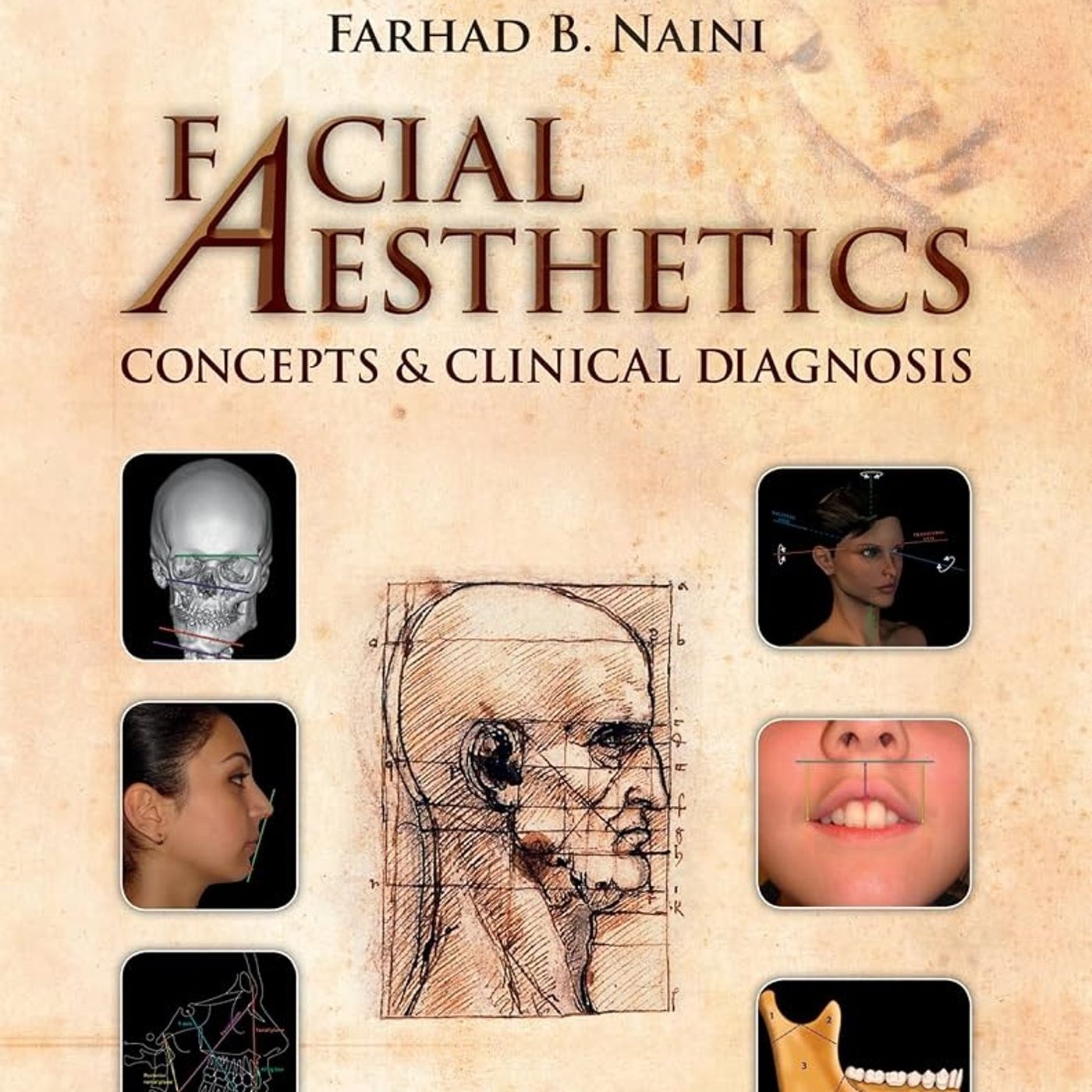
About this episode
Get the Book now from Amazon:
https://www.amazon.com/dp/1405181923?lv=shuf&channelId=500&plpRedirect=mhFallback&linkCode=ll2&tag=cvthunderx-20&linkId=9d7a956d270ddc953a1dd2a7abe9604c&language=en_US&gaOptInStatus=true&ref_=as_li_ss_tl
You can listen and download our episodes for free on more than 10 different platforms:
https://linktr.ee/dentistry_made_simple
Produced by:
https://www.podcaistudio.com/
Get every episode summarized
Each time Dentistry Made Simple publishes, we email you a written briefing from the transcript — the topics, who appeared, and any specific claims, with the ad reads skipped.
Email me new episodesFree for 3 shows. No card needed.
Hosts & guests
Transcript ready
384 searchable segments. Every word is indexed and playable.
Full transcript
Dentistry Made Simple — Facial Aesthetics: Concepts and Clinical Diagnosis. Machine-transcribed; use the interactive transcript above to jump the player to any line.
It's fall in Jeep country and during the drive-in-to-fall sales event get a great deal on 4x4s that refuse to be contained like Jeep Wrangler. Confidence built into every drive with the most awarded SUV ever, Jeep Grand Cherokee, and freedom that can't be denied with the open-air freedom in Jeep Gladiator. After 85 years, it's no surprise that Jeep became America's SUV brand, yet a great deal during the Jeep Drive-in-to-fall sales event. Jeep is one more awards-overts lifetime than any other SUV brand, even the Jeep Grill Register trademarts of FCA US LLC. Enjoy big savings with Red Hot Deals at Vons and Albertsons. This week at Vons and Albertsons, baby-backed pork ribs are 2.99 per pound with membership where applicable limit 3 racks. And ballpark hot dogs or hamburger buns 8 count are 2.99 with digital coupon. Plus, personal seedless watermelons or cantaloupe are 1.99 each with digital coupon. Enjoy fresh and delicious savings for every meal. Hurry in, these deals won't last. Visit Vons or Albertsons.com for more deals and ways to save.
It's fall in Jeep Country, and during the drive-in-to-fall sales event get a great deal on 4x4s that refuse to be contained like Jeep Wrangler. Confidence built into every drive with the most awarded SUV ever, Jeep Grand Cherokee, and freedom that can't be denied with the open-air freedom in Jeep Gladiator. After 85 years, it's no surprise that Jeep became America's SUV brand. Get a great deal during the Jeep Drive-In-To-Fall Sales event. Jeep is one more awards over its lifetime than any other SUV brand. Jeep and the Jeep Grill Register trademarts of FCA US LLC. Usually when we talk about a medical diagnosis, there is a certain expectation of cold hard precision. Right, like engineering or something. Exactly. Like if you break your arm, the X-ray shows this jagged white line. The doctor points to it and says, well, there's your problem. Yeah, it's very black and white. But when you step into the world of dentistry or orthodontics and craniofacial surgery, suddenly that simple X-ray machine feels, I mean, a little inadequate. You're stepping into a diagnostic landscape that is just this ultimate unapologetic fusion of art and science.
It really is a completely different paradigm. You know, we are evaluating the human face. It's not just about what is biologically functional or structurally sound. The face is deeply tied to identity, to human emotion, and to this very primal perception of what we even consider beautiful. I mean, you are treating the person's primary interface with the world. And that is exactly what we are mastering today in this Jeep Drive. Whether you are a dental student prepping for the clinic, a young professional refining your eye, or just a curious self-learner trying to, you know, understand why certain faces captivate us. Our mission today is to figure out how dentists actually map out human beauty. Which is quite the undertaking. It is. We are taking a master class from Farhad B. Naney's concepts on facial aesthetics and clinical diagnosis. The goal is to understand how we actually bridge the gap between those ancient artistic canons and modern evidence-based clinical practice. Because the clinical diagnosis of a patient's face really requires you to inhabit two mindsets at once.
You have to be a rigorous statistician, but you also have to be an artist. Yeah, I look at it almost like reverse engineering a masterpiece painting. Except, you know, your canvas is a living, breathing person sitting in your dental chair, and your brushstrokes are mere millimeters of bone, cartilage, and soft tissue. That's a great way to put it. But to reverse engineer that masterpiece, you first have to understand the underlying rules of the painting itself. Like, how has humanity historically even attempted to define something as subjective as beauty? Well, it feels subjective, but biologically beauty is shockingly universal. Really? Yeah. There are core elements that make a face attractive across virtually all cultures. We're talking about ideal proportions, symmetry, averageness, neotiny. Let's slow down and actually unpack those. I think people here are term like averageness and assume it's an insult. Like, if someone calls my face average, I'm not taking that as a compliment. Right. It sounds like a slight, but biologically averageness is actually a massive evolutionary flex.
Really? How so? Well, in this context, it means a face that represents the mathematical median of a population, a face that is statistically average signals to our ancient lizard brains that this person has high genetic diversity and robust health. How I see. Yeah, they don't have extreme genetic mutations. Similarly, symmetry signals resistance to environmental stressors and parasites during development. Our brains are literally hardwired to view these health indicators as beautiful. Okay, that makes sense. And then there's neotiny, which is just a fascinating biological trick. Oh, definitely. Neotiny is the retention of childlike features in adult faces. Think of a disproportionately large eyes, a rounder forehead, or a smaller lower jaw. Which explains why we find certain faces so cute. Exactly. When we see these features, it triggers a subconscious, hardwired, nurturing response. We find those faces endearing and attractive. Add in sexual demorphism. That's the distinct secondary sexual characteristics, right?
Yeah, the features that differentiate male and female faces driven by testosterone and estrogen. And mix all that together and you have the fundamental recipe for human attraction. It's crazy because humanity has been trying to crack this biological code for a long time. I mean, the ancient Egyptians and Greeks took swings at it, but this really got codified during the Renaissance. And you cannot talk about Renaissance proportions without talking about Leonardo da Vinci. Oh, absolutely not. The guy was just obsessed with measuring the human form. Obsessed is putting it mildly. Da Vinci established aesthetic rules that clinicians still actively reference today. The most enduring is the facial tri-section. He proposed that an ideally proportioned face can be divided horizontally into three equal parts. And he got incredibly specific with his landmarks too. Like, he noted that the distance from the globella, which if you're listening, is that smooth, flat part of your forehead right where your eyebrows meet, down to the bottom of the chin, should represent exactly two thirds of the total facial height.
It was a brilliant observation for the time, but this artistic pursuit eventually evolved into a search for a singular, perfect mathematical formula. People wanted a magic number that explained all beauty. Okay, this is where I have to push back a little because this leads us straight to the infamous golden proportion. The ratio of 1 to 1.6, 1.8. Right. We hear about this everywhere, an architecture, a nature, and an infacial aesthetics. But is the golden ratio actually a biological rule for the human face? Or is it just mathematical peridolia? Mathematical peridolia? Yeah, you know, that human tendency to stare at clouds and see faces or stare at data and force a neat magical pattern onto it, even when the map doesn't actually add up. That is an incredibly important skepticism to have, especially if you are holding a scalpel or designing a treatment plan. Because the scientific reality is that the golden proportion is not a clinical magic bullet. Right. When researchers actually measure the faces of professional models, people's aside, broadly agrees are exceptionally attractive.
Those faces do not consistently fit the golden proportion. That is wild. The data on ortho-natholic surgery, you know, jaw surgery is what really solidify this. Yeah, and the surgery studies are eye-opening. Yeah, there are studies tracking patients who underwent major corrective jaw surgeries. Afterward, their aesthetics drastically undeniably improved. But their post-surgery facial proportions were equally likely to move away from the golden proportion as they were to move toward it. And that data point changes everything for a clinician. It proves that chasing a single, mythical mathematical ideal can actually lead to disastrous clinical decisions. Like you could ruin a face trying to make the math work. Exactly. You might surgically force a patient's jaw into the golden ratio and end up completely ruining their facial harmony. So if we throw out the magical math formulas, what replaces them? It's fall in Jeep country, and during the drive-in-of-fall sales event, get a great deal on four by fours that refuse to be contained. Like Jeep Wrangler, confidence built into every drive with the most awarded SUV ever, Jeep Grand Cherokee,
and freedom that can't be denied, with the open-air freedom in Jeep Gladiator. After 85 years, it's no surprise that Jeep became America's SUV brand. Get a great deal during the Jeep drive-in-of-fall sales event. Jeep is one more awards over its lifetime than any other SUV brand, Jeep and the Jeep Grill Registered Trademarks of FCAUS LLC. Enjoy big savings with Red Hot Deals at Vons and Albertsons! This week at Vons and Albertsons, baby-backed pork ribs are 2.99 per pound with membership where applicable limit three racks. And ballpark hot dogs or hamburger buns eight count are 2.99 with digital coupon. Plus personal seedless watermelons or canelope are 1.99 each with digital coupon. Enjoy fresh and delicious savings for every meal. Hurry in! These deals won't last. Visit Vons or Albertsons.com for more deals and ways to save. Toyota's easy choice sales event is on. Whether you're looking for the performance of a camera, the versatility of a RAV4, the efficiency of a Corolla, or all electric driving in the BZ.
There's a Toyota that's just right for you. And with great deals across the lineup, now's the time to find yours. But hurry, these deals won't last long. Toyota's easy choice sales event ends soon. We make it easy! Toyota, let's go places! How is a clinician supposed to know what normal or ideal actually is? Well, that problem is exactly what drove the field out of the classical artist studio and into the modern clinician's laboratory. This was heavily led by a 20th century pioneer named Leslie Farcus. He's the father of modern craniofacial anthropometry, right? He is. Anthropometry being the rigorous scientific measurement of the human body. Farcus realized that instead of looking for one universal, mythical ideal, we needed to measure actual living, diverse populations. Okay. He categorized facial measurements into two incredibly useful proportion indices, aerial and interraryl. Let me make sure I understand this right.
An aerial index involves measurements isolated to just one anatomical neighborhood. Yeah. So if you, the listener, measure the width of your own nose and divide it by the height of your nose, that is an aerial index. Exactly. It tells you about the shape of the nose itself. But an interraryl index zooms out, it compares measurements across two entirely different regions. Like comparing the width of your nose to the total width of your face. This tells you how the nose fits into the broader facial landscape. But, and this is a massive flashing warning sign attached to Farcus' work. These indices are guidelines, not rigid rules. Because context matters. It's the single most crucial takeaway for anyone working in clinical aesthetics. A measurement is just a meaningless number until you give it demographic context. You have to evaluate these guidelines against normative values that are highly specific to the patient's age, their biological sex, and their ethnic background. Give me an example of why that demographic specificity is so vital. Like, why can't we just use a global average? Because you cannot recognize abnormal craniofacial morphology unless you have a statistically sound baseline
of what is normal for that specific patient. Right. Let's look at nasal width. A perfectly normal harmonious nasal width for a 40-year-old male of one specific ethnic background might be considered a severe structural anomaly for a 15-year-old female of a completely different background. The population averages provide your baseline frame of reference. That raises a massive practical issue for the clinician, though. You have all these populations statistics, the history of the biology. But then a patient walks into your clinic on a Tuesday morning and sits in your chair. Where do you even begin? It can be overwhelming. Right. How do you systematically apply all of this data to a living person? This is the cultivation of the trained eye. And it relies on a very specific, continuous diagnostic loop. It's not a one-and-done evaluation. I look at this diagnostic loop like a seasoned mechanic diagnosing a complex car engine. You start by just standing there, listening to how the car runs, feeling the vibration. Yeah. That's your qualitative evaluation. Yeah, taking it all. And then you plug the car into the computer diagnostics to get the hard, cold numbers that's your quantitative analysis.
Finally, you synthesize the tube. You ask yourself, does the computer data actually explain the weird rattling sound I heard? That is a phenomenal way to visualize it. In the dental or surgical clinic, the qualitative evaluation is your initial, asidious observation. You sit down, have a conversation with the patient, and you just watch them. Just evaluating them in motion. Exactly. You are looking at their facial harmony, their symmetry, how their soft tissue moves when they speak. You're letting your brain process the obvious discrepancies. Then you move to the quantitative analysis. This is the systematic, rigorous collection of anthropometric and cephalometric data. And what happens if those hard numbers from the computer don't back up what your eyes initially saw? Let's say your eyes tell you the patient's jaw is severely recessed, but the measurements say it's completely normal. Then you hit the brakes and start over. Really? If the quantitative data doesn't perfectly corroborate your visual assessment, something was missed. Maybe your initial visual impression was tricked by a fixed soft tissue chin pad, masking a skeletal deficiency.
That makes sense. Or maybe your measurements were taken from the wrong anatomical landmarks. You cannot proceed with the treatment plan until the qualitative observation and the quantitative data align perfectly. So to get those quantitative measurements, you obviously need impeccable diagnostic records. We are talking about radiographs, study models, and modern 3D imaging. Yes, all of the above. But there is a huge caveat here regarding clinical photographs. They are standard every clinic, but they are absolutely not a substitute for real life evaluation. You never. I can't stress that enough. A photograph is a static 2D representation of a dynamic 3D structure. It is essential for documentation and precise geometric analysis, but a photo cannot show you muscle hyperfunction. It can't show you how the upper lip dynamic changes the smile line during spontaneous laughter. You have to evaluate the patient in 3D space. And to do any of this measuring accurately, whether you are examining them in person or analyzing a photo, the patient has to be positioned perfectly.
This requires establishing natural head position or NHB. NHP is crucial. It's a standardized, highly reproduced posture of the head in space. It is essentially the position a person naturally assumes when they are looking straight ahead at a distant object, exactly at eye level. Also not looking up or down. Exactly. It's the only scientifically reliable starting point for facial analysis. If the head is tilted even a few degrees back or forward, every single measurement you take will be compromised. Okay, so once you have the patient locked into NHP, you have to establish the facial midline, also known as the midsagital plane. I found the clinical methodology for this fascinating because you don't just like eyeball aligned in the middle of their nose. No, definitely not. You start by drawing a true horizontal line through the soft tissue globella again, that space between the eyebrows. Then you drop a line perfectly perpendicular to that horizontal line, exactly like a plum line hanging from a ceiling. And that true vertical plum line becomes your facial midline.
And the reason you build it this way is that the nose and the chin are frequently asymmetric. Right. If you use the tip of the nose to find the middle of the face and the nose is deviated, your entire diagnostic framework collapses. You're just basing everything off a crooked starting point. Precisely. You use this true plum line to assess the real symmetry of the face, to check the dental midlines, and to evaluate the midpoint of the upper lip, the cupid's bow. So we have our patient in natural head position, we've dropped our plum line, and our midline is established. Now we start zooming in on the actual numbers, moving into the sephalometric analysis and facial proportions. Right. Sephalmetrics is the rigorous measurement of the head based on very specific skeletal and soft tissue landmarks, typically derived from radiographs. And a foundational concept here is the anterior face height ratio. This specific ratio is so cool to me because it highlights a crucial difference between the underlying bone and the visible soft tissue on the outside of the face. It's a very important distinction. Let's look at the skeleton first.
When you measure the underlying bone, you look at the middle anterior face height, which goes from the nasion, basically the bridge of the nose, down to the anterior nasal spine or ANS. Yes. You compare that to the lower anterior face height, which goes from the ANS down to the menton, the absolute lowest point on the chin bone. And skeletally, what does the ideal proportion look like? Skeletally. The ratio is asymmetrical. It is roughly 45% for the middle face, and 55% for the lower face. Correct. And here's where the clinical precision comes in. When you measure the soft tissue on the outside of the face, the ideal proportion is exactly 50-50. But wait, if the bone underneath is 45-55, how can the skin covering it be 50-50? That doesn't make physical sense. It is a great question. And the reason for this discrepancy is vital for a clinician to understand. The ratio changes because the landmarks used to measure it change. For the skeletal measurement, the uppermost point is the nasion, which sits a bit lower right at the front and nasal suture.
But for the soft tissue measurement, the clinician doesn't use the nasion. They use the soft tissue globella, which is significantly higher up on the forehead. Oh, so you're starting from a higher point? Exactly. That superior shift in your starting point lengthens the upper measurement, changing the overall ratio from 45-55 to a perfectly balanced 50-50. It just goes to show how obsessive you have to be about what exactly you're measuring. Bone and skin tell two totally different stories. They really do. But we also have to look at the face horizontally, the transverse proportions. And this brings us to a classic guideline, the rule of fifths. The rule of fifths dictates that an ideally proportioned face can be divided vertically into five equal sections, with each section being exactly the width of one eye. Okay, so if you apply that math, the distance between your two eyes, the inner can't all width, should be exactly one eye width. Yep. And the width of your nose at the base, the LR base width, should also be exactly one eye width. They should perfectly align.
That is the classical artistic guideline. However, modern clinical practice and statistical analysis have refined this a bit. Like Giron's addendum. Yes. Giron's modern addendum suggests that aesthetically, the LR base, the width of the nose, can actually be one to two millimeters wide. And the face will still be perceived as highly attractive, sometimes even more natural. Which again proved that these aren't rigid laws of physics. Yeah. You have to treat the whole person. You can't just measure a nose, declare it three millimeters too big according to the rule of fifths, and immediately plan a rhinoplasty. Context is absolutely everything. A large nose, quantitatively speaking, might be perfectly proportioned if the entire craniofacial complex, the jaw, the forehead, the cheekbones is also robust. Right. This is why a clinical diagnosis must evaluate the face in all three planes of space simultaneously. The sagittal plane, which is front to back projection, the vertical plane up and down height, and the transverse plane side to side with. You are treating a holistic 3D structure, not just a nose or a jaw in isolation.
Which naturally leads us to the grand finale of facial aesthetics. We've gone from the ancient historical canons to the statistical population averages to the specific skeletal ratios. Finally, we arrive at the domain where dimple professionals have the most direct immediate and profound impact. The dental viola complex. Exactly. We are talking about the smile. The smile is the dynamic focal point of lower facial aesthetics. It's incredibly complex because it involves teeth, gums, lips, and muscle movement. But the absolute anchor of smile design, the true north from which everything else is oriented, is the position of the maxillary central incisors. The two front teeth of the upper jaw. Yes. All other teeth are positioned relative to those two front teeth. And to figure out exactly where they should sit vertically, clinicians rely heavily on phonetic analysis, right? Like having the patient speak certain sounds to see how the lip moves and how much of the tooth is exposed dynamically. Yes. The amount of incisor display when the lips are at rest and during speech or smiling heavily dictates the youthful appearance of the face.
Because things change as we age. Right. As we age, our upper-lep lengthens and sags showing less upper tooth and more lower tooth. If you set the maxillary central incisors incorrectly, the entire smile is thrown off balance and you can inadvertently age a patient by a decade. Wow. So if those upper front teeth are the untouchable anchor, what happens when a patient comes in with a gummy smile? Or an excessively deep bite? You have to move something. This is a critical point in treatment planning. If a patient shows too much jingiva or if the bite is deep, the modern orthodontic approach generally favors the active intrusion, the upward pushing of the mandibular incisors, the lower teeth. Instead of the upper teeth. Yes. You want to desperately avoid over intruding the upper maxillary incisors. Because as we just established, if you push those upper front teeth too far up into the bone, they disappear behind the lip when the patient speaks, completely destroying that youthful aesthetic. So you protect the vertical position of the upper front teeth at almost all costs.
Exactly. But what about the sides of the smile? When someone smiles broadly, the last tooth you usually see is the first or second premolar. This brings us to a vital aesthetic concept. Negative space, commonly referred to as the Buckel corridors. If a patient's premolars are palatally inclined, meaning the teeth naturally tilt inward toward the roof of the mouth like they are caving in on themselves, they fall into shadow. It creates this dark cave at the corners of the mouth when they smile. Exactly. It makes the smile look narrow and constricted. To correct this, clinicians will often orthopedically or orthodontically expand the posterior teeth. Or they could use veneers, right? Yes. Alternatively, they might use ceramic restorations like veneers to literally thicken the Buckel or cheek-facing aspect of the teeth. This pushes the reflective surface of the tooth outward, filling out that negative space and creating a broad, radiant smile. And as your eye moves naturally from those front central incisors toward the back premolars, you're supposed to see a specific transition called the gradation effect.
The gradation effect is the natural, seamless, visual progression of two sides, morphology, and color from the front to the back. It shouldn't look like a sudden jarring drop off in size. And the way clinicians mathematically check for this is by looking at the Buckel contours. Imagine drawing a tangent line along the gingeval thirds, the part of the tooth, right up near the gum line of the canine and the premolars. Those tangent lines should be perfectly parallel to each other. Precisely. Some exact geometry applies to the mid-thirds of those teeth. They should all align in parallel planes to create that perfectly smooth visual transition as the smile curves backward. It's all about that harmonious alignment. Okay, I have a major question here about how we apply all this. If the maxillary central incisors are the ultimate reference point, what happens if the patient's primary deformity isn't in their teeth at all? What if the problem is a severe skeletal under bite in the lower jaw? If a clinician just focuses on making the upper teeth look perfectly proportioned using braces or veneers, aren't they just aesthetically camouflaging a massive functional problem in the lower jaw?
You have just described the exact trap that a rigorous clinical diagnosis is designed to prevent. And this is exactly why that qualitative and quantitative diagnostic loop we discussed earlier is non-negotiable. If you simply camouflage a skeletal mandibular deformity by aggressively flaring the upper teeth outward to force a bite, you might create a passable smile from the front. But it's just an illusion. Exactly. Functionally, phonetically, and aesthetically from a profile view, the patient's facial harmony will be severely compromised. You must diagnose and treat the underlying skeletal discrepancy, not just provide dental camouflage. It all inevitably comes back to treating the whole face in three dimensions, balancing the biology with the mechanics. Always. Which is actually a perfect segue to our review exercise for today. We want to give you the listener a chance to apply these concepts in the real world. Next time, you are looking at a clinical photograph of a patient's smile, or even just checking your own smile in the mirror, practice identifying that gradation effect.
This is a great exercise for the train die. Ask yourself two diagnostic questions. First, look at the corners of the smile. Are the buckle contours of the canine and pre-mullers aligning in parallel planes, creating a smooth front-back transition, or is there a dark negative space collapsing inward? And second, is the entire smile truly anchored by the proper vertical exposure of the maxillary central incisors? It is amazing how, once you know exactly what to look for, you can never unsee it. It will start seeing parallel tangents, natural head positions, and anatomical planes on every single face you meet. It is the ultimate education of the eye. But it also raises our rather profound philosophical question as we wrap up this clinical deep dive. If our modern clinical diagnosis is so heavily reliant on mathematical averages, population norms, and standardized proportion indices, and as surgical and orthodontic interventions become globally accessible and highly standardized. Oh, I see the trajectory here. Are we slowly collectively moving toward a global homogenization of the human face?
If our ultimate clinical goal is to correct every slight asymmetry, to expand every buckle corridor, and to push every face toward the statistical median of averageness, what happens to the unique individual quirks that have historically defined human character? Is there a danger that in our rigorous pursuit of evidence-based beauty, we are systematically erasing the very things that make a face uniquely memorable? That is wild. We started this deep dive talking about reverse engineering, a masterpiece painting on a living canvas. But maybe the ultimate level of clinical art isn't in painting by the statistical numbers perfectly. I mean, maybe the true art is knowing exactly which flaw on the canvas you should intentionally leave untouched. A very provocative thought to take with you into the clinic. Definitely something to mull over before your next patient consultation. Enjoy big savings with Red Hot Deals at Vons and Albertsons! This week at Vons and Albertsons, baby back pork ribs are 2.99 per pound with membership where applicable limit three racks.
And ballpark hot dogs or hamburger buns 8 count are 2.99 with digital coupon. Plus, personal seedless watermelons or canelope are 1.99 each with digital coupon. Enjoy fresh and delicious savings for every meal. Hurry in, these deals won't last. Visit vonsoralbertsons.com for more deals and ways to save. Toyota's easy choice sales event is on. Whether you're looking for the performance of a camera, the versatility of a RAV4, the efficiency of a Corolla, or all electric driving in the BZ, there's a Toyota that's just right for you. Three deals across the lineup, now's the time to find yours. But hurry, these deals won't last long. Toyota's easy choice sales event ends soon. We make it easy. Toyota, let's go places. Meet the Red Bull Dragonberry Emergeizer. It's one of the many new drinks out now. Who knew ice cold drinks could be so?
Fire. Try them all only at McDonald's.
More episodes
More from Dentistry Made Simple

Endodontics: Principles and Practice
Dentistry Made Simple

Endodontic Radiology
Dentistry Made Simple

Emergency Medicine Oral Board Review: Pearls of Wisdom
Dentistry Made Simple

Essentials of Pharmacology for Dentistry
Dentistry Made Simple