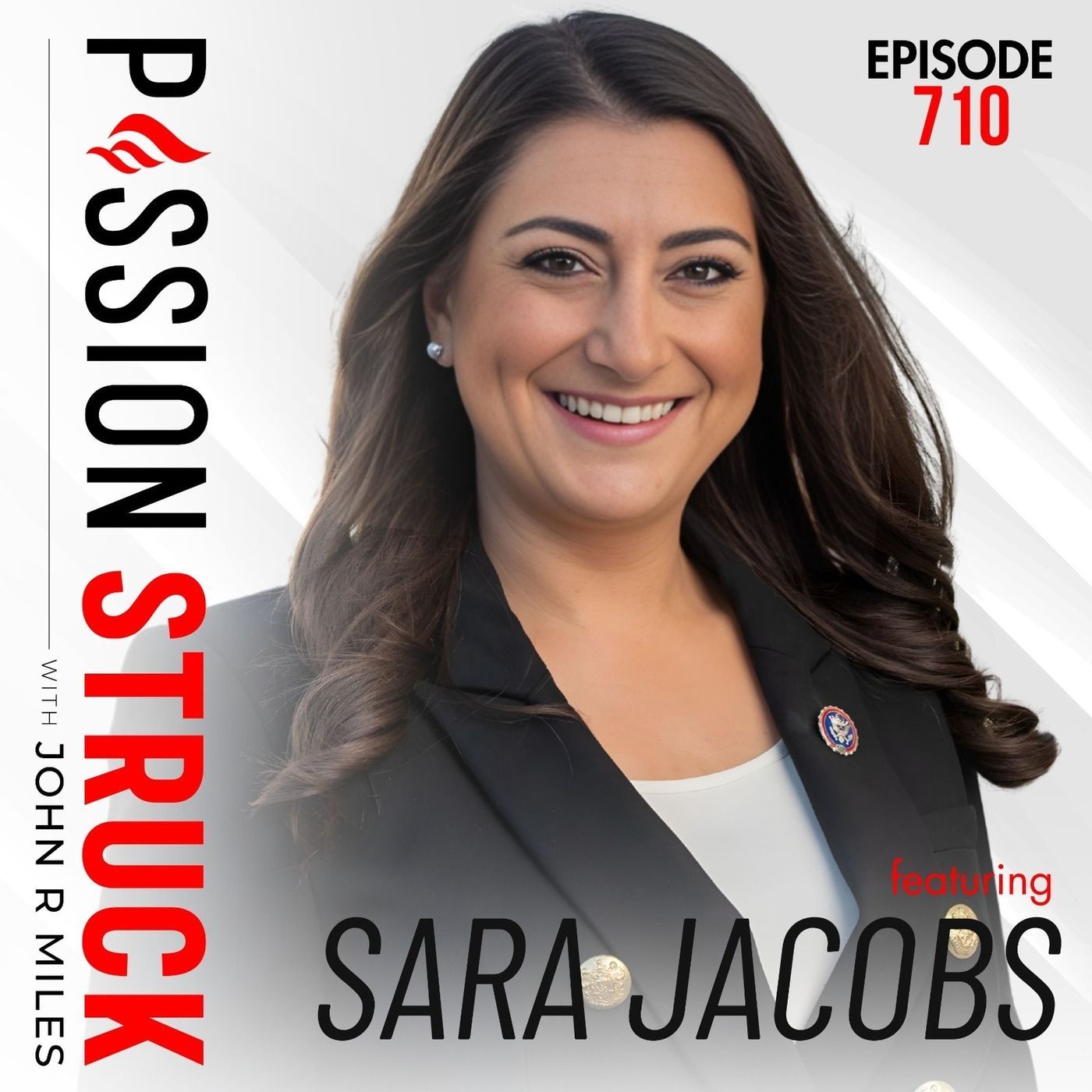
Congresswoman Sara Jacobs Egg Freezing Choice: Why Authenticity Wins | EP 710
About this episode
What if one of the most personal decisions a woman can make (when and whether to become a mother) became a public act of courage that shifted the conversation for an entire generation?In Episode 710 of Passion Struck, Congresswoman Sara Jacobs (D-CA) joins John R. Miles for a deeply human conversation that has nothing to do with politics and everything to do with agency, worth, and vulnerability.At 31, newly sworn into Congress, Sara froze her eggs to preserve the option of motherhood on her own timeline. At 36, still serving, she returned for two more rounds and chose to speak openly about the physical toll, emotional weight, and empowering choice behind it.Sara shares the raw realities (hot flashes, intense cravings, acne, and the surprising joy of taking control), why she rejects pity for empowerment, and how radical vulnerability has become her superpower in leadership. She challenges the idea that women must be perfect to lead, explains why fertility is not just a “women’s issue,” and calls on male leaders to recognize their experience represents only half the story.If you’ve ever felt pressure to follow a prescribed path or wondered how authenticity can reshape both personal life and public policy, this conversation is for you.Check the full show notes here: https://passionstruck.com/sara-jacobs-egg-freezing/All links gathered here, including books, Substack, YouTube, and Start Mattering apparel: https://linktr.ee/John_R_MilesFor more about Congresswoman Sara Jacobs: https://sarajacobs.house.gov/Pre-order You Matter, Luma: https://youmatterluma.com/Radical Vulnerability Companion WorkbookReflect. Reclaim Agency. Redefine Worth.Gentle prompts and exercises to explore your own relationship with choice, vulnerability, and self-worth, inspired by Sara’s journey and the message that you matter exactly as you are.Download the free Companion Workbook at: https://www.theignitedlife.net/p/sara-jacobs-radical-vulnerabilityIn this episode, you will learn:
- Why Sara Jacobs chose egg freezing twice while serving in Congress and why she frames it as empowerment, not loss
- The surprising physical and emotional realities of the process (from hot flashes to intense cravings)
- How radical vulnerability became Sara’s leadership superpower and why perfection is the enemy of connection
- Why fertility and reproductive choices are not “women’s issues” but human issues that demand broader understanding
- The danger of tying women’s worth to motherhood and how redefining agency frees us all
- What Sara wants the next generation of women (and men) to internalize about authenticity, choice, and speaking up
Connect with John
- Pre-Order The Mattering Effect: https://matteringeffect.com/
- Book John to Speak: https://johnrmiles.com/speaking/
- Keynotes, books, podcast, and resources: https://linktr.ee/John_R_Miles
- Children’s Book — You Matter, Luma: https://youmatterluma.com/
- Substack: https://www.theignitedlife.net/
Support the Movement: https://startmattering.com/. Every human deserves to feel seen, valued, and like they matter. Wear it. Live it. Show it.
Disclaimer
The Passion Struck podcast is for educational and entertainment purposes only. The views and opinions expressed do not necessarily reflect those of Passion Struck or its affiliates. This podcast is not a substitute for professional medical or psychological advice.
Pre-Order The Mattering Effect: https://matteringeffect.com/. Take the 90-second diagnostic to see if you're disappearing.
Explore the Show: https://passionstruck.com/starter-packs/. New to Passion Struck? Start with the best episodes curated for you.
Connect with John
- Website: https://johnrmiles.com
- Book John to Speak: https://johnrmiles.com/speaking/
- Substack: https://www.theignitedlife.net/
- Children’s Book — You Matter, Luma: https://youmatterluma.com/
Support the Movement: https://startmattering.com/. Every human deserves to feel seen, valued, and like they matter. Wear it. Live it. Show it.
Passion Struck — #1 Alternative Health Podcast. 85M+ downloads.
Disclaimer
The Passion Struck podcast is for educational and entertainment purposes only. The views and opinions expressed do not necessarily reflect those of Passion Struck or its affiliates. This podcast is not a substitute for professional medical or psychological advice.
Hosted by Simplecast, an AdsWizz company. See pcm.adswizz.com for information about our collection and use of personal data for advertising.
Get every episode summarized
Each time Passion Struck with John R. Miles publishes, we email you a written briefing from the transcript — the topics, who appeared, and any specific claims, with the ad reads skipped.
Email me new episodesFree for 3 shows. No card needed.
Transcript ready
481 searchable segments. Every word is indexed and playable.
Full transcript
Passion Struck with John R. Miles — Congresswoman Sara Jacobs Egg Freezing Choice: Why Authenticity Wins | EP 710. Machine-transcribed; use the interactive transcript above to jump the player to any line.
coming up next on passion strike. I'll be honest with you. Body image, body, weight, food are things that I've struggled with my whole life and I've worked really hard to get to a place where I feel neutral about food and that I don't have the scarcity mindset and that I love my body the way it is and not I'm constantly trying to change it and that's really difficult work. It's work that I have to do every single day and I hope that as a society we do a better job of not giving the kinds of messages that I received as a young girl to future generations. Welcome to passion struck. I'm your host John Miles. This is the show where we explore the art of human flourishing and what it truly means to live like it matters. Each week I sit down with change makers, craters, scientists and everyday heroes to decode the human experience and uncover the tools that help us lead with meaning heal what hurts and pursue the fullest expression
of who we're capable of becoming whether you're designing your future developing as a leader or seeking deeper alignment in your life this show is your invitation to grow with purpose and act with intention because the secret to a life of deep purpose connection and impact is choosing to live like you matter. Hey friends and happy 2026 welcome back to episode 710 of passion struck. This is one of my favorite times of the year. There's something so powerful about the quiet reset of January 1st, a moment when the noise eases. Intentions come into focus and we get to ask ourselves not what do I want to do but who do I want to become this year and if you're like me it's also that stretch of the calendar where you're gearing up for the college football and NFL playoffs a reminder that preparation timing and teamwork matter just as much as raw talent
which makes today's conversation especially fitting over the past month we've been in what I call the season of becoming exploring identity discomfort leadership flow creativity and compassion with voices like Susan Grouw and Libra Brent Collison and a prior Nirbashan David Nurse Mark Murphy all he raised in Forest McGuire Rick Hanson and Joshua Green today's conversation continues that journey by going into deeply human territory this is not an episode about politics and I want to be clear about that and it's not just an episode about fertility it's an episode about agency what it looks like to choose yourself without abandoning your purpose my guess today is representative Sarah Jacobs a third term member of congress representing California's 51st district she's one of the youngest women serving in congress and she's also been remarkably open about a deeply personal decision freezing her eggs while serving in public office Sarah chose
to speak publicly about that journey the physical toll the emotional complexity the body scrutiny and the invisible labor not because she was seeking attention but because lived experience makes better leadership possible in today's conversation we explore what it means to take agency when biology ambition and service collide why not yet can be a powerful values aligned choice how stigma around women's bodies quietly shapes policy and culture why leadership without embodying understanding leads to blind spots and how vulnerability when chosen intentionally becomes a form of strength at its core this episode asks a bigger question what would change if we designed our systems around real human lives not idealized timelines if you've ever felt pressure around timing if your body has ever felt inconvenient to your role if you've ever wrestled with choosing between contribution and care this conversation is for you before we begin a quick reminder if this episode resonates please share it with someone navigating a similar
season and if you haven't yet five star rating review an apple podcast or Spotify helps these conversations reach the people who need them most and catch the full visual experience on our youtube channels passion struck clips and john miles all right this is episode 710 let's step into this honest powerful conversation with Sarah Jacobs thank you for choosing passion struck and choosing me to be your hosting guide on your journey to creating an intentional life now let that journey begin hey friends there's something about March that makes you want to reset your space for me that started in the kitchen clearing out what I didn't need and upgrading what I use every single day that's when I brought in caraway what I love is how simple caraway makes everything the ceramic coating means food just lifts right off so I'm using less oil clean up take seconds and cooking actually feels enjoyable again but it's not just performance it's the intentional design the storage system keeps everything organized and I've become a lot more mindful about what I bring
into my home and that's why it's so important that caraway is third party tested and made with high standards which just gives me more confidence and what I'm using every day it's one of those upgrades you feel immediately caraway's cookware set is a favorite for a reason it can save you up to two hundred thirty dollars versus buying the items individually plus if you visit caraway home dot com slash passion struck you can take an additional 10% off your next purchase the steel is exclusive for our listeners so visit caraway home dot com slash passion struck or use code passion struck at checkout caraway non toxic kitchenware made modern I would like to welcome congresswoman Sarah Jacobs a third term member of congress representing California's 51st district to passion struck welcome Sarah how are you today I'm good thanks so much for having me today we're not talking about your job as a congresswoman we're not talking about
politics at all we're talking about something personal that you have been going through can you take us back to the moment when you realized if I want the option of motherhood I need to act now what was happening in your life and work at that time so I got sworn into congress at thirty one years old and realized that I was going to be quite busy getting everything started and I come from a big family I always knew I wanted to be a mom but I knew that it wasn't the right time and so in my first term in congress in my first year in congress I froze my ex and made that decision because I wanted to have agency in my life and my timeline and be able to make that decision when was right for me not just based on my biological clock and then as I continued serving in congress I turned thirty six and realized it was still not quite the right time for me it was time to go back and check on some things my doctor recommended we do another round of egg freezing to make sure
that I had as much optionality as I could get myself and so this past year I did two rounds of egg retrieval froze my eggs and spoke about it very publicly which I will say was difficult it was like to say it was an act of radical vulnerability I did not have talking about my boobs hurting with the New York Times on my bucket list but that's what happened but I feel like it's important to be talking about these things because look as a 36 year old woman right these are the conversations I'm having with all my friends all the time right who's having a baby who wants to have a baby who doesn't want to have a baby and if we're not normalizing those things if we're not talking about them we're certainly not going to make good policy about them in the end yeah I was wondering as you were going through this what surprised you the most was it physical changes in your emotional well that's such a good question I had the most intense food cravings and food noise and I feel like I was going through puberty and menopause at the same time so like I got terrible acne
and my boobs hurt but then I was also having hot flashes and really weird body temperature control so I guess I'm not looking forward to that in the future because the hot flashes were really challenging and then I really wanted frozen yogurt and cinnamon rolls like every night man my wife has recently been craving cinabuns when we do it on our rare occasion but man we just had one and they are so good they're so good the struggle the struggle is real that's right when when you are making this decision did it feel like you were gaining control or more like you were acknowledging uncertainty I felt like I was gaining control I think a lot of people think about ed freezing and like when I would share this with people they'd be like oh I'm so sorry and I'm like why are you sorry this is like a very empowering decision where I am taking one of the most important decisions in my life and giving myself more agency about it and that felt
really empowering to me it didn't feel at all like something that I had to feel bad about or feel sorry about or anything like that and emotions are something I love to talk about on the podcast and you just talked about you were giving yourself agency but I'm wondering was there any grief alongside that agency kind of grief for how complicated this choice had to be yeah look I every so often think what could my life be like if I've chosen differently right like I am very fortunate I have the means and ability to choose to stay home with kids if that's what I wanted to do and there that's the choice that most of the women in my family make and I think there is some grief about figuring out how to balance all this and that it's not it doesn't feel the same quite like a fairy tale story right because there's like very practical considerations that I'm thinking about it's not just I want to have a baby but like when and how and if and the
logistics right I fly five hours twice a week to get to my job and I will also say these are decisions that usually fall on the women to make and so many women are facing these things but yeah I'm glad you asked it that way because I think there is some grief just about what different how different my life could be if I've made different choices yeah and part of the reason I was asking it that way is I think there's a cultural narrative as I've been studying to prepare for this interview that egg freezing is like something that's sad or a last resort but you've said it was empowering what why the difference for you for me it didn't feel sad at all like I was very clear and I do a lot of therapy and I think everyone should so I had a lot of clarity for myself about like my values which are that it matters a lot to me to serve my community to be to work hard and it matters a lot to me to be a parent and I was very clear on the fact that this was not the
right time for me to do that but that it was something that was important for me to keep the option available for the future and so to me it was about preserving options and about giving myself as much agency as I could in this decision so that I wasn't ever forced into a corner where I had to do something at a time that wasn't the right time because if I didn't I wouldn't be able to have this thing that I know I want which is to become a parent. Okay and you've read up agency a couple of times now what does agency really mean to you is this decision beyond biology or time and why is it agency? I see a lot of my friends who maybe end up with the person they're with when they're 35 because they're worried about not being able to have kids right that is a lack of agency or a lot of friends change their career path or change their jobs not because they want to but because it's the only way that they can make a family work and for me it's really about
being very clear about my values being very clear about what I want and then really trying to give myself as much optionality as I can and like a lot of my life is out of control out of my control right this job is very unpredictable we get called back at a moment's notice I've missed friends weddings because I had to be stuck here to vote I'm back and forth across the country all the time and so any piece of my life that I feel like I can try and give myself more options or I can try and smooth the noise in the chaos I try and take and this was one of the most important ways of doing that for myself. Yeah the reason I was asking it is because I talk a lot about our need to matter on this podcast and to me agency is often what restores matter and when circumstances feel constraining is that kind of how this felt for you. I totally agree with that and I feel like the times when I feel the most out of control or like the most upset about things
is when I'm in what my therapist would call like a crouching position when it feels like things are happening to me that I don't get a say in and one of the most important things you need to do is right push through that crouching position push through that feeling that you don't get a say in your life and get to a place of agency because we we do get a say in our lives and like most type A oldest daughters honor student right like I thought there was a path I had to follow and that if I did all the right things this I had to do and then you get the A plus at the end but that's not actually how life works there is no path and I've worked really hard on trying to get out of this idea of what I should be doing and trying really focus on what do I want to be doing what is aligned with my values what actually feels fulfilling not what do I think I should be doing because that's what society or whatever told me to do and I think a lot of women feel that way about having a family right there's so much messaging and pressure on women right now to have a family
and to do it early whether that's all of our social media or messaging and this was one way that I could break through that noise for myself and try and get out of that crouching position and remind myself that I get a say in this I don't have to do things the way society says I should so I was recently speaking to one of your constituents right Gleason who's a retired Navy SEAL lives in San Diego and we were talking about his new book all in did this choice change how you think about being all in your own life look I think it was a big sacrifice to make like anyone who's gone through an agritriful knows that it's not an easy process like my body went through a lot I had brain fog and pen and all these other things that come along with it we were literally in the middle of a committee meeting and I had to run up to my office to give myself shots and run back down which is not a pleasant experience shots never are no and I know that with everything
happening in the world right now I just knew that I couldn't be all in with my job if I was also having a family and a baby right now and so I knew that to be on the way I wanted to show up and be present in the way I want to in this moment that our country is in that I needed to make this choice so that I could be all in on my future family when the time is right and I want to switch to your job just for a second because you have a demanding job you already talked about how you have to fly back and forth all the time have friends who were in congress from clear water St. Pete to Florida area and they often complain about the travel although I have no sympathy for people who live on the eastern time zone like they do yes but as I understand it you're giving yourself the injections like you were talking about there was time period where you're going to daily ultrasounds and your commute in cross country while representing San Diego what does it
mean for you to legislate while your body is going through something most colleagues never even have to consider to me that was a really important part of it right it's no secret that congress is older and male and wider than the average population and that's part of why I decided to talk about it so publicly and to be so open about it because I knew that there are so many people who are facing these same choices who are going through these same things who have way less support than I do and who deserve a congress who understands what this is and is trying to make it easier for them and after I talked about this very publicly the first time I was at a meeting with military families and service members and a young woman who serves in the Navy came up to me and was like I read the article about you freezing your eggs and I really wish that something I could do and that was the genesis of me working to get track hair the military insurance program
to cover fertility treatments and that conversation wouldn't have happened that legislation would have happened if I had it myself been living the thing that so many people are living and look it's not easy I've had to give myself shots in the middle of really important things the brain fog and all of that is real but I also think to myself like a lot of women who are going through this are doing it while they have two toddlers at home if they can do it I can do it and this is this two-shell pass and this is the momentary discomfort to get to my ultimate values aligned goal I was going to go to the service members next given I'm a veteran but I remember my own time constantly deploying constantly really under tense circumstances in my experience haven't been in Iraq in a few other places I was exposed to to burn pits and chemicals other things that have had a long-term impact on my life but I don't think a general public thinks about all these
things and the fact that when we serve in the military that's right in the middle of the primary productive years of trying to have a family and yet we have all these complications what do you think about those trade-offs that are so quietly demanding of our servicemen and women in their futures we know that military families face higher rates of infertility than that civilian population one in four military families reports infertility and it makes sense right for all the things you said right in your primary productive years you're far away from your partner you're being exposed to dangerous things to chemicals and we know that a lot of military service members are leaving the military because they can't build their family and serve the country the way they want to and it's a readiness issue right it's you know this right we train we put so much money into training these folks for them to leave at the prime of their career because we're not giving them the
support they need is not good for our national security and I do wish more people understood the real sacrifices we're asking not just of the service members but of their whole family and I talked to a woman named Lydia who her husband served multiple combat deployments she's an army wife and she's tried 11 rounds of IUI they've not been successful their doctor recommends IVF the next step but they can't get try care to cover it even though his service is part of why he's facing infertility challenges and they've literally considered divorcing so that she can go somewhere else to get the coverage she needs that's not what we should be asking of people who already like sacrifice so much for us right and on this topic of agency right like agency isn't just about the ability of yourself to make a choice it's about having choices right it's about having accessible choices that you can then take agency in your own life to make and right now military families don't have that access to IVF coverage and so we are taking away that agency
from them before we continue I want to pause on something important listening to a conversation like this is one thing living it especially when the timing is hard is another so many of you write to me saying I know what I should do but I don't know how to honor myself without letting someone else down that tension between agency and obligation calling a capacity is exactly what the season of becoming is about becoming isn't about rushing into the next chapter it's about choosing alignment before pressure makes that choice for you that's why each episode in the series is paired with a reflection tool inside the ignited life my sub stack not to give you answers but to help you ask better questions like where am I choosing urgency over alignment what decision have I been postponing because I'm afraid of how it will look what would it mean to honor my timing without apology inside the ignited life you'll find weekly reflection prompts tied to each episode identity and agency practices tools to help you integrate what you're hearing into how you actually love because becoming isn't passive it's a choice you practice quietly consistently with courage
you can join us at the ignitedlife.net now a quick rake from our sponsors thank you for supporting those who support the show you're listening to passion struck on the passion struck network now back to the conversation with Sarah Jacobs I know there's a lot of sensitivity even from the veterans I talk to where they say why are we investing so much money in women in service and then they're going to just leave to have children it's I'm bringing it up because it's real I've heard it's a lot of them but my own experience of this is it's not just the female in this situation who's impacted oftentimes the reason you can't get pregnant is also because of this the other side of the equation and they're deployed they're stressed out the things are happening and it just impacts the family in totality so this isn't just about female service members it's about both but what are your thoughts on that because I think we jump to the conclusion that this is focused on
one sex and I think it impacts that's exactly right in fact most of the military families I've been talking to you it is the male who's having fertility challenges because of the service related reasons and that's not always the case but we do know that it's very prevalent that it is that the male who who does have these infertility challenges but I also think one of the things I find difficult about this conversation maybe is that while I know that it's not the right choice for me to have a child right now and be able to be fully present in my job I also have a lot of colleagues who have small children and they are incredible at their job and I never want to give off the impression or to make anyone feel like they can't do that and actually some of my best employees have kids at home like mothers are sometimes the best employees right they're highly efficient and they're very focused and so I also don't want to say you can't I guess I reject the whole premise of that that like when a service member has a kid they become a less good service
member in many cases I think they become a much better service member potentially and so like we want to give people as much agency and choice and accessibility as we can to be able to make those their own choices and oftentimes those having those choices actually makes them better at their job and I just want to make this real for people. Earlier this year I had a former astronaut named Susan Kiorin on the show and Susan was the second female shuttle pilot but prior to that she was the first female at 14 pilot so someone who had to invest a lot to break down barriers to get to where she was. Her husband happens to be a Navy SEAL and after she got done with that space flight they wanted to start a family and she didn't have the option that you're talking about so it cost her dearly. She ended up removing herself from NASA at that point so she could start a family because she
really didn't have that choice so I'm just trying to bring it make this real because you think about the impact and gut-wrenching decision that was from her perspective having a position that is so hard to get harder than becoming a four star general in the Marine Corps when you think about becoming an astronaut. And like I hear these kinds of stories all the time people who have to give up their military career because they need to get a job in the private sector so that they can get health insurance that will cover these fertility treatments for instance and look I don't want to say it's only service members who face these challenges obviously the work of service members is like very unique in a lot of ways. Our prime reproductive years also tend to be like when we are reaching our prime earning potential productivity years right and a lot of families are facing these same questions right do they continue on this career path they're on or do they deviate to start a family and how do they do that and like why does it all happen right at the
same time it feels like your 30s or when it all comes to a head and it's not easy for anyone and there's like an added layer of it with service members because what they do for all of us is so incredibly important. Yeah well Sarah one thing I did want to talk about a little bit is body image because I think it's important especially for young but also all our listeners and body image to me is something that affects again both men and women but as I was doing research for this I understand that there were a number of comments that were made about you and your body during this time and that had to be hard first what do you think it reveals about how women's bodies or our bodies are treated in public life. People have been talking about my body since I first ran for Congress there have been so many comments about my hair my voice I literally had someone tell me that I should do a add in a bikini so that men would want to vote for me and they meant it
quite literally and as I was going through this egg freezing process as most women do who go through it I gained weight and had bloated descended belly from everything I was going through and I there were so many comments about my body and can be really hard like my job is to be in the public eye and as much as I try and ignore what people say like it does affect me and part of what affects me is that I don't want the young women who I know follow me to see those comments and make it think about themselves and I'll be honest with you body image body weight food are things that I've struggled with my whole life and I've worked really hard to get to a place where I feel neutral about food and that I don't have the scarcity mindset and that I love my body the way it is and not I'm constantly trying to change it and that's really difficult work it's work that I have to do every single day and I hope that as a society we do a better job of
not giving the kinds of messages that I received as a young girl to future generations I grew up in the 2000s the height of skinny the skinny era where Jessica Simpson was the size six I think and all of the tabloids called her fat right like those are not good things for our young girls to be learning and now it's back especially with the GLP ones and how a lot more people are maybe more skinny than they would naturally be otherwise and we're starting to see that like very skinny chic look come back one of the things I think a lot about being a leader is that a big part of my job is to show people that leadership can look and sound different than what they're used to right that a lot of people in their head have this idea of leadership that's Spartacus leading the charge and that's a very specific image of who can be a leader and it's not someone who looks like me but I think leadership is listening I think leadership can be very different and part of what I tried to do is show that leadership can look and sound different so that we can have more people who look and sound all sorts of ways see themselves
as leaders and step up and take agency in the direction of our country I want to switch directions to creating policy which is something I can't even imagine how difficult that is right now but I read that you wrote we can't make good policy if the colleagues around us don't understand how these things work what did you mean by that? I will give you a very concrete example right after Rovey Wade was overturned and the Dobs decision came down I started getting all these texts from my friends and peers asking what they should do about their period tracking apps and TikTok had a whole thing like delete your app I use a period tracking app so I was wondering this for myself and I started looking into it with my team and there's basically no federal protections for this data and so I started talking about that with my colleagues but first I had to explain like yes we track our periods and then yes there are apps that help us do that and here's why protecting that data is so important and as part of that process I became the first person
in house history to talk about my own period on the house floor if I hadn't been experiencing that myself as someone with a period tracking app wondering what I should do in this moment change I don't think we would have gotten that policy about how we protect that kind of very sensitive data because so many of my colleagues just didn't do that and so didn't even realize it was a problem and when I think about all of this something that you were trying to bring to Baram you've been so public about this which is very difficult given your position but I want to look at this from a different perspective which is the cost of abstraction and leadership and what happens when our bodies become statistics instead of realities because I think with what you were showing here you're trying to do the opposite yeah and I just wanted to acknowledge you for that and get your thoughts on how it's changed how other people are looking at this now
I think that's so crucial I can't remember who said it a statistic is a statistic and a story is what changes people and I really think that's true the way we humanize these issues is what really matters and that's not to say we don't need people like many of my colleagues here it just means we need more diverse perspectives around the table to make sure that more lived experiences are there when we're making this policy and like I do think the more we can humanize these issues the more we can take it out of this policy realm and into these real human realm the less politicized it becomes and the more we can find common ground and agreement even where we don't think we can't a lot of the folks I work with on IVF is because someone in their family or they themselves have used IVF to get pregnant and that human lived experience that enables us to work across the aisle to work and build these coalitions and I know everyone looks at Washington and thinks that we're just fighting all the time and like in many cases that is true but the way that we get out of that
battle space is by making these things as human and personal as possible so that we can relate on a human level and then figure out how we can work together to solve our problem I have two related but a little bit different questions I wanted to ask the first is unfortunately last year my sister who was a graduated from Columbia she went to the International Oblok Affairs Program like you did she died of pancreatic cancer and as I've talked to members of congress because I'm active with pancan what they've unfortunately told me is because there's such a the research has not been able to penetrate causing causality to improve the chances of people surviving there's not been a lot of policy conversations about it so my question is this and it's not just something like pancreatic cancer it's like how do we create better policy conversations without requiring millions of people to suffer first not just here but in other areas
yeah that is such a good question because honestly when we have seen progress it's usually been because someone in power has had a personal experience with something so we were able to get marriage equality because Senator Portman's son came out and he realized it was an issue and it shouldn't take leaders have a personal experience with something to want to do things and I think the way we get to a better policy discussion is by creating new two-way feedback loops between people and their leaders and actually to me this is a big piece of agency right this is one of the key things I'm focused on as a leader is that people have lost trust and faith in leaders and institutions in policy and government because they don't feel like we're listening and they don't feel like they get a say in the decisions being made about them and we have new tools and technologies now that enable us to actually be able to have these two-way feedback loops and have more people be part of the policy making process so that we can get more of these lived experiences that we don't have to wait till one of 435 people has experienced something themselves
but that we are having this way to hear from and bring in people into this conversation and we can address challenges before millions and millions of people have been heard you know one of the best examples I saw that was when this was done for people who suffered as a result of 9-11 and the ongoing rupeecussions from that which my sister was one of them so there's another area that I wanted to cover that's really important to me and I think a lot of people who are listening this and that is traumatic brain injuries for those of us who've deployed down range traumatic brain injuries are all too common and I just wanted to share an interesting story with you and I promise it's leading somewhere a few years ago went to Texas and I participated in a four by four by 48 challenge to bring awareness to traumatic brain injuries and mental health issues that many veterans are going through and there were about a hundred other veterans who were there and Morgan LaTrell and his brother Marcus were supposed to be there but Morgan was in the process of running
first first term at the time so he couldn't be but what was interesting to me because it's not something that I often talked to other veterans about but at that event I did 99.99% of us were experiencing the same repercussions and what's troubling about this is that it's very difficult to diagnose between the long-term effects of TBI's and post-traumatic stress disorder so it often gets mislabeled as a mental issue instead of what it actually is and I think a lot of veterans feel invisible misunderstood minimized I know just personally it's led to a lot of suicides for veterans because they're not getting the help they need but so first I wanted to thank you and Morgan for sponsoring this because I think it is so important not just for veterans but first responders and other people but what parallels do you see between how we've treated brain injury and overall how we're treating women's health because to me they're like a lot of
similarities between the two yeah and look like it shouldn't take someone like Morgan LaTrell getting to Congress as wonderful as I think he is as a human to be to get us to do something about this again like it we shouldn't need someone who's had personal experience and we shouldn't require people who have experienced trauma to have to bear their trauma to us over and over again to get us to act right that shouldn't be how we do things and I think you're exactly right it's like things that are outside of maybe the experience of your typical leader your typical member of Congress don't get as much attention and that's not how it should be and that's not fair and I'm actually excited that we have a much more diverse Congress than we've ever had and I do think that it's shown that things are changing right Morgan and I worked across the aisle to get funding for TBI to address some research that we think needs to happen around potential cures and that's because I represent a military community of San Diego I hear about this from my constituents all the time
he's lived it himself and we were able to come together and get things done and I do think the more young people we get into office the more people who are have different experiences the more we will be able to address more types of issues and we need to fix the system so that it doesn't require members of Congress to have personally experienced something to us actually be able to get something done on it what do you think it would look like if we design systems around human lives and not these idealized timelines that happen to us so much of our system right it's not actually designed for what life looks like right now and one of the things I think a lot about is AI and new technologies that's something I do a lot of work on and I actually think one of the things I'm most concerned about in terms of what AI will do is that there will be even more of these decisions made big and small about people's lives that not only will they have no agency and they will have no recourse they will have no way of being like seeing visibility into why that decision was made and I really do worry about what that will mean for how people feel about
agency and feel about their sense of belonging and I think the sense of belonging is so important and I really feel we need to build community backup from the ground up that it really is about how do we humanize these issues how do we convene how do we build community it can be as simple as I tell people all the time they call me they're like I'm so overwhelmed by what's happening in the news and like go to a local trash pickup go clean up a park go volunteer at a neighborhood school and help paint the playground right like those are the things we need to do to build community and that's what we need to do to build systems that actually encompass all of us as humans and give us ways to have agency in the decisions being made about us whether that's by nameless faceless bureaucrats or an AI system or anything else yeah well I am so glad you brought that up Sarah because some of what you were just talking about is one of the most important things that I'm concerned about which is this whole topic of belonging and when I think of the fact
here in America that 40% of our teenagers are feeling constantly sad or hopeless to me it comes right back to this issue of feeling like they matter in their lives and so I've actually taken on a project I call it the mattering verse and the first phase of this is I've written a children's book called you matter and Luma comes out in February but I'm trying to attack this when kids are four to ten years old because that's when this whole value system starts breaking down and the reasons it's breaking down is to what you just described we have so many adults who don't feel like they matter so that's what they're passing down to their kids it's like the immune response is absent it's getting worse and worse because this keeps getting passed down from one generation to the next and what you said about these ripples of kindness or ripples of mattering to me that's how you restore it and it takes each one of us showing up differently in our interpersonal relationships and our communities to change this so thank you for bringing that up I love that I'll
look forward to getting that book for my niece who turns four in February but let's send you a copy but no I think that's exactly right and it's something I take very seriously as a leader that's what I say that a big part of leadership is actually listening it's making sure people know that they are seen they are heard they matter and that there is someone here who cares about them so I know we have to wrap this up I had just a few more questions so the first is what do you hope women who are listening to this get out of this conversation what do you want them to learn from this I hope women learn that we don't have to be perfect to be successful and actually that the more sort of vulnerable we are actually sometimes the more successful we can be that this idea of chasing perfection actually often gets in our way and I know for myself as a young woman and when I talk to other young women we often feel like oh we don't know enough we haven't done enough
homework yet like we have to have the perfect answer before we can say anything and it's not true like I can tell you I've been in all the most important rooms no one has the answer and we need as much creativity and ingenuity as we can find right now and that's only going to happen if people actually speak up and share their voice and your voice really does matter and I also want young women to know that you get agency you get a say in your life there is no should there is no path and I'm working hard to make it so that those options for when you when and if and how you build a family are more accessible but your worth is so much more than your fertility and you don't have to feel bad for making different choices than society tells you that you should make okay and on the other side of this what would you want male leaders to understand after listening to this I want male leaders to understand first of all that their experience is only the experience of half the population and that I'm tired of the days of when things that men experience are considered mainstream
and things that women experience are considered women's issues right like first of all fertility isn't just a woman's problem I've heard leaders on both sides of the aisle who will say things like we need to focus more on health care not on those divisive issues like reproductive health care and I'm like well reproductive health care it's my health care I'm a 36 year old woman that is my health care and I really hope that my male colleagues that male leaders really take the time to learn and see that what they're going through is only half of the story and it is not just mainstream because it's what they are going through and that these things that women are talking about are not just women's issues they're things that impact all of us yeah and sir one of the reasons that I wanted to have you on the show is I think conversations like this can actually shift culture not just policy so my final question for you is when you look back on this chapter of your life what do you think it taught you we've talked a lot about agency but also your own sense of worth and what would you want the next generation to internalize from your example I think for a generation of women leaders
they felt like they had to be perfect and that made them seem guarded and that actually impeded their ability to make true connections with populations and one of the things I think they like they really thought they had to be silent about personal challenges right that any sort of vulnerability was a weakness and I am so grateful to that generation of women because it has allowed my generation of leaders to be able to be as authentic as we can be and to know that this kind of radical authenticity radical vulnerability is our superpower and is what makes us stronger and is what enables us to connect on a different level and I really hope that the next generation takes that lesson and goes even further that they are not so worried about being perfect and following this sort of should path but that they know that actually being their individual self is what matters the most and the more true they are to that the more successful they'll be in the better our whole society will be as a result. Sarah thank you so much for joining us today
on PassionStruck I know it was a very vulnerable conversation for you and I'm just glad we can get this out into the world. Thank you I really enjoyed it. That's a wrap on today's conversation with Sarah Jacobs what stayed with me most from this conversation is this truth agency doesn't always look like bold action sometimes it looks like choosing alignment over urgency Sarah's story reminds us that mattering isn't just about what we produce how visible we are or how much we carry for others it's about whether we feel we have a say in our lives even when the constraints are real the stakes are high and the timing feels unfair this episode is not asking us to agree on policy it's asking us to humanize the people behind it and to recognize how deeply personal experience shapes better leadership better systems and more humane outcomes if this conversation expanded how you think about agency leadership or matter and please share it with someone who's navigating a hard choice of their own and if you want to go deeper with these themes agency identity belonging join me at the ignitedlife.net where each episode is paired with reflection tools to help you
integrate what you're hearing and how you actually live next up we're starting a new series called The Meaningmakers and we're going into an even deeper layer I'll be joined by Dr. Stephen post one of the world's leading researchers on compassion altruism and the science of giving and our conversation we explore his life's work on what he calls pure unlimited love is a scientifically grounded spiritually recognized force that shapes human flourishing and how expanding our concern beyond ourselves may be the missing piece and how we think about becoming because becoming isn't just personal it's relational it's collective and it's not sustained by pressure but by care freedom means a lot to me but more in terms of honoring the spirit of freedom which means the positive version of the golden rule which it means much more to me than the negative version do not do one to others which it would not happen do one to you well I can get home tonight and if I haven't kicked anybody in the shin I can probably feel okay about myself hopefully not but if
I've used my moral imagination and I've asked myself how can I contribute meaningfully and positively to the lives around me then I've fulfilled the golden rule I'm John Miles you've been passion struck and until next time keep choosing alignment over pressure agency over autopilot and live like you matter you
More episodes
More from Passion Struck with John R. Miles

The Agency Paradox: Why Real Adaptability Starts Inside the Box | John R. Miles...
Passion Struck with John R. Miles

You Don't Need More Freedom. You Need Better Constraints | David Epstein - EP 81...
Passion Struck with John R. Miles

World’s Most Influential Psychologist: The Hidden Force That Drives Human Progre...
Passion Struck with John R. Miles

You Are Not the Only Variable: When to Change Yourself and When to Change Your E...
Passion Struck with John R. Miles