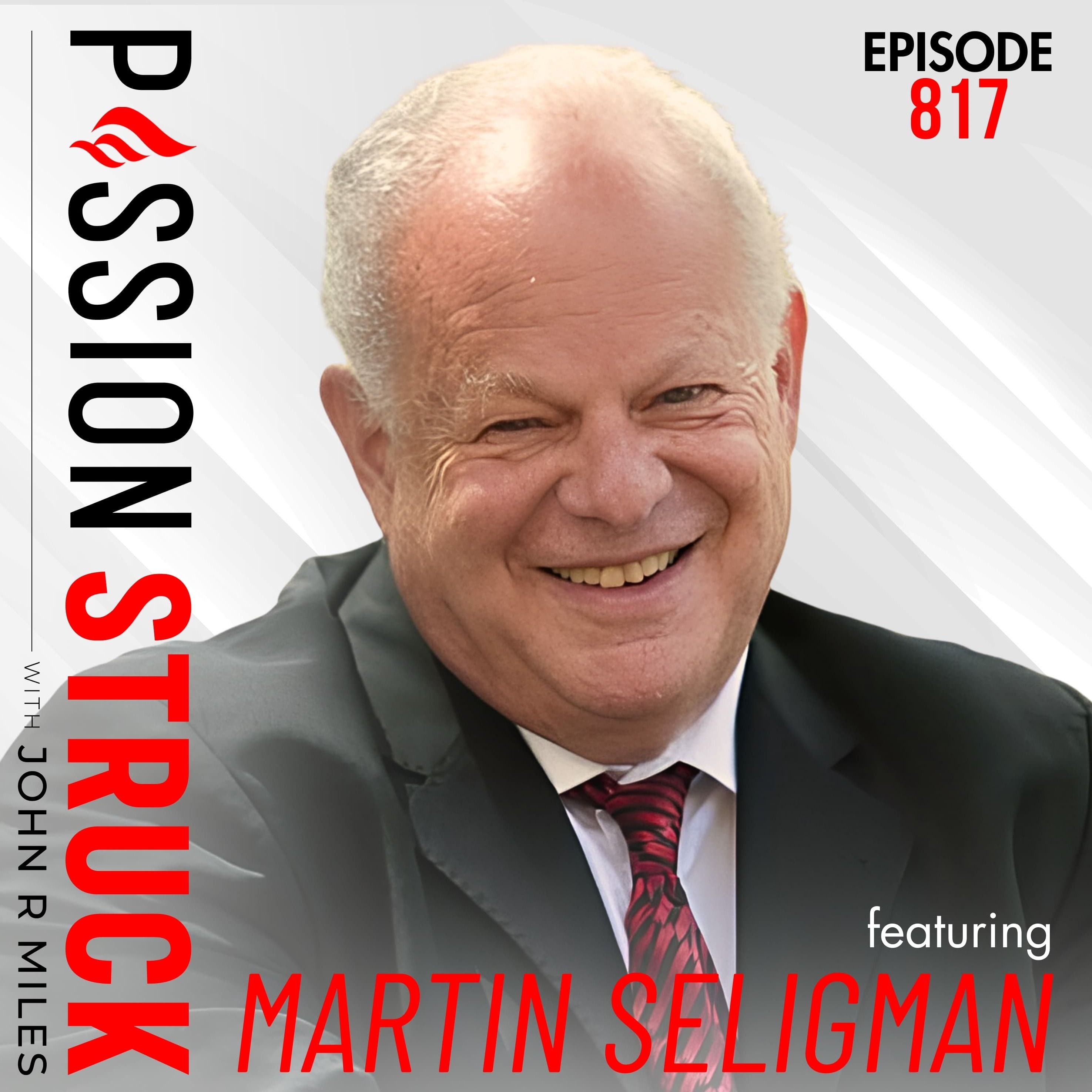
World’s Most Influential Psychologist: The Hidden Force That Drives Human Progress | Dr. Martin Seligman – EP 817
About this episode
Passion Struck with John R. Miles is made possible by:
Have you ever reached a point where you stopped believing that what you do could actually make a difference?
Maybe you tried harder. Maybe you kept showing up. But after enough setbacks, rejection, or disappointment, something inside you started asking, "Why bother?"
Today, John R. Miles sits down with Dr. Martin Seligman, one of the most influential psychologists of our time and a pioneer of positive psychology.
For more than six decades, Seligman has studied learned helplessness, optimism, resilience, and human flourishing. His new book, Agency: The Psychological History of Human Progress, brings that work to a much bigger question: What makes individuals—and entire civilizations—believe they can shape the future?
Seligman explains that agency is built from three capacities: efficacy, optimism, and imagination. Together, they give us the ability not only to believe that we can act but also to envision a future worth acting toward. But this conversation goes far beyond individual psychology.
John and Marty explore what happens when agency becomes collective, why societies need to balance “I can” with “we can,” and how mattering and agency may be connected. Marty argues that our actions begin shaping our sense of self through the responses we receive from other people and the world around us. When our actions repeatedly produce no response, learned helplessness can take hold.
They also take the conversation into the future of AI, education, creativity, and human possibility. Seligman describes how AI is already allowing him to test ideas that once would have taken years to investigate—and why he believes the technology could become an extraordinary amplifier of human agency.
In this episode, you’ll learn:
- Why Seligman believes agency—not just happiness—is central to human flourishing
- How learned helplessness became the foundation for his lifelong study of human agency
- The three psychological capacities that make up agency: efficacy, optimism, and imagination
- Why some people stop acting when their efforts repeatedly fail to produce a response
- How agency and mattering may reinforce one another
- Why the future may depend on balancing “I can” with “we can”
- What ancient civilizations can teach us about the psychology of human progress
- How AI is changing the way Seligman conducts research and thinks about creativity
- Why education may need to shift from teaching children to be “smart” toward character, leadership, kindness, cooperation, and flourishing
- What Seligman hopes his grandchildren—and future generations—will believe about human possibility
This is ultimately a conversation about one of the most important questions we can ask ourselves: Do I believe that what I do can make a difference?
Because agency doesn't mean believing you control everything. It means believing that your actions still matter.
Download the FREE Companion Digital Workbook
Pre-Order The Mattering Effect: https://matteringeffect.com/. Take the 90-second diagnostic to see if you're disappearing.
Explore the Show: https://passionstruck.com/starter-packs/. New to Passion Struck? Start with the best episodes curated for you.
Connect with John
- Website: https://johnrmiles.com
- Book John to Speak: https://johnrmiles.com/speaking/
- Substack: https://www.theignitedlife.net/
- Children’s Book — You Matter, Luma: https://youmatterluma.com/
Support the Movement: https://startmattering.com/. Every human deserves to feel seen, valued, and like they matter. Wear it. Live it. Show it.
Passion Struck — #1 Alternative Health Podcast. 85M+ downloads.
Disclaimer
The Passion Struck podcast is for educational and entertainment purposes only. The views and opinions expressed do not necessarily reflect those of Passion Struck or its affiliates. This podcast is not a substitute for professional medical or psychological advice.
Hosted by Simplecast, an AdsWizz company. See pcm.adswizz.com for information about our collection and use of personal data for advertising.
Get every episode summarized
Each time Passion Struck with John R. Miles publishes, we email you a written briefing from the transcript — the topics, who appeared, and any specific claims, with the ad reads skipped.
Email me new episodesFree for 3 shows. No card needed.
Transcript ready
777 searchable segments. Every word is indexed and playable.
Full transcript
Passion Struck with John R. Miles — World’s Most Influential Psychologist: The Hidden Force That Drives Human Progress | Dr. Martin Seligman – EP 817. Machine-transcribed; use the interactive transcript above to jump the player to any line.
Have you ever reached a point where you stopped believing that anything you did would really make a difference? Maybe you kept trying Maybe you worked harder Maybe you kept showing up, but eventually something inside you started to wonder Why bother? When I asked Dr. Marty Seligman what happens when people lose their sense of agency? His answer went to the heart of more than 60 years of his research. Take a listen Individual action is where things start, but whether or not it modifies the world that is your mastery and agency or it falls flat and your helpless and your non-agentic is crucial to the shaping of the self and to flourishing and in general the more
reciprocity the more our actions produce upward spirals in the world the more agency the more flourishing we have Done and welcome to Passionstruck. I'm so glad you're here whether you're a long-time listener or someone who just discovered the show Thank you for pressing play today Maybe you've built the life you were supposed to want but you've quietly wondered why it still doesn't feel like enough If that's you you're in the right place Every week I sit down with the world's top scientists researchers and thinkers to uncover what it actually takes to build an intentional life that matters Thanks for joining me. Let's get into it You Welcome back to Passionstruck. I'm so glad you're here This is episode 817 and today we're continuing our new series The Adaptive Human
How we thrive in a changing world Over the past two episodes we've been exploring an important question How much control do we really have over the direction of our lives? Angela Duckworth challenged us to think about the power of the situations we're in The people the places and the environments that quietly shape our behavior and Jared Diamond took that question even further asking when individual leaders can actually change the course of history But today we come to the question underneath both of those conversations Do we believe our actions can make a difference? Because there are moments in life when that belief gets tested You try you fail you try again and eventually especially when nothing seems to change It's so easy to begin asking yourself why bother That's exactly why I wanted to have this conversation with Dr. Marty Siligman Marty is one of the most influential psychologists of our time and one of the pioneers positive psychology
For more than 60 years his work has explored helplessness Optimism flourishing and one of the most important ideas we'll discuss today agency In his new book agency Marty explores what happens when people Organizations and even entire societies lose the belief that their actions can shape what comes next And what it takes to reclaim it In this conversation we talk about why learned helplessness is about more than simply giving up Why agency begins with action? How hope differs from optimism and why the way the world responds to our actions Help shape our sense of who we are But here's what stayed with me long after we finished recording This wasn't just a conversation about psychology Was a conversation about what happens when we stop believing that we matter to the world around us Because agency requires more than action Somewhere along the way we have to believe that what we do can create a response
That our choices can influence something beyond ourselves And when we lose that belief It's not just our motivation that disappears Our sense of possibility can disappear with it I think that's a conversation that all of us need right now So let's dive into it Here's my conversation with Dr. Marty Siligman Thank you for choosing PassionStruck And choosing me to be your host and guide in your journey To creating an intentional life that matters Now let that journey begin I am absolutely honored and thrilled to welcome Professor Martin Siligman on PassionStruck Marty it is such an honor to have you on this show Oh thank you John, I'm happy to be here Marty you probably don't even realize this But PassionStruck has been in many ways completely built on your work And I heard you recently on the Happiness Lab talking to Laurie Santos
And she also mentioned that the Happiness Lab wouldn't exist without your work The same thing goes with PassionStruck Because this whole podcast really goes into human flourishing And I've tried to take the lessons I've learned from you And explore this every single way I possibly can Because I think today so many people are struggling with living their life in a flourishing way Have you found that to be the case as well? Indeed that's the theme of my last 40 years of work I think if I did anything I ushered in a new psychological age Of looking at what was going right flourishing as opposed to looking at what was going wrong And trying to correct it So I think that's the examination flourishing as opposed to the examination of apology
Has been the theme of the last 40 years of my work I, today we're going to be discussing your brand new book which I have to say is incredible It's titled Agency the Psychological History of Human Progress And I want to start out here Your career began with a simple but a really profound question If helplessness can be learned Can hope be learned too Looking back now, was there a moment you first encountered what you now call agency What surprises me about the trajectory of my work is how long it took me to realize That I was not working on pessimism helplessness and hopelessness But I was really working on the opposite which is human agency And the new book agency is the culmination of 60 years of work
And how I realized that the human future and the individual future for us is not Correcting our weaknesses But finding out what we're good at and building flourishing on what we're good at You write that psychology in the 1960s Suffered from free blind spots that you saw at the time Happiness, freedom and thinking itself Which of those blind spots do you still think shapes our culture most powerfully today I think psychology has changed to work on happiness, freedom and cognition But I think in many ways our society is still stuck on misery On a lack of freedom constraints And I do think we take cognition seriously for a change
So the behaviorism that existed in the 50s and 60s I think is gone from psychology And I think it's also gone from the society as a whole So I think we take mental life And what we're feeling and thinking seriously Both in society generally and in psychology finally Marty the book opens up with the story of a woman named Susan And it's a deeply personal story for you and obviously has affected you for decades And when I was reading her story it reminded me of my own mentor a woman named Wendy Lawrence Who was my physics instructor when I was at the Naval Academy and Wendy became the first female astronaut from the Naval Academy And she and I as we've had conversations over the years Her central message to children today and it's been this way for decades
Is that to oftentimes the first time they run into any hardship Instead of trying harder They give up And it's something that you have studied as well When did you realize that learned helplessness Wasn't simply an individual phenomenon But something entire institutions Cultures even civilizations can experience It took me a long time John so as a psychologist What I worked on was individual helplessness First helplessness in animals And then helplessness in individual human being The book opens with someone named Susan Who's actually a collage of two seasons That I brilliant students of mine that I had in my very first job teaching at Cornell And both of them when I gave them a really difficult
Research problem Their reaction was to Give up and I can't do it And they both turned out to be success stories One went on to become the editor of the Journal of Animal Psychology The other one went on to become the president of the American Psychological Association Wow so a lot of my mentoring of them had to do with breaking up individual helplessness My thinking about individuals really went on for almost 40 years And it began to dawn on me First that I wasn't really working on helplessness I was working on mastery and agency I was working on the opposite But white psychology was all about was about pathology And what getting grants was all about was curing pathology So it took me almost 40 years to realize
That I was not working on pathology but it's opposite on flourishing and growth The question of society as a whole of human history Was a new one for me starting maybe 25 years ago Mandy and I have seven children And we've homeschooled them Mandy felt that I was incompetent for teaching psychology So I got consigned to teaching history Okay, I never taught history before And so I started to teach and taught five of our children American history And it was reading American history starting 25 years ago That I began to think about helplessness, hopelessness And agency as a historical societal situation
And not just an individual situation So I think it started with teaching my children about the history of the world And which I had to begin to learn myself This whole topic is so interesting to me because as I have leaned more into the research And what's happening in the world I keep looking at the challenges that we're facing in society as more systemic in nature So in order to fix some of the upcoming things that are going to need to be fixed We're going to need overall systems change to happen And so I think what you were discovering with learned helplessness long before me I am now leaning into more and more On the changes that need to become part of civilization on a greater level Marty as I told you earlier by podcast is built on the foundations of positive psychology
And your permamodel has been one of the frameworks I've returned to over the years Over the course of this podcast I've had the opportunity to interview and get to know many of the people In your intellectual orbit people like Rebecca Goldstein Barry Schwartz David Yaden And Gabriella Kellerman have all been on the show And one thing that fascinates me Was your collaboration in 2019 with Rebecca Roy Bimostor Barry David Gabriella and others On mattering and significance Where I'm going with this is when you first introduced karma Meaning occupied a central place in flourishing But later in your work The conversation has seemed to expand towards mattering When did you come to understand that flourishing And meaning alone couldn't fully capture
The M in the permamodel and that mattering needed to take on a bigger role in the model Meaning has always bothered me It's a pointy headed to be the kind of discussions I had with my roommates when I was in college Around meaning But if I ask you John how meaningful is this conversation That for me is a real head scratcher I don't have a good handle on meaning Even though there is a very substantial literature That when people feel a sense of meaning They're more productive and they're happier But the problem for me was its intellectual pointy-headedness About seven years ago Gabriella Kellerman and I with better up Called together a meeting of about ten of us To ask the question about mattering Is mattering a better notion
And what we found both in our meeting and then our subsequent research That if I asked you John how much do you matter to your family If you disappeared tomorrow Thanish what would happen to your family How much do you matter to passion struck would it keep going People had a very good handle on how much they matter They could talk about it articulately and they could rate it on a one to seven scale For their family for their work and for the world And so for me the fact that mattering Was a psychologically more accessible notion than meaning Has led me to work on M In perma being much more measurable about a mattering And I think we know more about how
To change mattering than we do to change meaning It's the specificity and accessibility of mattering That converted me away from meaning as a basic psychological notion Thank you for answering that I have a couple follow-ons from it I have really been putting a lot of my intention recently in studying reciprocity And I've had some really intriguing conversations With people you would know like Claude Steele, Harry Reese, on you Libra Meresky And others on this topic and One thing I wanted to ask you about it when you think about reciprocity I kept wondering whether agency and mattering are reciprocal forces What is your thought on that? I think the crucial thing is our in perma Which is other people in that relationships matter
And that so much of what we Know about flourishing has to do with other people So I don't think the individual is a fertile ground for Happiness for perma or for accomplishment and we are social creatures And if there was one thing I had to say about flourishing that I'm certain of Is that anything that makes us happy That increases flourishing if it's done with someone else It multiplies it So what Chris Peterson said about the heart of positive psychology being Other people matter is for me what reciprocity is about I want to ask this to you a little bit differently because I understand where you're going I was trying to ask Do we first believe we met matter and therefore we act or do we
Act and discover that we matter after our actions Well, I think in development we act And the way we learn what we are and who we are Has to do with other people in the world's reactions to our acting So I think individual action is where things start But whether or not it modifies the world That is you have mastery and agency or it falls flat and your helpless and your non-agentic Is crucial to the shaping of the self and to flourishing and in general the more reciprocity the more our actions produce Upward spirals in the world the more agency the more flourishing we have
The world doesn't react and people don't react that's exactly learned helplessness We'll be right back with more of my conversation with dr. Marty Selegman As you're listening today, I want you to sit with one question Where in your life have you started to believe that your actions won't make a difference One of the most powerful ideas in this conversation is that agency doesn't begin when we're certain will succeed It begins when we act and when we learn Through our relationship with the world around us that our actions can create a response That idea Connects deeply with the research behind my upcoming book the matter and effect coming this October Because one of the questions I've been exploring is what happens when people begin to feel that their contributions don't matter That they can speak and not be heard act and not make a difference And show up and still feel invisible
Over time those experiences can change not only how we see the world But how much we believe we're capable of influencing it If you'd like to go deeper into these ideas you'll find a companion workbook Inside the ignited life on substack designed to help you put these conversations into practice You'll find the links in today's show notes Now a quick break for today's sponsors. Thank you for supporting those who support the show You're listening to PassionStruck on the PassionStruck Network now. Let's get back to my conversation with dr. Marty Selegman So Marty about 15 years ago I Took a 34-week class on the Bible called discipleship one and I had always I grew up Catholic. I had always grown up around the Bible But I had found that I had never really studied it end to end and that's what this course I was aimed to do
And during this course I started To get this subliminal messaging. I feel it came from God himself That I was supposed to make a major career change and that the words I was given was that I was supposed to help the helpless The lonely the hopeless the disengaged the burned out etc and for years I studied and pondered and couldn't sleep because It seemed to me to be such a broad collection of people I was supposed to help and as I leaned into this more and more One of my central arguments that I started coming to and you've brought up loneliness and helpless now a bunch of times And this is a central argument that's in my forthcoming book and before we came on today you asked me about something that I call The Great Erasure but the greater erasure to me is that I have
Become more and more convinced that loneliness helplessness burn out disengagement hopelessness may not be separate epidemics But symptoms of something deeper and there's something deeper something I've been exploring with Rebecca Goldstein And I've called it systemic unmaidering And what I define this as is the erosion of people's sense That they are consequential within the groups And the institutions that organize their lives so school their families work environments could be the military From everything that you've learned over the past decades about helplessness flourishing loneliness and now agency Does a society lose agency when people stop believing that they matter to one another? The short answer is yes, but I want to go back and resonate with you about epiphanies in your life
Changing one's career Because I had one too That without dissimilar from yours. So let me just tell you the story John of one of the major changes in my thinking and my life Which may have paralleled yours and generally I've had Several different careers and almost each major change revolved around the epiphany But the first big one was in the early 1970s. I was a young became a well-known researcher and got 10 year very early in my wife from the 1970s And my mentor was someone named Aaron Beck and Tim Beck and I Worked together and I was at least present at the founding of cognitive behavioral therapy But the story I want to tell you John is the epiphany story
So Tim and I would meet once a week for lunch. I was now a tenured professor of pen He was a tenured professor of psychiatry 25 years older than me and we're having lunch together and he says to me Marty if you keep doing what you're doing you're gonna waste your life now I choked on bike grilled rubin and I thought I was being pretty successful and Tim was the most congenial generous person. It was the first cruel thing he ever said to me About two weeks later I had a dream which changed everything In the dream John I'm walking I'm at the Guggenheim Museum and I'm walking up the ramp in the Guggenheim Museum I don't know if you know the museum I do it's been yours since I've been there but I yes And I opening doors on the right hand side and in each room there are people playing with cards
And so I say I ask why is everyone playing with cards We're upon the roof of the Guggenheim opens and the godhead appears and the god I saw actually had a white beard Very biblical and in a loud voice Said selling men at least you're starting to ask the right questions Well that changed my life. I went from working on helplessness individual pathology to working on people and hopelesses and flourishing Like you I felt cold to my work and Indeed has changed my work I just wanted to start by saying the background here for me has been a science change by epiphany
It's eerily similar how much our two stories are separated by years but have A lot of hominality in them because the version of god that appeared to me was a very similar individual who kept showing up and still shows up in my dreams guiding me In general with my Map students. So map is the core citation for pretty much adults people your age Masters of applied positive psychology and I have get 50 new students every year at the graduate level and I ask them Are you where you called to be here and these are successful smart adults doing well in the world and about 80% of them echo what you and I are saying that they've been called to this work on flourishing
So it's a mysterious phenomenon for me, but it's close to universal among the people I work with Having been called to their work. Have a vocation and not just a career Marty, I wanted to return to the second part of that epiphany that I Was telling you about and that is When you look at all these things that are plaguing society today The number of people who feel burned out the number of people who Increasingly report feeling numb The disengaged workers we have the rise and people who feel helpless The people who feel invisible Do you think there's something that sits At the core that is creating all these what I think are symptoms to emerge By coincidence this is what I've been working on for the last week or so So I'm first trying to find out is it true
Now for me that means we don't have questionnaires over Bless 100 years about agency about optimism and about hope So what I've been doing with AI with Claude and chat gpt is assembling a vast Data source magazine articles books speeches scholarly commentary literally hundreds of millions of words And I scan them for agency for optimism and for hope because I now have mechanical ways of using AI to read whole passages and to make judgments about optimism agency and hope and so far as of this morning john I have not found much of a change
Across the last two years in American rhetoric speeches songs novels In hope and agency So the first thing I want to say is that I'm not convinced that we're in the middle of an enomic period in which people are feeling more helpless less agentic and more pessimistic Before I can begin to answer the question of why What I've been trying to do is document whether or not it is actually true So I started where you were which is my impression from reading the newspapers and the Depression statistics are that depression has gone up And anxiety has gone up in America But so far I've not been able to find that agency has gone down
And that pessimism has gone up The big fact is depression is up Now the question is why and I've always been interested in the history of depression I did a horse race recently between john heights theory And you're in my theory Okay, so I started with the theory which is very much like yours that agency mattering helplessness of all going up and that's why depression is going up And I think that's where we're both starting from John height has a very different view He says it's the social media And that the participating in the social media particularly with girls females and with young people Is the cause of more depression Because I've got a lot of data both on depression going up
And a lot of data on agency Changes helplessness changes over time What I did is created a statistical horse race Between the increase in young people using social media And the increase in agency as predictors of more depression Says it clear what I was after year So what I found was that john won That once you canceled out the increase in social media statistically The changes in agency were no longer predictive of depression So I wrote john about three weeks ago I said in terms of john it looks like you're right here And that social media are having more of an effect on depression particularly in young females Than any changes in agency and helplessness So I've been disconfirming what both you and I
Intuitively believe that we're seeing an increase in Decrease in mattering a decrease in agency and a decrease in optimism That those are the causes of more depression and anxiety So as of June 30th that's where I am statistically about this That's fascinating it obviously the court cases that have happened in new Mexico and Los Angeles with YouTube and meta Have really opened the ideas of How damaging this can be in addition to what john has written and others have talked about with social media I guess what I keep coming back to is that might explain this for this next generation that's been coming up But it's still not explaining it to me for the adults Who are also feeling this way and so And a a i john has put us in a new world in which we can actually check our speculations
So I started out believing exactly what you believe That the increase in depression has to do with a decrease in agency And I was actually repelled because I'm a great fan of AI in the media I was repelled by john's notion that it was The social media that was causal here 10 years ago you and I could speculate forever about this But right now because of the analytic power of Claude of chat gpt I can with it a day Statistically check whether or not you and I were right or john was right about the increase in depression So one new age wherein is the kind of psychological speculations and bias is that you and I share We can actually check and in this case for me disconfirmed Marty I want to take us back to the book
I had the unusual privilege of reading both an earlier version of the manuscript which I received several months ago And more recently a different and updated draft And what struck me was that the later version as I was reading it to place as much greater emphasis on collective agency And on the balance between quote unquote I can and we can and on meaning relationships And contribution as foundations for progress What changed in your own thinking between that earlier draft and this newer draft if I'm reading these two drafts correctly There were two big changes and let me start with the one that I think is a major discovery And then terms of the question of individual versus collective So what I do in a lot of the book is to go back to one of the great mysteries of human history
Then I think I solved a mystery And let me tell you what the mystery is and that's what's in the version that you would see Recently the mystery is that something big Happened across the globe between 1,000 BCE and 500 BCE Now it's called historically the axial age and Basically the portrait is if you look at the Hebrews the Greeks the Chinese the Persians the Indians 1,000 BCE No progress no technology limited thinking no medicine Very little progress in the arts and literature no political freedom 5,000 BCE in the 500 year stretch
There appears Progress technology villages become cities Money is coined political freedom breaks out and the great thinkers like Buddha and the Socrates and the Confucius all occur The question is why did human progress break out Between 1,000 BCE and 500 BCE and this has been a mystery for all historians of the ancient world So I had the hypothesis that maybe in these five civilizations 1,000 BCE they did not have the words for agency They did not have words like I can do it and we can do it and human ability And that their words were all about the gods doing things
But in the 500 years in all five of those civilizations They invent new words of a form agency I can do it we can do it Now I never could have tested that in my lifetime So but cloth and chat gpt contested Because unlike any human being they are fluent in ancient aromatic ancient Hebrew ancient Greece ancient Persian ancient Sanskrit And the vocabulary 500 years later And so I turned to them and it turns out in every culture New words are invented they don't have the words for agency 3000 years ago But by 2500 all of these cultures have Agentic words and what we basically discovered it's the invention of new
words That produces Human progress and that in many ways is the theme of the new book So that's part one John of what's new it's about what all of the ancients across the world Discover in this 500 year period Now the second thing that's in the book that you raise is the difference between I can do it and we can do it between individual agency and collective agency So when I wrote the history of Western progress It's essentially a story of a growth in individual agency But then I began to work with the leading Chinese scholars about the history of China and the history of China Looks very much like the history of the west in that when agency Goes up progress occurs when the belief in agency goes down
stagnation occurs, but the difference is in China It's the balance between I agency and we agency So for China when I agency is crushed by we agency Over and now we've done it for all of the history of China. That's when Technology freedom For all stagnate, but when there's a balance between I agency and we agency That's when you get progress So when I think about our future, I think there's a lesson from China So mostly the west has been about I can do it individual agency But I think the role of collective agency Has become more and more important and our future may have more to do with the balance between I agency
And we agency as in the history of China I often think of it as the difference between either or thinking versus both and thinking and how differently the west approaches Problem solving versus how the east So does problem solving which I think touches on what you were just saying But I do have to say one thing about it which is one of the things about being an academic for 60 years So I've been attending faculty meetings for 60 years And basically what they do is form a committee to solve problems We agency and I must say in my individual experience over 60 years The collective faculty meeting is a poorer problem solver than individual So one of my worries about collective agency is the mediocritizing of agency
And so that's something that I think we have to worry about As we seem to have in America now according to my statistics A growth in collective agency And one more question about it So as I plot modern America and this is tentative That when individual agency goes up Productivity goes up GDP goes up But depression also goes up If you plot collective agency GDP goes down Patents go down Productivity goes down But depression goes down as well So there's a way in which the collective Makes us feel happier and more consoled But it may interfere with progress Whereas progress may be individual
And it may bring about depression and anxiety So those are the very topics that as we speak on trying to analyze carefully about modern I guess I want to ask this more directly So what you're analyzing is do hopeful people build flourishing societies Or do flourishing societies give people permission to hope Is that one of the fundamental questions you're trying to answer I think what I'm tackling Is that flourishing has different aspects and progress has different aspects So on the one hand we can care about human happiness How we feel the P in perma how much depression we have On the other hand, we can care about the A in perma which is a accomplishment Now I would have liked to believe that P and A go together
And that the forces of that produce more accomplishment produce more happiness and well-being So one of the things that really concerns me Today John is that productivity accomplishment Is differently engendered than happiness and well-being So at the moment what I'm trying to analyze for and is one of the themes in the book is that collective agency produces more Felt happiness less depression and less anxiety but it also is tied up with less accomplishment And when you've got a highly individualistic society A capitalistic society that's based on I rather than we Then you make it more
GDP more productivity more patents But at the expense of more depression and anxiety So I want to fractionate perma Into what are the different drivers of P or M and A And I'm worried at the moment John that P positive emotion And A accomplishment may have different antagonistic drivers Marty what do you think happens when collective agency becomes conformity worth authoritarianism in its approach I think that's the lesson of China So when we look at the balance between we agency and I agency in China When collective agency is very high It mediocratizes and squashes individual agency
But on the other hand I think when individual agency is very high It squashes the benefits of collective agency And that's what occurs in China And we don't know about the West for that and indeed What I'm working on as we speak is the importance of collective versus individual agency Now in America and also across history in the West And you are doing some extremely deep thinking As you and I were coming on the podcast you were talking about how Much AI has opened up research portals to you that didn't exist in the past How have has AI helped you Rethink in addition to the example that you gave about John Heitz research Your own thinking on so many of the things that you've been studying for decades
And what do you think are Its potential harms in the future and what do you think it's overwhelming benefits maybe Let me tell you the story of what happened the day before yesterday So there was this lovely article in the New York Times Which said that the reduced fertility rate in America is producing depression And that's because the more siblings you have Less depression will occur because you've got siblings who will take care of you Who will babies hit who you can learn from That's a beautiful idea So I thought I would check it with AI Now Ten years ago There was no way of checking this it would have taken me a full year To go back Over the century Look at the number of siblings look at the amount of depression and anxiety and plot them together
But Them yesterday morning I was able to go to Claude and say Claude give me the Fam sibling size and the rate of depression over time And isn't the case that the more siblings you have the less depressed you are Whoosh One minute later I have a complete statistics and the answer is no There's no difference in depression by number of siblings So then I said to Claude well how about is it could it be that there's more depression as this author states Because your mother goes to work and doesn't take care of you So what's the relationship between depression and children and full-time mother working Is it that the mother working produces more depression whoosh
No relationship between mother employment full-time and depression So basically when the course of a morning Actually when the course of about an hour I was able to disconfirm this lovely article in the New York Times Which I would have sent a mentally said oh it's great to have a lot of kids And it's great to have your mother at home Because then you'll be less depressed She was wrong and I never could have found that out without a year's work on my part So that's one way in which the AI is a Agentsic for me in a way that's never been before The other has to do with the question and this is the big one is AI creative Well, that's for really I work on creativity and that's really interesting for me
There are essentially two theories of what the unit of creativity is Well, one is the usual Michelangelo theory that the brow of Zeus Michael one brain Creating a David I don't think AI is creative in that sense But there's second theory is that the creativity is two people Going back and forth the right brothers McCartney and Lenin Dalin Sheenant Farrell correcting each other Now that's the sense of which I interact with AI So the story I told about discovering new words I have the hypothesis that there were new words that the ancients discover about agency I asked for it and chat And they were able to answer it going back and forth with me
That's the kind of creativity That AI has It's the best Companion I've ever had and just one last example of this John It's the book you've read Chapter eight of Agency is about the Chinese and agency in China Chapter nine is about the Hebrews and the Bible and agency So I'd written the book that this is a draft you saw and my editors said Marty There's no transition between chapter eight and chapter nine Well, I've been staring at these chapters for Five years and I didn't write so I went to clout and said clout please read chapter eight on the Chinese And chapter nine on the Hebrews and the Bible and write me a one paragraph Transition and here's what clout wrote while the Chinese were struggling
With the relationship between the state and the individual The Hebrews across the globe at the same time were wrestling with a much deeper question The relationship of individual agency to God's agents Well, that's exactly right I hadn't seen that in five years and clout sought creatively on a rereading The bottom line of this story and I'm enacting it every day of my life now is that an ascent of creativity Going back and forth With another person Go a human being going back and forth with ALI now produces an enhancement of agency unlike Any agency I've ever had before in my life's work Marty I have two questions where I wanted you to apply this book to
modern environments that We find ourselves in If you were redesigning education around agency rather than performance What would schools teach differently in the future? Oh, that's very important the You and ALI John you at the Naval Academy me at graduate school We were trying to be the smartest kid in the room And in many ways we were both raised and raised our children to be smart Well, is that what education should be about being smart? How much you know uh, well it turns out We can never be the smartest kid in the room anymore AI is so much smarter and more knowledgeable than we are AI levels the playing field about knowledge about IQ about being smart
So what should we be teaching our children and what should education at the Naval Academy at the University of Pennsylvania in grade school be about? I think it has to turn now on questions like character Well-being leadership kindness cooperation and not how smart you are For me the machines level playing field and are going to transform education To be what I think of as positive education about flourish and not education about being clever I Couldn't agree with you more. I love that answer the second question I wanted to ask is Parents today often oscillate between over protection and achievement pressure Which of those poses the greater threat to developing agency in their kids?
They both have an upside and a downside Over protection Means your kids are going to be safe But will they be resilient? How will they do when they out in the real world when they come across events that are uncontrollable? On the other hand teaching kids about achievement and resilience and overcoming runs the risk of danger of failure of death And I don't have a good answer about the balance between over protection versus over achievement Mandy and I have raised our children. She's an over protection person. I'm an over achievement person We compromise But she already wanted two kids and I wanted no kids and we compromise on five
Ha Marty my last question is this we began our discussion and you began Your career by asking whether helplessness could be learned This book asks whether agency built civilizations and you dedicate this book To two of your grandchildren When your grandchildren grow up and inherit the world That we're creating today. What is one belief about human possibility You most hope they carry forward I think it's a strong belief in progress That the human story Has been a story of progress Just the fact that my grandchildren are alive at age four 200 years ago one out of two of them would have been dead Yes, we often hear the notion That there's been no progress and that progress is not an important human value
So when I want my grandchildren To believe and to be part of Is the growth of human progress Not just technological progress John but spiritual progress as well Marty it has been such a profound honor to have you on the show today and thank you for the amazing contributions that you have made to so many people over the years Including myself. I am so thankful to finally Interview you and I do have to say I had the opportunity to Talk to Angela Duckworth last week and every time I talked to her and she talks about you all the time She always refers to you as her second father And so one of the things I thought was so fitting is that your two books are both coming out in September One week after the other and I thought that was just an amazing coincidence So I will end there and just tell the listeners that I love this book and I read the first version end end and then I read the second version end to end and I think
Maybe the best book that you've ever Marty and that says a lot so thank you so much for joining us today Thank you, John Hope today's conversation gave you something to think about For me one of the biggest takeaways is that agency begins with a simple but powerful belief What I do can make a difference That doesn't mean we control everything we don't But we can choose to act we can choose to respond And over time those actions help shape both the world around us and the person we're becoming If something from today's conversation resonated with you, I'd love to hear about it Send me a message on substack linkedin or instagram or share this episode with someone who may need a reminder That their actions still matter and if you haven't already make sure you're following passion structs So you don't miss what's coming next because in our next episode. I'm joined by best-selling author David Epstein You probably know David from his best-selling book range We made the case that broad experiences can help prepare us for an unpredictable world
But his new book inside the box asks the question that naturally comes next Once you developed all those capabilities, how do you actually channel them into something meaningful We talk about why more options don't always lead to more progress Why boundaries can sometimes create freedom and how to focus your energy when the world keeps giving you more things to pay attention to and I think it creates the perfect next question for this series Agency gives us the belief that we can act adaptability helps us learn where to direct that action I think you're going to love this conversation. I actually think the gap between the mentally of myth and reality Is symbolic of something important Which is that we overvalue the complete freedom of something like the dreaming brain and undervalue to power of constraints to channel us into productive experimentation I think most breakthroughs do With a much smaller problem that opened into something that changed the world Until then remember you don't have to control everything that happens next influence what happens next
Sometimes it starts with simply believing that what you do can make a difference I'm John Miles and as always stay curious stay intentional And stay passion struck You
More episodes
More from Passion Struck with John R. Miles

You Are Not the Only Variable: When to Change Yourself and When to Change Your E...
Passion Struck with John R. Miles

World-Renowned Historian: When Leaders Actually Change History | Jared Diamond -...
Passion Struck with John R. Miles

World-Leading Psychologist: How to Change Your Life by Changing What’s Around Yo...
Passion Struck with John R. Miles

How to Stop Feeling Like You’re Never Doing Enough | Caleb Campbell - EP 813
Passion Struck with John R. Miles