About this episode
Each house in the New York State legislature released its budget proposal, and both called for raising taxes on wealthy New Yorkers. Jimmy Vielkind, New York State Issues reporter for WNYC, reports on how that will affect negotiations, since Governor Hochul is firmly against a tax hike, and other issues in the assembly's and senate's proposals.
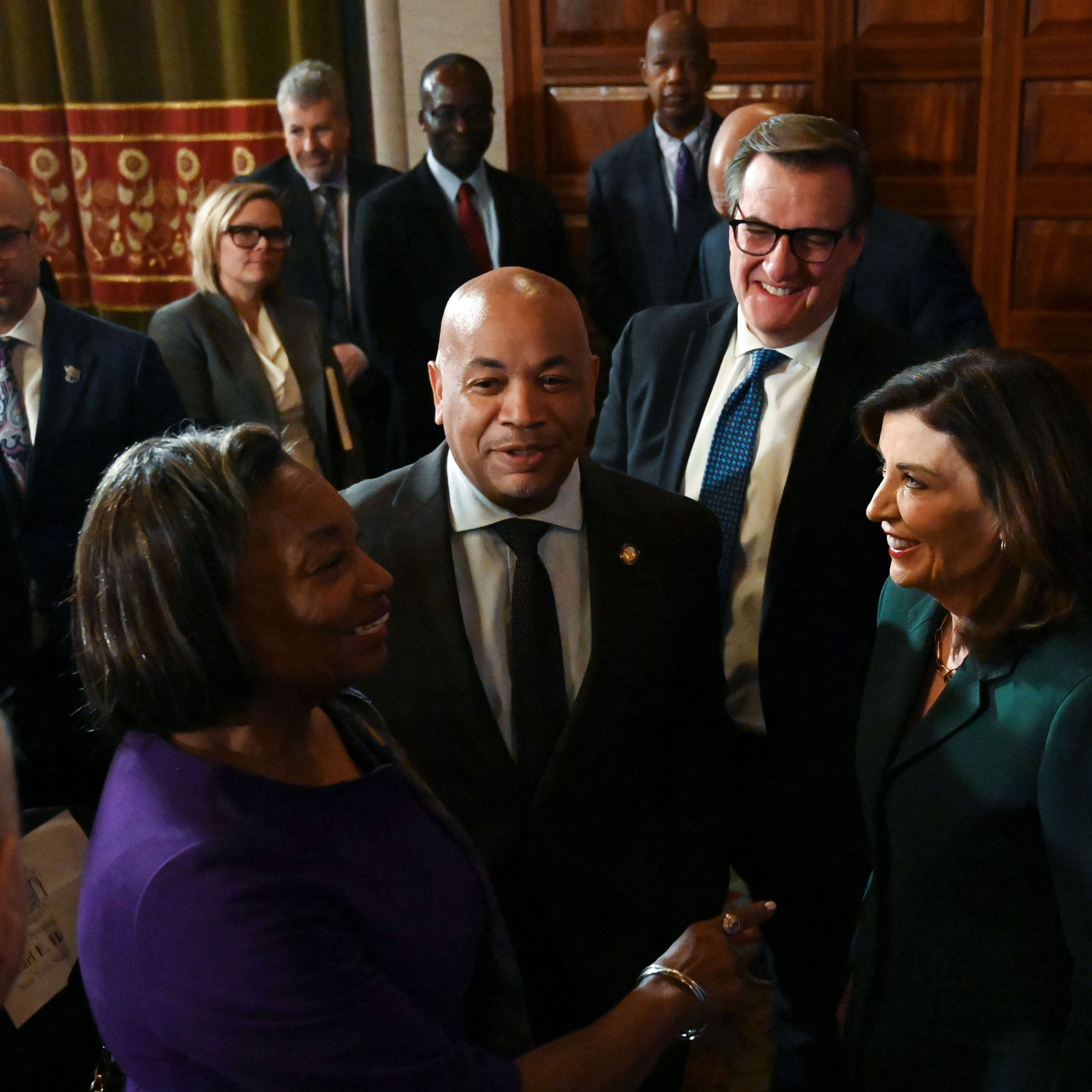
Photo: Senate Majority Leader Andrea Stewart-Cousins, left, and Speaker Carl Heastie, center, meet with Gov. Kathy Hochul, right, following a presentation of Gov. Hochul's executive budget proposal on Tuesday, Jan. 20, 2026, at the Capitol in Albany, N.Y. (Will Waldron/Albany Times Union via Getty Images).
Hosted by Simplecast, an AdsWizz company. See pcm.adswizz.com for information about our collection and use of personal data for advertising.
Get every episode summarized
Each time The Brian Lehrer Show publishes, we email you a written briefing from the transcript — the topics, who appeared, and any specific claims, with the ad reads skipped.
Email me new episodesFree for 3 shows. No card needed.
Hosts & guests
Transcript ready
332 searchable segments. Every word is indexed and playable.
Full transcript
The Brian Lehrer Show — Albany Budget Negotiations in Full Swing. Machine-transcribed; use the interactive transcript above to jump the player to any line.
So the New York State Budget Debate got even more interesting this week when both leaders of the legislature came out in favor of Mail Mom Donnie's tax height proposals for the wealthiest corporations and individuals. Have you heard that yet? But Governor Hoke will remain supposed. So we'll hear the arguments and the politics now from our Albany reporter Jimmy Veelkind and we'll also ask is it okay for a judge to call the defendant an animal? That's a question in Albany now too. Hey Jimmy, how you doing? Good Brian. So the big headline here is that the legislature is taking Mom Donnie's side on raising taxes. The mayor's proposed raising income taxes on those making a million or more a year by two percentage points and raising the top
top corporate tax rate from seven and a quarter percent to eleven and a half. How close are the assembly and senate proposals to Mayor Mom Donnie's? Well the assembly and senate came in a little lower than what Mom Donnie had been seeking. He wants to raise taxes for New Yorkers reporting a million dollars or more and the state senate assembly came in setting that bottom threshold at five million dollars. I think that they've also put forward a corporate tax increase that's a little less than what the mayor was hoping for but the sum total effect is the same. Mom Donnie is grappling with a five point four billion dollar deficit in the city budget. He's asking state lawmakers to step up to help him fill that gap. He wants to raise taxes on the rich and on corporations to fill that gap and by and large the senate and assembly have backed up that position. So state senate majority leader Andreas Stewart Cousins and assembly speaker Carl Hastie are who we're talking about. They've
both been vocal about the need for new revenue. Here is Speaker Hastie framing the legislature's priorities like this. The end is justified to mean so looking forward to getting involved in this discussion. It's not so much about taxes or which taxes you know do we have enough money or what we have enough money to take care of all of the priorities that we have across the state. So Hastie sounds in that clip committed to the outcome but not necessarily the specific mechanism. Does that signal that there's room for local to offer something short of the millionaires tax and still get a deal done? I think that's a very astute lesson, Brian. I came to roughly the same analysis and I think it's important context for listeners to know that the senate and assembly for years have put tax increases in their one house budget resolutions. Now these resolutions
which were formally adopted yesterday they don't mean anything. They are essentially statements of priorities, statements of principles that really inform the final stretch of talks which includes the governor and both Hastie and Stewart Cousins. Liz Krueger who's a top Democrat in the state senate on the finance committee said that the one house is quote our hopes and dreams for what we can get to by April 1st which is the budget deadline. But you know she in the next breath said that we know we usually don't get there but we like to try. So yes Hastie and Stewart Cousins have both been very focused on saying they will deliver for the mayor what he needs to balance his budget. They have not said unequivocally that they will raise taxes and I think the big question is how much backbone they're going to put into this at the negotiating table with governor Hocal. Right well there is some backbone coming from progressive members of the legislature here for
example is state senator Michelle Hinchey from the Hudson Valley. We have to level the playing field. We need to make sure that the people who got tax breaks under Trump are paying their fair share to our community. So how much are people like Hinchey pressuring Carl Hastie and Andrea Stewart Cousins not just Hocal. You know they are pressuring but this is a balancing game and the leaders are in a position of power. The other thing to remember Brian is that this budget is already increasing between seven and nine billion dollars from the current year's budget. Now part of that is to make up for the loss of some federal funding but part of it is and we've talked about this before Wall Street had a really good year in 2025 and when Wall Street does well it's people get bonuses and those bonuses are taxed pretty heavily by both the city and state of New York. So there is extra revenue to play with. Now governor Hocal has already committed 1.5
billion dollars to help ease that budget gap that mom Donnie is dealing with and we know she's also committed to invest some of the early funding for extending the 3k program to two year olds setting up so-called two care in neighbors hoods around the city in the fall. So Hastie and Stewart Cousins have to deal with pressure from progressive numbers but at the same time they have to get through Hocal. This is not Buenos Aires. This is Albany. It does not take two to 10 go here. It takes three and if you don't have governor Hocal on board you're nowhere. And here's part of how the governor has pushed back with this classic argument about the effects of raising taxes. I have to look at the fact that we are in competition with other states who have less of a tax burden on their corporations and their individuals and I would say remote work changed everything. There are people who could only work in an office in Manhattan and work in New York State and
they were captives to our state they were going to stay. We've saw that that's not the case. But how does that argument hold up? You know we've done a number of segments on that particular question from multiple points of view. I don't know if you've done independent reporting on it but you know one could argue the remote work boom was a few years ago not as much now so not as easy to locate out of the city if you're working for Wall Street firm that's still on Wall Street. You know one of our one of our guests who was an analyst on this not a partisan said that yeah there are more Wall Street jobs like Goldman Sachs jobs, JP Morgan jobs being created in other cities now but they're also still going up in New York. There's a record number of JP Morgan and Goldman Sachs jobs now in New York compared to the past so how much of a dissincentive is it
really in meaningful terms. I don't know how much you know you feel you can answer the question. You know there are a few data points that people really point to when we talk about raising taxes and when we talk about the potential of taxpayer migration. The first is the raw number of tax filers who report more than a million dollars a year and that's the millionaires in the state and we know that since New York state increased its top income tax rate in 2021 the number of millionaires has gone up and people who advocate raising taxes point to that and they say this is a myth. This is the myth of the migrating millionaire. At the same time people on the political right and opponents of raising taxes will say look at the share of millionaires in the state of New York which is really driven by the five burrows and its surrounding areas and they say that that share of millionaires in the United States relative to other places places like California or Texas or Florida or the Carolinas is decreasing that there is more wealth
moving around. So it's very difficult to perfectly track it. There are obviously some high profile wealthy people who leave and make a big stink but there are other people who come to New York they do well they succeed and they don't move. So I don't have a definitive answer on this Brian. I expect we'll hear collars on both sides of the issue. We hear from officials and analysts on both sides of this issue but you are right in pointing out that there are fewer and fewer lucky individuals who can work from home five days a week in in in 2026 compared to perhaps 2021. And listeners we can take phone calls and texts for Jimmy Vealkind our WNYC and Gothamist Albany reporter to one two four three three WNYC anything on the tax hikes which you know this is getting to be an old debate now we've gone over just on on this show multiple times but now it's coming to a head in Albany the new fiscal year starts April 1st so this is
getting real or other things pertaining to New York state budget negotiations that are kind of getting lost in the sauce because there's so much focus on this question of tax hikes for the wealthiest individuals and corporations two one two four three three WNYC opinions welcome questions welcome to one two four three three nine six nine two and here's a question Jimmy from a listener who texts has the governor said whether she will veto tax increases are there the votes to override a veto you know that is a good question and it's a little bit tricky to do that in the context of the budget process now New York state had it a consolidated executive budget that really came about during the progressive era this is the era of former governor Al Smith and it gives the governor lots of leverage over what can be written into budget bills what can be modified by the legislature and what can't so the legislature can add spending they can increase
the dollar amounts for say you know school funding or aid to hospitals but in terms of writing policy and writing taxes it's not something that can just be done in a budget where there's a veto and an override it's a little bit more complicated for some nuanced legal reasons so that's not a very strong and likely outcome here's a clip of republican minority leader in the senate rob or it who raises a different issue this is kind of an upstate downstate question it just really begs the question how much money the city of New York needs if we're bailing them out and they're still raising taxes and that goes for Buffalo 100 places as well so that's so interesting because what he argues is the rest of the state is bailing out New York City if it allows this kind of tax increase but how does it really work is it old news is it true anymore
what I used to think which is that it's New York City's economy that subsidizes the rest of the state services that is true and that's a point that Mayor Mom Donnie and some of his lieutenants including First Deputy Mayor Dean Fullahan have been making and made when the mayor came to Albany to give budget testimony there was a day when that was not the case when New York City's economy was lagging and its social service needs were soaring and sort of the state and the rest of New York did seem to subsidize a little bit but that hasn't been the case for quite some time so I think that or its comments are interesting in court of two ways and they go to that listener question which is that if you give a big bailout to New York City what are all your other kids going to say what are all the other cities who have fiscal woes going to say why are you helping New York City but not helping other places is interesting that weren't mentioned Buffalo the state's second largest city which has a massive structural budget problem and a new mayor Sean Ryan who's grappling
with it I don't think listeners are particularly attuned to it but the city of Buffalo is getting about 40 million dollars that the governor has put on the table to help it limp through and get its house in order and the other thing that I think is important is to go back to that texting question the question of votes so Democrats do have a two-thirds majority in the state senate and assembly but not by a lot so we can expect Republicans will stand against taxes and I would expect that there are some Democrats maybe they're not particularly vocal but in an election year who don't want to override a veto who don't want to be super out front in raising taxes during an election year so I do think that it is not quite as much of a slam dunk as it may seem in New York City and also even though the polling suggests that it is politically popular in a state well on a state wide basis Tina and Harlem you're on WNYC hello Tina
uh hi Brian how are you doing thanks for kicking my call I am just as sounded on your show the other day I learned that the state tax is millionaires at the same rate as somebody making over 60 thousand dollars it's actually New York City and so we'll parse that difference go ahead did you want to finish that or just or just leave it there with that's kind of mind-blowing statistic like the federal government taxes people at different rates as their incomes get higher why don't we I mean I don't know about corporations yeah Tina thank you yeah Jimmy this this is a thing that came up on the show uh the other day the state has a number of different tax brackets it's fairly progressive I think it's five or seven or nine some fairly large number of different tax brackets that kick in at different income levels but the city tax because
there's a city income tax as well as a state income tax if you make $61,000 you are in the same bracket as somebody who makes infinity um and so the the city's tax brackets are not progressive enough by that accounting and I've seen where the assembly wants to give the city the power to raise its own income taxes the state would have to allow it but is this you know is this a stat what Tina just cited what our guest on yesterday show said that only Brian Lershow listeners know why isn't this being talked about more that the city's share of the income tax is not more progressive than it is well Brian count me as a Brian Lershow listener who just learned that but I I don't file taxes with a New York City income I I live outside of Albany so um but that is that
is inferencing information and you are absolutely right in that part of mayor mom Donnie's ask and part of what has been offered as you said by the state assembly it's just the ability to control its own taxes not to raise taxes on people who live throughout the state not to touch the state income tax rates but just to touch those city rates um mom Donnie's argument is that if you took someone who was reporting more than a million dollars in income or more than five million or more than ten million dollars and you add it just a few more basis points on their tax rate you could generate a lot of money and mom Donnie argues it wouldn't necessarily capture it wouldn't be enough to make somebody leave the counter argument to that is that tax law is very complex the exact place that is counted as your legal residence whether it's New York City or if it's maybe in a state in the Hamptons or West Palm Beach or or wherever people who have multiple residents as like that live that if you don't get counted as being a capital are resident of New
York City then you're not subject to any of that New York City income tax even if you are say someone who's making a lot of money working for a company that is headquartered in New York City and but commuting regularly into New York City so it is a little bit more complicated and the state income tax is a little bit broader based in that it captures income that is earned in the state of New York as opposed to just affecting residents of the city of New York which is how the cities income tax work Henry and Manhattan you're on WNYC hello Henry yes good good morning gentlemen there are more millionaires who live in New York than any other place in the nation and then any other place in the world and the big beautiful bill cut the federal income taxes flash the federal income taxes of the richest people and therefore an increase in their taxes in New York will count as nothing tax the rich Henry thank you very much so you talked before how
the number of about how the number of millionaires in New York continues to increase but decrease as a share of the millionaires in the country generally but to his point about the big beautiful bill quote unquote do they make the argument does the mayor or do the leaders of the legislature make the argument that even these New Yorkers with the million dollars or more year income if this income tax did go up by the two points that the mayor wants that they wouldn't be any worse off then they were a year ago because of the federal income tax cuts in the so-called one beautiful bill one big beautiful bill that the caller is referring to yes they do Henry's argument is something that is very much on the minds of advocates for raising taxes this year and that clip that we played from state senator Michelle Hinchi of the Hudson Valley that was the point she was making she spoke at a pretty big rally in the state capital that brought
almost a thousand people to what's called the million dollar staircase because I guess the time it was built in the 19th century it cost a million dollars which probably got you a lot more granite or excuse me a lot more sandstone carving than it would now but they they're saying that that the wealthiest have gotten relief from the Trump administration and that it's high time to to recapture some of those benefits for the state at a time of reductions to federal aid to New York state particularly in the Medicaid program here's Laura in Manhattan who I think is going to say she makes a lot less than this cutoff that we're talking about but would see her taxes go up under these proposals Laura do I have that right higher on w and 1 c hi no you don't have that right what i'm sorry that's okay what i'm saying is that I from path unretired from passive income I earn over two hundred thousand dollars a year so my taxes would not go up but boy when I pass
I live in a two million dollar apartment when I pass a homeless person on the street I want to cry like why is the city not doing more to help you know low income yeah I mean you just kind of a piece on minimum wage and people not wanting to pay higher minimum wage I can't believe people are working to reach out and I'm not getting tax more for my passive income and I'm actually I'm I'm walking to sorry I'm at a breath walking I'm talking but I'm walking to a yoga class in the middle of the day because we're tired Laura now I understand your point you're saying you make two hundred thousand dollars a year from your investments as a retiree you would voluntarily pay more taxes correct now I worked hard for an entire career so I you know earned this money but I would be happy to pay more in taxes yes Laura thank you so much for your call and listening
as you're walking and calling us while you're walking out on the street no less I love it yeah we've gotten calls Jimmy from people riding bikes and listening on their bike radios and calling on their bike phones and Laura walking out there we got one not that long ago somebody running in Central Park who was more out of breath than Laura was but isn't there another proposal now that would hit people with less than a million dollars a year income I think it was married couples with more than half a million dollars of income you're familiar with that proposal I'm not familiar with that one there are lots of things that float around in the legislature the people at the top of the pyramid of power aren't really talking about a threshold that that's low again Mayor Mamdani said a million dollar threshold it's obviously a nice
round number you can say millionaire but as as I said both speaker Carl Hastie and Senate majority leader Andrea Stewart Cousins they set their threshold at five million dollars and one of the things that happened when New York state raised income taxes in 2021 was there a creation of new brackets at the five million mark and the 25 million dollar mark to make the tax code even more progressive for people who are really really really doing well as to Laura's point and I think you know congratulations to her on working hard and and finding a wonderful lifestyle and retirement most of the proposals include some kind of trims for what are referred to as middle class taxpayers I don't know if you'd want to consider someone making $200,000 passively as middle class but generally speaking lawmakers couple increases to the highest rates with very very tiny trims to people who are making in the six
figure range or less than the six figure range on their state income taxes and then the other thing to say about Laura's point is that there are people of means be they millionaires or not who have expressed sentiments similar to her there's a group called the patriotic millionaires whose leader Morris Pearl is somebody who I've interviewed over time and who make the point of we're doing well like I want to spend my taxes on the common good on building out social safety nets on investing in infrastructure and perhaps bracing toward climate change but they they they they are a potent voice but they are not always reflective of the majority voice of business and money interests Jimmy before you go I want to touch on a couple of other things one I see that both chambers in their budget bills and again the New York State fiscal year begins April 1st so you know we are in the home stretch here and I see that these bills included
mum donnies fair free bus pilot program over locals objection this would not make every bus in New York City free or would it no these are at this point just limited pilot programs and in some ways there are a resurrection of what mom donnie successfully pushed for in 2023 which was a pilot just to see what what would happen here you know the mayor is proposing a system wide fair free experiment for four city buses which he says will increase their their speed and and provide for more equitable service and now failing that he's he's proposing a pilot during the the world cup this summer as another way to sort of test this out but you know this is the kind of thing where leaders of the mta which is a state controlled authority uh not something that's subject to mayor mom donnie's jurisdiction have really expressed some concerns about what it would mean to implement for fair free buses what impact it would have on
ridership how that might cannibalize uh fixed rail subway service which would still be subject to a fair but at the same time it's not a ton of money in the scheme of a 263 billion dollar state budget so it would surprise me if something on a small scale akin to what's proposed did make for uh did get through in state budget negotiations or at the very least make for a big discussion point in those coming talks why did the previous fair free bus pilot experiment a few lines around the city um not get made permanent or expanded to more lines mom donnie was in favor of that of course a leader in that when he was in the assembly was it considered a failure on any level you know Brian I'm not well count myself as an expert on exactly how that went but I understand that folks at the transit authority were not wild about about doing this you know sometimes
members of government aren't aren't happy to be told what to do by the the state legislature but also that it was something that just wasn't really pushed for or reupped again uh so I'm afraid I don't have a very specific answer on that and I'm sorry by the way an addendum to the phone call from from Laura uh two texts one of them is from her somebody else wrote distinguished between income and wages income from investment is not taxed as wages when we talk about you know income and what income levels would get a tax hike and then Laura herself texted and followed up which is kind of amazing in and of itself right she walks she calls she does yoga she texts all at the same time apparently but she wrote this is Laura my treasury bill investments are not taxed by New York State so a distinction worth making in the context of this policy debate well I am not a
tax lawyer I am not an accountant but I did used to work for the Wall Street Journal so I would talk a lot to tax lawyers and accountants and yes it's correct that generally federal uh federal savings bonds and federal bonds are are have some interest uh tax protections on them so Laura is correct about that uh and the difference there is a distinction between wage income and passive investment or investment income but it's a question of residency and it goes back to what I was saying about New York State versus New York City residency if I am say an NFL player who goes to New York's only football team the Buffalo Bills for a couple of home games a year whatever percentage of my salary that is paraded for those games which I'm certain to lose because the bills are very good um is taxed as New York by the state of New York regardless of where the NFL player lives uh if that NFL player were to live in the state of New York then all of their wages
would be taxed as well as any passive income that they get so if you are a resident of the state of New York all of your passive income is taxed by the state of New York if you're a resident of wherever say California or Illinois and you have wage usually income that is sourced to New York that income is taxed by the state of New York and I welcome all the texts and calls from the actual accountants and tax lawyers to amend where I I gave bad advice to people so the the bottom line there is there are more there's more incentive for NFL players to join the giants or the jets who don't play in New York uh then they're out to join the Buffalo Bills right there is never an incentive for anybody to play for the New York Jets fair enough let me throw Richard on the upper aside in here because he just called and he said he would leave New York City because of taxes when his kids go to college do I have that right Richard yes go ahead um yeah I'm calling to say
that um I don't consider myself super rich I do own property in New York City I consider myself upper middle class and I'm ready to leave um I will gladly pay taxes if my taxes go towards infrastructure of New York City but my taxes are not going for that my taxes are going to uh programs that uh seem endless programs that seem to feed the poor of the world we had open borders on the Biden and that's where the money is going that's that's that's that's that's federal taxes right that's different than New York taxes well but state taxes are also fungible because if you direct uh uh state uh taxes towards different programs then you can uh relocate the money toward going towards programs so it does happen uh I live on the Upper East side and we have a beautiful promenade car shorts park uh north of that everything is closed
is been closed for years because it's grumbling and it's not safe so why can't we invest city yes I want infrastructure and just an anecdote I want to share with you uh the last good mayor in my opinion that we have was Bloomberg when Bloomberg was mayor I saw with my own eye salad department sanitation truck will plow snow and collect garbage at the same time now we have two uh weeks of of no collection because there's snow on the on the road and I mean two three four days I understand but two weeks right so you don't like how your how your tax dollars are being used Richard I hear you call us again thank you for today I have to go because we're running out of time in the segment and I do want to touch very briefly on this one other thing Republicans this week filed a complaint against the chief judge of the New York state court of appeals Rowan Wilson and I gather it had something to do with the fact that he objected to
another judge who called a defendant an animal can you give us a short version of this yeah this is in the context of a piece of pending legislation that's called the Second Look Act and what it would do Brian is allow judges to take people incarcerated people who are we're sentenced to 10 years or more in prison and and let a judge review their case if there's someone who committed a crime including a very serious crime when they were say 17 or 18 years old a lot can happen over 10 years in prison if this is a person with a good disciplinary record if this is a person who is maybe achieved higher education in that state prison then the advocates for this bill say what are we doing by keeping this person behind bars for another 5 10 15 years let a judge look at this and revisit the sentence and consider factors that perhaps you could not consider at the time of a person sentencing after some kind of an act and so Judge Wilson is in favor of this bill
this is judge Rowan Wilson the the chief judge of the state court of appeals which is the the top court in the New York state system he supports this legislation and speaking out of forum he referenced a lower judge who who in the course of sentencing someone said something the effect of you're an animal and you should stay in prison forever and then Wilson said to the audience that he was was very displeased with this and I want to read this quote exactly to to not purpose Wilson said quote judges here are elected or in some cases are appointed by elected officials and one thing that all of you can do is find out who those people are and there are organizations who are starting to do that and starting to publicize that and when those judges come up to be elected don't vote for them and get other people not to vote for them that's something you can do for me and so this really kind of pricked up the years of many people in legal circles including the series of Republican lawmakers who filed this complaint because they said you can't
have a judge weighing in on an election you can't have a judge weighing in and saying anybody who is making these kind of comments as a judge should not be in office uh and so these judges aren't supposed to make political endorsement yes and and they argue this is a negative endorsement now Wilson's spokesperson uh stood by the comments said that they were appropriate and said that quote it's also appropriate for him to speak publicly about proper judicial temperament and values and to encourage New Yorkers to stay informed about the conduct of the judges serving their community case communities and to participate in the processes by which those judges are elected or appointed so we will see if this goes to anything like an ethics slap on the wrist or maybe even an impeachment push which would never happen because there's a democratic legislator uh but there is that Jimmy Veelecine New York State Issues reporter for WNYC and Gothamist thank you so much thanks Brian always a pleasure to be with you and your listeners WNYC studios
is supported by Odoo when you buy business software from lots of vendors the costs add up and it gets complicated and confusing Odoo solves this it's a single company that sells a suite of enterprise apps that handles everything from accounting to inventory to sales Odoo is all connected on a single platform in a simple and affordable way you can save money without missing out on the features you need check out Odoo at odoo.com that's odoo.com since WNYC's first broadcast in 1924 we've been dedicated to creating the kind of content we know the world needs since then New York Public Radio's rigorous journalism has gone on to win a Peabody award and a Dupont Columbia award among others in addition to this award-winning reporting your sponsorship also supports inspiring storytelling and extraordinary music that is free and accessible to all to get in touch and find out more visit sponsorship.wnyc.org
More episodes
More from The Brian Lehrer Show

Tuesday Morning Politics: State of Iran War; Home Stretch to Midterms
The Brian Lehrer Show

The CDC and Measles Deaths
The Brian Lehrer Show

History of the War on Terror
The Brian Lehrer Show

Labor Day: Working Class; White Collar Unions; Supermarkets; Summer Songs
The Brian Lehrer Show