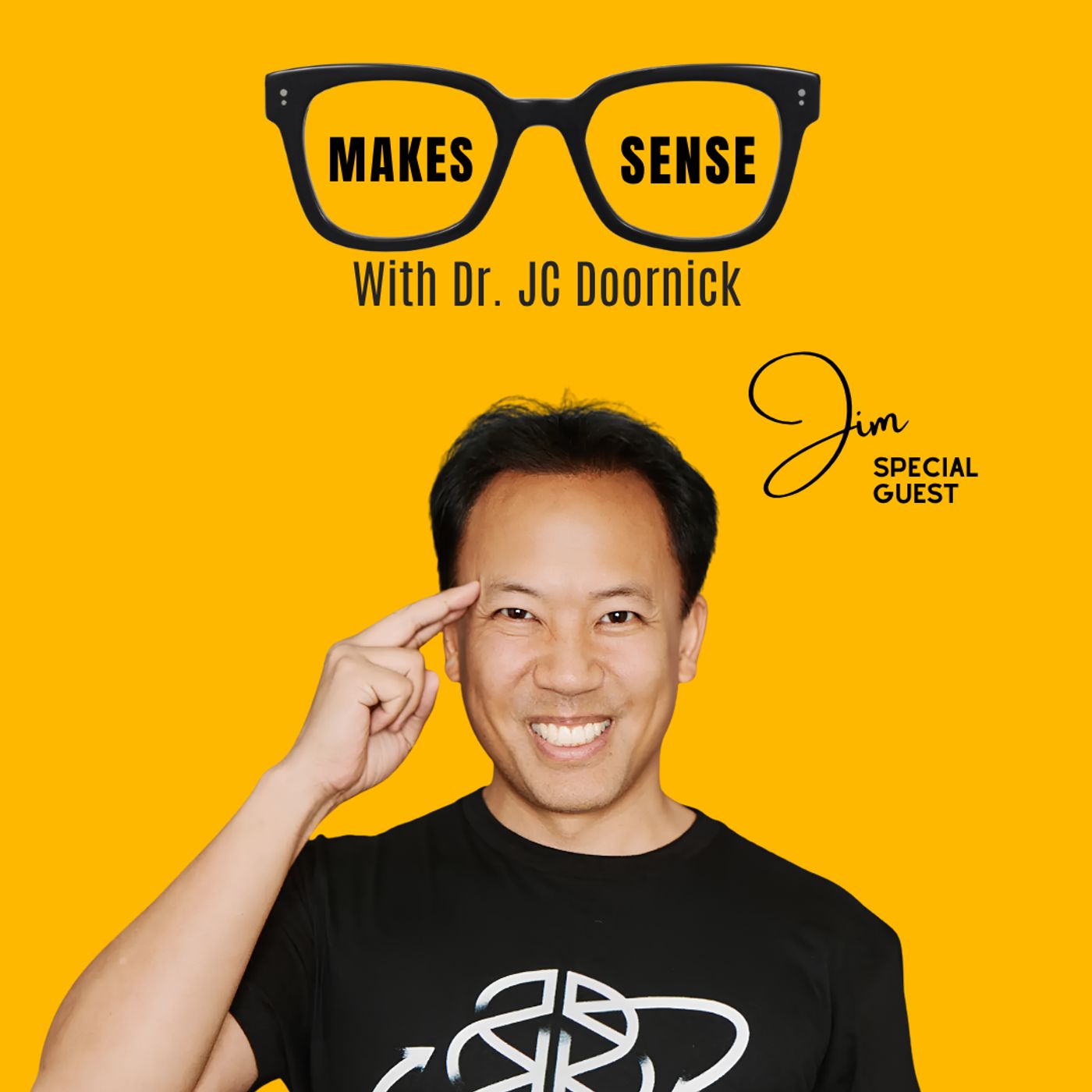
AI Isn’t the Future Without HI: Jim Kwik on Human Intelligence & Becoming Limitless Daily - E202
About this episode
What happens to human intelligence in a world increasingly dominated by artificial intelligence?
In this special conversation, Dr. JC Doornick sits down with world-renowned brain coach and bestselling author Jim Kwik to explore his new book, Limitless Daily, and why developing our own minds may be more important now than ever.
As AI becomes faster, smarter, and more integrated into everyday life, Jim makes the case that Artificial Intelligence still depends on Human Intelligence—our ability to think critically, ask better questions, remain curious, learn faster, remember what matters, and consciously direct our attention.
But becoming limitless isn't something you do once. It's something you practice daily.
Jim shares the philosophy behind Limitless Daily, a book designed to give you a powerful lesson, insight, or mental reset every day of the year. Think of it as daily training for your brain—a way to intentionally win the morning before the world gets a chance to program your mind for you.
JC also shares how reading Limitless Daily each morning became an unexpected companion during his cancer recovery, often delivering exactly the lesson, perspective, or question he needed that particular day.
This conversation explores brain health, focus, memory, mindset, morning routines, lifelong learning, the relationship between AI and HI, and what it really means to become limitless—not by doing more, but by learning how to better use the most powerful technology you'll ever possess:
Your own mind.
If you've been wondering how to stay focused, capable, creative, and distinctly human in the age of AI, this conversation with Jim Kwik is one you won't want to miss.Grab Jim's Book Now:
Web: www.limitlessdaily.com
IG: @jimkwik
Follow Dr. JC Doornick and the Makes Sense Academy:► Makes Sense Substack - https://drjcdoornick.substack.com
► Instagram: / drjcdoornick
► Substack: / drjcdoornick
►Facebook: / makessensepodcast
►YouTube: / drjcdoornick
MAKES SENSE PODCAST
Welcome to the Makes Sense with Dr. JC Doornick Podcast. This podcast explores topics that expand human consciousness and enhance performance. On the Makes Sense Podcast, we acknowledge that it's who you are that determines how well what you do works, and that perception is subjective and an acquired taste. When you change the way you look at things, the things you look at begin to change. Welcome to the uprising of the sleepwalking masses. Welcome to the Makes Sense with Dr. JC Doornick Podcast.
SUBSCRIBE/RATE/REVIEW & SHARE our new podcast.
FOLLOW Podcast: You will find a "Follow" button in the top right. This will enable the podcast software to alert you when a new episode launches each week.
Apple: https://podcasts.apple.com/ca/podcast/makes-sense-with-dr-jc-doornick/id1730954168
Spotify: https://open.spotify.com/show/1WHfKWDDReMtrGFz4kkZs9?si=003780ca147c4aec
Podcast Affiliates:
Kwik Learning: Many people ask me where I get all these topics, which I've been covering for almost 15 years. I have learned to read nearly four times faster and retain information 10 times better with Kwik Learning. Learn how to learn and earn with Jim Kwik. Get his program at a special discount here: https://jimkwik.com/dragon
OUR SPONSORS:
- Operly - Take Back Control of Your Work Day and Get Rid of All Your AI Apps - Welcome to the new world of Time Freedom and Unlimited Scaling and Success with Operly - https://go.getoperly.ai/video?ref=jean-claude-claude-d-2a95
- Blue Blinds Bakery - Handcrafted with all-natural ingredients - www.blueblindsbakery.com
00:00 - 02:04: Cold Open and Introducing Jim Kwik
02:04 - 06:00: "Shelf Help" vs Self-Help: Why He Wrote a Daily Book
06:00 - 10:52: The Reading Crisis and Reading as a "Superpower"
10:52 - 13:57: The Science of Your Morning Window
13:57 - 16:00: JC's Cancer Diagnosis and Protecting His Mindset
16:00 - 20:14: Jim's Story: The "Broken Brain" and Building Better Habits
20:14 - 23:16: The Story Behind the Color Purple
23:16 - 27:12: Writing the Book: Letters to His Newborn Daughter and Son
27:12 - 31:22: The Danger of Cognitive Offloading to AI
31:22 - 35:00: The BUILD Framework for Using AI Wisely
35:00 - 38:02: Choosing to Get Better, Not Bitter
38:02 - 42:17: The HUMAN Framework: 5 Traits AI Can't Replace
42:17 - 43:53: "It's Happening For Me, Not To Me": Reframing the Diagnosis
43:53 - 47:13: What Happens After 366 Days of Practice
47:13 - 49:49: Visualize Your Perfect Day, One Year From Now
49:49 - 53:22: Closing Thoughts and the Limitless Live Event
53:22 - ending: Outro: Learn It, Then Give It Away
Hosted by Simplecast, an AdsWizz company. See pcm.adswizz.com for information about our collection and use of personal data for advertising.
Get every episode summarized
Each time Makes Sense - with Dr. JC Doornick publishes, we email you a written briefing from the transcript — the topics, who appeared, and any specific claims, with the ad reads skipped.
Email me new episodesFree for 3 shows. No card needed.
Hosts & guests
Transcript ready
600 searchable segments. Every word is indexed and playable.
Full transcript
Makes Sense - with Dr. JC Doornick — AI Isn’t the Future Without HI: Jim Kwik on Human Intelligence & Becoming Limitless Daily - E202. Machine-transcribed; use the interactive transcript above to jump the player to any line.
Stop wasting your nights on a mattress that doesn't get you. Experience the most comfortable mattress in the world. The sleep number smart bed at the touch of a button. You can personalize your comfort. Choose firmer or softer. Adjust cooler to warmer. And right now, save up to $2,500 during our massive Labor Day event. Hurry into your local sleep number store today. Because we have your number. Come slash hardy backer. So here's the deal.
Your brain is going to be trained today. But the question is, who's going to train it? Have you noticed that the world that we live in has been doing most of the thinking for you? That your beliefs, perceptions, reactions, fears and doubts have been shaped by unsolicited outside noise? How easy it's been for you to slip into that default sleep walking mode and label it as life and reality? Yeah, that ends here. Welcome to the Make Sense with Dr. J.C. Podcast. This is your opportunity to start thinking for yourself, reclaim control and step back into that role as the shot caller and dominant force of your own reality. It's when you change the way that you look at things that the things that you look at begin to change. So let's wake up. Let's rise up. And let's make sense of why and how shift happens. Hmm. Make sense. Great morning, world.
Great morning, humans. This is your friend, Dr. J.C. Dornick, otherwise known as the dragon. And welcome to another edition of the Make Sense with Dr. J.C. Podcast. Today we have a very, very special edition of the podcast because I am here with my great friend for 25 plus years, Jim Quick. And once again, he's outdone himself. And this time it really, really hits home to me because Jim is getting ready to launch and serve the world with his new book, Limitless Daily. And we're going to get into this book, but we're also going to talk about why he wrote it and also how this book is going to be something that is going to truly impact the world. So my brother, so nice to have you. Thank you. It's very, very special that we're actually in the place where all the work has been done. I've been hearing this guy tirelessly working on this book for all of us for so long. And this is where it happens. So great to be here.
No, thanks for having me back in the show. Yeah. I want to get into this right away. And just first of all, you know, recognize that we have massive, massive success with Limitless. You know, this was a best best seller and just sold millions of copies. And it really laid the foundation for personal growth for like so many people that impacted my life. So why did you decide to write a daily book? You know, that's a big, big shift. Why did you move to writing a daily book? Yeah, and I know we're going to go some from some of the lessons also in the book. So definitely stay tuned for all of those. One of the questions people had was Limitless is like an older's manual for your brain to learn how to speed read, improve your memory, improve your focus, the best brain diet. You don't have to have much of sleep or habits, flow states, your mindset was a big one. But people wanted to know like, what can they, how can they become Limitless daily? It's one of those things where I felt like people didn't need another book to put on their shelf.
And it becomes shelf health, not self health. And you read it for a few days and then you're done and you put it back on the shelf. And then move on to something else. I feel like people needed not a new book but a new practice. Because that book won't change your life unless it becomes a practice. And I feel like people need a new habit. I feel like people first, you first create your habits, then your habits create you. You create your habits of doing some kind of meditation, movement, optimizing your sleep, you know, communicating with loved ones. And it shapes you also. But I wanted to daily also because you don't just eat one salad and you're just like healthy for life. You don't go to the gym, do one strong workout and you're fit for the whole year. It's the daily stuff that adds up to big stuff. So I wanted something where people could do in no more than five minutes. That's the promise of the book. It's a three minute read with a two minute exercise on a very specific like idea. So really become more limitless that day and help them with distraction or burnout or postures.
Maybe people have a fear of failure or fear of success or maybe they're self sabotaging or maybe they're procrastinating. All those kind of issues or they're overloaded, right? Or they need a better memory. And you know, and they need to get rid of like some, you know, stuff in the past. So it helps them on that way. And I feel like you remove that friction from people's lives. I mean, you get the latest version of AI, Claude, get the news version of Chatchee BT. You get the news version of Zoom, right? You update all your apps. You get the new iPhone. But when are we taking time to upgrade the most important technology, you know, which is your brain? That controls every part of your life that's created all the technology out there. So it's the promises five minutes in the morning for to upgrade your brain every single day. The goal is I think that most people, they overestimate sometimes what they can do in a day. But it's been my experience. People underestimate what they can do in a full year. That little by little, we had James Clear on our podcast years and years ago, who wrote a Tom McHabits and he was saying,
if you just improve 1% a day, you know, was that over a course of a year? Most people think, wow, you're going to double, you know, you'll be double your productivity or happiness or whatever you're practicing. Or maybe they'll say triple or five times or even 10 times. It's actually 37 times multiple. Just 1% a day. So consistency compounds. Like if you're persistent, you can achieve it. You can lose the weight. You can make the money. But I think if you're consistent, you get to keep it. And my goal with this book is that you become unrecognizable after the course of a year. And I really think, I tell people this, that there's a version of themself that's patiently waiting a year from now. And the goal is we show up every single morning for just five minutes until we're introduced. Yeah, you know, there's kind of a paradox going on. And what it is for me is I'm somebody that's known you for so long. And I'm one of those people that took your reading courses. And you know, I now read at least one book a week. And a lot of people are enamored by that.
But in our world, that's fairly normal. But in reading this book, it's kind of weird when you read so much. And I enjoy reading. But now I'm only reading for five minutes a day. What's part of this about also helping people learn that habit of reading, like you just said, because for me, I kind of say to myself, I wish I had this book when I took your course. Yeah, no, I love that you point that out. There's a challenge right now, globally, where people are spending less time reading. There's a big article that was everywhere in the Atlantic magazine. And it said only 16% of people read a book every day. Read something every day, outside of emails and social media and everything else like that. 51%. And this is across age, gender, and ethnicity. 51% of individuals won't read one book a year. And there's so many benefits to reading. I think reading is to remind what exercises your body.
They also have some of these decades of experience, like you do, and you put into a book, which you did, and somebody could read that book in a few days, then they could download decades of wisdom, and insight, and research, and mistakes, and like literally in days. What greater advantage is that? Is there to be able to fast track your success? And the challenges most people aren't reading. But reading is a great exercise for the brain also. It's a great exercise in focus. It's a great, for neuroplasticity, which is just your ability to remodel your brain every single day. It doesn't, the people used to think it was only when you're kids, but at any age, a stage of life, you could make new connections with new thoughts, new feelings, new behaviors, new learnings. I mean, it's huge. So yeah, it's kind of like a gateway habit. Because then what happens is this book, the promise of this book is really about changing your identity. And I know you talk a lot about that in your work, in your books, in your podcast, in social media, where it's like, you can't outperform, like under stress, we don't rise to a level of our aspirations and goals.
We fall to the level of our self-image and our stories. So we have that IRS, that we have to navigate. And so I feel like when you read every single day, you are giving yourself clear evidence where it's not like, oh, I have to try to read today. It shifts to an identity where I am a reader. And then all of a sudden, reading beyond that, something else could really open up all new doors. And so people have seen pictures of me online, you know, for a Connect Down Social Media with OPR, Elon, or Gates, or whoever. People always want to know how we connect, we bond it over books, right? Because even Warren Buffett, 500 pages a day, you know, very, very wise person. But then when you read more, when you know more, you could do more. When you know better, you could do better. You know, I think if knowledge is power, then reading is your superpower. Yeah, that really, really hits home. And another interesting thing is, as somebody as an avid reader, if I'm really telling the truth, if I read two, three chapters of a book in a day,
it's very hard for me to maintain and capture all of the lessons that I learned. So I find that reading five minutes a day, which is an interesting thing. It's like, it's hard to not go and read the next lesson. Right, right. But I find that just reading five minutes, sure, I get education, I get some science-based facts. But there's always one thing in there that ends up becoming kind of like a theme that I can build on that day. And it's really just something that I enjoy doing. Yeah, from the early galleries that we've sent out, just to friends and clients, they're reporting things like you've said to me where it's like, it's the exact message that they needed to hear that morning. And I say in the morning, because before the day takes over your life, right? Yeah, you know, everyone with family and work and everything else that goes on, when you wake up in the morning, it's like you're rebooting your computer. And it's coming online. And that means there's no tabs open or anything, right?
It's totally refresh. And so it's not like the other tabs can be opened up by your coworkers or clients or patients or your family. Everyone has things that they need from you. And so what I like about this is kind of waking up and you have a clear whiteboard. Nobody else has scribbled all their stuff or dooms growing everything else. So I recommend people read this first thing in the morning, actually. There's something called sleep inertia. It was interesting science, sleep inertia is when you're going from a waking, like a sleep state to a waking state. And it can last anywhere from 15 to 45 minutes on average, depending on what stage of sleep you woke up in. Like a rather sleep or deep sleep, depending on your circadian rhythm, much rather than at the belly's 15 minutes to like 45 minutes. And what happens is there's a sleep inertia time, the mental inputs that you choose to put in that window of time, that precious window, could have a disproportionate effect on the rest of your day, specifically on your focus. Like what you consume first thing in the morning will activate your reticolor activating system,
which is your filter system to show you what the shine of spotlight on. And it'll impact your focus. It also impact your feelings, your mood. And people know this, right? If they ever picked up their phone first thing in the morning, which I bet a lot of people are guilty of, then what is it magnifying comparison or conflict or war or whatever it happens to be? Or maybe they're getting a message from a social media comment that puts them in a mood or a voicemail or a WhatsApp or an email that could put them in a mood. And so your focus, your feelings, and also your framing of the day. Like certain situations, you'll frame differently based on the mental inputs you put in during that period. They call it attentional priming. It's attentional and emotional priming. And then it's also priming your emotions. How you're going to feel also. That's why when people use that window for, let's say, something more empowering than doom scrolling, right?
Because no one would invite 200 strangers into their bedroom. Can you imagine like you wake up in the morning, there's 200 strangers in the room and they just start talking about whatever they want to talk about. But that's kind of what people are doing on their phones. But useful things you can input that's going to be influenced disproportionately. Prayer. A meditation. A gratitude practice. Like I promised when people did a little bit of gratitude during that window, they'll see more blessings throughout the day. Because they've intentionally emotionally primed the day. You know, connecting with a loved one during that window. Or setting your goals for those which want to follow. You know, for the day. Because then you're going to start seeing opportunities to meet those goals later on. You're going to feel more empowered to be able to do it. So for me, whether or not people get limitless daily or not, it's just, I always say mind before media. Right? It's intention before interruption.
It's set your direction for the day before distraction. You know, for me, I prefer to use five minutes of that time to read limitless daily, even myself reading it. Because it makes that much more of an impact. Right? Because if you want to win the day, you have to win that first, you know, handful of minutes. On this show, we're always talking about making small changes that create big results. But one thing we don't talk enough about is sleep. And that's why I genuinely love cozy earth. The first night I slept in their sheets, the biggest surprise to me wasn't how incredibly soft they were. It was actually that they stayed cool. If you've ever tossed and turned at night because your sheets got too warm, you'll appreciate the difference immediately. I also really appreciate that cozy earth backs everything with a 10 year warranty and 100 nights of hassle free returns. So trying them is completely risk free. They're made from visco's from bamboo, breathable, soft and built for summer. Get on over to cozy earth.com and use my code, drag and for an exclusive 20% off.
And if you see a post purchase survey, mention that you heard about cozy earth right here. I only recommend products that I truly believe add value into your life. Better sleep simply makes for a better life. And to me, that just makes sense. 100%. And you know, you talk about consumption. And I always say, one of the things I like to say is that what we consume every day with regularity ends up becoming what we assume with regularity. I love that. So as you know, and all of my listeners know that idea of protecting what I let in is more important to me than ever. I'm battling cancer right now at stage four cancer. And I'm not going to sit here and tell you that limitless daily cures cancer. But what I can tell you is that since my birthday and so it's been, it's been a little over a month that I've been reading these entries.
I can tell you that I'm getting miraculous results not only in my metrics of my tumor grow, you know, shrinking and all of that stuff. But my mindset, you know, and I'm protecting my mindset. So this idea you mentioned just before and I actually have proof of it because I read this morning. I do read it in the morning because I want to protect my, my, you know, faculty here because this is what I'm going to use to interpret the day as it comes. So, you know, I don't know how you did this. And you, when you signed my book, you wrote, I wrote this book for you. And I feel like you did because in reading these, it's not just like some sort of a lesson that I learn every day. I know you well and I feel like first of all, I'm talking to you, I'm having a conversation with you. But it just seems like time sensitive wise what I'm reading ends up being what I needed that day. And I can't tell you how important that is for me because if I allow something else in, you know,
so was that part of your intention or are you just figuring that out now that you wrote this book for the person? You know, I feel a friend of mine, Rory says that you're best suited, you know, and position, powerfully position is served the person you once were. Right. You know, and I feel like, you know, knowing people had no my story of having traumatic brain injury and learning difficulties and who's in my grandmother, the househimers kind of put me on a path. And, you know, where I just felt limited, right, this because that was a story when that teacher said that's the boy with the broken brain. It only took five seconds for her to say, but I spent 10 years telling myself that same story, right, to myself. Because the most important conversation you're ever going to have is the one with yourself. And before you talk to a spouse or your kids or your clients or coworkers who're talking to yourself, you know, for the same in the morning. So I wanted to have an early conversation with people like maybe it's a conversation that they have with themselves, where there's some prompts in there to ask themselves questions instead of going to AI, they're not going to their own human intelligence and reflecting on their day.
But it's really about building more intentional human beings, right, in a world where, what happens in a world where we lose that intentionality, where we're just, you know, where we are, especially in a world of AI, where we're outsourcing our thinking and everything else. To make the decisions and to tell us what to do and all that stuff. You know, I feel like this is a nice daily practice because it's because of the small friction, right. I mean, I think, yes, I'm glad that it helps people every single day. They get a little coaching for me first thing in the morning, but really it's about creating intentionality in your day and hopefully that maps out how you do anything is how you do everything. You bring that intentionality in your relationships, you bring that intentionality in what you eat. You bring that intentionality in terms of your work, which are creating and contributing. And that's really the goal. But I also know that big transformation rarely comes from just an occasional random burst of effort.
You know, it's always the little things that add up to the big things. I want this to be so like second nature, it's like brushing your teeth. Maybe it takes three minutes to do, but you don't floss your teeth and brush your teeth for three hours and then you're done for the year. But I want to make it part of their morning routine just like that and I feel like it's everything. And because this Duke University says that 40% of our behavior is habitual, totally unconscious. We don't even know why we're doing it. We're just doing another 40%. 40% because the brain loves efficiency. It loves to automate whatever it can automate. So it creates these habits, but where those habits come from. And then also we're going up against, if you watch social dilemma and all these documentaries, all the billions of dollars that go into our devices in terms of making it more addictive, making the impulse. So I recommend one of the most important lessons people can learn from limitless,
the original book about habit design is you control your environment. You want to make the things that are bad for you more difficult. You don't have the junk food in your house, so you're not going to go in-night snack. And you want to make things that are good for you easier to do. You'll notice my office have a pull-up bar right in Zorroide. It just makes it easier for me to do that habit. And something you can do with this is take your phone off your nightstand. It shouldn't be there anyway. We've done podcasts also about EMFs and just proximity to your phone, like your brain and how kids sleep with their phones or get the pills and all that. But even I was talking to Simon Sinek and we had this video that nine years ago on Facebook memories, it has 38 million views. And I was talking about don't touch your phone for 30 minutes a day, last 30 minutes a day, and so on. Like even having your phone at a dinner table, even if it's faced down, you still have the impulse to grab it. And it takes you away from being present with the experience of itself.
So I say replace your phone, put it in the bathroom, replace it with something useful. It could be limitless daily. I made it purple because I don't know, it sounded like purple books on my shelf. I have thousands of books here and other rooms. But as I did do it for branding, I did it for becoming. And I love your shirt also. We call it color coordinate. Yeah, how did that happen? Purple is, you know where purple came from? Well, two things. So my son, this is a good kid so much, right? Every morning we take him outside and he's in early rush. I was like, me, like dad, and he's only three and a half and we watched the sun come up. One day I took a picture and I color matched the sky to the cover of the book. And it's interesting going from darkness to light, right? There was a shade of purple in the sky that day and I wanted that to be there. Also purple, not only is it distinctive, but it's not meant to be on your shelf,
it's supposed to be on your nightstand. It's a rare color. A thousand of years purple was like the most valued treasured color because it was the hardest one to create. A thousand of years ago, around the Mediterranean, they would have to extract it from a snail shells. That's why royalty would be like purple, pebbles, and others. And I feel like you are royalty for reading this. Like you are in 10. And it's rare, just like the color purple was. And your, I think intentionality is rare. Like sometimes whether you're an entrepreneur or your parent, you want a more limitless life, right? You want to bring intentionality to your relationships, to your workouts, to your business, whatever happens to be. I feel like that's a rare quality nowadays where people are more easily manipulated by authorities or agendas or marketing or media. And that's the challenge I have with AI. People are cognitively offloading, so they're not thinking for themselves and they're not building those muscles. But the other thing about purple, and I could talk about color psychology and what red symbolizes in blue, making purple and all that.
But purple is associated with sovereignty and wisdom. And I want to remind people that they have sovereignty, right? That they, no matter what's going on, the weather, the market, the economy, politics, whatever, you know, your family. Like you have sovereignty, you have agency that you don't have to be easily controlled or influenced. We are a thermostat, not a thermometer. Thermometer reacts to everything, doesn't have sovereignty. But thermostat gets set at temperature or standard and the environment changes around it. But I like the color purple a lot for that. And also you notice the rays of the sun, if you're watching this on video. There's also like 52 rays of light over on the sun for the 52 weeks in the year. And it's 366, because I don't want to give people an excuse, you know, for February 29th, many years. No days off. No days off. So you just show up every single day, you don't read it through, you just read one page.
And it's, you have multiple, multiple benefits. But I did write it though, you know this. And again, I didn't want to write another book, because after the success of Limitless, you know, it's in dozens of languages all over the world. I didn't want to write another book, just kind of read and put on the shelf. I wanted something like a practice for our community and for our readers. But it didn't start out that way. When my daughter, we ever wanted to have your own daughter to just adores you. It's, when she was born, she was born a little bit early. But I remember, I write every morning. That's when I'm most creative. And I've done that for as long as I can remember. Things like gratitude or what I'm thinking about or what I want to focus on this day. Just kind of like stream of consciousness. But when I was in the hospital, looking at my wife holding our daughter, which is born and my two-year-old son at the time, I started writing to them for when there are adults, you know. And my 50s, so I started late as a father, as you know.
So I just like, God forbid I wasn't here 20 years from now. What would they need to hear from their dad on a hard day? You know, and I started to write about those things about not feeling good enough or feeling scared to take that step or, you know, overwhelm or burn out or postures syndrome. All the things that could hold people back. And then the next morning I wrote another letter to them. And another and another. And then it transformed into a book. And then what I knew was it was something that I want to bring to the world. And then I added the science to it. Because there are a lot of daily devotional. So I have all of them. You know, that pull from Judaism or Christianity or Buddhism or Stoicism. For me, I pull on science. The science of the mind, which is psychology. So I was reference, you know, a new idea with the science, the back, it either psychology or science of the brain, which is neuroscience. For I kind of show people, give them a little bit insight. It's not too technical at all. But I think a lot of people want to see like, it's a little bit of brain anatomy or psychology or how hard you just something about like some study of that kind of backs it up.
And then one little small implementation, which you know, it takes more than two minutes. And then we added an affirmation. An identity statement. And identity statement. Because ultimately I want people to feel at the end, you know, going through this. And I think a lot of people are going to do this past year. They're constantly come back to it. Because of the way they transform. And I just love this idea, you know, where let's say people watch this and thousands and thousands or tens of thousands of people in your community. Start reading. I don't know, same as that page. Same page. Right. And you know, going through the same thing. And I broke it down in the seasons too. Where I didn't want to do like a month on motivation or a month on mindset or the judge or let's say March is all about focus. Because I think I feel like, you know, like after a week or two, they'd be like, okay, you know, I've got this candle. I broke it down in the seasons. So I broke it down into winter, spring, summer and fall. Because I feel like in life, sometimes we go through a winter for our health. Right.
Or we go through a winter or spring with our business. Or maybe a summer with our relationships. So I feel like we all go through those seasons. So I kind of put those different topics in the right season. How people go through this journey together. I love it. You know, I find, because it only takes me five minutes, I find that I carry it around quite often. So I'm starting to hear all these people saying like, what's that purple book? So I mean, I mean, purple is my favorite color. And we did not plan this. I just heard purple kind of in support of the whole. It's also like the high, like for people, it's also associated with higher learning and higher consciousness. And for people who are familiar with with shock resistance and like it's just, it's a very, and I'm surprised. It's also the universal color of healing. It's got healing qualities. I used to use that in my practice back in the old days. I want to get into something that you kind of brushed on before and that's AI.
I'm a big fan of AI, you know, you and I enjoy playing with all the, and it helps with efficiency and everything like that. But we're in this position now where the experts are starting to get worried that we're offloading too much of our cognition to AI and responsibility. So I'd love you to talk a little bit about the danger of that. And then once again, pointing to the value of working on the HI, the human intelligence. Yeah, I'm curious in the community how many people are really active using AI on the daily. You've got to let us know on social media. So I'm so pro technology, you know, it allows a lot of this to happen right here. I think AI in particular is an amplifier, right? It could scale things, but it can only scale and amplify what a human brings to it. If somebody's confused and uncertain, you know, chaotic, it's going to scale that. If somebody is very competent and capable, then it's going to scale that. And so there's a difference. It's ultimately the human being that that that's the value.
It's like having a race car, like a multi-million dollar piece of technology. That's like AI, right? We get to work with a lot of sports figures and like coach, you know, as a brain coach. And the driver, though ultimately, is going to determine the performance, right? And it's just the same thing with this. Somebody could use AI because AI is not a competitive advantage anymore. Everybody has access to it. It's like information. Everybody has access to all information. You know, and so like somebody could use AI to make a nice social media post. Other people could use AI to create the next multi-million dollar venture. You know, but it's because it's the human that makes it. And it really feels one of the challenges is what you mentioned cognitive offloading. Cognitive offloading is where we're using AI that think for us. And there's a big challenge there because your brain is an organ, but it acts more like a muscle. And it requires effort to be able to grow. But AI is removing all the friction and all the effort. It's like going to the gym and asking your friends to lift the weights for you. Right? You get no benefit.
It's like an elevator is an early form of technology, right? And if your office is on the seventh floor, your Parmesan seventh floor, technology is very convenient. But then you don't take the stairs, right? And so there's a physical cost. Because if you put your arm in a cast for a year, it wouldn't grow. It wouldn't even say the same, right? It would atrophy. And the same thing, if you take a car to go, which is a technology, to go 10 blocks to run an errand as opposed to walking. Right? And so I love AI. When it's leveraged intelligently and intentionally also as well. Because there's a MIT study, a lot of people who are watching this or have heard this study, where they took, at MIT, they took students and had them write essays in group A, B, and C, A, use chat G, B, T to write their essay, group B, use Google, and group C didn't use either. And then they scan their brains to see which ones are most active and engaged. And obviously it was group C, right? Because they were doing all the lifting. And least was group A, right? Because there was no effort involved, though,
than putting in the prompts. And what was interesting though, is when they tested them for comprehension and retention, which is what matters in learning, the group A remembered very little, because they were just given it, right? But group C, remember the most, because they earned it. And so I just want to, I don't, imagine a society that just cognitively offloads, or even worse, cognitively surrenders, they're thinking to it's form of technology, right? And so what happens to our critical thinking, our judgment, our decision making, our rationale, or logic? I mean, I think it'll make a society or civilization weaker, because it will be easier to manipulate by authorities or agendas, that have agendas by marketing or media, because we can't think for ourselves. We can't sort through information, misinformation also as well. And our life is a reflection of, as you know, our thinking, a big part of it, because that determines what we focus on, what we feel, what we do in life.
And so, yeah, I just think it's important. So before I go to AI, I'll give you an example. I do a few things before I go to AI. And I always say build before you borrow intelligence. Build your own intelligence before you borrow. So I use an acronym build. The B, let's say there's a situation that you go to the AI for, and people could actually, you know, roleplay this. The B is brainstorm yourself. Before you go to AI to give you a simple answer, brainstorm. Like, you know, come up with me, like, really understand what the situation is. The U is understand, meaning, that's the problem or the prompt. I think too many people are optimizing for the wrong problem in life, at work, or even the problems they put into AI. You put junk, prompt and you get junk answer, right? So they say Einstein, and I don't know if this is attributed Einstein, who knows nowadays. But if he said, if he had an hour to solve a problem, he would spend 55 minutes defining the real problem. Right. And so, you know, and so some people, they're prompts internally, because people think prompts are new. Now we've been asking our human intelligence prompts all the time.
How come I can never lose weight? Why am I not good enough? Right? Why does anyone love me? Right. And then you put that into AI. You're going to get a whole bunch of evidence like, oh, this is why you can't let all these stuff. That might not be the most useful. So really understand to define the problem. And then the eye is imagined. I went once you've clearly defined the problem. The eye and build is imagine three solutions yourself before going to AI. And so come up with your own answers, right? And this is also good for memory. It's it's it's active retrieval. Right? It's like reading a book twice is not going to be much benefit, but reading it and asking and then quizzing yourself what you read. You'll really know how much you really understood. And also clearly what you don't. But come up with three solutions. And I will give you a couple of tips using your imagination, because I said imagination is more powerful in knowledge. I would do something like if I was in a situation, I would say like, how would a how would a five-year-old look at this problem? Right? Because sometimes you get to be a bit of obvious. Or I'll ask myself a fun question like, what would somebody 10 times smarter than you? How would they approach this problem? Right? And so you could do some fun things. Or like if you have a business mentor or someone else, like how would you know my mentor look at this?
You know, for different aspects. And then the L in build, so you brainstorm, you understand, then you imagine, right? You understand, you want to really create them to find the problem. The eyes imagine the your own solutions. Then the L is leverage AI. And I would give some tips. Besides asking your question that you understand better, I would ask you to use it more to poke holes in your assumptions. Right? To dispute it. Yeah, to pressure test your idea, like this business idea. Because sometimes we have to admit, AI use poorly. Like a lot of times it's just a sickle fan. It can make the most non-intelligent person feel super like they're genius. Right? And so it'll play Kate to you often. So I would ask it like, what argue against this? Like you are the best debater on this subject. Give me the arguments of why I'm wrong. Right? That takes a lot of courage to ask that. You know, even with our assumptions, the way I love your work also, I feel like you can have strong opinions, but they're loosely held. Right? Part of intelligence is having cognitive flexibility. If you change your beliefs around new data. Right?
And so you can leverage AI in all these different ways to point out your blind spots. What am I not seeing here? You know, what are your cognitive biases and everything? And then the D in builds. So you've gone on before you go to AI, you brainstorm, you understand the problem, you imagine solutions, you leverage AI, and then the D as you decide. You know, then with all this information, then you can make an intelligent decision. And ultimately also, I just want to remind people, there was a quote in limelist that was very highlighted. And he said, life is a letter C between B and D, or B as birth and D as death and life see as choice. That our life is some total of all the choices we made. You know, and I still believe that these difficult times can diminish you. These difficult times can distract you. These difficult times they can define you. Or these difficult times they can develop you. Right? We decide. Like when you heard the news, right, of what was going on with your health, like you could have got bitter, but you chose to get better. Right? But that was a clear decision. And so like I feel like every day we cast a vote for who we want to be. Right? And I feel like doing and being intentional with our life.
And I really feel really optimistic in a world of AI. Like I, you know, I'm concerned about the cognitive offload in the cognitive surrendering, but I also feel like people step up on our intentional. This, like it's called an AI revolution could be a human evolution for human intelligence. Because ultimately this book is helping people to become more human and intelligent. And I define intelligence as how you use your brain and direct your mind to create the life you want. Like somebody can know a lot about money. Right? They read every book on money and wealth and investing and everything. But if their bank account's not growing and it's not reflecting that, then how intelligent is that person? Right? And so this book is really geared towards helping people create actions that will create results. That would be evidence that they, you know, they're creating the life they desire and they really deserve. You know, and it's hard to imagine in five minutes a day. But again, it's that lead domino. It's like something you start first thing in the morning that sparks the rest of the day.
But I think this, this renaissance of humanity can come because all through history from before there was writing, like all technology has changed the way we think human beings. We started to write, it changed the way we think. Because now we can put things out, we can take our memories, put it on paper, right? Printing presses, a lot of that go a little bit more to scale. Libraries changed the way we think also, you know, and then the internet, you know, or calculators. Right? Calculators, now people, that was at dinner the other day, and there's 10 people, and they had four people took out their phones to divide the bill by 10. Right? But that's the challenge, right? When we lost that capacity. GPS, like if you're asking technology to tell you when and where to turn, then we don't have to build our visual intelligence, our visual spatial intelligence. So we don't want our natural intelligence to become artificial, right? Then everything, if we're not, we're all thinking the same, that everything we create on using AI becomes derivative, becomes generic.
That's the, they have slots that's out there. And so, but I feel like it'll make us more human. And what specifically do I mean? 5 5 things, I feel like in order to be valuable, because we're not going to out computer out process, you know, like AI, right? But we're, before us to become more valuable, we focus on acronym human. H is heart, emotional intelligence, I be doubling down and building your EQ, you know? And so it's empathy, it's compassion, right? It's our ability to do that, to be able to connect. The U is understanding, like, you know, really going deeper and understanding something, right? Getting curious. I think that's a through line between, you know, like something happens, we get curious about why this is happening as opposed to being critical. Right? And so getting curious, really curiosity something. And then the M is is, is meaning. I feel like it's so important more than ever, especially with AI replacing so many jobs.
Like what happens to a radiologist now, when AI could do it a thousand times better, what a human eye can detect? Right? What happens is somebody who spent all his years in schooling, all those years in their career, or a visual designer in the world of AI, you know, or a coder in the world of AI. So much of it is what people are transitioning through as an identity crisis, because so many people identify, I am a their career, right? But besides that meaning, like, finding purpose, because when this purpose give you, that's a human trait, because AI doesn't, you know, doesn't, doesn't feel anything. But that's what's going to get you through difficult times, which are inevitable, right? Challenge, adversity, you know, and I think adversity can be an advantage, you know, with challenge comes change, with struggle, comes strength, but you need to find that meaning. The A in human is adaptation. I would really become more cognitively flexible, you know, and challenge your own assumptions so much time when we're on social media. I don't even, I'm not on social media much, but can you ever notice, like, you don't see what your followers are posting, you know, like, what do people you're following are posting?
You see what you're engaging with. So then becomes an echo chamber, because whatever you're engaging with, there's just a show you more of. So you never get to see other points of view, right? And this can be religious, this can be political, this can be your diet, whatever you're up in to be engaging with. But I think to be very cognitive, flexible, it's important to see, you know, different angles. And also, by the way, like so many people are so successful, they have hobbies, right? They have real other interests, does that allow us, in the pulse of, you know, for their main interest to pull distinctions, you know, into that. It's just like Steve Jobs, you know, where everything he created, you know, he's really into calligraphy and this typography, right? Design, psychology and storytelling, you know, that melded into, you know, those interests, you know, those interests melded into the final products. So I think we need to be adaptable. We need to be able to learn to unlearn to relearn, which is a big part of the book, because I feel like those, we live in the age of adaptation, because what's the opposite is cognitive rigidity. Like somebody who's cognitively flexible, it's like you're physically flexible. You'll bend, but you won't break, right? You can do mental parkour, be more creative.
So, how cognitive rigidity is, you can't think outside of what you're thinking. That's going to be a challenge. Then you have a blockbuster video, right? It's not flexible to change and adapt, or you have a Kodak that created the backbone for like the original, like digital photography, but they shelved it, and worse Kodak now. And I'm dating those, you know, like in terms of, some people watching this have no idea what Kodak is, but you don't want to be stuck and rigid, because that's death. And then finally, the end in human is nexus, which is connection. It's influence, it's connection, it's leadership, it's parenting, right? It's managing, it's sales. I think that would, you know, AI is not going to easily be able to affect that as much, because AI could feign sympathy or empathy, but it doesn't know what it's like to go through cancer. It doesn't know what it's like to go through a breakup. It doesn't know what it's like to ask for forgiveness. It doesn't know what it's like to support a crying child.
They can feign that, synthetically, but I think this is going to force us to become more human, more authentic, and lean into that in order to stand out and be valuable. In the workplace and in life also as well. You know, it's funny, I'm just to show you the power of, you know, the reading that I do is like I was just listening to you talk, and you said, you know, something to the nature of our struggles turn into our strengths. And I was just thinking, oh August 25th, which is what it's today when we're filming this live. And what's interesting back to what we said in the beginning is that's exactly what I needed this morning. And I was kind of feeling a little bit thumb-sucky about my cancer and my kid was happening to me. So then I read this to start my day and I go, oh, this is happening for me. So that's just a quick example. Kind of enclosing one of the tenants that we've absorbed into our, our makes sense community.
And I talk about this all the time with our community is that, and this, this comes from Wayne Dyer. Wayne Dyer always said, if you change the way you look at things, the things you look at will change. When you change the way you look at things, things will look at change. What I find is that people are constantly coming to me, especially lately, asking me, I don't understand how you could have cancer. Stage 4 cancer and seem excited about it and look at it as an opportunity to grow. It's the way I talk. And a lot of people think that I'm lying and I'm just trying to like say affirmations. But the truth is that that's the way I have chosen to do it. That's the way I look at things. And what I can tell you is that this is a big factor in that because this is that consumption that's making me, you know, have the strength to do it. So my final question is, is, and I don't know how you're going to answer this, but what is going to happen to somebody? What's going to happen to me, but I kind of have a lead on people, but what happens to somebody after 366 days, if they actually read this, five minutes a day for 366 days?
What is, I know you can't like guarantee. What's possible for that person? And that's really the word is possibility. You know, limitless is not about being perfect. Limitless is about advancing. It's about progressing beyond what you've done in the past or what you believe is possible or even believe that you deserve. You know, I think it's interesting when we first thing in the morning, when we take a pause, you know, before media and everything else, sort of other people's buying for our time, that pause is very powerful. Right? There's power in pause. There's like if you pause a computer or a camera, you know, or a television, it just stops working. But when human beings pause themselves, I feel like we start working in different ways. We start recreating. We start restoring when we pause. We start re-evaluating. We start recalibrating and recovering all these great things. And so, you know, I think that a little pause each morning for yourself, that's evidence that you are, like I think the most important, when we talk about medication thinking about your thinking, I think one of the most important habits is,
is do what you say you're going to do. Right? And it's hard when we break our own trust, meaning that we say we're going to work out and we don't work out or we say we're going to do this and we put it off like that. Because if other human beings in our life did that, they kept on saying things or promising things never fall through, that would be a breach in trust and, you know, then our connection. But what about the trust and connection we have with ourselves? You know, so I make it 366 to include in February 29th, the leap year to give people and again no excuses. So this is time for you to prove to yourself, first thing when you wake up that you're showing up for yourself. Right? And that stacked compounded, that self-trust compounded, that habit of showing up for yourself compounded, you know, where it doesn't it touch. You know, it touches your confidence, your courage, right? Because we get pride by doing hard things. So it's like a little bit deliberate discomfort for people first thing in the morning, getting something where you're earning your dopamine. Like you pick up your phone and you do them scroll and you get this dopamine, which is a molecule of motivation or you go to a site to give you dopamine or a stack on something that's not earned.
So people have this misconception, you have to be motivated to take action, but it's the opposite. You take a little action, you get that dopamine that you earned, and then it's more likely you're going to follow through with that action and create momentum in your life. And so what can't you do if you show up for yourself first thing in the morning every single day, every single week, every single month, maybe even every single year? That's where you become unstoppable. And again, it's not about being perfect. It's about giving yourself a little bit of grace and a little bit of an edge first thing in the morning to get disproportionate results. And because what doesn't come from how you focus, what you feel, and how you frame the rest of the day. So my goal is, as I mentioned that there's, imagine yourself one year from now, and it's like your perfect day. Imagine you're waking up into your perfect day. This is like a thought experiment. You could close your eyes if you're not driving or working out and lifting heavy stuff. But just imagine like, what do you hear?
You know, who are you with? What are you proud of? What are you saying to yourself a year from now? It's like your perfect day. What's your face look like right now in terms of your facial expressions? How common at peace are you in terms of your breathing? And just like that. And I really think if you imagine it, you feel it, you hear it, you say it, you step into it, and you work daily for it. And that's really the key. Again, that version of yourself is waiting for you. And this person is begging you to show up every single day until you get to be introduced. And so, and this is also the other thing I've noticed that people are buying like five or ten copies to gift to family members and friends because they want to talk about it. They want to be able to gift it out to everyone and their teams. Because what happens if your whole team or your family or your community is on the same page and they're reducing that distraction or they're believing in themselves again or they're overcoming a fear for that day.
You know, how much energy does that? I always tell people, you know, what you say and do frequently becomes your frequency. What you say to yourself and what you do frequently becomes your frequency. What happens to your family's frequency by talking about something that's not, that is purple on the scale is pretty high consciousness, right? But it's something that's a higher conversation and I feel like from there what can't you create? What is impossible? You know, and I feel like sometimes change can be scary. Sometimes growth can be hard. But nothing is as scary and hard as being stuck somewhere that you just don't belong. I think this book is for people that believe that there's more. There's more for their relationship, there's more for their health, there's more for their expression, there's more for their fulfillment, there happiness, there peace, their bank account maybe, whatever happens to be. You know, and I think some people just need a little guide. So this is like a one year journey, but I'll take together.
You know, and it's a reveal and realize really, you know, remembering who we really are. You know, and so that's my promise for everybody. Well, this has been so incredibly special. I mean, for me, somebody that's going through the motions of experiencing all this stuff, it's frustrating for everybody that they don't have theirs yet, but they'll have theirs soon. I almost feel like I want to invite, you know, hundreds of thousands of people that will watch this or listen to this to join my book club, which will meet every day. That doesn't mean that I'm going to meet my video every day, but that's kind of what this is. So I just want to thank you so much for, you know, once again inviting me into your home and, you know, sharing so much of this. I think that the way I put this is that because neither of you and I are not very salesy people, more servants and just from a servant heart, this is not a book because it's not really a book where amongst all these books and I've told people, oh, you should get this book.
This is not like that. This is not a book that you should consider getting. This is a book that it would just make sense for you to have because you either have it or you don't. And what's super cool, and this is my invitation to you, is as soon as you get yours and, you know, go out there to Amazon and, you know, order your copy of this. But once you do, we're going to be reading this together on the same day and just imagine the conversations that are going to take place. Jim, thanks so much. This is by far your greatest work ever. Thank you. And we do something really special during the subrate the launch. People can just go to limitlessdaily.com. Perfect. And then we have some companion and some gifts that come along with it that I feel like people are really happy with to help them on this journey, you know, this adventure that we're going to take together. You know, people are watching this before this happens. We also have our annual gathering. And it's really just coming right up.
Yeah. And so if you if you're watching this before September 11th and 12th, we're going to be just down the road from where we both live here. And it's going to be a credits in credits Connecticut. We'll be giving out, well, at least I'll say I'll be giving out free hugs free hugs for every book. Okay. I love the size sign me up. So it'll be people on a limitless live.com. JC, I haven't seen it last year and we'll be there for those two days. But it's not just an event with some amazing speakers like JC, you know, and we have, you know, other individuals like Stephen Collar, who's the top, you know, flow researcher in the world, flow states for people on a field or best and perform their best, you know, Dave Asperger on how to biohack your brain and just how LRAD talking about like, you know, he sold millions of copies of Miracle Morning. But how to design a miracle morning around limitless daily. But it's really the people that show up, you know, the people that make will make life time friendships.
You know, over the years we've had people meet each other and get married. But it's also a very special group. But if we're using this not just as an event, but as a way for our readers to get together. And this is where that this event, the book comes alive because each of those presenters are going to be talking about one aspect or principle of the book. And it's kind of like this is where our one year journey begins together. So that's that limitless live.com. Look how excited he is. I'm not excited. This is exactly my friend. So just in closing, as I always say, if you learn something today, you know, and notice that if you remove the L, you get just earn. And that's what he mentioned before. But if you learn something today, you've just learned about this. Give it away. Don't just take this and get the book and court it to yourself. Give it away because that's how it's going to stay. So what I'm most excited about is to kind of pay forward what it is that's changing my life dramatically.
So thanks so much for being here and see you next time. Make sense. Substack for free daily quotes, live streams and blogs. And remember, learning without action is just another form of distraction. If something hit home and you learn something today, give it away. That's the only way it's going to stay. See you next time. Make sense.
More episodes
More from Makes Sense - with Dr. JC Doornick

Misunderstoond - How to handle unsolicited criticism - E207
Makes Sense - with Dr. JC Doornick

GOOD SHIFT- Transformational Gardening Vs. Weed Whacking - E206
Makes Sense - with Dr. JC Doornick

Danny Goler: DMT, Lasers & the Hidden Structure of Reality: What Science Won't T...
Makes Sense - with Dr. JC Doornick

Why You Trust Fear More Than Your Own Potential - E204
Makes Sense - with Dr. JC Doornick