About this episode
Sandy Nurse, City Council member (D-37, Cypress Hills, Bushwick, City Line, Ocean Hill, Brownsville, East New York), talks about her proposal for legislation that would increase New York City's minimum wage from the current $17 per hour to $30 per hour by 2030.
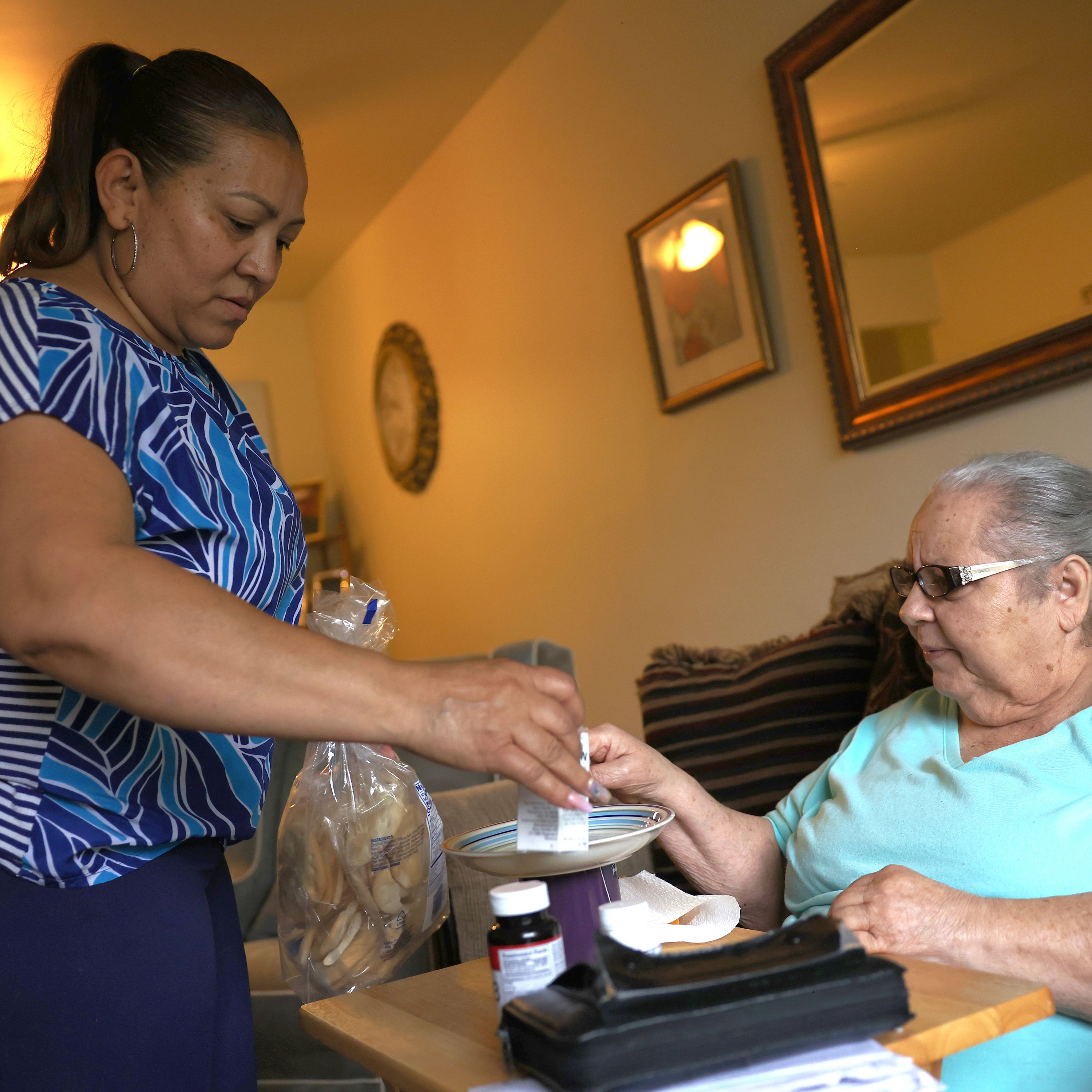
Photo: Lidia Vilorio, a home health aide, gives her patient Martina Negron her medicine and crackers for her tea on May 05, 2021 (Credit: Michael M. Santiago/Getty Images)
Hosted by Simplecast, an AdsWizz company. See pcm.adswizz.com for information about our collection and use of personal data for advertising.
Interactive timestamps
Jump to segmentGet every episode summarized
Each time The Brian Lehrer Show publishes, we email you a written briefing from the transcript — the topics, who appeared, and any specific claims, with the ad reads skipped.
Email me new episodesFree for 3 shows. No card needed.
Hosts & guests
Transcript ready
439 searchable segments. Every word is indexed and playable.
Full transcript
The Brian Lehrer Show — A $30 Hourly Minimum for NYC?. Machine-transcribed; use the interactive transcript above to jump the player to any line.
0:00Here's a shift worth noting. Better health care is care that meets patients where they are. United Health Group is bringing it directly to living rooms. This is a win for patients managing chronic conditions. And here's the interesting thing. By closing those care gaps, administering in-home exams and identifying risks earlier, more diseases can be prevented and patient outcomes can improve. In 2025 alone, United Health Group patients received over 19 million home visits. Learn more at unitedhealthgroup.com slash commitment. Few things are as uplifting as the greatest moments in sports. And nothing brings us together quite like team USA at the Olympic Winter Games. From NBC Universal's iconic storytelling, to the innovative technology across Exfinity and Peacock, Comcast brings the Olympic Games home to America, sharing every moment with millions. When team USA steps onto the world stage, we're not just watching. We're cheering together. This winter, we're all on the same team. Comcast, proud partner of Team USA.
1:08It's the Brian Lairishow on WNYC. Good Friday morning, everyone. Did you hear that one of Maimum Donnie's signature campaign promises has now been introduced as a bill in the City Council? It's the $30 minimum wage. Here's, at that point, candidate Maim Donnie, talking about it in the WNYC, Spectrum New York One May or El Debate in October. The reason that we put forward $30 by 2030 is that that's the minimum that a New Yorker needs to be paid to be able to afford to live in this city. And what we are looking at right now is the possibility of the place that we know and love becoming a museum of where working class people used to be able to live. Our proposal that we've put forward would be phased in over a longer period of time for small business owners to ensure that they could deal with this. And it's also one that we are confident we would be able to accomplish because of the fact that we are seeing from New Yorkers time and time again. The absence of it is pushing them to live in Jersey City, to live in Pennsylvania,
2:11to live in Connecticut because they can't afford to live in New York City. So Ron Maim Donnie has candidate Maim Donnie at the WNYC, New York One May or El Debate on October 22nd. Now, Council Member Sandy Nurse from Brooklyn is sponsoring the bill that would eventually boost New York City's minimum wage. And he did say eventually there, too, by 2030. $2.30 an hour. For a little context, the minimum wage here is currently $17 an hour. Some other cities by comparison, Seattle, Little Hire at $21.30 an hour, $19.29. I don't know how they arrive on such an odd number. But $19.29 in Denver, and again, New York at just $17 an hour despite the cost of living here. Opponents, of course, say it would kill jobs, not just make life more livable at the bottom of the wage scale for people who have jobs. Council Member Nurse represents the 37th district,
3:14which covers Cypress Hills, Bushwick, Cityline, Ocean Hill, Brownsville, and East New York. We'll also touch on the city budget where Council Member Nurse's chair of the Council's Committee on Civil and Human Rights is pushing for a significant funding increase for the city's commission on human rights at a time when federal civil rights protections are being rolled back. There are, of course, a lot of other budget controversies as well after the mayor's initial proposal. So Council Member Nurse, welcome back to WNYC. Thank you, Brian. Good morning. And listeners, phones are open. Text thread is open on a $30 minimum wage. Are you a minimum wage worker in New York City? How do you make ends meet right now? And what would $30 an hour mean for you or your family? 212-433-WNYC if you're a business owner? What would a $30 minimum wage mean for you? 212-433-9692, call or text.
4:15And of course, you can ask a question as well as maybe make a comment with our guest, City Council Member Sandy Nurse from Brooklyn. All right, Council Member, how would you build work and on what timeline? Thank you, Brian. So there are over a million New York City workers earning the minimum wage here. And after taxes, a full-time worker making $17 per hour brings home about $2,000 a month, which means they're basically surviving on $500 a week. And no one is truly surviving here in New York City on $500 a week, which is why one in three New Yorkers have said they expect to leave this city in the next five years. The cost of living is just simply crushing workers. And a recent study, MIT study, actually found you need about $38 per hour just to cover basic expenses. That's not even enjoying life. It's just covering basics. Our bill is asking for $30 per hour for all minimum wage workers by 2030
5:18and for smaller businesses by 2032. $17 per hour really is just not a livable wage. It's actually a crisis. It's a daily crisis for these million workers in our city who have to make extremely tough choices between food and medicine, transportation or rent. And we just don't believe that's a dignified life. And as you mentioned, we're behind many other cities. I mean, Flagstaff, Arizona is further ahead than us, Denver. And that's really unacceptable. Especially when we have an affordability crisis, people in this city just want to safe roof over their heads. They want to be able to put food on the table and enjoy the city. They keep running every single day. We believe they deserve higher wages and that $30 an hour would make a world of a difference for them. Before I get to some of the pushback arguments, humanize this for us. Who among New Yorkers are we actually talking about when we talk about minimum wage workers in the city?
6:18What job categories for the most part? And demographically, who? Low wage workers are a lot, are tons of New Yorkers. It's a million workers. So people who work in your deli, who are in your coffee shop, people you interact with on your local commercial corridor, people who work in the book shop when you're on your street. So these are everyday New Yorkers who are working in all types of sectors. And they are struggling. And they are working multiple jobs normally, just to be able to make ends meet. They are cramped in apartments. You know, the average rent for a room in a shared apartment is on the conservative end, $1,200 to $1,800 a month. The average cost of groceries for a person is about $600 a month. Transportation, $132. Utilities in Wi-Fi, $200. That's already over your whole monthly paycheck. And that's if you're sharing expenses and living with other people.
7:20So the math just isn't adding up. And the wages aren't adding up. They're too low. And the cost of living is too high. For all of the people you interact with throughout the city who are keeping this city running. When you talk about the cost of living, that brings up one of the contradictions or paradoxes that opponents of raising the minimum wage so high bring up. That raising the minimum wage is of itself inflationary. So if wages go up, especially significantly, businesses will pass the cost along two consumers. And then prices will go up. And how do you know that the wage increase will outpace the price increases? Yeah, that's a great question, Brian. During recent periods of record inflation, it's actually really been corporate price gouging that increased costs so drastically and not the cost of labor. I mean, if you remember during the pandemic when people were charging outrageous amounts for
8:24Lysol and basic goods because they knew that people needed them. It was big businesses that were actually overcharging people and they never really brought their cost down even when other costs came down. The fact is, prices have already outpaced wages. So raising the minimum wage is the best thing we can do to ensure New Yorkers can afford life in the city. Can you back that up? Because a lot of listeners may hear that and think, yeah, price gouging is definitely a thing. But it's not the only thing. And maybe it's not the major thing that's creating the prices that consumers have to pay today. I mean, what you can look at when we raised the wage before. We raised the wage from $7.25 to $15 an hour over a period of time. And actually, when there was a study that looked at Pennsylvania and New York and they looked at a couple different sectors. They looked at the leisure, hospitality, and retail sectors.
9:24And they found that Pennsylvania, Pennsylvania state at $7.25 and New York continued to raise their wage year over a year. And what they found is that those sectors in New York far outpaced Pennsylvania's throughout the entire wage increase schedule. And that was the reverse of what critics of the minimum wage increases predicted. There was another study done by the Institute for Research on Labor and Employment. It was a detailed analysis on the effects of the $15 or and higher minimum wages across the United States. They found substantial pay growth and no disemployment. So there are a lot of contributors to the high cost of living. We have issues with housing. You know, for businesses, the cost of rent is high. There's issues with insurance. There are a lot of policy solutions for those things. And this is just one of them to provide immediate relief to workers.
10:25But it's been a benefit to businesses and a lot of the sectors here in New York City when they have raised the wage. We actually have a small business owner in our coalition. He runs an organization called BetterHelpMates. And he actually came and advocated at our press conference recently and said it's actually called well paid maze. I don't want to misspeak. But he came and explained how paying fair wages has actually helped his business because he's investing in his workers. His workers stay longer. They're invested in the company. They provide better customer service. They provide higher productivity. And Aaron's business is growing and thriving because he's paying fair wages. So we do have small business owners who understand that higher wages helps them grow as well. Let's take a phone call from Jack and Richmond Hill who is a pharmacist on WNRC with Brooklyn City Council member Sandy Nurse
11:26on her bill that would increase the minimum wage in New York City to $30 an hour. Hi, Jack. Hi, Brian. How are you? So we spoke a couple of months back when you were talking about drug prices. And we talked about reimbursement. Your guest was talking about how PBMs take away money from insurance companies and from pharmacy managers, those middleman companies. Go ahead. Well, I have a question that, you know, if I am getting negative reimbursements on my prescription costs and I am like struggling to make money as is, you know, with a six-year degree, these pharmacists that graduate with a farm-day degree making on an average anywhere from $45 to $50 an hour, if they open a business such as I did, how am I going to afford paying people $30 an hour, standing in the front, bringing the registers, helping the customers, whatever they're doing,
12:30right? I have somebody who's coordinating my deliveries. $30 an hour. When I myself probably net out somewhere around $45 after all my losses with the PBMs, there are several other businesses that are regulated by insurance companies and other agencies. Not everybody is making cash money like this woman is talking about for, you know, cleaning services, et cetera. So a lot of us work in a regulated industry where payments are capped. I don't think a lot of the industry is going to afford a $30 minimum. So, Council member, talk to pharmacist Jack from Richmond Hill. Yeah, and it sounds like some of the challenges you're facing are issues that would be dealt with some other policy solutions such as the reimbursement rate, which, you know, we, I also agree, is a major problem. You know, the pharmaceutical industry, the medical industry, the transparency that is required to help bring down those costs is something that those
13:34industries fight against very clearly with a lot of money behind it. You know, raising the minimum wage boosts consumer spending. Our economy depends on consumer spending and businesses, you know, generally you have more customers and consumers than you do have employees. When those customers have more money to spend, they spend it locally. They put it back into the economy. And so the minimum wage increases go right back into local businesses. You know, this bill isn't going to solve every single challenge that small businesses or large businesses face, but it will make a world of difference for people who are earning $17 an hour and are maybe sometimes not even able to get to work because they can't afford to get there. A huge population of people living in our shelter system are working at minimum wage and they cannot get out of the shelter system because they cannot afford to live in housing and live out in the world. So
14:41I agree and I am extremely empathetic and interested in continuing to fight against those bigger costs that are impacting businesses, but we are also interested in making sure workers can afford to stay here and live here. Jack, what do you think about that argument that if consumers who have been making $17 an hour, we're now making $30 an hour, they might have more money to spend at your pharmacy, for example, on things other than prescriptions, which I understand as you describe are regulated in terms of price, but all the other things you might sell at your pharmacy and maybe it would even out. What do you think about that argument? So a lot of that excess money that could be spent on goods. A lot of that has come out of pharmacy at this point. You see that a lot of the Walgreens CVS big box stores, they're closing locations just because they don't have enough people walking in for that inventory. Some of it is
15:47part of the theft issue and the other is because people are using Amazon's for delivery for those some of those products, most of those products. So the foot traffic for people coming in to spend money has gone down drastically. A lot of that money has also moved over to OTC cards, which is again part regulated. People that use OTC cars to make purchases for these pharmacy items are now. So you're saying you really do make most of your living on prescription drugs per se at the pharmacy? Absolutely. Jack, thank you very much for your call. I appreciate it. Council member go ahead. Yeah, and Brian, I just wanted to mention that particularly for small businesses as these big box stores are closing down. I had a right aid block away from me. It closed down and I could go to the Walgreens another five or six blocks down, but I've actually moved to shopping at my smaller
16:50pharmacy and it's really this is really important because for small businesses to survive and thrive in competition with large corporations, they have to give customers a reason to shop at their store and keep buying from them. Not just because the loss of convenience of a big store that has a bunch of stuff in it, but also because of the experience they have when they're in that shop and that depends heavily on customer service, which depends on employees and employees who are not paid enough to live have immense amount of stress and anxiety. They're worrying about all of their ability to make their basic payments. They have better morale studies show this when they can afford to stay with the business. They're engaged. They're engaged with the customers and people want to go back because they have a good experience there. So this also helps small businesses thrive. What about the city's own payroll? Not all city workers are in $30 an hour. Would the bill also require the city to bring its own workforce up to that floor and you know as a member of city
17:52council and you know the budget is topic number one this year for this week for the coming fiscal year there's already a projected deficit that you'll have to close. What would this do to that with respect to city workers? Yeah city workers are you know a lot of city workers are on contract and are in a union and so they they bargain for their wages but for minimum wage workers outside those are folks that are working in you know retail jobs in the shops in your neighborhood those folks are are ones who this bill is meant to to improve their lives meant to give them put more money in their pockets help them continue to stay here in New York City in the city that they keep running every single day. Let's take a call from another business owner from your district I think Keisha and Bedford Stivocent you're on WNYC hello Keisha. Hi my name is Keisha Merritt I'm
18:56the former president of Tompkins Avenue Merchant Association and one of the founders I also have a small business a lot of businesses are facing high rent which is like five to almost ten thousand dollars a month we have to pay for our garbage even though we pay taxes we still have to pay for garbage collection we have to pay for permits we have to pay for fines my question to you not only do we have to pay you want to pay $30 an hour but also $30 an hour plus the tax for each employee that we have to pay on each payroll that's almost like $35 an hour or more there is no way a business can survive that if they are making a average of a hundred thousand to two hundred thousand dollars a year now if you're talking about businesses like McDonald's are making billions of dollars we understand that before a small business making two hundred thousand dollars to
19:59three hundred thousand dollars or a hundred thousand dollars one employee alone is going to cost you over sixty thousand dollars in wages you're going to be driving small businesses out of New York City we are the heart of New York City that is ridiculous and within five years to do that I am not a supporter of that at all Keesa thank you for your call and we could keep taking calls like this council member now that's not to say it's a scientific poll you know of the people of the city of New York I say this a lot on this show the people who call in are generally more aggrieved than they are happy with whatever it is we're talking about so you know I don't want to misportray what we're getting on the phones as somehow public opinion period but you see what you're provoking in business owners like Keesa yeah yeah I mean the point of legislation is public debate right so I welcome public debate and I welcome engagement here because at the end of the day
21:03those workers working in that small business whether it's one or two workers if they are getting paid seventeen dollars an hour that worker is probably miserable right they are struggling they are living with a ton of people they are making choices when they leave that shop at night they are going home making very very tough choices about what type of food they can put on the table is it healthy food is it junk food they are thinking about can I afford my prescription medicine at the pharmacy or not can I pay for child care or not do I have to stop working because I can't pay for child care do I have enough money to get get on the train and buy my monthly pass like this is the challenges our workers are facing and most of them are expecting to leave one in three New Yorkers expects to leave in the next five years because the cost of living here is crushing them bit like I said there are many things we should be doing all at once to support small businesses
22:04and bring the cost of living bring the cost of running businesses down the Mamdani administration launched a task force to support small businesses through identifying a bunch of fees and junk fees that businesses are paying there's legislation right now in at the state level for commercial rent stabilization because we do recognize that the cost of rent for small businesses skyrocketing and it makes it almost impossible so there are a lot of different solutions that need to happen at the same time what this bill is focused on is the human worker at the heart of it small businesses are the heart of New York City but the workers are actually the lifeblood of the city and if we are not protecting them and keeping them here then we won't have any businesses here and as I mentioned before when we looked at the Pennsylvania versus New York wage increases over a similar period 2013 to 2019 so six years versus five we found that the retail sector grew every
23:06year that New York City's wage increased whereas Pennsylvania which stayed at the a meager seven dollars did not so this is you know there is data there is scientific evidence to support this and I do want to engage and I do want to have the small business community collaborate and figure out what we can do so that everybody can win and you are getting support from some of our listeners as well one rights I wonder if the small business owners can imagine the lives of their employees who are living on so much less than $60,000 per year another one right Sandy Nurse represents me I own a small business workers over owners always people deserve a livable livable wage otherwise what's the point of having a minimum wage props to the council member and one more behind you on this I think Ricky and flat push you're on WNYC hi Ricky hey how you doing Brian I'm loving what the council woman is saying because um she's
24:13speaking for the the small people that really is not getting valued out here um I understand the business owners from the small business owners but you're a boss and if everybody become a boss then who's gonna be the worker who's gonna show up you know and um that's all that's called in was the boss keeper this guy on a pharmacy this lady owned whatever business she owns and everybody owned but nobody's speaking for the first time I got to show up at work I got to get a five o'clock in the morning go show up to these places open up the place is making sure it's function I'm a driver and where I deliver every day and I'm not I'm gonna live and check the check and I'm just loving what she's saying and we need your race because everything else is going up the food the rent everything else is going up around it and yes it's not just the small business owners it's the big corporation like Amazon and and McDonald's and Burger King and where all these
25:15big things that's out here that people work at every day well not just the small people business owners we're not just attacking those we you know I'm saying we want you to be a boss and do your thing but at the same time checking with your worker you know we live and check the check um you don't know how we eat and like the lady say you know I'm saying like the the metro card the omnipot everything is going and it's hitting you at once and it's nothing going up for you at the job the job is not nothing going up for you it's just the every day you're going to work and you have to figure it out and I'm just glad that somebody saying something and I'm saying at least put it out there and get the conversation started even if it's ain't 30 25 dollars 28 something time a chamber we can't just stay at the same level and let's expect the same was like people not to leave or think about going somewhere else Ricky thank you for raising your voice please please please call us again so council member he he brought up maybe there's a difference between Amazon he cited as an example
26:21and you know Joe's pharmacy enrichment hill whatever it is could there be different minimum wages in the city for companies of different sizes so right now the bill has two tiers we have businesses who businesses have 500 or more employees will will have to get to that 20 the 30 dollars by 2030 and smaller businesses 500 or less employees will have even longer they'll have till 2032 look I think what we've seen across the city and of course across the nation is that there is a lot of workers workers in at Amazon workers at Starbucks workers at a number of big corporations have organized I mean the delivery the delivery workers organized and pushed to get a higher minimum wage we just passed a bill last year to get the Instacart workers to have 21 dollars and 44 cents for a minimum wage which again is is not enough to live on and these fights go
27:30on for a very long time sometimes years people get fired for fighting for minimum wage increases across the board workers are fed up not just here in New York City everywhere I mean everybody is living paycheck to paycheck the cost of living is just astronomical and so you know what we're asking for 30 dollars an hour is even eight dollars below what more than one study has said people need we're trying to fight for people who do love to work they they love to work they want to they want to raise their families here they want to put food on the table and not just that they want to have a little bit extra just a little bit left over to enjoy life in the city take their kids to a movie theater you know take their kids out for a day like people just want to breathe a little bit and that's what we're asking for here and this bill is not meant to crush anybody who is running a small business we love small businesses I helped start a bid in my district last year I have a lot of immigrant owned businesses this year the council also fought
28:37for the vendors the smallest businesses in New York City we care about everybody who's trying to make a living here we want to keep New York City thriving that means workers that means small business owners that means everybody that's why we're focused on universal childcare and affordable housing there's a ton of things that need to happen at once this is just one tool to get us there to make an intervention in the lives of people in a really meaningful direct way so house your head count for this in city council we know the mayor supports it we played the clip of him at the beginning of the segment he raised the $30 minimum wage on the campaign trail you have 51 members of city council so you need 26 how close are you that's right we have I think I haven't looked at the thing I think we have a maybe like 10 folks on 10 or 12 we've got a dozen we actually introduced this bill last year and and I know that we we all love the mayor but the council has been working on this issue for a lot longer than he was running for mayor so we introduced this last year and
29:45this this year we reintroduced it we have new council members and we have a much bigger coalition with labor groups grassroots groups small business owners and so this is just the first step was was getting it introduced and starting the public conversation we want to get a hearing and we want as many New Yorkers as possible who are both in favor of this and against it to come out and talk about it because I think at the end of the day what's on everybody's mind is that the cost of living is is too damn high and people are not making enough to get by in this city and we need all all the solutions on the table to make life better here so we are going to be working extremely hard to build that coalition and to reach some kind of consensus with all the stakeholders who who will be directly impacted by this before you go off the topic of the minimum wage I want to give you a chance to describe to our listeners your particular what's what's the term your particular
30:47well one of your particular priorities for the city budget because it's one that I think doesn't got to get a lot of headline coverage you are chair of the council's committee on civil and human rights and I see that you're pushing for a $10 million increase even as the city is trying to close a budget gap and fund other things for the city's commission on human rights so what does that agency actually do and why do you think it needs more money right now yeah thank you for asking this the commission on human rights is really the protectors and and and defenders of New York City civil and human rights laws we have some of the most comprehensive some of the strongest human rights laws in the country and that's because countless New Yorkers have fought for these rights to defend against all sorts of defend and fight against all sorts of discrimination but this this little commission is is is little it's a small but mighty commission it's never really
31:50gotten the resources it needs and we're continuing to ask more of it in in the last few years we've added new protective classes we've expanded the human rights laws to prevent discrimination based on criminal history height weight where you have tattoos or not at your job of course your source of income if you're using a housing voucher with a landlord and and as employers and landlords are searching for new ways to cherry pick their tenants or their employees or attempt to get around human rights laws we cannot shortchange the enforcement agencies and so we're asking for an additional 10 million to bring the commission to 25 million in total which they've never had to to do what they need to do to defender our laws we actually have there's a bill in the council to create a hotline where folks who are experiencing anti-semitism or Islamophobia could call in
32:50this would be an addition to a hotline we already have that has an extraordinary wait times almost 40 minutes or or longer to get the phone picked up if that we can't depend on folks who don't have enough resources to protect New Yorkers and so I'm really hoping that with this budget and with this mayor who has championed human rights throughout his political career that we actually get the resources we need to defend the rights of all New Yorkers here and so I'm really grateful that you actually brought it up because it is a it is a it is a little commission that doesn't get a lot of love but it deserves all the resources we can give it to make sure that people aren't discriminated against at their jobs when they're looking for an apartment or or anywhere else and so we're hoping for that 25 million this year one one quick follow up on this then we're out of time the Trump administration has been cutting or threatening federal civil rights enforcement of various kinds
33:52right at the EEOC the Department of Education's Office of Civil Rights other agencies does that federal retreat make what's happening at the city level more expensive are you seeing cases that would have gone federal now landing at the city commission to try to get resolution for the people yeah I mean certainly the number of calls and and increase to the commission has increased exponentially year over year and especially during the Trump era I mean the fact is we have a president who has is is almost explicitly very explicitly a white nationalist and he is cutting any program that is meant to create equity and level the playing field for everybody in this country and in New York City where we have millions and millions of people that creates a lot of problems right we're lucky that the commission is actually almost 100% funded by the city and not dependent on federal funding streams but that makes it that much more important that this year in the
34:56city budget that we actually provide the expansion it needs because there's more calls there's more people walking in the door you know we've had landlords threatened to call ice on tenants put signs up in the building that say that have ice literally ice on it to scare people and to maybe try to drive people out this is blatant discrimination and these are the types of cases that are coming to this commission and we need them to have the resources including the enforcement piece because they they do have enforcement capability so we really really want to make sure this is on the top of mind for New Yorkers because we no longer rely on the agencies at the federal government to protect our civil and human rights. New York City Council member Sandy Nurse representing District 37 in the Brooklyn neighborhoods of Cypress Hills Bushwick Cityline Ocean Hill Brownsville and East New York Council member thanks for some time today in talking through these issues. Thank you so much Brian. Since WNYC's first broadcast in 1924 we've been
36:02dedicated to creating the kind of content we know the world needs since then New York Public Radio's rigorous journalism has gone on to win a Peabody Award and a Dupont Columbia Award among others. In addition to this award-winning reporting your sponsorship also supports inspiring storytelling and extraordinary music that is free and accessible to all. To get in touch and find out more visit sponsorship.wnyc.org
More episodes
More from The Brian Lehrer Show

Tuesday Morning Politics: State of Iran War; Home Stretch to Midterms
The Brian Lehrer Show

The CDC and Measles Deaths
The Brian Lehrer Show

History of the War on Terror
The Brian Lehrer Show

Labor Day: Working Class; White Collar Unions; Supermarkets; Summer Songs
The Brian Lehrer Show