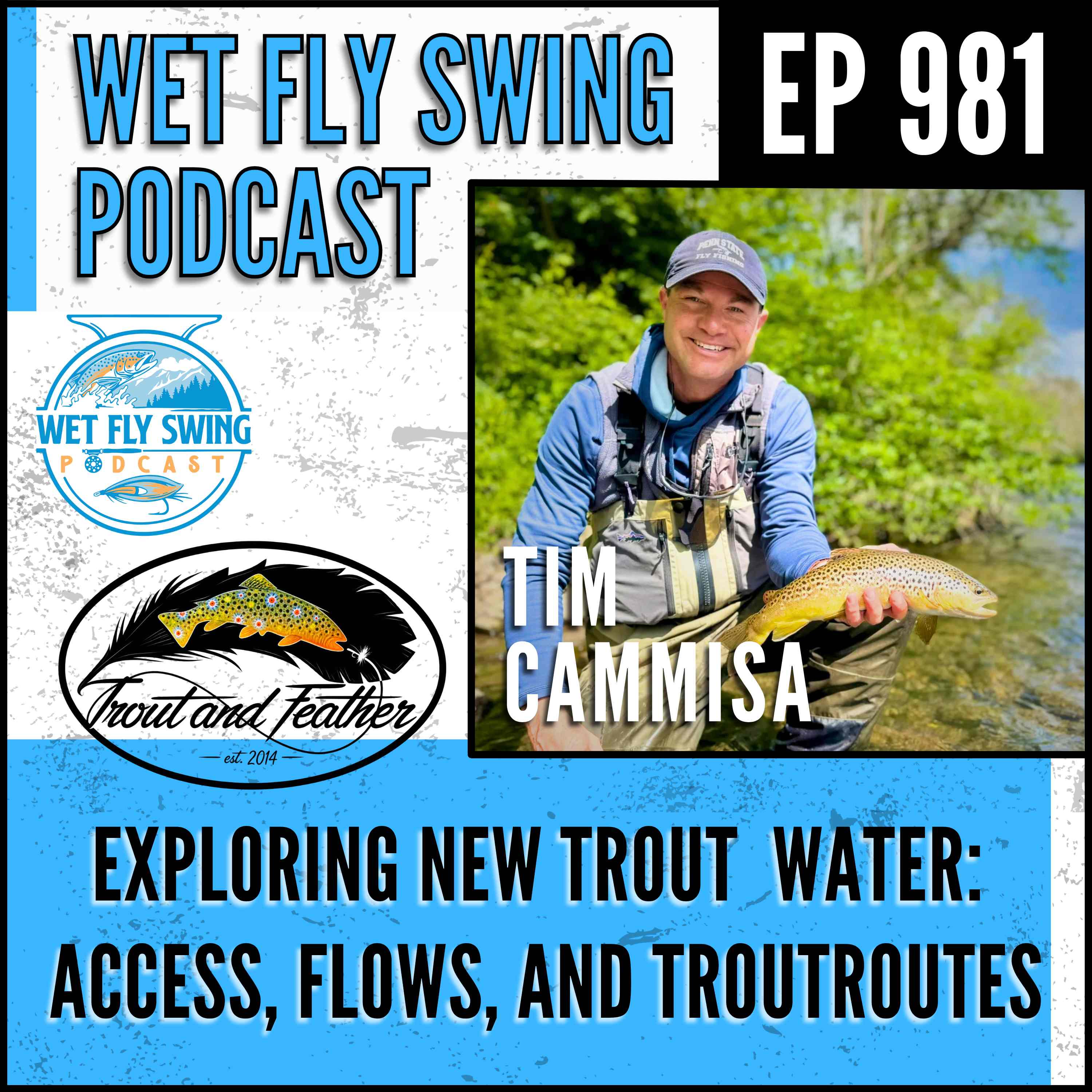
981 | Exploring New Trout Water with Tim Cammisa: Access, Flows, and TroutRoutes
About this episode
#981 Show Notes: https://www.wetflyswing.com/981
Presented By: TroutRoutes
In this episode, Dave talks with Tim Cammisa of Trout and Feather about exploring new trout water with a better plan. Tim explains how he uses TroutRoutes, access maps, USGS streamflow data, local information, and backup locations before leaving home. The planning does not end when Tim reaches the river. He confirms access, checks water temperature, watches for insects and rising fish, and studies the dominant water type before choosing a fly. Dave and Tim also discuss river-reading, technology, social media, and protective trout water.
#981 Show Notes: https://www.wetflyswing.com/981
Get every episode summarized
Each time Wet Fly Swing Fly Fishing Podcast publishes, we email you a written briefing from the transcript — the topics, who appeared, and any specific claims, with the ad reads skipped.
Email me new episodesFree for 3 shows. No card needed.
Hosts & guests
Transcript ready
1,536 searchable segments. Every word is indexed and playable.
Full transcript
Wet Fly Swing Fly Fishing Podcast — 981 | Exploring New Trout Water with Tim Cammisa: Access, Flows, and TroutRoutes. Machine-transcribed; use the interactive transcript above to jump the player to any line.
Today's guest kept a fishing journal for years and started to notice a trend. Every spring he was returned to the same sections of river, fishing the same flies, and probably catching the same fish. That realization pushed him to start exploring new water and today we're breaking down the system he uses to do it from researching access points and checking stream flows to reading a river when you finally get there. This is the Weft by Swing Podcast where I show you the best places to travel to for fly fishing how to find the best resources and tools to prepare for that big trip and what you can do to give back to the fish bichis we all love. Tim Camisa is back on the podcast. He is the guy behind Trout and Feather and author fly fishing educator in an angler who has spent more than three decades figuring things out. Today you're going to find out what Tim does during the first few minutes after arriving to the stream including why he uses binoculars, what water temperature he's thinking about insects, he's figuring things out and we're going to discuss it all today. We're also going to talk about why your dry dropper may actually be too buoyant and the
lesson Tim picked up from top competition anglers and is in his new book. We're going to get into this one. This is a great tip. Tim also is going to share how he uses trout routes, Google maps, USGS gauges, fly shops and Facebook groups to build a better picture of unfamiliar water. Also going to break down how he looks at fishing seams, riffle edges, soft pockets, depth changes, current breaks, runs and tail outs. This is going to be a good one. We're going to get into the pre-trip, planning the on the water, planning when you get there. Can't wait to jump into this one. Here he is. You can find Tim at trout and Feather.com. Here's Tim Camisa. How are you doing Tim? Dave, it is a pleasure to be back here talking with you and helping people get better fly fishing, man. Nice, nice love it, man. Always good to have a chat, always. I think last time it's been a little bit, but I think we got our little annual check-in, which I think we should keep this going. You know, have a little podcast every year, I think. Is that sound about the right cadence?
That's about the right cadence. I mean, I'm very fortunate to talk with a lot of people on a bunch of different podcasts, but I'm not going to lie. I'm very partial to yours, man. We've got so much fun over the years. Let's keep this going. Let's keep it going. Well, today we've got another great topic. I mean, I think that you're known for a lot out there, fly tying YouTube, your prolific presenter, show speaker. You've got all the trips you've got going, which is amazing. We want to get caught up on that as well. But yeah, so we're going to get an update on all that. And then Trout Routes, I want to say. So Trout Routes, an amazing brand out there. We're going to get an update on how you're using that and some of the things you're doing. But before we get there, give us an update. It's kind of mid-summer. We're September's right around the corner right now. Have you, what do you got going? Have you been doing some hosted trips, things like that? Yeah, I mean, listen, I'm very lucky. I mean, I think for your listeners who have not been introduced to yet, my name's Tim Kameesa. I grew up, I learned a fish in Pennsylvania. I've been involved in fly fishing and fly tying for, I mean, kind of embarrassed to say. I'll just say over three decades.
How about that? So, you know, and I have my website, Trout and Fathers, I have all my YouTube videos and I've written some books. The one thing I want to say, and because you mentioned summaries, that a lot of people don't understand that my day job is as a school teacher. I'm actually an elementary school teacher. I teach sixth grade social studies in science. I love it. So I think that's part of the, you know, why I really enjoy the teaching aspect of this. And somewhere along the line of all this fly fishing education, I got involved in doing a lot of trips. And this summer, it was kind of no exception. We had a ton of trips. I don't like to brag about them because it's not a bragging thing. And it's kind of tough being a teacher because I get back to that first in-service day. I see all my colleagues and, you know, everyone Dave is asking like, hey, how's your summer and they're talking about the beach. And they ask me and it's like, I'm embarrassed to tell them like what I do over the summer. Like, you know, we're talking, this is the end of summer, 2026. Like I spent June in Montana. Then I went to the outer banks to chase redfish. Then I went to Alaska with my family. I brought my family there.
This wasn't a trip, hosted trip per se. But I brought my family up there and, you know, Chase Sam and Enrembotrao went to Brooks Falls to see the bearers. And then I got back from that. And like four days later, I was hosting a trip to Iceland for trophy brown trout in Atlantic Sam. And so it was, whenever I say I had an exceptional summer, it was awesome. And, you know, I got to spend a lot of time with family, friends, some, a lot of new clients, some returning clients. And then I made a lot of content in between all those trips. So it was a crazy summer, but it was a great one, Dave. Nice. That's awesome. Yeah. So on the surface, it's like, wow, you know, Tim's out there just travel and live in the dream. But I mean, like you said, three decades, you put some time and effort into, right, to get to this point. Yeah. I mean, I'm really lucky with, with a lot of these trips and everything that I've built up a pretty decent client list over the years. So whenever I announce trips like, for instance, in summer, 2027, I have a couple trips going to the Iceland. I have trips in 2028 that are already planned out. I have new steelhead trips to the Great Lake Tribitaries.
And the majority of my trips sell out within about a week or two. And you can look at it from a couple different angles like, oh, he's really lucky. But it's like, I've really been working my butt off to make, you know, these trips, like the best possible turnkey experiences. And just, you know, I really, I'm a very big believer in getting reflections afterwards and talking to everyone who's been on the trips to make sure like, what went right and what didn't go right and how can it be better next time? And probably the same as you with your podcasts. It's like, I am just a big believer. And if I can make something better the next time, it's like, don't apologize. You know, learn for whatever mistakes or just learn how to make it better. And that's how these trips have gone. So I don't know. We had just a fantastic summer. I can spend probably two hours talking about each of the trips because they were that good this summer. But, you know, fishing was good. It was, it was a good summer for me. That's great. Well, we'll follow up with that as we go here a little bit today. But, you know, we want to talk, yet a great topic. We're going to cover, which is kind of researching and planning and mapping out a trip. I think that, especially the new waters, that's always a struggle for people.
You know, there's the whole thing of kind of where to go, where to fish and all that. So where do you start that? If you're going to start this conversation today, you know, how do you help somebody maybe have a better chance if they're going to a new water this year? That's great. And Dave, I'm really excited to talk about this one because this is kind of outside of my typical talks that I would give it like the fly fishing show. Because I think whenever you and I were coming up with this, we said, let's go this angle like from the map to the first cast. Like, how do you explore new trout water? So we'll really focus on trout. You can apply some of these concepts to other fish. But, you know, whenever I think about my own background, again, growing up in Pennsylvania, I think to myself like whenever I was 16, I got the most important license at that time. And it wasn't my fishing license. It was my driver's license. And my cousin and I, we just started exploring because we were both anglers. We wanted to catch fish, especially trout. And I had grown up, you know, my teenage years learning to fly fish. And we had fished a lot of what I call delayed harvest and like fly fishing only water. And it was almost like if there was a sign there that said you could fly fish, that's
where we went. But then as I started driving around, I realized there's a lot of, there's a lot of public water in Pennsylvania and a lot of it held trout. So here I am. I just, I can picture myself Dave like driving around were 16, 17 years old. We have a topographic map and my pencil were marking like access points, water temperatures, like places we caught fish, the patterns we used and like all that. And now like, I don't know fast forward three decades and it has changed so much. The landscape of technology, especially when we have tools, some of them that are free like Google Maps, we have trout routes. And they really opened the door to this trip planning. So I don't know, even when I think to myself like the past two summers, I've spent time in Montana fishing some of the most popular rivers yet there was no one around me. And that didn't just happen by luck. So whenever I kind of say to myself, all right, what can Dave and I do to get this rolling? Let's start with, you know, why do people struggle on unfamiliar water? And before you get to that unfamiliar water, what I really want to point out to, you know,
all the listeners get out of the rut. And what I mean by that is kind of something that I had to do a number of years ago. And it was, I kept a fly fishing journal. Now, my first trip to Montana, I remember my mom bought me this leather bound journal. I would write about my experience every day and like it was great. It just felt like it was very natural for me to do as a writer. But then I never went back and looked at that journal because it just wasn't, it wasn't utilitarian enough for me. So at some point during this time fly fishing, I thought to myself, why don't I make a fishing journal that I can refer to on a regular basis? And I did. I created an Excel spreadsheet. And I've talked about this a number of times and I'm happy to share this with any of your listeners. They're more than welcome to reach out on my website. And on this journal, I would put the date, the water I fish, the section, what the conditions were like if I could find the USGS stream data, flies that work, just a bunch of data. And I did this for a year. And it was cool to kind of start to see like the dates fill in and the waters fill in.
And then I did it for a second year. And then the third year was when I really started to hit home that I felt like I was in that Bill Murray movie Groundhog's Day. I started looking back, Dave, and realized like on April 15th every year or about that day, I was fishing the same river in the same section using the same flies and probably catching the same fish. Right. Now, and that really forced me to get out of that rut to start figuring out new water. But there's issues with that because I think whenever I, I don't know, when I think about what I did and what, you know, some people that I've talked to over the years have done, like number one, like you just automatically maybe you choose the most famous river. Or you pick one access point and you don't have a backup. You get there and you realize you can't fish. And maybe you're only looking at fishing reports from a fly shop website or from Facebook. Or maybe you just completely ignore the stream flow or the regulations or the parking. And maybe you don't even understand if there is a private versus public spot there.
Some other things that, you know, I've talked to that people struggle is, you know, assuming every mile of a named river fish is the same. And when I say a named river, I mean pick any ex famous river and say to yourself, I'm on this river. But just because you're on mile two versus mile 12, that river can fish dramatically different. I mean, there's one in Pennsylvania that I know of that I could be catching trout and three or four miles down river. We're catching small mouth. So you have to kind of pick that apart as well. And then, you know, something I probably did as a 16 year old. But I spent way too much time driving between locations or, you know, something that happened a couple years ago, I arrived somewhere. I hadn't downloaded maps to my phone. I didn't have any service and I was out of luck. So whenever, you know, I look at all this, I kind of say to myself, a lot of these bad fishing days, it was probably bad planning on my part. So whenever I say, all right, how do we start? It would be with something like a pre-trip scouting system or a plan. So for me, if I'm saying like, hey, I'm going to plan a day on unfamiliar water instead
of picking like a famous river or a river that surrounds that famous river, I'm just going to look at, first of all, like the general region and say to myself, what is this area like? Are there a lot of houses? Is it very rural? What are the rivers like? What are the streams like in there? And without a doubt, the whole notion of public land. And I also say to myself, like, if I get to this river that I've never fished before, I have to punt. What's the driving distance somewhere else? Like, is there a nearby alternative or is it one of those deals where you drive, you get there, and if it's bad or if something's wrong, like you're stuck? So I know like whenever I think of these things, like stream classifications, you know, ratings, they're a great starting point, but they are definitely not a promise. Because I don't know, highly rated streams, they could be crowded, they could get blown out, they could fish poor. And sometimes whenever I think about like those less celebrated streams, I don't know, they tend to fish better when there's fewer people on it. I mean, I used to guide on and I fish some of the country's most popular rivers.
I mean, I guided on the West Branch of the Delaware. And they're great. Like rivers like that, like the Missouri River out west. I mean, I can name a handful. I'm not here to spot burn, but they're wonderful rivers. There's a reason they're so popular. They're great. But I can also tell you that within 45 minutes of every one of those rivers I'm thinking of is one that probably fishes just as good and it gets easily half the pressure and notoriety. Right. So that's something that, you know, I think I want to really point out to people, if you want to fish X river, name it. I mean, I don't know, babe, the one that just I wanted to keep saying is the matter. Yeah, there's all sorts of them out there, right? Yeah, the Madison, the Madison River. The Madison River, right? I mean, I hate to, that's like the river. It's like everyone wants to fish the Madison. And that's great. Like fish it. Like you definitely should. I don't think anyone should, you know, I don't want to remove that opportunity, but no, like you don't have to go to that bridge that everyone else fishes that. There's lots of spots there that also can get you in the game. So that's kind of what I would call my, I don't know, we'll just get into that first notion would just be this pre-trip. Right.
And he thought so far. That's perfect. Yeah. So basically instead of narrowing down, which I do the same thing, I haven't been doing the journal, right? I need to start doing, I talk about that, right? Because I'm sure I do the same thing. I go to the same spot over and over again. And instead we need to be expanding out. So I think that's a good, get a perspective of the region of the bigger area and say, okay, I'm going to this part of whatever, Madison, but there's a lot more trips to that. Places to explore. So what do you do once you're like, you know, you want to go to this area? Let's just say it's the Madison area. Then what is the next step to finding those little secret gems that maybe not the perfect? Yeah. I guess the next step would be, I got to study the access. That's really a big deal. I mean, whenever I think about access, I think about somebody like Bob Beasley, he's written so many articles. He's spoken at length about this topic because I mean, some states, in some states like the landowner, you know, has to the high watermark. In some states, you could be drifting in a boat or in a tube and you're not even going to put your foot down. What is it in your state? What is it in Pennsylvania? Yeah, there's a couple different things because, you know, there's some rivers that I fish
where you can only be on one bank in Pennsylvania. There's some rivers that, you know, it's fully public because the river was deemed navigable. navigable, right? You know, and then there's some rivers that it's completely private. Because it's owned on both sides. Technically the water belongs to the Commonwealth, but how are you going to access it? So that's one of the tricky parts. I mean, and you know, I fish internationally as well. Like whenever I go to places like Iceland, every single river in Iceland is private. The only access you have is through an outfitter. So you really have to study access, which is why, you know, we'll bring up, I know we're going to mention trout routes, you know, occasionally, but what's nice about an app right, like that is they include public and private land information. And thousands of access points, which is why that's one of my preferred apps to use. I mean, I love Google Maps. It's free. You can put it on your phone. It's simple. But to know that you have like the ability on a free app like trout routes to just get this information, that's huge to say, all right, here's six different, like parking spots that are all within, you know, an easy walk of the river.
This is where I want to go. And other things that I look for, depending on what state I'm in, you know, is it a public parcel? Is there a fishing easement? Is there a bridge or a trailhead I have access to? Is there a boat launch? Because that could be somewhere that's, you know, easy for me, especially if I'm going to be bringing one of my tubes or one of my rafts. And most importantly, it's not just where the public access begins, but it's also where it ends. Because I am like notorious for saying, you know, I'm going to work up river for a couple miles and get out and walk the road back or something along those lines. And you might spend, you know, walk two miles up river and go to get out and realize you're on private property. So, you know, knowing where you can legally fish is almost important, as important as knowing where the trout might be. So that's the first thing I do. I study access. Once I've decided, all right, I'm going to this spot, then you got to check your conditions. And this is a tricky one. I mean, the story that I like to tell is, you know, years ago, I was going out to Central Pennsylvania to fish, you know, my buddy Jason and I, we were just super excited and we
didn't check the conditions. We were just hanging out the night before we stayed up late, yet rained all night, but we didn't really think too much about it. And we show up at the river and it's just complete brown and it's mud. We didn't have a backup plan. Like we had nothing. So here we are, like, what are we going to do? There's a local fly shop. We go on this fly shop. I run into this guy who I later became very good friends with. His name's Eric Straub. And he saved our day. He's like, hey, listen, there's a little stream that I know of. It's, you know, about an hour away. It's, you know, on top of a mountain, it never blows out. Go up there. Jason and I went up there. We caught log pork trout for hours. It was like just us and the fish. The water was perfect. But that doesn't mean you shouldn't go if you don't have an alternative because, you know, that's just, that's not the way it works. I can look at like another story that I could tell is, you know, how one, one day it was like the last day of the summer. I was going back to school the very next day and it had rained all night. And I'm on my computer. I'm looking at the USGS website and as I'm looking at it and I'm realizing like my river's
probably blown out. It's skyrocketed and it's like four in the morning. I'm standing at the window holding my cup of coffee just like, I don't know what to do. And I'll, I'll never forget this. I was like saved by my wife Heather who also is a very prolific angler. And she came down. She's like, what are you doing? Why are you still here? I'm like, I don't know if I'm going to go fishing. She's like, you're literally going to be in school tomorrow, you know, at an in-service day wishing you were fishing. And here you are. Like, you have a day you can go like get out there and like she motivated me. Yeah. Thankfully, she did, Dave. I got there. The water was starting to come down. It had peaked and it was now on its way down. And it was one of those days where it's like every streamer that I threw, it felt like a fish ate. Oh wow. So sometimes you get lucky and sometimes you don't. But you got to know your conditions. And what do I mean by that? I mean, my favorite site for that is USGS, which is on a lot of apps as well. I mean, what's nice about it, that website tells you things like the current flow and it compares it with a typical flow.
You can kind of see if it's rising water versus falling water. You know, it's not up to date by the second, but it will at least get you in the game. You can check for recent weather, you know, water temps, seasonal runoff, you know, a tail water versus, you know, a free stone, that type of stuff. If you know the type of river that can give you some clues as well. The tip that I kind of, I really like to share and I really hope your listeners can take this one to heart. I'm saying like, you don't always have to fish that famous river. But sometimes if it's not a famous river or if it's not a popular river, there may not be a USGS gauge on it. And that's not a good or a bad thing. That's just a thing. So my tip is see if you can find a nearby river or one in the same watershed and look at that gauge. And if you can find that gauge, that can give you some clues as to how your river probably is going to be that day. Other places that I think up for resources, I mean, we talked about going to fly shops, but many fly shops also have a daily blog or they give you stream updates on them.
You can find a fly shop in the area that's great. And then for people out there who are saying, Tim, there's no shops in my area that I'm going to tell you getting involved in social media. And you know, for me, I look at social media, you know, I use it pretty frequently, but I think people are inherently good on social media. And the one that I steer people to is Facebook, but not just Facebook in general, but this thing called Facebook groups. And if people haven't used them before, imagine a group where I can type in the name of a river, I can type in a name of a state and fly fishing. So I can put in something like, you know, Wyoming fly fishing, you know, Vermont fly fishing. And there's a group of people that are just focused on that area. And you can join the group. Sometimes you have to answer a couple questions. But once you're in the group, you can do stuff like just make a little post and say, hey, I'm thinking about fishing this river next week. Does anyone have any tips? And you would be shocked by how many people will either comment on your post or reach out privately because, you know, they don't want to give up too much information to the public.
But again, I think people are inherently good. And Facebook groups is just, you know, one of those ways that you can easily check conditions and help you get into the game. Yeah, I agree. I agree. It feels like it's socials getting. Yeah, you could find the, you know, there's some, it's views for bad, you know, and sometimes right? It's used for some stuff that's negative. But I think for us in fly fishing, there's just a lot of good, right? Like you're saying, there's a lot of great people out there just wanting to share. You don't have to spot burn. You don't have to share your photo of the spot and then throw a thousand people. But you could ask questions like you're saying in groups and all that is great. Yeah, you got it. Yeah. All right, so we got two conditions. Now, a couple other little thoughts that I'll just throw out here is, you know, thinking about like the elevation, the stream character, you know, I think about like, does this water have a steep gradient, which means there could be more pocket water, some plunge poles, probably faster, maybe good for nymphing. Is there a lower gradient, which would mean longer poles, you know, some softer seams? Maybe even warmer water. Are there meadows sections with undercut banks?
Is it a head water that could have some more wild or native populations? Is it a tail water, which I love tail waters? They're very stable when I think about temperatures and insect activity, but sometimes they have more fishing pressure. So, you know, the nice thing about using maps, they may not show you the exact holding lie, but they can at least help me anticipate the kind of water I'm going to encounter. And then as I, you know, start to get everything there, I'm like, all right, I'm getting ready to go. Then I'm building my, you know, my plan A, my plan B, my plan C, like what's my primary stream? Do I have a backup stream or spot if that's not going to work? Do I have a high water alternative? Do I have a low water alternative, which is another interesting, you know, spot of that like right now, we're at the end of August in Pennsylvania. The rivers, they're, we've had a little bit of rain off and on, but if I get to a spot and it's just too low or it's too warm to fish, like I might say to myself, do I have a warm water pond or lake as a backup? Right. Well, and I'm looking at, I just typed in the lower Madison, or the Madison just to
see on trout routes. And I'm looking at it, it's cool. There's a pop up right there on the first page that said, hey, there's certain restrictions on this river and I opened it. And it says, who'd out restriction prohibits angling from 2 to PM right to midnight? So there you go. So we've got, I mean, that's the other cool thing is having knowing that would be good to know, right? You don't want to get out there at 3 PM after 2 because you're not fishing. No, no, I'm, no, I don't know. I still think back to myself like 16 year old me or 12 year old me, like I would be blown away by the technology we have now that just, I don't want to say it makes it easy, but it just, we have so much information, which I think probably your listeners out there right now are saying, there's almost too much information, which I believe there's too much in fly fishing now to, you really have to sift and sort and find those resources that tend to be the cream of the crop, the ones that rise to the top. So for sure, and you know, I guess finishing up my plan, I like to have a couple access points. You know, just say I'm going to try these spots. If I am using an app like, like trout routes, I do use the, the pro version. So I'm going to download some offline maps because that could, you know, make or break
the day depending on myself access. And I don't know, I just, when I think to myself, like what am I trying to get out of these plans? I don't want my entire fishing day, depending on one parking lot or one access point or just one river. I want to give myself options. So this, this is the stuff that kind of all goes on behind the scenes before I arrive. You gotcha. So that's it. So you've done all this before. You've even hopped on the road. This is just getting you, so you've got a plan of attack. And now you know kind of where you're going. You know what flies. You've got all the, the until how much time does this take you to think everything you've just covered these first four pieces? I've gotten pretty quick, you know, pretty good at it over the years. So it's a lot faster for me because I kind of know, you know, where to look, what to look at. If I'm looking at a website like the USGS, I can figure it out pretty quick though I will say, I'm sure your listeners will agree with me. They've changed the interface over the last few years, one or two times. And every time they change it, I'm like, ah, this is now new for me. I can't figure out how to use this. Where's this one screen?
So the one thing I've not liked with USGS is how it's, it's kind of changed a couple times. You know, whenever we use some of these, these apps, they're a little bit nicer because you can open an app, click on a river and it just tells you the USGS immediately for stream report. So I like that aspect to be able to look at the number, even though there may be more data on the USGS website. But I don't want to say it takes me X amount of minutes because there's not that bit. And maybe this is going to sound weird, but I'm also the person I love preparing for trips. I love the anticipation. I love tying flies. I love getting my leaders ready. Like thinking about the rods, like I love the pre-trip planning. There's, it doesn't matter if it's a, you know, a week long trip, you know, a day trip, like just a couple hours. I love getting ready for trips. So I am weird in that aspect, Dave. Yeah. Nice. Nice. Cool. So where do we take this next? So you've got a plan of attack. You know, heading out, getting on the water, talk about that. Yeah, you got it. So now let's, let's get there.
Let's say we're arriving. What happens when you arrive? And, and you know, whenever I think about my arrival routine, first, I'm going to confirm that the access looks legitimate. I love to tell this story. I fished in Michigan, you know, pretty frequently. And one of the first times there, I was on a river that many people probably would know. And I parked and I went down to the river and I'm fishing. And I was actually with, I met a friend at this access point. And after about like 10 minutes, we hadn't gotten too far away. Someone yells like, hey, someone's parked at the boat launch. And I'm like, oh, man, like I didn't even know there was a boat launch here. And, you know, we keep fishing and they yell again, hey, who has, you know, this vehicle. I'm like, that's my vehicle. And I yell back, hey, that's mine. I'm not parked there. And I'm like, you're parked in front of the boat launch. And I'm like, no, I'm parked in front of these steps. And they're like, that's the boat launch in Michigan, these steps. Because they have these real long skinny boats. And these canoes, I'm like, I'll ride down and like move it. So here I am, like, I'm at the boat launch, blocking everybody. They're all mad at me. Oh, wow. And here I am. I got Pennsylvania plates in Michigan. I'm like, they're going to nice.
Deflate my tires. So again, make sure you understand that. Something else I like to do that just takes a few minutes. I don't know. I like to observe the river. And the first thing is bring a pair of binoculars. Could just be a real, cheapy pair. Just something that you can scope quickly. And just take a look at what's going on. Can you see riftly water? Most importantly, can you see fish rising? I mean, I love to urinate. I love to throw streamers. I love to swing wetflies. But man, I love dryflies. And if I find fish rising, like I'm going to go after those ones. So take some binoculars and see which you can kind of dig up. I don't check the water temperature. There's a few different thermometers that I use. I use this one. Digital one, I can just click and get a surface temp. I have this fish pond one that I put on my boots. So I can just walk in the water and it'll tell me the temps. Or you can just use an old school one and throw it in. But find the temperature. Make sure, kind of like what you're saying now. It's not too warm. Or the other side of things, it's not too cold. A story that I love to tell, I was fishing this river
in Western Pennsylvania. It had been freezing. And it was finally a day where everything warmed up. And I'm like, this is the day. And I showed up. And I wasn't catching anything. But I was freezing in my waiters. And I'm like, I don't know why I'm so cold. It was gorgeous. Well, it was gorgeous. And it was so warm that it was melting all the snow. And the snow was breaking off. Ice chunks were actually going into the river. And it was lowering the temperature of the river that day. Whenever I finally took the temp, it was like two degrees or three degrees above freezing. Like the temperature of the river actually went down even though the day warmed up. So I got to take my own advice sometimes. Just don't assume. Just take that temperature. Look for insects. Look for feeding activity. I mean, go into the water, turn over a rock or two, my other little tip that I have. If there's a bridge or somewhere where you can find a cobweb, look in that cobweb. See if there's any insects that are left over from the night before. Maybe some mayflies. Maybe some catasflies. I'm going to identify the dominant water type. And just say, are there a lot of ripples?
Are there a lot of poles? Are there a lot of whatever? I mean, find out what that dominant water type is. Which will help me figure out which technique I'm going to use. Because one of the things I'm guilty of, I'm thinking many people might be as well, I get there already thinking I know which technique I'm going to use. And sometimes Dave, I even know what fly I'm going to use. I know. That's not right. You know, like you and I know, that's not the right way to approach it. But it's like, yeah, I'm going to get there. I'm going to put on a fesentail or I'm going to put on my ex-catas or this black jig bugger. And it's like, don't do that. But it's tough not to. You just want to go to that water type and you're comfortable with and use that fly you're comfortable with. But you really have to think about reading stuff. I mean, we can get into different water types next if you like, but just don't show up, you know, saying, I'm going to do this. Just really see what the water has to offer you. Trout routes by Onyx is built for fly anglers who want better intel without spending hours
digging for the information. You'll get access to public land maps, stream access points, regulations, and even road and trail maps all in one place. It's become my go-to app for scouting new trips. You can check them out right now. Go to wetflyswing.com slash trout routes and download the app today. And you know, what is the next step? How do you know when to put on the dry fly versus the wet fly? Do you wait to tell your seeing heads popping out? And you know, what's your describe that for somebody who maybe struggles with that a little bit? In terms of when to do which technique, is that what you're saying? Yeah, like if you win up and you're looking, well, first you mentioned water types. You've got ripples, you've got pools, like what do you fish first? You know, do you have a system on that where you come to it? You're like, well, I'm going to start with, well, you said you start with dry flies if you're seeing, is that kind of what you're doing? Is there a way to see if you're seeing some action? Well, I guess it comes down to your comfort level as well because you have to fall back on what your comfort level and whenever I think about fly fishing, I think we all have our comfort level in terms of a technique. I mean, I know anglers who will throw nothing
but a dry fly. That's their dry fly or die. I know other anglers that are just, I'm going to Euro-Nymph. It doesn't matter if there's fish rising. I'm going to Nymph right through them and then there's this one, you know, angler that I'm thinking of that is going to throw streamers all day. Doesn't care if he lands a fish. He wants to see that bright yellow streamer coming through the water and maybe see an occasional chase. So I think you have to say to yourself something, you know, I am notorious for saying, it's good to have a lot of arrows in your quiver and to have a lot of techniques. Yeah. So if you're a dry fly, what if you're just sitting there, you really want to get some dry fly action today? What would you be? I think you got to say to yourself, you know, what water do I look for? Because this is probably the toughest part of fishing for most new anglers, for many intermediate anglers as well. And it's learning how to read water. Because, you know, whenever I get to unfamiliar water, that's what we're talking about. It's one thing when you say, I know I'm going to go to this spot. I know there's going to be fish there. But when you get to unfamiliar water, the first thing you have to say to yourself is, you know, where should the fish be today? And if you can make connections to not just the river
where you catch fish, but the river where you catch fish that time of year, or that water temperature, or that, you know, water depth, or that water clarity, if you can build that connection and say, when the water's like this at this temperature, this is the type of spot I go to. And I'll give you an example of that, where I failed once. And it was in the middle of winter, I was fishing this super fast water. Why I'd fish like really fast water all fall, and I had nymphed that water. I had fished a bunch of really nice, just transition points that was real fast current along a slow current, just a nice little seam, basically. And I really just fell in love with that style, bringing flies like parrots going through there. And I show up in the winter, and I get to that spot that I had just so much familiarity, so much comfort with. And I'm fishing these nymphs, and I picked up a fish or two, but nowhere near what I should have. And finally, I was able to say to myself, Tim, like, it's the middle of winter. You know, fish aren't going to be in this style of water. They're going to be, you know, in holes. They're going to be in pools. They're in slow moving water.
They're conserving energy, because there's no bugs hatching right now. And if there's no bugs, there's no protein for them to get. Like, they're not going to be wasting their energy, swimming back and forth in those seams. So then I moved to a slower, you know, slower water, changed my approach, changed my style, caught a bunch of fish. And so I think you have to first say to yourself, what are you comfortable with? What connections can you make? But what do you see in front of you? I mean, the stuff that I tell people to look for, it really comes down to transitions. I mean, I'll say these things, and as I say them, let me first just say them, and I want your listeners to say to yourself, can I picture this? Then let me go through like how I would fish this, and what I would think about in these spots. I mean, I don't know, Dave, I think of seams. I think of riffle wedges. I think of soft pockets. I love undercut banks. I really think depth changes are really critical for anglers. I like a riffle to run transition. And I also look for obstructions, current breaks, trees down, boulders.
I mean, those are areas that, even if I've never been on that water, you should be able to go to those, however many I said, 678 places and say, there's gonna be fish here. If the temperature is good, if this is a stream that's known to hold trout, they're gonna be in those spots. And the first one is a seam. I mean, think to yourself, if there is slow water, immediately beside a faster current. That fast current's gonna deliver food, and those trout are gonna be sitting in the slow water. So you gotta work that boundary between those two speeds. Don't cast into the fast current, but hit that boundary water, right where that fast water meets the slower. And now you're saying, what technique do you use? That's nymphs. That's nymph water. Dry jobper can also be really well, if that seam is shallow enough for fish to decide to go the whole way up. And especially if you've seen some heads popping up. And I think that's kind of that, do I go dry or nymph? If I see an occasional head,
that might be a dry dropper, which means I'm gonna be fishing a dry fly with a nymph as a dropper, either off the bend through the eye of the hawk or just off a dropper tag, which is kind of my preferred way. If I'm not seeing any fish rising, I'm probably gonna fish one nymph, maybe two nymphs if I'm legally allowed to do so there. But whenever I see seams, that's what I want my fly in that feeding lane, that really that boundary water will cause as long as I can keep them there. Yeah, and the seams are gray. So that's a good tip that it's not necessarily, you see a seam off of a pool. It doesn't mean necessarily you're throwing a dry fly, a nymph might work better in this situation. Do you, what about in the dry dropper? What's your size? Let's say you had a nice dropper, you were in a fish that had a paragon or some nymph. How small could you go on that dry dropper? Or do you need a big fly, typically, bigger fly? Wow, Dave, this is a great question. I probably would have answered this different maybe five years ago. I recently wrote a book called Time Euronems. And in that book, I interviewed like 30 of the top competition anglers today.
And it was all about nymphs originally, but at the end of every interview, I asked them a little bit about just their other favorite flies and styles. And these people, these are anglers that have lots of arrows and their quivers. I think most people assume, oh, it's a competition angler, they're good at nymphing. Like, no, like these got, these anglers are excellent at every style. There's a reason they're the best in the world. And a lot of them, most of them fish dry dropper because in competitions, they can't use an indicator. And indicators, I don't care what people say. Like, there's a reason indicators are effective. You can cast them at distance. They help to carry a light line, especially urine, nymphing rigs or mono rigs. They're great for just long pulls. I mean, indicators are a great way to fish. But dry dropper can be equally, if not better, depending on the situation. The tricky part is I think too many anglers state themselves, I need a really buoyant fly. I'm gonna put something on like a tubby chinnoble and then a size 18, wall swarm or pair to go. And I will say, that doesn't mean that's a bad setup.
I'm not telling you it's a bad setup, but the tip that I learned, the hot take, that I'll tell you that all these, every one of these competition anglers said, they wanna dry fly that will just barely suspend that nymph. So if anything touches it, that dry fly will go down. That's right. And that's what they want. So they use a lot of CDC. They definitely use foam, but not as much foam as you would think. Like in my mind, it was like, I want something that's gonna float, it can suspend a heavy fly. Yeah, super buoyant, they can go through the rapids and stay dry, right? Yeah. I think it was Josh Miller. Don't quote me on the exact, but I think it was Josh Miller. He was like, he's like Tim, like picture like an overweight guy and like a kid's life preserver. That's how I want my dry fly acting as a dry dropper. And if you think of it like that, like just the slightest. Oh, he's going down, that guy's going down. Exactly, does that make sense? Oh yeah, that's perfect. I love that analogy, the big guy, the kid's life jacket. I need to come up with a more appropriate analogy, but that's the one I got for now. No, that's good, that's good. I love that, yeah, and that's a good reminder because that makes you start to think like,
yeah, you don't need the biggest fly. You need just to fly big enough that any little subtle touch will indicate that you've got a fish maybe on the, yeah, exactly. And then it could still take the dry fly, it could still take that dry. Abs, I mean, yes, I was fishing Yellowstone drainage this summer. We were doing dry dropper off of rafts. And I mean, that was, that's the style. I mean, it's just cast in blasts as many cast as you can make within inches of the bank. And sometimes they're going to nail that dry fly. Sometimes they're going to take the nymph, but that was the issue. It was really dialing in that correct weight where at one point I said to the guy, I'm like, hey, I got to put on heavier nymph. I think fish are eating my nymph, but it's just, it's not showing. Like it's not a, not like they're just not balanced correctly. And sure enough, we put it on. And that heavier nymph actually slowed my dry fly as well. And it was just immediate. Like just we just started catching so many more fish. So there is a balancing act between those flies. Awesome. Well, that was awesome. It seems maybe give us another one if you mentioned some of these soft pockets under. That's what's another good one you really when you see it in the river, you're like, man, I'm fishing that spot.
Yeah, I don't think we have time for every single one, but I don't know. I love, these are all transitions. Let's first say that. These are really just all transitions. I think something big is depth changes. Anytime you have a sudden transition, think of it that way. From shallow to deep water, that deserves attention. I mean, trout will position themselves near the drop where they can still remain protected, but they can feed on food that comes in from the shallows. Because a lot of people forget, like things like ripples, those are food factories. There are so many insects that just, they hatch in the ripples. And there are so many fish, especially in late, spring in the summertime that just live in the ripples. And they never have to leave the ripples. I mean, I think I mentioned the ripple edge. One of the biggest no-nose that I see is so many people get to a ripple and they walk in looking for like juicy water within that ripple or looking for an obstruction within the ripple. And it's like, before you go anywhere, fish the edge of the ripple. That's where trout holds. You know, it's real soft water. It provides everything they need. Oxygen, food, it's not too much current.
So you want to fish that soft edge first with nymphs, especially. You want to concentrate on that transition between that fast and moderate current. And it's the same thing with that depth change. I say to myself, I want to work that lip first and then move progressively deeper. Because those fish more than likely aren't going to be at the top. They're going to be positioned somewhere in that depth change where they can still be protected, where if they do sense danger, they can swim into the depth. And they swim into the deep. They see an overhead bird or some type of predator and they're out. So I'm going to work that lip go deeper, especially with nymphs. And whenever I say I'm going to fish nymphs, I'm going to try to possibly adjust my weight or my depth. So I'm reaching that transition point. Because if you're coming from a riffle and you're working your way into that deeper water, you may have to add weight progressively as you get there. It could be a larger bead on your fly. It could be a split shot or two or even some of that soft putty. But make sure you're doing that. And let's not forget those people who like streamers. I mean, retrieve a cross or along the edge of that drop,
don't just blindly cover the entire pool. Like, say to yourself, I'm not just going to cast and retrieve in and see what happens. Like, say to yourself, where's the drop? I want to fish my streamer right along the edge of that drop. So that's one. And I guess you said a couple. How about a riffle to run? Yeah, yeah, riffle to run. That's a good one. So a riffle to run. And that's a little confusion too. With the riffle, I think everybody gets the riffle water. But the run, I think there's some confusion on what a run is. Because doesn't that turn into kind of a pool or is there overlap? How do you describe a run? Yeah, I mean, whenever I think to myself, like, what's a run? I mean, this is a run is a spot that's just kind of a long glide of faster moving water. That's a run in my mind. And whenever you go from that riffle to run, which you know it, by the way, it's riffle run pool, riffle run pool. It doesn't matter where I'm fishing in the world, you have those. That's the characteristic pool. And then after a pool, it drops down into tail out and then back to a riffle and then same thing. Exactly. It tails out, back to a riffle, and starts that transition again to riffle run. So whenever we have that type of setting,
you say to yourself, like, food's coming from the riffle. And it's going to get concentrated right there as it moves into the upper end of that run. So instead of immediately, which it's so easy for us to go to that deep water, it's so easy. I mean, I grew up in Western Pennsylvania. I feel like people just live in pools in Western Pennsylvania. And pools can be great spots to fish. But go to the upper end. Because that's where those fish tend to be. Target like that deepest water as it just starts that transition into that run. I mean, that's where I like to go. It could be a nymph. You could also hit a mergers there and hit dry flies, especially during a hatch. I mean, it's too convenient to say, I'm going to go to a pool. I'm going to sit at the back end of the pool and just wait for those dry flies to work their way there. The rear of a pool is so tough during a hatch. But the head of a pool or the head of a run, especially those could be great. Because fish just have just a minute amount of time to say, I have to say yes or no. And if there's a dry flyer or a merger,
those fish are expecting it. They come up. They say yes a lot easier than they will. And that's slower moving water. That's good. So the rear, so during a hatch, you're saying the rear of the pool towards the deeper, or I guess the deeper spot in the big bucket. That's the harder spot. Because why? Because it's kind of calmer. There's not as much cover or why is that? Now, I think it's because fish have a lot more time back there. I really believe they have a lot more time. Because I mean, we think about like a riffle. Why do I think riffles are so effective? They're shallow, they're rocky. They have surface disturbance, which means you can get closer to the fish. There's a lot of obstructions. There's a lot of bugs there. Fish just tend to be eating when they're in the riffles. And they're not there all year long. I mean, we can get into that as well. Then when you get to the run, it's deeper water. As we said, kind of faster current. It's almost smooth and uniform. Kind of look at it that way versus that pole is just like deep calm water. And once it's calm, I don't know. I feel like fish have a lot more time to kind of inspect things. And especially those near the tail out, they have more time to kind of look around
and see what's going on and sometimes see you. And that's not a good thing. The tail out of a pole can be effective at times because the tail out's a little shallower. So as those fish are closer to the surface, I don't think they can see you. As well. And there's a little bit more disturbance on the water, especially if it's breaking into a riffle again. So whenever I even think about riffles, runs, pools, tail outs, don't just look at it like that. Say to yourself, where's the transition from the riffle to the run, from the run to the pole, from the pull to the tail out. Like if you can find even those transition points, that will help you even more to break it apart. And I think that's one of the mysteries to reading water. Whenever I say, oh, riffles are great. People are like, all right, Tim said riffles. I mean, go to a riffle, but where do you fish? Yeah, where do you start? Yeah, like start on the edge. Look for obstructions. Look for soft pockets behind structure. Look for a log. Look for a current break. Like those are the types of spots that I really want to point people to. So yeah, we'll take us to whatever you got next year. To keep this going.
I don't know if we want to transition in over to the next thing or start to take it out of here, you tell me. Well, let me look over some notes. Let me see if there's anything that I'm missing that I wanted to kind of really reinforce because I do have a couple other things. I mean, we've gone into this idea of like, you know, what happens once we arrive, we get there, we're talking about the water types. I think we've given some examples to everybody about, you know, what's a practical trip planning. I mean, we talked kind of about if we're doing like a local morning in Pennsylvania, what would that look like versus something like a weekend or, you know, in a new state or even a Montana trip. So I think we kind of hit all that. We did. And one thing I was thinking about too, I think would be good. You mentioned, I think in there, the tech versus the knowledge. That might be a good thing to talk about too. Maybe, you know, the fact that we do have this tech, but there's also the knowledge when maybe, you know, I don't know, what were your thoughts there? Yeah, let's get into that. I don't know. Let's get into the idea of technology ethics and what's the word spot burning? Let's get into that thing. Yeah, right. This can get a little interesting because I think there's some questions we have to ask
ourselves. And it is, does a mapping technology like this place too much pressure on small streams or on famous streams? And to me, that's a legitimate question that whenever I go on these apps or whenever I go on websites to say fish X river, like now it's not only, I'm not, I'm not only saying like you can fish X river, these apps, this technology is telling you where to go, where to fish. There's some apps that I've seen Dave that even show you anglers that have caught fish. And you can find the exact rock where they caught that fish. So that's a question. I mean, I think that's something we have to keep in mind. I mean, there are some people out there that take that extreme like, hey, if you catch a fish somewhere, you catch that one, you should go somewhere else. And there's other people I know that could hold up and they want to catch every single fish out of that one spot. So is there too much pressure on rivers today? And I think the answer is yes and no. I think it really depends on where you live, what the populations like. I mean, I feel like there are areas of the country where I go and it's, I don't
want to say an aging population, but just not as many anglers anymore. And you go to these rivers that you think like, wow, there are so many fish. These rivers should just be, there should be, you know, 20 cars that every access spot, there's nobody. And then you go to places that have a really young population. I'm not going to say the states, but I think people can figure out a few and you get there. And it's like, you get to a spot on the river that you think should only have one or two anglers. And there's like seven lined up, just fishing next to each other. And man is that frustrating, but that's the spot. That's the area. It's fly fishing has gotten very popular in some spots in this mapping technology. I'm not blaming that, but it definitely, it can put pressure on on places. And I don't know, I think it's also in my mind, it's a little bit fundamentally different from using guidebooks or state maps. I mean, or my topographic map, because whenever I used my topographic map, I had to do so much more of the homework myself. It was me with my like Tykonda Roga number two pencil driving, like marking spots off,
like Xing out rivers that weren't good. I mean, I could think about all the rivers that I fished that were no good, that I got there looking for like wild brook trout in Pennsylvania. And we'd fish for hours and we didn't catch a thing and we'd go on to another one. And there's two sides of that. It's like, you know, I'm at a point in my life where I have a couple small children, you know, I'm a full time teacher and I do all this content and I host these trips where I don't know if I, you know, truly have hours that I want to go and spend and spend all that time looking for a trout. So I see that side of it where people just are so busy, but then there's the other side of it like, I wouldn't give up those days of my life that time for anything. Like those, I learned so much like it's really different to now say like now I have an app that I know it's going to say, oh, this is a blue river in trout stream where it's designated as class one or class A or, you know, and it tells me like there will be trout in this river. It's not going to tell me necessarily where, but I don't know what's that, what are the
ethics there? What's the technologies? Is that a good thing or a bad thing? And even something like Chatchy PT Dave, I mean, you know, whenever we start getting into AI, I remember a couple of years ago, I was using it before it got super, super popular and I would ask it questions like if I was going to this river, what do you think I should use? And now I've asked some of those same questions again and it's scary how accurate it is. Is it pretty good? It is. I'll ask it about rivers that I think no one knows about in my, in my home state and it will tell me likes and I'll say say to it like give me some access spots. Tell me where you think I should go in. Tell me what flies I should use. Tell me about, you know what techniques and it will really dial it into the point where I'm like, oh, that's a good idea. Like there was one spot. There was one spot. It was like Tim, you're probably going to get there and there's going to be lots of dry flies, but it's going to be dark. If you have trouble seeing it, instead of doing dry dropper, do a dry dropper but have two dry flies with a large dry fly and a small dry fly. And I'm like, that's my idea. Like how did it read my website? You know, like, it's not just making this stuff up.
It's pulling the information from somewhere, but... No, well, sometimes it doesn't make stuff up and you catch it and you're like, wait a minute, are you making this up and then it apologizes? It's kind of fun. Oh my God, that's crazy. Yeah, so that's another question and I think probably the bigger one and this is now this is looking at the negative side of the internet is, you know, should anglers share exact locations or images that have too much information in them on social media and it's like, man, is that spot burning? Because I've seen people that say I was on this river in this section and they're holding up a beautiful fish and there's two sides of it. I mean, there's one side of it where you don't know their story. That could be someone who has, that's their first time out fishing. Yeah, that's true. They caught this beautiful brown trout. They are so excited to share it with whomever. You know, I mean, I remember being like, whenever I caught my first brown, I can remember some of my first trout. I was, I had this little click codec camera and I was trying to hold it up and click a
picture so I can show my grandma. Like, I was so excited to share that and I think of like old, you know, fly shops or old bait shops and they used to have all these pictures. I hate all the pictures. Yeah. And now it's like these people, you know, someone will post that image, not telling their backstory, just posting that image. And in the comments, people will just blow them up. I know. That is the tough one. You know, tough one. Yeah. It's really tricky because they're not intentionally trying to spot burn. Some people might be, it's a dilemma where, you know, I know like, you know, whenever we talk about like people who I look up to as like ambassadors at the sport, those people can't like message them and say, hey, you shouldn't do this like that. That doesn't play well either. It's almost like, right. We need more like fly fishing mentors. Well, and that would happen on the river, you know, I mean, and that's happened to me in the past in the river where you're out there and you see somebody doing something kind of weird. You know, you just, you go up to him and just say, hey, I don't know if you knew this, but you're doing something that's kind of weird. You know, you might want to try to, you know, you might want to try this. So you have that conversation.
But then also on the river, I've been in situations where there's been fights that have happened because, you know, somebody was mad and, right? So I feel like that's always gone on. It's just now we're on the social media thing, which makes everything worse because you're not in front of anybody anymore, right? I think that's the part of the problem. Yes. Exactly. Now, that's exactly it. You know, whenever I think about this stuff, it's like there is a responsibility that comes with easier access to information because that's the gist of this whenever I go back to the beginning, like, what do we call this? This is, you know, this idea of, you know, from map to first cast, like how to explore a new trout water. And we have this ability now to, I've given you all these resources and all this stuff. And now, you know, I've just given all your listeners, like, this is stuff that's taking me over 30 years to figure out. And now I just gave it to everybody. It's like, well, wait, before you go out there and use it, like, say to your self, how can I be a responsible angler with this access, with these resources, with these apps, with this AI? Like, what can I do to make sure, you know, I, I don't want to say you protect your spot
because, you know, at least for me growing up, Dave, like, I didn't share my spots with anybody. And I still don't just because I'm afraid sometimes by me saying the name of a spot, it could dramatically change a spot that doesn't get pressure. I mean, there was one time, but I'll tell two stories. There was one time I was fishing a little Brooktrout stream in the middle of nowhere, Pennsylvania. I was the only one that I've ever seen fishing this river or this stream. It's not a river. It's just a tiny little stream. And I'm fishing. And as I'm getting to this one spot, there's another angler. I've never seen anyone even on this river, let alone an angler. And sure enough, he's got a fly rod. And he looks at me and without hesitating, he goes, you're Tim Camisa. And I'm like, oh, I've been spotted. He's like, is this a good stream? You like to fish here? And I was like, oh, my God, this is like my favorite Brooktrout stream of my life. Like, what am I saying? That's what you're saying. I've never been here before. You know, you're Tim Camisa, so you don't know what I'm doing. I'm just exploring. So, you know, there's a dilemma that comes in there.
And now I'll go to another podcast host, Tom Rosenbauer, who was a fly fishing podcast. And, you know, after I fished with Tom up in Vermont, we were Tom and I were fishing this one little Brooktrout stream. And we're fishing and we're catching these beautiful Brooktrout in Vermont, just what you'd want to do with a bamboo fly rod and dry flies. And as we're fishing, there's a couple that's walking along the stream. And they stop and they're admiring us fishing. And I'm like, oh, what do I do here? And they yell down, how's the fishing? And I turn to say, hey, we're having a wonderful day. You know, just something like that. And without hesitating, Tom looks at them and yells up, the fishing sucks here. We haven't caught a thing. Oh, nice. And I'm like, all right, well, there's my answer in Vermont. There's your answer. And Tom was very quick to tell me, hey, we do not give up our spots. That's so, and I kind of, I grew up with that mentality, David. Yeah. It's to the point now where, you know, if you're smart, you would never ask me where we were fishing. You would ask like, my wife or my son, but I've trained them.
Like in Pennsylvania, we have a very famous river called Spring Creek. And there's actually a number of rivers in Pennsylvania called Spring Creek. Anytime, you know, somebody asks any one of my family members where we're fishing, my son, Angelo, knows to always say, we're fishing Spring Creek. That's just, that's the line. And it's now to funny because he's 10 years old. And we were just talking about fishing yesterday as we were driving somewhere. And my son said to me, Dad, you know how we always tell people we're fishing Spring Creek? And I'm like, yeah, and he's like, but what if we're actually fishing Spring Creek? Right. What did we say that? Yeah. I don't know, buddy. You think Spring Creek is great? The name that it's like, it probably doesn't matter because there's multiple. Yeah. So I don't know. So whenever I, to kind of reflect on this session, this section of technology and ethics and the notion of spot burning, I mean, I don't know. I look at this, this information, it definitely can help someone locate water. It doesn't, you know, necessarily remove the responsibility to respect landowners, the rags, other anglers and the resource. And I don't know. I guess I'm comfortable helping someone understand how to find water. But that doesn't mean I have to post the exact pull where I caught a fish.
So I'll tell people, you know, be cognizant of that. Like I'm kind of known whenever I give these presentations to clubs around the country. I'll tell them, like, spot on, like, here's a picture of me on, you know, this river. I'll tell them to name the river and I'll say, I posted this picture on my Instagram four months after I caught that fish because I didn't want somebody to recognize that river and say to themselves, oh, Tim was on that river yesterday catching that fish. So I am very cognizant of when I make my own posts to social media of fish, especially those that I catch in rivers that I believe are popular. And I guess that last spot is, you know, I don't know. I got to be honest that technology, it can increase pressure. So let's not pretend it doesn't exist. It's just teach people how to use it responsibly. I think that's the key. I think that's a good takeaway. It's just, you've got all these tools just to be responsible. And that's the reason, you know, why things like trout routes or on X-ray, these things that have land ownership is great. That's being responsible. You know where private property is and you have no excuses anymore, right?
You shouldn't be trespassing, right? Yeah, exactly. So I don't know, I guess wrapping it up. I mean, these are some of my thoughts regarding finding new water. I love to do it. Even though I complain and say I don't have time, like I still love to do it as much as, you know, Pennsylvania is probably like many other states out there. It feels like there's a lot of pressure on a lot of rivers. You know, I fish with my wife and my daughter, who's, you know, she's six. My son is 10 years old. And when I go fly fishing, I want it to just be the four of us. And, you know, we don't fish too much private water, like we fish public water. So know that we are out on the river most weekends. And, you know, as many days as we can in the summertime and very few people see us. So I'm willing to use apps like trout routes and find spots that aren't necessarily on the popular river or are on the popular river, but just somewhere else. Because I do want to fish and just the four of us be out there and have a good time and catch fish and, you know, enjoy the experience because that's what it's about for me.
You know, it's truly is about that experience of just getting out there and spending time. So, you know, I'm going to tell people, you know, get out there. If you're in a rut, you've been fishing the same waters, say to yourself, like how can I, first of all, get out of that rut. And then, you know, use some of this advice and try to fish a new river, a new county, a new state, even a new country, man, like just save yourself. Like get out of there, get out of your comfort level. You might get your butt kicked. I can tell you very bluntly I have. Like I've traveled and said, like, oh, I can't wait to get to this spot. Because it's like, oh, if you travel so far, you pay so much money. Of course, the fishing is going to be easier. Like, no, it's not. It's still going to have bad weather, but you're going to learn from that. And then you're going to say, like, kind of like my current thing. I love Atlantic salmon fishing right now on the fly. And man, have I been humbled with that. And, you know, when they come together, like this summer, they came together in so many ways. And oh, I had just one epic morning that I could talk about. And it just like everything worked.
And it finally came together. And that moment for me was like, like, yes, that last three years, that has really just made the difference for me. So get out there and, you know, grow a little bit as an angler. That's perfect. Yeah, I think we both have that in common on the Atlantic salmon now. I think we'll have to talk about that maybe on the next one. We could trade notes in there. You get the Iceland thing on. But, but go, well, tell me this, Tim, before we get out here, you mentioned Tom. I'd love to hear, like, you fished with the big guy. What's he like on the water? What's it like fishing with Tom? Is he, how would you describe him? Does he, does he like use that intense? But he, it sounds like he is a little bit. Yes, and no, it was a really interesting day. We were fishing new water for me. And I will say this, let me go back. Tom is awesome. He is the most generous person as an angler. Whenever I pulled up, we actually met at the Orvis, the main Orvis store in Vermont. So we, you know, I pulled up there. He was outside his SUV, gave me the nicest handshake. It was like, he's so excited. He's like, I'm so excited to meet you, Tim. Just made me feel like so comfortable.
So however, if you're listeners, also listen to his podcast, however you imagine him from that podcast, he's exactly the same. Right. Exactly the same. And I've, I've had dinner with him, you know, many times now. I've texted, we email, I've been on his podcast multiple times. He is just wonderful. He's, you know, just top notch. No question about it. But he gave me a hard time because when we were fishing, a couple of things, we had a prototype Orvis bamboo fly rod that he had told nobody about. The manager of the Orvis rod shop didn't even know this rod existed. He had the bamboo guy build it for him. So we bring it out and he wanted, I think he was kind of using me to see what it was like. So we could go to the manager the next day and say it was a great rod and he wanted to build, which was very awkward just in itself. And this is a bamboo rod. Imagine fishing with, yeah, Tom Rosenbauer, a prototype Orvis bamboo rod that no one's ever seen before, were fishing spot to spot. And after he would catch a fish and I'd be up, he'd throw the rod in the air to me. And I'd have to catch it. It was like, just fishing with Tom is, you know, nerve wracking enough. But him throwing this special bamboo rod in the air, it was just crazy.
And here I am, like, making the connection back to Pennsylvania, kind of like digging into these spots and making casts near the tail. And Tom's like, no, no, no, you make three casts, put them right up by the drop. If they don't eat, we move to the next drop. And we put on so many miles, Tom was climbing boulders like he was 18 years old. I just developed so much respect for him. One of my other takeaways was, here's the guy that's like the ambassador for fly fishing. He has access to every single fly fishing item gadget tool rod, real that, that orifice. And then he probably anybody else sells. And I look at him compared to me, I have like this vest on all these gadgets. He's got this little sack. He's got like a bottle of water and that's it. I mean, he carried so little with him. And he really inspired me to start carrying less and less on the river. So I don't know, it's just one of those days that I, that day, especially, that I'll never forget with him. That's great. I love it. I love that we're leaving away with the Tom Rosenbauer story. The guy, hopefully someday I'll build a connect with him and water as well.
Well, I got you, we still got a connect up here. We've connected plenty on the podcast, but I think we're going to maybe do that in next couple of years. But cool Tim, well, thanks again for all this. This has been great. I think we can leave it there for today and tell the next one and definitely appreciate all your knowledge. And we'll keep in touch with the atroughtonfether.com, of course, and connect with you there. And yeah, until we meet again, thanks again. That sounds great, Dave. Thanks so much for everything you're doing for Fly Fishing. I love to say at the end of your podcast, I don't think anyone has any idea how much time you put into this and how many resource you're giving for all of us. I'm a listener. I'm a fan of your podcast as you know, and I don't know, man, you are running some great shows. So please keep doing it for all of us. Your plan is before your next trip to try out Tim's plan and look at this ABC approach. Take your primary water, find at least one backup, check access and flows, then give yourself permission to change it as you go. Remember that fly fishing and fishing in general is always changing and Tim paints a good
picture of how you can be better prepared for the next trip. If you're interested, we would love to have you in the boot camp. The fly fishing boot camp, we do throughout the year. We have a few of these going on and this one is going to be our biggest yet. We've got 20 amazing speakers. Many of you have likely heard of before who have been on this podcast and who have all been on this podcast before. We're going to go deep in the fly fishing boot camp. We're going to break down presentations by speakers and they're going to take you to that next level. You can go to weflyswing.com slash boot camp to get more information and I hope to see you there. If you're interested in checking in with us, you can do that at the boot camp or wefly swing pro anytime. I'm going to leave it there. We've got a bunch of great stuff coming up here including more episodes, of course, or almost there every day for you. So if you get a chance, please check them with me, daveatweflyswing.com. Always love to hear from new listeners or if you haven't checked in in a while. And I'm going to sign off here today and wishing you a good morning.
Even if it's early, maybe it's 4am in the morning. You got up early to get going and you're listening to this on your way out. If that's you, I appreciate you for stopping in and listening today and I hope you're having a good morning. If it's afternoon or evening, no matter where you are in the world, thanks again. We'll talk to you soon. Thanks for listening to the Wetfly Swing Fly Fishing Show. For notes and links from this episode, visit wetflyswing.com.
More episodes
More from Wet Fly Swing Fly Fishing Podcast

980 | Swinging for Steelhead in Indiana with Tim Scott of Tie-A-Thon
Wet Fly Swing Fly Fishing Podcast
979 | Fly Fishing Belize with Chris Leeman: Permit, Tarpon, and Bonefish
Wet Fly Swing Fly Fishing Podcast

978 | Miramichi River Atlantic Salmon with Marlon Prince from New Brunswick Fish...
Wet Fly Swing Fly Fishing Podcast

977 | The Small-Fly Playbook: 14 Tips from Ed Engle
Wet Fly Swing Fly Fishing Podcast