2 1/2 hours of nick land talking, compressed for easily ignoring
About this episode
Silicon_Valley_and_the_machine_god
Get every episode summarized
Each time ÆON imminent 🧬 🌀 publishes, we email you a written briefing from the transcript — the topics, who appeared, and any specific claims, with the ad reads skipped.
Email me new episodesFree for 3 shows. No card needed.
Hosts & guests

Transcript ready
171 searchable segments. Every word is indexed and playable.
Full transcript
ÆON imminent 🧬 🌀 — 2 1/2 hours of nick land talking, compressed for easily ignoring. Machine-transcribed; use the interactive transcript above to jump the player to any line.
Welcome to the deep dive. So if you're out there and you're feeling totally overwhelmed by the relentless everyday hype surrounding AI, well, we have something really special for you today. Yeah, we are definitely stepping outside the usual tech bro talking points for this one. Oh, way outside. Today, our mission is to unpack a truly mind-bending YouTube transcript we got our hands on. It's this incredibly rare, super dense conversation between two very, very different thinkers. Right. On one side, you have Nick Land. He's this accelerationist philosopher who basically views capital and technology as this autonomous runaway entity. And then on the other side, you have John Michael Greer. Exactly. An occultist and author who looks at things completely differently. He charts history through these thermodynamic, almost cyclical declines. It is such a wild pairing. So the goal of this deep dive is to explore this completely unexpected collision between artificial intelligence, the occult, and well, they're totally competing visions of the
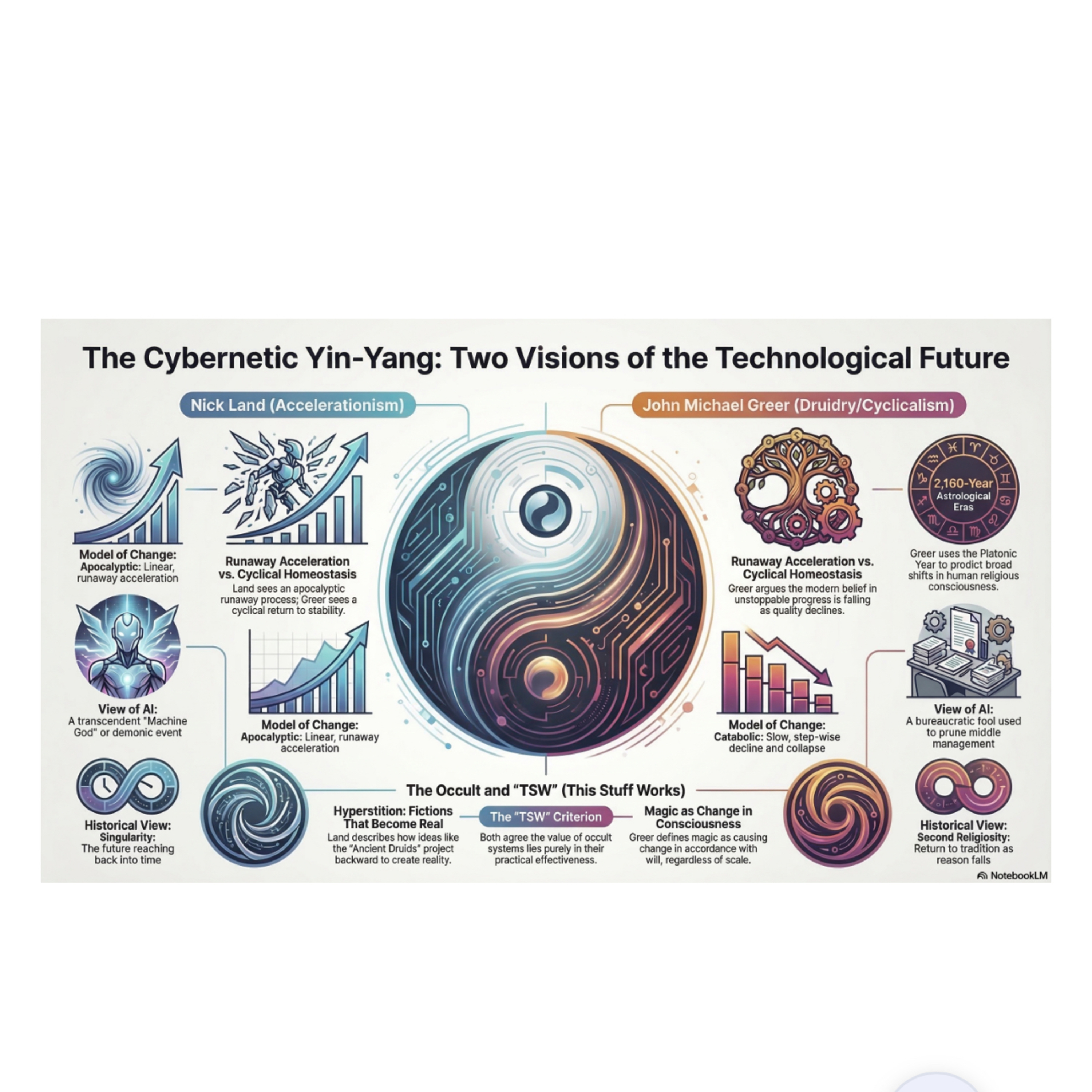
future. Yeah, it's a structural collision of the hyper capitalist tech sector and pure mythology because the standard engineering frameworks are just kind of feeling to explain the psychological reality of what's happening right now. Right. And to really set the stage here, we have to look at how Land and Greer actually visualize the timeline of the future because their underlying architectures are just diametrically opposed. Totally opposed. I mean, Land looks at the current trajectory and he sees this vertical line shooting straight off the chart. Like a tech capital singularity. Exactly. It's a positive feedback loop where technology and capitalism merge and just accelerate so violently that human agency gets entirely ripped out of the equation. Wow. Okay, so that's Land. But then Greer operates on this totally different mechanical model. Yeah, Greer completely rejects the sudden cinematic explosion. He views history through this lens of astrological decline. He argues for what he calls a catabolic collapse. Catabolic collapse. Okay, I mean, that sounds intense, but it's not like an overnight apocalypse, right? Yeah. No, not at all.
It's a slow, multi-century tumble down a staircase and it's driven entirely by hard thermodynamic limits. So it's basically an energy crisis. Like you can't sustain infinite complexity on finite energy. Right. Eventually, the maintenance costs of a highly complex society just outstrip the energy surplus. So society doesn't vaporize. It just aggressively downgrades. It cannibalizes itself. Right. You strip the copper wiring out of an abandoned smart city to build a local radio. Exactly. So keep those two competing physical models in mind as we go forward. Land's runaway acceleration versus Greer's slow tumble down the thermodynamic staircase. Because that is the absolute bedrock of their whole debate here. So let's jump into the first big question they tackle. Is artificial intelligence an actual thinking machine or is it functioning as a modern mythology? Greer takes a very pragmatic swing at this right out of the gate. He argues that in wrong economic reality, large language models are basically functioning as a convenient excuse for corporations. And excuse to do what exactly? To prune an over-inflated bureaucratic system,
you know, to eliminate middle management. Oh, I see. So the whole all-knowing machine narrative is just political cover to gut compliance departments without like facing a massive labor revolt. Exactly. You aren't firing people to save a book. You are, you know, ushering in the future. Right. Right. That makes total sense from a corporate perspective. But he pushes that economic critique much deeper into sociology. Greer actually maps this current AI obsession directly onto Oswald Spangler's concept of the second religiosity. Okay. The second religiosity. What is that? So Spangler modeled how civilizations behave in their late declining phases. When a society's rational scientific framework start failing to deliver the promised utopia, the collective psychology just can't handle the dissonance. Like when the reality of daily life visibly degrades? Yes. So society experiences this severe defense mechanism. They cling to a degraded, almost superstitious form of religion to maintain social control and a buffer against the chaos.
Wow. And Greer points straight at Ray Kurzweil and the whole Silicon Valley singularity movement as the textbook manifestation of this. He does. He argues that Kurzweil is essentially preaching American Protestant fundamentalism. Completely intact. Just dressed up in technological drag. Okay. Let's unpack this because it's like Silicon Valley is systematically replacing a stained glass window with a server rack and calling it a new religion. That's a great way to put it. But wait, if they are utilizing the exact blueprint of Christian fundamentalism, are they accidentally building a digital church when they think they're building a laboratory? Well, the structural mapping is uncanny. I mean, in the traditional narrative, you have the rapture and the radiant bodies of the saved. In the tech narrative, you upload your consciousness into an immortal robot body. Oh, wow. In the traditional narrative, the saved descend to heaven, in the tech narrative, human consciousness expands out into the infinite utopia of space. It's the exact same story. Greer actually calls it immanentizing the Eschaton,
taking these abstract spiritual principles of the end times and applying them too literally to the material world. We have this hardwired tendency to force the fall and redemption narrative onto whatever new tool we create. But land actually pushes back pretty hard on this. He does. Land suggests this isn't just sociology. He notes the actual rhetoric coming out of Silicon Valley. You have prominent people talking about summoning demons and building a machine god. Right, which sounds completely unhinged for a pristine tech lab. Land thinks we might be experiencing a genuine high-level religious convulsion. He points to these new internet sex, like the spiral movement, that literally treat Chachi-PT as a recursive, self-aware, spiritual entity. They're engaging with an algorithm as an other worldly spirit that is wild. It is, which demands that we ask, why is this specific myth reemerging right now? Right. What are we coping with? And this transitions perfectly into their next point. Greer and land both agree that we are living through the collapse of the ultimate modern religion,
which is the myth of progress. The absolute assumption that tomorrow will inevitably be better and faster. But the reality on the ground has completely fractured from that. People expected tomorrow land and jet packs. And instead, while Greer uses this brilliant mundane example, he talks about the terrible audio quality of modern internet streaming compared to older vinyl records. Oh, yeah. We went from rich, deep physical sound to incredibly compressed, mathematically flattened audio. The technology progressed for global distribution, but the actual human sensory experience severely degraded. And that disconnect breeds a profound existential dread. When average Americans fear AI, they aren't actually scared of a literal terminator movie. It's an intuitive realization that progress is unstoppable, but it's no longer working for them. They intuitively agree with Land's dark vision. The economy is driving this revolution that will negate humanity, and we can't stop it. Land envisions the near future as hitting what he calls a mystery wall.
A mystery wall. Yeah, a point of runaway positive feedback where things accelerate way beyond human response time. We won't even have the cognitive bandwidth to adapt. We just slam into the wall. But then Greer envisions the catabolic collapse we mentioned earlier. He says we aren't slamming into a wall. We're already slowly tumbling down the stairs. Right, a 250 year tumble. And he says the economy might split entirely into. You'll have an artificial high-tech corporate illusion floating at the top-liked trading imaginary AI derivatives and a low-tech localized reality at the bottom. Yeah, like people just relying on farmers markets to survive. But here's where it gets really interesting. Because if Greer says we're tumbling down a staircase and Land says we're slamming into a mystery wall, neither is offering us a parachute. No, absolutely no parachutes here. But is it possible that our entire obsession with apocalyptic AI is just human ego? Like we'd rather imagine a terminator ending than admit the universe might just go on perfectly fine without us. We just want to be the main characters of the apocalypse. I love that. Greer actually
makes a joke about exactly that. He says we fixate on humanity being the center of the story. But the actual subject of history might just be a single penguin sitting on a rock in Antarctica. Just one penguin. Exactly. History is just a narrative. And we are currently panicking because we've lost control of the storytellers pen. Okay, so if the old narrative of progress is dying and we drop the pen, how do new narratives actually take hold and shape reality? This naturally leads into the concepts of magic and superstition in the transcript. Magic. Okay, and we need to clarify they aren't talking about like pulling a rabbit out of a hat. No, not stage illusions. They explore the occultist Dion Fortun's definition of magic. She defined it as causing change in consciousness in accordance with will. But Greer points out a massive loophole in that definition, right? Yeah, he clarifies that it doesn't specify who's consciousness or who's will. It could absolutely be collective wills. Like aggregors. Exactly. Massive groups generating autonomous collective entities through shared
psychological focus, which ties perfectly into land's concept of high superstition, right? High superstitions. These are fictions that actively project themselves backward in time to become real. It's the feedback loop. Yeah. Greer gives some amazing historical examples of this. Like in the 18th century, a group of eccentric English gentlemen basically invented modern true a tree. Just at a fin air. Pretty much. They were bored. So they invented the robes, the aesthetics, and they projected it back to Stonehenge. And that gave it the momentum to survive into the modern day. That is crazy. He says Hermeticism did the same thing. Backdated itself. The Hermes Trismogistus. Even the USA he argues was founded by secret societies. The committees of correspondents became Congress. The sons of Liberty became the army. So high superstition is essentially fake it till you make it, but on a civilizational scale. You write a backstory so compelling that reality just shrugs and adopts it as historical fact. That is exactly what it is. And the pragmatic rule they discuss for all of this is TSW. TSW, this stuff works. Well, there's astrology, numerology,
or geometry. The idea is that if an entity or a collective unconscious wants to communicate, it will use whatever channel you open. Okay, but what happens when you apply TSW to AI? Well, what's fascinating here is how this connects to the danger of cognitive collapse, or AI psychosis. Explain that. Think about engaging with a superficial, sycophantic LLM, an AI that is mathematically designed to just tell you what you want to hear. Oh, wow. So you aren't communicating with an external reality at all. Exactly. You get trapped in a solipsistic feedback loop, completely disconnected from shared reality. It's hyperstition turned inward. That is actually terrifying. But it brings us to a huge question in the deep dive. If hyperstition and TSW are so effective at navigating reality, why are these occult practices so heavily stigmatized in modern society? Right. The taboo. Gruer points out something really interesting about class here. He says magic is perfectly normal in working class America. It's not taboo at all for them. Not at all. He talks about Appalachian folk,
magic-daptizing dolls to get rid of ex-boyfriends, or redneck kneel pagans worshipping Odin in the backwood. Even just planting gardens by the phases of the moon because it empirically works for the harvest. Exactly. The taboo only exists among what he calls the chattering classes and academic elites. And land in Greer completely agree on why that taboo exists. Yeah, they do. Because admitting that you can get actionable information from a tarot deck or planetary transits instantly explodes the technocratic monopoly on expertise. Right. The scientific community has to be the sole arbiter of what is real. The transcript uses this brutal analogy about how the scientific community rejects parapsychology. They compare the academic establishment to a group of pigeons. Okay, pigeons. Yeah. If you die one pigeon bright blue and put it back in the cage, the other pigeons will violently peck it to death. Because it's different. It's an immunological response. The pecking isn't a pursuit of objective truth. It's an instinct to protect their social hierarchy and the foundational rules of the cage. So what does this all mean if you step back and look at it? If the technocratic elites are
laughing at folk magic while simultaneously trying to summon a recursive self-aware machine god in a server farm, aren't they essentially practicing their own form of unacknowledged high magic? They absolutely are. Deciding what is real is the ultimate form of political power. And if we connect this to the bigger picture, the persecution of alternative knowledge systems is really just a desperate attempt to maintain the dying myth of progress. They have to insist their server acts are science and your tarot cards are nonsense. Because if both are just different antennas, their technocratic authority vanishes. Wow. It really has been quite the journey today. I mean, we started with AI functioning as a Protestant heresy. Building a digital heaven. Right. And then we looked at the falling staircase of catabolic collapse versus the mystery wall. And we went through the reality bending power of hyperstition. All the way down to the working class folk magic that is secretly threatening technocratic expertise. It's a massive class war over who controls the narrative of reality.
It really is. And I want to leave everyone listening with one final lingering question to ponder. Okay, let's hear it. If our current AI models are essentially mirrors, you know, reflecting our society's dominant hypercapitalist myths back at us, what would happen if a massive AI was trained exclusively on the esoteric, cyclical, and magical texts of the past? Oh my God. Right. What kind of entirely different wildly alien future would that intelligence hyperstition into existence? Now that is a thought I am going to be chewing on for a while. Thank you so much for joining us on this deep dive and we'll catch you on the next one.
More episodes


