Loading...
About this Episode
Tssui
Hosts & Guests
Transcript
Usually when you make a video analyzing an obscure internet meme, well, that is the end of the transaction.
You post it, people laugh in the comments, and you move on with your life.
Right. Yeah. Because memes don't really have real-world agency. They're just pictures on a screen.
Exactly. But in this case, a YouTube creator made a video dissecting a very niche internet meme.
And the caption of this meme was something like,
uh, my architect, be losing his mind. Bro, what is this?
Which is pretty funny. It is. And underneath that text, it featured pictures of this incredibly
eccentric architect and his wild, almost alien-looking buildings. But the creator argued in his video
that this guy wasn't losing his mind at all. He argued this architect was actually a visionary,
like, trying to bring nature's brilliant engineering into modern civilization.
And that is exactly when the phone rang.
Yes, the architect actually saw the video. He traps the creator down, calls him completely out
of the blue, and casually says, hey, I used to live near you in Minneapolis. Also, you're welcome
to come visit my house in California any time. Oh my gosh. I know, right? Next thing you know,
this creator is literally on a plane flying out to Berkeley to stay in this half-gutted,
tardigrade-inspired, earthquake-resistant structure known as the fish house.
Which is just, I mean, the absolute definition of a surreal origin story.
Okay, let's unpack this. Because the subject of our deep dive today is that architect, Eugene
Sui. And honestly, the word architect doesn't even begin to cover what this guy does.
No, not at all. He is a clothing designer, a musician, a former nightclub bouncer,
a competitive gymnast, a boxer, and a relentless environmentalist.
You really is. And he's such a fascinating figure because he challenges, well, basically,
every single basic assumption we have about the build environment.
Yeah. Our mission today isn't just to give you, you know, a great biography of interesting guy.
We are looking at a fundamental question for you, the listener. What happens when a human being
completely rejects standard societal norms to build a life, a home, and even a daily wardrobe,
based entirely on the unbreakable genius rules of nature?
All right, because it's so easy to look at pictures of his work or look at his flamboyant outfits
and just dismiss him as a provocateur. Like, he's just some eccentric guy trying to get attention.
Which is exactly what we want to avoid doing today. What's fascinating here is that Eugene is not
just throwing weird shapes against a wall to see what sticks. He is a fiercely hyper-logical thinker.
Totally. He's been preaching this brand of nature-driven pragmatism since the 1980s,
which is way before sustainability was like a corporate buzzword. Yeah.
He basically looks at nature's four billion year research and development process and asks,
why on earth aren't we copying this?
So let's start where this whole journey began for the creator, the fish house in Berkeley.
Eugene built this house back in 1991, specifically for his aging parents.
Right. They were moving from Minnesota to California.
In California, obviously comes with the constant threat of earthquakes.
So they told him they wanted absolute safety. They wanted to cocoon that insulated them from the
roaring noise of city life and natural disasters. And if you're trying to build the ultimate safe
house, where do you look? You don't look at other modern houses because they fail all the time.
You look for the toughest organism on the planet. Which is what? Like a cockroach?
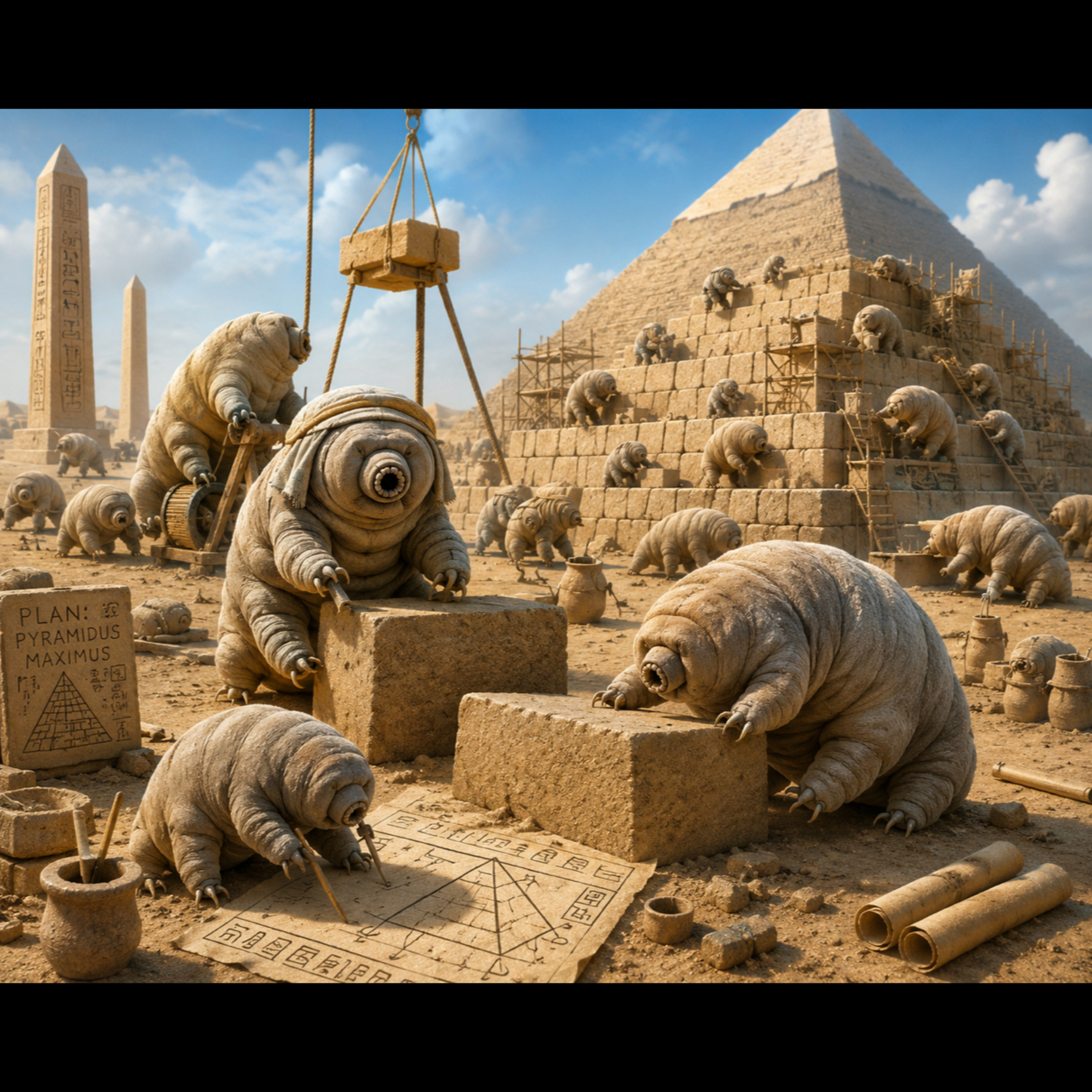
No. Even tougher than that. You look at the tardigrade.
Ooh. The water bear.
Exactly. If you don't know what a tardigrade is, it is a microscopic eight-legged organism
that is virtually indestructible. I mean, they could survive being frozen at minus 273 degrees
Celsius. Wow. Yeah. And they can survive being boiled in toxic gas. Scientists have literally
exposed them to the radiation and vacuum of outer space and they survive.
Okay. But how do you turn a microscopic water bear into a house for your elderly parents?
Well, you analyze its morphology. Eugene asked, how is this creature shaped so that it can
withstand incredible pressure? And he found that the body of the tardigrade features a
parabolic arch on top and a catenary arch on the bottom.
Wait, hold on. A catenary arch. I don't think I can picture that. What does that actually look like?
So think about holding a heavy metal chain between your two hands.
If you let it droop down loosely, the natural curve that chain forms under the force of gravity,
that is a catenary arch. It's nature finding the perfect balance of tension.
Okay. I see it. Now, imagine freezing that shape, flipping it upside down,
and using it as the foundation of your building. Got it.
So he takes that exact geometry and implies it to a human dwelling.
The bottom portion of the house that catenary arch shape is made out of a foot of styrofoam
wrapped in reinforced concrete. That gives the house an insulation value of roughly R80.
Which, just for context, your standard modern home today might have an insulation value of R13
or maybe R20 in the walls. So R80 is an incredibly massive, sturdy, thermally impenetrable anchor.
But the top half, the parabolic arch, is totally different. It's not concrete. It's made out of
wood intention, meaning it is lightweight and incredibly flexible.
And that structural combination is the secret to surviving an earthquake.
It makes me think of a martial artist, actually. If someone throws a heavy punch at you,
and you instantly tense up and try to act like a rigid brick wall, your bones are going to snap
under the impact. Oh, absolutely. But if you relax, if you roll backward with the punch,
the energy just dissipates safely, or it's like a boat floating over massive waves,
rather than a sea wall trying to stop the wave entirely.
Standard buildings try to stubbornly take the hit of an earthquake. They fight the earth.
Right. They resist it. But this house is designed to let the heavy, rigid bottom move with the earth
while the lightweight flexible top acts almost like a sail, just absorbing and safely dissipating
the shock waves. That's a perfect analogy. Earthquakes break things that fight back. And he takes
that dissipation principle all the way down to the micro details too. Think about when standard
brick or concrete buildings go through an earthquake. Where do they usually crack first?
Usually around the windows, right? Yeah, they crack right at the sharp 90-degree corners of the
windows and doors. Because those are the natural stress points. All the pressure funnels directly
into that sharp angle. Exactly. So in the fish house, there are no corners. None.
The entire place is full of circular and oval motifs. That's so smart. It is.
The circular windows ensure that when shock waves hit the surface of the house, those violent forces
are tangentially thrown away and dispersed around the circle, rather than accumulating at a sharp
corner and tearing the wall apart. And speaking of the windows, they're completely wild. Yeah.
He invented these things called nostril windows. Sonstril windows, yeah. They're basically stainless
steel screened tubes built directly into the walls. So you don't slide a pan of glass up and down.
You literally push the tubes in to seal the air out and you pull them out to allow natural
ventilation to flow through. But what's really fascinating here is that he's not just building a
cold apocalyptic doomsday bunker. He is translating biological survival into genuine architectural
empathy. Oh, I like that phrasing. Yeah, the entire space specifically catered to his parents'
physical vulnerabilities. For example, he knew his mother's knees would struggle with stairs
as she aged. So instead of a traditional staircase, he built a gentle, sloping spiral ramp,
connecting the levels. He even designed the built-in shelving to be so structurally integrated
with the walls that you can literally do pull-ups on the shelves, which apparently his kids used as
a jungle gym when they stayed there. That's amazing. It is this perfect blend of extreme,
bombproof durability and total inviting coziness. It really feels like a living organism.
And you know, if the fish house was about surviving a natural disaster, his newer projects take
that a step further. They're about preventing environmental disasters altogether, specifically by
completely eliminating the need for mechanical heating and cooling systems. He wants to build spaces
with zero HVAC systems, which sounds completely impossible for a large modern building. That does
sound crazy, but he is currently working on an underground residence that is 16 feet deep and about
2700 square feet. Right. And the logic there is actually really sound. When you build underground,
you are already tapping into the earth's natural ambient temperature. Oh, right. Yeah, the dirt
of few feet down remains incredibly stable. Usually somewhere in the 50s or 60s Fahrenheit,
regardless of whether there's a blizzard or a heat wave on the surface, but you still need power,
and you still need air circulation. So to power it, he uses these things called
arrow texture windmills. Now, when I say windmills, you are probably picturing those massive, noisy
bird-killing turbines you see out in the desert. Right. The giant white ones. Exactly. These are
completely different. They're only four feet wide. They're completely silent. They move slowly,
and they don't harm birds at all. He's placing two towers of these right on top of the underground
house. And structurally, digging a hole that big comes with challenges. Dirt is incredibly heavy.
So he angles the underground walls of the house upward at a 15 degree pitch.
Okay, I have to push back here for a second, because living 16 feet underground sounds deeply
unpleasant to me. You wouldn't want to do it. No, I feel like that angled wall thing would feel
incredibly claustrophobic. Just mentally knowing thousands of pounds of dirt are right behind that
wall, closing in on you. It absolutely sounds that way, but structurally and visually,
it achieves the exact opposite. First, let's talk about the dirt. Why does dirt want to cave in?
Gravity. Sort of. It's called soil overturning
tendency. When dirt gets wet, it gets heavy, and hydrostatic pressure pushes it
laterally against whatever is buried inside it. If you bury a perfectly straight vertical
cardboard box in wet mud, the size will cave straight in. Okay, that makes sense.
But by angling the wall slightly backwards at a 15 degree pitch, the geometry of the house
is actively leaning into the dirt. Think about standing against a heavy door that someone is trying
to push open and you don't stand perfectly straight right. Right, you lean your shoulder into it.
Exactly. The geometry pushes back against the earth, making it infinitely more stable.
Oh, that's brilliant. And because the walls are leaning outward, away from you as they go up to
the ceiling, it creates a forced perspective. The room actually widens at the top, which
visually enlarges the space. Yeah, it opens it up. Plus, he includes this 40-foot high
g-day dacic porch with glass stairways bringing natural light all the way down. So he's essentially
pulling the sky downward into the earth. It proves that Eugene designs for the human psyche
just as much as he designs for thermodynamics. And he's taking this same philosophy to a massive
commercial scale too. Oh, really? Yeah, he designed a 19,000 square foot commercial building that sits
40 feet underground. And again, absolutely zero conventional HVAC system. So how on earth do you
circulate fresh air through a 19,000 square foot underground box? You build a massive 40 foot indoor
waterfall right at the entrance, which sounds like just a fancy architectural flex, but it's actually
highly functional engineering. I need you to explain the thermodynamics here because how does water
move air? It's all about temperature differentials. Hot air naturally rises and cold air sinks. The
waterfall significantly chills the air, immediately surrounding it. That creates a massive, heavy
column of cold air that rapidly sinks to the bottom of the building. And that creates a low pressure
zone that sucks the warmer, stale air from the rest of the building toward the waterfall to replace it.
Wow, it creates a massive organic down draft. It's exactly like when you open the door of your
freezer on a hot day and you feel that rush of cold air spill out of your feet. And he didn't
just blindly guess that a waterfall would act as an air conditioner. A team of researchers from
California Polytechnic University actually ran a complex 3D computer analysis on this exact design
and they completely validated it. The waterfall acts as the active engine, effectively pushing and
pulling air through the entire 19,000 square foot building just using natural physics. Which is
incredible. Yeah, but it also tells us something deeper about Eugene. His philosophy doesn't just stop
at the perimeter of a building. If a house is a macro environment that we live in, he views clothing
as a micro environment that we wear directly on our bodies. Yes, this is my favorite part. Because
it makes you wonder if this guy is so obsessed with optimizing the buildings we live in. How does he
handle the immediate environment around his own skin? Standard clothes are terribly inefficient.
They really are. So naturally Eugene designs his own clothes and by clothes, I mean, incredible,
sequined, drenched, fauxfer line, highly engineered capes. He has over a hundred of these elaborate
unisex outfits. And again, picture this. You see a man walking down the street in a massive
faux leopard print cape. Your first instinct is to write them off as eccentric. But look at the
hidden engineering. Right. Think about standard capes or even just wearing a heavy winter coat
draped over your shoulders. They constantly slip off when you move your arms. No, constantly.
You know how when you wear a heavy coat and reach for your keys, you have to do that awkward,
jerky shoulder shrug to keep it from sliding off your back. Yes, exactly. Eugene completely solves
this by sewing a customized internal harness directly into the lining of his capes. You slip your
arms through the harness first. And no matter how much you reach, twist, or bend over, the
cape stays perfectly draped on your shoulders. It cares the weight efficiently. He also focuses heavily
on the collar. He designs these very high rigid collars that funnel and trap your body heat
around your head and face. Because that's where you lose heat. Exactly. He actually studied human
physiology and realized that a massive amount of heat escapes from the neck and head. If you can
trap that pocket of warm air right around your neck and shoulders, your extremities stay comfortable.
He is literally capturing his own thermal exhaust and recycling it. If we connect this to the
bigger picture, Eugene's clothing reflects a total unapologetic refusal to accept bad standardized
design just because it's what everyone else buys off the rack. Oh, standard design infuriates him.
He looks at regular mass-produced running shoes, for example. And he just sees a medieval
torture device that crushes your toes into a point. They really do. So he wears these ventilated hemp
running shoes with a wide fan-shaped toe box that actually follows the natural splayed shape of
a human foot. It's extreme biological pragmatism dressed up as high fashion. It really is. He builds
zipper purses directly into the sleeves of his coats. So you keep your credit card right at your
wrist. And when you go to the grocery store, you just casually lean your arm over the tap-to-pay
machine, no digging in your pockets. And so could be it. He soars hidden security pockets that
physically lock underneath your belt line to prevent pick pockets. And one of my absolute favorite
quirks, he takes those stainless steel tubes that expensive cigars come in and he soars them
directly into the fabric of his garments for waterproof storage. Which is incredibly clever.
Although he freely admits that wearing a vest covered in metal tubes makes going through TSA
airport security an absolute nightmare. I can't even imagine trying to explain that to a security
agent. Seriously. But the clothes are so visually striping that people constantly stop him in the
street asking if he's a prime minister or some visiting foreign dignitary. There's this amazing
story where he was trekking through the misty mountains of Tibet. And he ran into a group of
Tibetan monks on a 500 mile pilgrimage. Now keep in mind these monks are wearing traditional,
highly functional wool capes designed for harsh mountain weather. Right. And Eugene and these
monks just stop on the trail in the middle of nowhere and mutually admire each other's capes.
The monks loved his designs so much they asked if he could make them one. Oh, I love this story.
Eugene says, sure what address should I send it to? And the monk just smiles and replies,
we're on a 500 mile pilgrimage. We don't have an address. But it just shows how universal this
appreciation for highly functional, beautiful design can be. So if I'm understanding this correctly,
we're basically looking at his clothes as wearable architecture. Like he's building highly
engineered personalized micro climates for his body. Exactly. But it brings up a huge question.
To design revolutionary underground buildings with indoor waterfalls and to confidently walk down
a city street in a faux fur cape covered in cigar tubes, you need a very specific almost bullet proof
psychology. Really do. How does someone cultivate the embedded confidence to just totally ignore
societal norms? Because society usually crushes that kind of behavior out of people by the time
they hit high school. To understand that, you really have to look at his origins. It started with
a tolerance for absolute bone-chilling discomfort in the pursuit of his vision. Discomfort. Yeah,
as a young man, he lived in a freezing apartment in the Montreal, Canada. Rent was $50 a month.
There was no heating system. And temperatures outside would regularly drop to minus 40 degrees.
Minus 40. That's physically painful. It is. He was working grueling jobs as a nightclub
bouncer in a massage therapist just to buy food. But he spent every spare second in that freezing
room bundled up, drawing bold, highly unconventional architectural designs. And he didn't wait for
permission or a fancy degree to validate his ideas. He literally walked straight into the office
of Bruce Goff, who is arguably the most renowned imaginative architect in America at the time.
Just walked in. Just walked in. Eugene had zero formal schooling, zero experience. He just puts
his bold drawings on Goff's desk and says, this is what I think architecture should be. And Goff
looks at them, sees the raw, unpolished vision and gives him a six-year apprenticeship right on the
spot. That's incredible. But that embedded confidence also comes directly from his father. His
father was a man who would confidently give academic lectures at universities,
wearing traditional Georgian robes, Turkic boots and bright purple sequence suits. Wow. Okay,
so it runs in the family. Yeah, he instilled in Eugene the fundamental belief from a very young
age that anything is possible and that you absolutely do not need to be ashamed of who you are.
Which is a beautiful, inspiring sentiment. But in practice, it translates into a very intense
worldview that can be jarring to regular people. There's this story Eugene tells about having a
young intern working at his architecture firm. The kid had just graduated from USC architecture
school, but Eugene noticed he looked miserable every single day. So Eugene pulls him aside and asks
him point blank why he's so unhappy. Yeah. The intern admits he doesn't actually want to be an
architect. He's always secretly loved photography. But his parents paid for his incredibly expensive
degree. So he feels a heavy obligation to stick with it. And Eugene looks at him and says, you don't
owe them a prison sentence. You will hate yourself for the rest of your life. And he basically
fires the kid. He fires him. He pushes him out the door, tells him to go buy a camera and forbids him
from coming back to the architecture firm. Which predictably immediately triggers an incredibly
angry phone call from the intern's father. The dad is screaming, how dare you kick my son out, he has
a degree, he's going to be an architect. And Eugene just calmly says, from my point of view, it's the
wrong thing. And I have to be honest, hearing that story, it borders on insane arrogance, doesn't it?
Just kicking a kid out of an internship he earned and telling his dad he's wrong to his face.
It's very easy to read it as arrogance. But if you look closer at Eugene's philosophy,
it's actually an intense, almost overwhelming sense of accountability. Eugene operates on the
belief that every single person has a specific unique gift and wasting that gift just to please
society or your parents is a tragedy. Right. He genuinely believed he was saving that kid's life.
And by the way, what actually happened to that intern? A year later Eugene gets a phone call.
The kid moved to Paris, rented a tiny studio, and is absolutely thriving as a fashion
photographer. He loves his life. So Eugene believes that individual action is the most powerful force
we have. You can't just sit around and wait for systemic societal change to happen on its own.
You have to force it. You have to be what he calls a working example. You practice what you
preach. You change the way you live, the way you eat, the way you build your house, and you show
people firsthand that an alternative is possible. And he plans to be that working example for a very,
very long time. His mother lived to be a hundred one and both his father and grandfather lived well
into their late 90s. Eugene is banking on those genetics, along with his strict plant-based lifestyle
and competitive gymnastics, to live to be 150 years old. 150? Yes. He desperately wants to stick around
long enough to see the rest of the world finally catch up to the environmental ideas he was pitching
40 years ago. As he puts it, if I die trying, well, I'm going to die anyway. It's a remarkable,
uncompromising way to live. We've traced this whole journey starting from a viral internet meme,
moving to a tardig-grade inspired earthquake house, down into subterranean buildings powered by
waterfalls, across the world to Tibetan capes, and finally into the mindset of a man who just
flat out refuses to be anything but himself. And it brings up a question I really want you the
listener to think about today as you go about your routine. Look around your life. Where are you
passively accepting regular design or societal norms simply because that's how it's always been done?
Yeah, that's a great question. Where are you wearing the shoes that crush your toes?
Metaphorically speaking. On the walls of Eugene's design studio, there are two quotes that perfectly
summarize his entire ethos. One is, work is love made visible, and the other is simply,
you're not going to squash me. You are not going to squash me. I love that so much.
Eugene says that nature's abilities are so wildly far beyond our human comprehension that in his
words, the more you realize how expansive nature is, the dumber you feel. That's very true.
So I want to leave you with this final provocative thought to mull over. If you had to completely
redesign one ordinary frustrating item in your daily routine, the car or your desk or jacket,
but you could only base it purely on how nature would build it, what would it look like,
and more importantly, would you be the one your friends are making memes about?
Until next time on The Deep Dive.


