Loading...
About this Episode
The_Industrial_Logic_of_Aztec_Sacrifice
Hosts & Guests
Transcript
I want you to imagine for a second standing in a city that is vastly more magnificent and
like way more orderly than literally any city in 16th century Europe.
Right.
Just completely ahead of its time.
Yeah.
Exactly.
You're looking at these ochre towers and pyramids and they're just rising like a dream
out of the shimmering waters of Lake Texcoco.
The walls of the city are gleaming white, shining with lime, decorated with brilliant
paintings everywhere.
Yeah, the aesthetics were incredible.
Yeah, really were.
You've got public gardens, these grand, processional ways, aqueducts bringing in fresh water.
I mean, it's a level of modernist urban planning that Europe honestly wouldn't see until
what Paris was redesigned in the 19th century.
Oh, absolutely.
It's an incredible visual.
I mean, when the Spanish soldiers first arrived and looked down at this metropolis, a lot
of them actually thought they were dreaming.
Really?
Yeah, they wrote that it looked like some enchanted city from a fantasy romance just kind
of floating on the water.
Wow.
But see, now I have to completely shatter that beautiful image for you.
Yeah.
Here comes the reality check.
Right.
Because the central paradox of our deep dive today is that this architectural miracle to
noctitlin, the capital of the Aztec or well, more accurately, the Mexica empire, the
Mexica ended up, we see was also a civilization whose art, their economy, their entire daily
life was completely centered around the industrial scale, highly bureaucratic mass butchery of
human beings.
It is, it's honestly one of the most jarring juxtapositions in human history.
It's why you have this absolute pinnacle of human aesthetic and civic achievement, right?
But it operates structurally as a literal engine for human sacrifice.
Welcome to today's deep dive.
We're exploring a fascinating and frankly super haunting book review written by John Smith.
Yeah, it's a heavy one.
It really is.
It's reviewing Inga Klandin's Seminal Book Aztec's and interpretation.
And our mission today isn't just a gawk at, you know, what the Mexica did.
Right.
That's too easy.
Exactly.
It's too easy just to list the horrors.
Our goal for you today is to understand the profoundly alien world view like the actual
why that made this horrifying system make perfect, logical sense to the people living inside
of it.
It made complete sense to them.
It did.
Okay.
So, let's unpack this.
Hernán Cortez and his soldiers arrive in the new world.
They see this gleaming city, the state run guilds, the deeply refined etiquette.
But then they also encounter a scale of bloodshed that just completely breaks their conceptual
framework.
It broke their brains, basically.
Totally.
To understand how those two things coexist, we first have to talk about the physical universe,
the Mexica believe they lived in.
And spoiler alert, it is not a comforting place.
Not at all.
I mean, if you want to understand the brutality, you really have to understand the precarity.
Right.
And the cosmology wasn't like modern religions, right?
Where the universe is this stable, divinely protected creation overseen by some loving architect.
Right.
There's no safety net.
None.
The Mexica believed the Earth was unimaginably fragile.
They actually thought it was suspended on this razor's edge between ravenous abyssal powers
on one side and just the complete emptiness of the void on the other.
So basically no guarantees of a tomorrow.
So on whatsoever.
They genuinely believe the world could just, you know, wink out of existence at any moment.
That is terrifying.
It is.
And every 52 years, this existential dread culminated in this massive terrifying event called the
New Fire Ceremony.
Oh, man, the source notes on this part.
It's intense.
Yeah.
So this was the end of a calendar cycle, right?
And it was the exact moment they believed the universe was most likely to just collapse.
So what did they do?
The entire nation would extinguish every single flame.
They smashed the pottery.
The whole society just waited in total suffocating darkness, holding their breath while the senior
priests went out to this lonely hill outside the city.
Okay.
I read this part of the source notes and it genuinely made my stomach turn.
Yeah.
It's rough.
In the dark, the priests would take a bound captive.
Yeah.
And they didn't just sacrifice them normally.
They feverishly worked a hand drill, like, you know, what you'd use to start a campfire
directly into his open bare chest.
Yes.
They were trying to drill fire into wet flesh and bone.
And see the mechanics of that are just so important to understand their mindset.
They believed that if the friction somehow sparked a fire inside this human chest cavity,
it was a sign.
A sign from the gods.
Exactly.
The gods had accepted the offering and granted the world a reprieve.
The universe would live for another 52 years.
And if it didn't spark, then the demons of darkness would descend.
A devour humanity and the universe would just slip into nothingness forever.
Wow.
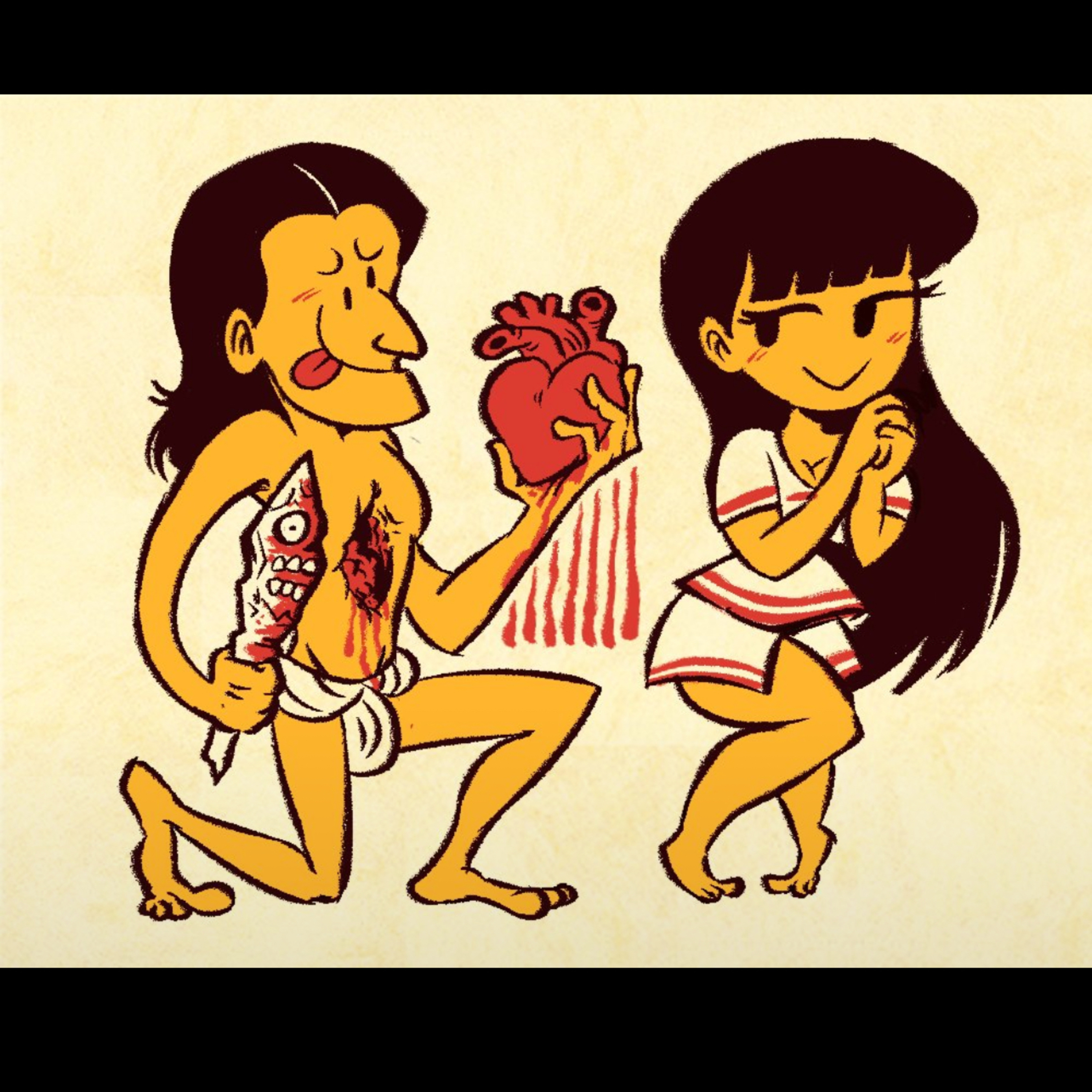
But the second that drill spark, they would tear the victims chest open, feed the new flame
with his heart, and then sprint relays to carry that new fire to all the temples in
the city.
You know, hearing the mechanics of that really reminds me of Cosmic Horror.
Oh, that's an interesting connection.
Yeah.
Like that genre of speculative fiction, you know, usually attributed to HP Lovecraft in
their early 20th century.
Right.
Humans are just these utterly insignificant microscopic specs compared to these ancient
uncaring gods.
But I mean, the Mexico basically codify the entire genre of Cosmic Horror back in the
1300s.
That's a really sharp parallel.
And what's fascinating here is how that cosmic dread translated directly into their state
policy.
How so?
Well, the Mexico gods didn't care about humans.
They were casually destructive.
Like think about how much concern you have for an anil when you're just walking down the
street.
And you're not actively trying to ruin their day.
Exactly.
If you step on it, it's not because you hate the ants, you just didn't notice them.
The Mexico gods viewed humanity the exact same way.
So if a giant indifferent god is about to inadvertently step on your world, how do you get its attention?
I suppose you have to scream as loudly as possible, you know, put on the most extreme spectacle
you can engineer.
And the Mexico believed the gods were most sensitive to fear and pain.
That was the frequency they tuned into.
So to get their attention and to keep the incredibly fragile machinery of the universe
running, you had to offer them what they noticed most.
Which meant blood.
Yes.
Daily bloodletting, horrific self-mutilation by the priests, and ultimately just a continuous
river of human lives.
Right.
Because the gods required this endless diet of pain just to sustain the universe.
So the Mexico essentially had to build a societal engine explicitly designed to harvest it.
And the scale of it is just...
The scale is staggering.
The source mentions this one specific festival.
The rededication of the Great Pyramid, where 20,000 victims were sacrificed in a matter of
days.
20,000.
The blood was literally rolling in a slow, thick curtain down the steps of the pyramids.
It's hard to even picture.
It is.
They had four lines of mannacled slaves stretching out of the city, just trudging toward their
doom.
And everybody in the society was involved in the processing of these bodies.
Cooking the flesh and domestic pots, displaying dried thigh bones in their courtyards.
Yeah, exactly.
But let me stop here and push back a little bit though.
Sure.
Because when I first read these numbers, my immediate thought was like, are we sure this
isn't just Spanish propaganda?
Oh, that's a very common reaction.
Right.
Like weren't the Mexico just fighting normal wars, capturing prisoners of war, and then
the Spanish just inflated the numbers to justify conquering them?
I mean, though all ancient cultures have blood on their hands from territorial expansion.
It is a very natural instant to try and contextualize this as just standard ancient world violence.
But the source relies on Clinton's work to explicitly address why this was uniquely
terrifying.
This wasn't judicial execution, right?
And it wasn't just some grim byproduct of territorial war.
Capturing humans for sacrifice was the primary goal of the society.
It is the main export, basically.
Exactly.
The reviewer notes that the Mexico displayed what modern psychology would call dark triad
personality traits, but like scaled up to a macro societal level.
So charming, highly organized, bureaucratic, but utterly devoid of empathy.
Precisely.
It was the violence combined with this chilling bureaucratic calculation that makes it so deeply
alien.
Like, think about how they structured their military.
Every male was theoretically a warrior from birth.
But the army didn't function like a cohesive tactical unit aiming for a strategic victory
on a battlefield.
Yeah, because I was trying to figure out how a military like that operates.
Like if the goal isn't to take land or kill the enemy king, what are they actually doing
out there?
Right.
And I realized it's almost like a twisted, modern corporate quota system.
Oh, that's a good way to put it.
You know how in some hyper competitive sales departments, the only way to get a promotion
is by the raw number of new client acquisitions you bring in.
Yeah, the Glen Gary Glen Ross model.
Exactly.
Nothing else matters.
No teamwork, no long-term strategy, just individual quotas.
That is a brilliant way to conceptualize it.
A Mexico battlefield was exactly that.
It was a chaotic, swirling melee of individual glory seekers just trying to hit their quotas.
Your only path to social advancement, wealth, prestige.
It was all tied to securing live captives for sacrifice to the war god, who had sea
lopopoly.
It was a vicious zero-sum game against your own peers.
Which completely explains their weapon design.
This blew my mind.
Yeah, the weapons are fascinating.
Their weapons were specifically engineered not to kill.
They used these long, shallow obsidian blades and heavy, flint-studded clubs.
Right, they were going for lethal blows.
No, they weren't trying to hit the neck of the heart.
They were actively trying to smash a kneecap or hamstring you.
The entire technology of their warfare was designed to incapacitate a person just enough
so they could be dragged back to the killing stone alive.
If we connect this to the broader historical picture, this non-lethal capture-focused warfare
is exactly why the Mexican machines suddenly broke down.
Oh, interesting.
The source comments point out that this is why they couldn't fully subdue indigenous groups
like the Chichamaeq and it's a massive reason why they were so rapidly defeated by the
Spanish.
Because the Spanish weren't playing the quota game.
Exactly.
The Spanish and the Chichamaeq, for that matter, fought simply to kill and to win by any
strategic means necessary.
So it was a total mismatch?
Yeah.
The Mexico were trapped in this highly ritualized, highly deurocratic game of capture.
When they encountered a force that just wanted to exterminate them on the battlefield, their
entire paradigm collapsed.
Man.
Okay, so if this society is a massive, unfeeling machine designed to harvest pain, you
have a massive logistical problem.
How to staff it.
Right.
You can't just rely on natural human instincts to staff this machine.
People naturally avoid pain and death.
Mostly, yeah.
So to make this society function, you have to reprogram human nature, basically from the
exact moment a person takes their first breath.
You do.
You have to socialize them into the nightmare.
And for the Mexico, birth itself was viewed not as a beginning, but as a literal battlefield.
The details on the childbirth rituals are just wild.
When a baby boy was born, the midwife didn't just clean him up and hand him to the mother.
No, not at all.
She would literally shout war cries in the delivery room.
She would cut the umbilical cord and tell the infant, you know, your home is not here.
You are an eagle.
You are a little captain.
It's intense.
And then they would take that umbilical cord and give it to a veteran warrior to go bury
on some foreign battlefield.
They were establishing the social contract immediately.
Right.
Like a dystopian sci-fi state.
They were telling this mother in her most exhausted, vulnerable moment, this child is not yours.
He is fuel for the state.
He belongs to the sun.
Yeah.
But I mean, I have to ask, how did the women process this?
Yeah.
How do you maintain a society where half the population, the mothers are told their sons are
just fodder?
What was the psychological tradeoff for them?
Well, that brings us to the contrasting ritual for the girls, which really reveals the
strict, inescapable gender roles of the empire.
Okay.
The baby girl's umbilical cord was buried by the hearth.
The midwife would tell the infant girl that she was doomed to a life of domestic drudgery
bound to the home, grinding maize and weaving.
It is.
But for the mothers themselves, the Mexica cosmology offered a brutal kind of compensation.
They didn't view childbirth as labor in the sense of a medical event or a physical chore.
What was it then?
They viewed it as actual mortal combat.
Women found their own warrior glory on the bloody field of childbirth.
A woman in labor was seen as being literally possessed by an overwhelming, terrifying, external
force.
So for women died in childbirth, it wasn't just like a medical tragedy.
It was a soldier falling on the front lines.
Exactly.
Women who died in childbirth were treated with the exact same reverence and the exact same
fear as a warrior who died taking a captive.
They were elevated to this terrifying, divine status.
Wow.
The vital programming doesn't stop at birth, right?
The source outlines that the most important and honestly the most tragic moment in a
Mexican person's life was weaning.
Yes, the transition.
The moment a baby stops drinking breast milk.
Why was that specific biological milestone so critical to their worldview?
Because it marked the permanent transition from freedom to inescapable cosmic debt.
Yeah.
According to their beliefs, before a baby is weaned, they exist outside the human condition.
They are pure.
If an infant dies while still nursing, they don't go to the grim underworld.
Oh, where did they go?
They go to a specific paradise with a wet nurse tree that has countless breasts to
suckle them eternally.
Wow.
That is strangely beautiful in a very stark way.
It is.
But the moment that child is wean, the exact moment they consume their first bite of
maize, everything changes.
Because they've eaten from the earth.
Exactly.
The maize and all earthly food was believed to be the literal flesh and bounty of the
earth gods.
By eating the fruits of the earth, the child enters an involuntary unavoidable debt to those
hungry gods.
And guessing they don't take cash.
No.
That debt can only be paid with one currency, their own eventual death, and their own flesh.
Oh, man.
This transition perfectly sets up the pantheon of gods they had to deal with.
Because once you eat that earthly food, you are bound to the earth lords.
And these aren't the distant and different cosmic gods we talked about earlier.
The earth lords are up close and they perfectly reflect the inescapable cruelty of the
Mexico world.
The earth lords are a fundamentally different far more visceral category of deity.
In Mexican mythology, these gods were cast out of heaven.
They were tornace under, flayed, or dismembered during the creation of the world.
And because of this trauma, they are physically trapped on earth, horribly mutilated, and
eternally, unsatiably hungry.
They're just constant agony.
Yes.
They are in constant agony, and they demand that humans share in it.
The source mentions Ciuacotl, a goddess characterized by this gaping, terrifying mouth and ferocious
teeth, who is constantly demanding to be fed human hearts.
Yeah, she's terrifying.
But the festival that truly encapsulates the psychological horror of these earth lords
is the festival of Tochi.
Oh, Tochi, yes.
Tochi translates to our grandmother, and she is, essentially, the patroness of midwives,
and domestic things.
But the description of her festival in the source is just, I mean, it's a masterclass
and visceral terror.
It's a highly calculated piece of psychological manipulation.
The festival begins with days of silent, rigid, formal marching by the warriors.
The tension in the city just builds and builds.
Right.
Then, the women and midwives suddenly erupt into this chaotic play skirmish.
They take a doomed captive woman who has been selected to impersonate Tochi, and they
tease her.
They divert her.
They play games with her for days.
They have to keep her constantly distracted.
But wait, why the distraction?
Because if the captive realizes what is happening in weeps, it's considered a catastrophic
omen for the entire city.
She has to remain oblivious.
Oh, my God.
So they are literally gaslighting this poor woman right up until the end.
Pretty much.
In the dead of night, in total silence, they hurry her to appear amid.
They stretch her out on the back of a priest.
Yes.
And in the dark, they strike her head off.
Yes.
And this is where this sheer nightmare logic of this religion completely takes over.
They flay her body.
Yeah.
A massive, powerful male priest strips off his clothes.
And in the darkness, he struggles into the captive woman's wet, slack skin.
It's a horrible image.
It really is.
I have to pause here because I just don't understand the mechanics of this belief.
Why make the priest wear the skin?
What does that actually achieve for them?
It achieves a literal physical transformation.
Through the act of wearing the skin, the priest becomes pussy.
Okay.
Layer by layer, they adorn the skin wearing priest with the traditional clothing of the goddess.
And the profound horror of the ritual is the reveal, right?
The benign, comforting domestic figure of the grandmother transforms before their eyes
into an insatiable eater of men who then personally slaughters more captives.
Jesus.
It's a highly theatrical public demonstration that underneath the comforting domesticity
of daily life lies a pitiless, violent, devouring hunger.
The earth will eventually eat you no matter how safe you feel at home.
But here's where it gets really interesting.
Okay.
So you have the indifferent cosmic god to my drop the sky on you.
And you have the ravenous earth god to want to eat you.
But there was one more layer to this pantheon.
This wild card god who sits above it all, just pulling the strings.
Descartes LaPoca, the lord of the here and now.
Tesscat LaPoca is arguably the most complex deity in their entire pantheon.
He is essentially a sadistic, trickster god.
His title is the enemy on both sides.
Unlike the cosmic gods who ignore humans, Tesscat LaPoca is intensely interested in human
affairs, but entirely for his own amusement.
Like a kid with a magnifying glass over an ad hill.
Exactly.
He lights in elevating a person, making them incredibly wealthy and proud, and then completely
destroying them for absolutely no reason.
But here is the thing that confused me the reading.
This wanton, anti-social trickster god who ruins lives for fun was the patron deity of both
the Mexican kings and the slaves.
Why on earth would the absolute ruler of the empire and the lowest captive in the society
worshiped the exact same trickster?
That's a brilliant question and the answer lies in how the Mexico understood destiny.
Tesscat LaPoca represented the pure arbitrariness of individual fate.
To be a slave was to be a victim of Tesscat LaPoca's cruel joke, right?
You just drew a bad hand.
But to be a king wasn't a divine right either.
To be a king was to sit on what the Mexico literally called the slippery place.
The slippery place?
Yes.
You were only king because Tesscat LaPoca allowed it today and he could cast you down into
the slavery tomorrow just to watch you fall.
They dramatized this perfectly in the Toxcatel Festival.
Oh yeah.
It's almost like performance art about the futility of ambition.
They would choose this beautiful, physically perfect young male slave.
And for an entire year, they dressed him in fine clothes, paraded him through the streets,
playing flutes, and treated him as the living embodiment of Tesscat LaPoca.
They gave him everything.
Everything.
The horse notes he even ruled the city for five days while the actual king hit away
in his palace.
He is given the absolute pinnacle of human experience.
Right.
And then at the end of the year, he takes a canoe to a small island, walks up the steps
of a ruined temple, and the priest cut his heart out.
And as he is dying on the stone, the flutes of the next chosen slave can be heard starting
up in the streets.
I mean, it's a societal message saying, look at this perfect, beautiful thing we made,
now watch us destroy it, because that's what the universe does to everyone, no matter
how high you rise.
It instilled an intense, inescapable fatalism in the population.
Every Mexican child was taught from a young age that the world was bleak, that success
was highly temporary, and that the only absolute certainty in life was pain and eventual destruction.
Looking back at this incredibly bizarre, highly functional nightmare of a society, really
forces us to confront some of our own modern biases.
It definitely does.
The source of your brings us up brilliantly.
It points out how modern political lenses just completely failed to capture the reality
of the Mexican.
Oh, absolutely.
So in one hand, the author notes that, you know, right wing commentators often just dismiss
them as bloodthirsty savages.
Right.
Which completely erases their immense architectural, economic, and intellectual achievements.
Exactly.
But then on the flip side, left wing commentators often try to sanitize them, treating them
purely as misunderstood, peaceful victims of Spanish colonialism.
Which completely ignores the industrial slaughter we've just spent the last 15 minutes discussing.
Yeah, exactly.
Both sides miss the point entirely.
And the review highlights how both of those modern reactions are their own forms of cultural
erasure.
We struggle to look at the Mexico objectively.
The author gives a great example of this sanitization, actually.
He mentions this AI generated video from 2026 that went viral, imagining what Tenochtitlin
would look like today if it had never been conquered by the Spanish.
Oh, I heard about this.
Yeah.
And the video basically portrays it as Brooklyn, but with step pyramids.
Right.
Everyone is just hanging out in public squares, drinking coffee, living this modern, progressive
cosmopolitan lifestyle.
That video perfectly illustrates our own cultural blindness.
We are so deeply trapped in our 21st century post enlightenment worldview that we just assume
every successful complex society will eventually look exactly like ours.
Like we're the natural endpoint of human evolution.
Exactly.
We assume human societies all naturally regress to a mean of liberal democracy, human rights,
and casual coffee shops.
But the Mexico prove that assumption completely terrifyingly wrong.
The reviewer comes to this profound realization.
He says the real horror of reading about the Mexico isn't that they were barbaric.
The horror is that they weren't barbaric.
No, they were highly advanced.
Highly advanced, highly sophisticated, culturally vibrant, and their society function perfectly.
They prove that a civilization can be utterly, unvathomably, demented by our moral standards,
yet still thrive, innovate, and maintain equilibrium for centuries.
It forces us to accept that our current way of living isn't the only way a complex civilization
can operate.
The Mexico built an extraordinary human engine for survival, but they hitched that engine
to a worldview of inescapable, formalized cruelty.
And well, it worked for them.
So we've journeyed through this incredible horrifying landscape.
We've seen that Tenochtitlan wasn't just a beautiful city on a lake.
It was a brilliantly constructed machine.
A very dark machine.
A machine designed to help humans find a stance.
A way to operate.
Within what they genuinely believed were the completely inhuman, cruel conditions of existence.
Well said.
So, you know, what does this all mean for you listening to this today?
I think it means we have to drastically expand our understanding of the vastness of human
possibility and perhaps human malleability.
Exactly.
I want to leave you with a chilling concept to write from the source text.
The author writes that the most frightening words in the English language might be,
the distribution of possible human societies is very wide.
It's a haunting thought.
Think about the implications of that for a second.
If a civilization as vast as functional and as fundamentally alien as the mexico could
exist in perfect equilibrium in the past, what does that say about us?
We look at them with cosmic horror because their equilibrium was built on literal blood
altars.
But if human nature is that adaptable, what foundational unquestioned practices in our
daily modern lives might historians 500 years from now look back on with that exact
same cosmic horror?
It makes you wonder.
What if our current equilibrium?
As society we think is the natural endpoint of human progress is actually just a tiny
fragile bubble in a much darker universe of possibilities.
It's entirely possible.
The next time you picture those ochre towers and the shimmering waters of Lake Texcoco,
remember the true nightmares don't always look like chaos.
Sometimes they look like perfect, beautiful order.
Thank you for joining us on this deep dive.
Keep questioning the world around you.


