About this episode
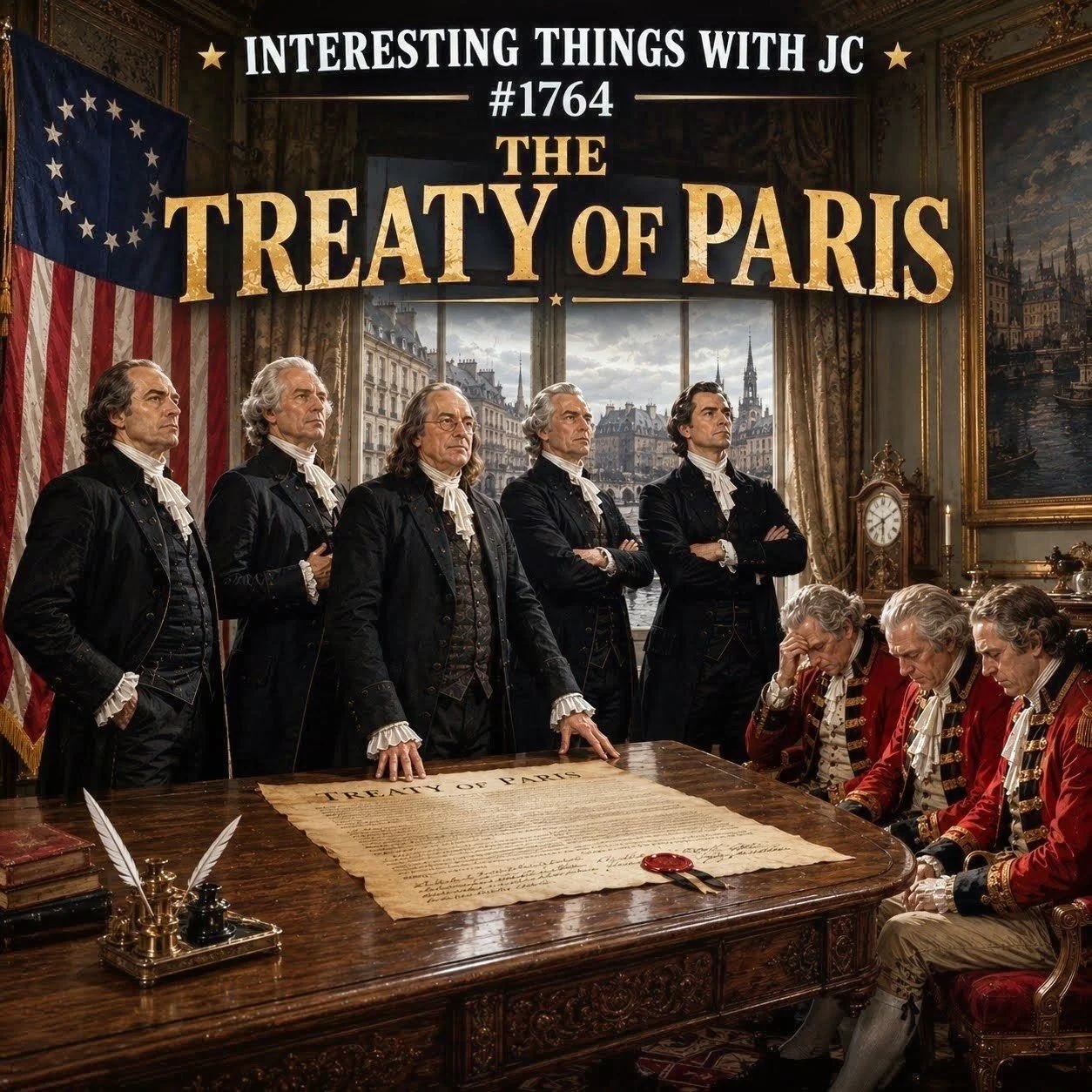
Interesting Things with JC #1764: "The Treaty of Paris" – Britain signs the Treaty of Paris recognizing all thirteen American states as “free sovereign and Independent States” and giving up its claim to govern them. The United States controls its own government and territory extending west to the Mississippi, while Britain agrees to withdraw its forces and deal with the new nation as an independent power.
Get every episode summarized
Each time Interesting Things with JC publishes, we email you a written briefing from the transcript — the topics, who appeared, and any specific claims, with the ad reads skipped.
Email me new episodesFree for 3 shows. No card needed.
Hosts & guests
Transcript ready
27 searchable segments. Every word is indexed and playable.
Full transcript
Interesting Things with JC — 1764: "The Treaty of Paris". Machine-transcribed; use the interactive transcript above to jump the player to any line.
Three years Americans fought a war over a pretty basic question. Who had the right to govern them? They had given their answer in 1776 with the Declaration of Independence. Britain did not accept it, so Americans fought for it. Then, September 3rd, 1783, Benjamin Franklin, John Adams, John J. They sat down in Paris with British Representative David Hartley. In front of them was the treaty that would formally end the Revolutionary War. This time, Britain had an answer of its own. Article 1 names all 13 states and says King George III recognizes them as free sovereign independent states. Sovereign can sound like a complicated legal word, but in this context it means something pretty straightforward. Britain no longer had the right to govern the United States and the treaty went further. Britain gave up its claims to American government and territory. It recognized American boundaries extending west to the Mississippi River.
Other articles that with fishing rights, debts, oilless property, and the withdrawal of British forces. These weren't terms for colonies that were staying in the British Empire. These were terms for ending Britain's claim over all of them. Now, there's a theory that still circulates claiming this wasn't really independence. In some versions, Britain secretly remained in control. Free Masons helped arrange the Revolution and the Constitution later covered up the arrangement. There are real facts mixed into those claims. George Washington and Benjamin Franklin were free Masons. Britain remained economically powerful after the war and Americans continued doing business with British merchants and owing money to British creditors. But none of that none gave Britain the right to govern the United States. Parliament can no longer pass a law and have it become law in Virginia or Pennsylvania. George III could no longer appoint American governors and Americans could establish their own government.
Collect their own taxes and send their own representatives overseas, maintain their own military, and make agreements with other countries without the permission of London. That is what independence looked like once you got past the words on that treaty and those words that were very clear. The Americans hadn't simply been handed independence in Paris. They had declared it seven years earlier. They fought for it from Massachusetts to Georgia through defeats through disease, shortages, brutal winters, and years when the outcome was anything but certain. Paris was where Britain finally finally recognized what Americans had fought to establish. Congress ratified the treaty January 14th, 1784. The revolution was over. The argument over whether Britain had the right to govern the United States that was now settled. The declaration said America was independent. The revolution was the fight to make itself and the treaty of Paris was Britain putting it in writing.
From there governing America belonged to Americans. These are interesting things with JC.
More episodes
More from Interesting Things with JC

1773: "The Clock Behind Instant Replay"
Interesting Things with JC

1772: "Staten Island Remembers"
Interesting Things with JC

1771: "Debut of the Fresh Prince of Bel-Air"
Interesting Things with JC

1770: "When a Parasite Rewires Behavior to Spread Itself"
Interesting Things with JC