About this episode
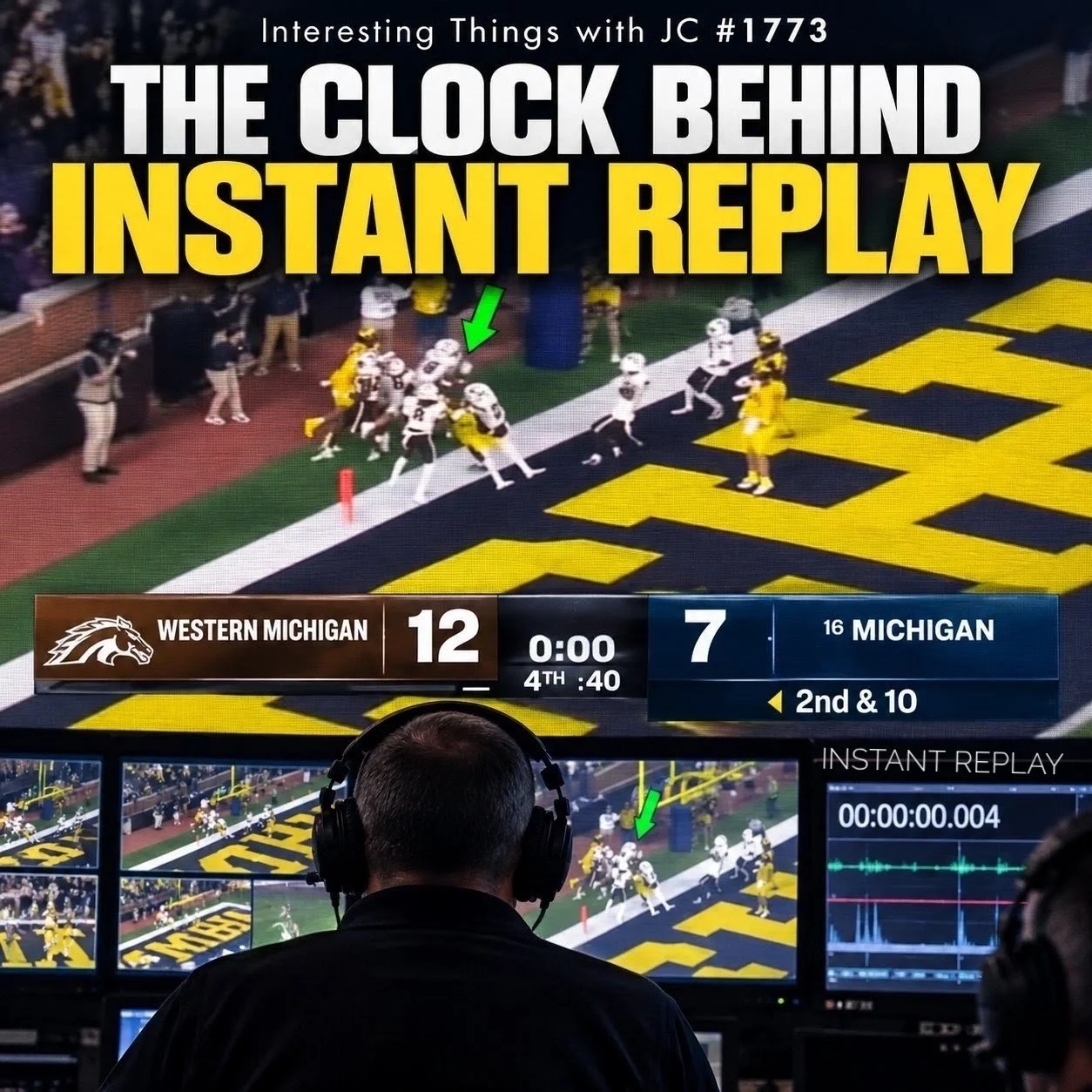
Interesting Things with JC #1773: "The Clock Behind Instant Replay" – Two instant-replay feeds showing the same moment can reach officials milliseconds apart. Every step through processing, switching, transmission, encoding, and decoding can add hidden latency, so replay has to determine when each frame actually occurred instead of trusting when it arrived.
Get every episode summarized
Each time Interesting Things with JC publishes, we email you a written briefing from the transcript — the topics, who appeared, and any specific claims, with the ad reads skipped.
Email me new episodesFree for 3 shows. No card needed.
Hosts & guests
Transcript ready
37 searchable segments. Every word is indexed and playable.
Full transcript
Interesting Things with JC — 1773: "The Clock Behind Instant Replay". Machine-transcribed; use the interactive transcript above to jump the player to any line.
When instant replay officials compare two camera angles, those pictures they don't necessarily reach the system at the same time. Different processing and signal paths can separate them by milliseconds, and that matters when a quall depends on the exact frame a knee hits the ground for a ball crosses a line. Think of two letters mailed at the same time, but taking different routes. One arrived Tuesday, the other Wednesday. The delivery time differ, but the postmark shows that they were sent together. That's the difference between latency and synchronization. Replay has to know when the pictures belong together, not simply when they arrive. The Big Ten handles the first part before the game. 85 minutes before kickoff every broadcast camera used for replay synchronized with a strobe, including a dedicated camera on the stadium clock. The flash gives them a common visual reference, but synchronization does not remove latency.
Every step after the camera, including processing, switching, transmission, encoding, and decoding adds delay, and different feeds can take different paths. Modern IP systems can carry precise timing information with the video so downstream equipment can keep the frames on a common timeline. Instead of assuming the signals arrived together, they were captured together. Exact compensation methods are not fully disclosed to the world though. Sony's Hawkeye system then lets officials advance multiple synchronized angles together, comparing the same instant from a few different views. The game clock adds another timing source. A residual latency of only a few milliseconds, for thousands of a second, for example, it can be enough, so when one feed reaches true zero, a feed carrying that small extra delay still shows time remaining. On a clock that displays only whole seconds, that difference registers as one full second
left on the clock. That is exactly what happened in Michigan's 2046 game against Western Michigan. The television clock had hit true zero. The dedicated stadium clock feed available to Big Ten replay still showed a second on the clock. The officials restored that time, even though the game was over. Signals can take different amounts of time to travel. Instant replay still has to preserve one common definition of when each frame occurred, and because the job is not only seen what happened, it's making sure every camera and every clock agrees on when it happened. These are interesting things with J.C.
More episodes
More from Interesting Things with JC

1772: "Staten Island Remembers"
Interesting Things with JC

1771: "Debut of the Fresh Prince of Bel-Air"
Interesting Things with JC

1770: "When a Parasite Rewires Behavior to Spread Itself"
Interesting Things with JC

1769: "Football Brain Injury Cover Up"
Interesting Things with JC