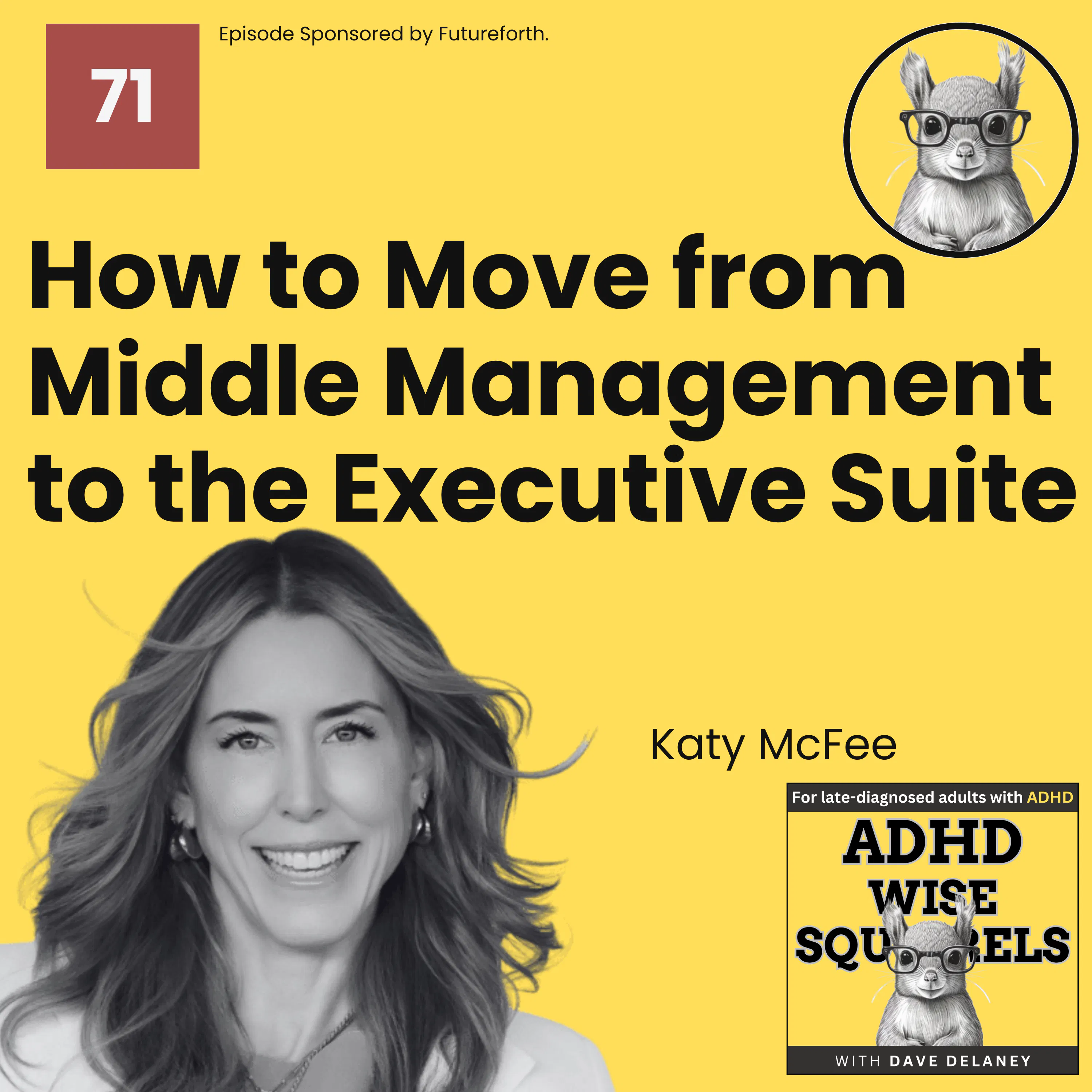
WS71 How to Move from Middle Management to the Executive Suite with Katy McFee.
About this episode
Get every episode summarized
Each time ADHD Wise Squirrels for late-diagnosed adults with ADHD. publishes, we email you a written briefing from the transcript — the topics, who appeared, and any specific claims, with the ad reads skipped.
Email me new episodesFree for 3 shows. No card needed.
Hosts & guests
Transcript ready
600 searchable segments. Every word is indexed and playable.
Full transcript
ADHD Wise Squirrels for late-diagnosed adults with ADHD. — WS71 How to Move from Middle Management to the Executive Suite with Katy McFee.. Machine-transcribed; use the interactive transcript above to jump the player to any line.
Before we jump in, I wanted to let you know about something new. I'm really excited about it. It's called The Nest, our online community, and I'd love to see you inside. Each month, I'm hosting two live virtual sessions where we can come together for group coaching, body doubling, real conversations, and occasional guest experts who'll share their wisdom with us. You'll also get access to the community itself, where you can meet fellow Y squirrels and get episodes early, tap into extra resources, and you can enjoy plenty of good things. I'm adding along the way. It's all waiting for you in The Nest. Visit YSquirrels.com slash Nest for details, and I'll see you inside. Welcome to YSquirrels, the podcast for late diagnosed adults with ADHD. I'm your host, Dave Delaney. I am so excited to share that I'm scheduled to deliver my first TEDx talk on March
28th in Franklin, Tennessee, which is a lovely little city just south of Nashville. I'm describing my talk as one that has been 50 years in the making, and for those of you YSquirrels who have been listening for a little while, or even a short amount of time, you probably know what I'm alluding to. So if you're in the area, drop by. I'd love to see you there. I love, love, love, standing on stages and delivering presentations and seminars and performing, and if you know of opportunities where you think I'd be a good fit for your company, your school, maybe your conference, don't hesitate to check out DaveDelaneySpeaks.com for more information about that. I don't just speak about ADHD related topics. Everything I speak about is about communication, and certainly knowing yourself fits into that topic as well. So drop by DaveDelaneySpeaks.com. I've been making some updates to how our online community works over at
the nest. Namely, I've moved operations of it over to Substack. It seems to make sense. Given the fact that many listeners are over there, it makes sense to be there. So if you haven't yet, check it out, the nest. If you've ever felt like you're working twice as hard just to stay at that manager level while the C-suite feels like a gated community, today's episode is for you. Joining me is Katie McFee. Katie spent 18 years climbing the corporate ladder in biotech and technology, eventually reaching that executive level. But here's the kicker. She did it all with undiagnosed and unknown ADHD. Only getting her diagnosis at 43, so turns out she's a fellow Y-squirrel. Today, she's an executive coach on a mission to close the gender gap in leadership. And I love that idea. We're diving deep into the messy middle of management. Why being a hard worker might
actually be keeping you from a promotion and how Katie turned her ADHD into a strategic advantage at that VP level. Our conversation led me reflecting on my own career. Now I've worked for myself for over 13 years, but I've certainly had jobs throughout my career and never made it to that executive level. And I think part of it was self-doubt, self-confidence, problems, and posture syndrome. But also with undiagnosed ADHD at the time, I think a lot of it was in my head that was holding me back. And Katie really makes the case today on why an executive level can be a wonderful thing for a Y-squirrel. And whether you're a neurodivergent person, a woman looking to land that first VP role, or just someone trying to figure out why your operating system feels different than your bosses, this episode is for you. And so without further ado, here's Katie.
I'm Katie McFee. I'm a former executive turned executive coach. So that's what I do as well. I help women generally break through and land their first time VP roles. Nice. That's great. And how long have you been doing that and working in that space? Yeah. So I'm a former exec myself. So I did 18 years in corporate work in in biotech and tech. And I started my business four years ago. I always say like my journey to the top was not a straight line. It was very all over the place. I got stuck at a couple of places in my career. It was always very ambitious, but I found myself getting stuck as a manager, stuck as a director. I had undiagnosed ADHD at the time as well. And I find that middle management for folks with ADHD can be particularly challenging. But when I finally broke through to senior leadership, I realized lots of people get stuck in those same places. And so in this next chapter of my life, I really wanted to help people with that transition from manager to direct VP and beyond.
Was it like a, I mean, you mentioned you had drive there, but I think sometimes with self-confidence and sort of imposter syndrome and these things that, you know, neurotypical people experience as well, but it's, you know, at a little field of the fire when you have ADHD. So certainly undiagnosed and untreated. And I'm speaking partly from my own experiences working when I worked for people, when I had jobs, jobs, jobs, jobs that I never did get to the senior levels that maybe I aspired to partly because I just even didn't want to or maybe I didn't feel like I could handle that much. And maybe I couldn't have. I don't know. You know, it's so interesting because so from my first job, I wanted to be a VP like my boss. I really liked it for my boss. I thought he was really cool. He's really fun. He was like nothing like me. He was like six but three alpha alpha male runby player like we're so different. But I was like, I want your job. Like it seems really cool to me. And I was,
I mean, I was really fortunate that I stumbled into sales biotech sales. And I say stumbled because like I know clue what I want to do with my career. I like switch programs three times in university. I was all over the place as you can imagine. And but I stumbled into biotech sales and I loved it. And I was good at it. And it didn't require like I was good at winging it. I was, you know, I was really interested in the types of things I was selling. So I was able to like learn them inside and out. Yeah. And so I did progress relatively quickly to middle management. But that was where everything started to catch up with me. Right. And so a lot of the executive functioning stuff, you know, you're you're managing down. And so you're keeping track of all of that and developing your team and like you're managing up. And so you're, you know, also trying to impress your boss. And there's just like so much to handle at that level. And you don't necessarily have a lot of resources yet. Yeah. And and yeah, I would look at I would look at the executive sometime.
You can talk about imposter syndrome. But I was like, these people are not like me. Like I forgot to pay for parking today and got a ticket or like, you know, I was like 15 minutes late for the leadership meeting. I'm so embarrassed. And so a lot of this stuff that was actually undiagnosed ADHD. I saw as like me just like being a bit of a shit show like me just not, you know, just being different. But here, this is the interesting thing I discovered is once you become an executive, if you can push through that messy middle, usually you have an assistant, you have resources, like you actually have people that take care of all the stuff that you found so difficult. Like I was no longer book in my own travel. I was not doing my own expense reports. I was like all this like executive functioning stuff. I was kind of able to hand off, which actually allowed me to do even better. I would say it's an executive that I did in middle management. That's a great perspective. Yeah. No, I love that. And it's a good, it's a good reminder for folks.
Yeah, that if they aren't at that senior level yet in their career, that's a wonderful reason to do that, right, is to get to that point and having that that scaffolding in place, having those assistants and others. And so biotech, so you, what did you, where did you study? You're from Ottawa as we were talking about before. And that's I'm from Toronto originally. And so where did you go to school? What kind of stuff for you to study? So I did chemistry at Carlton for a bit. Then I actually did nutrition at Ryerson, so I was in Toronto. Yeah. And then I did biopharmaceutical science at the University of Ottawa. Because again, like I was, I was a decisive, I didn't know what I wanted to do. I was kind of all over the place. So it took me six years to get a four year degree. So I mean, it probably didn't look like I was going to be super successful at least initially. But luckily, the third degree stuck, I was able to finish that one and then move into the workforce. Yeah. That's great,
because like I barely passed high school, let alone, I think I went to five different high schools in Toronto. But I digress. But yeah, no, I went to Ryerson as well and studied business communications marketing. And then before that studied radio and television broadcasting at Seneca, knowledge and Toronto. It's interesting. Yeah, it's interesting where your path takes you. Well, with the sales type of role too. And when you're into something and hyper focused on a topic of interest, preferably, I went down a different path and I studied like improv comedy at second city in Toronto. And I've done a lot of improv. And now I do like corporate communication training and things using skills from improv, certainly among others. But that improv sort of aspect of that dopamine rush in the moment of thinking quickly on your feet can, you know, standing on a stage in front of an audience, making sure they're laughing and they're having a good time, which is also something as a speaker, a big part of my work. But in your shoes, I would have met without putting words in your mouth, I'm sure like that, you know, a high state
sort of sales situation is kind of similar, right? Oh, yeah. Like hitting your number, every sale what comes in like all either it's totally and the interesting thing because I didn't understand myself at that time and understand my brain. But I would I would get these huge highs from because I was good at sales, I actually did really well. And I would get these huge highs and then I would have these major lows when, you know, between sales. And so yeah, I would, but I did really love it. And because I was also I was I worked at a lot of startups, I worked at a lot of companies doing really cool things. I did really think the things I was selling were cool. Like one of the companies I worked for, one of my customers was the the scientific advisor for Jurassic Park. So like really cool, like, you know, so we got to have great conversations and that kind of thing. And so yeah, it's I imagine those kind of similar, the idea of like improv and speaking,
you do get that same dopamine rush that I think we all kind of thrive on. So that kept me going a while. Yeah, yeah, yeah. And so now you're coaching executives, is that right? Yeah, so the the thing I really want to do. So I'm my mission, I would say, is to help close the gender gap and senior leadership because I came up in biotech and tech. I was often the only woman at the table or the only woman in the room. And so I really lived this male dominated industry thing. And I've always wanted to just like help the women around me, especially as I started to see my own success and see women getting stuck in the same spot. At least we're like super hardworking, smart, you know, awesome women. I was like, yeah, I want to I want to help to close this gap a little bit. So what I do now is I focus on helping women land their first peak year old. So that's like the single place that I think I can help the most because I I joke that I thought about this more than anyone on the planet. When I was a director for five
years, I couldn't get that promotion. And I really did become kind of like obsessed with figuring out what does it take to become a successful executive? Why do some people get to do it? And some people kind of never figure it out. And then yeah, once I became a VP and an EVP and eventually decided to leave the corporate space because also when you get higher and higher up into leadership, there are certain things that my brain long to do, love strategy sessions, love connecting to dots, love looking at my sales dashboards for teams. They didn't love dealing with legal and compliance. Didn't love having to follow all these processes and whatever. So so eventually got to the point where I wasn't really feeling aligned and I decided to to leave the corporate space. But I thought this is what I want to do. Like this is the people I want to help. And so I've been doing that ever since and it's it's awesome. It's so much fun. And you said you've been doing that for four years now? Is that what's the timeline like in your diagnosis as well? Yeah. So I wasn't diagnosed with ADHD until after I left corporate.
I was thinking that I wish I really wish I had known sooner. Yeah. But I didn't. And so the way it ended up happening, I was kind of suspected deep down that I might have ADHD. And my second child pretty like sure has ADHD like 99.9%. But during the pandemic, I remember I have a friend of mine who was a hairdresser was coming over to do my hair. She was like a friend of a friend. She'd also been a social worker and her daughter was diagnosed with ADHD. And the reason that that matters is the story. So she's doing my hair. We were talking and I think at some point we were talking about her daughter or something. And I might have said something like, yeah, I think I probably have ADHD or something like that. And I would say something. I didn't know if I really meant it, but like sometimes I would say that. And we spoke, you know, took a while. I got a lot of hair, right? So she's doing my hair for a couple of hours. And then she was leaving. I remember I can picture this so clearly not. She's leaving and I was saying goodbye to her at the front door. She just looked so good to see.
I was like, oh, so good to see you. She goes, oh, and by the way, Katie, you 100% have ADHD. And I was like, what? And on it, it just completely shocked me because I was like, really? Like you actually think I do. She's like, 1,000%. I was like, oh, okay. And so that's what kind of got me starting to think about what does that mean? Like I had never even really looked into what I mean, I had the picture in my mind of like, you know, nine-year-old boy bouncing up the walls, but I hadn't really looked into ADHD in women or as adults or any of that kind of thing. And it's so funny because at the time I was like, I'm not hyperactive. Like I am the most hyperactive person. I don't know why I thought that. I'm so hyper. How long were you sitting in a chair under scissors and blow dryers? You were probably like, she's like, I remember being when I was a director and my CEO was giving me feedback about why I wasn't being on the OVP and how it seemed
more senior unless junior. He's like, you need to move less in meetings. It didn't click in. Like I knew I was fidgety, but it just didn't click at that time. Hey, I'm not sure if you know about this, but I was a speaker and a trainer for Google for nearly six years. In addition to this, I've been a coach through a lot of my career, helping small business owners and entrepreneurs improve their businesses. But now with ADHD, I've learned a lot about helping other wise squirrels like me. Check out the link at ysquirrels.com slash coaching and book a free session with me to see if I can help you. I have a feeling I can. And so after that, I did kind of start to think about, yeah, maybe do I look at this? I sort of listened to, you know, if you podcast and things and looking online, like, how do I know of ADHD? You know, that kind of thing. And then I did seek out a diagnosis.
So then I ended up being diagnosed when I was 43. So I'm 46 now. So three years ago, those days shortly into my entrepreneurial journey. And the interesting thing is I had already created so many hacks in my life to function well with ADHD that when I started to look into the tips for managing your life at ADHD, I'm like, oh, I've naturally started doing so many of these things. Yeah. Because it was like, you know, 43 years of trial and error of like things not working at and finding things that work. So yeah, they're called, they're called coping mechanisms. Yes. These terms, these terms I'd never heard of a few years ago. And now I'm like, oh, masking. Oh, okay, I get that. Now I understand. Or coping mechanisms. Yes. Yeah. And I remember saying, you know, because I think especially, probably still maybe so, I don't know, but a few years back, it was kind of cool to be like Kardashian board. Like, like, you know, not the animate, like just be like, yeah,
no, no, no, no, like this, like your phone, vocal fry, right. And I'm an animated person. I mean, I'm like, again, I'm, I, I, so I'm combination. Like, I'm both, yeah, yeah, when I was right, I think it's like, you have to meet like, either like maybe six overall criteria or four in each cat or in a cat or something like that. I mean, like almost all of them in both categories, but I have all of the ADHD symptoms. And so I remember thinking, like, how do people like sit so still and speak so boringly? You just can't. Yeah. How are you? How are you in like in grade school or in like high school? Like, how, how are you then? Um, so I mean, I was smart. Like, I, I did well in subjects like math and chemistry because they don't require studying. Like, as long as you understand it. Yeah. Um, it has a good hyperfocus. I actually, if, like, if I went to class and I listened, I would absorb the information and
understand it. Yeah. Um, I couldn't study. Like, I, I remember, I remember, uh, the first one I ever had to study, for example, like, I was literally like, I don't even know what you're supposed to do. Like, I was so lost. Um, so that's all never come naturally to me. So my grades were up and down. Like, I remember in, in grade 10, I felt like the highest mark on our math class. And then grade 11 hit. And I think I like had a crush on a boy or something and like, wasn't really going to class. And also my marks just like plummeted. So, uh, but early grade school, I would say the biggest thing was Katie talks too much in class. Katie is not paying attention. She's really smart, but she's being influenced by people around her and that type of thing. Um, I remember years later going back and looking at my old report cards and being like, oh, this is so fascinating to read now. Yeah. It's great. Yeah. My mom kept mine too. So it was quite hilarious to read them. Yeah. Yeah. And it is interesting. Yeah. Cause I think
there is this, and I can part of the reason why I asked you to because like, so a generalizing and again, not a doctor, I always say this and I'm, you know, not one, I don't pretend to be one on the internet either. Well, there's enough of that out there. But, um, but my understanding too is that like, with these three different presentations of ADHD, the, the inattentive presentation, the hyperactive impulsive presentation, then then the combined presentation. And I always use the analogy or the like, I use the Lisa Simpson as inattentive Bart Simpson as the hyperactive and then Calvin from Calvin and Hobbes of, uh, as combined. And, but generally speaking, and I don't know like percentage wise, but my understanding at least is that women tend to be more the Lisa Simpson more inattentive and, and boys obviously are the more hyperactive. And as far as the reason why I was asking to you is because I was that I was Bart Simpson. And so, you know, I was the one. And so it, it also helps to explain why,
besides just, you know, misogyny and sexism and all the things that certainly exist and existed more so than as well, you know, uh, so I wrote a post about this recently that I read a study that women tend to be diagnosed five years after men, uh, with ADHD. And, and I think part of it is as a child, if you're more inattentive, you're playing with your hair, you're just daydreaming, but you're getting the work done. And so you're not disrupting the class. So there's no reason to pay attention to you. You know, you're passing, maybe you're getting by or you're, you're doing great. I always stress that ADHD has nothing to do with intelligence so you can be like Einstein, who was believed to have had ADHD. Uh, so there's that. But, um, and then the combined presentation is an interesting thing because I think, and again, I, I, this is more anecdotal and I don't know if there's science to back it up, but my belief is that as you get older, I think everybody starts to become more combined, more so. Um, and you also learn these coping mechanisms
and masking methods to sort of deal with that hyperactivity. So like, instead of bouncing around the room, you learn to like, you know, maybe, I don't know, like just get fixate on your phone or whatever it is, right? Yeah. Um, so it's, it's interesting looking back at that. And also you mentioned, I think it was your daughter, you said, right? Or did you say, um, but ADHD is, is as, it's almost as heritable as height. So that means that if, if you have ADHD, there's a high likeness, one or more of your children do. Yeah. And it also means that one or more of your parents probably did too. Yeah. Or do, um, which also can help the, you know, help with kind of looking reviewing your life and thinking of perhaps trauma or things that you went through. Um, certainly because of that undiagnosed ADHD that that could have been in the background. And so, and also women tend to be more typically, especially inattentive, tend to be more diagnosed with anxiety or
depression and only diagnosed with ADHD. Hopefully later, if that's the, the root cause because I'm diagnosed with anxiety. But so often what happens is anxiety and depression are really common comorbidities that come along with ADHD. Um, less common or OCD and bipolar and things that can come along, but they don't necessarily do. Um, and just to be clear too, for listeners like, you know, you can have clinical anxiety or depression and not have ADHD, of course. But what happens is that if the ADHD isn't treated and that's the root cause, then you're never really going to fully understand yourself or deal with that anxiety or depression. And, and so that's, I think a part of the reason why women have been missed, uh, and, and, and how women are getting diagnosed now, mainly is by taking their child, you know, now the stigma is being removed. Mental health is something we support, uh, hopefully, mostly. And, and so now you, you feel more encouraged to take
your child and if, to, to get tested if, if they need it. And then when they get diagnosed with ADHD and you start to learn about it with your child, and this is often the woman, uh, the mother, you, you start to be like, you're like, oh, wait a minute. Oh, hello. Yes. Now I understand. And I'm, I'm such a big believer that this will end not end, but this will really curb future generations of trauma and kids because if the parent is treating their ADHD and understand this about themselves, they will naturally learn to be less impulsive or less prone to addiction or, or these different things. So, sorry. Oh, 100%, 100%. No, it's going to stay with, with women oftentimes, I think it's two things. One is getting their children diagnosed, learning more about it and then seeing themselves, right? I've heard the story so many times, like reading it. They're like, uh, this sounds exactly like me. Yeah. Um, this second thing is as women start to reach perimenopause and our hormones are out of, I want to lack ADHD. So, I mean, to get worse. And so,
I think that's another time of life that a lot of women start to be like, whoa, like I was already barely hanging on by a thread. And now everything is just like, yes, totally bananas, right? And so, they start to look for, for answers at that sort of stage as well. Yeah. I want to bring a doctor on to talk about that because that is something I've put some feelers out about, about speaking like a PhD or someone or an MD about, about that because yeah, obviously, I don't know a ton about menopause or perimenopause, but I do know, yeah, I hear a lot about, you know, yeah, exactly what you said that. And I think, yeah, I think these different stages of life, whether they're like physical like that or whether they're like situational like, I know a lot of young adults get end up getting diagnosed now because they go off to college and now they have no scaffolding, they have no parents to nag them to do the thing and they're completely overwhelmed. And suddenly, I need a therapist and that therapist might diagnose them and be like, oh, because they're facing,
or they're partying too hard and partaking and, you know, things to partake in and that excess can, can lead to bad things too. And you're like, yeah, it's so crazy how much changing my lifestyle has impacted my symptoms because when I think about at my worst when I was like, drinking wine every night and I had no morning routine and, you know, I just have fallen into a lot of really bad habits, a lot of, you know, yeah, dopamine fueled the lifestyle. And it really was serving me like it was, I couldn't even get to work before 10 o'clock. And now I would say my life looks completely different, but a big part of that for me has been, I don't drink anymore, either, you know, you mentioned that you drink anymore or either. I prioritize like healthy living, exercising every morning, meditation, like all of these things. And I tell my kids like,
this is good for anyone, by the way, like it, but my middle child who, like I said, I'm nine members, I sure he has ADHD, but he's not on any medication. I haven't gotten a formal diagnosis for him. But I'm like, we can put systems in place to help you be successful right now. We don't need to go get a diagnosis to do that. So, yeah, it should work on. Are you do, you know, there's things you can just start doing that are going to help you to be more successful. Let's just put those in place. Yeah, I was going to ask you about that. Actually, how, how was the, I almost said process, but I'm talking to Canadian process feels better. I might even talk, I might even talk in metric a little while. Yes, I'm not, baby. I miss my home and native land sometimes, often times these days, but I digress. As far as the diagnosis goes and the, the access to medication, things like that, how did that go for you? In Ontario, with sort of the,
yeah, I hear different reports of different provinces. And I'm always curious about how things are looking. I know like kind of the NHS in the UK, sort of a bit of a mess. And so how, you know, having spent some time last year with my mom in the hospital in Toronto, my experiences were great and hers more importantly were great. But I mean, the shortages are there, the funding gaps are there, problems are there. So, how did it go for you for that diagnosis? Did you have a long wait? Obviously, as a, as a former executive, you probably have some capital that you can invest in helping to make a couple of things. Not everybody has that. How was that, how was that looking for you in Ontario? Yeah, there are, there are some significant wait times depending on what you choose to do. So because of that, I did go like a paid telehealth route because it was during the pandemic.
So I did it all through like a telehealth route that specializes in, in like neuro diversity and ADHD and all kinds of stuff. I can't, I can't even remember which one it was, but I did pay to go through the process. We made it a little bit quicker. The funny thing is that I was amazed I even got through it because I have ADHD and you have to fill out hours of forms and answer things. And then you do interviews too. But like the first step is like filling out form after form after form and I was joking with my now husband that I was, I was like, I wonder if part of the process is they actually can see my screen and they know how many times I like accidentally go do something else. I come back to it. I forgot to save like, and so it was, in that sense, like that was, that was really hard. I was joking. Like I can solve the biggest problem in your company. Don't ask me to fill out a form. It's just like, so, so painful for me. So that's the process
that I ended up going through again because I was able to access that more easily. And I was, you know, wanting to get something quicker. But now overall we do see some, I've seen lots of info on wait times like both for Ontario, but also at last, like I've seen different provinces, you know, post. Yeah, yeah. So I mean, as you know, the thing with the Canadian health ecosystem is it can be amazing when you, I'm going to say, quote, really need it. Like, when it's urgent, like, you're going to get the best care. But a lot of things that are considered more elective can take a lot longer. And so I think there's a lot of people that are definitely challenged with that for sure. Yeah, it's funny because when I was diagnosed, you know, I've been in the States since like, like for 18 years now. So, and you know, still being like, I only became a US citizen, Connecticut, as Neil Young says. So I'm still probably, you know,
Canadian. And that's our exit strategy. Should we need it? But when I got diagnosed, like I've always been, you know, for people unaware, like, it's only in the US that you see ads for drugs on television, like you don't you're talking about blah, blah, blah, like that's illegal. And every, I think it's every country now except the US. And so you don't see that in Canada or anywhere else for that matter. And so, and because the US Americans generally speaking, of course, are so medicated on all sorts of different things. Again, generally speaking, I've always been proud to not be on anything. Even when I was hung over back in the day, I would take, I would, I would not allow myself to Tylenol. I would only take a Tylenol if I had a headache on a regular day. But if I had a hangover, I was like, nope, sorry, sucker. You got to push through. So I've always been very careful with that. But it was funny because the timing of my, my, my diagnosis and treatment, suddenly I'm on anti-anxiety meds and on stimulants. And it was like just like, it seemed to be like a month after
becoming an American citizen that I'm like, damn it. Like they got me. I mean, I still don't have a bunch of guns or anything. So I haven't gone that far. But they're still time. Yes. Yes. Yeah. Yeah. It's interesting because there is even like a mental, like, hump to get over around the idea of taking medication. And I've, so I'm going to say something that I hope is not like really bad. But I've tried like friends medications like I don't have a prescription. No one coming get me. I don't know if that's illegal or what. But so the, and probably I would need to test out a number of them. But I'm just the type of human that I feel everything I take. Like I'm just like hyper sensitive. Yeah. So when I've tried, I had a friend who was taking Adderall or something. She also has ADHD. Obviously. And she's on a very low dose. But I, and I was like, yeah, you know, we're good friends. So she was like, you want to try? I don't think I actually do.
And I found that the benefit, the big benefit for me was certain. So again, if you're a woman, oftentimes your ADHD symptoms will also shift with your menstrual cycle. So like a week before your period, they might get much worse where again, we're really good at masking. We're really going to hang it on. But then when our hormones get at a wax suddenly, it's like everything falls apart. And so oftentimes in that period of the month, I'll feel like extremely overwhelmed. Like I just can't, like it's like I can't even move. And so I find taking ADHD medication because it calms the ADHD symptoms takes away that, that overwhelm. And I'm like, oh, I can function. Like I could just like be like a regular person and like get a thing done. I can fill out a form maybe. Who knows? But the thing I didn't like for me was that I felt like it also took a little bit of my mental sharpness away. And I didn't like that feeling. And so again, it might just be the
wrong one. Like I can't, I'm also like not a doctor. And it could have been the wrong dose or drug or whatever. But what I decided was I'm just going to see what can I do with all of the various other hacks and things that I can create in my life. And then make a decision. So I'm always like never say never. I don't know. There may be a point where I'm like, yeah, no, you know what, I'm ready to, to, to try that. But I'm like, you, I never take anything like I, it's rare that I take medication. And so there's also for me that's logical thing that I kind of have to get over about taking something every single day. Yeah. And it has, yeah, it's been interesting. Like what I've learned with like stimulants, especially like if you're on an anxiety or depression medication, like that's not something you can just stop. Like it's not safe to do that. Where stimulants, you can, you can, I mean, with, you know, talk to your doctor, of course, but you can just stop or you can take them as you need to. Like if you really need to focus on, you know, if it's a weekend, you don't have anything to do, then maybe not. And it also,
it's interesting because they're not, at least for, you know, ADHDers, they're not addictive. Which is great because that's the big thing. Yeah. Well, they forget to take their meds, right? It's like, well, you're not addicted if you forget to take your meds, right? Like clearly, they're not. But one thing that I heard about a lot, and I talked to my doctor about this, not that a few months ago, was I always hear more anecdotally online on social, which, of course, don't believe anything there. That you hear these eureka moments of people taking an ADHD med, and like a stimulant, and they're like, oh, the clouds have parted. And they're like, oh, my god, this is life. Oh, my god. And my understanding, at least for my doctor and my own experiences, I didn't get that at all. And in fact, it's really neuro-typical people who take an ADHD stimulant who shouldn't be. And they feel the, oh, because, yeah, they ain't supposed to be on that. It's not for them. And so, but it's interesting too. The other thing I was going to say with ADHD meds is,
and my experience is when you start, you start on stimulant A, and you start at like 10 milligrams or whatever the dose is, and then you increase the dose with your doctor. Of course, you increase that dose gradually until you feel like it's in a good spot. And what can happen is there are some side effects. Nothing that I know of that are terrible, but again, I'm not a doctor here, but you know, things like sleep or, or, you know, add it like just changing moods, mood swings, things like that. And so, if that comes up, or we, like I had a weird thing with vivenants where I had this, like, sense that I could smell like gas, gasoline, it was a weirdest thing. And my doctor said, that's unusual. And so we switched meds, and when you switch to a different stimulant, you can start at 10 and kind of gradually move up until you find that sort of sweet spot. And then making sure that it behaves with anything else that you're, you're taking as well. But my big experiment was actually under my therapist recommended during this,
was to take a week off the stimulants instead of, and just see how I feel. And I wrote a long blog post and newsletter about this at yscorals.com, basically describing what I went through, which was this feeling at first of like being at like the nicest resort in the pool, in the center, the bars over there that like, you know, it's beautiful day. It's like, and I'm, I'm trading water and I feel great. And then like my arms start getting tired. And then my legs are getting tired. And suddenly I'm like, starting to bob and I'm like, I'm going to drown here. And that was kind of how I summarized it in written form to kind of describe how I felt. And then, and then once I came back up for air, I was like, how is my wife still here? Like, we've been married like 25. We've been together since 98. I'm like, how the hell does she murdered me yet? Yeah. Kind of a miracle. But, you know, God bless her. Uh, so yeah, you learn a lot about yourself. Interesting. I love that you said that you thought it was going to be this Eureka moment because
that's what I thought too. And I have never experienced that either where I'm like, I just feel kind of the same, although maybe like less overwhelmed or less, whatever, like I can, you know, I feel a little different. I feel like, again, I feel I'm not drowning. So I totally see that analogy. Yeah. Um, but I've heard people say that, you know, the first image at ADHD medication, they're just like, this is what people's brains feel like. This is like the basic and things so clearly I can whatever. And I'm like, yeah, that didn't really happen to me. So yeah, it's like whenever poser. Yeah, it's like, you probably have like three cups of coffee and you're like, I'm bouncing off the walls when I can drink like a pot and still be like, yeah, yeah, totally. It just gets me up to big blind. Right. Exactly. Yeah, yeah. Uh, that's hilarious. Um, yeah, I know. I mean, I'm, you know, obviously, and coaching the, the coaching work that I do, helping professionals improve how they communicate, because a lot of my coaching clients now come through Y Squirrels because I've learned so much
about ADHD. Again, not ever claiming to be a doctor or a therapist or someone, but certainly being hyper focused on this topic and learning so much about it and understanding myself and others now, even with more like empathy, that's the other side of it, right? Like you can be more forgiving of your son if he's like, maybe, you know, I mean, they're kids. They'll drive plus crazy by two due to you can be a little more empathetic perhaps and same with your parents or parents who might have like, you know, made you crazy. They're like, oh, they didn't, they weren't diagnosed. That's why the scotch. Um, self-medicating. Yeah. Yeah. Exactly. Exactly. So, and as far as the business goes, so you're, you're, you're helping executives and with a focus on women trying to move up that, that ladder, what are some of the common things you see and maybe for a listener who is at that level or not at that level yet, who is, you know, sees the ladder,
ready to climb said ladder, but yeah. Yeah. So some of the things, well, so first, I do end up attracting a lot of women with ADHD to work with me. I think because like, it tracks life, right? We do. Yeah. Yeah. I remember someone saying to me like, well, I've ADHD. Well, will the thing to teach work for me? And like, will I develop them for myself? And I have ADHD. So I think, yes. Yes. But they work for, they work for anyone. So they work for people who are neurotypical. They work for people who are neurodivergent. But some of the things that I see, I think a lot of this comes down to the way we're conditioned as girls to be pleasers, to be a good girl, to wait our turn, put up our hand, all of the things, translate into the way we show up in the workforce. And so, you know, some of the things that I see happening are women, these like really high functioning women who are like the person that gets stuff done. They're the
goat. And I always say these are my like high performing executors. And they think they're doing a good thing by doing it all themselves and saying yes every single time. And truthfully, early in your career, this actually helps. Like putting up your hand for everything, taking on the extra project, like that will get you those early promotions. However, once you get to middle management, you want to move into senior leadership, this totally stops working. Because that's the point where people want to start seeing you be more strategic, be more intentional, like really be thoughtful about should we be doing this thing? What are the biggest problems I need to solve? What is the best way to solve those for my team? And oftentimes, and like this is totally me included, we're going so fast, meeting, meeting, meeting, work, work, work, that we don't slow down long enough to ask ourselves those questions, right? To really think about like what are the most important things? Like how can I really drive greater impact here?
And a lot of the women I work with even almost feel guilty. I would say like block out even a single, deep work time, like a single, deep work block, every single week, two hours. Yeah. And they're like, like, like, block it out. But then as soon as somebody asks me to block over, I let them or my team needs something or whatever. And so as women, we have to feel guilty, blocking that time of not putting pen to paper or on calls or in one to ones all the time. And so that's a really big thing that I see a really big challenge. I think that a lot of women need to become aware of like once we're aware of it, that's what we're stuff, right? We can start to do something different. Yeah, absolutely. And kind of everything flows from there. Like if I take a huge step back, a lot of this comes down to just acting with intention. How do I want to be showing up in this situation? Who is the leader I want to be? Allowing yourself that freedom? Like you can take an hour and think about your career or think about things. You don't just have to be like go, go, go from to sit. Yeah. Yeah. Do you think that it's funny because I see myself
in a lot of what you've described, right? Like of being like a overachiever and a hard worker and taking on the extra tasks and all that stuff. But more from undiagnosed, of course. And so and not having either the gumption or the courage to kind of get to that next level in a sort of corporate setting. Yeah. If you're I'd be curious, you know, sometimes, yeah, it's probably controversial to say it. I may piss you off. But sometimes it's like, well, it's sometimes, I mean, I always say like, you know, as a speaker too, and like, you know, I'm a white, straight male. And I always preface this by saying like, we've had a great run. Yeah, it's been great. Like we've had a really nice run. It's been great. So yeah, it is time to move over and let other people in, right? Not to say I've ever intentionally done anything like that. But sometimes I hear like from like women friends or minority friends who have these groups they go to that are only women or only minorities. And it's like, but I want to come too. Well, I can use some help. I can use
some help too. You know, it is. Yeah. I run free master classes because that's, you know, I share I help people gain insight. So what might be holding you back today? That's that's the thing in my master's in the beginning. So it's in the same line as changed a little bit over time. But it's always the same thing. I want someone to walk away with an insight into what is the actual thing holding me back? Because when I was stuck, I didn't know. I wanted, I like, I wish someone would have helped me see what the real problems were. And I've had a few men that have messaged me because I get like men on my email list and stuff. And they're like, I've registered but is it okay? Because I'm like, I'm a man. And I'm like, yes, yes, come. I'm like, hey, if you want to do me a favor and invite a woman, you know, because like she can actually sign up for my program. But I'm still like, yes, I, I, you know, I post content every single day. And and to your point, like, I noticed that men and women get stuck at this stage. And initially, when I started my business, actually, I was coaching both men and women. But as I started to post or online and realize what I was really passionate about and and see like think about my own experience,
I was like, no, I really want to work with women. I really want to help them do this. But I've coached some amazing men. I've coached men and helped them make this transition in the past two, right? So I do think that a lot of people do struggle with the same things. And the challenge is like, no one tells us this stuff. Like there's no course that's like, how to start, you know, how to shift people's perception of you, like how to start seeming more strategic and less tactical. Like that's not out there. You can find stuff on people leadership. You can find stuff on, you know, very specific, maybe skill development. But a lot of this transition stuff, I mean, at least when I was going through this, there was nothing. So that's really what prompted me want to create it. Do you see that like the women and obviously women had been held back professionally and underpaid, professionally and underappreciated? I mean, professionally, I've been also personally too. Like, I mean, moms, hello. That's a full-time job in its own. So, you know, I'm not discrediting any of that. But yeah, so being clearly and I would assume you're pretty extroverted,
I just a hunch. But I also, much to the chagrin of my wife, who is introverted, she's like, when are you traveling again? We're like empty nasters now too. So it's like, you know, she's like, well, I keep telling my neighbors that if you don't see me for a few days, because Heather has murdered me. And God, you know, it's right. She probably should. I ask, no, I say all that because, you know, obviously you're extroverted, you're driven. Do you find that most of your clients, primarily let's say are women that are obviously trying to get to that next level? And the fact that they want to get to that next level and recognize that they should and so forth, are probably already more extroverted and driven to even reach out to you in the first place. Or do you find that, you know, what about like the more introverted shy woman that's kind of middle manager who would also like to go that next step? But it's like, I just don't want to have to talk about it. I mean, you know what I mean? Because, you know, people are shy, people are more
introverted. And I think sometimes that can, yeah, I wrote a book about networking. And I also, I've written a lot about networking for introverts as well. But, you know, there is that that challenge for the introvert or the shy person. Any tips there or thoughts for those types of clients? Yeah, I mean, I would say I do get a lot of women who are introverted who come work with me as well. Potentially because, I mean, I do, so I do live cohorts and they're, they're small-ish groups, like half of them at 25. So they're super small, but they're not super big either. And so everyone does get attention. And it's like a safe space, right? Where it's, it's all women. We're all in the same vote. I do think though that, I mean, there, there is that additional, there's so many additional things actually that we can layer on because a lot of the women, even that come work with me who maybe come from like various different cultures are also layering on conditioning around putting everyone
else first and not not challenging superiors. I like to say many things, right? But definitely version is a real thing. And, but one thing that I do love to remind people of is that showing up needy confidently and assertively doesn't have to be loud. Like, you don't actually have to be the loudest one in the room. You want to be intentional about what you're sharing. You want to ensure that when you have something important to say you do it and think about a way that that works for you. So, for example, I had one client that's constantly being talked over and interrupted by a male colleague. And so we actually came up with strategies like what are you going to do? And I was like, so one thing you could do is you can create and do like a physical gesture of like kind of like putting up your hand or, you know, making a gesture as he's interrupting. So like that, well, it's kind of like a patterned interruptor, right? That you're, you're, I'm still talking. Um, if you're on a Zoom call, which most of us are these are going to put up your virtual hand.
Like actually, but, you know, and I'd be kind of funny, but you could say like, I really want to, I really want to finish my point. And so I didn't want to have to talk over so and so. I'd love to finish before we move on. And so we come up with the language that feels good to them. Like, I'm a really big believer of not just doing something that someone tells you to do, but it has to feel authentic to you. It has to feel good to you. And sometimes that might be different with women and men. It might be different with introverts versus extroverts, like all kinds of things. And so I really love to work with women on that. Like, let's come up with language that feels good to you. If you need to push back, for example, if you need to ask for something or advocate for yourself, don't do it in that weird awkward way. Yeah, yeah, that's going to feel good to you. And that's often the defining thing that allows them, like, almost gives them permission to do it. Yeah, love that. Yeah, I do a lot of a big part of besides coaching a lot of my business is speaking. So I go to conferences and trade shows and companies and deliver presentations on
communication. And I was speaking at a conference last year. And these two gentlemen were standing in the back talking during my presentation. And I saw them and I was like, like, zeroed in on them. And I know how to handle it. Or the first time I did this, excuse me, the first time I did this was many years ago. But and I knew to like, I walked off the stage and sort of as I'm speaking in the audience, I walked right up to the two guys. And I stood like right in front of them looking at them, saying the thing that I was talking about in the presentation. So I wasn't like pointing the matter or anything. But I just walked and they were both like, I had both of their attention at that point. And then, like, you know, and I bring a lot of humor and performance to the presentations anyway. So, yeah, it was all good. But I got home and I told my wife this. I was like, you wouldn't believe what I figured out. Cracked the code. And she said, what, what? And I told her, and she's like, Dave, I'm a school teacher. And I'm like, oh, and she's like, this is like
teaching 101. Like, so obvious. Like, why don't you just ask me? I was like, I cracked the code. I figured it out. But then also like during, especially during the pandemic, you know, the peak of things there, all the speaking I was doing was staring into these magic webcams. And so I've learned a lot. And I do virtual speaking training on camera. And some of the stuff that I've learned and a big one. And especially for women, because there's been studies to back this up. But turn off yourself, you. Because I have it on at first to do like your spinach check and your teeth. But like after that, turn off the self view. And there's that option on all the different platforms. So your camera's still on. But you don't see yourself. Because women, generally speaking, are more self judgmental. But I mean, men are too. And it's just so sucking to stare at yourself as you're speaking, especially if you're on back to black calls, right? Yeah. So it's, I do
encourage anyone to try that to turn off the self view after the spinach check, of course. And then and just see how you're feeling at the end of the meeting or the end of the day. I think you'll find pretty quickly more energy. And you're like, oh, yeah. So this new fatigue kind of helps to, it doesn't cure boring meetings. But yeah, anyway, I do love that though, because I have had a few women that have mentioned me that that's like particularly challenging to them. So yeah, being able to turn it off and just like be yourself and not stare at your, it is really strange to stare at yourself. It's not human. Yeah, I mean, like if you're rehearsing a presentation in front of a mirror, I get that or a magic trick. If you're a nerd like me. But but yeah, otherwise, yeah, it's better to just turn it off. So and just remember that it's on them. So you're not like picking your nose or something. This has been awesome, Katie. Is there
anything I haven't asked you about or anything else you wanted to share? I know I've just noticed the time and I'm like, I'm having so much fun, but it's flying by. Yeah, no, I mean, I think the big message I want people to know is that you're listening to this podcast and you have ADHD, you can be an executive. You can actually be like a killer executive. A lot of the way our roles work, I think really help us to excel at those really senior levels. And so yeah, you might be running 15 minutes late. Maybe you forgot to pay for part. Maybe whatever the thing is, but don't just count yourself, right? Don't take yourself out of the race because of that because I'm like living proof that you can really thrive at those senior levels. And I've seen it lots of times with with others that I know. So that's my big message for anyone listening. Now I love it. Yeah, and it worked for like like Sarah Blakely is always the the name that comes up in my mind right away as someone who's a female executive very extremely successful entrepreneur. Spanx is one one for brands. She has a new one. I forget what it is, but she's like ADHD or as well,
right? So like yeah, it's and the studies I've seen, it's like 60 to 80 percent or people with ADHD are 60 to 80 percent more likely to have entrepreneurial intentions. And nearly 100 percent were likely to start a company or a business at some point or a side hustle or whatever. I feel like all of my entrepreneur friends of ADHD. Yeah, yeah, there's something there's certainly something to that. Business such a good conversation. I always encourage anyone if they're if they suspect they have ADHD. Often as I'm like, if you think you have ADHD, you probably have ADHD. Like we tend to gaslight ourselves. I certainly did before I was diagnosed. And so I do encourage people like go seek that out. Even if you don't plan to do anything about it right away. Yeah, it is good to know, right? Just going to know your operating system. Yeah, how can people find you? How can they, how can they learn more about what you do and get in touch? Yeah. So if yeah, if you liked, if you liked what I talked about, I post on LinkedIn every single day. So if you want more
leadership advice, it was a lot of leadership advice and stuff there. I also have a podcast called More Women Promoted. So you can probably guess what that's about getting more women promoted. And so I talk a lot about things you can do. It's like bite-sized episode, like 20-minute episodes that I try to make really just like actionable and applicable. So go check those things out. Nice. That's awesome. Yeah, and I'll include links to everything in the show notes. Katie, there's been so much fun. Thanks for thanks for joining me. Well, thank you so much for having me. Yeah, I love this conversation. So thanks a lot. If you enjoyed the show today, please leave a rating and review. This helps other Y-scorals discover the show and reminds me to keep doing this. Do you have questions or comments? Want to share an audio comment or question? Do you have questions about joining the nest? Or are you interested in a free coaching session with me? Just visit yscorals.com for details. Support of the podcast comes from our generous sponsors, our guests, and you. Thank you for being here without you. I'd be talking to myself and that's no fun. Hosting
for Y-scorals is provided by our friends at the Marketing Podcast Network at MarketingPodcast.net. You'll find special event invitations, links, show notes, free resources, and a whole bunch more at yscorals.com. And while you're there, sign up for the newsletter. That way you'll never miss another episode. Let's see you soon. Thanks for being here. This episode is brought to you by Athletic Brewing Company. No matter how you do Game Day, on the couch, in the crowd, or manning the snack table, athletic brewing fits right in. With a full lineup of non-alcoholic beer styles, you can enjoy bold flavors all game long. No hangovers, no buzz, no subbing out for water in the second half. Stuck the fridge for tip-off with a variety of non-alcoholic craft styles available at your local grocery store or online at athleticbrewing.com. Near beer, fit for all times.
More episodes
More from ADHD Wise Squirrels for late-diagnosed adults with ADHD.

WS70 Mindfulness, Meditation, and Procrastination with Dr. Lidia Zylowska, MD. (...
ADHD Wise Squirrels for late-diagnosed adults with ADHD.

WS69 ADHD Medication Quality, Oversight, and Reporting with Emma Yasinski.
ADHD Wise Squirrels for late-diagnosed adults with ADHD.

WS68 Ketamine Assisted Psychotherapy, Memory & Trauma with Amanda Johnson.
ADHD Wise Squirrels for late-diagnosed adults with ADHD.

WS67 Mindfulness, Meditation, and Observing Your Mind with Joseph Goldstein.
ADHD Wise Squirrels for late-diagnosed adults with ADHD.