newsAug 13, 202650:27pending
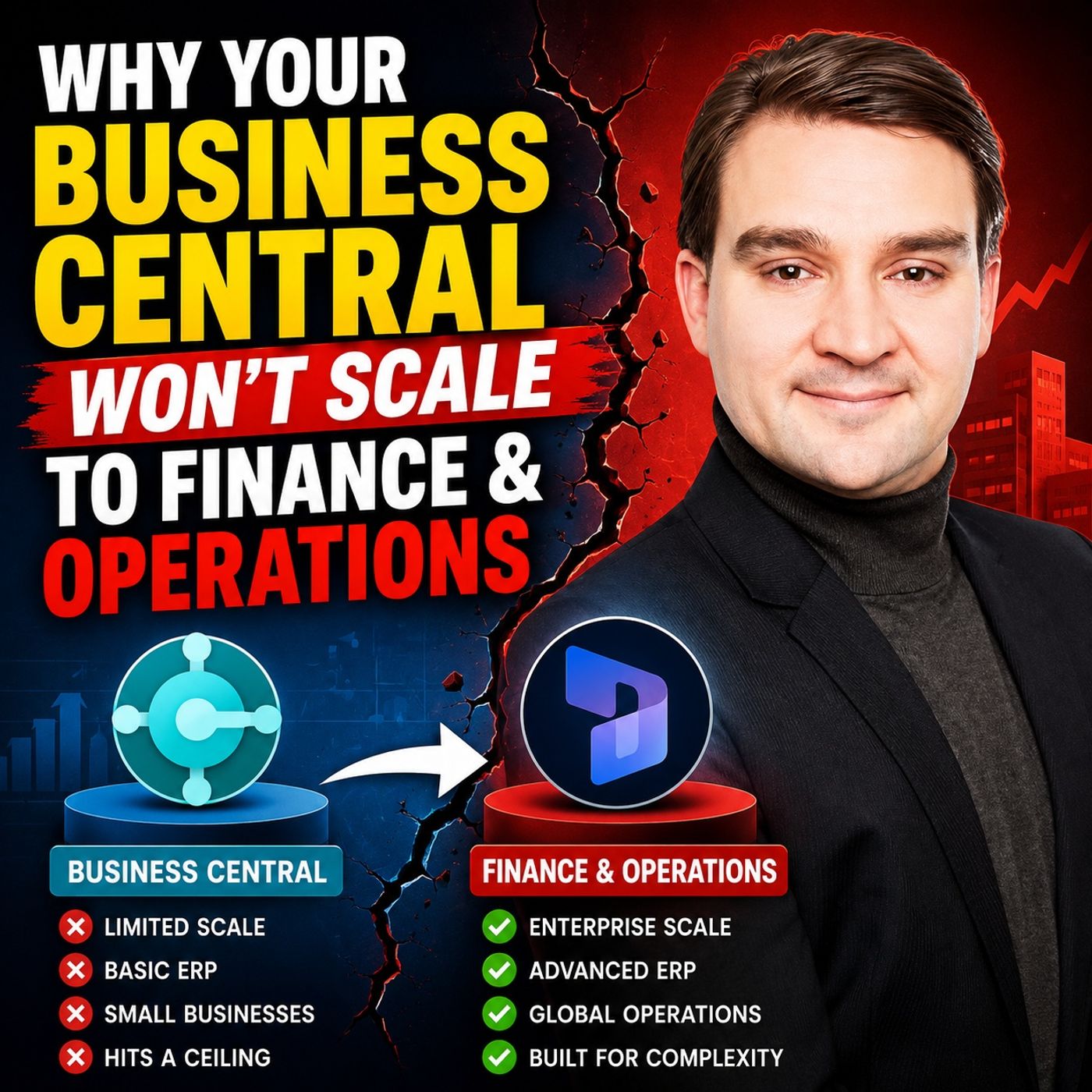
Why Your Business Central Won't Scale to Finance & Operations
About this episode
Business Central works. Your finance team trusts the numbers. The company grows. Then someone says: “We’ll just move to Finance & Operations later.”There’s one problem: Business Central and Dynamics 365 Finance & Operations are not two steps on the same ERP ladder.In this episode of M365 FM, Mirko Peters breaks down why moving from Business Central to Finance & Operations is not a traditional upgrade or migration. We explore the architectural differences, data models, consolidation challenges, Dataverse integration, M&A scenarios, migration costs, process redesign, and how organizations can prepare before growth exposes the gap.
THE BUSINESS CENTRAL TO F&O TRAP
Business Central and Finance & Operations come from two different product families.Business Central evolved from Dynamics NAV, while Finance & Operations evolved from Dynamics AX. They were created for different organizations, different levels of complexity, and different operating models.That means moving from BC to F&O isn't equivalent to upgrading NAV to Business Central. There is no simple upgrade button because the underlying architecture itself is different.
WHY THIS IS A REIMPLEMENTATION
The technical architecture, data models, posting logic, dimensions, account structures, and legal-entity concepts differ between the platforms.Moving data therefore requires extraction from Business Central, transformation into F&O's structures, loading through F&O's data-management tooling, and extensive validation.Each stage introduces its own workload and risk, making the move closer to a new ERP implementation than a conventional software upgrade.
WHAT BUSINESS CENTRAL WAS BUILT FOR
Business Central prioritizes simplicity.It works particularly well for organizations with one entity or a relatively small number of connected companies, straightforward financial structures, regional operations, and teams that need an ERP without enterprise-level complexity.Complexity is something Business Central allows organizations to add when necessary rather than something every implementation starts with.
WHAT FINANCE & OPERATIONS WAS BUILT FOR
Finance & Operations starts from a very different assumption.Multiple legal entities, multiple countries, multiple currencies, enterprise consolidation, sophisticated manufacturing, complex approval structures, and global financial operations are fundamental parts of its architecture.F&O treats enterprise complexity as something that exists from day one rather than an exception added later.ㅤ
WHEN GROWTH EXPOSES THE DIFFERENCE
The architectural gap can remain invisible for years.Then an acquisition happens. Suddenly there are multiple ERP instances, charts of accounts, currencies, financial definitions, and legal entities.Leadership still expects one consolidated view of revenue, margin, and financial performance. Finance teams can find themselves extracting information from multiple systems and reconciling it manually in spreadsheets.This is often the moment when “let's move to F&O” changes from a future roadmap idea into an urgent business requirement.
WHY M&A MAKES THE PROBLEM BIGGER
Acquisitions multiply ERP complexity.Several acquired companies can mean several Business Central environments, separate charts of accounts, different master-data definitions, different configurations, and different financial processes.Intercompany eliminations and consolidation then become particularly difficult because F&O's native capabilities operate inside its own architecture rather than automatically solving every external Business Central scenario.
DATAVERSE AND THE INTEGRATION REALITY
Dataverse can provide a shared data layer across Microsoft business applications, but this does not mean Business Central and Finance & Operations suddenly become one system.F&O's dual-write capabilities and Business Central's Dataverse synchronization are separate integration mechanisms.Organizations operating BC subsidiaries alongside an F&O headquarters therefore need to understand that they're connecting separate integration architectures rather than enabling one universal synchronization switch.
WHY REAL-TIME FINANCIAL VISIBILITY GETS DIFFICULT
Financial information crossing system boundaries can introduce synchronization and batch-processing delays.This becomes particularly important during month-end close, when headquarters needs accurate consolidated numbers while subsidiaries continue posting transactions.Integration can move information between systems, but it does not magically turn independent ERP platforms into a single real-time database.
WHEN THE PATCHWORK BECOMES MORE EXPENSIVE
Integration has an ongoing cost.Custom mappings need maintenance. Elimination logic changes. Synchronization jobs need monitoring. Acquisitions introduce additional complexity. Finance teams spend time reconciling systems, and auditors need to follow transactions across multiple environments.Eventually, organizations need to compare the continuing cost of maintaining that architecture with the cost of consolidating onto Finance & Operations.ㅤ
MIGRATION IS THE WRONG WORD
A BC-to-F&O project involves much more than transferring data.The systems use different table structures, posting logic, account frameworks, workflows, and business assumptions.Extraction, transformation, loading, and validation are substantial projects themselves. Calling the initiative a simple “migration” can therefore lead organizations to underestimate both budget and timeline before implementation even begins.
BUSINESS PROCESS REDESIGN
The difficult part isn't only data.Procurement, manufacturing, finance, sales, approvals, dimensions, and other business processes can operate differently in Finance & Operations.Organizations therefore aren't simply teaching employees where familiar buttons moved. They may be redesigning how entire business processes operate.That organizational change is a major reason enterprise ERP implementations require significant time.
CLEAN THE DATA BEFORE MOVING IT
A technically perfect migration can still produce a bad result when the source data is poor.Duplicate vendors, unreconciled balances, forgotten customizations, outdated workflows, and undocumented fields can all become migration problems.Every customization should be evaluated: rebuild it, replace it with native F&O functionality, find an alternative application, or retire it completely.
NOT EVERYTHING SHOULD MOVE
A clean implementation does not require transferring every piece of the previous system.Legacy custom code may no longer make sense. Business Central reports often need to be rebuilt against F&O's different data model. Historical information can potentially remain available through archived or read-only systems rather than being loaded into the new production ERP.The objective should be a clean enterprise foundation—not recreating every historical workaround inside a more expensive platform.
BUSINESS CENTRAL CAN STILL BE THE RIGHT CHOICE
None of this means organizations should avoid Business Central.For the companies it was designed to serve, its simplicity, implementation speed, and lower complexity can make it the appropriate ERP.The important distinction is between growing in size and growing in organizational shape. Adding revenue, customers, and employees does not automatically create the same ERP requirements as adding countries, legal entities, acquisitions, and complex consolidation.
DESIGN FOR FUTURE CONSOLIDATION
Organizations that may eventually grow through acquisitions can prepare early.Design the chart of accounts and dimensions with future consolidation in mind. Establish consistent customer, vendor, product, and GL master data. Consider future Dataverse requirements. Most importantly, document customizations when they are created rather than attempting to reverse-engineer their purpose years later.The goal isn't to over-engineer Business Central. It's to avoid making a future transition unnecessarily difficult.
THE PHASED PATH TO FINANCE & OPERATIONS
A realistic transition happens in stages.First, stabilize and clean existing Business Central environments. Second, establish the required shared-data and integration architecture. Third, deliberately design consolidation and elimination logic. Fourth, treat the actual BC-to-F&O implementation as its own project with its own budget, testing, timeline, and parallel-run period.Skipping early phases rarely eliminates the work. It usually moves the problem to a later and more expensive stage.
THE KEY TAKEAWAY
Business Central does not simply “scale into” Finance & Operations.Moving between them means rebuilding on a different ERP foundation.If acquisitions, international expansion, multiple legal entities, or enterprise consolidation could become part of your future, start preparing before those requirements arrive.Audit your chart of accounts. Document your customizations. Understand your master data. And stop planning around an upgrade bridge that was never designed to exist.
Become a supporter of this podcast: https://www.spreaker.com/podcast/m365-fm-a-microsoft-mvp-podcast-by-mirko-peters--6704921/support.
THE BUSINESS CENTRAL TO F&O TRAP
Business Central and Finance & Operations come from two different product families.Business Central evolved from Dynamics NAV, while Finance & Operations evolved from Dynamics AX. They were created for different organizations, different levels of complexity, and different operating models.That means moving from BC to F&O isn't equivalent to upgrading NAV to Business Central. There is no simple upgrade button because the underlying architecture itself is different.
WHY THIS IS A REIMPLEMENTATION
The technical architecture, data models, posting logic, dimensions, account structures, and legal-entity concepts differ between the platforms.Moving data therefore requires extraction from Business Central, transformation into F&O's structures, loading through F&O's data-management tooling, and extensive validation.Each stage introduces its own workload and risk, making the move closer to a new ERP implementation than a conventional software upgrade.
WHAT BUSINESS CENTRAL WAS BUILT FOR
Business Central prioritizes simplicity.It works particularly well for organizations with one entity or a relatively small number of connected companies, straightforward financial structures, regional operations, and teams that need an ERP without enterprise-level complexity.Complexity is something Business Central allows organizations to add when necessary rather than something every implementation starts with.
WHAT FINANCE & OPERATIONS WAS BUILT FOR
Finance & Operations starts from a very different assumption.Multiple legal entities, multiple countries, multiple currencies, enterprise consolidation, sophisticated manufacturing, complex approval structures, and global financial operations are fundamental parts of its architecture.F&O treats enterprise complexity as something that exists from day one rather than an exception added later.ㅤ
WHEN GROWTH EXPOSES THE DIFFERENCE
The architectural gap can remain invisible for years.Then an acquisition happens. Suddenly there are multiple ERP instances, charts of accounts, currencies, financial definitions, and legal entities.Leadership still expects one consolidated view of revenue, margin, and financial performance. Finance teams can find themselves extracting information from multiple systems and reconciling it manually in spreadsheets.This is often the moment when “let's move to F&O” changes from a future roadmap idea into an urgent business requirement.
WHY M&A MAKES THE PROBLEM BIGGER
Acquisitions multiply ERP complexity.Several acquired companies can mean several Business Central environments, separate charts of accounts, different master-data definitions, different configurations, and different financial processes.Intercompany eliminations and consolidation then become particularly difficult because F&O's native capabilities operate inside its own architecture rather than automatically solving every external Business Central scenario.
DATAVERSE AND THE INTEGRATION REALITY
Dataverse can provide a shared data layer across Microsoft business applications, but this does not mean Business Central and Finance & Operations suddenly become one system.F&O's dual-write capabilities and Business Central's Dataverse synchronization are separate integration mechanisms.Organizations operating BC subsidiaries alongside an F&O headquarters therefore need to understand that they're connecting separate integration architectures rather than enabling one universal synchronization switch.
WHY REAL-TIME FINANCIAL VISIBILITY GETS DIFFICULT
Financial information crossing system boundaries can introduce synchronization and batch-processing delays.This becomes particularly important during month-end close, when headquarters needs accurate consolidated numbers while subsidiaries continue posting transactions.Integration can move information between systems, but it does not magically turn independent ERP platforms into a single real-time database.
WHEN THE PATCHWORK BECOMES MORE EXPENSIVE
Integration has an ongoing cost.Custom mappings need maintenance. Elimination logic changes. Synchronization jobs need monitoring. Acquisitions introduce additional complexity. Finance teams spend time reconciling systems, and auditors need to follow transactions across multiple environments.Eventually, organizations need to compare the continuing cost of maintaining that architecture with the cost of consolidating onto Finance & Operations.ㅤ
MIGRATION IS THE WRONG WORD
A BC-to-F&O project involves much more than transferring data.The systems use different table structures, posting logic, account frameworks, workflows, and business assumptions.Extraction, transformation, loading, and validation are substantial projects themselves. Calling the initiative a simple “migration” can therefore lead organizations to underestimate both budget and timeline before implementation even begins.
BUSINESS PROCESS REDESIGN
The difficult part isn't only data.Procurement, manufacturing, finance, sales, approvals, dimensions, and other business processes can operate differently in Finance & Operations.Organizations therefore aren't simply teaching employees where familiar buttons moved. They may be redesigning how entire business processes operate.That organizational change is a major reason enterprise ERP implementations require significant time.
CLEAN THE DATA BEFORE MOVING IT
A technically perfect migration can still produce a bad result when the source data is poor.Duplicate vendors, unreconciled balances, forgotten customizations, outdated workflows, and undocumented fields can all become migration problems.Every customization should be evaluated: rebuild it, replace it with native F&O functionality, find an alternative application, or retire it completely.
NOT EVERYTHING SHOULD MOVE
A clean implementation does not require transferring every piece of the previous system.Legacy custom code may no longer make sense. Business Central reports often need to be rebuilt against F&O's different data model. Historical information can potentially remain available through archived or read-only systems rather than being loaded into the new production ERP.The objective should be a clean enterprise foundation—not recreating every historical workaround inside a more expensive platform.
BUSINESS CENTRAL CAN STILL BE THE RIGHT CHOICE
None of this means organizations should avoid Business Central.For the companies it was designed to serve, its simplicity, implementation speed, and lower complexity can make it the appropriate ERP.The important distinction is between growing in size and growing in organizational shape. Adding revenue, customers, and employees does not automatically create the same ERP requirements as adding countries, legal entities, acquisitions, and complex consolidation.
DESIGN FOR FUTURE CONSOLIDATION
Organizations that may eventually grow through acquisitions can prepare early.Design the chart of accounts and dimensions with future consolidation in mind. Establish consistent customer, vendor, product, and GL master data. Consider future Dataverse requirements. Most importantly, document customizations when they are created rather than attempting to reverse-engineer their purpose years later.The goal isn't to over-engineer Business Central. It's to avoid making a future transition unnecessarily difficult.
THE PHASED PATH TO FINANCE & OPERATIONS
A realistic transition happens in stages.First, stabilize and clean existing Business Central environments. Second, establish the required shared-data and integration architecture. Third, deliberately design consolidation and elimination logic. Fourth, treat the actual BC-to-F&O implementation as its own project with its own budget, testing, timeline, and parallel-run period.Skipping early phases rarely eliminates the work. It usually moves the problem to a later and more expensive stage.
THE KEY TAKEAWAY
Business Central does not simply “scale into” Finance & Operations.Moving between them means rebuilding on a different ERP foundation.If acquisitions, international expansion, multiple legal entities, or enterprise consolidation could become part of your future, start preparing before those requirements arrive.Audit your chart of accounts. Document your customizations. Understand your master data. And stop planning around an upgrade bridge that was never designed to exist.
Become a supporter of this podcast: https://www.spreaker.com/podcast/m365-fm-a-microsoft-mvp-podcast-by-mirko-peters--6704921/support.
Get every episode summarized
Each time M365.FM - Modern work, security, and productivity with Microsoft 365 publishes, we email you a written briefing from the transcript — the topics, who appeared, and any specific claims, with the ad reads skipped.
Email me new episodesFree for 3 shows. No card needed.
Hosts & guests
No transcript yet
This episode has not been transcribed. Request it and it moves to the front of the queue.
More episodes
More from M365.FM - Modern work, security, and productivity with Microsoft 365

How Finite Capacity Scheduling Actually Works in Manufacturing
M365.FM - Modern work, security, and productivity with Microsoft 365
Sep 14, 20261:54:54pending

Why Your Critical Path Changes When Production Changes
M365.FM - Modern work, security, and productivity with Microsoft 365
Sep 14, 20261:51:17pending

How AI Changed Software Development Forever — Building the Agentic Future with A...
M365.FM - Modern work, security, and productivity with Microsoft 365
Sep 3, 20261:11:37completed

Architecting Power Platform for Complex Enterprise Solutions with Ian Tweedie [M...
M365.FM - Modern work, security, and productivity with Microsoft 365
Sep 2, 20261:01:31completed