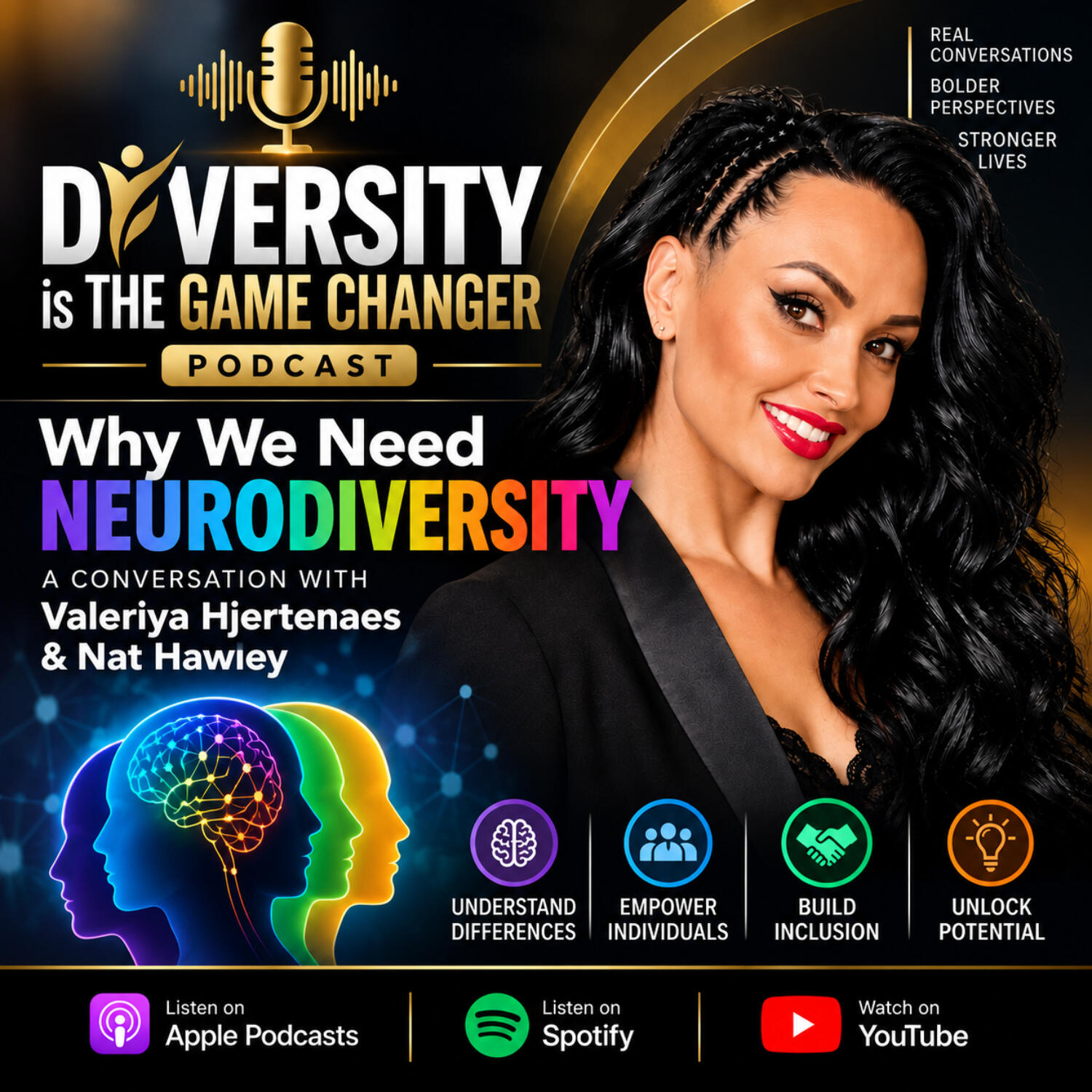
Why We Need NEURODIVERSITY conversation with Valeriya Hjertenaes
About this episode
Why We Need NEURODIVERSITY conversation with Valeriya Hjertenaes Nat Hawley
”Why We Need NEURODIVERSITY with NAT?” @nwhawley @exceptional_individuals Join me for a powerful episode of “Diversity is THE GAME CHANGER” where your humble host Valeriya Hjertenaes—Mrs. World Congeniality, PhD researcher, and NeuroDiversity advocate—dives deep into the transformative power of Diversity, Equity, and Inclusion (DEI). Our guest, Nathaniel “Nat” Hawley, is a TRAILBLAZING NEURODIVERSITY EXPERT, TEDx speaker, and AWARD-WINNING ADVOCATE for learning Neurodivergent differences. With a background in Applied Neuroscience, Nat’s work has inspired change in global organizations, media, and workforce development✍️😇 Together, Valeriya and Nat will explore🤝 ✨ How neurodiversity drives innovation and inclusion. ✨ The role of storytelling in transforming societal narratives. ✨ Practical ways to embrace DEI for a sustainable future. DO NOT MISS 🛎️ this opportunity to learn from two changemakers shaping a more inclusive world 🌎 🌟 @nwhawley @spotifypodcasts @exceptional_individuals @julio_verissimo_ @yuva.official20 @tedx_official @ted @ted_talks_quotes @tedxstalbans #neurodivergent #neurodiversity #diversitymatters #diversityandinclusion @spotifyforcreators
Get every episode summarized
Each time THE EMBC NETWORK Featuring: ihealthradio and Worldwide Podcasts publishes, we email you a written briefing from the transcript — the topics, who appeared, and any specific claims, with the ad reads skipped.
Email me new episodesFree for 3 shows. No card needed.
Hosts & guests
Transcript ready
615 searchable segments. Every word is indexed and playable.
Full transcript
THE EMBC NETWORK Featuring: ihealthradio and Worldwide Podcasts — Why We Need NEURODIVERSITY conversation with Valeriya Hjertenaes. Machine-transcribed; use the interactive transcript above to jump the player to any line.
Yes, now we record. Cool. Perfect. Welcome today. It's the third episode of Diversity is the Game Changer and then my culture, the third thing, it's absolutely magical, perfect thing. And you, we believe that before you should really succeed, right, you should do everything from the third time, not for the first time. And I'm so happy that today, for my third podcast, I'm hosted. So very, very special guest to me. Really, I'm so honored and thrilled to have Nataniel and he has already tried to teach me how to say it right. I'm sorry Nat, Nat's beautiful. So yes, I'm so really privileged to have you today because you know, this subject neurodiversity, it's quite new for me and for many people, but I already feel it's my great passion and it will be definitely lifelong passion.
I kind of feel that it was always in my heart. I just didn't know the definition how, how really should I put in the box, how all this aspect I can kind of puzzle in one and how I can call it. I always felt that I was different, also like you, but I didn't know the difference whether it's good or it's bad. But now I'm so, I'm so grateful. I could discover that not negatively charged definition like disabled, handicapped person, but that neurodiversity. And I'm so happy to have you, your absolutely great champion of neurodiversity, your my role model, especially your TED Talk. It has so much influence on me. So I basically said this night after I could hear you first time and I made the whole raw version of my TED Talk about neurodiversity and I already sent to my coach and I have
coined like, I believe it's new, but even like not disability because I don't like this of disability, dysfunctional ability. I also call them diffability or divability. And so much over to you. So welcome to our episode and to them so happy like I said. So welcome and absolutely feel free and be as possible different as you can do whatever you want here. It's no boxing at all. Me as well. You see, I'm trying to be a little different for you as well. They like, you know, break the rules. It's my husband's clothes actually and one black one. Very nice. Welcome. No, it's honestly it's a pleasure to be here. Just looking at your background is so so impressive and any opportunity to chat about this lovely brain of ours, more than Maria.
Thank you. And now I would like to start with a brief introduction of your really bright and soul diverse by career and why I'm saying brief because oh my god, so young age you have achieved already so many accomplishments. So if I should sit here and talk a little bit about everything you could manage to accomplish them, it's not just one podcast. I don't know how many episodes we should have, but I will try to pack a little bit. So that is an award-winning, never-diverse, to expect, like I have a red dimension and advocate dedicated to empowering, never-diverse, in so many ways. Holding a master of science, master of applied science, right? Yeah. Yes, congratulations because I know in your TED talk, your first one in your family who could achieve that well done. I appreciate it. It was effort, but nice rewarding. Yes, especially when you mentioned that the K, they put label on youth school, unwilling
to learn, right? Unwilling to learn. Yes. And sometimes you should really not, or teach at school in your own way, not being present, so like pretty bad-ass. It was very funny. I like, okay, so I'm just a continuum. So holding a master of applied science, net combines academic expertise with practical experience to drive meaningful change in diverse and inclusion initiatives. Recognizing by his high-skinned Charles for your heroism and international fundraising efforts, you have received really numerous collates, and then including Pride of Britain, award nomination, right? And inclusion and written on the 30th. Ted speaking, which I said completely, literally, congratulations. I love this bloody TED talk, which you have mentioned yourself. I'm staying here and delivered blood to Ted talk.
Cool. I put it in front of me. I will be the same feeling when I'm staying in the other body. I'll tell you what it is. Yes. And of course, a social entrepreneur, workforce development training, never-diversimatic spirit, your brilliant extensive experience to your work. But I could just continue for the wrong, but for me, it's much more joyful to listen to you. So my first question that you're joining. I'm so inspired, really, for many of us. Thank you for everything you're doing. How can you please share with us the first year motivation? What was the first, what was your motivation to become a neurodiversity advocate? Well, first of all, that's like more compliments than I've had in the year, so I don't know what to do with them, but I appreciate it. I guess for me, I never planned to be a neurodiversity specialist. I mean, who really does? It's kind of something you fall into.
For me, I always knew I was a bit different and I was given a label so young and I find while labels are great starting points, they are very, very limiting. And I was capped so early on saying, all right, well, now this is great, but you know, you probably can't do this. You know, don't worry about reading, don't worry about that. And I was like, well, why? I want to do these things. I'm a curious person. I love learning. I find it really, really difficult or I thought I did, but what I really found difficult was learning how the education system expected you to learn. And that was kind of the biggest roadblock. And I noticed whatever I did in life, whether it was academia, relationships, professional work, I was having barrier after barrier. And being someone who loves a bit of self development, I was never afraid of working on myself, but the more I learned about the brain, the more I started to think, you know,
well, I don't think there's anything wrong with me. I think maybe the system's broken and you know, you just started going down different rabbit holes. So I started learning about the brain on my, I used to ditch school and I'd learn about the brain. I would find out all the history about how people have been treated in the past. Essentially, I just go down lots of little rabbit holes. And when I started learning more about it, I started to see myself in what I was learning, but also seeing that they would pass me that I didn't see. And maybe the labels that we have been given don't give someone the full picture. And then I started sharing my experiences. I think I realized my mum probably is neurodivergent though she's never been diagnosed and I can kind of see a lot of her traits in myself. And in short, when I worked for the media for a little while, I did a lot of volunteering as on the side.
And then I just thought I enjoy that more. I get more self-worth and fulfillment from it. So I swapped my main career and my hobby and I switched them around. So while I still do media-related things, I get a lot of fulfillment through educating people, taking super complex subjects which are really not accessible to the every person and make them nice and easy that everyone can learn from it. And just kind of spread the good word of neurodiversity because like you said, all these words disorder, broken, damaged, it would be like they're horrible. But not just that, they're actually false because they don't tell you the whole story. What I find really interesting is that when you look at the history of all these developmental differences or disorders, they were created by a neurotypical person. So a person who thinks more or less the same as everyone else, they saw us as a problem.
And then when like, oh, you're a bit of a problem, I'm going to give you a label to basically say, I'm right, you're wrong, I'm okay, you're broken. And then I will tell you how to sort your life out so you integrate better with the rest of the world around us. And I'm like, whoa, whoa, whoa, you know, why don't you change to fit into my world? Now you can see you get a bit of an odds here. And neurodiversity isn't about boxing people in. Ultimately, it's about neuro as in how the brain thinks neuro pathways and diversity were all different. So if you have a brain, you have neurodiversity, and that's why I love to turn because it's all encompassing. It doesn't exclude people, whether or not they come from a privileged background that may or may not have a diagnosis. Personally, I don't give a monkeys if you've got the selects, the spraxial autism. What I care about is how you learn and how you think and trying to adapt processes to kind of fit in with that.
So yeah, I do teach about all these labels, but I find it's a good entry point to kind of kind of hook people in, get them interested, and then start pulling it apart and think, what do you really mean? You say you're autistic, what do you mean by that and trying to get to know the person a bit better? Yeah. Yeah, it's amazing, it's true. What gives me sometimes, well absurd or non-several ironically approach that we kind of all know that all these great inventions in our life before and now, and especially if we are talking about creative domain in our life, we know it's kind of takes of bunch of people who has very special skills. And for us, we know maybe the most propelling, the most industrial, inventive things, they
are actually created by people with very special skills, right? Yeah. So, I mean, but ironically, we are forming this society, we are propelling this society, but yet we don't fit this society, right? So it's amazing how like all people want, everything should be further discovered in a lot of research and development, especially in medicine, critical important topics like, you know, like we had COVID and many different disease and after that we can discover many people who really, really like Charles Darwin, like Thomas Edison, like Michael Angelo, Nicola Tesla, right? So, both of them, there are absolutely not neurotypical persons and they have invented like an all-entrudent, these great things.
So then we kind of all, we say, yes, we appreciate really that, but we don't think this is all, this is rare, this is too much, right? It's still very heat culture in organization really, but if you're too much, oh my God, no, it's too much, it's stressful. So, but at the same time, like you mentioned in your TED talk, like, come on, look, biodiversity is essential, right? For health, is it? Yeah. But our human diversity, no, it's not essential to survival. This is nonsense, right? Absolutely. I would always ask a question like, what honestly is the difference between talking about neurodivergence and talking about innovation? You know, they have very different connotations, but essentially they're the same thing. Innovation is coming up with new ideas that have new purposes and neurodivergence is about thinking in that way, which kind of gives birth to these new ideas. These great inventors that you speak about, they sometimes can be a slight bit controversial
because like, well, are they neurodivergent? Well, that's a beautiful thing about it. I cannot tell you, honestly, if Einstein was autistic, how could I possibly know that? But what I can tell you is he did think differently. And that way he thought differently is now praised. But whether something is praised as an advantage or a superpower or shunned as a disorder or something not to talk about, or that depends on whether or not someone is able to jump across all those boundaries one after the other and eventually reach success. Think about how many amazing people this world has given that has never reached their full potential because for one reason or another, the barrier was too high. We've got so many great examples of amazing individuals, but they needed the right platform. So I look at people like Vittson Van Gogh, who in his life only sold two paintings, I believe.
He was miserable by the end and now we see him as his success. So it seems a shame that why do we have to wait for someone to achieve before we appreciate them and we can't appreciate them beforehand? But I think we need to like reevaluate, treat people as success before they reach their success and then it might nurture them to kind of blossom earlier on. Because I reckon we've only got like the tip of the iceberg of these massive success stories where are all the others? And there really aren't that many success stories of people who have outrightly said, hey, I am neurodivergent because you wouldn't talk about it. There's a reason why love him or hate him, Elon Musk, not that long ago came out as Burgers, which was previously a form of autism. Why did he only talk about it? Now he's the most one of the successful guys on the planet is because stigma isn't going to affect him now.
There's no amount of bad press, which is going to bring him down. So people contribute his success to the diagnosis where I guarantee you had he have mentioned it when he was starting off trying to get seed funding, people would have seen it as an absolute negative. It is interesting how our perceptions changed based on people's level of success. Yes, I fully agree. We need really systemic change and rebranding of our brain and against systemic change even the word change. It depends when people do something differently, right? But everybody the same how we can actually change something if if blind thinking will be from all surroundings. And yes, like you said, also, absolutely one go again many other examples why we don't really, really appreciate people who are distilled alive and when we can influence their
lives, right? And what really, really frightens me in this whole subject, like you mentioned brilliantly, in your TED talk that can you just imagine 70% of people in 14, right? In unemployment, 70%. And I know from other statistics that this is a dramatic problem, but what is even more scary about the significant number of people with diagnosis or with these outgoing labels, they experience much severe depression 300 times much more than nearly a person and 400 times more condensed to suicidal. And one of the people in this world is neurodivergent. If you just think about scaling of that, right?
How dangerous it is actually if we really still continue going with these labels, if we really are not into systematic change, because change at least raised curiosity, curiosity, it's bridge to education and when it's education, at least we can have some threats that we could have self-advocacy, right? Like you started learning, especially your brain and how you came yourself to, oh, that's nothing wrong with me. I'm just different. And you said, your mom, she has never been diagnosed because it's called the lost generation of autism because they never know that goes, displaying present differently. It came official papers came 2016 that laid this actually totally different. So can you imagine how many people was identified?
It means that they never came, they never got support and support means services in the society, right? And then it's depression and societal, ever since so interconnected. So I am kind of from what you mentioned, kind of torn a bit between, you know, on one hand, we need to get more people diagnosed so they can have access to support systems. But on the other hand, I actually think we need to scrap the labels altogether. And the reason I say that is that, as I said, we give people labels who are different from us who do not integrate or gel with how we expect people to behave. And that is going to be problematic. I've got a bit of a theory that neurodivergence has always been a thing. Maybe it's not so much of a theory, but, you know, the world has always fought different. And if we go right back to our caveman and ancestors where we had hunters and gaffers,
they're two very essential types of thinkers and doers, but were different and they were great for being different. And as time kind of progressed on, we had artists, we had people who would come up with like theories and ideas and teachers. And then the industrial revolution happened and we're like, you know what, let's start streamlining. Let's start making a cookie cutter mold where everyone looked exactly the same as each other. It allowed us as a society to upscale to industrialize. But the consequences of that is that we stifled innovation meant that if you did think differently and if you did take adjustments, that was no longer seen as the optimal way of being. And that has gotten us so far in history, but it's also gotten us to the point where we're starting to stagnate now. But I do think there's a silver lining. And I think with the rise of AI artificial intelligence, where computers are now becoming
the optimal human being in terms of following processes and routines, it leaves a massive gap for those who do not think like computers who can kind of break the mold. So I like to say that there is like a renaissance happening for neurodivergent people and it's part of the reason why we're even talking about it today because businesses cannot go on. There is a massive skills gap in all sectors. There aren't enough people to fill these high end roles. And now they're looking at neurodivergent people. So once again, it's only now that we are becoming useful slash successful that people are taking notice of us. And I just hope that we can keep developing our understandings because you are totally right. Women could not have autism. Adults could not have autism. And obviously that's completely false. But those sort of stigmas have really stayed in place.
So we've come a really long way now. But essentially if you are white, if you are male, and if you come from a privileged background, you will get diagnosis and you will get support earlier on and you very well may turn out to be one of these geniuses that we praise every day. For instance, Elon Musk, yeah, he probably is a smart guy, but he was also very wealthy. You know, that success didn't come from nothing. What about the people who maybe come from a minority background might be female, might not have as much money as their peers? And we make sure that their innovative brains are heard and listened to. And if we aren't careful, while there is a renaissance happening with AI, AI is only good as the information we feed it. And there is a real rory that AI is going to be biased towards neurodivergent thinkers. For instance, you go to a job application and you're kind of doing the hall like AI screening,
AI is looking for a very, very particular type of person. And if you don't meet that needs, you are going to be unemployed. So I often ask employers, why do you think 70% of autistic adults are not an employment? Is it because of the autism or is it because of how society reacts to the autism and the lack of adjustments? Some people with autism aren't able to work. Some people without autism aren't able to work. There are some, I'm not saying everyone, but the vast, vast majority of people who think differently are more than capable of being able to contribute to society and they want to contribute to society. The barrier is us. Why aren't we adapting and why are we changing so slowly? We are depressed. We're on an depressence. We have anxiety, not because genetically we're more dispossession to it, but because
you try going your whole life with always having to fake who you are, always trying to swim upstream, you are going to get tired, you are going to get burnt out. If it could have been different, maybe we could have been the dominant ones and those neurotipical could have been the ones on the fringe of society, maybe women could have been the more dominant sex who were able to be in control and men were the ones who had the gender pay gap. The world has become the way it is and it could have turned out in any number of ways. I think it is the duty of those who are in the minority to not just accept that different exists, but to level the playing field. I get way too passionate about it. Yes, yes, I would mean too. I'm basically sitting now and like a meditative valerian member is now his turn to talk because I'm also so eager to talk about passion and then I want to really like you come with this more default, but now it's my learning skill, but maybe also my own city that you know that
I am learning to listen to people. It's really like for me it's not that easy believe me. My specialty. Yes, you know, because so much you have taught now I could reflect it like immediately wanted to add something, but it's so important for me also to understand your opinion because yes, you know, every new what you have described now, I'm so fully agree and I like very much the quote of Cindy Cooper. I also after your TED talk two persons there like very pain automatically on my a stop and I could hear her TED talk about also neurodiversity and then she she described it brilliantly like she said that she doesn't understand why we really create this very advanced society, but we don't fit in and then I really about this depression and suicidal. She's like oh my god, we are stuck on the fridge and it's killing us.
So we should really do something and not just we we like many say yeah we should be accepted. No, I'm not agree on that. Not just except for me accepted and tolerated acceptance and tolerance. It's it's actually not enough it's not enough positive. Why I why I should be just accepted or tolerated? No, I want to be embraced valued I want to to be encouraged to to be really treated like I'm also very special and why I should all the time try to prove that I'm good enough why because I'm just different that there is no make sense plus I believe yes it's renaissance it's rebranding now and I'm so agree with you that that look from the perspective that everything which is really needed for this evolution and for our planet and everything and
everyone who's really the strongest one it's still flourishing and continue to survive. If these genes like autistic genes, OCD, this select said this proxy was useless right I mean like everything in our life biologically and your study and that from child's diving like the survival of fetus right just in this really hard competitiveness can survive and can you imagine through all these centuries even if they were not diagnosed identified but all these genes which you have in your brain their flourishing still so many people so it means we should think about that that weakness no uniqueness because if they were weakness they should be like you know eliminated many centuries before but somehow they're still now with us and they just get stronger and stronger right so it should also give us just reflection okay wow they're still
with us in flourishing and they give the best results will know maybe nature nature no never can be food nature shows how we should really build build with sometimes should really get more advice from our nature right so I just know I think that's a really really interesting perspective that you know nature wants neurodiversity you know otherwise right it would have been kind of weaned out it is not just a it's a natural thing but we have branded it as a disorder words are so powerful yeah I truly believe that neurodivergent brain is going to be the thing that saves humanity we know that there's a climate crisis at the moment and if we keep doing what we have always done we are on a one-stop road to like absolutely Armageddon and obliteration we're killing ourselves yeah and we are going to need people to think different another great example is Greta Funberg you know the Swedish environmentalist yeah she has autism and okay if you know
she's got a disorder because she's so narrow minded she's so fixated on one thing she might struggle in interviews okay but what about the other side she's dedicated she's unrelentless she will never quit she's ultra passionate about one particular area we've been told our entire lives to not put all your eggs in one basket because if you trip you have nothing but what if we allowed people to be all in on something hey if you struggle with I don't know communicating or struggle in maths or some areas what about if you just didn't do it and you put everything into one area no we are not islands people work best when we are collaborative I know my psyche profile I know there are some things I'm amazing at and I will eat on them but I know there are things that I will just aren't my forte but that's okay because my colleague is amazing at those and they're not stupid at the thing so like we balance each other out stop looking for generalists and start
looking for specialists and have a diversity of all because without rain there is never a rain goal you know we need all that is true but I now I like we speak about so many great persons and they impact but now I'd like to focus more on your great impact and can you please share example of project or initiative you have been behind or impacted right which I know already it caused significant impact could you please tell about the projects you have been involved and still creating I know about your achievements and all these prices I've already mentioned but what could you really maybe because we don't have all the time yeah no I mean again all the cost and impact for probably you could see well this is really changed people's I find the things that make the biggest difference in the world are typically the things that go
unnoticed and you don't get awards for awards awards you know they they don't really mean anything they know they're nice they go on your mum's fridge but they don't really do much else now the things that really make a difference are when you do not get noticed so things I'm really proud of is I was the I'm the director of the neurodiversity employment academy where we essentially teach people who are on the fringes of society to understand their brains better we teach them to talk the talk when people go into interviews let's say you see a lot of us have had a whole lifetime of kind of being looked down upon that affects yourself confidence I essentially teach him how to change it hey I'm not I have dyslexia it's my advantage because and so you go in with a solution rather than a problem and help change the narrative I'm part of my own organization that I do on the weekends divergent thinking I teach autistic children how to make video CVs because a lot of
them while on paper they lack conventional qualifications which are normally seen as the entry point to get into jobs their personalities more than speak for themselves they are highly dedicated really motivated they have great retention rates so we let themself speak for themselves another thing I'm really really proud of a community I created every single first day me and my team we deliver free webinars aimed at neurodiversion people once again to understand their brains better I my master's in a dinner science I got all that really amazing material and I made it in a way that everyone could understand so again it's putting you in the driver's seat no longer are you the person who gets labeled because your difference you're the person who gets to define yourself in your own vocabulary so yeah I'm proud of that absolutely fantastical that we don't need to feel just
excuse big excuse and their victims we're captains of our uh this tenison sometimes just because of the uh yeah all these barriers we we really lack of really like rolled map right or rule book kind of thought from school age that no this is just one rule book and this is just one one right road map but we don't understand it doesn't appeal to our uh way of processing the world information because basically I don't know how listeners we we were so eager to start discussing the subject but neurodiversity it's actually uh the whole idea that our sense and the feelings and emotions they're not different we just process them differently just uh our brains right it's not weird it's wired differently I liked very much it's almost the same world but it's if you put this eye to spot down and it just because it's a lot about narrative and vocabulary it's not weird
put this let it is why we are wired differently that's why it doesn't need that we less we are less valued or we are broken so uh I'm so glad that you you are behind this initiative and I also want to also to uh to fill the scheme in this webinars which you are starting from January on Thursday and I look more than happy also to participate it will be yeah I can't wait to get you on board on that uh so I'm doing it for a few years now and we have like hundreds of people sign every week that are real great regulars um you know one of the people who attends my webinars I actually mentioned in my TED Talk Emma and she's just an example many many people who attend you know these are really really smart people but they are ridiculously long term unemployed and you think well someone's not adding up here and the thing is recruitment process is set up
to make us fail because it isn't looking for people who might come out problems from a different perspectives uh I fail I've lost many of jobs because of psychometric testing and that's why the webinars are so important because it allows you to advocate for your own thing so you go to a job let's say they have psychometric testing you might think there's nothing I can do I'm fit I'm going to fail but what happened if you went to the HR and you told them why you shouldn't do it should we have to be responsible for always having to fight the system hell no unfortunately that's where we're at the moment so at least it gives you a fighting chance and we've been doing this as a community for a couple of years now and it's gotten to the point now I'm like real content I've yeah I've got my opinions in my two cents but I want to broaden it out now who I'm getting the most innovative smartest minds including yourself from all different backgrounds to share their insights
not because any one of us is right but because all of us together can kind of add different flavors and to this kind of real interesting tapestry that we have so I'm really excited to get more people involved absolutely I also said that diversity it's like rainbow or human legacy we should really think about that and um before we start maybe a webinar so you have already mentioned what you have established yourself but if you could give like a couple just of advices to managers which are still a little bit afraid maybe to employ neurodegers in persons but already start at least getting more curiosity because I believe it's already their promise in start because more and more at least speaking and raise awareness it's it's already achievement right if you can
change the live one person you change the whole planet is so how do how they should I don't know approach because I you know I have PhD and I'm interviewing people about diverse demand and I'm usually now speaking with like top executives and I am very sometimes provocative and asking like okay you speak in just about diversity but for me it's like you know very nice for profiles thinking of the books that we are there and that but what is your like really what actually concrete you are doing and and you speak about gender diversity maybe cultural diversity but what about neurodiversity have you actually started considering that and then like sometimes they're really like some of them actually try to build the airs we we are there but actually know and and then I also ask them should actually then you advise like you know you're executive like us because I have OCD should I be transparent about that it's less chance to
get the job or or more or what but if you give your advices how we should start approach even broader like you said these executives that they and show them or give them actually some skills how they how should how they should start creating this neuro inclusive culture I mean that's a big question I I suppose you know when people say to me I you know is it you know I have no one who's in my team who's neurodiverse wrong you definitely definitely do as we said it could be like up like one in five one in seven you know the number varies but it's a high percentage of people who are neurodiverse you 100% have neurodiverse people in your team absolutely you don't know about it because your environment isn't inclusive enough and people don't feel comfortable to talk about it I have people come up from you all the time hey now I've got a job coming should I disclose and you'd think that I would be like yeah definitely disclose
I can't do that because I don't know where the organization where they are on their journey some people say autism and they think someone who is completely unable to do any sort of interaction in the work environment other people say autism they see someone with super abilities and we need to make sure that all of society and all of organizations are on a similar pattern to understand that this is not just a nice to have not just something you do to tick a box for social corporate responsibility but something you do because it makes sense to the business neurodiversity will equal profit because it allows innovation to happen so education education education is always the key way to it and being open to discuss if you are a manager I guarantee you you have neurodivergence in your life whether it's yourself or it's your family members a friend down the road but share
these experiences we need to break down this glass ceiling when people hear neurodivergence they think of some entry level person who's struggling the tide their shoes or something while they may be the case there are many of us who aren't like that and I think you know I want to see more role models I don't want to just see your bill gates where Elon Musk switch on kind of too unattainable I want to see real people who have yeah like is that who has thrived because they think differently but I don't want people to just thrive because they think differently I want them to be able to do it without having that kind of cognitive burnout having to feel that they have to fight every single day of their life to be seen and to be heard no mean you it's clear we've done quite well but there's a dead if you want neurodiverse and because parents come up to me oh my child I've just found out they have autism should I be happy should I be sad I'm like well honestly it could go either way they could either
hit a glass wall fill their potential as capped and become an underachiever and become one of those statistics which statistically your child is likely to be unemployed or they could be encouraged could be empowered could be shown to be an advantage and they could kind of tip and become absolutely bosses in their own right I don't think neurodivergent people should either have to choose between in choose between being a well famous entrepreneur whose a madvera can go their own or be unemployed why can't we be entrepreneurs work with in organizations and innovate from within so by organizations being more open to neurodivergence they not only open themselves up for more innovation real diversity which is thinking differently we're also be going to get loads of people offer benefits which will more than enhance our economies which is struggling all around the world it's a win win for everyone and the thing that's blocking us at the moment is stigma pre-held ideas
but just a few hundred years well a hundred years ago autism didn't exist then it was a thing called childhood schizophrenia you know mental health people were executed they were euthanized in well war two um during like the 1670s you had like the refrigerator mother which if your child had autism it means you're a bad parent all of this stigma it sticks and it takes a long time to get rid of so a lot of the people who still are a bit unsure about it I'm not blaming you I get it history has been awful and for us to re-change the narrative takes a long time people still think that if you've got an injection that's why you have autism it's not true but people still believe it so this is why we need to have more open conversations and start educating people and not educate them just one day a year but educate them every single day and I believe that is our best bet to create a more equal future fantastic amazing and I'm sorry the education education education education
there you like how you have mentioned it's the greatest breach to empathy and empathy it's the real true inclusiveness together we are stronger united we are stronger that's true because I'm so agree with you about people really don't know that much they have so narrow lens to our specialities because when I'm when I am raising hoping that I have OCD so people immediately so what I don't I you how they ask me how many times and then washing my hands or checking as it no actually no I don't have rituals I don't wash my hands and I have this and that and then they're like oh but this is not OCD yes it is I OCD because for me also and probably for many other persons it's so challenging also because I'm displaying another type of OCD right and yeah and kind of I can be terrific actress and can really put my together if I need to act and
handle but they have no idea what's happening here when I have this in through the polls right so it's but by being educated right so I mean that's easier for all of us because actually we are all everyday in interaction with diverse people if yes one or if so you have like you said all your employee or your family or your friends or you can be for the love is one of those persons so so inclusiveness and education is the the most important right like you mentioned and had talked that when you have shared that you had autism so people starting speaking slowly or you feel like really this bad man the same with me so I think it scrapped the labels because of well keep them for doctors and medical reasons but for instance the label OCD is probably not very helpful to you because it doesn't give anyone any more information about you they have their
own preconceived ideas oh you have dyslexia you can't read you had dyspraxia you can't ride a bike you have autism oh you're gonna melt if you make eye contact you have OCD are that you're washing your hand the time it's not like that these are very broad labels which include lots a lot of different characteristics different traits and people don't fit neatly into boxes is why you can have multiple conditions because essentially we don't know what to call you they are very very broad starting points and I hope we can change that like Tourette isn't about swearing very like 1% of people Tourette has like swearing variety most people dyslexia are able to read the key challenge to neurodivergence is normally around kind of memory and people's perceptions of us rather than the kind of the headline we've got the TV and media to blame like most things they like a cheap laugh and they'll focus on the kind of key trait and they'll perpetuate it and make a cheap laugh and joke at our expense I'm all open for a laugh and a joke but we've got to
make sure that the representation is balanced I want people to when you say ADHD I don't want you to think oh some like naughty kid I want you to think someone who thinks differently is able to innovate I want you to think of how you can come up with support strategies in order to get the best out of them so we need to encourage positive representation be it in the media in the work plays in just day to day conversation around the dinner table it's these actions which are super small that anyone can do at home now but over a couple of years over a few generations will have a completely different landscape you gain only 100 years ago autism wasn't a thing it was like madness now it's seen as something which oh what's so sure about in the next 100 years it could be the thing that is kind of driving us to our sustainable future but that only happens if we talk about it and we start changing the narrative absolutely we should change and maybe again if somebody
really really can be just observed and trust more how nature really gives us all this support information like you know biodiversity we mentioned and our fingertips right yeah but I like why this should be like very strange so okay and we have the tradition in the diverse is the game changer and I would like to wrap up with always like a little bit high-up notes and the pulp and the future now like we mentioned rain sounds it's like rebirth and I'm so I'm so really believer now especially this magical time before Christmas we need more magic and actually magic happens also by believers who believes in doing and risk in doing things differently right so but I would like to grant you one wish from this you know we have
from Aladdin right you know this genie he was generous with three wishes but okay if we a little bit I have a little bit more shy possibilities so if you could wish something can be personal can be big and be smaller but just I'm your miss is genie today and you could wish one thing for the Christmas or that I can really make it happen what's in that so I'm assuming I can't wish for more wishes I can't wish for more wishes yes of course you can it's tricky one okay okay a bit cheeky no I won't do that that's probably I don't know I suppose related to what we're talking about I just wish that people don't get limited of what they believe their possibilities are um too early on because it's it's that childhood where I think we are formed and we need something
to help break the system you know you know as a parent you you know you pick up chips on your shoulder and then eventually that kind of feels down each generation and each generation just kind of continue that I'm no good I'm worthless and I want people to be able to be empowered know that you can be anything you want to be but you do have to work for it but it's still a possibility it doesn't matter what you being labeled as you have just as much possibilities as any one else but rather than being told you can't do something being told you might not be able to do it this way but try and find another way around it I want all of us to be design thinkers I don't want in an ideal world I don't want us to be diagnosed with things we can't do I want diagnosis to be a bit more free-dimensional I want them to take everything in consideration I would love it that we
are able to in the future be able to say like okay this is how your brain works this is how to get the best out of you and this is the adaptions that might be able to help so every single person is treated as if they are a blank canvas and that we kind of create tailored approaches in order to make everything a possibility for them I don't know what I'm saying but I just think creating a world where we can all be whatever we want to be or at least have the possibility that should we want to should we have that drive it is something which isn't within reach I I really think it's absolutely adorable wish thank you for sharing and then I would like just to of course thank you from all my heart for our beautiful and meaningful conversation and I really do hope that we will
make more nervous magic together with you in the future is just the beginning I'm so privileged now to be in your tribe and today you know it's ironically enough I had no idea but today is actually International Day of People with Disabilities but I have already posted my Instagram that these abilities know diff abilities diff abilities different abilities divergent abilities so it's perfectly for us to wrap up so I think that we have been discussing it so many times now we should create more inclusive neurodivergent organizational cultures where reducing inequality isn't just a goal or a box of being taken off on the profile or agenda it's about celebrating and recognizing unique friends and perspectives of every single person every single person is unique resource and real inclusion is at the heart of creating a truly sustainable and resilient future together
we can break down barriers and amplify voices that have to be often so silent united we are stronger oh so empowering I love it you so much net it was absolutely pleasure to have you and now this is the moment that I feel already like a little bit sorry that the podcast already just the time was flying but it's just the first time I hope that we will see you soon again something brilliant which you are doing and you're so you're inspirational and like you said it's about storytelling it's not just like you know Elon Musk Bill Gates Rayman or Fortisson we need really really considerate about the storytellers of every single person and today together we can make really impactful change for our future for our kids because yes environmental and CO2 all the time speaking out about sustainability and everybody still believe it's more about the environmental part but we should remember that
people profit plan but it's people again everyone is actually causing because of people and how they interact because we live in society we cannot just be prima donas and solo we really need to do is global challenges and then we should really react globally all together like that not like we are here normal you got the little bit strange them no we everybody together like face in this challenge and then we really should that hello it should be two way street not just us trying to fit in all the time no we need to go together and meet in the meeting point in between right yeah there is no environmental solution to our crisis without neurodiversity but anyway thank you so much I love what you're doing with this podcast it's great I think you're a fantastic role model and happy birthday tomorrow thank you so much you have a lovely and blessed day thank you bye bye
More episodes
More from THE EMBC NETWORK Featuring: ihealthradio and Worldwide Podcasts

Cell Phones Health ,Dangerous Addictions - Norbert Heuser Roy Coughlan
THE EMBC NETWORK Featuring: ihealthradio and Worldwide Podcasts

Unlocking the Dynamics of Relationships_ Rules, Roles, and Identities
THE EMBC NETWORK Featuring: ihealthradio and Worldwide Podcasts

The Lion’s Code Brett Lavender on the Lost Languages & Mastering the Human Machi...
THE EMBC NETWORK Featuring: ihealthradio and Worldwide Podcasts

Gratitude, Community & the Courage to Pursue Your Purpose with Rachel Desrochers...
THE EMBC NETWORK Featuring: ihealthradio and Worldwide Podcasts