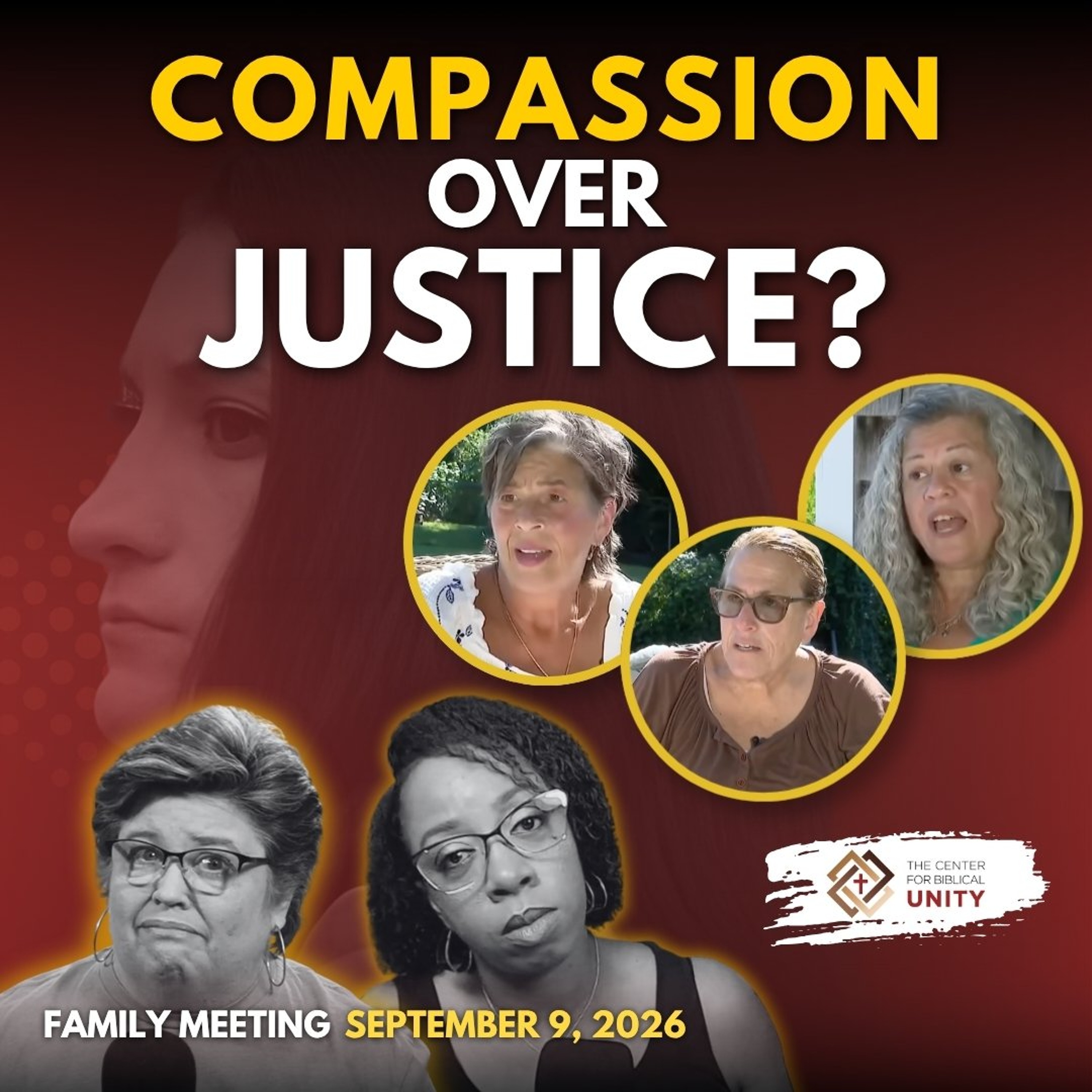
Why We Can’t Call Evil 'Compassion'; Black Studies in Seminary?
About this episode
Get every episode summarized
Each time Family Meeting | CFBU publishes, we email you a written briefing from the transcript — the topics, who appeared, and any specific claims, with the ad reads skipped.
Email me new episodesFree for 3 shows. No card needed.
Hosts & guests
Transcript ready
1,014 searchable segments. Every word is indexed and playable.
Full transcript
Family Meeting | CFBU — Why We Can’t Call Evil 'Compassion'; Black Studies in Seminary?. Machine-transcribed; use the interactive transcript above to jump the player to any line.
All right, welcome to the family meeting, y'all. Welcome, welcome, welcome, how you doing? Well, not gonna lie. Feeling a little sad. Please don't lie. The everybody's having a party at the Women in Apologetics Conference and I won't be there. We are all very sad. We are. We are very sad. But I have a very good reason. You do. You're expecting your first grandchild this weekend. I don't know if I mentioned that, but yes. We've talked about it. Have we in public? Yeah. I think so. I'm sorry. Well, we have now. We have now. You know what else we need to talk about? Family, hold on. First of all, let me, I can't see where anything is. I got my glasses on. Okay, so. Talk me off of Cliff as I pack for a wee. Girl, I packed every outfit I got for a wee. I don't even know.
I just, I didn't have time to sit and think through. I got sweatpants to go with suit jackets. I don't know what I'm wearing. I have no idea what I'm wearing. I'm taking a red eye out so I'm leaving in a couple hours and I had to wash my hair before I left because there's no way I can wash my hair on a hotel absolutely not. Absolutely not. That's always a whole production when we go to the hotel, the things that she will and will not do in a hotel. Do you remember when we were in Minnesota and I washed my hair and when I went to go blow dry at the smoke alarm, I'm smoothing off? Do you remember that? Yeah. Yeah. So we were on their reality tour. Uh huh. Somewhere like even prairie or something like that. Yes. And then like people are evacuating the hotel and then I had to call the front desk and be like, I'm just blow drying my hair. Absolutely not. I'm just a friendly neighborhood black person just blow drying my hair. Okay, these are the things.
This is where culture differs and why understanding culture matters because I remember even being at Biola and blow drying my hair. And I wasn't the only one, but like we were blow dry our hair and then here comes the smoke alarm. And at some point the girls, the non-black girls just realized like, oh, somebody probably just blow dry in there. They didn't even stop. No more. And this is these are some of the differences. Now I am sure there is a white woman somewhere with thick hair who also has a smoke alarm go off every once in a while. But so I am now here with this wet hair and I was like, Kristen, does my hair look funny? Cause it's wet. And she said no, but only a little bit. It kind of reminds me of Al Sharpton's Jerry Coral. Y'all, the way I almost didn't show up. Al Sharpton's Jerry Coral. That kind of, remember, you don't know Luther Vandross,
but Luther Vandross used to have a Jerry Coral and it didn't quite Coral all the way. But you know what? This is not what we are here to talk about today at all. Christa got moved to the top of the prayer list for that one Lord. All right, she need to be at the top of the prayer list. I'm just saying. She need to be at the top. Okay, you want to get started? I put together a family meeting this week and I started, I wanted to start by talking about the horrible, horrible Lindsay Clancy. Try what a debacle. What a mess. What a mess. You go first and then I'll say a couple things. Well, no, you go first. Cause what I want to, I want to actually get to talk about the jurors. So go ahead. Yeah. Well, I want to get into the jurors too, but I've been talking on my potluck on Sunday nights. People can watch my Sunday night live stream every Sunday. Afternoon and I've done a couple episodes about the Lindsay Clancy trial. And I did a thing this past week
where I played some clips of Ben Shapiro giving some legal analysis of the very complicated Massachusetts law and thinking that we were dealing with reasonable people, rational people, thinking like, all right, I want to give them the benefit of the doubt. Maybe they voted for acquittal because of this law in Massachusetts, very unique law where you have the prosecution has to prove insanity. It's a very high level of proof that you have to provide. And so I did like this, all this sophisticated analysis on Sunday night. I kind of want to take it all back because now that we've heard from the jurors, that that was not part of the reasoning. These are just room temperature IQ people. So yeah, go ahead. Room temperature, gracious, because I was like ice cold. Ice cold, like.
Yeah. Yeah, somebody's crayons are not as bright as the others. Yeah. You know, there's one whole, the one holdout juror that many people talked about and is being held as the hero. Which basically he was engaging in a project of what's called jury nullification of like, this is messed up. So I'm just gonna hang the jury here. Yeah. So I listened to a couple of interviews with other jurors, not with him, but talking about him. Yeah. I'm like, dang. Yeah. Is that bad? But I think it's also very interesting and telling to hear how some of the jurors went into the trial automatically thinking that they knew how they were going to vote. That you ain't heard nothing. You ain't seen nothing, but you're already going in with this, we need to be compassionate.
We need to be pathetic. This limperisted, uber-feministic culture that is over on society has really pushed us into a place of thinking like instead of wondering or looking at how do we do true justice or what is the consequence for murder? We want to understand what is the most compassionate thing I can do? What is the most empathetic? How can I be with her in this process? And to me, it's just a reflection of culture, but the way that they responded to him, I think it's also very telling of where we are as a culture because he really is kind of classified as toxic. I mean, I didn't hear anyone say that he was toxic. We put all the pieces together. You know, I looked it up today and she actually has raised $1.2 million. Wow. And they have increased their goal from $2 million to $3 million.
Wow. She's raised $1.2 million. And so what I'm seeing on like X and Facebook are other women who have either died, you know, like in fires, rescuing their kids or who have been severely burned or who have done, you know, all of these heroic things so that their children didn't die. And they have raised not even half of what she has raised in their go-fund me accounts. Now you might say, well, it wasn't, you know, widely publicized and things like that, but I also wonder just how much of this story makes Lindsey Clancy the hero and we want to support our heroes. These summits, comments on the go-fund me, sending love from Utah. Call it women's intuition. I never believed for one second. Lindsey was a cold-blooded monster. Look, I don't know what parallel universes, women are living in. I see a portion of myself in you. I can't help but think it could have been me in your situation.
So much love and support for you. Beautiful Lindsey, holding you and your precious angels in my heart every day. Lindsey, we are all with you and your family. You don't deserve any of this. I don't even know what we're doing right now. The woman who murdered her kids, we are looking at the uber feminization of a society where we need to believe on women, where we need to lift women's voices, where men don't have the right to speak in and say anything, like this is what we are watching and it's really not, it's not okay. We are not okay. Yeah, and I think like, I've done everything I can to fall into the extreme of, oh, this is going to inspire copycats. No, no, no, I think there's been two since the verdict.
I don't want to fall into that mindset of like, oh, this is going to normalize killing kids. You know, like Ben Shapiro made a big deal of like, patracite is very, very rare. It only happens in like, I don't know, like, 0.5% of murders, it's very, very rare, it's uncommon. So I don't want to fall into the extreme of saying like, hey, this is going to normalize this, but what really concerns me are these women who think that, like, look, if you think that you are on a hair trigger of we're all Lindsey and we're all just like her, like, no, like, there's questions as to whether or not her psychosis is real or whether it was fake. Like, that's a question that the court will likely still have to sort out. But even so, you know, I don't want to live in a world where we're trying to say that all women
are on the border of psychosis, like, when they have children, like, I don't want to live in that world, like, that's, no, we're not all on the border of psychosis. Well, and, I mean, what does that, that way of thinking, due to women? Yeah, you know, should I, if I have kids, should I be allowed to be alone with my kids? Should I be automatically seen as a threat to children? Because women be trusted with guns, can women be trusted in political office to make big decisions, to have the nuclear suitcase if there's a female president? Like, why are we really saying here? And yet there's this push of like, we're all Lindsey, we're all just like, no, no, we are not, we are not all like this. No, there's some good comments coming from, I'm gonna butcher this. I am so sorry right now.
I want to say, you know, Owen is not Owen, because there's an E in front of it, smiles. Oh, this has done Lord of the Rings thing. I don't, I've never seen Lord of the Rings. No, I have, yeah, I haven't seen the other one. You lived with us. But it, but she says, truly horrifying that so many women are justifying the cold, let it murder of children, but if you take abortion to its logical conclusion. And I am like, yes. And that's what I've been trying to avoid. Like, don't want to go there and say that. It just sounds so extreme. No, no, no, no, no, no. And it's not that it sounds extreme, but that it is really a question of personhood. And I talked about this. I want to say on the last family meeting or on all the things, it's a question of what does it mean to be a human person? Mm-hmm. I think that's part of it. I'm not gonna say in the Clancy case, if that's all of it, but what does it mean to be a human person? If this person isn't a human being, it's not a person,
then I can justify killing my kid up until whatever point. And I mean, there have been arguments even recently about, you know, we should be able to kill kids at birth. Or, oh, I was just reading, Love Diabadi by Nancy Pierci. And she talks about a guy who was advocating for being able to kill babies up until like three days after birth, because they're not technically human persons. And so I do think that there is some framework or some tie-in to what does it mean to be a human person? And if we think about this, do my body dualism and like, hey, I am, or you are this person, this human is not a person until they are able to live on the wrong until they're able to think for themselves
until they're able to have memory until they're able to enjoy life. Like whatever we put that as, then, you know, what it means to be a human maybe different than what it means to be a person, and it might be okay to kill persons. Or, you know, people that are humans that are not persons. Does that make sense? Yeah, and I know that that's a big conversation and feminist circles. I guess what I'm stuck on is our women like boss babes and empowered and all of this or are they weak and subject to their hormones? Like, which is it? Because women have been fighting for a hundred years to say we don't make emotional decisions. We're just as good as a man. We don't, you know, you can trust us in the boardroom and with the nuclear football. We don't worry, we stop saying women are weak and just emotional. But this whole trial is kind of weaker women
or weak and emotional. Like this is peculiar, like which version of feminism are we promoting here? What are we talking about? Well, I mean, there's that, but there's also the whole thing of men or women, but now here we are where men have an opinion, or men can be women. And it's like, well, men can't actually be women. Well, I don't know if men can be women or men can't be women now because they don't understand postpartum depression, but three days ago they could be women. It's a lot. I'm so confused, but this is the reality of our culture where we have allowed feminism to just run rampant and the like this over compassionate, over emotional and over empathetic, just way of being. Well, and then now it's like really kicked up the dust again of the whole repeal, the 19th Amendment crowd,
women shouldn't vote because look out unstable you are. Well, you're not exactly helping our colleagues here that you know, and it's, this is not a version of what it means to be a woman that I want to be involved with. And these jurors, let's go back to the jurors because these jurors are like, these are people that there should be a prerequisite. If you're gonna be on a jury, you gotta take a logic class first. Like, or you have to pass a logic test or at least know like 10 informal fallacies. Like, you gotta know something. These people do not strike me as people who are able to reason impartially. All right, here we go. Here's a couple of them. Kelly, I experienced you to be one of the more expressive jurors. On the J everybody was very serious and somber and human by all means, but you kind of had a, you know,
what I brawled at occasionally went up and I'm wondering what your reaction was to the prosecution's opening statement. There were some things that they said in their statement that I thought got a reaction out of you on day one of destiny. I just found it to be harsh, so very, very harsh. I mean, again, I mean, we're talking about with ourselves. So her concern is that the prosecution is harsh. They're the prosecution. They're case making. What are we even doing right now? What are we doing here? Well, I mean, again, this over a feminine culture, this Uber like Joe Rigg, I think it's Joe Riggity who says the sin of empathy. Yeah, like people don't like it when you talk about this. No, they, they, but the culture, it is a shift. You know what? Just go ahead and say it.
If you murder your kids, you need to go ahead and be dead the following week. Like I am not a person who is, I am pro capital punishment and if we know that you have done something, I don't see why the average, the average extent for someone on death row is 15 to 18 years. Something like that, yeah. Why? Oh, no, I know it is. Grime have done the research. Well, why? Why must my tax money go for the, and now I'm not talking about the one who you know, we don't have beyond a reason without like, we don't know for show for show, but like if I know for show for show that you didn't off eight people, why do you get three appeals? Why do we have to sit and how's you and pay for your food and pay for your medicine and all it is? For like a hundred thousand a year or more in some places. Why do you get internet? I pass TVs. Corn. Oh, I was like, I don't even like everybody should have a vegetable but never my not understand. Like why, why do we do this?
It's time to go. It's time to go. And I know that some people will say that, you know, well, the time that they sit on death row really gives them a chance to understand what they've done to really come to terms with their own guilt and their own sin and maybe they'll accept Jesus. Baby, you got seven days. That would be my position. Now I know that I am not as kind. I am not as kind as many people. Well, they're worried about the prosecution. All right, let's continue. Let's just seem so foolish. Dear, but the fact that they had no character witnesses, character witnesses. Can't turn when we got to Lindsay. Why do you get a character mother? I mean, the gate is like, you're presenting all these medical professionals, but nobody's presenting and for the prosecution, a woman and a mother of three children.
So I found to be biased right out of the gate. Oh my gosh. I haven't watched this clip. This is the first time I've seen it. I tried to send it to you in advance. I know, but this, Mom to Abigail says these women were exactly what I pictured. Exhausted. Oh, I mean, unless you have seen the whole clip, but it gets better. All right, let's keep going. I just, this reasoning is so bad. I found the muscle to be kind of unprofessional and just without a heart. And for me, that right away, I was like, okay, where is this going right from statement one? There is no compassion in this courtroom right now, which I guess is expected of a prosecution. Yeah, think, but I thought it was very cold. But hold on. I want to talk about the defense and camera. Okay, go ahead. So, but here's the thing. It is very external. I find that way, first of all, about the character witnesses,
they don't usually bring on character witnesses until sentencing. It's not usually part of prosecution. Anyway, this woman is just so ill informed. All right, go ahead. But it's very external. It is, we need to do this for her. And so again, like, how do I extend all of that compassion for her, but if it were me, if it was her, her if, if, if Clancy had killed her kids, or her dog, she would be expecting the fullest extent of the law. She's not going to turn around and say, well, I mean, there were no character. I just, I mean, they're just treating her so harshly. I can't believe how their hearts were just so hard to word her. That's not, no, it's not the case. We want, we will want justice for us. And we will want people to come down with the fullest extent of the law when it's us, but when it's not us, I think there's a separation from reality. And clearly, she is separate.
The situation, the horror of this case with, with, Clancy saying, you know, there was no doubt that she killed Koran, Kalam and Dawson. And so there was a lot that the defense never has to present an argument, which you know, the defense that's up to the commonwealth to prove someone guilty. But there was a lot that Kevin Reddington didn't challenge because the facts of the case were there. And there were also a lot of things that Kevin Reddington kind of left out there that we, armchair lawyers thought he should have challenged. And the issue of his putting forward that it was postpartum psychosis, that was the, the, the, the, the, the, the, the, the, the, the, the, postpartum psychosis that caused Lindsey to kill the children when, according to the law, you don't really need a diagnosis in order to find not guilty by criminally insane. Did any of that come into play with, did you go back into the deliberation room and review the case and think, well, he didn't say this, we did say that or.
Not, not very much for us. We were appreciated. The Kevin didn't delay the, the, the trial two more weeks with, with, you know, bringing in other doctors. I mean, you could only listen to so much of that. Kevin was really, he really shot from his heart. Again, the prosecution had no witness to question her credibility. He brought all my God. Oh my God. People that loved her family, her, their in laws. I mean, even Patrick was very compassionate. So this, this woman is like the whole thing is about, she likes the defense lawyer because he's compassionate. Really? This is the epitome of be kind culture. Oh my gosh. This is what this is. When we continually incentivize, and I know somebody's going right in and be like, well, kindness is a fruit of the spirit. I mean, when we look at how we have been trained to be kind,
we don't want to say anything that's hard. We always want to look for kindness. We always want to see where people are being kind because that's the greatest attribute. No, no. Kindness is not an absolute virtue. It kindness is, we need to understand that, yes, we should be kind. Yes, you know, like we should allow kindness to rule over bitterness and things like that. But kindness and justice, we don't have to surrender one for the other. Oh, this is bad. This is none of this conversation is about evidence or anything. In fact, if anything, they don't like the evidence. They just want more compassion. The more to the point of really who Lindsay is in what her life was like. And, you know, obviously something happened to this woman that shouldn't have not happened for many reasons. And we appreciated the fact that Kevin was just,
you know, cut through the folder. If he don't mind me saying and just moved it along with just so much compassion for her. And we didn't find any compassion in the prosecution. I mean, I know it's their job. But in a case like this, you expect a little bit. I think, okay, I can't do this. And this is just too much. You remember me? I'm going to say something a little bit controversial here. But, controversial for me, you. How many of our churches are filled with women like this? Because I don't see this as being as much of a cultural value in African-American spaces. But in predominantly white spaces, all this like compassion and be kind and gentle parenting and all this stuff,
we're at the expense of justice. How many of our churches are filled with women who think that this is a version of kindness that is the fruit of the spirit? So, I didn't think we, my cousins, was out here defending Clancy either, but there is a whole lot. Really? I said, where did we come from? Dunst. Because yeah, normally that ain't us. No, that's not not my experience. It's just not a culture. I think what you're hitting on is different cultural values. Yeah, that's why I'm talking about that. Don't worry. Yeah, and so that isn't necessarily need to be split down color line. But I will say that I agree with you. I do think that those who participate in more of a, try to think of the best term for, I think the cultural term that's used a lot is the white evangelical community would be seen as participating in some of that, where as the Black
church tradition would address or approach the idea of kindness differently. But yeah, they're old. Yeah, I think there's quite a few blacks, Black people who are like, yeah, I'm Pearl Lindsey. When I, because I've seen it on TikTok recently, where different influencers are coming in, and they are as shocked as I am. What in the world? What? But again, I think that this is something that goes beyond culture. I think this is definitely more of a, we are women, and we are going to stick together as women. And that's, that's also very concerning because this isn't women. This isn't historically how women have, you know, treated their children or thought about justice or things like that. Well, and not only that, but like I mentioned on one of my potluck episodes, like
anyone remembers Susan Smith. She's a mother who unalived some of her children about 30 years ago. The country could not be done with her quick enough. Like there's just, it was just, we want, we, I mean, she got convicted, it was quick. That woman is still in prison. And just to show, to me, this, it just shows the, the shift in our sensibilities of now, all the compassion is geared toward the, the murderer rather than the children. Like if we're going to have a conversation about kindness, where is the kindness and the justice for the children? Now, maybe the prosecution didn't do a great job, and that's where I think during notification in this case was a good move because there's an opportunity for the prosecution to regroup and try, try again. Maybe they'll have better attorneys. Maybe they'll organize their case better.
Maybe that, that, there's been a lot of criticism of the lead prosecutor. She wasn't very good. So maybe, maybe they'll make some shifts and do better next time. That's what happened in the, Menendez trial back in the early 90s, they went through this whole long trial, ended in a mistrial, then they tried those brothers again, and they got convictions. So maybe, maybe that will happen. I don't know, but there has to be justice for those children. Yeah, but then what about justice for Lindsay? Yeah. This is something. I am just playing. Please do not think that I am. But this is like that, that is upside down world that we're living in. What about justice for mental health victims? I mean, this is the problem when we make everyone a victim, when we redefine what it really means to be a victim. And we just now slap that, that label on anyone, then yeah, I committed a murder because
well, I'm the victim of mental health. And as a victim, how can I be punished for something that really isn't my fault? Yeah, well, when everyone's a victim and you got one in six people on antidepressants and everything's victims and everything's trauma, then nothing is. The word just kind of loses its meaning. So I don't even know what we're doing right now. Yeah, it's going to be, I can first see it being a problem. We're going to need to nip it in the butt. Yeah. Yeah. Okay. I think we should go to Kosti Hens little thing and then we can end this segment. Yeah, go ahead. He had a little slide. I really appreciate his thing. Yeah, Kosti Hens, for those who don't know, he's a pastor. I think he's out in Arizona. He actually has an article. It's an, it's an entire article on, I want to say, for the gospel. I think it's on gospel coalition. No, it's on for the gospel. No, it's for the gospel. And we can link that in the show notes or description.
But he also took the, the blog and broke it down into like a slide show for Facebook. Yeah, there's a, we could, the technical word for that is carousel, as I learned from our designers. It's called a carousel. So Lindsey, Clancy Trial, compassion cannot redefine evil. That's the, also the title of the article. So it's a great title. Three innocent children were killed by their mother and in light of what we must declare God's word, not medicine, culture or emotions, determine the truth. Furthermore, we must resolve to say God's word, not medicine, culture or emotions, or even the courts defines good and evil. We are people of truth, we meaning Christians. No matter the details, Christians should be capable of looking at a case, this horrifying without surrendering the truth. Postpartum psychosis is real and the human mind can become profoundly impaired. Courts must wrestle with questions of criminal responsibility, but none of these things
changes the moral nature of what happened. The word of God is our authority. God's word, not medicine, culture or emotions defines good and evil. Woe to those who call evil good and good evil, who substitute darkness for light and light for darkness, Isaiah 520. God has already spoken concerning the sanctity of human life, humanity bears his image, murder is forbidden, and the shedding of innocent blood is condemned throughout scripture. Legal innocence is not the same as moral innocence. That's good. A court operates within a particular legal framework, but Christians should never confuse a legal verdict with God's final moral verdict. Whatever the outcome, you can know the truth. The United States courtroom is not the heavenly throne room. Our authority is scripture. What's the verdict according to scripture?
The Bible locates the fundamental human problem within us as sin. It comes from the heart. If every sin can ultimately be explained away by identifying psychological or external influences, eventually nobody is truly guilty of anything. But that's the core of it. Yes. I care. Yes. And once guilt disappears, so does the meaning of forgiveness, and so does the need for the gospel. Wow. Yes. Great. Great slide sequence. Yeah. Oh, what was I going to say now, darn it. darn it, darn it, darn it. I completely lost it. But I did. I really appreciated just his approach, just take on it. You know, one of the things that I was talking with a friend about is the idea that it does, we don't have a precedent in scripture. At least I haven't found it.
Where if someone on a live someone because they're feeling sad, or they have a mental health issue, like, like, there doesn't seem to be a caveat or a get out of jail free card for murder. Like, well, I was poor. So I did it. Or, you know, I was rich and they were trying to steal from me. So I unalive. Or I had psychosis. I had psychosis. So I unalive them. Or they piss me off. So I unalive them. Or like, we don't see this idea of, you know, unaliving people is bad unless it says do not do it because people are made in the image of God. And so all of these little caveats, I even hear a lot of Christian, and I'm going to just plainly say it's a Christian woman that have come through my feed recently,
talking about, well, she has, or well, we need to know that our scriptures don't offer this caveats. And I mean, scripture does offer a caveat for accidental murder. Yes. And so, and so, but that would be manslaughter. Like, that would be, I thought, the different categories from murder, from the, the, I intentionally did this. Like, think about it. There was premeditation involved. Like, we don't, we don't have that. So it's a great point. Maybe somebody can think of an example. But yeah, I would love to chat. Yeah, you can email us at info at center for biblicalunity.com. Second topic is, and I can't really figure out how to merge them. So I think I'm going to just go to the, the schools. Okay. So someone sent me a seminary. I think it's, um, Nazarene theological seminary, which I've never heard of.
Me either for, for, but we have received many letters over the years of people experiencing problems with progressivism in their local Nazarene churches for whatever that's worth. So I don't know if they're wrestling through some things. I think they may be point Loma to girls. Lynn, um, their names are Lindsey and Isabella. Um, our former students at point Loma that we've both been in contact with. And they've been doing some, um, outing of point Loma over on Instagram. If you are connected to the Center for Biblical Unity on Instagram, we are a part of that. We've, um, partnered with them on a couple of Instagram posts. Collab, it's called collaborating. Collaborating. Collaborating. Gotta have the lingo. Yeah, we've collaborated with them on a couple of posts. Um, we also are, I, I know that Alisa Choders has done an interview with former students at point Loma Nazarene and talked about the liberation theology that has
been taught there and a lot of progressive things that are going on within point Loma. And so, um, no, so John, John Michael Watson, the people that Alisa talked to are a husband and wife who were at point Loma. The people that the Center for Biblical Unity has collaborated on are different people. Yeah, they haven't as Instagram account. Um, I'll just flash it on the screen. Yeah. In case people want to follow it, it's called for further discussion. Yeah. So at for further discussion on Instagram. And they are chronicling some issues. And they have, um, the girls running that account have reached out to us and been in communication with us. Yeah. So, um, John, the people on Alisa's podcast, they talked a lot about just, I think a lot of the progressiveness of point Loma overall. But these two young women are were, and I'm sure they'll go into, in more detail,
into a lot of the progressive things maybe over time, but they have really focused on, um, like, black liberation theology, a lot of, um, maybe whiteness studies or things like that. Yeah. Two different groups of both doing good work, letting people know, hey, this is what your money's going to a point Loma. But in that vein, someone sent me something from Nazarene, um, theological seminary. And it was a, um, degree, it's a doctorate of ministry and black leadership and ministry. And they were just like, you know, this seems to, you know, be going around or, you know, have you heard of this? I don't think the person who sent it to me had, had heard of or knows about the black degree programs that are popping up at many seminaries. Biola has one. Um, there are a couple of different seminaries that have specific leadership degrees for the African
American context. And I wanted to talk about it because I think there are some questions that we should be asking as more seminaries become black conscious, black minded, you know, one of the things that Chris, I think I originally text you about, I'm going to say if I'm going to pull up my notes, maybe while you're looking for that, I wanted to point out even on the Talbot School of Theology, they have a doctorate of ministry track. So it's similar to the Nazarene one African American ministry. And this has been going for a couple of years now. African American pastors and leaders have a unique opportunity to be a voice of hope, healing justice, wisdom redemption and reconciliation to the broader church at large. This, the African American church has the potential to have a powerful transformative effect in rebuilding and renewing divided communities. I don't, I'm not really totally sure what that means.
But they will explore biblical foundations, historical dimensions, socio economic realities, cultural influences and missiological principles unique to the African American experience. So it's not just super progressive seminaries, I have these kinds of programs. It's also evangelical seminaries. And I guess my question is, is there ever in your mind a specific scenario where you could see a legitimacy for this kind of program? Or is it all just a Trojan horse for a bunch of critical race theory where I immediately take interest or I don't maybe interest is not the right word, but it says African American pastors and leaders have a unique opportunity to be a voice of hope, healing justice, wisdom redemption and reconciliation to the broader church at large. Is that not the responsibility of one, all Christians, but two, if I'm going to be a pastor, should that not be the
responsibility of all pastors? Like I don't like the fact that there has to be this, well, one, I'm going to ask them wonder if any person, can I be white and take this course? Can I be white and get a degree in this? Probably, technically. Yeah, I don't know. I don't know. I don't know that I would be able to sit there and not get a side eye if I was white, but you know, should I try to enroll? You should. But it's African American pastors and leaders have a unique opportunity to be a voice of hope, healing. No, the underlying assumption there is that there's something special about African American pastors that is unique and we need them in the mosaic of people groups. You have, you're hitting it on the head and it's not that I think we want to exclude people, but these, I think that these specific types of African American ministry things often are done to be able to
bring people in under this banner of we still need to be doing racial reconciliation. We still need to be talking about justice to the oppressed black communities. We need to be doing all of this work and see we're a good seminary. We're going to do it. I'm just not bought. I'm not bought into it. But I'm sure if we're called Talbot, they would say, you know, oh, we're not teaching critical race theory. This is, this is all fine. This is just us engaging in a public project of quote unquote racial reconciliation and looking at the potential for powerful transformative effect that is unique to the African American church. There's definitely a good underlying assumption here that there's something special about the black church. They bought into socialism and they women abort their kids at higher rates. Like this. Why do you have to go there? This is the thing. But no, so here's where I can see a tool like this being useful. If it was really about that.
Like what we can't do is want to come in and empower the black church. We need to come in and change the black church. We need to come in and challenge the black church. But what I don't want to do is just you know, help people. Let me let me just equip you in how to or empower you in what the black church already is. The black church is a mess. It's filled with socialism. And so when I think about this idea that we just want to come in and we want to empower black, no, does that black leader understand the crisis that the black church is in? So your contention is and this is one of the difficult things about the quote unquote black church is Kojik, church of God and Christ is the biggest black denomination. But it's very mixed. There's conservative Kojik churches and there's very progressive Kojik churches. It is not like the Presbyterians where
the conservative Presbyterians left and they went and they formed the PCA or the OPC. And then so then you got all the crazy progressives all in the PCOSA. Kojik is not like that. And so everybody's like all mixed in there together because the unifying thing, I'm going to say something very controversial so you can correct me. But it seems like in Kojik, the unifying factor is their history as descendants of slaves rather than the thing that holds them together is the doctrine. I think that there is definitely a not to tradition that people don't want to give up. They don't want to give up the shouting that good preaching, the whooping, the hollering, the music. Like that. It's the culture that you define. Yeah, it's the culture. It's also the idea of liberation.
But the conservative Kojik churches, I don't know if they would say that. Like I don't know if Bishop would be in the conservative. The conservative churches are an anomaly. I don't know if that's true because Bishop Wooden would say or Apostle Quick might say, you know, no, there's this many and we know who they are. But it seems like the thing that I know and that proves my point. If only you know who the conservative churches are, they might be an anomaly. It's a hasty generalization. Because you're working off this small sample size and being like, no, look at that. I know six right off the bat. Your small sample size does not mean that the Kojik denomination is not turned out on liberating people. But that's the black church. It doesn't matter if you're missionary Baptist. It doesn't matter if you are Kojik, if you are whatever. Like so much of what a being a black Christian is, is this for one for a
long time, it was a conservative position. But that conservative position was also mixed with this idea of liberation. So no, we aren't going to go on a board. Our kids know we aren't going to go out and cheat on our spouses or things like that. But there was also this air of what does it mean to be liberated? And now I think the conversation of liberation along with social justice, socialism and all of that have really come in and conquered the black church. But the unifying factor in the black church, as far as I can see is the culture, the heritage, the lineage of being descendants of slaves. That is the unifying thing. That's why you can have very progressive churches and very conservative churches all in the same denomination. They're all mixed up in there together because they share this common heritage. So it's a different unifying factor than the Presbyterians. The Presbyterians are like, what unifies us is doctrine.
So the progressives organize themselves over here, the conservatives organize themselves over here. It's just very different. It is very different. I would have to think about that a little bit. I don't not say that you're wrong. I just need to think about it a little bit. But I think that in these kinds of doctor of ministry programs, and I'll just read a list, Asbury has one that is classes offered in Spanish. I know Talbot is working on a program offered in Spanish. I would say that those are a little different. And I think I highlighted that on our notes. If I am wanting to truly equip people, and I understand that there's a large Hispanic community who really wants to come and learn, but they learn better in their native language. Okay, fine. I don't really see that though when I look at Fuller's African American Studies program. Or, and you know what I said to say, I doubt that Biolas is that either. This isn't about working with
people and helping people to understand how do you minister within this cultural context. It is that there is something special about the Black Church and that we need to be working with them on reconciliation. We need to be working with them on matters of justice. Well, do we work in the broader Talbot scheme on reconciliation and matters of justice? Or are we going to play by Rosa partiality and only give that to the Black Church? Well, yeah, that kind of brings me back to the what is the purpose of these kind of programs. Those that are doing more like bilingual education or in Spanish classes, they're training at scholars and evangelists to work within a particular context and making sure that they're equipped to do that that work in that cultural context. So if this was in the Black community, like, hey, we want you to get equipped of how to evangelize your community within the Black Church context. I would have less problems with that,
but that I hold on. Go ahead. Go ahead. But I don't think that that's what this is. Me or do I? Because from our observations, it is not uncommon for Black churches to be in older neighborhoods that Black people don't even live in anymore. They drive in from other places and they don't live in those neighborhoods anymore. They don't want to live in those neighborhoods anymore. They're middle class, upper middle class, Black people who drive into a historic Black church in downtown, down on Martin Luther King Boulevard. But if the purpose of the Doctor of Ministry Program is to raise up prophetic voices within the Black community to engage in how do I get equipped to minister in the Black community? How do I speak out against the absolute slaughter
of Black babies within the Black community? How do I engage in intellectual renewal within the Black church? How do I preach the gospel? I could kind of see a case for that. But this doesn't sound like it's that. If we are teaching like a look, how do we like like a Apostle Tommy quick? Before people come in and say there's no such thing as a Apostles today, please understand that we know. But I mean, it's a cultural context, that's all I'm saying. But when we think about Apostle Tommy quick and his church and his ministry Christian families against destructive decisions, they are raising up people to be able to reach their community with the message of marriage and family. Get married, have babies, get a job, get married, have babies.
Like within the Black community, it's targeted. Like this is our people group. This is our mission field. Yes. Yes. And so if if violist thing was like, Hey, how do you reach out to South Central and there ain't even I don't feel like there's a ton of Black people in South Central and more mainly Hispanic. But you know, how are we going to reach out to this to these people here and reach them with the message of your women need to get married? Only one in four of y'all are getting married today. And there's an even smaller number of y'all who are actually staying married. How are we not having kids out of wetlock? How are we choosing to actually get married and have kids not just get married and then be double income and no kids? What are we? How are we teaching our women to value the Lord, value the scriptures, value themselves, value their men, both like above above their education? So many of Black women are just so consumed on
education that it then removes us from being able to date and to get married and all like, how are you reaching the Black community with practical things instead? What you want to do is get us honed in on racial reconciliation and matters of systemic racism. That's what they're talking about when they say justice. But if we're going to talk about, you know, what does it really mean to be a leader in the Black community? We need to figure out what does it mean to be relevant? How are you stopping Black women from going and participating in African tribal religions? We want to talk about reconciliation. So I mean, to put it graciously, you're saying you're skeptical. I mean, I think that that would be a great thing. Maybe somebody from Talbot can reach out to us and tell us more about the program. I mean, I think that they have kind of a three year strategy of what they're up to.
Looking at year one is looking at the rich traditions of the Black Church. African American spirituality, that little bit concerning language for me, but I'll try not to be overly realistic about it. But I know what I say. What else? It's development as a spiritual and socially transformative movement. That sounds like it's going to be a lot of civil rights talk. Now, I'm up. We can have a civil rights conversation as well. We can talk about the infiltration of socialism into the Black Church. And that would be a question that I would have. Connections to ancient African Christianity. Okay, that's an interesting historical point. I think it's to kind of depends on the context and how it's used. Then in the second year, they're going to look at the integral role of Black Theologies. You know what I'm done. That sounds like
that inspectionally. That sounds a little bit like coded language for liberation theology. I don't know. Or stand back with the habit right here. But here's the thing is that if you're looking at Black Theologians, I would say no, not all Black Theologians are Black liberation Theologians. For sure. Vody Bacchum was a black Theologian. Vody Bacchum is as white as they complete do not. Vody Bacchum would not. And I don't mean this disrespectfully. His mother might watch this show. So be nice. No, I'm not I'm not being this I'm not trying to be disrespectful. They would categorize him as being an other the same way they would categorize me as being an other. I don't fit inside of that language and lane of an urban apologist or a Black Apologist. I'm in a What I was going to say is that Vody is a Black Theologian, but he didn't advocate for Black
theology. Those are two different things. Yeah. You're a Black Theologian, but you don't advocate for Black theology. This this wording is you know, putting on get his Charlie dates. That would be the ESA Mccolly reading while Black. The psychosocial dynamics associated with Black church. Historic Black scholars and theologians to address suffering evil justice redemption and power. This sounds like coded language for Black liberation theology. It sounds like they're going to start every meeting with weight in the water. Like I just I can't like it to me it. There's so much that is missing that that the Black church really needs to address. And you know it this I mean I'm sure this earns people a lot of money. I am sure that people
fill in power to go and to do Black church. But there there's a lot that can we address womanism in the Black church? Can we address you know the things that are really going on in the Black church? And maybe this program addresses that and helps them to figure that out. That would be a question. That would be it. Honey I don't know why you keep me in yourself. Boo Boo. What's you doing? I don't know what's going on today. I think that's a question that I would have about the program is like what's your angle? Is this about evangelism? You know what books are we going to read? If it's looking like yeah we're going to read James Come but we're going to read him redemptively. You know we're going to look at him as an important voice in the history of the development of Black theology. I'd be really concerned if they're going to read Langston Hughes or something but I'm not going to go there. I love Langston Hughes. He was a different
kind of dog name Langston. I did. I love Langston Hughes. But you know what I think what concerns me too is that it just continues to keep the buckets separated and it has just from what I've seen. It seems to have an assumption that Black people need to minister to Black people. The body of Christ is so, you know, trigger word, diverse. We are so, you know, ethnically diverse, culturally diverse. I might have, I might be a white person who has a very strong interest in calling to go and minister in an African-American community. But the wording on the website doesn't really, to me, open that door. It doesn't feel very inviting for all people to come in to minister to humans. But instead what we do is we get caught up in the color of our standard,
our cultural heritage and traditions. Instead of saying these, all of these things must fall. They must bow at the throne of Jesus. And so how do I go from that posture as a human to encourage someone else in the gospel to allow those things to bow at the foot of Jesus? Yeah, it's a good question. You know, I think I could see a case for a certain kind of program that would focus on the African-American context. If it was looked at as being a cultural context, not a racial context. And we were really going to have some real conversations about cultural practices that are destructive to the black community and go against the word of God. But I'm not sure that that's what's happening here. My question is why, why didn't somebody start a training program to the people in Appalachia? A doctor, a ministry track targeting,
yeah, we're all on that program. Yeah. They might have that at BTS. I don't, I don't know, but like, where is that program? We are so programmed to think a certain way and that these people need something really special. But then when we are really special, that's the assumption that people are very special. But then when we approach the conversation from that position as opposed to, hey, look, how do we reach humans? I think that it just becomes easy to overlook other humans. Yeah. There are times and contexts like you said, like, hey, look, if you have a project and you want to go out and you want to help people to stop killing their babies to get a marry to, you know, understand whatever, like sure. But that's the only thing I feel like so many seminaries, one, there were a ton, a ton, I only put six on that list. There were at least 20. And so, you know,
I'm just like, where, where is that? And I didn't, I didn't, I didn't ask, I asked to think rock to do a search for ethnic based degree programs, ethnicity based degree programs in seminaries. They're not, I guess they just assume that all white people are the same with the same needs and issues because there weren't any to Appalachia or, you know, different white communities. But I don't know. It's interesting. I looked on Talbot's site. They do actually have a program to Appalachia. Kind of for small town church. That blesses my heart. That blesses my heart. And I was wrong. Good. Look at, but look how to think and preach in a time of subjective relativism. That's quite a bit different language than the, the, the, the black track. How to love in an era of tolerant, where tolerance and compassion have been politicized to the point that it hurts.
It brings harm to its recipients. How to pray in the internet age, how to be a faithful presence and witness for Christ in a world that is perishing. We will seek to revitalize your church and ministry and implement a faithful and win some strategy to reach your town with the gospel of Jesus Christ. Just very different wording. Just noticing the more missiological focus of the program. Yeah. Small towns have their own distinct strengths and their own unique challenges. Good for them. Yeah. Good for them. I still think the black track is a mess. I'm not changing my position. Well, it's still, it's still active. They're still taking Yeah. Applications according to the website. So just some things to think about. Yeah. Alrighty. Well, with that, it's time for us to go. I have a flight to catch. All right, my friend. We will God willing to see you next week. Yes. We'll be back for some more fun and frivolity in the news.
Yes. Yes. Make sure to check out the work of the Center for Biblical Unity by going to Center for BiblicalUnity.com. Please pray about supporting the work that we do. You can support the work of Christ the Kevin and myself by hitting that donut donate button on the Center for Biblical Unity website. Also, I'm going to be doing a book group for teens through Alisa Choders book another gospel student edition where she is asking specific questions to teens and young people. And so you can register for that on our website center for BiblicalUnity.com. And then I also, I know it's early in the year to be thinking about this or even early for next year. But we at the Center for Biblical Unity have already started our inaugural ambassadors for Biblical justice cohort. And we will be opening up the next rounds of applications in February of 2027.
So please, perfectly consider becoming an ambassador for Biblical justice. You can find out more information again at our website Center for BiblicalUnity.com. And with that, I'll see a lot of y'all that we are. That's right. We will see y'all soon. Have a good week. Grace and peace. Bye.
More episodes
More from Family Meeting | CFBU

Who Defines Mental Health? Why Your Worldview Matters
Family Meeting | CFBU

The WNBA Can't Define 'Woman'; Plus: A Dolly Parton Tribute
Family Meeting | CFBU

New MA Law, Abortion Up To Birth; We React to ERLC President
Family Meeting | CFBU

Two Extremes Want to ABOLISH the Constitution—Here's Why That's Dangerous
Family Meeting | CFBU