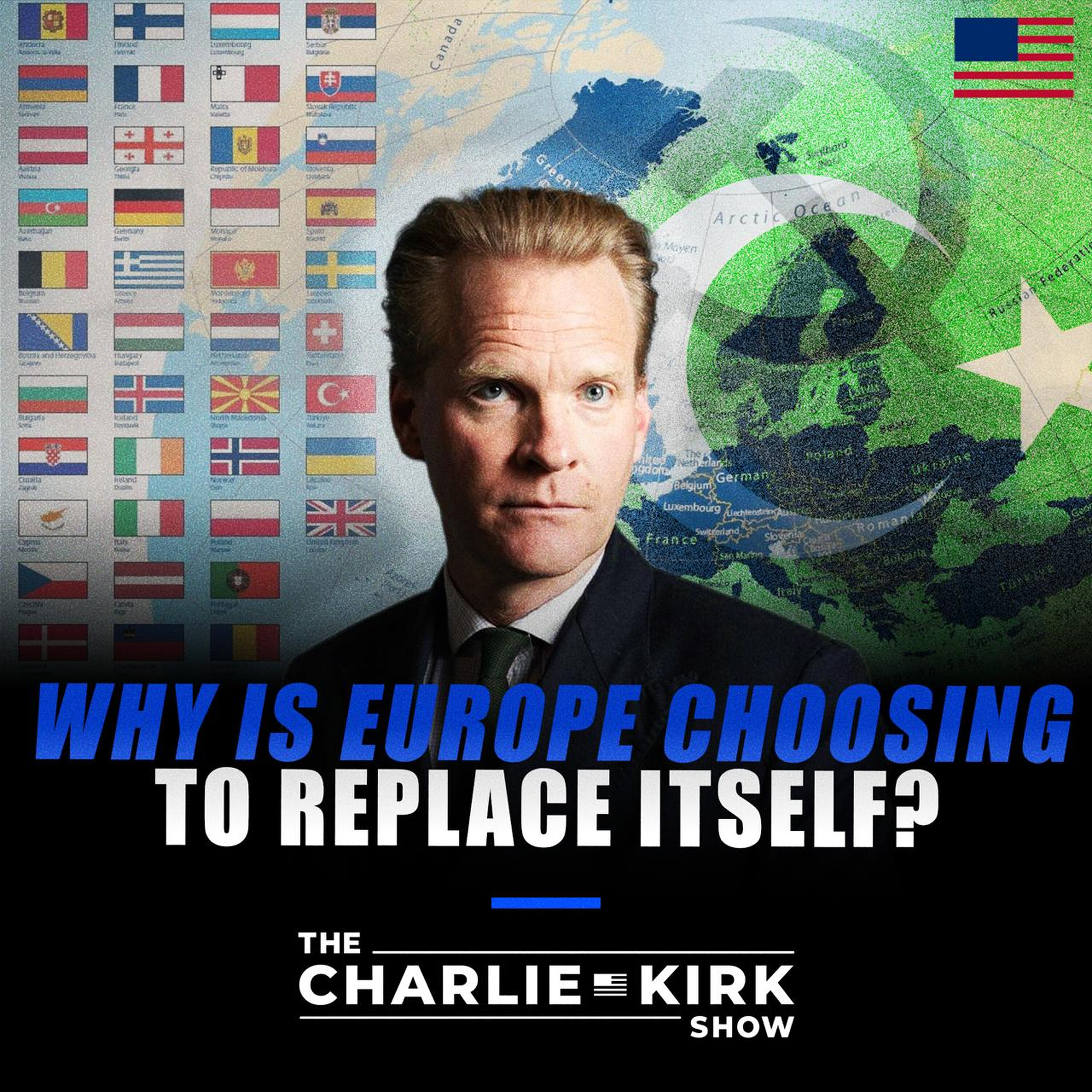
About this episode
One of Charlie’s favorite modern thinkers was Dr. James Orr, who has the lonely job of defending Western classics at Cambridge University. Shortly before Charlie’s martyrdom, he and Dr. Orr met in-person to talk about European decline, why the West decided to give up on itself en masse, and what hope exists for a turning of the tide.
Watch every episode ad-free on members.charliekirk.com!
Get new merch at charliekirkstore.com!
Support the show: http://www.charliekirk.com/support
See omnystudio.com/listener for privacy information.
Interactive timestamps
Jump to segmentGet every episode summarized
Each time The Charlie Kirk Show publishes, we email you a written briefing from the transcript — the topics, who appeared, and any specific claims, with the ad reads skipped.
Email me new episodesFree for 3 shows. No card needed.
Hosts & guests

Transcript ready
630 searchable segments. Every word is indexed and playable.
Full transcript
The Charlie Kirk Show — Why Is Europe Choosing To Replace Itself?. Machine-transcribed; use the interactive transcript above to jump the player to any line.
0:00My name is Charlie Kirk. I run the largest pro-American student organization in the country fighting for the future of our republic. My call is to fight evil and to proclaim truth. If the most important thing for you is just feeling good, you're going to end up miserable. But if the most important thing is doing good, you will end up purposeful. College is a scam, everybody. You've got to stop sending your kids to college. You should get married as young as possible and have as many kids as possible. Go start a turning point USA college chapter. Go start a turning point USA high school chapter. Go find out how your church can get involved. Sign up and become an activist. I gave my life to the Lord in fifth grade. Most important decision I ever made in my life. And I encourage you to do the same. Here I am. Lord, use me. Buckle up, everybody. Here we go. The Charlie Kirk show is proudly sponsored by Preserve Gold, the leading gold and silver experts,
1:02and the only precious metals company I recommend to my family, friends, and viewers. I could say the only conservative professor at Cambridge University, Dr. Orr, who is a contributing editor for Heritage and Culture at JB News, Dr. James Orr, everybody. Good to be with you, Charlie. Dr. Orr, great to see you. First, I want to just, you know, you sat through the presentation. You've been around all of this as a, as a Brit, as a professor. What is your take on this whole thing we have going on here? Well, I got to say first off, I was saying to Andrea earlier, it's, it's pretty overwhelming for a Brit like me to see the scale of your success and of your ambition, what you've achieved. There's that, you know, lots of, lots of students at Cambridge are in claim they want to change the world that they can go into jobs that are going to change the world. And I thought to myself this morning, you really could say that you are changing the world as America goes, so goes the world.
2:04And that's what you're doing. You're doing extraordinary things in transforming America, recalling it to its founding ideals, promoting people of caliber and character and courage, particularly among the young. It's a huge problem for us on the right in Britain. We're working very hard on it. And I just felt both envious, but also excited because I thought we can, we can bottle some, some curk juice and take it over to, to Britain. And we need to work out what the DNA is and we need to try to replicate it as best we can. It's hard to, hard to do that, particularly if you're a movement that's focusing on national pride and national distinctiveness and sovereignty and so on. You can't just copy and paste everything that you're doing. Of course, you have a very different constitutional set up, very different electoral dynamics, very different challenges in many ways, but I think philosophically, we're very much there. We're very much on the same page, that is to say we want to work out what the, not so much what the politics of left and right is. I think that's the sort of the politics, the philosophy of the, what I call the long 20th century, 1914 to 2016.
3:07I think the long 20th century ended in 2016 and the politics of left and right ended in 2016. And we're now talking about the politics of national preference, the politics of national interest. So this is still still a kind of shocking to the liberal ear, but, but this is the direction of travel for the new right on both sides of the Atlantic. So what do you mean by that, the long 20th century? Well, so historians like to talk about this that, you know, periodizing in history is always very, very difficult and it turns out that the human development doesn't always obey neat, neat time periods. But of course, we know what we mean by the 20th century, but I think there are these sort of history doesn't quite obey those neat kind of neat, neat even divisions. And so historians will sometimes talk about the long 19th century that sort of began roughly in 1815 and probably ended in 1914 right at 1815 Congress of Vienna. And then really you've got this extraordinary period of peace in Europe. And then 1914 is really the point at which that peace explodes.
4:07And so I think also we can talk about the long 20th century persisting in some ways beyond 2000 to 2016 as a fundamental watershed moment in how we think about national flourishing, how we think about politics, how we think about the organizing axes and horizons of national flourishing of mutual flourishing. Was that Brexit plus Trump? Is that why you think 2016 was the year that began the 21st century? I think that's right. I think it's always easy to conflate the two phenomena. They have distinct phenomena in lots of ways, but there's lots of overlaps too. And I think that it really marks a moment of change in the West as a very convenient point. It's not just Brexit and Trump. It's also the rise of pro-nation national conservative movements all across Europe. You're seeing it with Vox in Spain. You're seeing it with Chager in Portugal. You're seeing it with AFD in Germany. You're seeing it with the Hassan Blumau national in France, the Fratelli, Italy in Austria. You're seeing it in Italy. I'm sorry. And in Austria as well all over Europe for deaths in Hungary and going at different speeds and one of the challenges conservatives are always trying to conserve what is our own.
5:14And so it's actually very difficult to form what are the communists used to have a common turn. It's very difficult to have a con in turn because Marx could say workers of the world unite. But the progressives can say, wokesters of the world unite. It's a fundamentally transnational ideology that's very, very powerful. This is something that moves in lockstep. Before conserving our own nations, it's much harder to have that sense of international solidarity. But I think various movements are trying to catalyze that and the national conservatism movement, which I'm proudly that the chair of in the UK is helping to do that. And so, yeah, that's a big challenge. So what do you think led towards that national conservatism moment? And let's go a step back. And also take a moment, introduce yourself. You teach the Western canon at Cambridge, correct? I wouldn't say I'm not allowed to teach the Western canon. It would be sort of too big. But it's either an example I teach a program moral philosophy from Plato through to Nietzsche.
6:14That includes Aristotle, it includes Augustine, it includes Aquinas, Kant, Hume. So as much of the kind of classic Western philosophers as I can fit in. And then I also teach an Enfield program. But broadly speaking, yes, I teach Western philosophers without, but not through the prism and not through the lens of critical theory. I try not to politicize my teaching in any way. Of course, that itself is a political act these days, just trying to be neutral, trying to listen to these ancient thinkers on their own terms and not trying to force ideological kind of masks onto them. But yes, I see myself very much as trying to pass on what is best in the Western tradition. I think really universities have only three primary purposes. That is to pursue the truth, to preserve the truth, and to pass on the truth. And then there's a little bit crude, but those are the three ways I sort of think about what I'm doing. So partly it is preserving the best of what has been said and thought in the West.
7:21But it's also not wanting to be inert in that, always having that sort of sense of looking forward, testing, always probing, searching for new things, being open to novelty, open to change, but kind of anchored in the great Western tradition. So with that backdrop post World War II, there was somewhat of a new world order that was established, the neoliberal world order. And it was one that was based on free trade, that was based on both American dominance, but also kind of NATO expansionism, international cooperation, some could call it globalism. And liberalism seemed to be an inevitability. The famous book End of History by Francis Fukuyama was what, 1980s, not mistaken? 1992. Okay, 1992, where he basically said, this is it. We've reached it. Like all the ideas that have been tried have led us to this moment, classical liberalism, whatever you want to call it, liberalism is the best it's going to get.
8:27And congratulations humanity, history is over. What happened from Fukuyama in 1992 to now, what you say 2016 to now, where you go from this kind of hubris stick prideful, you know, kind of exaltation of liberalism to a completely different moment right now. Yeah, well, that book, the end of history by Francis Fukuyama is it's a fascinating kind of moment of sort of kind of hubris, you might say kind of misplaced optimism, but if you read the very end of that book, the actual full title of the book is the end of history and the last man. And he has his fascinating kind of final chapter or two of that work where he says, look, actually this sort of sense of this end of history dispensation, where we're everything is we've hit the sonnet up, plans of the kind of liberal utopia and peace and prosperity for all that in the end is not going to satisfy the man's instinct and this is particularly this is what he calls the the Fumas, this is this is if we think of Plato's like three level, three level soul, you've got the news at the top, the mind, then you've got the Fumas, which is courage, it's this sort of sense of that kind of the spirit that animates us, and then you've got the epithumea, which is kind of the base appetite and Plato says you've got to have all three of these in check.
9:46And what Fukuyama says is that there's a real danger that with this kind of the in the sonnet uplands of the kind of globalized utopia, we're going to suppress the Fumas, but that Fumas is not going anyway, it's not going away, it will come back. And so he's very he's not he's not quite as naive as that, and I think what's happened, you know, that quite think of the quest for Fumas as the search for identity, in fact, Fukuyama wrote a very interesting book on on identity where he sort of starts to conceive that the kind of sort of Berkeley liberalism was was never really going to deliver the goods, and so I think you know the suppression of that sense of sense of self sense of rootedness sense of home sense of distinctiveness and what we are and what we love that was never going to be sort of erased by the liberal doctrines of of of a kind of a blank slate doctrines of human nature, we're rooted, we're rooted human beings, we're related to what's around us, we're conservative about what we love most about what's closest to us, and that's never going to go away. And and we got to face up to reality is it is given to us and not as we would like it to be, but what went wrong with the liberal project.
10:50Well, I think the fundamental problem with the liberal project is that it's grounded on fundamentally mistaken assumptions about what it is to be human. The basic idea is that human beings are born into the world with completely independent, completely blank, completely blank slate. There's a lot of view of the tabular raser or the white page, and we're completely free of all unchosen obligations. And there can be no obligations that we don't ourselves choose. And this is just a complete fantasy. I don't think it's an accident that the great liberal philosophers like John Locke and Emmanuel Kant never had any children. Anyone who's had any was had had a child will understand that the radical nature of dependency, that most basic bond, we're born into the world with that most literally with a with a physical bond, we're attached to a physical bond to our to our mothers. And so that was always going to be a problem that we're not we're not blank slates, we are connected, we flourish most when we're connected to what is closest to us.
11:52And it's not natural to love what is closest to us. I was in France, I think last month, up in the mountains, this beautiful shadow addressing some must have been 50 or 60. I suppose conservative right wing students from all across I think probably you know 25 different nations. And I open up wasn't quite sure what is going to save them that the organizers hadn't been very clear. So I found myself beginning the session by saying, who here has got the best mom in the world. And every hand went up. And they looked around and they started laughing at each other. And I said notice what you're not doing right now. You're not arguing with each other. You're not discussing what are the proper optimality criteria of being a mother. You're not there would be a crazy, you know, inhuman thing to do. It's a totally natural thing to think that your mom is the best mom in the world.
12:54And then I said, who here lives in the best country in the world. And everybody's hands went up. And my point was, I don't owe you an argument for why my country is the best country in the world. Any more than I owe you an argument for why my mom is the best mom in the world. Somebody who asks for an argument has had what the philosopher Bernard Williams calls one thought too many. The person who has one thought too many is like the guy the utilitarian who walks up to the river and he sees two women drowning his wife and a strange woman and stops to ask, what if that strange woman might win the Nobel Prize in public economics? That person has had one thought too many. It is a totally natural disposition of every human to love what is closest to their own. Aquinas sees this. Aristotle sees this at the beginning of one of the greatest works of politics ever written book one page one of Aristotle's politics. He says, how do we think about how we get on? How do we think about the life of the police? Politica.
13:59He says, well, you know, we're born into the world and we're dependent upon each other. Male, female, men and women will bond. Then they will have, then they will procreate. They'll be a family, a household, an oikos. But that won't be enough. That will be enough for daily needs. But it won't be enough first sort of, you know, non-date, more than daily needs. So you'll have a village and the village will come together. But that won't be enough either. You will need to grow into a police for self-defense and so on. A city state, as it were, a country, a nation. And that Aristotle thinks, okay, that's pretty small in fifth, fourth century BC. Greece, but that was the functioning. That was the way in which Aristotle, that was the kind of optimal size for human beings to flourish, to, as it were, get fulfilled. Their proper ends as human beings. And I think that's still the basic way of thinking about things. I think it's really what you see in Aquinas. I think it's what you see in the Bible as well. Wow, there's so much there to think about.
15:02We're honored to be partnering with Alan Jackson Ministries. And today, I want to point you to their podcast. It's called Culture and Christianity, the Alan Jackson podcast. What makes it unique is Pastor Alan's biblical perspective. He takes the truths from the Bible and applies it to issues we're facing today. Gender confusion, abortion, immigration, doge, Trump in the White House, issues in the church, he doesn't just discuss the problems. In every episode, he gives practical things we can do to make a difference. His guests have incredible expertise in powerful testimonies. They've been great friends. And now you can hear from Charlie in his own words. Each episode will make you recognize the power of your faith and how God can use your life to impact our world today. The Culture and Christianity podcast is informative and encouraging. You could find it on YouTube Spotify or wherever you get your podcasts. Be sure to subscribe so you don't miss any episodes. Alan Jackson Ministries is working hard to bring biblical truth back into our culture. You can find out more about Pastor Alan and the ministry at Alan Jackson dot com forward slash Charlie.
16:04So let's go let's let's pull one of those threads, which is that all the French young people that at that chateau will raise their hand who lives in the greatest nation. Why does Europe not vote or believe that vocally in any of their politics? Let's now center our conversation around continental Europe and then we'll make our way to your home. If I may say so continental Europe is a husk of its former self. It's an open air museum. It's sad. It's depressing. There are pockets obviously of joy and of history, but I think you would agree doctor or it's not what it used to be. How did that happen? World War II, the West won, right? And now we look in 2025. Europe is an unrecognizable continent in more ways than one. Yeah, I think that's absolutely right. And we would it would take a very, very kind of long long conversation to really get to the bottom of it. I mean, one book I'd really recommend on this is actually by an American Christopher Kuldwell or reflections on the revolution in Europe.
17:06This actually goes way back to 2009, which is a long time considering what's happened in the intervening period. But I think Kuldwell really sort of is an incredibly prescient book. And he starts to see the kind of the sort of conditions of the unraveling kind of kicking in. And you're right, you know, after the Second World War, the French had what they called the taunt glorios, the 30 glorious years. In Germany, you have at least in West Germany, you have the Vischapwunder, you know, this economic miracle is extraordinary explosion of economic flourishing and national self confidence in West Germany. And I suppose, you know, 1989 has got to feature somehow in the story of Europe's decline or Europe's sort of, you know, once that, you know, the great bug bear of the Soviet Union and that great enemy of freedom everywhere had been dissolved. Then I think there was a sense of, well, you know, before that, there was a sense of what are we full? We know what we're full. We're for freedom. And this is something that is pretty uncomplicated and it's going to stitch us together as a kind of, as the West, it was easy to think about the West and it was easy to think about the rest.
18:12I think after, you know, 1989 into the 1990s, that the fall of the wall, that the fall of the wall in a way sort of starts to mark the beginning of the kind of questioning, what are we about? What are we about? What is our story? What do we fall? There's a fascinating moment in 2004 when the European Union is trying to work out a constitution. In the end, it fails because it can't agree on anything really. And there's a huge debate about what goes in the preamble of the constitution. Like, how do we set out right at the beginning of the constitution? We, the European Union, who are we? What makes us we? What makes us a we? They said, well, our Hellenic inheritance, Greece and Rome, the classical inheritance, yes, the Enlightenment inheritance as well. No mention of the hebraic or the Christian inheritance. This was seen to be something that was, you know, low status, not something that wanted to be admitted. John Paul II is right towards the end of his life in 2004 and got involved in it. Italian politicians got involved. There's a huge fight about it. And in the end, the decision was no.
19:14We're not going to have any recognition of the fact that the European Union is in any way a tool, the successor to what it really was a successor to. Namely, Christendom and the Holy Roman Empire and that which stitched Europe together as a sort of self-conscious collective entity. That was gone. And now, I don't want to overstate that too much, but I think that it was an indicator and index into the way in which the Europeans were beginning to run out of a sense of what, who are we? What, what are we for? Where do we come from? And then of course with emergence of a kind of technocratic, a democratically unaccountable, potentican parliament in Brussels and Strasbourg, the parliament is in both places. Wait for this for a hundred million, a hundred million euros a year. The European parliament moves from Brussels to Strasbourg. I think it's every fortnight back and forth. How long is a fortnight? Sorry, you don't have fortnights over here. Four, it's 14 days, two weeks. We do, just trying to get a fortnight to say to you. And it just said, think about it. They can't, they couldn't resolve something as basic as that.
20:17But they moved back and forth. They moved back and forth. Yeah, just said the Belgians out, you know, the kind of Franco-German pact is happy. And then the sort of, you know, the idea of there being a European union beyond the Franco-German alliance. So that's what you get when you go to Brussels. So all these crazy things, crazy sort of features of the kind of European settlement. And there's a kind of democratic deficit, you might say. I used to play this parlor game when I was, I'm now at Cambridge, I was at Oxford in 2016 just ahead of the Brexit vote. One of the parlor games I would play with my, I was the only out of the closet Brexit tier. As far as I know, in the whole of this college, among, I didn't know, I think about 70-80 colleagues. And I used to ask them, who's our MEP, who's our member of the European Parliament, like which, who represents us? Who represents Oxford in the surrounding areas in Brussels, Strasbourg? And no one can answer. No one, no one knew. Not even the professors of politics.
21:19And there's no reason for them to know because it's a fake, because it was and is a fake parliament with very little powers, very, very little, few veto powers, very few powers of it to initiate legislation. Nobody voted for them, nobody, nobody had any reason to know who they were. And so that has been a huge problem. That kind of sort of European Union project has been, you know, from 1992 onwards, where it really became a self-consciously political union and not just an economic and trade one. That's really been, it's been a disaster. And I hoped that in 2016, Brexit would be the first brick in the wall, that it would, it would catalyze a kind of domino effect. That was probably wishful thinking because particularly in the Euro, so here in the Euro nations, you know, it's one thing for Britain with its own pound, its own currency to break away. It would be a much more dramatic consequences if a Euro country split away. But the Euro has been a disaster for the countries who have been members of it.
22:21I mean, Italy, for example, has scarcely had any GDP growth. I think it started to pick up recently, really for the first 20 years of it being being part of the Euro effectively nothing at all. Greece and Spain, youth unemployment, was through the roof. Effectively, you know, you've got the, you know, the Spanish currency, Greek currency, effectively being shackled to the German benchmark. And so the Germans weren't complaining because the currencies was artificially depreciated. So there are exports more attractive. And so it was all this kind of elaborate Ponzi scheme, which at some point is going to unravel. And then somehow, you know, ideologically within the elite forming classes in Oxford and Cambridge and London, certainly in Britain, you know, the idea is that to be European was to be part of the European Union. Those two are absolutely part and parcel. And I never understood this. You know, you can hate FIFA and love football, as I've often said, you know, or soccer, I should say. You can hate FIFA, like the World Wide Organization for soccer and you can, and you can love soccer. In fact, you can hate, I hate FIFA because because I love football. I don't like what FIFA is doing to international football. I don't like the corruption. I want the game to be a richer game. And I think it's the same of the European Union.
23:28And it's had this sort of deadly effect on our sense of what it is to be European. What explains the hyper secularization of Europe post-World War II? Why did we see such a dramatic drop off of church rates? Is it as simple as they saw tragedy and suffering and nihilism took the void? Because Europe has had depressingly low church rates and they just keep on finding new lows every decade, where what percentage of people in Europe do you think regularly attend church? It varies quite a bit from country to country, but it is shockingly low relative to the United States. So, you know, Italy, it's now very, very low. I think it's certainly well below 5%. I mean, religious adherence is just a very difficult thing to measure. Is actually going to church, does it count as sort of being a Christian or being a church girl? In Britain, you know, what caused it? I mean, it may be the opposite, I think. I think I'm more tempted to the analysis that actually it's prosperity and flourishing, particularly material flourishing and prosperity that tends to catalyze a sort of collapse in the sense of any need for meaning or any orientation to the transcendent.
24:45I suppose also in the 60s you're seeing the emergence of competing systems of meaning, competing accounts of what it is to have significance, competing sets of answers to live's deepest questions. We see that a lot of that imported from California and elsewhere. And I suppose the sort of something, you know, there's something fashionable about religious skepticism that was certainly true in the 60s. If you think back, you know, to the high noon of the New Atheists in 2005, you know, there was something very, very sort of elite. There was something very, a lot of cache in being, in being an atheist. And I'm tempted to think that the New Atheism was just a politically correct way to be skeptical of Islam. I think that the timing works quite well there. But I think if you look in the last few years, and I just saw some data out from Britain this morning, you know, I think between 8 to 18 to 35 year olds, belief in God has tripled over the last five years.
25:46Bible purchases has gone up by 87% over four years. Now, it's from a pretty low base, but something is happening out there. You know, it's still quite, you know, it's still quite small, but the numbers among, among Gen Z or Gen Z, as you call them, that you call them Gen Z. Well, because that is how you pronounce the letter in English. And I know you Americans have a different way of putting it, but it's interesting. So let's now, let's now take our attention to your country, which I had the opportunity to visit. And you hosted us wonderfully in Cambridge. Quite quite the ambush, so not by you, but by Cambridge, but we survived it. More than survived it. Yeah, we, I think we, we triumphed, some could say, and you were so sweet and so kind throughout that entire process. So the United Kingdom or Britain or England, whatever word we want to, want to give, give it, voted for Brexit in 2016.
26:49Where are British politics today? What is the status of British politics? Yeah, well, it's, it's, it's a great question. You know, in 2016, we have this extraordinary expression of the democratic will in 17.46 million people voting for the principle that laws affecting the United Kingdom should be made in the United Kingdom and should be accountable for the people and voters of the United Kingdom. Very, just, you know, seemingly entirely uncontroversial principle, but it was the biggest vote of, we've, we've had in, in, in history, in British voting history. And another key driver there was the sense of, we're losing our sense, we're losing what it is to use the first person plural as Roger Scruton. Well, my favorite philosopher's likes to put it a sense of we, we, the people, what is it that makes a we and what was going on in Brexit was, was, was, was kind of in co eight kind of cry, that we are losing that sense of who we are, that every time for the last 40, 50 years every time the British people have had an opportunity to express a view on mass demographic change and transition.
28:03It is said no or go much slower and every time its leaders have effectively ignored those that, that, that clearly expressed will. And I think 2016 was a moment where suddenly it looked as if we might have the opportunity to, to finally regain control of our laws and regain control of our borders at the same time. What actually happened in the last five years, one in, what have we had is one in 27 people in Britain have arrived in the last five years, one in 60 arrived in the last 18 months. In the first 25 years of this century, gross migration, gross immigration, talking 12 to 15 million people, that's roughly four to five times as many people who arrived on our shores in the first thousand years of our history.
29:06It's difficult to overstate, I know you've had, you know, you've had enormous influxes too under the Biden administration, but you're a much bigger, you've got a much bigger territory. And you've got a different kinds, different kind of categories of migrants coming in and you've at last got an administration that's willing to do something about it. Praise God for that. And indeed, and that has had, but has had a profoundly kind of traumatic shock on us, Brits, and it's had a kind of tectonic effect on the landscape of British politics. So what's happening in British politics? Well, quick update. Last year, July 2024, we saw the loveless landslide. So we see the Starmer government getting an astonishing 175 odd seats, majority in parliament, which is an enormous, enormous majority at one of the biggest in living memory, on only 20% of the vote, 20% of the people eligible to vote, something like 34% of the vote share. It was, you know, the sofa one, I mean, the couch won that election. It was a very low, very low turnout. Nobody, it was an apathetic election. Nobody seemed to care.
30:15Fast forward now, you know, we're just over a year in back in the 1st of May of this year, we had the local elections. We're a pretty good proxy. It's a bit like the midterms and not a bad proxy for what the country's mood is is. And I think, you know, labor gets goes from 34% to 20% the conservative party goes down to 15% extinction level, almost an unprecedented low. And a new, for the first time in 100 years, a new party emerges, a third party to rival the duopoly that's had Britain in its grip since 19, 1923. And that is Nigel Farage's reform UK, which surged through to win 677 local seats, which if you extrapolate that out is 30% of the electorate. That's an extra, they were at 14% a year ago. And that that's going up and up and up. And what you're seeing for the first time in the history of British politics, since there have been political parties, let's say the Tories are emerging like the 1670s, 1680s, and really kind of betting down in their modern form in the 1830s.
31:25For the first time in the history of British politics, there is another right wing party emerging, another conservative party that is, it looks as if, in my view, we'll have to see what happens next May with some more proxy elections. And then there'll be a general election in 2029, the last point that Keir Starmer can can call it, but my sense is that Nigel Farage is on track to be the next prime minister of the United Kingdom. That does there are some applause. So let's examine that deeper and more thoroughly. Some people in the audience will hear, wait, hold on, the conservative party, don't we like them? Explain what it means to be part of the conservative party. That's not exactly, let's say, the equivalent that we would have here in the United States of what we consider to be a conservative. That's right. But even here, I suppose, in the States, there are lots and lots of fascinating debates within the GOP, within the Republican parties, what is it to be a conservative?
32:29Is it to be a Reaganite? Is it to be a fusionist? Is it to be a Trumpist? Is it to be a kind of compassionate, bush-like conservative? So to some extent, we mirror some of those debates, those debates about freedom, economic freedom, how to rank that and the order of what it is we want to conserve. But roughly speaking, the conservative party was in power from 2010 to 2024. And all of the good things that it delivered, it delivered by accident, it granted the referendum on Brexit in 2015, not expected in its manifesto, it didn't expect to win in 2015. It thought there would be another coalition that the referendum would be scrapped by their coalition partners, but they won, almost unexpected, not expecting to. They granted reluctantly the referendum, they campaigned against Brexit, that was the official government position, then they lost the government fell, a new government came in, headed up incredibly by Theresa Mayer Prime Minister, who voted against Brexit.
33:29A Prime Minister who voted against Brexit was tasked by the internal party political dynamics of the conservative party to deliver Brexit. And sure enough, it was a complete catastrophe, that's when I cut up my membership card. To be conservative in 2016, 2017 was quite a straightforward, you've got one job, 17.4 million brits have asked us to do this one thing. And right now, all that we want you to do, and it couldn't do it, it couldn't do it, it couldn't do it. Finally, the May government falls in summer of 2019, after a spectacular defeat at the European elections, as the European elections are good for something, it turns out. Because in the space of six weeks, Nigel Farage sets up the Brexit party and goes from zero to winning a national election in the United Kingdom. That was inconceivable, quite just unthinkable. And that's spelt the end of the May party, and Boris Johnson takes over, and finally manages to get Brexit over the line.
34:33Then the plague strikes, and COVID, and lockdown, and so on and so forth, spending goes through the roof. And we've got very, very serious economic problems, headaches to worry about. And being conservative has been very, very hard to kind of keep a track on what it means to be conserved. If I suppose for brits, the British Conservative party is just to be conserved, is just to be a pragmatist, just to be pragmatic. But as, you know, I remember La Rianca, he kept us through a mutual friend of mine and Charlie's came through, said that the trouble with pragmatism, James's, it doesn't work. And it's true, you know, you got it, you can't, GK Chessson says, you know, the pragmatists' chief end is to be something more than a pragmatist. If all your pricing is efficiency, then it doesn't, then what is efficiency? Efficiency towards what? If the aim, you have to aim your destination. You've got to have a tell us, you've got to have a horizon. And I think for years and years and years, the Conservatives' horizon was just to win.
35:33We just need to win. And they were very good at winning. They're the most successful election. Like a Republican party that we know. Of very similar. But I mean, and the Conservative, British Conservative party is the most successful election winning machine in the history of politics, anywhere in the world. But, you know, I think that is, that may now be coming to an end. This is Lane Schoenberger, chief investment officer and founding partner of YRIFI. It has been an honor and a privilege to partner with Turning Point and for Charlie to endorse us. His endorsement means the world to us. And we look forward to continuing our partnership with Turning Point for years to come. Now, hear Charlie in his own words. Tell you about YRIFI. I want to tell you guys about YRIFI.com. That is Y-R-E-F-Y.com. YRIFI is incredible. Private student loan debt in America told us about $300 billion. YRIFI is refinancing distress or defaulted private student loans. You can finally take control of your student loan situation with a plan that works for your monthly budget. Go to YRIFI.com. That is YRIFI.com.
36:33Do you have a co-barrower? YRIFI can get them released from the loan. You can skip a payment up to 12 times without penalty. It may not be available in all 50 states. Go to YRIFI.com. That is Y-R-E-F-Y.com. Let's face it, if you have distress or defaulted student loans, it can be overwhelming. Because of private student loan debt, so many people feel stuck. Go to YRIFI.com. That is Y-R-E-F-Y.com. Private student loan debt relief. YRIFI.com. YRIFI.com. That is defines the conservative party. Reform, which is Nigel Farage's party, is growing. How, and you have mentioned this, how does mass immigration, specifically mass Islamic immigration, playing into how people are thinking about this election and the United Kingdom? Yeah. Well, it is a great question. It is very hard to know with so many people coming in. It is very hard to know who they are. What do they believe?
37:33What do they think? Let alone working out strategies of integration or assimilation. What is happening now? Illegal immigration, so roughly tens of thousands of people coming onto the Calais beaches and paying people traffickers three, four thousand euros a pop money in dinghies across the channel. And so there is an immediate... Now, those numbers are tiny relative to the levels of legal migration, which are huge. But somehow it concentrates the mind, this fact that these people are coming over. Nothing about them. Most of them are young men fighting age, very few women, very few children, very hard to believe that they are actually refugees fleeing persecution and warfare. I mean France is not a great country right now. You might not like it very much. But is it in the grip of civil war and widespread urban conflict?
38:33Only in August, really. And actually Calais are pretty nice places to be. But that's what's going on. And so the government doesn't know what to do with these people. The tourists didn't know what to do with them. Labor party didn't know what to do with them. We are wedded and kind of enmeshed in all of these complex webs of international obligations, treaty obligations. There's a foreign court in Strasbourg that has jurisdiction over who we can and can't admit it to them. Or was it Brexit supposed to fix that? Well, is there something that is worth clarifying here? So there are two courts, two European courts. It's the European Court of Justice in Luxembourg. And then there's the European Court of Human Rights in Strasbourg. And we did not leave the European Court of Human Rights. That is a separate jurisdiction, which emerges after the Nuremberg trials in the late 1940s, where there was a sense that in order to kind of ensure that this could never happen again, that the Nazi war criminals were never able to say, what laws did we break? And actually, it was very hard.
39:33You know, the Allied prosecutors found it very difficult to argue. Jackson, the US prosecutor and David Maxwell, and it's very difficult to say, well, you know, it's not clear what laws you have broken. I mean, technically, it's not clear that the Holocaust, for example, was against the law. The Nazis were screwpillous legislators. So there was this sense we have to have this convention. We have in order to ensure that this never happens again. And that's different from the European Union. The European Union doesn't come along until later. And we still remain under the jurisdiction of the Strasbourg Court. And for as long as we are under that, it's jurisdiction. We effectively, you know, our courts are required, you know, to effectively grant the rescission of deportation orders by the British government. On the grounds that deportation, on our engine country, would breach the deportees' human rights. And so you're getting, you know, I had a story that was happening last week of people facing deportation,
40:35going to their embassies, protesting outside the embassies, claiming that they would have caught the eye of officials within the embassy, and then claiming that it would be too dangerous for them to go back. They'd be likely to be political prisoners or they'd like to be victims of political persecution. It's quite extraordinary. You have, you know, people joining terrorist organizations, because that will mean that they're going to be politically, you know, persecuted politically when they go back to their origin countries. Or Article 8, right to a family life, which is incredibly open, basket, human right. You can say, no, I just feel I'm going to be, you know, oh, I'm gay. And Syria is not going to like that. Okay, fine. You're not going back. And you're not going to win that. You're not going to win that. The government is not, no government is going to win that case against the human rights, legal, industrial, complex, because Britain very much, you know, it's no longer the rule of law, it's the rule of lawyers. The, is Nigel thinking about ending that jurisdiction?
41:36And what is he running on in regards to immigration? So one of the key questions is, do we get out of this court? How do we get out of the court? In my view, if you want to really get Brexit done, you just, this is, you have to finish the job. You have to, we have to remove ourselves from the jurisdiction of the Strasbourg Court. That means rescinding Tony Blair's 1998 Human Rights Act. But the political appetite to repeal a human rights act, and effectively this sort of new constitution of kind of rights-based regime, very kind of continental and spirit, very different from the common law approach that England has always, has always had. Contrast that. Can you build into that for a second? I don't want to just sit by that. Let's just think about this. There's a very different, you might say there's the kind of, the jurisprudence of the English-speaking peoples, kind of a common law, the idea that we discern the principles of justice, of natural justice from the bottom up, on a case-by-case basis. And we work it out through concrete quarrels between particular neighbours,
42:38between contractual disputes, or, or in the case of the criminal law. The European model, this is a little bit crude, but broadly, I think, broadly kind of plausible. The European model is just to kind of imagine what, you know, to come up with codes, abstract codes that we're going to just apply universally no matter what. But a basically agnostic and kind of not attentive to the concrete particularities of human and interrelations. And so, you know, one of the great sort of guests of the English-speaking peoples is this idea of a kind of bottom up common law approach. We see this in Blackstone, we see it in Cook, we see it in all the great jurists that we, the English-speaking peoples, have inherited. Whereas the European idea is to think in these sort of rights-based ways, which is basically kind of a metaphor drawn from kind of the world of property. So, I mean, one way of thinking about this is, you know, we have an offences against the person act, 1861. And we have, were these words, these lovely earthy sacks and words like murder, and manslaughter, grievous bodily harm, actual bodily harm.
43:44And I sometimes joke with my students, you know, which do you think is the more kind of morally accurate way, what's the kind of right moral grammar in these two scenarios is, Peter murdered Lucy, or Peter breached Lucy's right to life. And I think, you know, kind of the common law bottom up way of thinking is just more accurate. He murdered her, or maybe it was Man's Law, a diminished responsibility, whatever it might be. Whereas a rights-based view is a much more kind of artificial liberal kind of construct of this sort of floating ethereal blank slate with all these kind of strings and these different rights coming off it. And it's very difficult, it turns out, to reconcile all these different rights. It's intentionally confusing. Exactly right. Exactly. It's a feature not a bug. It has turned out to be a feature not a bug. And part of the, you know, part of what is, what they're attempting in the rights-based regime is to say, well, if we all signed up to one common shared view,
44:44of what is right, capital R, singular right, then secularism can't work. Because the point of secularism is to try and create this slightly fake, neutral public square, where everybody's allowed to kind of disagree about the fundamental question so we don't have any more wars of religion. Like, this is the basic idea of kind of Treaty of West Bali in 1648. And so, we've got to be agnostic about the underlying capital R right. Because if we're not agnostic about it, then we'll start killing each other. It'll be a kind of, you know, Hobbesian war of war against all. So what we say is, everybody, every individual has a right to determine what is right. And then it becomes impossible for any judicial process of discerning what is absolute, because what is it, what is a judicial, what is a judge supposed to do? To discern the right, to discern objective natural justice. And it's impossible to do that when you've got these competing, conflicting claims, conflicting demands. So that's so helpful.
45:44The question that a lot of people have is, why is Europe continually importing people that not only wish them harm, but will replace core European identity and culture? What, get even metaphysical, if you have to here, it is confusing to me and to the audience. What, what is it? I mean, Paris, Brussels, London, these are unrecognizable cities. And it's being done voluntarily. Why? Who's voting for this? What is their argument? So increasingly, they're not voting for it. So we are seeing that this is the key driver for populist movements all across continental Europe and now in Britain. I think is a sort of, is a kind of emerging resistance to all of this. But it is taking a long time and it's a good question. Why has it taken so long? Yes. You know, I think the first, you know, shooting from the hip, the first answer might be guilt. A sense of kind of post-colonial, a post-colonial need for atonement. And you see this in France, it's present in Britain. There's a sense that we wrong the world.
46:49You know, we invaded the world. Now we need to invite the world. That's the kind of, that's the idea. And you see this, you know, there's even this sort of guilt dynamics with Germany. Even though Germany were useless in perilous, I mean, they were absolutely terrible. I think they had an Arabia, but they were, they were, they were, you know, maybe the problem of the 20th century is they feel they missed out. Namibia is actually a great country. Windhog is an underrated city. No, no, no, no, it is, but you know, they didn't actually have much of, they didn't have a lot of it. They felt they lost out on the 19th century. They were terrible at this. They were terrible for Africa. So 20th century now is our turn in our own backyard. I didn't have a speculative. But I remember in 2015, after Merkel announced, you opened up the gates. This sharpened us. We can do this. And she was making policy. That's a part one of the most consequential policies in the history in the history of Europe in, in living memory. It's, it's almost done in real time on a TV program where a, I think it's our young Palestinian or Syrian child. It's sort of emotes or it gives a, you know, begs, begs her to, begs her to help. And you can, she's almost changing her mind in real time.
47:56In 2015, she opens up the gates of Europe, effectively. She says the German borders are open, which of course means hungry, Romanian, Bulgaria, Greece. And suddenly you have this domino effect. And you know, tens of thousands coming across indignies, thousands dying, thousands drowning from, from, from, from these very risky voyages. And, and so, you know, the trains would be rolling into Munich. And there would be big signs in German saying simply, atonement, atonement. 80, you know, 80 years on 70, 70 years on. This is how we atone for our sins. And I think so, isn't it? There's a kind of, there's a just specific German version of that. There's a British version of that. There's a French version of that that explains those first ways. So that would be the first answer. And can I just interject before my view is that when you don't have Christianity, you don't know how to deal with guilt. And so you come up with these strange counterfeit ways. Because in Christianity, we go to the cross, we go to Jesus. In secularism, you invite a bunch of Muslims.
48:57I think that's a very subtle point. I mean, it's a, I don't know if you, it's not as simple as inviting a bunch of that. That's not what they're consciously thinking. No, but it's what it's, but yeah, it's, it's a kind of atonement for we're kind of atoning by finding new victims and finding victims that instead of we're kind of inflicting. Yes, inflicting suffering on them. Now we can sort of somehow, we can over time, we can sort of break, we can, if we can atone, we can seek kind of kind of secular redemption. But you're the second one that I interrupted you. So no, no, thank you. So very, very, very stupid point. Thank you, Charlie. That second point is, it's just the raw economics. So the idea is, you know, the dogma in the treasury, the finance department in Britain is, you know, we've got to just keep the Ponzi scheme going. We've got to just keep the GDP line, the line has to keep going up. The pie has to keep getting bigger. Even if it means that the slices of the pie keep getting smaller. And this is a dogma in finance ministries all across Europe. So it's just, it's just this Ponzi scheme where we're not having kids. We're aborting hundreds of thousands of them.
49:59And there's a demographic collapse all kinds of demographic collapse or winter all across Europe already. It's already here here in Britain. It's certainly happening in Britain. And so the dependency ratio of taxpayers to dependence, whether it's the out of work, which is, which is, which is very high. It's, I think it's nine million in Brent, so we basically have 27 million taxpayers, nine million out of work, six million public sector workers, 13 million pensioners. So we, that ratio and that ratio is going to get a lot worse pensioners retirees. Sorry, that's right. Pensions are retirees. And so with that, and those sort of dependency ratios of taxpayers to non taxpayers is going to get worse and worse and worse. So the idea is if we can just, you know, we can kind of import people who can contribute somewhat to our national economy. In fact, it turns out their net drains on our national economy, but that's been one of the myths. I think the other myth is to go back to liberalism for the third answer would be this kind of the liberal myth of the blank slate.
51:01And the way I love this, the way I was thinking about this the other day was in the context of the transgenitorism debate. And the view seems to be, you know, it's, it's the similar kind of metaphysical myth that is, that is kind of bewitched the liberal mind as with transgenitorism. So the, you know, with transgenitorism, you know, the problem is, is, if anyone can become a woman, what is a woman? What is it to be a woman? If it's subjective self declaration of any human being is, we've lost our definitional ascensions. And I think there's a same problem with what we might call transnationalism. If anyone can become an Englishman, what is an Englishman? If anyone can become an American, what is an American? We've got this such sort of definitional vagueness that we sort of, it becomes impossible to, to go back to that phrase, ever to use the first person plural. Ever to be able to say, we the people, we're not an idea, we're not a proposition, we're not a project, we're a people, we're the home, we're the history, we're the heritage.
52:04And that doesn't mean that we can't welcome people in. I mean, the model I have for this is the book of Ruth. And that very short, short book in the, in the Old Testament. And that's I think a, you know, perfect model. You know, what does Ruth do? She's a Moabite. She's not an Israelite. But what does she do? Her husband dies. She says to her, so she's like, where you go? I will go. Where you lodge? I will lodge. Bowers, right? Your people will be my people and your God will be my God. And she's, she shows humility. She integrates herself. She works the fields. She's loyal. And, and the interesting thing I noticed this, even to the end of the book. She doesn't become Ruth the Israelite. She's still root. So her identity is still there. She's incorporated into the people of Israel, but she's still a Moabite, a Moabite test. And we just have, we can't even have that conversation. We're not even, you know, we have no idea what it is. You're not allowed to say what is it to be an Israelite. You're not allowed to say what is it to be an Englishman.
53:11You know, there's, there was somebody the other day who just said, you know, the concept of the Englishness and English identity is evil. One of Tony Blair's speech writers, John Reynolds, he deleted the tweet, but that's interesting. There's been a vibe shift a year ago. He wouldn't have deleted it. But, and so things, things are changing fast. But there is this strange myth that sort of bewitches us that, that, that there's nothing that there is to be, to be British, to be English, to be Welsh, to be Scottish. You can just, you know, pass through the gates of the e-throw, get your piece of paper and this magic dust will descend upon you and infuse all of Shakespeare and sorcerer. And that kind of will ensure that your pulse quickens when you see a spitfire in the sky, you know, and it turns out that magic dust doesn't work. Like, national identity is more than paperwork. Yeah. It's more than just having documentation. And I look at Mamdani. Okay. Yeah, he's got his paperwork. Like, that's not an American. He's just not, nothing about him as American.
54:12He's got his paper. I'm not doubting it. Like, I'm sure he's got all of his documents. But nothing he says or believes is anything close to what it means to be an American. It's at odds, actually. In Islamist Marxist. Yeah. This takes us quite nicely onto, onto Islam because, you know, one of the challenges that Islam has always had is to incorporate into itself into its political theology, the concept of the nation state. The concept, certainly the concept of the secular public square. Of course, it's incomprehensible. Or the distinction between the secular and the sacred. This is not something that is that comes naturally a tool to Islamic theology. And actually, you can understand in many ways, I think, Islamic political theology is more consistent, more predictable, more kind of comprehensible than Christian political theology. You know, when Augustine comes along and says, well, yes, you know, God is in charge of everything. But there are some parts where he's just going to let us be neutral.
55:12And he's going to let these earthly authorities take control. And the church has the worries about the eternal and the earthly authorities worry about the, the, the kind of the temporal. And that's the kind of the beginning of the secular. The secular, the idea of the secular starts to emerge with Augustine. It's not meant to be a kind of godless zone, but that's really effectively what it, what it becomes after, after the 18th century. And, you know, for Islam, if you're, if you're a monotheist, that's a very strange idea. Why should there be any corner of creation that is somehow even kind of provisionally neutral and godless? Islam can't cope with this thought. And it, it's monotheism, it's particularly it's very, very aggressive, strong commitment to, to, to tell weed to the doctrine of oneness and, and the power to the power of God makes it very hard for this kind of Augustinean idea to emerge. And so the nation state is fundamentally a kind of secular construct. Now, it's one that Christianity has been able to baptize, right? I've just come back from, from Hungary. I mean, they are very self-consciously a Christian nation founded by St Stephen and there's going to crosses everywhere. It's in their constitution. That's not a problem. England, England is, you know, our monarch is also the supreme governor of the church of England.
56:29But technically, you know, constitution, if any of you watch the coronation or the funeral of her late majesty, you know, that is, you know, the ceremonial kind of pedigree is, is, is a Christian one. But within Islam, it's, it's, it's much harder for Islam to form it. It's much harder to convince a loyal Muslim to have a political loyalty to a nation. Rather than the Umar, which is rather than covering the covering rather than the Dar al Islam. And so Islam is a much more, a much more cosmopolitan and ruthless universal identity. And it finds it very difficult to work with the particular and with, with kind of sort of secular national boundaries. So, I mean, one of that, just to close the loop on the journey. So, right. For example, you know, there are sick roughly 6% of Muslims in Britain, 0.5% of them are in the armed forces. So much, the more British Muslims who went to fight for ISIS than there are in the British armed forces.
57:34I'm surprised only 6% because I'm going to London. It feels like a lot more than 6%. Well, that's because they're concentrated in their very dense. So how do we had a successful strategy of assimilation integration? That's a great point. Then there might have been a much, a much more diffuse diaspora. But, but that's not how it works. And you get these certain tipping points where effectively, you know, kind of effectively chain migration that creates these demographic silos. And that, that increase, that effectively means integration becomes impossible. What is it to integrate into the city of Birmingham today? What is it to integrate into the city of Bradford? You have nothing to integrate towards. To become a Muslim. That's right. But the majority population, majority population in Luton is coming close to or is even there. Mohammed is the number one birth name in the bigger cities all across. Yeah. And I think that, you know, that's indicative. It's a little bit complicated. That, that, that stat because Muhammad is way more common just as a first name among, say, you know, from 100 Muslims, you're going to have way more, way more, where is your first name is much more evenly, more, more evenly distributed in, in the West, I think. But it's still, it's, it's, it's, it is an index of sorts. Yeah.
58:45We're honored to be partnering with Alan Jackson Ministries. And today, I want to point you to their podcast. It's called Culture and Christianity, the Alan Jackson podcast. What makes it unique is Pastor Alan's Biblical perspective. He takes the truths from the Bible and applies it to issues we're facing today, gender confusion, abortion, immigration, doge, Trump in the White House issues in the church. He doesn't just discuss the problems. In every episode, he gives practical things we can do to make a difference. His guests have incredible expertise in powerful testimonies. They've been great friends. And now you can hear from Charlie in his own words. Each episode will make you recognize the power of your faith and how God can use your life to impact our world today. The Culture and Christianity podcast is informative and encouraging. You could find it on YouTube, Spotify or wherever you get your podcasts. Be sure to subscribe so you don't miss any episodes. Alan Jackson Ministries is working hard to bring Biblical truth back into our culture. You can find out more about Pastor Alan and the ministry at Alan Jackson dot com forward slash Charlie.
59:47So let's build on this Islam topic a little bit. What you're saying is that Islamists have no concept of separation between mosque and state. I think that's actually Islam 101. And I think that's important. And that's why when I say Islam is not compatible with Western civilization, I'm not inherently even attacking Islam. I do in other comments, I say, but not in that one. That's a separate topic for another time. But that one, they get mad. They say, oh no, we can coexist outside of the state. But Islam is a all encompassing there that that a lot is overall right that you submit in all that you do. And talk about how when the Islamists go into Western countries, we know that they don't assimilate, but they actively then try to run for political office. And then try to get involved in government, the rates of Islamic participation in government far exceeds race rates of Christian participation in government in the West.
1:00:54We are on the precipice of having a Muslim mayor in Minneapolis, New York, Calgary and London by the end of this calendar year. Well, I think the reason for that is because Muslims certainly in Britain tend to vote in blocks and tend to vote as households, rather than as individuals. And this is, it's just the way it is. They tend to be, you know, rooted more in kinship and tribe and ethnicity ban is common has been common in England. We know this is a wonderful book by Alan McFarlane, a colleague of mine in Cambridge called the origins of English individualism that shows that the English people from the 13th, 12th, 13th century onwards were constantly moving around, always moving around. We were not very familiar. We weren't very sort of plan based at all. Whereas our sort of new arrivals, the new English as it were, I do not take that approach at all.
1:01:55And so you've got, you've got very, very high rates of, of, of kind of electoral, electoral blocks. And that means, you know, it's like 80, 85% of Muslims will vote labor roughly. And so effectively, that's why you see a lot of, a lot of, you know, marital teas, a lot of local MPs will, the, the mayor of London's at eat carn as it seems to be like he's going to be running our metropolis for the foreseeable future. But isn't that interesting that 80, 85% of American Muslims, so Democrat, 80, 85% of UK Muslims vote labor, which is interchangeable parts that goes to show that it's not an outreach problem on behalf of the Republican party you're concerned. That's their disposition. Like you're importing future voters of a certain political party. Yeah, I think that's true. What interestingly we saw last summer was five MPs were elected to the House of Commons on explicitly pro-Garza tickets. That is to say they were elected, they were in labor strongholds, but they're promised to voters, they were going to stand as independent MPs.
1:02:55And their promise was, we're going to take Gaza more seriously, even than the labor party is taking it. And so for the first time in the history of British politics, we saw five members of parliament returned to the House of Commons who were explicitly loyal to a foreign entity that doesn't even exist, but not to Britain. And, you know, that is something that's new. And so you're starting to see some cracks in this strange coalition between, you know, Rainbow and Crescent and stuff. You need to build that out, because we're running tight on time. But so what is it? Say that again, Rainbow? So the Crescent in Star. So think of Rainbow as a kind of metronomy for progressivism and the Crescent for Islam and the star for socialism, good old fashioned old left socialism. And this is really this messy coalition that holds the left all across the Western political landscape.
1:03:55And up until now, they've operated in lockstep. I said this in my neck on speech last July, you know, the jokes on us conservatives when we laugh at Gaze for Gaza. The jokes on us, why? Because in fact, it's a completely within within their well view. It's a completely consistent and coherent position. It's not for it's not funny. It's frightening. What it means is what they're saying, what that movement and movements like it are saying is that we hate the West more than we hate each other. And we're going to we're going to destroy the West before we turn on each other. Gaze for Gaza. Rainbow and Crescent will be together until we've got rid of the cross. And so, you know, in Britain, you're starting to see those cracks appearing. I think, you know, maybe there are parts of America where you're starting to see. But then, you know, Trump miraculously gets airborne and he gets a very, you know, he wins the Muslims, which does very well among the Muslims.
1:04:59It's more complicated with you over here. But I mean, that coalition is very fragile. And, you know, for now, it's held together by this sort of common sort of collective hatred for the oppressor, whether it's Israel or whether it's the British establishment. I have two two final things I want to talk about the first of which is broad. And then I want to talk about JD Vance at the end. The first of which is when you come to America, what is it that you appreciate about this country that you want that you want Americans to know as an outsider that you see that is different and unique? Well, in a strange way, coming to America is like coming to a new world, a strange and unfamiliar world where, you know, you can't speak English properly. I have all these funny habits. But another, you know, for the most part, there's a sense now, particularly given the scale and speed of demographic change and churn in my corner of England and southeast of England, there's a sense of coming home.
1:06:00I can, you know, I can land in, you know, particularly somewhere like Phoenix a couple of nights ago, and I sort of, I'm surrounded by not quite my people, but I'm surrounded by the English speaking. I'm among the English speaking peoples. I'm in the Anglosphere. I'm, I'm, you know, I'm in the world of the Anglosphere. And that's something which now has, almost there's a kind of nostalgia, there's a sense of, there's a sense of home, weird homecoming. Because I can see glimpses of the old world in the new, glimpses of the old world that are no longer, that are beginning to fade in the old world. I don't know if I'm putting this very clearly, but do you understand what I mean? I do. And look, we're, we're a very confusing country because we're, we're very, we have contradiction, but one of them is free speech. Free speech was a British birthright. If, how many people are arrested on a daily basis in Britain for speech crimes? 30. A day.
1:07:01Arrested. 30 offenses. So we, you know, what we now have in England is this sort of kind of complex shopping list of different offenses and indeed non offenses. 15 years ago, something was introduced called a non-crime hate incident. How about that for, or well, and I was going to say. So the idea behind a non-crime hate incident is if you've been, you haven't committed a crime. But somebody has got upset at something you've said or you're sailing a bit too close to the wind on discrimination. We'll take your name and we'll record it and we'll keep it now that the last government did manage to reverse. It introduced it, but it managed to reverse some of the worst of that, but it's, it's still there. And so we have these extraordinarily kind of pernicious statutes on the books, which effectively weaponize allow the police to spend their whole time policing tweets, not streets.
1:08:01And what you're seeing on the police force is a sort of massive mass demoralization. I saw three days ago, there's a 17% drop over the last year and sign up to the police force. It's because it's a pretty thankless job now. It used to be the case that a policeman to become a policeman was one of the great kind of professions you could get into if you were, you know, civic-minded, pretty bright, but, you know, not an egghead like me, you could go into the police force. Theresa May brings in a requirement for a degree requirement. You've now got to go to some Mickey Mouse University to get a Mickey Mouse degree to be eligible to become a British Bobby. And guess what? You know, they just want to sit around policing tweets and checking TikTok and, and, and checking your thoughts as one friend of mine who was arrested a few years ago was told by policeman on his desk. They're arrested for wrong speak. Wrong speak and wrong think in the case of these poor women or Adam Smith O'Connor that your vice president of the case that your vice president so eloquently drew attention to in his brilliant Munich speech back in February.
1:09:04Adam Smith O'Connor who whose child was aborted and he would pray outside the abortion clinic where his son was was aborted and pray silently in his head. And because he breached the buffer zones that have been imposed by the law in the course of the last government under the conservative government, he was arrested for breaching those zones and for being intimidating. There's no protest, no speech, not holding a sign praying silently. And do you believe that there is a reckoning that will come on the, on the culture of free speech in Britain? So I think there'll be a reckoning on, on, on everything. I mean, the part of the free speech crowd, you know, it's when you start talking about free speech. A society is talking about free speech, worrying about free speech that there's probably no more free speech. We never worried about free speech when we, when there was a we, when there was a first person plural.
1:10:05We don't have to worry about it. Why? Because basically 98% of the population broadly speaking shared a common universe of norms and conventions and manners that are built up over sedimented over centuries. And so we knew what the acceptable parameters and limits of speech were. But once you go through this extraordinary experiment, unprecedented experiment in mass demographic reconfiguration, let's just, just put it euphemistically, then all the norms have gone, all the norms are dissolved. And you've got to learn to cope with and get along with exist alongside people for whom free speech is, makes no sense at all. Well, especially Muslims are not going to be the ones arguing for free speech, the opposite. Correct. Correct. Absolutely right. They're not, they're not going to be your big fighters. No, I mean, because the central idea within Islam is Islam. So submit is submission. And also they don't want you to be able to criticize Muhammad or all that.
1:11:08The, you know, the idea of free speech comes through in Athens with this idea of parezia, isonomia, isagoria, in the Athenian assembly in the fifth century BC. But if you also see it come through in the Christian tradition, the second century AD, when these early Christian apologists are being arrested and they go to the emperor and they say, look, surely you emperor, you don't want me to bow the knee or burn my pinch of incense or worship you. If you wouldn't want me to do that, if you knew that my belief was being coerced. Surely it's a good thing for me to turn a freely decide on what I should worship. So you see this in Tatallian, the first Latin church father, he's the first person to come up with a phrase freedom of religion, libitas religiones. There's actually freedom of speech is downstream of freedom of religion as a Western value. I mean, yes, it's there in Athens, but really emerges in the kind of that tussle between the early Christians and the Roman authorities. And it's freedom of speech and freedom of expression and freedom of association is a kind of secular kind of counterpart to that and downstream of it.
1:12:20Last question, a piece just came out that showed you that has said that you were JD's mentor. JD Vance's mentor are wonderful vice president of the United States and maybe the next president of the United States. Tell us about that. First of all, that's ridiculous. If anything, he has mentors me far more than I've mentored him, I've learned so much from him. I've been learning from him since 2016 when a Texan friend of mine pressed hillbilly allergy into my hands two weeks before the election saying Trump is going to win. And this is why. And I remember reading that book and my mutual friend of ours, Roger was raving about it and did an interview with with JD and a book with you know, rocketed up through the charts. So he caught my eye then and just it's just a great great sort of privilege and source of pride to be able to call him a friend and we've got got to know each other over the years.
1:13:20And you know, that mentor line is just media mischief really. So what do you see in him as a statesman? So I see somebody who is sort of wise and mature beyond his beyond his years. And I think he's got a kind of a sense of calm, a sense of I think he's he's just highly intelligent. You don't get that many just really high IQ politicians anymore. Certainly not in Britain. I didn't know about America. But now we got a real problem. He's just got kind of raw cognitive processing power. And but he doesn't show it to you know, he doesn't show it too much, but it's there. And that helps a great deal. And he can size up. He can size up a problem. He can size up in this. You know, the most interesting thing about that leak signal chat. Do you remember from a few months ago? I thought the most interesting bit was JD saying something like, wait a minute. The US only gets X percent. I think it was 4% of trade through the Suez Canal. The Europeans are getting, you know, several factors more.
1:14:21Why are we bearing the branch of this? And I just thought, I mean, first of all, that what did that little revelation say? One, he really drilled out, he wasn't getting policy advice, he just worked that out. Two, he's working it out with the interests of the American people first and foremost in his mind. Very striking little detail that. And we just don't have politicians like that. We don't have politicians whose reflex is to refract every public policy question whether it's foreign policy, domestic policy, economic policy, cultural policy, through the prism of the national interest of national preference. This is just a strange, you know, idea to the liberal mind. But it's the politics of the future, it's the politics of home, it's the politics of belonging, it's the politics of nationhood of the first person plural. And it's what defines the new right. And it's why the old right gets confused when some slightly left leaning economic policies can sometimes pop up. And you know, Nigel's sort of talking about maybe, you know, re-nationalizing the water companies.
1:15:23And it seems crazy. I thought you was a thatcherite. But actually, if you're thinking that it may be the case that if you're really putting national interest first, maybe you want to go easy on trade, maybe you want to put some tariffs on. And it's very hard for the pre 2016, you know, the long 20th century kind of political ideology to understand this. But once you've got the national preference in mind, you can understand JD's decisions. You can understand the vice president's way of thinking about the world, you can understand the president's way of thinking about the world. He's not, you know, you might think he's a limousine liberal. You might have predicted him to be a limousine liberal from the 1990s onwards. And he's whacking all these tariffs on, and he's doing things which are, you know, it's foreign policy, neither isolationist, nor idealist. He's just being a realist. He's assessing the world as it is and not as the liberal mind would like it to be. Well, Dr. Roy, I think I'll use the first person plural. We really enjoyed our chat here today. God bless you, Dr. Roy. Thank you so much.
1:16:25For more on many of these stories and news you can trust, go to charliekirk.com
More episodes
More from The Charlie Kirk Show

Charlie's Friends And Charlie's Mentors + A Corn Maze for Charlie
The Charlie Kirk Show

How To Win Back The Youth: Chapter Leaders Roundtable
The Charlie Kirk Show

From the Archive: “As Long as the Lord Gives Me Breath in My Lungs” — Charlie’s...
The Charlie Kirk Show

THOUGHTCRIME Ep. 141 — Where Would You Live? MAGA Video Games? Fake NFL Players?
The Charlie Kirk Show