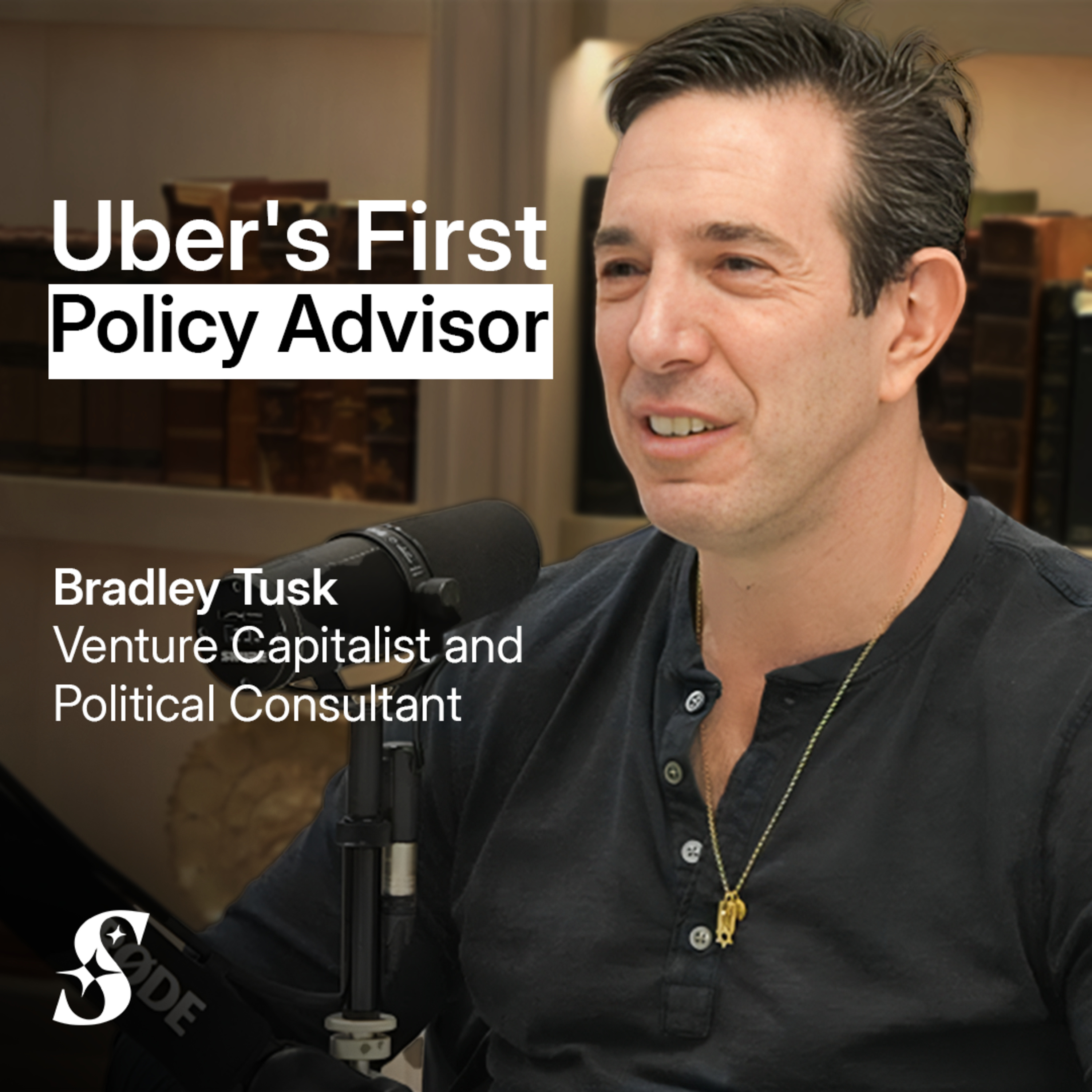
What Travis Kalanick Taught Bradley Tusk, & Why He Closed His VC Fund
About this episode
Bradley Tusk joins Sourcery to discuss what he learned working closely with Travis Kalanick during Uber’s early regulatory battles, and how those experiences shaped his decision to shut down his venture fund and return to an equity-for-services model.
Bradley explains why Travis was unusually fast, analytical, and willing to challenge institutions, and how that mindset influenced the way Uber approached politics and growth. He also breaks down how the current AI wave is affecting valuations, capital formation, data-center spending, and the broader regulatory environment.
The conversation covers the real economics of running a VC fund, why mid-sized funds struggle, how AI is reshaping startup incentives, and what founders should understand about regulation, policy, and long-term strategy. It’s a practical, grounded discussion from someone who has worked at the intersection of tech and government for over a decade.
Bradley Tusk: https://www.linkedin.com/in/btusk/
Molly O’Shea: https://x.com/MollySOShea
Sourcery: https://x.com/sourceryvc
𝐒𝐏𝐎𝐍𝐒𝐎𝐑𝐒
• Brex—The modern finance platform, combining the world’s smartest corporate card with integrated expense management, banking, bill pay, & travel. https://brex.com/sourcery
• Turing—Turing delivers top-tier talent, data, and tools to help AI labs improve model performance—and enables enterprises to turn those models into powerful, production-ready systems. https://turing.com/sourcery
• Carta—Carta connects founders, investors, and limited partners through software purpose-built for private capital. Trusted by 65,000+ companies in 160+ countries, Carta’s platform of software & services lays the groundwork so you can build, invest, and scale with confidence. https://carta.com/sourcery/?utm_medium=newsletter&utm_source=sourcery&utm_campaign=20250923-amer-carta_sourcery_data_insights
Follow Sourcery for the latest updates!
𝐓𝐈𝐌𝐄𝐒𝐓𝐀𝐌𝐏𝐒
(00:00) Intro
(01:25) How AI infrastructure spending is being driven by market narratives
(03:10) DeepSeek, inference models, and compute efficiency
(03:55) Where the $2T in AI data-center and energy capital is flowing
(07:10) Nuclear energy and the broader implications of AI’s power demand
(16:30) Zero-sum vs abundance thinking in tech and politics
(17:35) How people find meaning, purpose, and balance in high-pressure work
(27:00) Why Bradley invests heavily in his team and removes non-essential tasks
(32:00) How Bradley’s experience with Travis Kalanick shaped his view of founders
(32:35) “Travis’s Law” and turning users into political advocates
(37:05) Why Bradley decided to stop raising traditional VC funds
(44:30) The economics of mid-sized funds and why they’re so difficult to run
(49:20) How AI valuations differ from non-AI valuations
(54:40) What people misunderstand about Silicon Valley and DC
(59:40) AI, unemployment risk, and why Bradley believes UBI will be necessary
(01:05:50) The biggest lessons Bradley learned from Travis Kalanick
Get every episode summarized
Each time Sourcery publishes, we email you a written briefing from the transcript — the topics, who appeared, and any specific claims, with the ad reads skipped.
Email me new episodesFree for 3 shows. No card needed.
Hosts & guests

No transcript yet
This episode has not been transcribed. Request it and it moves to the front of the queue.
More episodes
More from Sourcery

Skydio HQ Tour: Skydio Commits $3.5 Billion to Expand U.S. Manufacturing
Sourcery
Skydio Raises $110M Series F at $4.4B Valuation | CEO Adam Bry
Sourcery

General Catalyst's First-Ever Quarterly Review | CEO Hemant Taneja
Sourcery

Financial Advisors Are Cooked – Public Co-CEO on the Great Wealth Transfer
Sourcery