Get every episode summarized
Each time The Story publishes, we email you a written briefing from the transcript — the topics, who appeared, and any specific claims, with the ad reads skipped.
Email me new episodesFree for 3 shows. No card needed.
About this episode
The Story is made possible by:
“Harvard Business School Executive Education delivers a world-class learning experience that energizes aspiring and established change makers. Prepare for the next elevation for your organization and for yourself.”From the transcript
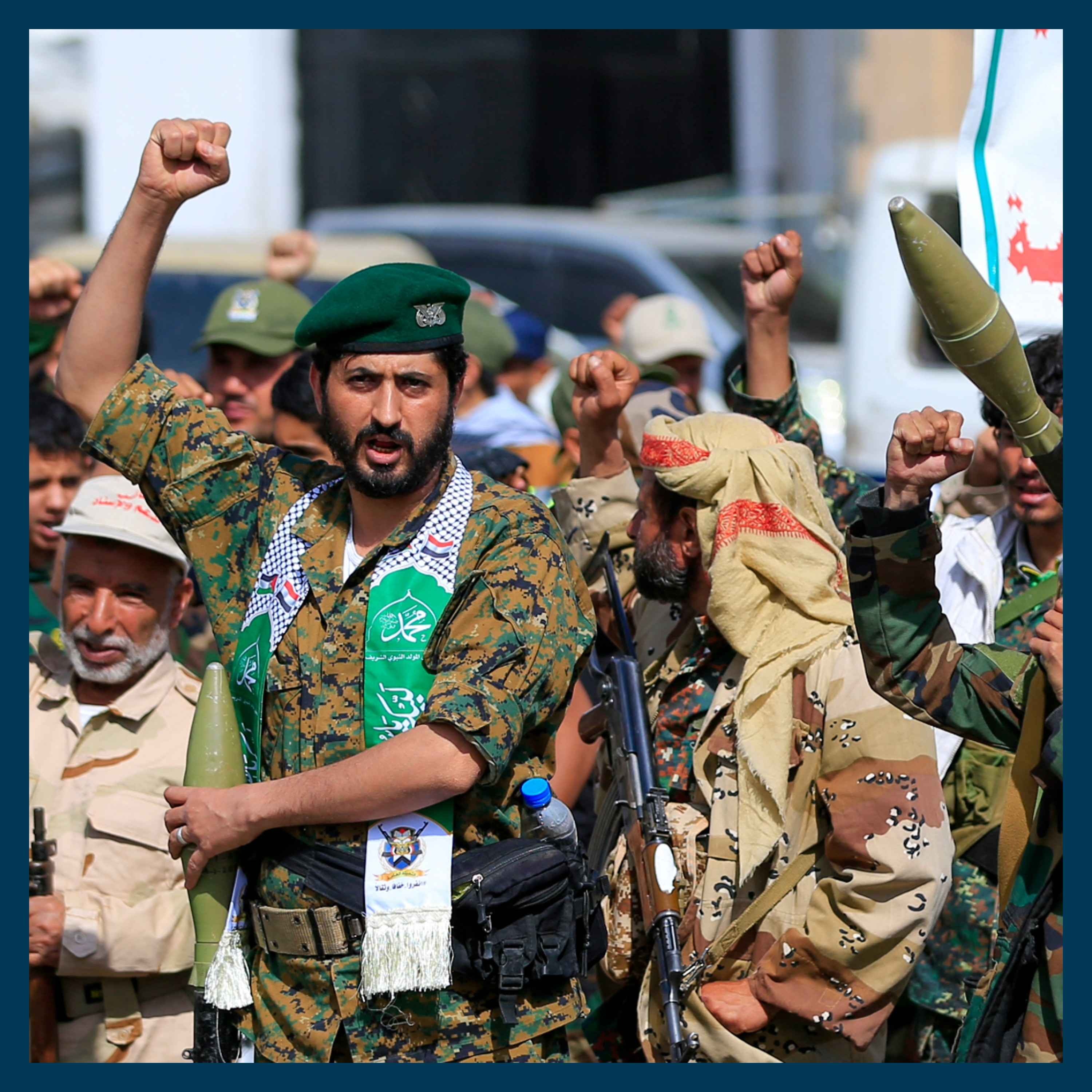
The Iranian-backed Houthis have seized large swathes of territory in Yemen and taken control of the Bab al-Mandeb strait, a key shipping corridor between Asia and Europe. About 12 percent of global trade passes through the strait, including huge amounts of oil, so the move has sent energy prices skyrocketing. But, who are the Houthis? What’s their aim? And with regional powers wary of getting dragged into yet another war, who can stop them?
This podcast was brought to you thanks to the support of readers of The Times and The Sunday Times. Subscribe today: http://thetimes.com/thestory
Guest: Dr. Elisabeth Kendall, president of Girton College, Cambridge, specialising in Arabic and Islamic studies.
Host: Manveen Rana.
Producers: Olivia Case, Robyn Simon.
We want to hear from you - email: [email protected]
Read more: Houthis seized strait ‘without a fight’. Now they’re bracing for one
Further listening: Inside the West Bank crisis driving Britain to act
Clips: PBS, CBS, BBC, France 24, Fox News, ABC, CNN.
Photo: Mohammed Huwais for Getty Images.
This podcast was brought to you thanks to subscribers of The Times and The Sunday Times. To enjoy unlimited digital access to all our journalism subscribe here.
Hosted on Acast. See acast.com/privacy for more information.
Get every episode summarized
Each time The Story publishes, we email you a written briefing from the transcript — the topics, who appeared, and any specific claims, with the ad reads skipped.
Email me new episodesFree for 3 shows. No card needed.
Hosts & guests
Transcript ready
309 searchable segments. Every word is indexed and playable.
Full transcript
The Story — What the lightning Houthi advance means for the world. Machine-transcribed; use the interactive transcript above to jump the player to any line.
Harvard Business School Executive Education delivers a world-class learning experience that energizes aspiring and established change makers. Prepare for the next elevation for your organization and for yourself. Learn more at hbs.me-slashbreakthrough. That's hbs.me-slash-breakthrough. This episode is sponsored by ZockDock. Have you been putting off a doctor's appointment or needed Dennis and don't know where to start? I've definitely been there and that's why we use ZockDock. Actually, over the holidays, Michael had a dental emergency. In seemingly every office was closed. But we hopped on to ZockDock, found an in-network dentist, had great reviews. So real-time appointments available, which was key. It was on New Year's Day and booked in appointment and just minutes. It took so much of the stress out of the already stressful situation. ZockDock makes it easy to search and compare over 250,000 local in-network providers
across more than 200 specialties. So you can find the right doctor or dentist and book instantly. Ready to be seen? Download the ZockDock app today and book that appointment on your to-do list. That's ZOC, DOC, ZockDock. From the times and the Sunday times, this is the story. I'm Manvin Rana. Global markets are taking a battering. Interest rates around the world look set to increase and everyone will in one way or another be feeling the impact. As oil prices have surged over the past week. Tonight, Americans are feeling the squeeze from skyrocketing fuel prices. Gas up 16 cents from a week ago to nationwide average of 431 a gallon. Diesel fuel also at an all-time high, impacting the cost of everything delivered.
Those concerns about the price of oil followed President Trump here to Ireland, where people are also paying more to fill their cars and heat their homes. In just one week, oil prices have shot up and a fueling global inflation. But is that all because of what some have described as a rag-tag army of rebel fighters? We are now getting a clearer picture of the fighting that led to the hooties lightning advances. With fists raised in the air and shouting, God is great. These hootie rebels are celebrating amid reports the group has taken control of the Red Sea City of Mocha. Oil prices have been under pressure ever since the war with Iran broke out in February, effectively closing the strait of hallmews. But now, a lightning charge by Yemen's hootie forces threatens the other main route for oil
to move out of the Middle East. In a matter of days, they've put themselves in a position to control the Bob Al-Mandab straight by plowing through Yemeni forces. It was already one of the world's most important maritime chokepoints. More so since Iran has maintained its chokehold on the strait of hallmews. Two chokepoints, choking not just trade in oil flows, but the chance at a swift resolution to this wider war. So who are the hooties? How have they advanced so quickly? And what does it mean for the future of global oil prices? The story today, how the hooties are holding up the world.
I've been in the Middle East for the past three or four days, so this is now my journey home which has been a bit disrupted hence I'm able to speak to you from an airport. Dr Elizabeth Kendall is an Arabist, Middle East expert and President of Gerton College Cambridge, and she's the person we always want to speak to about the hooties and Yemen. My own experience in Yemen is that I was in and out of Yemen very, very frequently for about a decade prior to taking up my position at Gerton College Cambridge in 2022. Obviously it's really kicked off in the last week or so. The most of the world has seen that reflected in oil prices shooting up, but just talk us through what's been happening on the ground. What's caused that huge spike? What's been happening on the ground is not actually something that's been happening only over the last few days. It's just that we've noticed it over the last few days because it has been exacerbated.
The hooties however, since earlier this year have been escalating inside Yemen. There's an ongoing civil war that's seen different groups at each other's throats for around about 11 years now, and although that dampened down in 2022 with a truce, it never actually technically stopped. And so those fronts have been re-opening again since around about February. And just in the last few days we've seen the hooties, this religious tribal political grouping from the north, often known as rebels, a sweep down and take some major areas of the Red Sea coast. Now, why is that important? That's incredibly important because that means they essentially are in a position to control the entrance to the Red Sea and hence cut off important trading routes. At the same time, there's a similar threat is happening across the other side of
the Arabian Peninsula in the Strait of Horomers. So it's a double whammy and that has for sure spiked the oil price. Elizabeth's just rolling out the map just so that people can envisage exactly what's happening. You've got Saudi Arabia in the middle, lots of oil. The whole world is trying to get hold of. They're trying to get it out of there on the one side of the country. You've got the Strait of Horomers, which obviously as we all know has been closed by the war in Iran and very little is trickling out of it. We haven't seen oil prices plung as much as they might have done up until now because it's been coming out of the other side. And that's where this is now. The hooties are now kicking off. Just describe that area, the Babel Mandub and what's been happening there in the last few days. In the last few days, the hooties have moved south down the Red Sea coast towards the Beerbel Mandub and that's that tiny opening, that narrow waterway, even narrower than the Strait of Horomers, that is the mouth from the Gulf of Aden and the Indian Ocean up into the Red Sea.
And the hooties haven't just taken coastal cities within Yemen, they've also taken a couple of really key strategic islands. And from one of those islands in particular, they can in effect attack shipping, navigating up into the Red Sea using only artillery. So they're suddenly in a very strong position, although there's a big question mark of how long they'll be able to hang on to that territory. So what you describe as the threat to the Strait of Horomers being somewhat mitigated by oil exports, at least from Saudi Arabia being able to get out on the other side of the Arabian Peninsula, the Red Sea side through a port called Yanbu, this is a really important point because that has really saved Saudi Arabia and to some extent the oil market by ensuring that millions of barrels still get out. Now the issue here is that
those barrels of oil, when they're collected in VLCCs, that's very large crude carriers, those massive tankers are way too big to go up through the Suez Canal, they can only get in and out through the Beirbel Mandub. So if the Houthis control the Beirbel Mandub then that is a real stranglehold on oil export. That's so interesting and so helpful for visualizing it too, as you say, it's even narrower than the Strait of Horomers, this tiny choke point that controls oil supplies to the world right now. At the same time, the Saudis have been under attack elsewhere too, we know that they have a crucial pipeline that has been helping them get world out and that's also being attacked. Tell us a bit about that. Yes, so the pipeline that is the life saver, really for the Saudi oil export industry, has now come under attack directly. Saudi Arabia forced to shut down a critical pipeline following multiple attacks.
satellite data from Saudi Arabia shows black smoke rising near the east west pipeline, regards only route to move oil away from the Strait of Horomers. That's together with all sorts of other energy infrastructure inside Saudi Arabia. Dozens of people are wounded in Saudi Arabia after wave of attacks from Iran-backed Houthi rabble. Houthi drones and missiles struck several military camps in the central province of Murray. Satellite images show smoke rising from Saudi oil facilities in the south-west of the country. And the Saudis are facing two fronts here. The weaponry, the missiles, the drones are coming both from the Houthis in Yemen and from Shii militias inside Iraq. And what's interesting here is that we know that the Houthis have been working closely with these militias in Iraq. And the strategy
seems to be coordinated. So it's a bit of a pince movement against Saudi Arabia. And this is incredibly important for Saudi Arabia because not only is the revenue from the oil, therefore impacted, but think about its vision 2030. Much of that relies on using the money from oil in order to open up other areas of the economy and to diversify, including areas like tourism and the Red Sea. Well, it's taken a hammer to that because we're not going to see tourism in the Red Sea as long as missiles are being locked overhead by the Houthis in Yemen. So it's a massive headache for Saudi Arabia. Dr. Kendall, for people who've sort of followed Yemen since 2014, they'll know that the Houthis have been effectively at war with Saudis for a very long time. Just remind us a bit about the history. I mean, who are the Houthis and why has this been
a war that has raged for more than a decade now? Yes. So the Houthis are a group that are named after a family, the Houthi family, from the area of Houth in Yemen, in the north of Yemen, in Yemen's Highlands. They're at the same time a political grouping, a military grouping, a religious grouping. And they were formed in the late 1980s. Really, they coalesced around the figure of someone called Hussein al-Houthi. And he actually died 22 years ago in 2004, but their current leader is his younger half brother, Abdul Malik al-Houthi. So they're keeping it in the family. A religion is part of their identity politics. They're a branch of shism. They've become ever closer to Iran as the war has gone on. And we've seen the Houthis emerge from this hardened fighting group that first went to war in 2004 inside Yemen. Over the course of 10 years,
they have been six wars between the Houthis and the government led by the House of President Ali Abdul-Lasalah. The Houthis were asking for more autonomy and they blamed the government for the underdevelopment of their region. So their narratives claim that they're fighting for the Muslim underdog. They're the great defenders of Muslims against the Zionist crusader imperialist plot against Islam. What they're actually fighting for is more likely to be about power, money, and recognition. All of which is ultimately linked to territorial control. They would like access to seaports. They have Houdeda, but they would like other seaports, particularly close to the Beirut-Lamandab, which will forever give them that ability to hold the world to ransom. And they want energy-rich areas of Yemen that would help the Houthis be able to generate and income for themselves. All of that would then help to give them enough power to be recognized, they hope,
as the legitimate political authorities in Yemen. They're now at the stage where they're not just some, I think, some American politicians have in the past described them a Raktag group of rebels. They are a group that is hardened by war. They're very experienced, they're disciplined, they control territory now inside Yemen, in which about two-thirds of Yemen's population lives. Now that must be around 28 million people. So they're a real force to be reckoned with. They've kept the United Arab Emirates and Saudi Arabia at bay during the Civil War since 2014 to 2022. They feel like they've won the Civil War. And subsequently, they've managed to weather air strikes by not just those previous ones by Saudi Arabia and the UAE, but also by Israel, by the United Kingdom, by the United States. And they still stand to fight another day. So
they are a really serious adversary. You mentioned their links with Iran. Some people describe them as an Iranian proxy. How close are they? Do they do the Iran's bidding? Are they aided by Iran? What does that relationship like? It looks like their proxy doesn't it? It's a bit like Hezbollah and Lebanon or Hamas in Palestine, Gaza. But in fact, it's more the case that they're aligned with Iran, rather than under the direct command and control of Iran. They frame their actions as retaliation against the decline that Yemen has suffered at the hands of Saudi Arabia according to them. They don't want to look like they're doing what they're doing because they're defending Iran. And yet they would not be able to do what they're doing without the backing of Iran,
who has been supplying them, not only with weapons, but also with training, with advisors. But I think the important point to make here is that the who these are acting for their own reasons, they have internal domestic reasons for wanting to extend their power, territory, resorters and hence perhaps gain political legitimacy. But their own reasons also coincide currently with those of Iran. And I think it would be foolish to avoid the obvious link that the who these have come out now, because now is the time when it suited Iran to play them as an ace card. It's certainly a hell of a bargaining chip in any negotiations the Iranians are having now. Why was it so easy to play that card? How have they managed to be so successful in sweeping down the coast in the way that they have? It does feel like they haven't really been stopped.
Yes, I know that a lot of people have been surprised by that. But I think about it like this, the the who sees are a hardened military force. On the other side, the Saudi-backed government forces in Yemen are really much more of an anti-Hussi grouping. They're not so much a unified grouping. The government side is made up of all sorts of different bits. I refer to them in the past as well as military spaghetti. You have southern separatists, the giants brigades, the national resistance forces, you've got religious groups, salafi groups, you've got tribal militias, warlord aligned groups, and you've got the regular army. All of these are supposed to somehow gel together against this enemy that has been fighting as a force for the last two decades. That's quite an ask. Then on the other side, you think about the who sees they have great psychological
warfare as well. They've been using AI to help them not only in their targeting, the programming of weapons, but also in their messaging to undermine and cast doubt in the government forces. And they've got a sophisticated cultural and media apparatus. And they're feeling confident. They saw what happened to the United States in Iraq, in Afghanistan. And they're feeling good. They're riding high and for them war is a way of life. So it didn't surprise me that having made a concerted effort, especially around the port of Mokha on the Red Sea, that they were able to be successful. Question is, how long can they hold it? Coming up, what impact will this have on the world's energy markets? And what or who could make the who sees stop? That's in just a moment.
If you're looking for something predictable and low friction over the long term, public markets may be a suitable option. But the moment you want different investment characteristics, it may be time to consider the private markets. See how your wealth can work smarter at creativeplaning.com slash access. Harvard Business School Executive Education delivers a world-class learning experience that energizes aspiring and established change makers. Prepare for the next elevation for your organization and for yourself. Learn more at hbs.me slash breakthrough. That's hbs.me slash breakthrough. AI is transforming sales, support, and every customer interaction in between. But too often, you're sold a different AI agent for every job. That changes with Finn. Finn is a single customer agent that works across the entire customer journey. From qualifying sales leads to resolving
support issues, Finn works across teams, carrying context from one conversation to the next. Meet the agent making perfect customer experiences possible at fin.ai Dr Ken, you've been describing how the Houthis actions over the last few weeks in particular where they've had this staggering success, how they will strengthen Iran, and of course America really a real headache in any negotiations over what happens to the straight-up foremoo. I mean, just describe the impact this will have on America and global energy markets. I think the impact on America is going to be felt in consumers' pockets. And we have seen gasoline go over four dollars. And we've also seen the price of diesel go through the roof.
So I think it's going to be a thorn in the side of President Trump as he goes into the midterm elections. And this is probably partly why he's now claiming that, hey, all of this will be over as soon as the midterms are over. Clearly he recognizes that this is not a good scenario. And equally, I think that's probably one reason why he has decided to ignore the pleas of Saudi Arabia to get stuck into this conflict and help Saudi in bombing the Houthis because he doesn't want to open up a second war in the Middle East when the first one that he's done with Iran is already so unpopular. So there's that. And there's also the fact that the Americans tried this before they bombed the Houthis for seven weeks in Operation Rough Rider last year between March and May 2025. The attacks happened on Saturday. Then the following day, US fighter jet shot down around a dozen drones. The US is warned more attacks will continue if the Houthis do not stop threatening to target
shipping lanes in the Red Sea. And after seven weeks, a great deal of money and treasure lost that war ended in a deal. Houthis have announced that they don't want to fight anymore. And we will honor that. We will stop the bombings effective immediately in Morocco. Do you have something to say about that? Yeah, this was always a freedom of navigation mission. These guys, these are, you know, a band of individuals with advanced weaponry that were threatening global shipping. And the job was to get that to stop. So it's, I think it's an important development. But it took only around eight weeks before the Houthis sank two more ships. So it wasn't a success and that was probably a warning not to get stuck in for a second time. What does it mean for the Saudis who obviously now have war raging east of off their coast with Iran in the middle of a huge conflict? The Americans aren't coming to help. The West Coast is now kicking off with the Houthis. They have any help coming? What does this mean for them? Well, I think the Saudis are
being assisted by the United States and other allies now in the form of intelligence. But it's not looking easy. And of course, they also have long experience of being embroiled in Yemen and it hasn't worked out well for them either. So I think it's also easy to see why the Saudis have now tried to diversify the security alliances by signing the mecca pact with Turkey and with Pakistan to help shore up the defence. And to help them against the Houthis. So it's probably quite disappointing for Saudi Arabia that, well, Pakistan, for example, has come out and said a bit like an insurance, a health insurance broker might say, well, this doesn't apply to pre-existing conditions and so I'm afraid you're on your own with the Houthis. That's so interesting because as you say when that mecca pact was done and people described it as the Middle Eastern NATO, there was a sense that perhaps they'd all fight together in the future,
but that doesn't seem to be holding. No, I think there was perhaps an impetus here that hoped that flexing some muscles and showing solidarity might dissuade the Houthis and the Iran backers from going for broke on the Red Sea, but it wasn't enough. You described how well the Houthis have done over the last couple of weeks, but that there might be a bit of a fight back now and we don't know how long they'll be able to hold those positions. What happens if they keep going? How does this play out? Well, look, there is a fight back now. I think that the government forces have had a shock and now they're going to try hard to get that act together. Saudi Arabia had already made strong efforts towards unifying all these disparate groups that are on the government side. So I think now that the situation has become
clear that we'll probably see more facilitation up and down the Saudi-backed command structures, better coordinated air support from Saudi Arabia, perhaps better intelligence and targeting support from the United States. And I would be surprised if the Houthis are able to hang on to all of the areas that they've seized along the Red Sea. It's just too important internationally for the international community to allow that to happen. But what might happen next? We might then see the Houthis turn their guns instead more towards Saudi Arabia internally and to harass Saudi infrastructure, Saudi oil infrastructure, airport infrastructure, in order to put pressure on Saudi Arabia. Why? Because it puts the Houthis themselves in a stronger bargaining position for any kind of peace deal within Yemen. And it perhaps might even glean some kind of payoffs in the
meantime from Saudi Arabia and the Houthis need money. They need money to pay salaries, they need money for reconstruction. Ultimately though, I think it's a pretty bleak outlook because war is the way that the Houthis do government. All of that has a pretty catastrophic effect on global energy markets. We're all feeling the pinch already with the world prices hiked up. What do you think from having watched the way they operate and you know you are probably one of the most expert people on the Houthis and in the West? What would it take to do a deal? I'm not sure what it would take to get the Houthis themselves to back down other than giving them some of what they want and you can't do that because then it shows that violence pays. Here's the dilemma. The dilemma is that the Houthis are part of the very fabric that is Yemeni society. That is Yemen and they control such a lot of territory and such a lot of the
population inside Yemen that they have to be part of a solution. But the Houthi leadership also holds supremacist beliefs. They believe that they are the legitimate rulers are just a Yemen but of the Islamic world. That's not a great recipe for a democratic Yemen or a power sharing government. So I think what you need to do really is first of all you need to sideline the Houthi hardliners and promote moderates within the Houthi camp. This is going to take a lot of time. You have to work on building institutions instead of paying off strongmen. You have to move away from patronage politics whereby you're just paying people for their support and that support becomes very fluid. The next man can just come along and pay more. You have to reign in Houthi propaganda. This is one of the biggest things. We're always focusing on Houthi missiles, on drones,
on military capability but in fact their battle for hearts and minds via their cultural apparatus, their media apparatus and their indoctrination educational apparatus is massive. So we need to reign that in. And then finally you need to align regional actors, states like Saudi Arabia and the UAE so that they're all pointing in the same direction in order to solve this problem once and for all. And you're just on your way back now from the Middle East. You know having seen it up close as well as followed the often mad actions they've lost for you months. I mean what's what's your outlook? I think this is a Pandora's box that has been opened and opened even a wider and in an even more difficult way to shut by the February attempt at regime change in Iran. That all of the different blocks and cards that had been predicted to potentially occur in such a
scenario have now come to pass and the world is in a situation where it is being held to ransom over these two waterways. And I would add to that in a worst case scenario we could put the Suez Canal in there too because we know that Hussi missiles can reach up to towards ports like Damiatah in Egypt. So it could still get worse. I don't see any very easy way of helping it to get better. That was Dr Elizabeth Kendall, president of Gerton College Cambridge and Middle East expert. The producers today were Olivia Case and Robin Simon. The executive producer was Sophie Malti. Sound design was by Dave Creasy and theme composition was by Mala Setto. If you can do leave us a
review where if you get your podcasts and if you'd like to get in touch with us about this or any other story or if you'd like to send us your questions drop us a line to thestoryatthetimes.com. Thanks for listening. We'll be back tomorrow. If you're looking for something predictable and low friction over the long term public markets may be a suitable option but the moment you want different investment characteristics it may be time to consider the private markets. See how your wealth can work smarter at creative planning.com slash access. You've probably been putting off your will or trust for years. Not because you don't care because hourly rates and a visit to an attorney's office haven't made it any easier. Legal zoom changed that. Start your will or trust online today with an
independent attorney available to help if you want one without the hourly rates. When you need a legal hand visit legal zoom. Legal zoom provides access to independent attorneys and self-service tools. Legal zoom is not a law firm and does not provide legal advice.
More episodes
More from The Story

Why is Ironman so popular? - The Sunday Story
The Story

Inside the Macklemore - Ed Sheeran tour fallout - The Saturday Story
The Story

Has space become the final frontier for war?
The Story

Has Trump paved the way to a united Ireland?
The Story