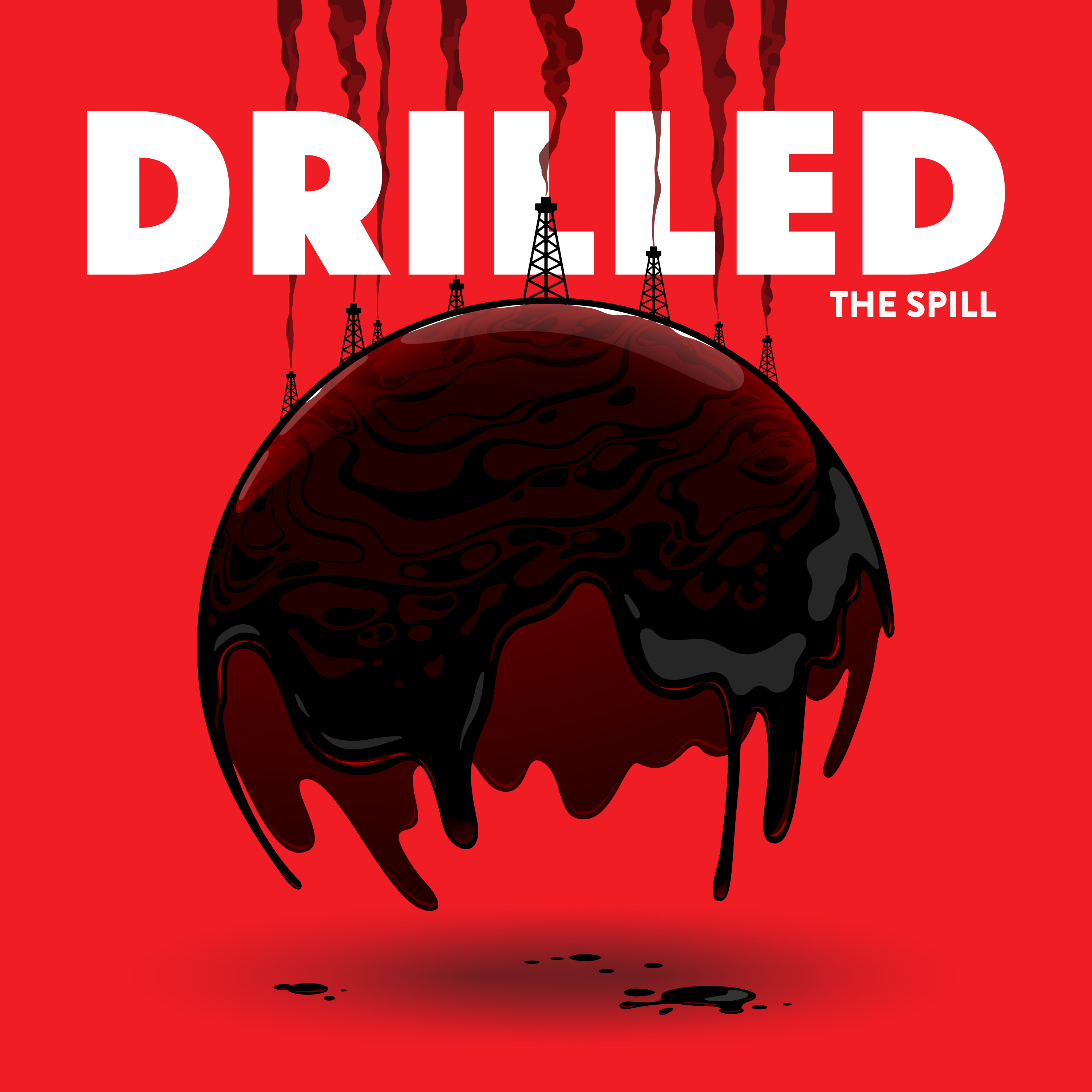
About this episode
Amy Westervelt, Nina Lakhani and Alleen Brown on the world on fire, how the media is covering the climate crisis, what's happening with the industry as a whole, and how it all relates to rising authoritarianism. The Spill is our new weekly show to bring you news, rants, and interviews in between narrative seasons.
Reading list from today's show:
- Amy's book: geni.us/broughttoyouby
- The Guardian on fossil fuel companies' war profiteering: https://www.theguardian.com/business/ng-interactive/2026/aug/04/revealed-major-oil-firms-make-93bn-profits-amid-war-and-climate-crisis
- Nina's past reporting on extreme heat deaths: https://www.theguardian.com/environment/ng-interactive/2025/oct/09/extreme-heat-deaths-autopsy
- Drilled coverage of criminal conduct in Venezuela: https://drilled.media/news/hopenhaym
- Drilled reporting on the U.S.-Venezuela-Guyana triangle: https://drilled.media/news/guyana-venezuela
- Alleen's new series "The Propagandist": https://drilled.media/podcasts/drilled/16/s16-ep01
See omnystudio.com/listener for privacy information.
Get every episode summarized
Each time Drilled publishes, we email you a written briefing from the transcript — the topics, who appeared, and any specific claims, with the ad reads skipped.
Email me new episodesFree for 3 shows. No card needed.
Hosts & guests
Transcript ready
367 searchable segments. Every word is indexed and playable.
Full transcript
Drilled — Welcome to "The Spill," Our New Weekly Newscast. Machine-transcribed; use the interactive transcript above to jump the player to any line.
This is an I Heart Podcast. Guaranteed Human. I want to tell you about the farmer's land trust. The farmer's land trust works nationally to transact farmland into community ownership through the farmland commons, which are local landholding nonprofits that give 99-year secure, affordable and equitable lease tenure to the next generation of farmers using regenerative agriculture to grow food, fiber, flowers, and other agriculture products for their communities. Find them at thefarmerslandtrust.org where you can sign up for their newsletter and learn more about the farmland commons model. Connect with the Farmers Land Trust on Facebook, Instagram, LinkedIn, YouTube, and your other favorite social media platforms. Pushkin.
Hello, welcome to Drill, I'm Amy Westerville. And this is a new segment we're doing, hopefully every week in between narrative seasons called The Spill. Aline and Nina introduce yourselves. Hi, I'm Nina Lacane. I am the Global Climate Justice Report of the Drill and now the Spill. And I'm Aline Brown. I'm a senior editor at Drill and really excited to be talking to this bill today. Yay! Awesome. So yeah, we'll be talking amongst ourselves about current news, things that are happening in media and then also using this as a place to interview other reporters, writers, experts, all the stuff that has been a bit of a hodgepodge that bonus episodes have drilled. Now organized into weekly episodes in your feed. Okay, so let's talk about some of the current climate news. There's been a lot of stuff happening, not necessarily a lot of news covering it. What are the things that you guys are paying attention to on the climate beat right now?
What's happening all around us at the moment? I mean, I think we're this year, like every year for the last few years, has shown us that we are now full force in climate breakdown. This isn't something that's going to happen. It's happening now and it's happening at a really terrifying speed at a scale, even the worst case scenario models were not forecasting to be happening so quickly. So this catastrophic breaking of the glacier and the Himalayas, which caused this unbelievable, I mean, terrifying floods at the Nepal Tibet border, confirmed so far 1200 dead with thousands more still missing. And I think this piece of this gassia broke off and the force at which it landed recorded at more than five on the Richter scale on the earthquake. This area of the Himalayas is really poorly studied partly because it's hard to reach, but partly because the whole world hasn't taken responsibility of monitoring what's happening at all of these glaciers.
But when I've been reading some of the coverage this last week or so, 75% of the glaciers in the Himalay region could all be gone by the end of this century. And we're already seeing far more glacier lakes, the lakes are bigger, they're deeper. And all of this means much more catastrophic flooding, sea level rise, all the things that we're seeing in communities around the world. For Mexico, to India and Bangladesh, to Australia, and so I think just the images of what's happened at the Nepal Tibet border have been like, like, hoaxing, you know, and yeah, tell me fine. And you know, and like at the same time, you know, we're seeing record breaking profits from the fossil companies, and I think that we absolutely can't forget that, you know, that there is a clear line of responsibility here, right? They're sort of raking in billions of dollars, right? Well, we've got these catastrophic flirts. They're negotiating like how to drill more in the Arctic while we have these catastrophic floods.
Well, yeah. And, you know, the war in Iran is directly contributing to those profits. You know, we're seeing the affordability of gas and daily essentials skyrocket while the oil and gas industry is seeing, again, record profits directly tied to the same war that is changing everyday people's ability to live. Yeah. Yeah. And the Guardian, my former employer, did a really good analysis recently, and in the first three months after the illegal sort of invasion of Iran, eight of the biggest oil companies amassed profits of more than 90 billion dollars. In three months, in three months, right? As so as, you know, fuel prices rose spectacularly for like everybody more than 90 billion in just the first three months after the, you know, the Ouranyvajor. Right. And that was double what they had brought in the year before, you know, so you can see that direct relationship and the way that profits are just going up.
Yeah. And, you know, this isn't something new, but I think it's something that's just getting so much less focus in the media and, you know, in conversations more broadly. But, you know, these catastrophes that we're talking about, we're talking about some of the largest scale ones like in Nepal, but like no matter where you live, you're being impacted directly by the actions of the fossil fuel industry. You know, there's the question of affordability, but also, you know, I was visiting family in Minneapolis this summer. And right as I was there, the boundary waters, this wilderness area in northern Minnesota was on fire. You know, there's really catastrophic fires taking place. That's an area that's like beloved by so many people in the region, people go canoe there. And it's like a water area. It's a, it's a bunch of like interconnected waterways. And, and that was in flames because of a combination of, you know, past extractivism, loggers going in and totally changing the ecosystem there.
And kind of displacing indigenous people who had their own fire based practices and ways of managing the land. And also, you know, the burning of fossil fuels. So, yeah. One of our producers, Ray Paine, who did the Slack season goes and does a canoe trip on the boundary waters every year and couldn't go this year because of the fires. I was like, I feel like everyone I've spoken to this past few months has had like some kind of personal life impact related to climate. But like, I don't know. I feel like there's been this, you guys both cover climate for a long time as a guy. I feel like there's been this assumption for a really long time that as that happens, that magically the political will to do something about it will appear. And in fact, we're seeing a total disconnect on that front. It's like it's never been more present. And the fossil fuel industry and the politicians in its pocket have never been working harder to stop anyone from acting on it. It's a weird moment.
And the personal life I was at home, you know, for all of July and August, you know, London, England, famously, drizzly grey skies. It was really not hot. Very steamy this summer. Yeah. I mean, yeah, UK had five heat waves this year, like over 35 degrees Celsius. I'm sorry. I don't know what that is in front of. It's like around 95 to 100. It's 95, 99. I think it got to get five heat waves. And for the whole of July and the first three weeks of August, it did not rain once in across Wales and in most of England. I mean, so when the solo clips have London, I was went to a parking or London to watch it with my niece. And it was 35 degrees at six p.m. But all the leaves of the park have fallen. They're all yellow. All of the leaves are down into the undy aff어. It felt like autumn, right? Because the crackling of the leaves and the grass is all just like completely dead. Yeah. And yeah, it was like in the middle of the summer, it was like, it's really quite dystopian.
And on your point, Amy, I think that I think that climate catastrophe, the breakdown is now happening so fast and everywhere that people have very quickly. It's become normalized. You know, it should be, you know, normal. So you know, yes, you have, you know, you have decent media coverage when this catastrophic floods happen, like it's glacier breaks off in the Himalayas. But every day these things are happening. People are dying from wildfires, from drought, you know, and it's just become normalized really, really quickly. I think actually like heat, this isn't really good one because I think with floods and fires is very visual. Right, you have the cameras there and like you can really see it. But, you know, drought and heat and the food insecurity that causes and the desert causes are, they sort of just happen like the hard to photograph the hard to visualize. You know, but we know in Europe, the shea, in just, you know, Europe counts excess deaths. So they look at, say, over the last 20 years, how many people have died in a particular week by on average?
And then when there's a heat wave, they look at how many people have died and they calculate them to be excess deaths related to the heat. So these aren't deaths, you know, a tiny number will be things from like heat stroke, for example, but the vast majority will be from, you know, an exacerbation of existing conditions, whether that be a heart condition or asthma or diabetes, right. And in Europe this year, just in May, June and July in half of Europe. So this is not even counting like the other half, 35,000 excess deaths were reported from just in June and July. Like the May, June and July. So that and August was even hot out. Wow. But the thing is this is, this has happened like two or three times over the last five or six years. You know, and like the first time was meant to be the game changer, right. This is going to wake up everyone is going to be political action. We are again, you know, and it's sort of, yeah, and it's just like we're accepting the fact that tens of thousands of people are dying before they needed to have died. Like because every heat death is a preventable death.
Yeah. Nobody needs to die of heat. You know, public health experts will tell you that every single one is preventable. And yeah, but we seem to have just accepted that as, okay, well, that's what's going to happen now. Yeah. Yeah. I think that's a good segue into talking about one of the, we wanted to talk a bit about how media is covering this moment. And NPR put out a big piece recently looking at the way heat deaths are undercounted in the US. So the CDC has tracked, I think, an average of around 1700 heat deaths annually. NPR partnering with Boston University looked more closely at excess deaths and found up to 9,000 deaths annually in the US that could be attributed to heat. So need it to your point. Yeah, this is just being vastly undercounted. I know you've done a ton of reporting on this, this issue specifically. Yeah, you know, when I was working for the Guardian in the US, I spent three or four consecutive summers in Arizona,
specifically reporting on extreme heat in Mary Copa County, where Phoenix, which is the US is fifth largest city and it's hottest big city as well as some of the surrounding, yeah, some of the surrounding counties, you know, and actually, Mary Copa County is by far the, you know, it's the gold standard when it comes to the US. And because in the US, they don't count excess deaths, right? And they never have. And so you've had these like unbelievably sort of under under reporting of excess deaths, you know, for the years I was working there, sometimes the deaths that were counted in Mary Copa County would be half of what the CDC was reporting was happening across the country, which obviously isn't true, right? It's just that they're counting it. Yeah. Yeah, they're counting it. But they can't the minute. And I think they don't do the excess deaths in part because of the way the health system is so disjointed, right? You know, like, you know, there is no public health system. So having access to that data and data being collected in the same way is much more difficult.
But I honestly also think there's just been a lack of will, right? And there's a lot of clever scientists and public health officials in the US, right? I mean, it's possible, right? It's definitely possible. Yeah. And even in Mary Copa County, which I, like I say, you know, it's a gold standard. They have trained their forensic team, you know, to look for signs of possible heat contribution to a deaf. And they do all toxic and they do investigations. Did he extent that in possible heat deaths, investigators will go to a person's house and see. And they know on the autopsy formula, did the person have a cooling system air conditioner? Yes or no. Was it turned on? Yes or no? They will ask why not, you know, like, was it, what's it working or was it not working? Because one of the things I found is even when people had air conditioners, sometimes they wouldn't have the money to run them or they didn't have the money to fix them if they were broken, right? But even in Mary Copa County, I mean, last year, I did an investigation looking at hundreds and hundreds of all toxic reports from the previous two years. And, you know, there were a whole number of deaths that were investigated as potential heat deaths, but then were not included.
They were then included. I was a deaf by substance misuse of a deaf of a unhoused person. And it made no sense. But these were people that, you know, he had clearly contributed and there were other people with similar cases that had made the numbers. So there was even an undercut going on in Mary Copa County, right? And so, I mean, you know, it's great that MPR and B.U. have teamed up. My instinct would be to be in from Europe and seeing how they, you know, it seems improbable, but a country of 320 million, which has you. Yeah. Yeah. Which has the worst health system in like, you know, the developed world would have less heat deaths than the U.K. That seems improbable. Yeah. Which you're moving. So, yeah. But at least it's a start. At least it's a start. I want to tell you about the farmer's land trust. The farmer's land trust works nationally to transact farmland into community ownership through the farmland commons, which are local land holding nonprofits that give 99 year secure, affordable and equitable lease tenure to the next generation of farmers using regenerative agriculture to grow food, fiber, flowers, and other agriculture products for their communities.
Find them at thefarmerslandtrust.org where you can sign up for their newsletter and learn more about the farmland commons model. Connect with the farmers land trust on Facebook, Instagram, LinkedIn, YouTube, and your other favorite social media platforms. I wanted to just also mention that Venezuela is back in the news. Or should I say the US fucking Midanisuela over is back in the news. Unbelievable. It's unreal. I think I have a theory on this that like a lot of it. Well, we know a lot of it is Trump trying to just scramble to bring oil prices down, you know, as the like his invasion of Iran is driving right. He's like, oh, don't worry about it. We're going to solve the crisis with Venezuela oil over here, which, you know, A is not how that works like this idea that somehow these fields are going to produce more than they ever have and that it's all going to be fine.
And it's an easy like plug and play operation is just just not how those things work. But also there's all kinds of nonsense going on with how he's approaching these oil fields and who's getting wet oil and how it's moved. And how it's moving around the world in general. Yeah, what have you guys been seeing on on that front. I mean, to your point, this has nothing to do with affordability like these oil fields, if they end up producing more than they already are, it will take years, US refineries that process that kind of oil are already backed up. Yeah, also, you know, this is this is such like it's such a like retro tactic to just step in. I mean, I guess it's never stopped to some degree, but to just step in and and take oil. That's what's happening. The US government has overthrown a government and stepped in and just blatantly taken the oil at the same time. You know, the company that the US is working with is run by a guy who has an arrest warrant out in Switzerland, you know, he's been investigated in the US for money laundering, but he's friends with the Trump administration.
So, you know, blatant corruption is at the core of all of this. Yeah. Yeah. And I think, you know, let's not forget that the illegal operation in Venezuela to abduct the sitting president happened in January, right. It's a way before the illegal invasion of the Iran war, right. So it was always about getting access to the oil and it was always a big grift, right. And like you say, Aline, this, you know, this is to me, I would describe it as a smashing grab imperial. Totally. Right. Very big like US and Latin America and the 50s vibes. Yeah. Yeah. And I, you know, so, you know, like you say, the Pentagon has done a deal with Venezuela national who has alleged, you know, money laundering and huge bribery scandal. Yeah. And with a company that is registered in Barbados, I mean, I think when you say those words out loud, you're like, hang on, did I actually say that? Right. You know, I mean, and you know, you know, when the invasion happened in January, you know, I mean, I drilled, we did quite a lot of reporting on this.
Yeah. It was a, it was a legal invasion under every sets of the world, like all international law. And the private corporations that are, you know, like rubbing their hands in Glee and sort of hearing the cash register go are potentially breaking the law, right, to get involved in a deal that has, you know, that is illegal, right, in from its roots. Yeah. Is could potentially land these corporations and their executives are in court one day, right? And I know that the Trump and the Israeli government are busy trying to dismantle international justice system. But these laws are still exists. They are still below. Yeah. And they are breaking them right. You know, and I mean, I think one good example is just to connect, I guess, some of what we're talking about, you know, is that there are three massive oil commodity. And one of the two trade is one of two traders that has been doing this sort of backroom deal with Trump to get access to this Venezuelan oil.
And it's also one of two commodity traders that a new report published in the beginning of September by all change international and so much, which is a Dutch organization investigating multinational corporations have found was one of two traders responsible for selling 11% of the crude oil that Israel has bought since the start of the genocide, you know, so a company involved in trade to enable a state that has been found to be breaking international law to be committing war crimes and has been accused of genocide. You know, is not OK. Like it is not legal for them to be doing that right. Now, just because the Trump administration says it is fine, doesn't make it legal and it's not. Yeah. Yeah. Kind of coming back to the press coverage side of things too, there's a thing going on that happens every time there's discussion. I think in the media around price per barrel and then price at the pump and all this stuff that the oil companies do a really good job of holding their hands up and saying like, it's not us that's driving the price of like we don't have control over the price at the pump, right.
But like a they have a lot of control over foreign policy, domestic policy, you know, subsidies, all these things. But the other thing that's happening right now is like Trump for a moment there. I don't know if you guys caught this a couple of weeks ago. Like he was complaining about the oil companies having record profits and like the price at the pump and whatever as though like he hasn't enabled all of that and they aren't his largest donors. And now he's turned it to focusing on the refining companies and no one is pushing back on that framing and saying like well, most of the refining companies are subsidiaries of the oil majors. These are not like separate companies. You know what I mean? Some of them are like there's a few but for the most part, they are in business together. Just yesterday I saw multiple different headlines from large mainstream media organizations repeating this. Oh, Trump, you know, he had a meeting with the refiner's. So it's like Trump to meet with refining executives over the price gouging and this and that.
The other as though this is like some different industry than the one that has you know, propped him up and that he has like returned the favor to. Yeah, as if his presidency is not a huge win for the fossil fuel industry. That's wild. Yeah, I mean, his presidency is the fossil fuel industry. They're the same thing. Yeah, it's like 100%. Yeah. I mean, you know, this is I think one of the most depressing things to watch and this is you know, when you know, we have got so many colleagues doing brilliant, brilliant work. You know, all sorts of different platforms, you know, but for me, one of the most depressing things to watch in this Trump term has been to see, you know, journalists that have done great work over the years. Become a journalist that Trump can pick up the phone and say, hey, I'm doing this and I'm going to do this in Iran. And I've told Netanyahu that he's got to do this and they just print it. Yeah. And they just print the propaganda like verbatim and without any scrutiny at all.
And you know, good journalist, good, good sort of media outlets and you just think, what is going on? You know, in on top of that, you have always like extreme rights or platforms as well. But just the like he has now got this whole group of journalists that he can bring up at the drop of a hat and they print or, you know, broadcast whatever he says is like really, really depressing. Yeah. And like none of this is disconnected from what feels like the collapse of the media industry as it has existed as problematic as it always has been. You know, we've been seeing wave after wave of mass layoffs for years and that, you know, fundamentally changes the way that these wars, the industry and the climate crisis is going to be covered. You know, multiple mainstream media outlets have cut their climate deaths Washington Post, Reuters and PR CBS, you know, at the same time as these these again, these are are shrinking more broadly, meaning that no one really like has capacity to cover climate crisis, the way they might have years ago, you know,
grist had a story up about this data from the University of Colorado that shows that since 2021, global news coverage of the of climate change has dropped 38%. Yeah. You know, journalists and, you know, some of the folks that are getting laid off are doing their best to keep doing good work, but you're in fewer places to print. I mean, even like like we get pitches all the time. Yeah. That only reason we're turning it down is just bandwidth, right? It's like there's just there's just like only so much that any outlet can do and then the ones that are still out there have to constantly be fundraising as well. So it's like, yeah, it's it's not for lack of stories or for lack of good journalists that are more than competent to cover those stories. It's yeah, it's the industry in general. And I think also like a lot of people are like, oh, well, social media and the influencer economy and data.
That didn't happen like on accident guys. That wasn't like, oh, whoops, the tech guys ruined the media ecosystem. They build an entire parallel information ecosystem that they could control entirely. They gave themselves all the benefits of publishers and none of the liability. They're very good at like wrapping any attempt to regulate them in the language of, you know, civil rights as though they're not just another industry trying to avoid being taxed. Like there. Right. It's incredible. There's not a system where politicians are required to disclose campaign funding to influencers. That just happens in the dark. Or podcasts, you know, actually, I mean, I know we're all in a podcast right now, but podcasts are actually like this is why they're so popular with these guys is that they're not regulated by the FCC. They're regulated by the federal trade commission, which is very different. If you hear a lie on a podcast, for example, you can file a complaint with the FTC, but they won't investigate it unless they get like 100 plus other complaints about the same lie.
This is why like Joe Rogan was able to lie his ass off forever. And it was only really actually other people in the podcast industry kind of kicking up a fuss about it that made Spotify be like, okay, we're going to, you know, fact check some of his stuff. There is no there's almost no legal recourse. So they can go hog wild in the content and in the ads. There's no regulation of the ads either. So like, yeah. I mean, so just for our non US listeners, because I think we have some. Thank you, Nina. Thank you. These are American regulators I am he's talking about and and the you know, the sort of I guess the panorama is quite different in different places. EU is certainly trying to do a better job, but facing a lot of like a backlash and a lot of push back from big tech and all of these sort of, you know, industries that have something to lose from that. But yeah, I mean, I think, you know, yeah, you know, they're also you know, podcasts aren't regulated.
They're also just really popular. Yeah, and so you know, politicians want to go and reach a lot of you know, reach reach a lot of people on them that way. I do think about mainstream media coverage. I don't think it's just a numbers game. I don't think it's just that, you know, I think it's the way that coverage has traditionally been organized, you know, and I see this has been quite different now in some of the excellent like small independent outlets that have have launched in the last few years, right? And even some brilliant sort of investigative newsletters that I, you know, that are happening in that. I think the way that mainstream media was has always been organized is across desks, right? And the climate crisis environment was a particular speciality, right? So actually the political coverage, you know, so this is like a simple example. When we have COP, no UK Prime Minister would have a climate environment journalist with them. They would just have someone from the politics teams, right? And so who are not specials and who will just be like, oh, when the Prime Minister announced that he's going to do this, you know?
And so I think it's just sort of lack of connecting the dots. And I think, you know, that's what we're trying to do. I think that's what others are trying to do. I think, okay, every single B is a climate B, right? Because the climate impacts real estate, it impacts your, you know, your pensions, it affects your health, impacts for impacts education, impacts everything, right? And it absolutely should be the hearts sent over all of our coverage. And it's just not organized like that at all, right? And I see some mainstream media trying to do more collaborative work, you know, across desks, across B. But I think as, you know, the climate is still considered to be like, like health, you know, it's something that you, you know, like it's a policy area. Do you mean rather than being something that is entwined? And I think the lack of connecting the dots between, for example, what we're talking about, what's happening in Venezuela, the, you know, the massive grift going on on the Pentagon, Iran, you know, the glaciers sort of collapsing the heat waves, all of that stuff. I mean, the, the corruption, the big tech money in politics, all of it's connected, right?
Yes. And I think that just the way mainstream media has always been organized isn't set up to be thinking in that way. I know. I've always thought that like, the solution, or at least part of the solution to that is having more climate people for lack of a better way to put it in, in like the editorial decision-making structure of, of organizations as opposed to like running the climate data. Or running the climate desk or running, you know what I mean? It's like you almost need to have someone who sits across all of it in a way to be able to be like, oh, that's a, you know, this story. Or like, we mentioned Venezuela and every time Venezuela comes up, I have to mention the huge Guyana size toll in the coverage of all the Venezuela stuff that like Marco Rubio the month before the US started attacking boats off the coast of Venezuela was in Guyana. He had been brought there by the government because the Venezuelan government has ever since Exxon discovered oil in Guyana been trying to claim the territory that that oil is in for itself.
And they had just kind of upped that a bit by sending naval ships to the floating offshore platform that that Exxon has off Guyana to say, hey, you're illegally drilling in Venezuela and water. And the Exxon guys freaked out and Marco Rubio shows up in Guyana saying, hey, Venezuela, you better watch out. We will do whatever it takes to protect Exxon. Specifically, that's what he didn't say to protect Guyana. He didn't say to protect the US or US interests. He said to protect Exxon. It would be a very bad day for Venezuela regime if they were to attack Guyana or attack Exxon mobile or anything like it would be a very bad day or very bad week for them and it would not end well for them. I'm not going to get into details of what we'll do. We're not big on those kinds of threats. I think everybody understands that I wanted to be free. So it's not even an insinuation that the government is acting on behalf of the oil majors. They're just straight up saying it.
And if you don't have someone in your newsroom who can point that out when Venezuela stuff comes up or when Iran comes up or whatever, then yeah, it just becomes like a foreign policy story or a politics story. Right. Yeah, I mean, we really need climate journalism to step out of the realm of simply like science and the realm of the natural world. I mean, that's really important. But I think rising authoritarianism around the world is one of the most important climate stories that we're seeing. We're seeing a retraction or even collapse just like with journalism, we're seeing a retraction of civil society, both in the US and globally. I specialize more in the US. And so just here, you know, thinking about big climate nonprofits, 350 to 100 basically shut down its US operation because they lacked funding last year. Yeah. The Sierra Club has shrunk pretty dramatically. Greenpeace is on its heels because of this lawsuit that we covered in the the series slapped filed by energy transfer.
Yeah. It has just decimated their ability to eat mint, which is like famously youth climate activism in the US has shifted its focus to authoritarianism. Yeah. Because they say that that's, you know, we have to fight authoritarianism if we're going to address the climate crisis seriously. Yeah. That these two things go hand in hand. Yeah. So as friends of the earth, England actually, which is now being led by Assad Raman, who who wants the director of one one. And exactly for what you're saying, you know, it's like actually if you want to tackle the climate crisis, you have to be tackling the rise of the far right of authoritarianism, misinformation, all of those things right. And so it sort of you can't do one of these without the other. Yeah. Yeah. That's a good segue into talking about some of the stuff that we're all working on because actually every single thing we just talked about totally plays into the stuff that we're working on right now. Ali, since your project is actually the most recent one, do you want to talk a little bit about the propagandist and what you unearth there?
Yeah, absolutely. So drill just put out this podcast that I hosted and reported called the propagandist. It's based on over 100 pages of public records from this private security company that was hired by the parent company of the Dakota Access Pipeline. So that company is energy transfer and you'll remember in 2016 and 2017 indigenous people from the standing rocks to tribe, let a movement to stop that pipeline's construction largely on the grounds of wanting to protect their water. Also, they were concerned about sacred sites, treaty rights and you know this global movement kind of mobilized behind the tribe also on the grounds of, you know, slowing the climate crisis. So this company, the pipeline company hired this mercenary private security company that got its start in the wake of the global war on terror. It was founded by an ex commander of the special forces unit Delta Force and they basically brought there, I guess, war on terror tactics to the homeland and aimed them at indigenous people.
So this story focuses specifically on that company's propaganda efforts. They hired this guy, this tech guy really he was like a virtual reality enthusiast and he created a lot of Facebook content designed to divide people within the movement against each other and also to divide the movement and the surrounding communities, which were mostly white, rural people. So, you know, spread this information on Facebook without disclosing who was behind the pages and it really influenced the way people thought about what was happening on the ground. And you know, I found that those divisions in those communities persist 10 years later, you know, I think the story is important because this is a type of strategy that happens all around the world. It's rare that we have such a close look. The stories are based on what's up chats, emails, you know, in one case, the propaganda guy is chatting with someone who was someone working for Tiger Swan, who's going undercover into the protest spaces pretending to be a friend.
And they're really explicitly talking about how to divide people, how to break relationships really or potential relationships. You know, I think it, I think this stuff really helps explain the polarization that we see today and the tearing of the social fabric that we see in mining communities around the world, places where extraction happens. This is not just in this one place. And now it's sort of on overdrive with the rise of influencers, the collapse of journalism ecosystems and the guy of AI too. Yeah, exactly. Yeah. My favorite detail about that guy is that he used like a cute dog to like weasel his way and he's got a nice guy. Yeah. Yeah. I mean, I don't even know. I'm a sucker for cute dogs. I mean, that's I do think that the fossil fuel industry is really good at like identifying people's fears and desires and
and playing with those in serious ways. You know, I think we talk a lot about, oh, you know, people aren't saying the word climate crisis as much these days. And I think I agree that that's bad. But also, you know, I do think sometimes the environmental movement could do better at meeting people where they're at, you know, I'm in New York. We have a mayor who's talking all the time about affordability and it makes a big difference. Yeah. Yeah. Totally. It's amazing. You've got all this detail. I mean, like we've all reported on the violence and criminalization of defenders across the world, right? And these sort of, you know, these old school divide and conquer tactics that go back as far as colonialism goes back. But then I saw the country's counterinsurgency manual sort of all those sort of tactics that, you know, which have sort of just been tweaked and changed a little bit to meet that, you know, meet the sort of environment. Of today. And that's what we say that's what you, you know, you found and we've seen that happen. We see happening in community after community and I do it because it's effective. Yeah. How many works? Yeah. Yeah.
Yeah. And I mean, the heart of this company explicitly talked about their work as counterinsurgency strategy. And, you know, a really important part of counterinsurgency is basically getting the local population to take on your priorities. You know, you want the local people to be the ones kind of advancing in Afghanistan. It would be US interests. You know, it's the same thing is replicated in these sites of extraction. You know, I have this like long running obsession with the PR industry in general and like the history of that. But the history of that is also like almost all of the big leaders in that industry, the people who really like innovative new tactics. They were all trained in military intelligence first all like learn how to do siops in the military and then came home and like had this skill set that they put to work on behalf of companies against the American public.
Yeah. It's like been going on for at least a century plus. Yeah. Amy, tell us about your book. You this is like directly related to you have. Yes, I've written a book. I have a book coming out this month. It's called brought to you by. And it is all about this kind of information warfare thing. Each chapter is sort of like a different layer of the information ecosystem that's been warped by these kinds of practices and walks people through how it works. A lot of the examples are climate and our oil related, but not all because I really wanted people to sort of see how these tactics work for all kinds of companies. So any company that's trying to circumvent democracy. You know, is going to use some combination of these tactics, if not all. And I think also it's important to understand and like I was thinking about this while you were talking about this private security company too and what they did at standing rock like these things that companies do.
One time, right as a project to avoid like they want to avoid bad press on a refinery project or they want a pipeline to go through or whatever. So they'll do all this stuff that really messes with the information ecosystem. And then they get their thing that they want and they leave, but the pollution is still there and it spreads to other things. You know, like we see it over and over again. It's like they I mean this community that you reported on it's been 10 years and that tension that they inflamed is still like that. You know, and how many things have happened as a result of that just because like they wanted to, you know, just like throw a turd in the punch bowl and walk away. Right. And these are people's lives, you know, like it's not I mean it is these big things like our ability to confront the climate crisis in a serious way. But it's also like people in a town's ability to have a relationship with their neighbor.
These are like really intimate things that are being disrupted. Yeah. Yeah. What Nina let's have let's talk a little bit about displaced. This is a new season that's coming soon that Nina's been working on all year and it's it's fascinating. Every time I like mention it to people they're like, oh, that sounds good. I want to listen to it. So yeah, tell us what you were working on. This is a series displaced. It's in the report is from three different communities in Latin America where communities have been displaced or a facing displacement because of some sort of climate disaster, including coastal erosion, sea level rise, drought, extreme heat. The series is about how these communities are confronting this, you know, and how they're trying to get their governments to do the right thing and to you know to give them what they need and that sort of depends on the on the community, what they're looking for. Some are fighting for the right to be resettled. Others are fighting for the right to remain.
And I mean, so there's lots and lots of great, you know, characters from the communities that I spent a lot of time in, but also, you know, I think in talking and coming back to connecting the dots, you know, what we're trying to do with this series is really connect what's happening on the ground to things that are quite sort of like one key and difficult to get people interested in like climate finance, like loss and damage adaptation, national adaptation policies, who's responsible, you know, who's accountable for what's happening and how community is going to be able to do that. How community is can access accountability and justice. Yeah, so that will be coming. I think hopefully yeah, the end of November, maybe begin to. Yeah, yeah, I think to like the thing that keeps jumping out to me, I get it's I get to like I get to listen to it along the way and the thing that keeps jumping out to me is the really nuanced and detailed questions around what does adaptation look like and who gets to decide how we adapt how these communities adapt. And when you know the thing works and like you get the government to do the resettlement and everything like there's so many other things along the way that need to happen in order to kind of keep a community whole and these questions of what are these communities owed and how you deal with yeah moving like a community that's a fishing ocean based community further inland without losing like the the fact that
that's just a lot more to it than just giving someone a new place to live, you know, these are communities that are de facto criminalized by the fact that they are brown people that are being displaced by the climate crisis and we're living in a world where migration is increasingly criminalized. These are the same people that would be snatched off the streets in Minneapolis or New York or anywhere else in the United States and potentially deported to countries in Africa that they have no relationship to. So I think it's so rare that we see in depth coverage of these communities and i'm really excited to listen to the podcast. In fact, like that is a cycle for one like one of the communities right that like there are people who have left a community because climate change has made it less viable in terms of farming, finding a job, all of that stuff and been criminalized in the US and sent back only to face more of the same the way that those two things are connected to I think is super interesting.
I mean, I think though as well what this report in and what a lot of the report in you know that I do shows is like communities are not waiting for their governments to come and say them right or for like an international NGO to come and see them yeah no and actually where the solutions lie are with these communities yeah and so when we're talking about climate finance and we're talking about adaptation plans. What we need to do is be able to sit and listen to what people are telling us like what their priorities are what the solutions for them would look like right and make sure the funding gets to them right because these are communities you know like we started of talking about Nepal when the pool has contributed not point less than 0.01% of global green house gases historically right. These communities contributed absolutely nothing to the climate crisis many of them still do not have access to electricity and light and water right and and so now and now you know what they're coming up with solutions ways to adapt and ways to you know to to live dignified lives and the money that is available isn't getting to them right and so I think it's sort of about you know not only have look they're not contributed the climate crisis there being excluded from the climate solutions that are on the table yeah.
Okay i'm just going to put in two plugs for other projects coming down the line one is that we will be doing some kind of coverage from cop and that happens in November cop is the annual UN climate negotiations meeting it's being held in turkey this year but it's co hosted by Australia there's actually quite a bit of talk about the Pacific Island nations trying to push Australia to push for. Some mention of fossil fuel phase out amazing to me that this is still even an argument that needs to be had look but so we'll have some reporting from there and then also. We're actually working on a project of looking at the the tech guys and their push to stop the regulation of disinformation in Europe there's a huge push from them to stop that there's a huge influx of like maga groups in Europe that are also working to stop it and pushing this. So I think it's a great idea that you know oh Europe is trying to censor the US I just saw the other day i'm scooping myself now but whatever I just saw a notice on the state department website the US has a call for proposals for organizations that will help to preserve the rule of law and fight against censorship in Europe and preserve Western values yeah so.
Amazing yeah so we're looking at all of that stuff to in that project will come out late in the year early next to so lots of stuff we're trying to you know keep soldering on over here and. We'll have more episodes soon so we'll be running some interviews some conversations with other drilled reporters other reporters in general others all of that stuff coming up make sure you're subscribed so you don't miss that and yeah we'll have more narrowed seasons soon too. Sailing yeah we've got a bunch of great interviews already lined up we've got human rights experts we've got a climate justice leader from a football club in Dublin Ireland that is doing amazing work we've got yeah we've got a whole bunch of really interesting people so yeah yeah sign up i'm super excited to see what we'll do I think it's going to be great. Thanks Elin well we're great so it will be great.
The spill is a regularly recurring segment of the drilled podcast it comes out every Friday when we're not in the middle of a narrative season if you have ideas for folks you'd like to see us interview on here let us know we're at drilled media on all social media platforms or you can email me at amy at drilled.media links to all the stories we mentioned and to pre-order my book. Our in the show notes spill is produced by Peter Duff our theme song is bird in the hand by four known artwork by Matthew Fleming our first amendment attorney is James Wheaton of the first amendment project you can find transcripts of the spill online at drilled dot media like the rest of drilled the spill is distributed by pushkin industries. The team there is Eric Sandler, Grace Ross Morgan Ratner Owen Miller, Kira Posey, Jordan McMillan, Brian Shrebernack and Jake Flanagan.
I want to tell you about the farmers land trust. The farmers land trust works nationally to transact farmland into community ownership through the farmland commons which are local land holding nonprofits that give 99 year secure affordable and equitable lease tenure to the next generation of farmers using regenerative agriculture to grow food fiber flowers and other agriculture products for their communities. Find them at the farmersland trust org where you can sign up for their newsletter and learn more about the farmland commons model connect with the farmers land trust on Facebook Instagram LinkedIn YouTube and your other favorite social media platforms.
This is an iHeart podcast guaranteed human.
More episodes


