About this episode
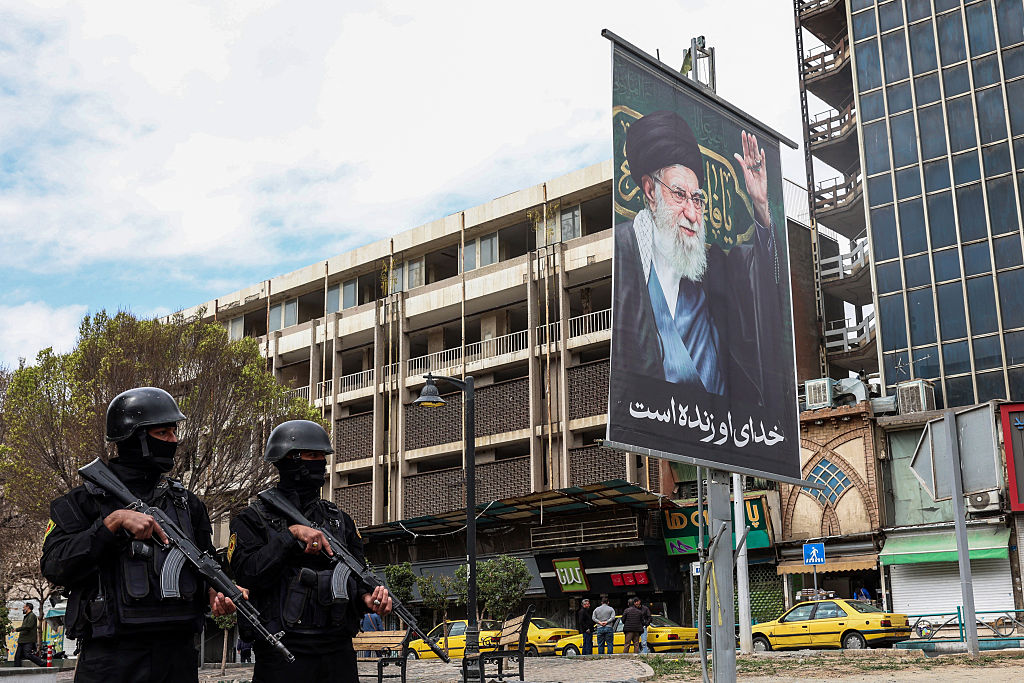
On today’s edition of The Briefing, Dr. Mohler discusses who is in command of Iran’s military forces, if President Trump’s attacks in Iran were constitutional, if inaction in Iran would have been worse, and the death of Khamenei and prediction markets.
Part I (00:14 – 07:44)
Who is in Command and Control of Iranian Forces? Iran’s Military is Likely Still Following the Orders of Ayatollah Khamenei
Part II (07:44 – 18:56)
Was the President’s Action Constitutional or Not? The Complications of President Trump’s Decision in Light of the Controversial (And Unconstitutional?) War Powers Act
- War and Peace Cannot Be Left to One Man — Especially Not This Man by The New York Times (David French)
- Secretary of State Rubio on Iran Strikes by C-Span (Marco Rubio)
What Would Be Worse in Iran, Action or Inaction? Inaction on Iran Assuredly Would Have Been a Failed Policy
Part IV (21:20 – 25:52)
Are the Prediction Markets Turning into Death Markets? The Death of Iran’s Khamenei in the Prediction Markets is Raising Massive Questions
- Bets on Fate of Iran’s Khamenei Spark Uproar at Leading Prediction Markets by The Wall Street Journal (Kevin T. Dugan and Krystal Hur)
Follow Dr. Mohler:
X | Instagram | Facebook | YouTube
For more information on The Southern Baptist Theological Seminary, go to sbts.edu.
For more information on Boyce College, just go to BoyceCollege.com.
To write Dr. Mohler or submit a question for The Mailbox, go here.
Interactive timestamps
Jump to segmentGet every episode summarized
Each time The Briefing with Albert Mohler publishes, we email you a written briefing from the transcript — the topics, who appeared, and any specific claims, with the ad reads skipped.
Email me new episodesFree for 3 shows. No card needed.
Hosts & guests

Transcript ready
461 searchable segments. Every word is indexed and playable.
Full transcript
The Briefing with Albert Mohler — Wednesday, March 4, 2026. Machine-transcribed; use the interactive transcript above to jump the player to any line.
0:00It's Wednesday, March 4, 2026. I'm Albert Moller, and this is The Briefing, a daily analysis of news and events from a Christian worldview. Events continue to unfold in Iran and surrounding Iran, and in particular, the military conflict referred to as a war by President Donald Trump that now involves the United States, Israel, not only Iran on the other side, but allied powers on both sides. On the side of Iran, you now have Hezbollah in Lebanon and elsewhere. Also now posing a threat, Israel is going to be directing more of its efforts against Hezbollah, that's an Islamic militia, very much tied historically to Iran. On the American side, you have not only, of course, Israel acting as an ally, very close ally in this situation, but you also have a very interesting diplomatic picture that is unfolding. And that turns out to be an issue with a lot of worldview significance. There are many people who believe that the proper approach to world conflict is to try
1:04to diffuse, or at least to take a lot of the energy out of those conflicts by means of international diplomacy. There are those who are faulting President Trump for not allowing diplomacy to do its work. British Prime Minister Kier Starmer made very clear that he was opposed to the United States' effort and basically said that it should have been handled in a way that amounted to diplomacy. You have similar statements coming from others, most importantly, perhaps, at least most interestingly, from the leadership of the United Nations, saying that this is a failure of the United States to go through the UN process. By the way, is it that? No, it's an intentional decision by the United States to go around that process, more on that in just a moment. Let's talk about the diplomatic process. Now going all the way back into ancient history, you have something like the rule of an ambassador. This would be an official representative of one nation represented before the government of another.
2:05Going back to ancient civilizations, including Egypt, Greece, Assyria, you could just go down the whole list of the Persian Empire. Add to that the various empires of the Pacific Rim. The point is something like diplomacy is taking place, even going back to those ancient times. The word itself is basically rooted in contemporary French usage. And by the way, France became so much the paradigm for so much of diplomatic culture that in some realms you still have French phrases used, including words like detente, entente, for various efforts at achieving peace. But nonetheless, even though the verbiage in this case is characteristically French, the reality is that the tradition is very, very old. You had one king send an ambassador to another king, one government to another government. And there arose also around the idea of a diplomat, usually with the rank of something like an ambassador. Around that also was created an entire culture, an entire culture of etiquette and formality.
3:11So for example, a foreign ambassador to the United States presents his or her credentials to the president of the United States and is recognized by the U.S. State Department as, say, the Belgian ambassador to the United States. An exchange of ambassadors, well, that represents a very healthy situation between countries. When you have, for instance, an ambassador recalled or you have an embassy or for that matter of consulate closed, well, that's a sign that there is big trouble. Now the United States and Iran have not had formal relations going all the way back to 1979. That's not to say that the United States and Iran have had no diplomatic contact. But that diplomatic contact, usually on both sides, was through independent parties. And so you would have another nation that had relations with Iran and still has relations with the United States, act as an intermediary. The United States would do the same thing, going the other direction. In recent times, a nation like Qatar might function as an independent third party recognized
4:16by representatives of Iran and of the United States. And they would meet together in at least attempt to achieve some kind of understanding. The breakdown of that process, the absolute breakdown of that process really led to the United States and Israel taking action that terminated the Supreme Leader there in Iran and also has led to an ongoing military conflict. Now let's speak about that conflict for a moment. The conflict is expanding. As of yesterday between 12 and 13 US military bases in the region have been hit by drones or missiles sent by Iran. You also have Iran continuing to attack other nations there in the Gulf area, including many of the Arab states. That raises a huge question. And in military context, this question is command and control. Who is in command? Who is in control of the Iranian forces? And the answer is, well, maybe it is the late Supreme Leader, the late Ayatollah hominee. And you say, well, how could that be so? Well, it is because there are widespread reports that the Iranian military is now operating
5:22on orders in the event of the death of the Supreme Leader. So the Supreme Leader may very well have sent these basic military orders, perhaps even with specificity in the event he were to be hit by an American or Israeli effort. That's exactly what happened. No one is sure right now who is in living control of the Iranian armed forces. But that takes us back to the issue of diplomacy because we really don't know right now what kind of government is going to come out of this. We do have to look back at the recent history and understand that you have criticism directed at the president of the United States and the prime minister of Israel. The criticism is that the Americans and the Israelis didn't work through diplomatic channels. And as I said, it wasn't just that they didn't work through them. It is that they rejected them. So let's just understand this. You have officials at the United Nations saying that the action undertaken by Israel and the United States was illegitimate because it was not authorized through you in action.
6:23And of course, it wasn't. But the point of the Americans and the Israelis is that if anyone is waiting for the United Nations to do anything in almost every case, by the time the United Nations takes any action at all, it is either symbolic or historically speaking far too late. The reality is that the Iranian challenge, the Iranian crisis has been going on for years. And Iran is still a member state of the United Nations. Now if you have a nation like Iran, the biggest state sponsor of terrorism all over the world. And they are allowed to be an ongoing part of the United Nations, then you clearly have a problem. Furthermore, any particular action of consequence would have to be undertaken with the authorization of the United Nations Security Council. So you're looking at the elite of that group. And the United States and Russia and China hold permanent seats among others on the Security Council. And the reality is that with Russia and China in the room, there is no way that the
7:24UN Security Council ever would have taken action authorizing the United States and Israel to undertake this military action. And so you just look at this and recognize that what you see here is indeed the breakdown of an entire system. But it is for the most part the breakdown of a system of pretense rather than action. Well, okay, but let's come back to the United States. What about the criticism in the United States that President Trump has acted and is acting unconstitutionally in this matter? Well, here you have to look at some very interesting voices, David French, writing at the New York Times, goes right at the President with a piece that is entitled, War and Peace cannot be left to one man. The key section of his argument comes down to this quote, here's the bottom line, Trump should have gotten congressional approval for striking Iran, or he should not have struck. And because he did not obtain congressional approval, he's diminishing America's chances for ultimate success and increasing the chances that we make the same mistakes we and other
8:25powerful nations have made before end quote. Now that's an interesting argument and I think it's a significant argument. That's why we're discussing it at this point. David French goes on to make a constitutional argument, he writes quote, the fundamental goal of the 1787 Constitution was to establish a Republican form of government and that meant disentangling the traditional powers of the monarch and placing them in different branches of government. He continues, I quote, when it came to military affairs, the Constitution separated the power to declare war from the power to command the military. The short way of describing the structure is that America could go to war only at Congress's direction, but when it does, its armies are commanded by the President. End quote. Well, I think there's a very real sense in which David French is right, certainly about the 1787 Constitution, which is to say our Constitution. The problem is that looking at American history, presidents have often felt the need to act
9:26commanding the United States military to go into action in one place or another for one reason or another, citing urgency and the need for the military to take action. Now you could also look at the fact that throughout American history, there have been various moments in which, quite honestly, the relationship between the President and Congress on these matters was somewhat informal and somewhat now unclear. The big game changer was the 20th century. The 20th century brought new military realities that, quite honestly, don't exactly fit a 1787 world. Now, the Constitution is still very much in force, but what has happened over time is that the President with the Constitutional Authority, his commander in chief, has acted more often by undertaking military action without prior congressional approval. So is that constitutional or is it not? Well, to put it in terms of America's history, it certainly has happened within our constitutional system.
10:27The President is the commander in chief, and to state the obvious, there are situations and have been certainly in the age of modern warfare in which it is impossible for the President to seek any kind of prior authorization for direct military action. And sometimes that military action is not just a strike, but it has to do with ongoing military efforts. Clearly, at some point, Congress has to get involved. Congress is going to have to authorize in two different ways. One would be a formal authorization in which Congress passes such a resolution the second way would be through Congress's power, the purse. Congress can, over time, if it chooses, simply cut off money in terms of military expenditures for any kind of action that may be undertaken by the commander in chief. So at least in practical terms, the way our constitutional order has worked for a matter of decades is that presidents, when they believe that a matter of urgency confronts the United
11:27States, presidents will take military action directly. They will, in their role as commander in chief, a president will simply order the United States military to take this action or another action or yet another action. There's a series of actions. And the president would simply say he did not have time to consult Congress. And this is not a formal declaration of war. Now here's where things get really interesting with President Trump's actions and language in recent days. And that's because he has used the word war. Now he probably didn't mean to do so in a specifically legal sense. Nonetheless, he did use the word war. Furthermore, he has also said that he undertook the action. He ordered the military into action in this case because there was basically an urgency. In historic terms, that's referred to as an imminent threat. The United States faced an imminent threat. The president went into action ordering the military to address that threat. All right. So was the president's action constitutional or not?
12:28I think in a clear historic frame, the action was and is constitutional. Congress alone has the authority to declare a war. And there's been no formal declaration of war at this point. However, there are open hostilities clearly between the United States and Iran. And those hostilities are not wrongly referred to as a war. Usually a war turns out to be a protracted military effort. In this case, we hope it's not so protracted, but President Trump has said it could last a matter of four to six weeks or even yesterday, he said, perhaps even longer. But if it's constitutional, is it legal? Well, that's another question. But that question also invokes a constitutional question. And here's where things in worldview terms get really, really interesting. The separation of powers that is built right into the US Constitution. It is formally, well, it is the most visible part of the constitutional structure that separation of powers between the judicial and the legislative and the executive. That's based in a Christian understanding of sin.
13:30And so what you want to do is distribute authority and distribute responsibility in separate branches of government so that human depravity being what it is, you can't have a concentration of power in one branch, say, a monarch. You have simply a monarchial form of government, but rather you distribute the authority simply because other reality of sin and of the temptation to tyranny. And so the Christian worldview has a great deal to do with the separation of powers in the US Constitution. And you can look at the original understanding. The president is Commander-in-Chief, Congress with the sole authority to declare war. And yet you understand that in the modern age, this really has become complicated. One of the complications is the War Powers Act of 1973. That legislation came about when Congress was quite frustrated by a succession of US president. It's most importantly, President Lyndon Baines Johnson, but also then President of the United States, Richard Nixon. Congress was very frustrated about the experience in Vietnam and wanted to prevent,
14:33or at least they thought they were going to prevent, a similar kind of action undertaken by a president as Commander-in-Chief. But here's the interesting thing. The War Powers Act requires a president to notify Congress within 48 hours after deploying US troops or the US military. Well, clearly, that has been invoked by now. You also have a limit placed on the president of 30 days of military activity before Congress would have to act. There is a 30-day extension that is possible. Now, given complications one way or the other, the exact number of days may be open to debate. The point is it is a limited period of time, sometimes referred to now as about five months of time at the maximum. But here's the interesting thing. It was a bipartisan Congress largely dominated by Democrats that pressed through the War Powers Act in 1973. Then President Richard Nixon declared that he believed the legislation to be unconstitutional. Now, here's what's really interesting.
15:35Every single president of the United States beginning with Richard Nixon has referred to the War Powers Act in 1973 as unconstitutional. So there's a bipartisan consensus by presidents, at least when they are president, that the War Powers Act binds the president in a way that is unconstitutional. There seems to be very good reason to believe that the law may be unconstitutional, but that would have to be tested, of course. It would have to be tested, presumably, all the way up to the Supreme Court of the United States. The point is that hasn't happened, and it's not going to happen really quickly, although it is interesting that what we can see now is the context in which there could be a challenge to the War Powers Act that might, in light even of the actions right now taking place in Iran, eventually go before the Supreme Court. But the point is we are now living in a time in which some of this appears to be almost abstract. So to give an example, you have those who would say,
16:36well, President George W. Bush did the right thing looking for congressional authorization before the invasion of Iraq. The first President Bush, the father of President George W. Bush, George H. W. Bush also sought that kind of authorization. He also sought a combined action undertaken with the authority also of the United Nations. But the point is that in both of those cases, the publicity about the effort to achieve that kind of consensus and get that kind of authorization was intended to have the effect of causing, for instance, in the case of Iraq, Saddam Hussein, to back down. But that isn't at all what happened. The situation, and I think this is what you're hearing from the Trump administration right now. The situation right now is that with the imminent threat of the development of all kinds of aggressive actions by Iran, and on the basis of the fact that Iran had already taken so many of those actions, when the opportunity came,
17:36and this largely came as we know as a result of work by Israeli intelligence, when the opportunity came to strike, there was no opportunity for negotiations. There was no opportunity for some kind of public confrontation that might lead to Iran backing down. It was a situation that required immediate action. The other major factor in the President's favor in this in terms of argument is that the amassing of so much military power, they're obviously in readiness for an attack upon Iran. It had taken place not only over days, but weeks and months, and Iran didn't get the message. And of course, I think a sane analysis will lead to the conclusion that Iran wasn't going to get the message. By the way, the issues we just been discussed, some of these issues came up in comments made by Secretary of State Marco Rubio, when he insisted, just in the last 48 hours, that the administration is acting in accordance with the War Powers Act of 1973. And at this point, I think unquestionably it is.
18:39The President, then the White House authorities, notified congressional leaders, but there's even more to this and that's the political reality that Congress has been somewhat marginalized in terms of this matter. It isn't clear that Congress doesn't want to be marginalized. Okay, so what are we saying? We're saying that the President of the United States, incumbent President Donald J. Trump, decided to take this action. And the action was taken in his authority as Commander-in-Chief. It isn't at all clear that congressional leaders, and I'll say this on a bipartisan manner, but certainly the Democratic leaders, that they want to have any responsibility for undertaking this kind of military action in the first place. So in one sense, politically, they are in what they see as a very advantageous position. They didn't have to take action themselves. They didn't have to go on the record making such a decision and they get to criticize the President of the opposing party for truly taking action. It's going to be very interesting
19:40as we watch the political debate unfolding. I wanted to go to the argument that the President is acting unconstitutionally. I don't think there is merit in that accusation. But you know what, it's up to Congress. If they believe, if a majority in Congress believes that the President has acted unconstitutionally, they have powers and mechanisms to respond to that judgment. It isn't at all clear that they want to put themselves on the line to make that judgment. Long-term, is it good that Congress has been so marginalized in these questions? I think a good conservative, Christian-based argument can argue that the Congress has signlined itself in ways that are not healthy. We do not know how this is going to end. We do not have absolute assurance that there will be a better situation on the other side of this military action. On the other hand, it's hard to believe how this military action could make the picture worse. There is good reason to believe it could make the reality far better. But President Trump has taken authority as the commander-in-chief for this action.
20:41And historically, that also means he will own it. It is also being routinely argued that every time America is acted in a similar way, there have been complications unforeseen and sometimes those complications endure long into the future. There can be no doubt that some of those observations are based in truth. The problem is, no one talks about the observation of what would have happened if the action hadn't been taken. Acting and not acting sometimes come with parallel risks. And at least some military historians will say that the greater risk seen over time is not in acting, but in failing to act. One final issue related to the war and to the ongoing consideration of America's challenge when it comes to gambling and the prediction markets. Well, it turns out that all this crashed together in the opening hours of the military action against Iran. And there are reasons to wonder if some kind of insider information wasn't in play.
21:41The Wall Street Journal runs a headline, Hamanai Wajers draws scrutiny. Here's how it begins, quote, before US and Israeli missiles struck Tehran, users of call sheet and polymarket play short-term wajers that Iran's supreme leader, the Ayatollah Ali Hamanai, would be out of power. The journal goes on to say, quote, now those bets are under scrutiny after the killing of Hamanai. Some US lawmakers have raised questions about whether the market should be allowed. And if some anonymous trader said inside information head of the strikes, meanwhile, some users complained about how their bets were resolved, a democratic senator, in this case, US Senator Chris Murphy of Connecticut said an opposed on Twitter or X quote, I'm introducing legislation ASAP to ban this. Well, you know, there are huge moral questions here. We're talking about the death of a human being and we're talking about something that was unfolding in terms of current military action. You also seem to have had some people who have had, let's just say, an eerily accurate sense
22:42of what was about to happen. In this case, we're also talking about the new developments related to prediction markets that some claim are not gambling, but actually function more or less exactly like gambling enterprises. You know, I think Christians will look at this and recognize we really are looking at a huge problem. When you're talking about current events, including current events that could involve the military, when you have Americans betting on actions that could involve the American military and information that could put our own troops as well as the lives of others at risk, when you're looking at market speculation in terms of a gambling scheme, as to whether or not or how quickly or under what circumstance as a political leader might die, I think we all see there are huge issues of moral concern here. By the way, these platforms did not allow direct bets based upon exactly when Iran's supreme leader might expire. Instead, they euphemistically referred to when his political influence would be at an end.
23:44Oh yeah, we all understand that distinction. On a note at its site, Polly Market stated, quote, the promise of prediction markets is to harness the wisdom of the crowd to create accurate, unbiased forecasts for the most important events in society, end quote. The journal then went on to quote the CEO of Kalshi, saying that he, quote, compared the Hamanai market to oil futures, which he said could also serve as a proxy during wartime. He said, and I quote, we believe that's different than having a market directly on someone's death, end quote. And he said it also in a post on X. The risks involved in this endeavor may clear by the Wall Street Journal listen to this paragraph, quote, war markets have been a particularly sensitive topic for prediction markets given that information about strikes against foreign adversaries could rely on highly classified information and those bets could put lives in danger, end quote. You combine these prediction markets and ongoing military action, and you simply have to ask the obvious question,
24:45what could go wrong? And the answer, I think you'd have to give in responses just about everything connected to this entire endeavor. But this is where we are. And it's going to be interesting to see not only if Congress decides to take some kind of action consistent with the War Powers Act. It's also going to be very interesting to see if Congress takes any action related to the prediction markets turned into a war market. It's going to be an issue, whether Congress takes it up or not. It ought to be a part of a public conversation. And frankly, it's going to be an issue. One way or the other, you can bet on it. Thanks for listening to the briefing. For more information, go to my website at AlbertMohor.com. You could follow me on X or Twitter by going to x.com, forward slash AlbertMohor for information on the Southern Baptist Theological Seminary, go to spts.edu. For information on Boyce College, just go to BoyceCollege.com. I'm speaking to you from Pasadena, California. And I'll meet you again tomorrow for the briefing. I'll meet you again tomorrow for the briefing.
More episodes
More from The Briefing with Albert Mohler

Friday, September 4, 2026
The Briefing with Albert Mohler

Thursday, September 3, 2026
The Briefing with Albert Mohler

Wednesday, September 2, 2026
The Briefing with Albert Mohler

Tuesday, September 1, 2026
The Briefing with Albert Mohler