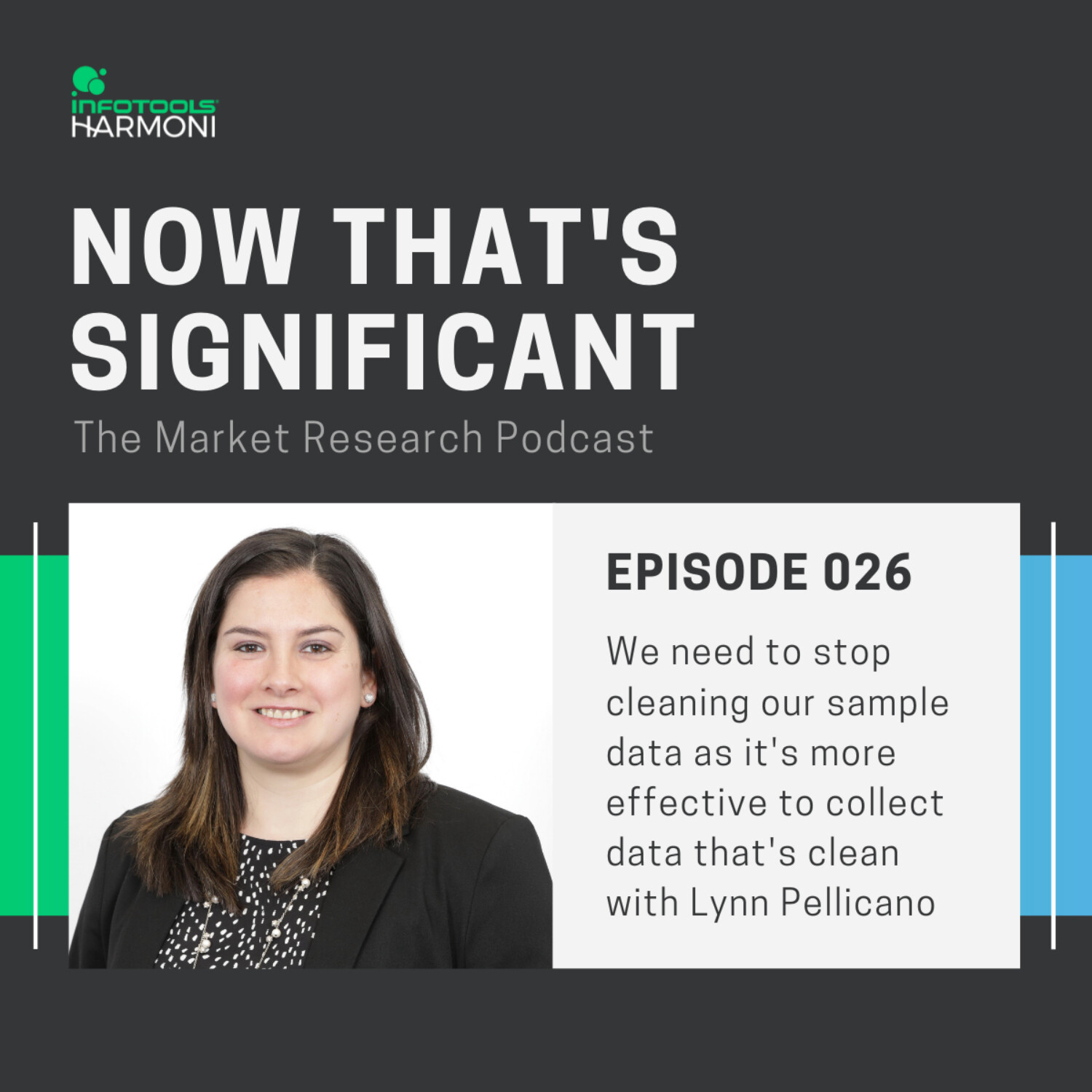
We need to stop cleaning our sample data as it's more effective to collect data that's clean with Lynn Pellicano
About this episode
We welcomed Lynn Pellicano on the podcast to talk about ways to improve our sample quality so we're spending less time cleaning it and more time analyzing it. In the podcast, we explored:
Sample quality has become endemic across the industry. You mentioned that B2B suffers from this the most, but obviously B2C prone to it as well. It is a significant issue. A number of things that haven't or aren't sufficient any more like the Double Opt In, self-selection, etc.
We really need to have buttoned up screeners to help us to weed out bad actors. Customer recruitment can help in this space too.
Phone interviewing and field studies are back, which is great, since it's fraud can't be scaled to the extent that 100% online can. This means there's a whole lot of new or not new, but existing collection tools that people can use to reach a broader section of society.
We talked about how some are cleaning up to 80% of the sample, which is quite scary to think about the value which they could be missing out on by doing such things incorrectly.
We discussed how we need to get our surveys shorter, be device agnostic with the with our collection tools and also use multiple recruitment methods to make sure we're not just focusing on over those representative, prolific online people.
We explored the use of technology in the recruitment phase, with the likes of geolocation, language, IP addresses to help keep people out of or confirm people before they enter using prescreen as well.
There's also improvements we can make in the design phase, using things such as refusals, questionnaire design, flaws, falsehoods, social desirability, people giving politically correct responses rather than the true opinions that we talked about briefly on the screening phase.
We looked into some things we can do in real time as well, such as developing consistent and efficient, accurate data checks, confirming knowledge respondents confirming attentive respondents, but not being too aggressive with it.
And then we looked at a few different things such as speeders, open interviews, straight lining, red hearings. You also talked about numeric outliers and contradictory and probable responses as well.
And lastly, we spent a moment imagining if we were to get everything right in the sample space, as improbable as it may be, and what would happen.
Enjoy the show.
Get every episode summarized
Each time Now that's Significant publishes, we email you a written briefing from the transcript — the topics, who appeared, and any specific claims, with the ad reads skipped.
Email me new episodesFree for 3 shows. No card needed.
Hosts & guests

No transcript yet
This episode has not been transcribed. Request it and it moves to the front of the queue.
More episodes
More from Now that's Significant

Now that's Significant - How Women in Research (WIRe) is giving back to the indu...
Now that's Significant

Understanding Culture: The struggle over meaning with Anastasia Kārklīna Gabriel
Now that's Significant

Imagining a world where consumers owned & benefited from their data with Wes Cha...
Now that's Significant

VIBE - Black Market Research & Insights Professionals Conference with Tikica Ben...
Now that's Significant