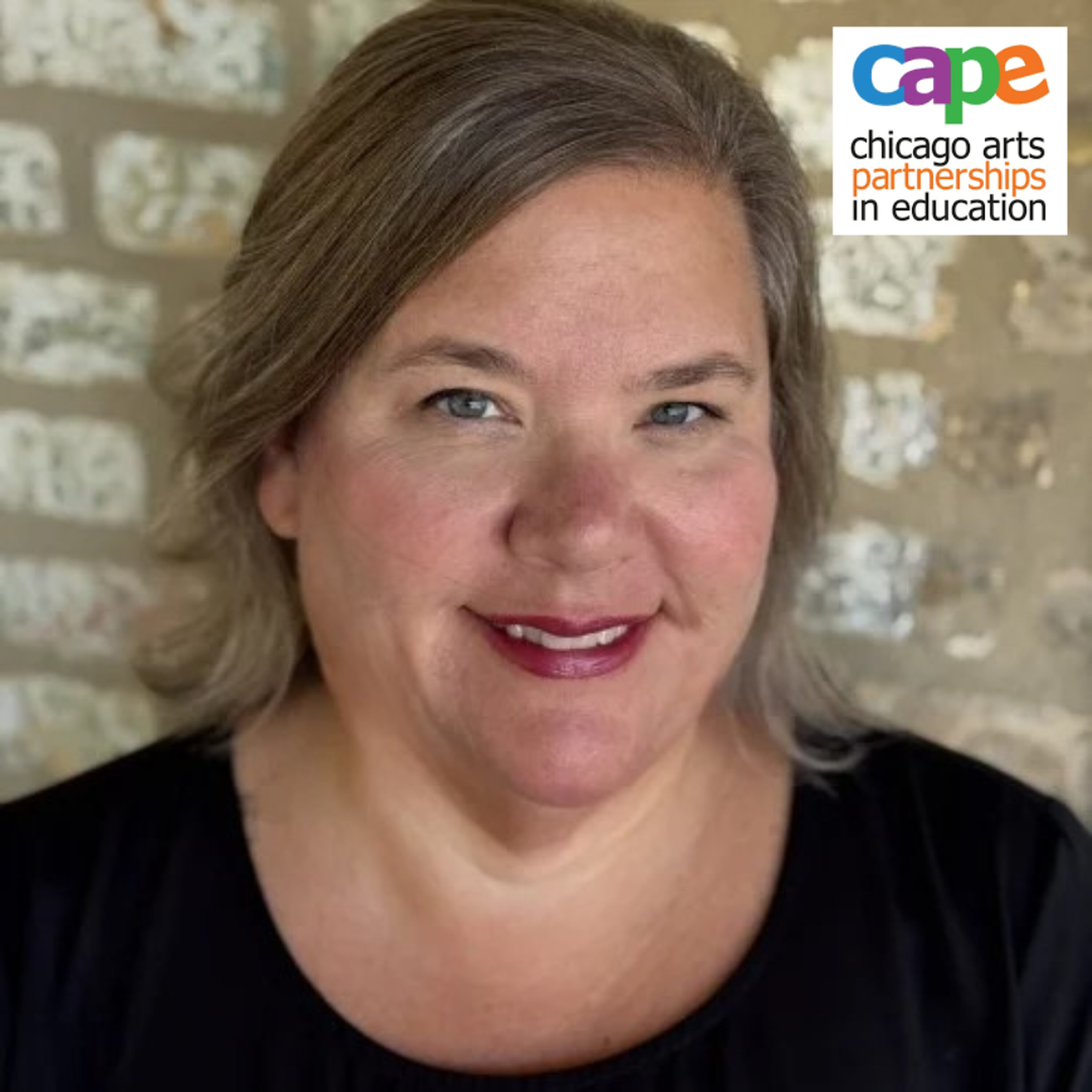
WCPT 820 Interview: Amy Rasmussen of CAPE
About this episode
Richard Chew is joined by Amy Rasmussen, executive director of Chicago Arts Partnership in Education (CAPE).
She discussed CAPE's school, after-school, summer, and parent arts programs, educational impact, funding needs, and the upcoming ArtJoy 2026 fundraiser, Saturday, September 12.
Program Impact
- CAPE serves about 40 Chicago public schools and suburban schools through in-school, after-school, and summer programs.
- Arts residencies aim to spark curiosity, strengthen engagement, and provide creative outlets rather than train every student to become an artist.
- Research has shown improved test scores among participating students; current tracking also includes attendance, parent feedback, teacher insights, and student stories.
Catch "Chew's Views with Richard Chew” weekdays from 6:00 to 8:00 a.m. Central on WCPT (heartlandsignal.com/programs/chews-views).
Follow us:
Website: https://heartlandsignal.com
WCPT Facebook: https://www.facebook.com/WCPT820
Heartland Signal Facebook: https://www.facebook.com/HeartlandSignal
Tiktok: https://www.tiktok.com/@heartlandsignal
Heartland Signal X: https://x.com/HeartlandSignal
WCPT 820 X: https://x.com/WCPT820
Instagram: https://www.instagram.com/heartlandsignal
Threads: threads.com/@heartlandsignal
YouTube: https://www.youtube.com/@heartlandsignal
See omnystudio.com/listener for privacy information.
Get every episode summarized
Each time Chew's Views with Richard Chew (Featured Interviews) publishes, we email you a written briefing from the transcript — the topics, who appeared, and any specific claims, with the ad reads skipped.
Email me new episodesFree for 3 shows. No card needed.
Hosts & guests
Transcript ready
470 searchable segments. Every word is indexed and playable.
Full transcript
Chew's Views with Richard Chew (Featured Interviews) — WCPT 820 Interview: Amy Rasmussen of CAPE. Machine-transcribed; use the interactive transcript above to jump the player to any line.
A few weeks ago, we had the privilege of having Amy Rasmussen with us. Um, and she's the executive director of Kate Chicago Arts Partnership in education. It's easier just to say the acronym. This is Amy. Good morning. Welcome back to choose views. Thank you so much. I know it's a mouthful. It is. What were y'all thinking? Yeah. I didn't have a start to organization. So I'm just playing. Yeah. It's good to see you again and glad you're, you're able to be back with this. I won't, when we first met, I was like, if you, I try to do this, if someone's got an event going on, I want to make sure that we can highlight that event when we get closer to it. Yeah. Um, what's been going on with the organization? We won't talk about the, but what's been happening with you guys, schools, back in session that give us the whole rundown. So we had, uh, I think I was here in this, like, uh, in the early spring. Yeah, I forget when it was, but yeah, and we had a great summer. Um, so Chicago Arts, Partnerships and Education, uh, provides a teaching artist's
residencies in a range of schools. We work in about 40 Chicago public schools as well as in the suburbs. And, uh, we do in school and after school programs. So during the school day, as well as providing, like, extensive after school. And we also do summer programs. So we had a lot going on. So we have a gallery space in Bridgeport at 10, 10 West 35th Street. And the summer, we had a teen artist studio program where we had a group of, uh, about 15, uh, ju, rising juniors and seniors spend about four weeks with us in the studio. Wow. Um, they were, uh, introduced a different artist studios in Chicago. They made art. They thought about what their lives could be like if they continued to study art and make art potentially in college or, you know, in a future career. So we had a great time with our teens. And then we had summer programs running at about six different sites across the city. Um, and then now we're in a little bit of a break because school just got started. We need time for the teachers to kind of reset. Yeah. And school started a couple of weeks ago and we'll be launching our, uh, after school programs
in a week or so to, uh, here we go. Wow. Yeah. So, so during the summer programs, we're, we're their students. And I think I know the answer to the question, but have you tell us, um, that we're part of a program last year or in a previous time that we're kind of chomping at the bit about being in programs this summer? Yeah. So it's a continuum. So when we work with those schools, um, they are attending their after school program. They're in the, they have the artist in the school day. Um, and then we try to continue that for the summer. So while there are sometimes required tutoring programs or extended learning programs for kids who are really struggling, uh, we like to provide programs and services for all kids that can sign up and also provide some, um, potential like relief for parents. Yeah. So they have a place, a safe space to send their kids, uh, for the summer in a familiar location at their school sites. Um, and those, those programs typically include not only like in classroom learning, but field trips to parks and, and, um, museums and, uh, different experiences for the kids so
that help them get out of the neighborhood a little bit. Yeah. Um, how many, not how many, but during during the, um, the build up to, you know, the summer programs, um, is there a, for like a better words, a waiting list? Uh, that's what I'm saying. How many, but is there kind of a waiting list toward? We, I should have asked my staff that question, but we definitely had row, but full programs this summer. Uh, we get about 20 to 30 students like per classroom, per teacher, artist, pair that sign up for those programs. So they're really popular for sure. Yeah. Yeah. So the students that are part of the program and obviously, um, I guess you have some discoveries of those who, um, maybe more, a driven, not necessarily more skilled, but more driven to art. Mm-hmm. How do, what, what do you see there? The kids that are like, this is something I want to do. I've got an older brother or cousin or sister or whatever that's doing this thing over here. Do you know what I mean?
Um, the, so the purpose for our program is really to spark kids curiosity. Okay. Spark, uh, spark their passion for learning. So they, well, they may have seen a piece of art or seen a older sibling participate in a program. Our design isn't that they all become artists or they all, you know, kind of go into that kind of career if they want to. That's great. But our, our goal really is to engage them in the classroom. One of the big challenges for schools everywhere has been enrollment and attendance. And so if we create engaging learning experiences that enables kids to demonstrate what they know by drawing or dancing or writing a play, then that is an engaging learning experience that will stick with somebody forever. So and I know that's true for me, which is why I'm so passionate about this because how many people remember doing a worksheet, a worksheet, right? But you remember when you had to build a diorama. Yeah. Or you remember when you, right?
Like you remember those. We've received. Yeah. You remember those projects that were just, um, super interesting and engaging. And, um, unfortunately, the typical standard curriculum, well, it gives teachers the ability to kind of think outside the box. They need a creative person in the classroom to help them expand on that. And so that's why we have the artist there to sort of bring those new ideas into the classroom. Yeah. And they brainstorm, they look at the learning standards, they kind of figure out where the kids are at and what they need. And then they work with the students to help them figure out what they want and learn and what they, what they already know and, um, you know, what they're really curious about. So you, uh, from, from a, um, application standpoint, I guess tools are there. Is it more, um, what's, how do I want to say this? Um, cause this is what popped into my mind earlier. Our kids working on tablets. Are they working on what, what are they, what are the, um, the, the, the, the, the, the palettes. The men, they call them, uh, manipulatables.
No, that's a terrible word. But the, the, the items that they're using. So, um, yeah, we do have technology in classrooms. That's not going anywhere. Yeah. Digital learning is, is a present part of a lot of classrooms, but, we absolutely provide, like, paintbrushes and, like, good paper and watercolors. And if we need, um, you know, costumes for performances and things like that, they're not digital. And sometimes those things are created by the students themselves. So we have, uh, one program that's like a costume design program where they're learning to so and learning to, you know, design, do some fashion design. And so it's a range of things that they're using. It's not just digital, although digital is also important. So what are you seeing the students feeling more comfortable doing digital or more non-digital? If there's even a way where you've measured that or even looked at that. We've not looked at that question in particular.
I will say that it really goes school by school environment and classroom by classroom in terms of how much and also grade levels at the lower grade levels. There's a little less technology as you go into high school. There's a little bit more use of it. But certainly the kids are very interested in both producing art with technology driven tools. And also in particular in high school understanding the world of media, not podcasting, social media, all kinds of communications that they're learning about and trying to negotiate. So, yeah. That's pretty cool. What's the, in terms of improving their education or improving their performance, maybe it's a better word? Have you done or do you guys do any sort of tracking or identifiers, markers, or any markers that say because of this program and these students being involved, what's that look like?
So that's a complicated educational research question. That's a P-A. You need a PhD in here if you want it, but I'll give it my best shot. So the gold standard, like any kind of research is to have, to look at what students are doing and then look at a comparison group and see if those students are not doing how they fare. Right. And then those long term studies, we're an organization that is one of the leading nationally to look at those comparison and control group kinds of studies that has shown that test scores go up among students who have cape in their classrooms. We have studies on our website. You can take a look at those very long white papers. And those have been, those have been funded primarily by the US Department of Education. Okay. So it's important work to do to lay the groundwork. And as we continue our work and know that we're still having that impact, we're not so tightly controlled by those standardized test scores. And there's a whole other reason for that because they have been changing so much.
But we are tracking things like attendance, parents opinions, teacher insights, which are actually more powerful for overall program improvement and for parent engagement. So that we can understand that if they acknowledge what their kids are doing, that they, if the teachers kind of can see what the kids are learning and how they're growing, then they get deeper insight into the work. So right now we're sort of in that mode of tracking some of those stories too. And I would assume maybe not to poorly assume that the parents are seeing some of those data points that then seeing that their children's scores are going, our performance is going on that, that obviously furthers them wanting to be involved in supporting the programs. Yeah. Part of our work when we is also to engage parents, we actually provide workshops for parents to make art. Really? Yeah. So separate from the children or? Separate from the children. Yeah. We do some work with parent groups. And so sometimes parents come to the table and they're artists and it's great.
Sometimes they've never picked up a paintbrush. And so it's important for... Stick them in and win them. Yeah. Right. And so we start with... And we also want to build parent community so that the way that schools are designed, it's democracy and action. It's parents have a voice in the role of the school. They can participate in the LSC, which is how does Chicago is designed the local school council. But they all should have a leadership voice in their school. And so building community among the parents is really important. And so if we can get them to make art together in a classroom that's a shared experience based on history and culture, language, then that creates a bond for those parents and they can go on to say, okay, I really think my kid needs this at school or I noticed that your child needs something else. And so you create an environment that is supportive of all children when you have programs for parents. I'm sure it's probably a lot of fun for the child to go home and say, my stuff looks better
than yours or dad, mine looks better. Yeah, let me tell you a couple of French readers and other things. Next thing you know, the parents are trying to put their art over the child's because they think it's better than the child's like, wait a minute, no, no, I got a better grade than you did. Amy, let's take a quick little break. The number is 7-7-3-7-6-3-9-2-7-8. You're listening to Choose Views. I'm Richard Chew. Keep it locked in. We'll be right back. All right, guys. Welcome back to Choose Views. If you were just tuning in, I'm Richard Chew. We are talking with the Executive Director of Chicago Arts Partnership in Education, also known as Cape. Amy Rasmussen is with us in studio and she is giving us the low down on why parents are fighting with their children and children are fighting with their parents about why their art is better than each other. And they're having a ball at it because parents, as Amy said, are feeling more engaged in part of the process of what Cape does and its summer programs and its partnerships with these schools in the city of Chicago and some of the surrounding areas.
It's a great program. You guys should plug into it. If you're looking for something to be a part of, this is one of those things. You know how I nerd out when it comes to professors or folks like Amy who are committed to making sure that we have a smarter, more engaged society and community. And she's at the tip of the spear with one of the best programs here in Chicago. Amy, let's talk a little bit about now that school is back in session for a couple of weeks. What are you kind of catching your breath now? I guess it's a way I put it based on what you said earlier. But what are some of the things that you are hearing in this short period of time that kids are back in school? Yeah. There's always a continued focus on social emotional learning for kids, for sure. I think that students are feeling like we're all feeling this political pressure, the economic pressures that are happening with families that is really felt within the communities in Chicago. You know, we're, I think last spring we were talking about cutbacks in snap funding.
And we have work with schools that have significant homeless populations. And so the pressures that the kids are under, whether they know that they're, you know, their families are struggling. They do know, based on the stress of the parents. And so we hear from principals time and time again that students are needing more customized support that they need, you know, teachers and parents that really understand what kids are going through. And so Cape's programs in part are designed to give children an outlet for expression and creativity to use their brains in a different way than maybe they have done in a classroom. And so that's been, that's our focus is trying to ramp up that kind of programming in schools. Well, and it's obviously working because of program, you know, you continue to be having these successes in the summer and it's growing. And obviously our introduction to it back in the spring was something new, but, but, but really, really, really important.
Who are some of your, for lack of a better words, political allies? And, you know, both here in the city, the county, the state, what, where do you, because we know that our folks in Washington, and who's leading the Department of Education, don't really give a darn, but who are some of the folks that you've aligned with or have aligned with you that are allies to the program? Yeah. So, as a nonprofit, we try to stay out of like partisan politics, but we also need government support to continue to run our programs. A significant portion of capes dollars comes from 21st century community learning centers, which is the nation's biggest after school program funding source. Right. A couple billion dollars that comes out of Washington, DC gets black granted to the states, and then the state grants it out in, in a highly competitive grants to partners and school districts. And so it's so important that we keep those dollars in place. And so myself working with other coalitions, like AC now Illinois, we do go to Washington
to advocate for those dollars. We do meet with legislators. And sometimes we get lukewarm receptions, and sometimes we get really enthusiastic receptions. So, the vast majority of representatives in Chicago at the federal level, tremendously supportive. And then we have some convincing to do with others, but yeah. Good answer. Yeah. In respectful to that answer. Yeah. And we do the same in Illinois too. So when we go down to Springfield, we have seen some gains in funding for after school programs and for arts programs in some incremental ways. So I'm happy to say that in particular for capes work, there's a terrible name, but it's called the after school funding program for the state of Illinois, very generic. We've received increased dollars from that program. And then also the Illinois Arts Council is the supporter of our work and those grants have increased as well. So we're grateful to the Pritzker administration for keeping the financial house a little
bit in order and providing some more certainty for organizations like Cape who are doing work in the community. So are there events that you, I mean, I know that you've got a big one coming up. We'll talk about that in a second, but our events is not the word I'm looking for. Are there times of the year where you see a spike or an increase in the contributions that may come from external groups or organizations like from private dollars? Yeah. So always in the fall is when we start our fundraising campaign and usually the end of the calendar years when we see a lot of those individual contributions, you know, from small dollar contributions from $10, $100 here, they're which really builds up and it makes a huge difference. So yeah. And then foundation dollars come throughout the year. So that's kind of all over the map. Yeah. Yeah. Well, you've got this big event coming up and that was a big part of the impetus of me saying, Hey, let's have you back as we get closer to that. Take a couple of minutes and talk about its origin.
This year's event, what your expectations or your aspirations are with it. Yeah. So I was talking with a few of our Cape board members and trying to brainstorm how are we going to raise money? Our Cape Spudget is about 2.3 million and we do have some solid support from the community, but how are we going to celebrate that support and also ask new donors and engage new people in our work. So and we wanted to really celebrate the arts that goes on in the school in an authentic way. So we were just kind of brainstorming, he went this concept of our joy because what does art bring into classrooms, but the joyful expression of creativity, new ideas, collaboration. And so we kind of went with that theme and it's turned into this great idea. So on Saturday, September 12th, we're having a fundraiser called Artjoy. It's going to we're going to turn our gallery space into an immersive art experience. We're going to have a live art making with, let me see, I've got a list of artists that
are going to be performing. And I want to mess in my name. So Tony Collins is a visual artist who worked with us on the West Side of Chicago at Nash School and a couple other schools. And Tony is a graphic graffiti influenced artist, but he's going to be creating a live art piece at the event. Also we have Emily Robinson, who's a photographer who's going to be making a photo quilt during the event. She's worked on a photo. Yeah. So I'm going to stop it there and say you're going to come and see it. So it'll everybody will be able to participate in it. And then if you come to our gallery, it's a, we have a skyline view of Chicago. And one of the fun, one of the more fun projects we've done has to been to create transparencies on our windows that creates artwork like in front of our skyline. So Katie Kuresh, she's a special education teacher. She's going to be working with Ann Vellone for students on a transparency's project during
the event. And so we're going to have to talk more about the event. But the only way you can see that transparency is to actually be there. Yes, right. You can't even just, I mean, you can describe it loosely, but it's an experiential kind of thing. Keep it going, Amy. Yeah. And then we're going to have some musical performers, DJ Kinky P, as going to be our late late night DJ. So we'll talk about that in a minute. And then we're also going to have the African dance club from National Elementary School. We'll be doing a short performance for us. So, yeah. So, so talk about the time frame that we know the date is September Saturday, Saturday, September 12th. What's the time frame? What it's a cost if anything? Yeah. Keep us going. So we're starting at 6 p.m. Okay. To get started at $150. They're on our website, keepschedoggo.org, and you'll click on the art joy link. We're sponsorship opportunities that we still have, even though it's a week away. And we will also have great food from our friends at Inc. Kering are doing a great job
for us. And so come join us. It'll be a fun evening. That's great. And obviously, if we have a great sunset that day, that'll add to the whole spectacular of this and our skyline because when the sun sets to the west and Chicago and reflects off the buildings, it is beautiful. It's one of the best in the nation. We have a, it's a beautiful skyline view of our city. And when that sunset, it just sparkles. Yeah. That's going to be exciting. It's going to be exciting. This is not a personal, personal ask question to ask you. What have been your, some of your best moments, some of those moments where, see you guys couldn't see this unless you're watching on Facebook or YouTube. She smiled when I said that because so you know that there's ones that are in there. But Amy, tell our listeners and viewers what some of the most important and heartfelt takeaways have been from you being in this role. Yeah. So running a nonprofit is complicated. I wear many hats. I feel the responsibility deeply because I feel this work is so important.
And for me, the, one of them, I like, I had a tearful moment a little bit, but as when I met, we have a family day every spring and we had some families to our gallery and a couple of them came up to me and said that the program had a significant impact on their child. So I won't use the name, but he, the child was struggling in school, struggling to make friends, maybe was a little neurodifferent, needed some additional support. And the parents came up to me, which is like, this has made a huge difference in his connection to fellow students and his ability to think of himself as a learner. So oftentimes, right? I think of yourself as a learner. Right. Because you, the, the content and knowledge can be presented in a way that is not immediately accessible to everybody. Right.
And you're constantly being told, oh, you got that wrong or that's not right. Or let's think about it. And so if you can switch that in your brain and say, Oh, I have to learn more about that. Or I'm interested in that. That changes somebody for life, right? And I think that was one of the moments where I was like, oh my God, we're really doing some great work with these children and families. So yeah, that was a moment. Then another moment was when we had one of the students in the gallery, which is hilarious. This young student. So what we do shows in our gallery space every quarter, we have different students show. And so we had a group of students come visit their artwork. And when the students saw his art piece up on the wall. And he immediately went, Oh, I'm a real artist. And then he kind of started asking me, well, I'm going to go to other galleries and I'm going to find other places where I can hang my art. And I was like, and he was like in like fourth grade. And I'm like, you go, right? The moment got to the energy touch.
Yeah. And that was real. And I have his picture somewhere. It was hilarious though. That's cool. That's really cool. Well, that's because folks like you, Amy, are doing the work to embrace the ability. I'm a learner now. That is touching. I'm a learner now. And I know you will, but hold on to that one because that's pretty strong. But thank you, Amy, for hanging out with us this morning. Thanks for having me. Well, absolutely. And sharing with us what you're doing in the organization and some of the experiences, we will definitely have you back maybe toward the end of the year when you're starting the push and all that. But real quick, how can folks find you last bit? How can they get involved? We're at Cape Chicago dot org C-A-P-E Chicago dot org. If you're interested in coming to our join next Saturday night, tickets are $150. Click on the art joy link. You can purchase them online. And we also have a silent auction. I should mention. And you do not have to buy a ticket to bid on the silent auction. You can go on one and do that. Yeah. So many of our cultural organizations and sports groups have donated tickets and experiences for us. So check that out if you're interested and maybe picking up some Cubs tickets for next
Monday or some tickets to the Chicago Symphony or Black Ensemble Theatre. Amy Rasmussen, thanks for hanging out with us.
More episodes
More from Chew's Views with Richard Chew (Featured Interviews)

WCPT 820 Interview: Amy McGrath
Chew's Views with Richard Chew (Featured Interviews)

WCPT 820 Interview: Ron Insana
Chew's Views with Richard Chew (Featured Interviews)

WCPT 820 Interview: Melissa Toufanian of Navigator Research
Chew's Views with Richard Chew (Featured Interviews)

WCPT 820 Interview: Leaving MAGA's Rich Logis and Addy Leugers
Chew's Views with Richard Chew (Featured Interviews)