religionDec 31, 20208:05pending
Veda Compiled In Arctic Devayana Pitruyana Evidence Rig Veda
About this episode
Indian texts have two calendars, one based on the movement of Sun,Surya Manasa,Solar Calendar and Chandra Manasa,based on the movement of the Moon.
The movement of the Moon is calculated by Thithis;they are fifteen.
Solar year is calculated on the basis of the movement of the Sun and the Stars are taken as the basis.
For auspicious occasions, the Nakshatra is given more importance while inauspicious occasions like Sraddha,the annual death ceremony, only the Thithis are taken into account.
These two are correlated.
One must rember the following before proceeding further.
1.The landmass in those ancient times were different from what we find today.
Please read my articles on Rodina, Pangea Super continents of ancient times.
2.Santana dharma was present throughout the world.
3. The Vedas were not compiled in one shot. The Truth ,as revealed to the Rishis were compiled as and when they were revealed.For details please read ‘when were the Vedas compiled’
So what is found in the Rig Veda is the oldest records.
What is mentioned in the Rig Veda about movement of Stars and Planets refer to the period and indicate the area wherethe people lived.
While the later Vedic texts mention Dakshinayna and Uttarayana, they refer to what they observed,that is the movement of the Sun to South or to North.
This is what we practice today.
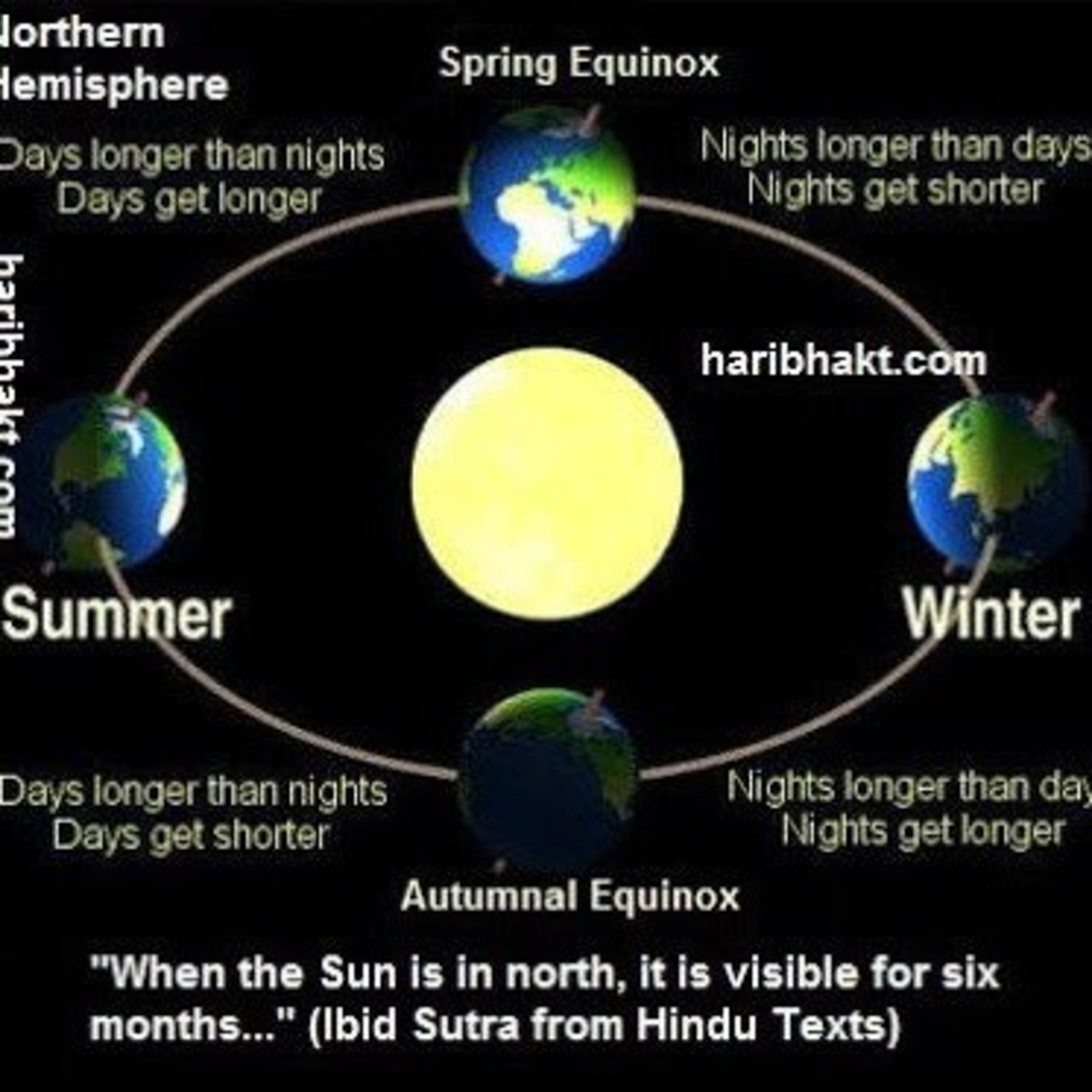
But what the people of the Rig Vedic Time observed was the day extending for six months, night for six months,was called as Devayana( Day) and Pitruyana(Night).
For more on this read my article On Aryaman.
4.It is also probable that two or three groups lived, one each at the Polar regions and another in the other areas.
This would account for the classification of Dravidas,Milechas and people being called Rakshasas who hailed from the south.
5.Thus the descriptions of celestial movements in the Rig Veda indicate that people of those times lived in the Arctic Region.
‘The Taittirîya Samhitâ and the Brâhmanas distinctly mention a lunar
month of thirty days and a year of twelve such months, to which an
intercalary month was now and then added, to make the lunar and
the solar year correspond with each other. The ecliptic, or the belt of
the zodiac, was divided into 27 of 28 divisions, called the Nakshatras,
which, were used as mile-stones to mark the annual passage of the
sun, or the monthly revolution of the moon round the earth. The two
solstitial and the two equinoctial points, as well as the passage of the
sun into the northern and the southern hemisphere, were clearly
distinguished, and the year was divided into six seasons, the festivals
in each month or the year being accurately fixed and ascertained.
The stars rising and setting with the sun were also systematically
observed and the eastern and western points of the compass
determined as accurately as the astronomical observations of the day
could permit. In my Orion or the Antiquity of the Vedas, I have shown
how the changes in the position of the equinoxes were also marked in
these days, and how they enable us to classify the periods of Vedic
antiquity. According to this classification the Taittirîya Samhitâ comes
under the Kṛittikâ period (2500 B.C.), and some may, therefore, think
that the details of the Vedic calendar given above are peculiar only to
the later Vedic literature.
A cursory study of the يig-Veda will,
however, show that such is not the case. A year of 360 days, with an
intercalary month occasionally added, or a year of twelve lunar
months, with twelve intercalary days inserted at the end of each year
was familiar to the poets of the يig-Veda and is often mentioned in
the hymns.*
More @ https://ramanisblog.in/2017/02/02/veda-compiled-in-arctic-devayana-pitruyana-evidence-rig-veda/
Get every episode summarized
Each time Hinduism History Practices Mantras publishes, we email you a written briefing from the transcript — the topics, who appeared, and any specific claims, with the ad reads skipped.
Email me new episodesFree for 3 shows. No card needed.
No transcript yet
This episode has not been transcribed. Request it and it moves to the front of the queue.
More episodes
More from Hinduism History Practices Mantras

Mrutunjaya Stotram by Markandeya
Hinduism History Practices Mantras
Jan 12, 20263:22pending
Surya Upanishad
Hinduism History Practices Mantras
Oct 2, 20255:22pending

Dhoomralochana Vadha Chapter 6 Durga Daptashati
Hinduism History Practices Mantras
Feb 5, 20253:56pending

Sri Vidya Explained,Texts Sources
Hinduism History Practices Mantras
Feb 5, 20259:19pending