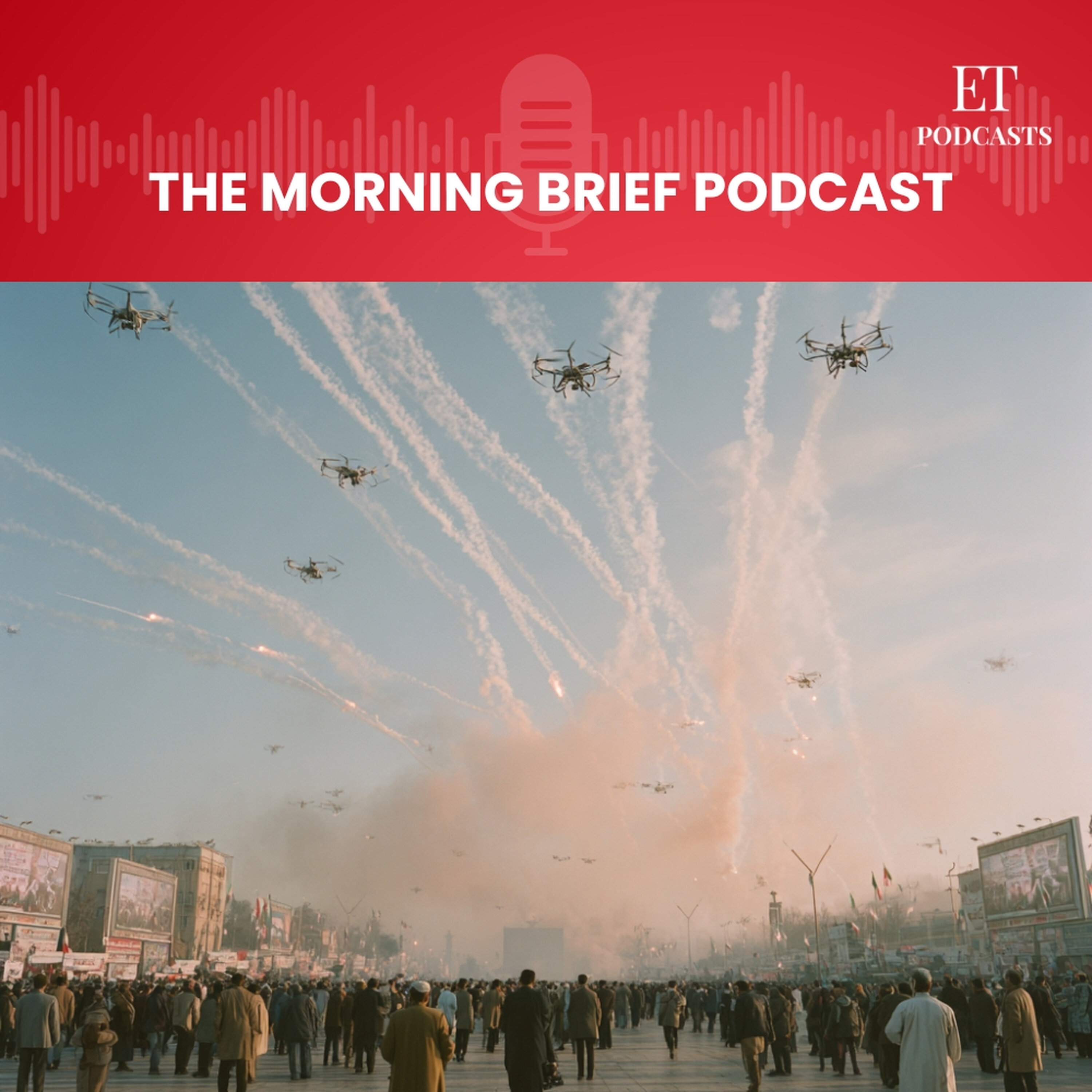
About this episode
From January’s protests in Iran to coordinated US–Israel strikes and widening retaliation, this episode maps how internal unrest morphed into a geopolitical flashpoint. Host Anirban Chowdhury and ET’s Executive Editor (Politics) Pranab Dhal Samanta break down the escalation ladder: is this about regime change, deterrence, or domestic politics in Washington? Can Iran’s clerical system withstand external pressure without fracturing internally? We examine oil volatility, Hormuz risks, Gulf street sentiment, and the proxy chessboard. We also assess China and Russia’s limited but strategic positioning. Finally, where does India stand — balancing energy security, diaspora protection, and strategic restraint in an increasingly combustible region?
Listen in:
You can follow Anirban Chowdhury on his social media: X and Linkedin
Check out other interesting episodes like: How Will a Volatile ₹ Impact You in 2026?, How Quick Commerce is Triggering a Health Crisis for Gen Z, India’s Labour Law Reboot, Viral to Valuation: Building Women’s Cricket as a Brand and much more.
Catch the latest episode of ‘The Morning Brief’ on The Economic Times Online, Spotify, Apple Podcasts, JioSaavn, Amazon Music and Youtube.
Credits: CBN News, LiveNOW from FOX, Fox News, FRANCE 24 English, WION, Business News, Sky News Australia, Firstpost, BBC News, Guardian News, DRM News
See omnystudio.com/listener for privacy information.
Get every episode summarized
Each time The Morning Brief publishes, we email you a written briefing from the transcript — the topics, who appeared, and any specific claims, with the ad reads skipped.
Email me new episodesFree for 3 shows. No card needed.
Hosts & guests

Transcript ready
382 searchable segments. Every word is indexed and playable.
Full transcript
The Morning Brief — US–Israel vs Iran: The War That Could Ignite the Middle East. Machine-transcribed; use the interactive transcript above to jump the player to any line.
It began in January this year with chance on the street of Tehran, women burning hijabs, young men defying batons, a regime tightening its grip even as economic pain deepened for citizens in Iran. The hundreds of protesters gathered outside the US consulate and chanted slogans. The protests found a supporter in Donald Trump undercurrent was a long-standing White House desire for a regime change in the country. Donald Trump's urge protesters to keep taking to the streets and that his help is on its way. Iran may be behaving badly, it hasn't been confirmed, but if it's confirmed, look they know the consequences will be very powerful. This was Trump in January, in a joint speech delivered with Israeli Prime Minister Benjamin Netanyahu.
Simultaneously, both countries were trying to broker a deal with Iran to freeze and roll back its uranium enrichment plans, basically stall its nuclear proliferation ambitions. Benjamin Netanyahu, President Trump posting on true social, saying nothing definitive was decided, but making clear he prefers a deal with Iran. He added, quote, hopefully this time they will answer. The US and Iran held hours of indirect negotiations over the nuclear program, but walked away without a deal. And then came more threats. To the members of the Islamic Revolutionary Guard, you must lay down your weapons and have complete immunity, or in the alternative, face certain death. And then on Saturday morning. Israel coordinated attacks against Iran, launching a wave of missiles starting at 8, 10 a.m. local time, both the Iranian President and the Supreme Leader targeted in the first
wave. President Trump says the US and Israel have launched what he called major combat operations. The President has also said there may be American casualties as a result of this operation, which has been dubbed epic fury by the Pentagon. The aggressors have also targeted the school in the city of Minab for most gun, prevents killing more than 100 children. Iran has launched missile and drone attacks against US military bases and allied installations in Qatar, Bahrain, Kuwait and the United Arab Emirates escalating what had already been a serious conflict. As missiles flew over Iran, flights turned back midair within minutes, airports fell into chaos. The passengers across key routes have been left stranded with no clear way back home. News from the Iranian state media now accepting the reality that the Supreme Leader Khameini is dead. The Lakhamenis are dead, many mourned the late leader, but others celebrated.
Iran's retaliatory attacks have engulfed the Gulf, allowing them to make them pay the price for common eyes killing. At least 10 people have been killed near the US consulate in Pakistan's Karachi. This is after protests broke out following the killing of the Iranian Supreme Leader Ayatollah Ali Khameini. The arc from unrest to full-blown war has been fast, volatile and global. Gulf capitals are calculating, oil markets are jittery, air corridors are disrupted and millions of expatriates, including Indians, are watching nervously. In this episode, I sit with ET's executive editor politics, Pranup Dhal Samanta, to decode the escalation ladder and why the next three days could change everything in West Asia. Will this exchange be contained or is this a wider regional war? What real signals should be watched? Oil, airspace, proxies, street anger? Can regime change actually happen in Iran?
And where does India position itself in this churn? Listen on, this is a special late-night episode on Monday, the 2nd of March. I'm Anirban Chaudhary, this is the Morning Brief. Hi Pranup, very warm welcome to the Morning Brief. Thank you Anirban, it's lovely being back to the Morning Brief and with you as the host. Thank you for having me over. Absolutely. Pranup, this must be busy days for you, like it is for all geopolitical reporters across the world. How do you see the next two, three weeks? The watchers are saying they don't expect it to go beyond three or four days. So are we looking at contained exchange or will it disintegrate into smaller flashpoints across the region or worst case scenario are these the early signs of a wider regional
war? Yeah, at the outset, let me also take the disclaimer that the next two, three days are very important to even sort of wade into the question of how long is this going to last? Because one side has flared its cards, the other side has shown some retaliation, but I think there is more in store. So this is just the dynamic of things started by the strikes by US and Israel. The way you analyze war is that one dynamic, whether it will lead to the next dynamic within the escalation ladder, right? The way to understand this, Anurban, is that what's at the center of this? See, at the center of this is the American desire, political desire to affect the regime change. That is something which the Israelis have always wanted, but this is now supported by Donald Trump as well and led by him. So he has also done that in Venezuela. What is effectively done is he's taken off the top leadership, in that case he sort of
took him to the US here, he has taken him out of the scene, but Iran is a different country and the thing is it has a system and the system has sort of held it together, you know all about the human rights situation, et cetera, et cetera, but it still has a unifying authority and it is working itself out in terms of putting in place a temporary sort of a committee or council or whatever they're calling it and the assembly of experts will sort of figure out who will be the next successive. Now will the regime change does happen just to answer that question? Now if it doesn't happen, what are the next options for the US, right? One element to this is US owned domestic appetite, all right, there is a domestic situation you know about the fact of the reversal of the trade tariff order by the Supreme Court. Now this Iran thing does give him a plus, but at which point does he stop?
Now if the regime change and the US is able to do business with the new regime and then it is declared as victory, but we know in countries like Iran, et cetera, it won't happen that soon of past because it has learned the art of dragging it on. So it's going to be difficult to where does the American strategic elite and the political is elite term this as a victory so that it has certain domestic effect for it. So there is a domestic angle to this whole thing which is not being discussed even the midterms, et cetera, which are going to come and Trump would like this to play out in his favor. The third dimension are the other Gulf countries. So the messaging coming from Tehran is okay, we cannot take on US, but we can attack a whole bunch of countries in the English station starting from Saudi Arabia, UAE or it is Oman also now or it's Qatar attacking American bases in Manama, however symbolic it may be
to hit the Y. The messaging to these other countries is very clear that we know that this is not happened without your tacit understanding. Now what the Iranians will count is on the mood on the street, the protests, the Islamic unity against elites who are supporting the US. And that will to quite an extent determine to what extent of the political stamina of these other countries in West Asia to allow this to continue. Because they will not be willing to take the military hits beyond a point because that will have a direct impact on the population and their economy. And if it spills on to the streets, these regimes are no democracies. They run by elites, they have their own issues. We've seen that happen during Arab Spring, how everybody got worried about it. So they also have their limitation and once that limitation plays out, that will also play into the US calculus.
So these are the three sort of barometers I would be looking at as we analyze that. Okay, two counter questions. One is we have seen Iran crushing protests just two months earlier, but you still think that may be a limiting factor? Let's see, the whole idea and what we are seeing is that the Americans believe when the Israeli is also dying along with the Americans are saying that there will be some kind of street revolution in Iran and they will overpower. That's what Trump is calling for as well. Yeah, he's calling for it, he's pushing for it, but where is it? So that we have to see over the next three four days, if they find a leadership to that there have been protests which have been put down in Iran and this is not the first time and I'm not saying this is not an authoritarian regime, I think it is an authoritarian regime like many others in West Asia, but it is a religious authoritarian regime. There is a religious orthodoxy which connects to the people on the ground as well.
There are issues over rights over women, younger people, freedom and the Iranian religious orthodoxy has been able to contain it. Now whether the current situation leads to Iranian national moment or whether it leads to an overthrow of the regime, I think that is what one has to see, I don't see that really happening at the moment on the streets, but maybe we have a leader emerge from somewhere saying in Venezuela there was somebody who was able to forest, but it's not the same to compare Maduro with the Iranian religious orthodoxy. So Iranians will play it patiently, they will play it smartly, they will duck it for the moment, they will wait to fight for another day, they will do all that to see how they can drag this to fight another day. Having said that, let's see if somebody comes out from the street and what Donald Trump says, there is some kind of a leader from somewhere, but I don't see that happening. I'm not saying that oppression is not there, there is oppression, but is there a leadership
from the other side? I have not seen anything like that, but I'll reserve my judgment. Got it, got it. So I think despite its claims, if there is an all-out war, the IRGC, etc, aren't so strong as to... The current political objective was to kill, come and aid, and affect the regime change, right? Now, if you don't get it, the second would be to go and occupy Iran, okay. That's an occupation war. An occupation war, beat on the ground, Israelis will have to be more at it, and any war that drags on has never been good for the U.S. at least, right? That's it. We've seen it, and we've seen it in Afghanistan, and look, once you go in there, then you remove the regime, then you poised a new regime, then you become the occupants, and then you become targets, and this is exactly the stuff which Trump has fought a election against. He says, I have a smarter way of doing these things. But that said, it's not that easy, I mean, Russia couldn't do it with Zelensky, Obama
went into Libya, did what he did, but couldn't exactly get back Libya, and that said the Russians had their own problem with Syria. So, you know, all of these things, we have to look at it with a historical context. Got it. Now, for the rest of the world, what signals should we really watch? I mean, there's oil, there's airspace, and also there's proxy activity. Now, oil and gas is written all over this entire dynamic. At the moment, from what I understand, the hormones is still open. I would wager into this that it's not even an Iranian interest to have the hormones close for now. What you will see is the insurers sort of reworking their insurance, etc. And shipping lines looking at alternate longer routes. But as of now, oil and gas like the next few weeks, the supplies will be there. How does the price move that we'll have to see? If the price moves very high, then you have to look at alternate supply route. Now, remember that we have the Russian issue.
So, will the Americans ease down on the Russian food? I don't know. So, that'll all depend on how the price fluctuates. I think the gas situation is a little better. You have stopped coming from Surinam and the Western Hemisphere, and even Brazil, and even now the US is putting stuff in the market. But for now, I think price will go up, let's see how far it goes, and at which point? Remember, all suppliers are sitting on excessive. They are not actually putting all that they can produce in the market. So, those pressures will also work. And moment these oil economies will have to take a call at some point, because it's the insurance of the shipping business, which will make the money more than anybody else. There was a point that everything used to come from hormones. But a lot of diversification has happened over the last, so that has to be taken into account. So, I don't think there will be a crisis situation right away, plus countries like India have good reserves also. So, I don't see a crisis in terms of availability for now, at least for the next three to four weeks.
Price volatility, possible. Okay. Now, coming to the humanitarian side of it, there are so many Indians in West Asia, and there have been exchange of messages for everyone. I mean, we all have friends in Dubai, Qatar, Bahrain, etc. How prepared is New Delhi for evacuation or later for labor shocks? So, I think one of the things people are scratching their head over here is that there have been so many advisories and strong warnings over the last month or Indians in Iran to move out. From what I understand, at least 70%, 75% of them are still there. They did not move out despite repeated advisories and warnings. So, now the headache is with airspace closure, how to get them from Iran. And if at all many of them do they want to come? I think the understanding is that yes, you can go, but the airspace closure sort of limits you, right? So, wherever there is a possibility and there are flights flying,
you can move out. Otherwise, you have to find arrangements. And I think Indian embassies, etc. will have to create those networks, talk to the host countries, give them the best possible sort of security that is available to any citizen over there. The larger point is obviously what you say about labor shocks. See, larger point is what it does show is that West Asia currently has become a very volatile place. Anything can happen anytime. And even though people living in Dubai, etc., Dubai is projected. Look, things can go wrong. And this is now like what the third instance or something, which shows that it is not just the Israel-Iran thing, right? It can widen out and all these other countries can be involved in Iran and all will always try to target and sort of widen the scope of the conflict. And you will get hit. So, one has to look at West Asia from that point of view as to whether it is going to remain that right destination for Indians
in the future or should they also diversify? Like, everything is diversifying in the world, should labor also look at diversifying their other markets also. There is that question which will hang because of the constant issues which Trump administration is there with Iran. Now, let's talk diplomacy. Now, India has, as you said, ties with Iran, but it also has friendship with Israel. And it has a very, very precarious relationship with the US as of now. What should it do? I mean, what should PM Modi do? Should we quietly mediate or simply stay quiet and hedge our chances to protect our energy and diaspora interests? So, here's the thing. I think for India, the best option is to lie low, not wait into places where it cannot impact anything for no rhyme or reason. The good thing for us is that if you look at the whole thing from the US point of view, the relationship is whichever way you termed it, but it is definitely on a better turn in the sense that the tariffs,
the 25% penalties had gone, 25% was there. But now the tariff order has come and everybody's doing business at 15%. That's great news. You have a good equation with Israel. You have a good equation with Iran. You would not like the Chahabar ports to go down or be targeted in the conflict. Right. So, that's fine. But let's see how far that goes. Remember Pakistan is also in the play. So Pakistan has already thrown its hat in the ring with the US. Pakistan is walking right into it and it's facing problems with Afghanistan and it is facing problems on its streets. In fact, the Jiljit, can you imagine? And we will be working on that today. Is that the unmogable military observers group the unmogable of the UN. Their office was burned down yesterday by the protesters. So, the kind of importance, and that's a Kashmir thing, right? The kind of importance that Pakistan places on the unmogable, it failed to protect.
Now, what is it that we have to watch out for? Watch out for us is our own domestic thing. I think communal harmony has to be maintained in this country. It can never be understated. I mean, this has to be underlined over and over again. We have our economic priorities and we want to move in that direction. But we have to be sensitive to the Shia. So we can't go right after Iran also. I have to balance that. We have to be sensitive. What we're also seeing is a lot of a Sunni solidarity which Shia's across the world on the street. We don't want all of that to play out in a big way in India. And the fact that India should not look biased towards only one side in the world. All these things are important given the fact that we have a very robust minority community. That is the only big thing, first top priority, apart from trying to ensure the security of your nationals overseas. This is a priority which must be looked into. Got it. Finally, Pranup, how do you see West Asian geopolitics changing,
especially in terms of external influences or leverage? And I'm talking about Chinese slash Russian external influence. Do you see a US leverage, for instance, growing? And you have touched upon that quite a bit. And finally, whether or not India wades into troubled waters, do you think its strategic relevance will increase, go down or its diplomatic room will shrink? Let's start with the India point. India's biggest sort of thing on the table is that it's a growing economy. Number one, it is an economy which everybody else wants grow also. So for any West Asian country, economic relationship with India is a plus plus. And we have seen that flourish. We will always be, now what we are trying to prove is an attractive destination for their money if you want to invest. Given the geopolitics, we are still an attractive destination. So we have that positive thing going. And I think that's where the economic relationship will give India strategic heft.
Let's be clear about that. And I think with that, the heft is coming. But do we really need to get into the political issues of West Asia? I personally don't think so, not now, but that's for others to also decide. As far as the US, I think Trump had a plan from 1.0, which were the Abraham accords. So that is why he's getting one of the reasons he's going after Iran. That he blames Iran and Hamas and all these other groups that Iranians supported for actually blowing a hole through the Abraham accords. So when you say leverage, leverage should always be calculated in terms of the objective. It's to get some kind of a situation where, you know, you can get that Abraham accords back on the table. I think that's where he will want to take the region to, which by the way, it should not be a bad outcome if the Iranians are contained. The Chinese will do lip service, but will want to do ultimately look at business opportunities just like all of us. And they will not want to rile the US beyond a certain point. They have called it violation of sovereignty and all of that,
but I don't see them putting boots on the ground or doing anything like that. The Russians will try to come to Iranian aid as far as possible, but their aid and their help will be limited given that they are also embroiled in a conflict. And if Russia wants to strike a deal with the US at any point on Ukraine, so that is also things which will have to be taken into account. But Russia alone can't move things, but China will try to use Russia as a way to sort of leverage conversation with the US. So that kind of politics you can expect. So the other thing is the Europeans. That's the interesting part because the US had a bad experience. The Europeans have had a bad experience in trying to strike peace on the nuclear talks with Iran. And Iran somewhere lost Europe on that. So in the current US Europe sort of frost as we see. The Europeans are not coming to the help of Iranians given the history. So their Iran is a little isolated.
But all of that is based on how the next few days go, how the mood on the street I keep emphasizing the mood on the street. Not just Iran, but also in these other Muslim countries, how they play out. And how much does CR Sunni solidarity play out? And the appetite of the Gulf countries. I think these are all very, very important markers as we move ahead. And if the Iranians make further strikes into other Gulf countries, then to widen the scope of the conflict, then we have more issues. Pranup, thank you so much for joining us. Thank you. As we record this, US troops have reportedly been killed in retaliatory strikes in the region, raising the stakes for Washington. Iran has publicly denied any resumption of nuclear deal talks even as Western media report back channel contacts. According to the Iranian Red Crescent Society, the US Israeli strikes have killed at least 555 Iranians
while Iranian retaliation has left 11 dead in Israel plus four US troops. Iran has made unverified claims about a surprise attack on Netanyahu's office. Meanwhile, proxy forces like the Hezbollah have joined the war which has spread to Lebanon and Kuwait and intensified in Bahrain. Oil prices remain volatile but not yet in shock territory. Gulf airspaces remain restricted. The Strait of Hormuz itself has become a flashpoint with tanker traffic plummeting sharply and insurers withdrawing war risk coverage as vessels anchor outside the choke point, amid attacks and warnings that passage is too dangerous. The Strait accounts for roughly 20% of the world's supply of oil and LNG, if it remains contested, ripples will continue to be felt across global markets. Meanwhile, India is quietly recalibrating, reviewing evacuation readiness, monitoring oil flows and staying publicly restrained.
Last known, about 27 Indian ships worth more than 1000 crore rupees are currently in the Strait of Hormuz. Officials in New Delhi have set up quick response teams for seafarers and are tracking how disruptions could feed into inflation, the rupee and remittances from the West Asian region. The next few days matter. That's it for today. You were listening to this episode on the Morning Brief. It was produced by me and Vinay Joshi, sound designed by Radhas Naik. A new episode of the Morning Brief drops every Tuesday, Thursday and Friday wherever you get your podcasts. Keep listening. All external clips used in this episode belong to the respective owners. Credits are mentioned in the description.
More episodes
More from The Morning Brief

J.P.Morgan’s Anu Aiyengar on Mega Deals, AI’s Banking Reset and the India Bet
The Morning Brief

ET Deep Dive: When Development Turns Disaster
The Morning Brief

Subrata Mitra on India’s VC Reset, the AI Capital Race and What Comes Next
The Morning Brief

HDFC Bank’s CEO Hunt
The Morning Brief