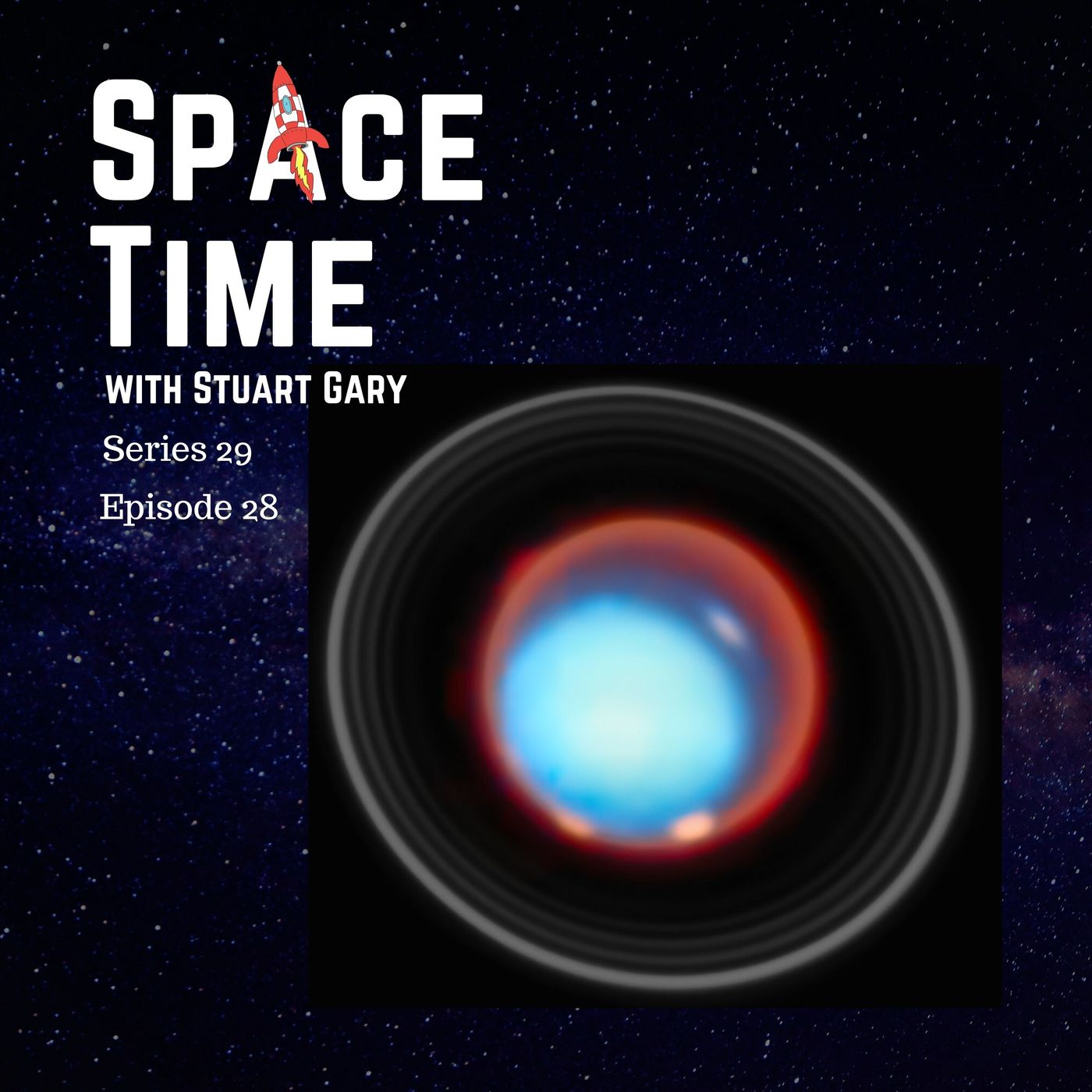
Uranian Auroras and Planetary Defense: Unveiling Cosmic Mysteries
About this episode
In this episode of SpaceTime, we dive into the groundbreaking mapping of Uranus's upper atmosphere, the European Space Agency's innovative Planetary Defense Fly Eye Telescope, and NASA's critical findings on Boeing's Starliner spacecraft.
Mapping Uranus's Upper Atmosphere
A new study has successfully created a three-dimensional map of Uranus's upper atmosphere, revealing how the ice giant's unusual magnetic field influences its auroral activity. This detailed mapping, reported in Geophysical Research Letters, shows emissions from molecules located up to 5,000 kilometers above the cloud tops, confirming a cooling trend over the past 30 years. The research highlights the complex dynamics of Uranus's magnetosphere, which is tilted and offset, leading to unique auroral patterns unlike any other planet in our solar system.
ESA's Fly Eye Telescope for Planetary Defense
The European Space Agency is developing the Fly Eye Telescope, designed to detect Near Earth Objects (NEOs) that could pose a threat to Earth. Inspired by the compound eye of insects, this innovative telescope uses a unique design to scan vast areas of the sky efficiently, identifying potential impact risks. With plans for a network of these telescopes, ESA aims to enhance our capability to monitor and mitigate the dangers posed by asteroids and comets.
Nasa's Scathing Robert on Boeing's Starliner
NASA has released a critical report detailing the failures of Boeing's CST-100 Starliner spacecraft, highlighting engineering vulnerabilities and internal mistakes that jeopardized crew safety. The investigation found Starliner less reliable for crew survival compared to other manned spacecraft, leading to a recommendation that no further crewed flights occur until all technical issues are resolved. The report underscores the need for stringent oversight in space missions to ensure astronaut safety.
www.spacetimewithstuartgary.com
✍️ Episode References
Geophysical Research Letters
Support our podcast: Become a supporter.
Get every episode summarized
Each time SpaceTime with Stuart Gary publishes, we email you a written briefing from the transcript — the topics, who appeared, and any specific claims, with the ad reads skipped.
Email me new episodesFree for 3 shows. No card needed.
Hosts & guests
Transcript ready
489 searchable segments. Every word is indexed and playable.
Full transcript
SpaceTime with Stuart Gary — Uranian Auroras and Planetary Defense: Unveiling Cosmic Mysteries. Machine-transcribed; use the interactive transcript above to jump the player to any line.
Hey there, it's Ryan Seacrest for Safeway. It's a stock up savings time. Now through April 2nd, spring in for store-wide deals and earn four times the points. Look for in-store tags to earn on eligible items from Oreo, Hagen Doss, Charmin, Tide, Sparkling Ice, Reese's and Special K. Then clip the offer in the app for automatic event-long savings. Stack up those rewards to save even more. Enjoy savings on top of savings when you shop in store or online for easy drive up and go pick up or delivery. Restrictions apply. See website for terms and conditions. Tyler Reddick here from 2311 Racing. The rush of racing? Nothing beats it. But Chumba Casino comes close. Chumba's got fast spins, fun games, daily bonuses, and all the action you can handle. Now that's a ride. Ready to hit the throttle? Get in the driver's seat and head to chumbacasino.com. Let's Chumba. Sponsored by Chumba Casino. No purchase necessary. VGW Group Void where prohibited by law, 21 plus terms and conditions apply.
The space-time series 29 episode 28 for broadcast on the 6th of March, 2026. Coming up on space-time. Mapping the mysterious upper atmosphere of Uranus. Ace's planetary defense fly-eye telescope and NASA's scathing report on Starliner. All that and more coming up on space-time. Welcome to space-time with Stuart Gary. A new study has mapped the upper atmosphere of the distant world of Uranus for the first time. The new three-dimensional map, reported in the journal geophysical research letters, reveals how the ice giant's unusual magnetic field shapes spectacular auroral activity above the planet's cloud tops. Astronomers observed Uranus finially a full rotation,
detecting the faint glow from molecules up to 5,000 kilometers above the clouds. The new work provides the most detailed picture yet of where the planet's auroral activity forms and how energy moves through its atmosphere. It also confirms that Uranus' upper atmosphere has continued to cool over the past 30 years. Auroras occur when energetic particles become trapped in a planet's magnetic field and strike the upper atmosphere, releasing energy that creates a signature glow. Using NASA's web-space telescopes infrared spectrograph, the authors map down temperature and density of ions in Uranus' ionosphere, a region where the atmosphere becomes ionized and interacts strongly with a planet's magnetic field. The measurements reveal that temperatures peak between 3,000 and 4,000 kilometers above the cloud tops, while ion densities reach their maximum around 1,000 kilometers up. The studies lead author, Pollitzer-Ranty, from Northumbria University, says it's the first time scientists have been able to see Uranus' upper atmosphere
in three dimensions and trace how energy moves upwards through the planet's atmosphere and even see the influence of its lopsided magnetic field. You see, Uranus' magnetosphere is one of the strangest in the solar system. Unlike Earth, where the planet's magnetic field is relatively aligned with the planet's rotational axis, Uranus' magnetic field is tilted by nearly 60 degrees and offset from the planet's center. Why do you, the planet also rotates on its side? And all this means Aurora sweep across the surface of Uranus in really complex ways. The web observations detected two bright auroral bands near Uranus' magnetic poles, together with a distinct depletion of emission and ion density between them, a feature likened to how magnetic field lines guide particles through the atmosphere. Similar dark origins have been seen at Jupiter, where magnetic field geometry controls particle flow. The web data also confirmed that Uranus' upper atmosphere is still cooling, extending a trend that began back in the early 1990s.
The team measured an average temperature of around 426 kilvons, about 150 degrees Celsius, lower than values recorded by ground-based telescopes or previous spacecraft observations. This is space-time. Still to come, the European Space Agency's fly-eye planetary defense telescopes and NASA's scathing report, unbowing starliner spacecraft. All that and more still to come, on space-time. The European Space Agency's fly-eye planetary defense telescopes are hunting for space rocks heading towards Earth. Asteroids, comets, and meteors pose a constant threat to our planet. And it's not a case of if another space rock hits the Earth. It's a case of when.
So, current inhabitants of this planet need to learn how to keep themselves safe from the next big one. The Chicksaloupe asteroid impact is probably the most famous space rock to hit this planet. The 10-kilometer-wide asteroid crashed into the Earth in what is now Mexico's Yucatan Peninsula, some 66 million years ago, causing a mass extinction event that killed over 75% of all life on Earth, famously including all the non-avian dinosaurs. While extinction event impacts a rare, small and medium-sized space rocks are far more common, and they can still do a lot of serious damage when they hit the Earth. Now while some of these asteroids hit the ground, others disintegrate in the Earth's atmosphere, what's called an air burst, like the one which caused the Chilna Blinks to vent in Russia back in 2013. They can create explosive events, resulting in shockwaves that shattered glass and splinter wood, damaging or destroying buildings, and injuring anyone who happens to be in the way of the debris. The term near-Earth object or near refers to any natural celestial body,
like an asteroid, comet or a meteor, whose orbit brings it close to that of planet Earth. So far, more than 36,000 near-Earth objects have been identified, and 1700 of them are on the European Space Agency's risk list, meaning they merit much closer follow-up observations. And that's where the European Space Agency's Planetary Defense Office comes in. It's designed to understand the current and future position of near-Earth objects relative to our planet. It will estimate the likelihood of an Earth impact, assess the consequences of any possible impact, inform relevant parties such as governments and national emergency response agencies, and develop methods to try and deflect hazardous asteroids, comets and meteors away from the Earth. To help achieve these goals, this is developing a network of fly-eye telescopes designed to scan the sky's forrogastaroids, comets and meteors, automatically flagging any that pose an impact risk. Fly-eye was inspired by the compound-eye structure of an insect.
It uses a single mirror inside the telescope, collecting light from a full-filled view of the sky. And it then feeds those photons to a pyramid-shaped beam splitter with 16 facets, which then divides it all into 16 separate tubes. The secondary lenses inside these tubes focus the light on individual cameras, subdividing a region of the sky into 16 smaller images, the grant a higher level of image quality over the telescope's large field of view. By placing fly-eye telescopes in both the northern and southern hemispheres, the entire sky can be scanned every 48 hours. So far, 256 centimeter test bit telescopes are primarily used to test data processing, currently being developed for the fly-eye telescope array. One of the telescopes is located in Madrid, another at the La Silla Observatory in Chile at the European Space Agency's partner organization, the European Southern Observatory. This report on fly-eye from ESA TV. Hi, I'm Kelsey Brennan-Wassels for ESA Web TV.
We join you from Milan, Italy at OHB, Italy, where a new high-tech telescope to detect asteroids is being built. Traditional telescopes have a narrow field of view, which makes hunting for threatening asteroids a slow and tedious process. But the fly-eye has 16 individual cameras, mimicking the structure of a fly's compound eye to offer an extra wide field of view of 44 square degrees. With this field of view, the telescope will be able to detect asteroids at risk of hitting Earth in as little as a week in advance. An additional three telescopes are foreseen to be produced and placed in complementary locations around the globe to increase coverage and improve the efficiency of the network. Once this first fly-eye telescope is completed, it is destined for Mount Mufara on the Italian island of Sicily. The telescope has to be mounted, has to be associated to an equatorial mount. Equatorial mount is a particular mount that allows to avoid that during the exposure time,
the stars track and the stars in this way remain fixed in their position when we take a picture from the telescope. And while the telescope is taking its pictures, it's important that the structure is very stiff in order to reduce vibrations that could blur the image and thus reduce the capability to detect very faint objects in the night sky. And in that report on fly-eye from ACTV, we heard from fly-eye senior article in Jean-Marco Tiorini from OBEH Italia. This is space time. Still to come, NASA's scathing report on Boeing's Starliner spacecraft and later in the science report, it seems warmer weather is causing humpback whales to swim closer to shore in the process, becoming more likely to be entangled in fishing equipment. All that and more still to come on space time. Are you a fraud-paying American? It's a fact that one in four honest, hard-working tax-paying
Americans has been a victim of identity theft. With life-lock identity theft protection, though, if your identity is stolen, they fix it, guaranteed, and get you your money back. Last year, the IRS flagged over $16 billion in refunds for identity fraud. That's billions of dollars that could come from your salary, overtime, or second job. But this year, you don't need to stay a victim. Life-lock monitors millions of data points per second for your personal information and alerts you to threats you could easily miss on your own. And if your information does fall into the wrong hands, only life-lock has US-based restoration specialists who are backed by the million dollar protection package. Because this tax season, fraud-paying American is something no Americans should have to claim. Visit lifelock.com slash iHeart and save up to 40% your first year. That's 40% off at lifelock.com slash iHeart. Terms apply. Drew McIntyre here from WWE. Wheeled in the Claymore can be a life of chaos. When I'm not dominating in the ring,
Chumba Casino is how this warrior takes a wee break. With hundreds of online social games and new weekly releases, there's always something fresh to try. And those daily busts, next level, even my free time feels like foul-halla. So when life feels like a battle, kick up your feet, have some fun. And let's Chumba. No purchase necessary, VGW Group Boyd were prohibited by law, CTs and Cs, 21 plus sponsored by Chumba Casino. Nasser is finally released its report into the many failures of Boeing's CST100 Starliner spacecraft and its findings are scathing. The investigation blame what it called engineering vulnerabilities in Starliner, along with internal agency mistakes, which resulted in a botched mission that left two astronauts stranded in space. The report found that Starliner is less reliable for crew survival than other manned spacecraft. And that Nasser should not fly another crew on Starliner until all the technical issues are fully understood and corrected. And importantly, its problematic propulsion system is fixed.
Following the premature mothballing of its highly successful space shuttle fleet after SDS 135 back in 2011, Nasser awarded contracts to Boeing and SpaceX under its commercial crew program for two independent spacecraft systems to transport astronauts to and from the International Space Station. SpaceX developed a dragon spacecraft while Boeing offered the Starliner. Nasser also established similar programs for the delivery of cargo to the orbiting outpost under a separate resupply contract with SpaceX and orbital sciences later Northrop Grumman winning those contracts with a dragon and Cygnus cargo ships. So far, dragon cargo was undertaken 36 missions to the space station while Cygnus has carried out 23. And the crew version of SpaceX's dragon has proven to be just as successful with some 23 manned missions now under its belt. But the record for Boeing's Starliner is far less attractive. In fact, it's downright appalling.
There've been just two unmanned test flights, the first of which almost ended in disaster. And the one manned test flight that surf had been undertaken had to be abandoned halfway through marooning the crew on the International Space Station for seven months. The Nasser report says Starliner faced challenges both during its unmanned and more recently manned missions. Nasser administrative Jared Isaacman says the technical difficulties encountered during docking with the International Space Station were very apparent. He says Starliner has lots of design and engineering deficiencies that need to be corrected. But for him, the most troubling feature revealed by the investigation wasn't the hardware, but the decision making and leadership at Nasser and Boeing. Isaacman says beyond technical issues, it's clear that Nasser permitted overarching program objectives to influence engineering and operational decisions. The ensuing investigation identified an interplay of combined hardware failures, qualification gaps, leadership missteps and cultural breakdowns
that created risk conditions inconsistent with Nasser's human flight safety standards. Starliner was launched on June the 5th, 2024 on its first manned test flight to the International Space Station. Originally planned to be a 14-day mission, the flight was eventually forced at to 93 days after propulsion system failures hit the spacecraft in orbit. Because of the loss of spacecraft maneuverability as they approached the International Space Station, Nasser has now classified that test flight as a type A mishap. That's the same classification as the deadly challenger and Columbia space shuttle disasters. While there were no injuries in the crew eventually regained control prior to docking, the decision to give it the highest level classification designation recognizes that there was a potential for a significant possibly fatal mishap. After reviewing the flight data and then conducting ground tests at the White Sands missile range in New Mexico, Nasser decided to return the spacecraft to Earth empty with no crew on board. Starliner did eventually land safely at White Sands
in September 2024. But the stranded crew were forced to remain on station until March 2025, when a dragon spacecraft was sent up by Boeing rival SpaceX to rescue them. This is space time. I'm going to make him an offer he can't refuse. With family, conoles, and spins mean everything. Now, he want to get mixed up in the family business. Introducing the Godfather at choppercicino.com. Test your luck in the shadowy world of the Godfather slot. Someday, I will call upon you to do a service for me. Play the Godfather. Now at choppercicino.com. Welcome to the family. No purchase necessary VGW group void were prohibited by law at 21 plus terms and conditions. The world's best service, the world's best service. The world's best service. The world's best service. The world's best service. The world's best service. Both were prohibited by law at 21 plus terms and conditions apply. And time out of tech,
another brief look at some of the other stories making using science this week with The Science report. The United States Department of War has selected Pratt & Whitney to power its new 6th generation stealth jet fighter, the F-47. The XA-103 adaptive cycle engine was selected ahead of General Electric's XA-102 power plant. The three-stream adaptive cycle design design can direct air to the bypass 3rd stream for increased fuel efficiency and cooling or to the core and fan streams for additional thrust and performance. The engine thrust hasn't been disclosed, although it's expected to be somewhere in the 35,000 to 40,000 pounds of thrust class. The new F-47 Fighters expected to reach speeds in excess of Mach 2.2 and have a ceiling of 65,000 feet. All that's comparable with the current F-22 Raptor, currently considered the best air superiority fighter ever built. But the F-47 will also support more advanced systems, including AI integration, drone coordination and potential future-directed energy capabilities.
Eventually, the F-47 War replaced the F-22 Raptor. It's expected to undertake its first test flight in 2028 with operational entry currently targeted for the following year, the US Air Force plans to procure an initial 185 aircraft. The new study has found that warmer weather is causing humpback wells living off the west coast of the United States to become entangled in fishing equipment more frequently. The findings reported in the General Plus climate show that high-SE surface temperatures are pushing wells closer to shore as they follow their food supplies. The authors found a 300% increase in fishing gear and tacklements during warmer years. The study shows that during major marine heatwave events such as 2015 and 2016 record numbers of entanglements were recorded. And scientists have finally figured out what makes sneakers squeak. Using high-speed imaging, the authors found that when basketball shoes slide on a polished court, the resulting squeak is caused by deformations in the soft material rippling across the
surface. The findings reported in the General Nature used high-speed imaging to capture the rubber sols pulsing in bursts across the court, finding the pitch of the squeak matches the red of the burst, which is determined by the stiffness and thickness of the shoe sole. In additional experiments with other samples, the authors showed that if a soft surface is smooth, the pulses are irregular and produce no sharp sounds. Whereas rigid surfaces, like the grip patterns on sport shoes, produce consistent pulse frequencies resulting in high-pitched squeaks. And these findings aren't just bellybutton fluff. They could also provide new insights into the effects of a range of friction situations from synthetic materials to geological fault lines. It's been revealed that a lab at the University of California Los Angeles was studying psychic abilities ghosts and auras during the 1970s. The Paris psychology lab conducted experiments on telepathy and other psychic abilities. But as the skeptics Tim Menden points out, the big problem was that the researchers were
true believers rather than neutral scientists searching for the truth.
He was a fellow who studied psychology at California State University who also said he experienced psychic abilities. He became an assistant, a researcher assistant, which is like saying, I've got someone who believes something trying to prove that the belief is true. That's a problem. There are other people who have psychic abilities they claim and this one person who referred to who volunteers, as he also went out and decided that someone he studied had been dealing with polo guys and that sort of stuff. So you have to be careful of people with a prior belief acting as your neutral umpires in a scientific experiment. It eventually closed after a while and it sort of disappeared. A bit of that's why it's a bit of an unknown psychology laboratory, as opposed to others. There was Stanford Research Institute, had a long-running one that was funded by the CIA, CIGA, Sam Targ and put off with it for a long, long time and some of them are still commentators on the field. Harvard had a, maybe Duke University who had a long-running laboratory to test psychic abilities way back to the 20s. He was one of the uses of the Zina cars, the X and the Y, X and the Square and the Circle and that sort of stuff. It's been more famous for parapsychology labs, none of them have produced definitive evidence
of psychic ability. That's not to say that these things weren't legitimate at the time because the idea is to find out if they were because we didn't know. That's right, that's right. That's perfectly good to do that and with some of the skeptics which endorse, do some proper scientific evidence, but watch out for the way you're doing it. And in many cases, these things were particularly slack. I mean employing someone who believes in this thing as your assistant who is going to be testing people means it's the vibe in this, right? That's not good. Allowing your subjects to wander freely and they're being tested as happened with Yuri Geller in the SRI test is not good practice and there are people who go there and look at it. Yes, do the testing, but do it properly, please. And when you look at the test situation, you find there's a lot of loophole and holes in the theories of the practices, which ends up impacting negatively on the results that they supposedly have. That's the skeptics team, Mindham and this is Spacetime. And that's the show for now.
Spacetime is available every Monday, Wednesday and Friday through bytes.com, SoundCloud, YouTube, your favourite podcast download provider and from Spacetime with StuartGarry.com. Spacetime is also broadcast through the National Science Foundation on Science Zone Radio and on both I Heart Radio and Tune in Radio. And you can help to support our show by visiting the Spacetime store for a range of promotional merchandising goodies or by becoming a Spacetime patron, which gives you access to triple-up episode commercial free versions of the show, as well as lots of bonus audio content which doesn't go to where, access to our exclusive Facebook group and other rewards. Let's go to Spacetime with StuartGarry.com for full details. Hey there, it's Ryan Seacrest for Safeway. It's a stock-up savings time now through April 2nd. Spring in for store-wide deals and earn four times a point.
Look for in-store tags to earn on eligible items from Lays, Jack Links, Cheese It, Classico, Hidden Valley and Helmonds. And click the offer in the app for automatic event-long savings. Stack up those rewards to save even more. Enjoy savings on top of savings when you shop in store or online for easy drive-up and go pick up or delivery. Restrictions apply, see website for terms and conditions. Well, what's up, fools? Men of the J.O.S. all here from the WWE. When it's just me between matches, it's day one-ish. And that means it's Chumba time. With hundreds of casino-style games and new titles arriving weekly, there's always something fresh to try at Chumba Casino. The daily booze may get even more fun. And have me, bout to get them all during my downtime. Ready for a fun way to chill out and enjoy a few minutes for yourself? Let's Chumba! No purchase necessary. VGW Group Void were prohibited by law, CTs and Cs. 21 Plus sponsored by Chumba Casino. 21 Plus sponsored by Chumba Casino. 21 Plus sponsored by Chumba Casino. 21 Plus sponsored by Chumba Casino. 21 Plus sponsored by Chumba Casino.
More episodes
More from SpaceTime with Stuart Gary

Comet Births and Neptune's Secrets
SpaceTime with Stuart Gary
Molten Planets and Solar Storms: Unveiling Cosmic Wonders
SpaceTime with Stuart Gary

Dark Matter Signals and Lunar Origins: Exploring the Universe's Mysteries
SpaceTime with Stuart Gary

Discovering Blazars and SpaceX's New Spaceport
SpaceTime with Stuart Gary