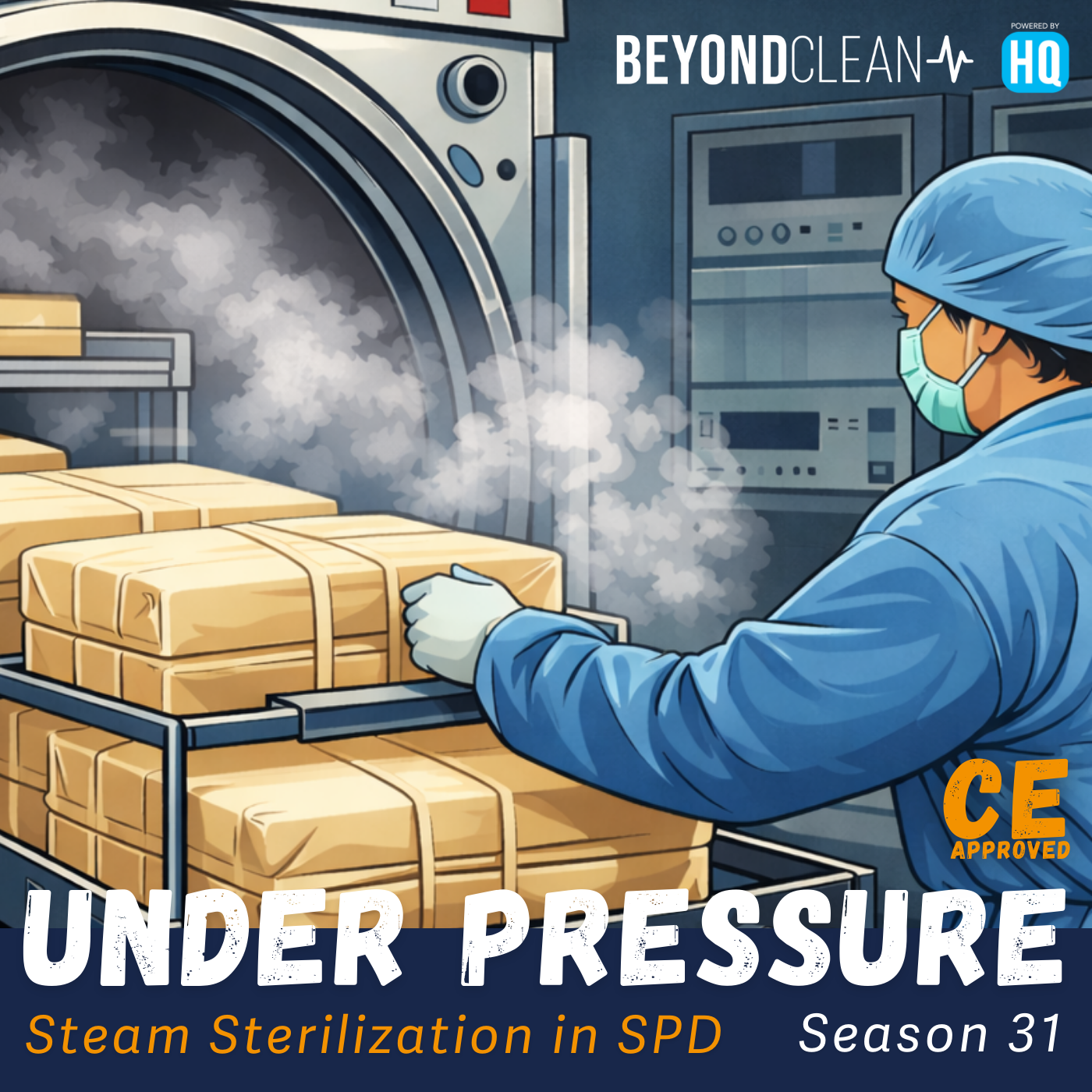
Under Pressure - Full Steam Ahead: A Deep Dive into Steam Sterilizer Anatomy
About this episode
You load trays and hit start on your steam sterilizer dozens of times a day. But do you actually know what's happening inside that chamber once the door closes? This week, we sit down with Jason Simon, Senior Product Manager at Skytron, to break down how steam sterilizers actually work—from air removal and steam jackets to exposure phases and drying cycles. Jason walks us through the critical role utilities play in sterilizer performance, why just buying new equipment won't fix steam quality problems, and what all those numbers on your cycle printouts actually mean. Whether you're troubleshooting persistent wet packs or just want to understand what's happening behind that steel door, this conversation delivers the technical knowledge you need to make smarter sterilizer decisions!
This conversation isn't over! Part 2 with Jason drops next Monday—don't miss it!
After finishing this podcast episode, earn your 1 CE credit immediately by passing the short quiz linked here: https://www.flexiquiz.com/SC/N/episode31-05
Visit our CE Credit Hub at https://www.beyondcleanmedia.com/ce-credit-hub to access this quiz and over 350 other free CE credits.
#BeyondClean #SterileProcessing #Podcast #Season31 #UnderPressure #SteamSterilization #SteamJackets #SteamExposure #Performance #WetPacks
Get every episode summarized
Each time Beyond Clean Podcast publishes, we email you a written briefing from the transcript — the topics, who appeared, and any specific claims, with the ad reads skipped.
Email me new episodesFree for 3 shows. No card needed.
Transcript ready
363 searchable segments. Every word is indexed and playable.
Full transcript
Beyond Clean Podcast — Under Pressure - Full Steam Ahead: A Deep Dive into Steam Sterilizer Anatomy. Machine-transcribed; use the interactive transcript above to jump the player to any line.
And I think there's advancements that we're doing with steam sterilization. You know, what can we do to make the machines more reliable like I discussed, but also what can we do to help shorten cycle times? Not without risking any type of efficacy of the product afterwards, but what can we do to shorten that dry time to make them more effective to discourage, you know, the use of the media use cycles to help our customers take those turnaround instruments and make that a more efficient, more safe preparation process. Rising above the buzz of ultrasonic cleaners and the clinking of stainless steel are the ideas and voices that are changing an industry. You're listening to the Beyond Clean podcast, the central nexus for the people, processes, and products that are improving our sterile processing world. Each week we speak with frontline technicians, CEOs, engineers, and entrepreneurs with a common goal
to help you fight dirty every instrument every time, whether you're tuning in for education or inspiration or glad you did. Now turn on those washers and turn up the volume. It's time to go beyond clean. All right, clean freaks. Welcome back to another episode of the Beyond Clean podcast. You're listening to season 31 under pressure, all about steam sterilization. I'm your host, Bobby Parker, and joining me for this whole season is our special co-host for the season, Melissa Morgan. Melissa, welcome back to the studio. Thank you, Bobby, so glad to be here. Excited to be in the season and moving right along. Yeah, for sure. It's funny, Melissa, we've done quite a bit on the steam sterilizer season, but we haven't talked a tremendous amount about steam or a tremendous amount of about sterilizers.
All of it's been ancillary to that. I definitely looking forward to diving more into some sterilizer anatomy and kind of the importance of just the individual pieces of a sterilizer because they can make a big difference. Absolutely. I'll never forget the first time I told a team to pull that drain plug. I'm sure it hadn't been pulled in a good five to seven years, so it was a pretty sight and grossed out a few folks pretty quickly. That's funny. Good reason that that operator manual says to check it every day. Exactly. I was shouting it was still working after it hadn't been checked that long. Yeah, kudos to that sterilizer. That's funny. I'm thinking about sterilizer stories. The ones that come to mind are just the gaps that I've made as a technician. I was one of those that accidentally put the plastic sticker gun on the carriage. In between, they tell you never said it on the carriage because you're going to forget it. Well, I did. So the thing came out
in a twisted melted mess. Yeah, just just a mess. But anyway, steam sterilizers love them or hate them. They're here to stay. They've been around since since SPD was a thing and they're going to continue to be around because they're so effective at what they do and steam is relatively cheap to produce. So we're going to keep using it. So it's best that we get to know these pieces of equipment that we work with every day and we've got some great questions here for our steam sterilizer expert Jason Simon, senior product manager over at Skytron. We'll be back with Jason right after a quick break. Are your SPD and OR departments struggling to keep up with demands? Learn how the StereQ multi-trace sterilization system can improve patient safety and throughput by eliminating many steps in your workflow. Reduce costs, OR turnover time, IUSS and surgical delays and increase confidence in sterility and staff satisfaction. The StereQ is the only container
FDA cleared for sterilizing lumens as narrow as .7 millimeters and as long as 850 millimeters with no limitation on quantity. To find out how you can save significant time and cost by using the StereQ go to www.thestereQ.com. That's T-A-G-S-T-E-R-I-C-U-B-E.com. In a world of AI automation robots and advanced technologies, the future is now and it's time for every sterile processing department around the country to start considering DSI's new high-density robotic storage system for those hard to handle DaVinci instruments. This new system is a game-changer, designed specifically for peel-packed or blue-rapped robotic instruments in a manner that exceeds industry guidelines. Conor the days of using ChromeWire cards made for the food and beverage industry 50 years
These DaVinci tips are expensive and extremely valuable for every hospital. It's time to protect those instruments in a specialized system offered exclusively by DSI. The instruments lay on their back and individual compartments running lengthwise in the tray and could store up to 108 arms within one cart. DSI's new system will protect DaVinci tips like no other system in the marketplace today. In a world controlled by robots and change coming at us in lightning speed now is the time to take action and connect with DSI. Contact DSI at dsidirect.com to find out more that's dsidirect.com From the studios of healthcare HQ, you're listening to Beyond Clean, the global voice of sterile processing.
And joining us now in studio is Jason Simon Senior Product Manager at Skytron here to talk to us about steam sterilizers. Jason, thanks for joining us on the show. Welcome to the studio. Thanks Bobby. Thanks Melissa. Thanks to you invite. Happy to be here. Yeah, absolutely. We're we're excited to to have you on the season. It's been a good season so far talking through steam sterilization but as Melissa and I were chatting about it, we really haven't done a whole lot of steam or a whole lot of sterilizer in the steam sterilizer season yet. So yeah, I'm looking forward to diving into that. But before we do, Jason, I'd love to give the audience an opportunity to to get to know you. You want to give us a quick thumbnail of what you've been doing in the industry? Thanks Bobby. Yes, I've been in the industry for almost 30 years now. Started as a SP technician between semesters in college and worked my way up through the hospital system into orthopedic implant prep position and then worked into capital equipment product management and
clinical specialist at Skytron. Okay, so you've you've kind of seen the whole gamut of the works. We've talked to a couple of people on this season, but I mean throughout the seasons for that matter about how they find sterile processing. I'm curious, how did you end up in college in that SVD job? Interesting. It was a entry-level position and the hospitals near my apartment, they were hiring and they had paid more than other entry-level positions in the hospital. And it seemed interesting. I did not know much about it getting into it and ended up making career out of it. Yeah, how about that? It is funny how much more interesting it ends up being than when when you look into it. You know, my story was transferring from another entry-level job. I was waiting tables at a cracker barrel and ended up in sterile processing, you know, kind of picturing the dish room in the back of the cracker barrel is, you know, what I thought I was getting myself into, but just yeah, loved it. All of the all the learning, the science, the involvement in the OR, the the degree to which patients depend on us. Yeah, really fascinating stuff.
All right, so one more follow-up question on your story. You said you got into orthopedic implants after after doing sterile processing. I hear at least starting out that can be a bit of a lifestyle and kind of a burner job like it's pretty pretty intense. How'd you find your way into that? I kind of end up being the lead technician to prepare most of our consign trays for the orthopedic implants stuff and one of the vendors needed assistance and that's how I got in and kind of my way up from a customer service role there transporting equipment all around the state along with the implants and then moved into a junior sales role there. But yeah, you're correct. It was high stress, high impact job that especially when you started getting in the trauma and found what I like doing now. Yeah, very cool. Well, one of the things I love about that story is, you know, we're all the time talking about growth on the show and all of the, just the multi-faceted ways that this entry-level job that we affectionately call sterile processing is so interconnected.
I mean, what other healthcare job are you going to have those relationships with vendors, the relationships with the operating room, with educators, with leaders? It's just, yeah, if you're in the right spot at the right time, there's just a tremendous number of ways to grow in the industry. Even if it's within the vertical in the industry, you know, we've talked to HSPA presidents on the show before. So anyway, that's the growth plug for today. Jason, we've got a lot to cover today. So I want to jump into steam sterilizers. Now, as a product manager at SkyTron, and then with some background in SPD, you've probably got a pretty good idea of, you know, how these things work. But we always try to start at the level of definitions. We don't know who might be new at joining our joining our episode today. So why don't you walk us through just a basics of, you know, what happens behind that magic steel door? Like how, you know, how is a sterilizer steam sterilizer accomplishing sterilization? And like, how does it do that?
Yeah, fair enough. When I was a technician, I knew the working end of the sterilizer, and what it's supposed to do, and what cycles to run, and how to repair the instruments going in, but I had no idea of the mechanics of how it actually functioned behind that. So that's, yeah. Great segue. Now I've learned more than I ever bargained for in the position. And now, so yeah, first, I guess, starting out with a sterilizer, there's a chamber. And that's what you can see when you're opening the door and loading your contents in. Beyond that, there's a steam jacket that's around that chamber. And that's the beginning of the portion that the regular operator cannot see. What that steam jacket is, it's a sleeve or a compartment around the chamber that is filled with steam. And that's maintaining a specific pressure and a temperature in order to keep our instrumentation packaging dry at the end of the cycle. So even temperature, consistent temperature throughout the chamber, and it also helps remove moisture from the steam.
So we are helping to mitigate wet loads from that steam jacket. Beyond that, you know, what the sterilizer does is, primarily, its first function is to remove air from that chamber. Typical, everybody in the industry knows about Bowie dick tasks. What you're doing with that is, you're showing any type of residual air that's left in the chamber. That residual air represents areas where steam cannot make contact to your instrument service. So the way that the air is removed is either with a vacuum pump or what's known as a venturi system. And depending on how specific you want to get with a venturi, it's basically water that's going through a system that helps pull it back and down to remove air. And that's one thing where they start getting into utility issues and water pressures that can start affecting those reforms of the sterilizer that way. I had to learn that the hard way, Jason. We had a water outage in our department. And we're like, okay, well, you know, you can't use the washers,
but at least we'll still have our sterilizers because that's getting supplied by a house steam. Nope, they all started alarming for that very reason. They couldn't run the vacuum pump to pull the vacuum for our pre-vax cycles. So yeah, who knows? Who knew that that utility piece would be important? Same thing was true of compressed air. There were some pneumatics in our sterilizer. And so sterilizer wouldn't run when the compressed air went down, you know, several floors above us. We had this giant compressor that fed our department and a couple others. And if it ever had an issue of how all the sterilizers quit working. So yeah, it's really important to know that. Yeah, it quite often said, in the best of your tutorial process on how to learn what's not functioning correctly on a sterilizer. Sometimes it can be seasonal. Sometimes it can be, you know, specific on what else is going on in the building. You know, just to tell a quick story, we had an issue that one of my colleagues told me about years ago where we had a wet loads that were happening at a specific time in the morning. And of course, they wanted to
send their technicians and, you know, not during peak hours to diagnose what was wrong with the unit. Couldn't find anything replaced a few parts just for cautionary. The same problem would happen. Sales rep ended up going out to the facility the next day. That same time of the morning found that all the water sprinklers and the parking lot were watering all the bushes and the grass, everything. What had happened was the building's water pressure was being focused more on the lawn care at the hospitals pulling water pressure away from the SBD. So that's why they were getting wet loads at that certain time in the morning, but no other else in the rest of the day. So just. It is complex the connections with the various utilities. Yeah, it's never the most obvious answer. Is it Melissa like this? No, like you have to really walk the walk. I mean, based on that, you can't assume that a malfunction or an alarm is just as basic as the alarm you anticipate, right? Like
and so it really, I guess that's the importance of a multi-disciplinary approach to what's going on in SBD. Is that what you would say, Jason? Yeah, definitely. And you know, where the why the water was so critical to this functionality is that's what's used to pull the vacuum inside the chamber, which is critical to removing all that residual air. And so are with the sterilizers doing at that point once it is effectively removing the air than it's pressurizing with steam. So you basically have atmospheric pressure and then you're doing a what's called a pulse where you're pulling it back in and repressurizing with steam. And typical amy-recommended parameters for cycles would have you do four of those pulses. And that's all in an effort to make sure that you have removed all that residual air from the chamber. And then once that chamber preparation process is completed, then you actually get into your exposure time and your temperature. And the rest of the cycles pretty much your vacuum system
trying to pull all that moisture and steam back out of the chamber, back out of all the packaging to make sure you're getting dry, no droplets, no moisture issues with your load contents afterwards. Yeah, so some homework for the audience. If you've got an extended printout on your sterilizer, you can see that activity happening in the conditioning phase. It'll pull big vacuum and then a pressure spike and then a vacuum and a pressure spike and probably four times over. And then it'll just have that high pressure steam for the exposure phase. That is if you're running a running a pre-VAC cycle. Jason, coming from a manufacturer's perspective working with facilities, I can imagine the first finger that gets pointed whenever we're having these persistent wet pack issues related to the sprinklers outside is these darn sterilizers just don't work right? Like we we need a different piece of equipment in here. So yeah, I think it's it's helpful to think through like sometimes it's sometimes it's not just about like the name brand on the piece of equipment
that you're working with. But like are we are we meeting all of the utility requirements, the the processing steps that are best practice to get a to get a sterile and dry package out of this piece of equipment? Because I mean in some senses steam sterilizers, steam sterilizer, and so we got to do the right thing by them. One more thing before we move on, I wanted to ask you about so and you know this isn't like this isn't a chemistry show, so we don't have to get too crazy with it. But why is it that putting you know in the absence of air just high pressure steam in a chamber with instruments? Why does that give us sterile instruments? Like what's going on on those instruments with with the steam? Yeah, great question. It's basically your high temperature steam is making contact with any microorganisms that are on the instrumentation itself and then you're denaturing the cell of those organisms so they cannot you know continue to grow and produce.
So there may still be organisms there but you've rendered them ineffective where they cannot grow anymore. I've always thought that was kind of interesting like the idea of you know dead microorganisms still potentially on the instrument. You know it may be related to that you know Aimee ST-108 came out I guess it was last year and there's all this talk about endotoxins of you know little bits and pieces of bacteria that are dead you know they're broken up but they're still in the water and can cause a problem for patients. What I was thinking about endotoxins in water it brought up this question for for instruments for me if we have an instrument that's got you know microorganisms on it and the steam sterilizer isn't removing those but just killing them. Why don't we have more endotoxin like issues with surgical instruments that are sterilized with with steam? That is a good
question. Some of it is tracking like how many of the patient infections that we do are really traced back to the sterilized instruments. I think steam is still the most effective and most efficient way to sterilize instrumentation. I've been involved with other low-temperature sterilization systems in the past but as a manufacturer representative I am a big fan of ST-108 now that we can get more consistent utility water qualities to our equipment we can expect higher performance for more reliability from that equipment as well and one of my mentors early in my career was always said you can't sterilize dirt so the instruments do need to be effectively cleaned before they go into the sterilizer so endotoxins would definitely follow that category. Now they just from an infection prevention perspective Bobby we're really learning and understanding the implications of endotoxins and you know when we talk about infection prevention in general
we really connect that this is not a one stop shot right we do a lot of things in surgery to prevent infections including steam sterilization right or irrigation post wound closure or you know pre-dosing antibiotics and so I think all of those things are combinations to help that but to Jason's point getting rid of as much my burden as possible eliminating it is the first step in all of it. Yeah for sure and you know to your point Jason of like the contrast of different options we have for sterilization there's no doubt that steam sterilization is the best tool that we've got like it's for good reason that that has been both kind of the first in the market for instrument sterilization but you know a couple hundred years ago versus you know chemical soaks or low temp sterilization you know forgive the violent analogy but in some sense it is kind of you know the nuclear bomb of sterilization like there's so much margin of error that's
that's built into it with us having exposure time at double the amount of time it would take to destroy those microorganisms and certainly the data of outcomes for patients bears that out so as more just more just one of those you know late night thoughts because that's what puts me to sleep at night is thinking about wait a minute what where do these little bits and pieces of microorganisms go maybe maybe we'll never know all right so Jason you mentioned being a big fan of ST 108 and water quality one of the things that that has brought up is just a conversation of sterilizer feed water not just not just the steam quality of what's coming from the house boiler down in the basement but some of these sterilizers that have their own steam generator on it and the need for critical water for that now that's getting more and more common in the industry but for those who haven't seen one of those or maybe aren't familiar like what is one of those kind of steam generating sterilizers like how does that how does that technology work yeah great question
we see a lot of need for self generating sterilizers in the market especially the growth of the ASC market a lot of those facilities for not built with steam generation capabilities in mind so customers are wanting that self-contained unit industry and you know saying that we hear a lot you know the one throw the choke they don't want to call a technician for the sterilizer and then find out it's actually a steam issue that's you know on the other side of the building and have to call somebody else that way too so there's some efficiency and an operation that way as well too a lot of these ASCs as you're probably aware you know they were maybe built for your tubes and cataracts now they're trying to do orthopedics and spine so being able to grow and handle that increased workload without expanding their space you know is a critical issue for them and having self-contained sterilizers help them with that task you know I think you really hit on something you know some of us have been through changes in equipment and you know
because it's a construction zone you're usually not there to see it so what's the magic behind actually getting one of these huge pieces of equipment inside of a hospital that's built yeah that's part of what we try to train not only in our sales area but on our service technicians is to treat each situation like that you know it's an individual basis because it is it's uh quite often we're we're telling them to map out point A to point B like where are you going to uncreate the sterilizer what are you going to do with the creating material and then how do you get it from point A to point B are there elevators with weight restrictions are there high requirements are there ramps that you have to take in or inclines and always that you have to prepare for so you don't you don't want a 4,000 pound sterilizer on a runaway train going down the public hallway I've seen some creative things that you know technicians have made friends with
crane operators working on the building across the street or whatever the parking lot that they will help load a sterilizer down the staircase to get into the basement something like that but there's been some creative things I've got some videos of technicians driving around a high low with the sterilizer on a dodging traffic you know trying to get to the receiving back so it's like and then a lot of these smaller ambulatory surgical centers like I described you know they don't have receiving docs you know quite often they're in a medical office building something like that so we have to really prepare for that and treat it on an individual basis yes there is there any degree to which the equipment slims down or gets taken apart some to get it to its final location or do you pretty well just have to find either a window you can take out or a elevator big enough or say sorry you got to get the smaller model of the sterilizer usually we'll find a way whether it's taking a part a door situation or we can't do disassembly of the sterilizer to a certain point to get it through doorways there's some facilities we've seen look like the
the hospital was built around the 30-year-old sterilizers in real place so you know we usually if it got in there it can get out and we can get a new one back in so yeah yeah that is a good sign if it's there funny funny story I wasn't there when it happened but our department went through a went through a renovation and we were up on the second floor and had some exterior windows which was nice like not not super common in in sterile processing and I hear they took one of those giant windows out and hoisted the sterilizer up on a crane and fed it in through the window to get it into place so I wish I was there with my cell phone out I would have would have liked to have seen that but it's just one of those pieces of steam sterilization that we don't really think about is like how did this massive piece of equipment get put here I'm even more curious about the cart washer because that thing is humongous so yeah that will usually ship and buy sized pieces and then it gets assembled like inside I don't I don't see how it could be any other way all right Jason well I want to give you the final words here we've got a little bit of time left
but you know we talked a little bit about anatomy you know the chamber the jacket some you know drain and traps stuff how steam sterilization works he answered my personal curiosities about about microbial life on instruments but are there any just you know big myths and misconceptions that you encounter out there in the industry related to steam sterilization that you want to set straight here on the show sure I think I've even had this from some customers that come in that aren't really concerned about looking at sterilizers begin with they think you know it's such a commoditized item that all sterilizers are the same there are you know you mentioned it's a couple hundred or a hundred fifty-year-old technology now so what more can we do to improve steam sterilization and a lot of that is coming from you know more systems that can be put in to make the system more reliable whether it's water restoration systems that help mitigate the water pressure issues talked about previously by building your own water supply to make that more consistent
quality of the materials there's a difference in how the sterilizers are built you know with full steam jacket versus partial or segmented steam jackets that can not do as great a job as mitigating temperature variation or wet loads I think that the myth that all sterilizers are created equal that's probably the the biggest maybe misconception and I think there's advancements that we're doing with steam sterilization you know what can we do to make the machines more reliable like I discussed but also what can we do to help shorten cycle times not without risking any type of efficacy of the product afterwards but what can we do to shorten that dry time to make them more effective to discourage you know the use of the media use cycles to help our customers take those turnaround instruments and and make that a more efficient more safe for the patient process Jason you hit on an important point for me is that constant
evolution at looking at how we could create efficiencies in our work processes you know for those of us who've been in this world for a long time sometimes it's hard for us to embrace that shortened time do you have any advice on how you know we communicate those because you know I was working I was doing a walk with a partner of mine in SPD yesterday and he just said you know Melissa I just can't get away from 10-minute dry and I was like our 10-minute uh exposure exposure time and I was like what you know so any thoughts on how to help those of us embrace change maybe you know as a good go-to card for myself and how I instruct a lot of our sales reps and technicians around the field is to refer back to the IFU of the metal device that's really the we can't fully deviate from that but what we can do as a manufacturer is that we can you know test to
various metal device IFUs and we can also validate that on our own so we are actually working on some systems right now which would validate shorter cycle times put that into our own sterilize your IFU it would give the end user the the documentation say that they can do this Jason you mentioned and it is a helpful clarification to say that you know not every steam sterilizer is created equal they don't all do exactly the same thing and I'm sure that there's somebody listening who finally got rid of their 1987 steam sterilizer and had hopes and dreams of the new piece of equipment was going to run flawlessly and not break down and they have more downtime with the new piece of equipment than what they had with uh with the old one and that's not an experience anybody would want I guess if you were a sterile processing leader today and doing your homework and your shopping on steam sterilizers like what kinds of things would you be looking into to make sure that you didn't have that experience that the new one is a worse problem than what
you just got rid of yeah that's a great question Bobby thank you and I try not to visually cringe when I hear people customers say this but you know we're having steam issues I want to get a new sterilizer you know that getting a new sterilizer obviously I'm in the business of moving equipment so I want to sell that sterilizer but it's not going to solve your problems the band-aid on the issue there are certain things that specific sterilizer manufacturers can do to help compensate the utility issues but in the long run you know you need to fix the root cause of the problem and kind of circling back to Amy SC 108 that's why I'm a fan of that standard yeah well said and yeah thanks for thanks for your insights really good interview I wish that we had time for a part two here to talk about dry times because my goodness that is that is a hot topic in the industry a lot of questions probably more questions and answers out there about that one but we'll just have to invite you back someday to to talk about kind of the evolution of dry times
and steam sterilization Jason I'm sure folks have additional questions you know we skimmed the surface of a lot of these topics particularly all the bits and bobs of sterilizer anatomy if somebody wanted to get in touch with you to continue the conversation is linked in the best place to do that yeah please search me up on LinkedIn under Jason Simon where you can also reach out to me and my work email it J S I M O N at Skytron awesome well thanks again Jason really good interview and look forward to talking to you again sometime soon thank you Bobby thank you and that was Jason Simon senior product manager at Skytron talking to us about a little bit of sterilizer anatomy you know this is one of those topics that is probably best learned via diagram or hands-on experience but there's only so much as he mentioned in the interview that you
can figure out as that frontline technician you know we're trained on you know how to load the carriage and get it into the chamber and then we close the door and we hit the button and we don't see what happens inside of there or I guess more importantly what happens in the spaghetti of pipes that's in that really hot room behind the behind the sterilizer so we skimmed across the top of it a little bit today but I guess my follow-up would be go find your certification manual turn to the steam sterilizer page and take another look at that sterilizer diagram alongside this episode here with Jason because yeah there's there's a lot of complexity of what's going on in there but at the same time a lot of simplicity as well we're just trying to create the conditions with no air and high temperature saturated steam and let it sit for a little while and I guess that's all it takes yeah I think it's you know fascinating to me how intricate and detailed things
are because you know people don't understand how complex steril processing truly is and the things that make them what making magic happen that's right well that's what attracted me to it certainly as a new technician is the certification manual and all the study and making sense of all of the buttons that we push and all of the instruments that we're checking and there's always something new to learn and of course getting to talk to industry experts like we do every week over here I I'm still learning something all the time just about just about every day and yeah that keeps me that keeps me interested and satisfied I also thought it was helpful for him to clarify his myth or misconception that not all sterilizers are the same I even kind of implied that they were in the in the interview just saying the point that like utilities is probably the biggest factor but there probably is some in shopping for sterilizers I don't know what your experience Melissa
has been but but yeah definitely not something that you want to do to buy that piece of equipment blindly and then and then end up having some having some challenges so definitely worth the conversation absolutely gotta have your facilities team your clinical engineering team as a part of that discussion because the machine doesn't work by itself that's right yeah it's all part of the network well that's gonna do it for today's episode as we're staring down the end of this season here with just a couple more left to do but until we talk to you again next time here about steam sterilization will leave you as we always do on behalf of Melissa myself and the whole team over here beyond clean keep fighting dirt thank you for listening to this week's episode of Beyond Clean as a reminder you can help support us by subscribing to be on clean on your favorite podcast app or by downloading the smartphone app
on iphone or android simply search for beyond clean in the app store google play the best thing about downloading the smartphone app is that you can access bonus content for certain episodes and view episodes in certain categories like articles on the go and vendor spotlights are you following us on LinkedIn or Facebook yet if you are in the 11 episode or post then let your social network know about it like comment or share our posts along with your thoughts and keep the conversation going if you have any topics or guests that you would like to recommend for a future episode just send us an email to info at beyondclean.net we look forward to hearing from you
More episodes
More from Beyond Clean Podcast

On Pathogens & PPE: The Challenge of Robotic Instrument Reprocessing
Beyond Clean Podcast

Season 20 Rewind - Not In Our House: A Team Approach to Decon Protection
Beyond Clean Podcast

Beyond Clean Canada: More Than Instruments: Supporting Canada's MDR Community
Beyond Clean Podcast

On Pathogens & PPE: Hand Hygiene in SPD
Beyond Clean Podcast